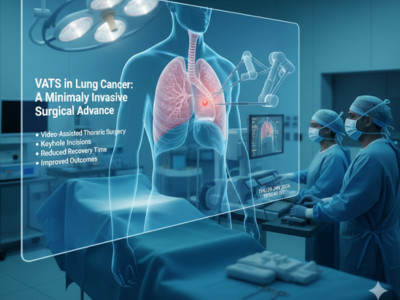
VATS in lung cancer represents a significant advancement in thoracic surgery, offering minimally invasive solutions for diagnosis and treatment. This technique allows surgeons to access the chest cavity using small incisions, specialized instruments, and a high-resolution camera. Consequently, patients experience reduced trauma, faster recovery, and improved postoperative comfort compared to traditional open surgery.
What is VATS in Lung cancer?
VATS in lung cancer refers to Video-Assisted Thoracoscopic Surgery, used to evaluate and treat lung malignancies effectively. During the procedure, surgeons insert a thoracoscope through small chest incisions to visualize internal structures clearly. As a result, surgeons can perform complex procedures without opening the chest extensively.
How the Procedure Works
First, surgeons administer general anesthesia to ensure patient comfort throughout the surgical process. Then, they create small incisions between the ribs to insert surgical instruments carefully. Meanwhile, the camera transmits real-time images to a monitor, enabling precise tumour removal or biopsy. Therefore, this approach significantly reduces surgical stress on the body.
Innovations in minimally invasive surgical techniques, including robotic-assisted procedures and video-assisted thoracoscopic surgery (VATS), continue improving patient outcomes by reducing recovery time and surgical trauma. These advancements increase procedural safety and patient acceptance while making lung cancer surgeries more effective, accessible, and appealing, thereby supporting overall growth in lung cancer surgical treatments.
Role of VATS in Lung Cancer Diagnosis
- Accurate Biopsy and Staging: VATS in lung cancer is essential for diagnosing the presence of lung nodules and staging confirmed cases of lung cancer. This is achieved through a minimally invasive biopsy, where the surgeon harvests samples for further pathological analysis. As a result, the cancer type, stage, and extent are determined more accurately than with imaging studies alone.
- Importance of Early Detection: Early detection of lung cancer is a significant factor in improving outcomes, and VATS in Lung cancer is essential for early and accurate diagnostic intervention. Additionally, accurate staging enables cancer specialists to develop individualized treatment plans.
Surgical Applications of VATS in Lung Cancer
- Common Procedures Performed Using VATS: VATS in lung cancer commonly involves lobectomy, wedge resection, and lymph node dissection procedures. In a lobectomy, surgeons remove the affected lung lobe while preserving healthy tissue. As a result, patients maintain better lung function after surgery.
- Treating Early-Stage Lung Cancer: Doctors primarily recommend VATS in Lung cancer for early-stage non-small cell lung cancer patients. This approach offers oncological outcomes comparable to open surgery. Additionally, patients experience less postoperative pain and shorter hospital stays.
Benefits of VATS in Lung Cancer Treatment
- Reduced Surgical Trauma: Reduced tissue trauma is one of the main benefits of VATS in Lung cancer. As surgeons do not require large incisions and rib retraction, patients feel little pain in the post-operative period. Hence, the recovery process is quicker and easier.
- Faster Recovery and Reduced Hospital Stay: Patients with VATS lung cancer surgery recover quickly compared to patients with conventional thoracotomy. Additionally, a shorter hospital stay decreases the chances of hospital-acquired infections and lowers healthcare expenses. Hence, patients can return to their normal activities sooner.
- Improved Cosmetic and Functional Outcomes: Smaller incisions result in minimal scarring, improving cosmetic outcomes significantly. Furthermore, preserved chest wall integrity supports better breathing mechanics after surgery. Hence, the overall quality of life improves post-procedure.
Patient Eligibility for VATS in Lung Cancer
Not all lung cancer patients qualify for VATS in lung cancer procedures. Surgeons evaluate tumour size, location, and spread before recommending surgery. Additionally, patient lung function and overall health influence surgical decisions.
In advanced lung cancer cases, open surgery may still offer better access and control. Tumours invading major vessels or structures may require conventional techniques. Therefore, surgeons choose the safest and most effective approach for each patient.
Recovery After VATS in Lung Cancer
- Postoperative Care and Monitoring: After VATS for lung cancer, healthcare teams monitor patients for complications like air leaks or infection. Early mobilization and breathing exercises support lung expansion and healing. As a result, complications are reduced significantly.
- Rehabilitation and Follow-Up: Pulmonary rehabilitation programs help patients regain lung strength after surgery. Furthermore, regular follow-up ensures early detection of recurrence or complications. Consequently, long-term outcomes improve steadily.
Risks and Limitations of VATS in Lung Cancer
Possible Complications
Despite being safer than open surgery, VATS in lung cancer still has potential complications. Bleeding, infection, or air leaks are possible in patients undergoing VATS. Nevertheless, these complications are less likely with minimally invasive procedures.
Importance of Surgical Expertise
The success of VATS can be attributed to the skills of the surgeon. An experienced thoracic surgeon can minimize the risk of complications and completely remove the cancerous tumor in the patient. Therefore, an experienced surgical center should be selected.
Technological Advancements Enhancing VATS
In addition to using robotic assistance, the use of advanced imaging will provide better results for VATS lung cancer procedures. The use of these technologies will increase accuracy and control during the surgical procedure. As a result, the surgeon may perform surgery on an extremely complex case with minimal invasiveness.
Conclusion: The Future of VATS in Lung Cancer
VATS in Lung cancer has brought about a revolution in the field of thoracic oncology by providing safer and less invasive surgical options. It has been a game-changer in the field of lung cancer treatment by providing less pain, faster recovery, and excellent control of cancer.
VATS in Lung cancer will continue to be an integral part of advanced surgical oncology with advancements in technology.
.png)
.png)
.png)
.png)
.png)
.png)
.png)
.png)