
AI in Video Surveillance Market Trends, Demand & Growth by 2034
AI in Video Surveillance Market Size and Forecasts (2021 - 2034), Global and Regional Share, Trends, and Growth Opportunity Analysis Report Coverage : By Offering (Hardware, Software, and Service), Deployment Mode (On-premises and Cloud), Use Cases (Weapon Detection, Facial Recognition, Intrusion Detection, Smoke & Fire Detection, Traffic Flow Analysis, Parking Monitoring, Vehicle Identification, Others); End Users (Commercial, Residential, Industrial); Geography (North America, Europe, Asia-Pacific, Middle East & Africa, South and Central America)
- Status : Data Released
- Report Code : TIPRE00039713
- Category : Technology, Media and Telecommunications
- No. of Pages : 150
- Available Report Formats :


- Last update date : August 12, 2026


2025 Market Size
US$ 8.91 Bn
Base year value
2034 Forecast
US$ 84.29 Bn
Projected by 2034
CAGR 2026-2034
28.36 %
Growth rate
Addressable Market
US$ 341.15 Bn
(2026-2034)
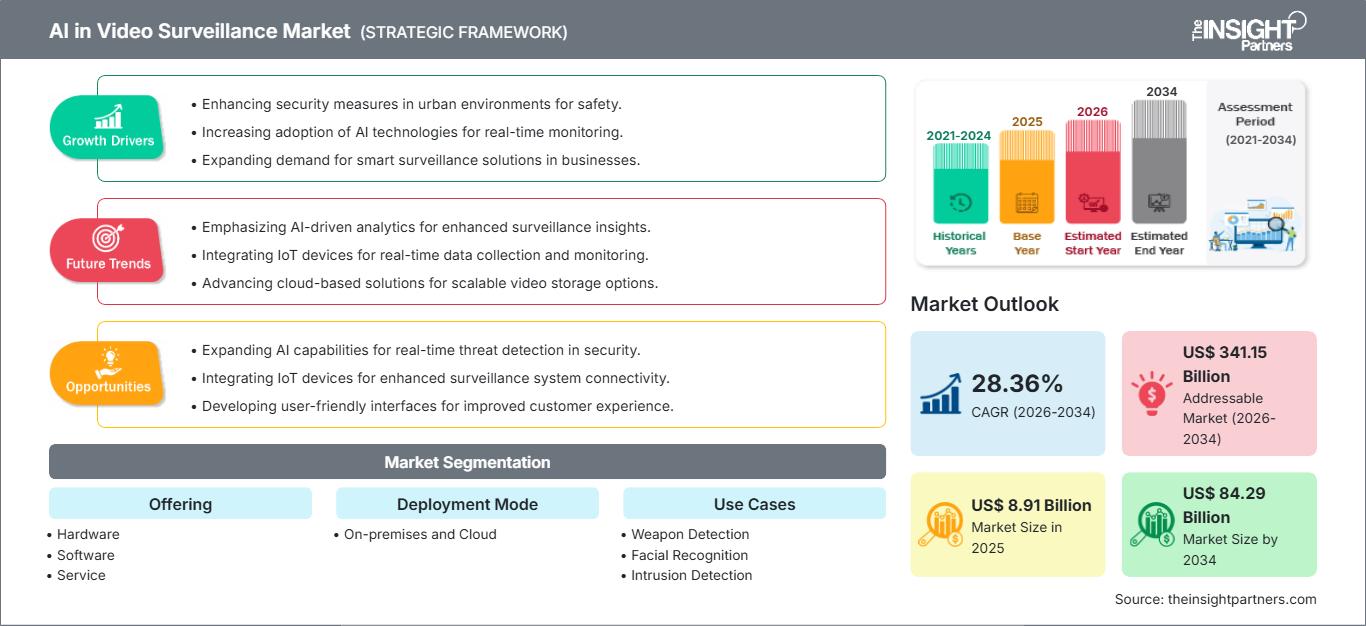
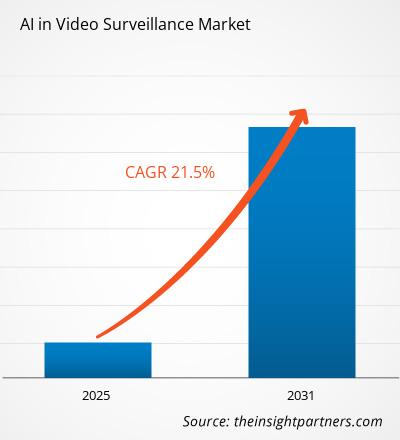
The AI in video surveillance market is expected to grow from US$ 8.91 Billion in 2025 to US$ 84.29 Billion by 2034, registering a CAGR of 28.36% during 2026–2034. Adoption is on an upward trend as firms, cities, transportation, and industries move from camera-based observation to automated events, notifications, and analytics-driven security systems.
North America will continue to be a prime market due to its increasing adoption of cloud video surveillance systems, edge AI cameras, and mandated security updates. The market size for the AI in video surveillance industry is driven by enterprise modernization, public safety investments, and smart infrastructural initiatives, with North America forecasted to grow at a CAGR of 26–28% till 2034.
AI in Video Surveillance Market Assessment and Insights
- North America held 33–37% share in 2025 and is projected to grow at a CAGR of 26–28% during 2026–2034, supported by cloud migration, enterprise security budgets, and early adoption of AI-enabled monitoring.
- US accounted for 74–78% of North America in 2025 and is expected to grow at a CAGR of 26–29%, driven by commercial campuses, transport hubs, and public safety deployments.
- Europe represented 24–28% share in 2025 and is forecast to grow at a CAGR of 24–27%, led by the UK, Germany, France, Italy, and Spain.
- Asia Pacific held 27–31% share in 2025 and is expected to grow at a CAGR of 29–32%, with China, Japan, South Korea, India, and Australia leading deployment intensity.
- Largest Segment Hardware accounted for 40–45% market share in 2025 and is projected to grow at a CAGR of 25–28%, reflecting continued investment in AI cameras, edge processors, and sensor upgrades.
- High Growth Segment Cloud deployment held 30–35% market share in 2025 and is projected to grow at a CAGR of 31–34%, as users prioritize scalability, remote access, and centralized analytics.
- Key companies analyzed in detail: Teledyne Technologies Incorporated, Axis Communications AB, Bosch Sicherheitssysteme GmbH, Genetec Inc., Honeywell International Inc., Huawei Technologies Co., Ltd., Ivideo, Milestone Systems A/S, NEC Corporation, Panasonic Holdings Corporation.
Source: The Insight Partners' analysis based on proprietary research, government publications, company annual reports, investor presentations, industry databases, and expert interviews.
Technology development is driving video surveillance technology from a recording-focused architecture to an intelligent, context-driven one. The use of edge inference, deep learning, and enhanced cameras lowers latency and enables video analysis to be done in proximity to where the action happens. Changes are happening on the production side too, as manufacturers of cameras, VMS vendors, cloud providers, and integrators design modular systems that can perform such functions as intrusion detection, face recognition, traffic analysis, and industrial safety.
The future growth will happen with hybrid implementations where on-premises control is complemented by cloud-based analytics and fleet-wide software upgrades. New geographies will be developing intelligent city corridors, ports, airports, commercial developments, and critical infrastructure protection. The privacy and cybersecurity regulations will have an impact on the buying decision, but also on those vendors that can prove the ability to provide auditability and data governance.
AI in Video Surveillance Market Report Scope
| Report Attribute | Details |
|---|---|
| Market size in 2025 | US$ 8.91 Billion |
| Market Size by 2034 | US$ 84.29 Billion |
| Global CAGR (2026 - 2034) | 28.36% |
| Historical Data | 2021-2024 |
| Forecast period | 2026-2034 |
AI in Video Surveillance Market Analysis
Market growth of artificial intelligence in the video surveillance industry will be driven by the necessity of reducing fatigue for operators, minimizing reaction time, and turning video feed into actionable information. The demand is most acute in places where camera coverage is already high but remains underutilized. Retail businesses, factories, distribution centers, offices, and municipal organizations are employing AI in order to find anomalies, confirm alerts, and raise situational awareness without scaling up their monitoring staff at the same rate.
Chain elements will be made up of cameras, edge computing processors, software for analysis, cloud storage facilities, video management systems, cybersecurity measures, and integration. Some of the favorable supply chain characteristics include the capability of organizations to combine precise models with viable implementation mechanisms. Edge AI ensures immediate alert, while the cloud strategy assists in monitoring different sites.
AI in video surveillance market report reveals that the competitive environment involves established security providers and software companies. Companies such as Axis Communications AB, Bosch Sicherheitssysteme GmbH, Genetec Inc., Honeywell International Inc., Huawei Technologies Co., Ltd., Milestone Systems A/S, NEC Corporation, and Panasonic Holdings Corporation are competing in terms of their analytics capability, interoperability, and security.
Investments in the industry are now flowing to hybrid systems, platform technology, and use-case specific analytics. Teledyne Technologies Incorporated provides technology related to image sensing. Genetec Inc. and Milestone Systems A/S are the software ecosystem providers suitable for multi-site applications. The differentiation in the industry revolves around accuracy, cybersecurity, privacy management, and AI integration within incident process.
● REPORT CUSTOMIZATION
Tailor This Report To Align With Your Specific Business Requirements
This report can be customized to align precisely with your business objectives, scope, and target markets. Customization options include tailored segmentation, geography, competitive analysis, and strategic insights to support informed decision-making.
Customize This Report →WHAT YOU CAN ADJUST
- ● Segmentations
- ● Geography
- ● Competitive Analysis
- ● Language Preferences
AI in Video Surveillance Market: Strategic Insights
Regional Insights
North America AI in video surveillance market
North America accounted for 33–37% market share in 2025 and is estimated to record CAGR of 26–28% until 2034. The growth will be fueled by an already established security infrastructure, the rise of cloud video solutions, and the willingness of businesses to update their existing camera estates by implementing AI-powered analytics for intrusion detection, access control, parking, and safety of workstations.
The AI in Video Surveillance market share in North America is backed up by investments made in the USA in public safety, retail loss prevention, transport security, and critical infrastructure protection. Hybrid solutions that allow running analytics on edge devices and management and storage through the cloud have gained much popularity among users.
U.S. AI in video surveillance Market
USA represents 74-78% of North America and is estimated to grow at a CAGR of 26-29%. Growth is seen across various segments, such as commercial buildings, airport security, logistics park, educational facilities, and municipal surveillance systems that benefit from AI reducing false alerts and efficient incident triaging.
Market players have significant geographical footprint, which includes Axis Communications AB, Honeywell International Inc., Genetec Inc., Teledyne Technologies Incorporated, and Milestone Systems A/S that cater to the needs of both enterprise and public sectors. The application trends include weapon detection, vehicle recognition, facial recognition regulations, and access control procedures.
Europe AI in video surveillance Market
The Europe region holds 24-28% of the share in 2025 and is predicted to expand at a CAGR of 24-27%. Its adoption is influenced by privacy laws, improved transportation, and upgraded commercial security solutions. United Kingdom is one of the largest markets owing to large-scale CCTV deployment and need for analytics-driven surveillance for retail, transport and urban security.
Germany demonstrates high adoption in industries, logistics, and public infrastructures where operational safety and physical security are a concern. France, Italy and Spain are growing their deployments in airports, retail networks, smart cities and traffic management applications. European consumers value cyber secure platforms, AI governed transparency, and integration with video security system.
APAC AI in video surveillance Market
APAC had a market share of 27-31% in 2025 and is forecasted to have a CAGR of 29-32%. China will be leading in terms of size, whereas Japan and South Korea will emphasize analytics, traffic control, and smart cities. India and Australia will be implementing their technology in commercial, residential, and infrastructure security.
The growth will come from the quick urbanization, investment in smart cities, industrial automation, and traffic flow analysis requirements. APAC will continue to serve as a large hub of hardware manufacture, which will result in competitive pricing and quicker product cycles. Adoption of cloud and edge AI will become widespread.
Middle East & Africa AI in video surveillance Market
Middle East and Africa is expected to grow at a CAGR of 27–30% during 2026–2034. Saudi Arabia and the UAE lead demand through smart city, airport, energy, hospitality, and critical infrastructure projects. South Africa contributes through commercial security and urban safety needs.
Facilities involving energy, ports, transport pathways, and public places must have real-time surveillance capabilities to enable them to detect intrusion, fires, smoke, and vehicle movement. Growth in the region is being facilitated through investments in infrastructure and need for centralized surveillance, though privacy governance, integration capabilities, and cyber security preparedness are still key concerns.
Segmentation Analysis
Offering
Offering is expected to grow at a CAGR of 27–30% during 2026–2034. The AI in video surveillance market scope spans hardware, software, and services, with buyers increasingly combining AI cameras, analytics engines, integration support, and managed services to convert surveillance networks into intelligent operational platforms.
- Hardware remains the largest revenue contributor as organizations upgrade cameras, edge processors, sensors, and storage devices to support real-time analytics, higher resolution, and on-device event detection.
- Software is gaining strategic importance because analytics models, video management systems, alert dashboards, and investigation tools determine how quickly operators can interpret and act on events.
- Service demand is expanding as enterprises require deployment planning, model tuning, integration, cybersecurity hardening, and ongoing support for complex multi-location surveillance environments.
Deployment Mode
Deployment Mode is projected to grow at a CAGR of 28–31% during 2026–2034. On-premises systems remain important for regulated and latency-sensitive environments, while cloud deployment is accelerating as organizations seek scalable storage, remote monitoring, and centralized analytics without heavy infrastructure ownership.
- On-premises deployment is preferred by critical infrastructure, government facilities, and industrial sites that require local control, low-latency processing, and strict governance over sensitive video data.
- Cloud deployment is scaling quickly across commercial and distributed sites because it enables remote access, faster software updates, centralized monitoring, and flexible storage capacity.
Use Cases
Use Cases are expected to grow at a CAGR of 28–32% during 2026–2034. Demand is moving beyond security recording toward proactive detection, operational automation, and safety intelligence across public spaces, transportation, industrial environments, parking facilities, and commercial properties.
- Weapon Detection supports high-risk venues by identifying potential threats earlier, improving alert escalation, and helping security teams respond before incidents move beyond controlled areas.
- Facial Recognition remains strategically important for access control and investigations, but adoption depends on privacy compliance, consent frameworks, and accuracy across diverse operating conditions.
- Intrusion Detection is widely deployed across perimeters, warehouses, campuses, and utilities because AI reduces nuisance alarms and improves response prioritization.
- Smoke & Fire Detection adds early-warning capability where visual cues can complement conventional sensors, especially in industrial sites, logistics facilities, and large public venues.
- Traffic Flow Analysis helps cities and transport operators assess congestion, signal performance, pedestrian movement, and incident patterns using existing camera networks.
- Parking Monitoring improves occupancy visibility, enforcement efficiency, and customer experience across commercial buildings, malls, airports, and smart city parking systems.
- Vehicle Identification supports access control, tolling, campus security, and law enforcement workflows by linking license plate recognition with event records and investigation tools.
End Users
End Users are forecast to grow at a CAGR of 27–30% during 2026–2034. Commercial facilities lead adoption due to loss prevention and operational analytics, while residential and industrial demand is rising as AI cameras become more affordable, connected, and easier to manage.
- Commercial users deploy AI surveillance for retail loss prevention, office safety, visitor management, parking oversight, and multi-site operational visibility.
- Residential adoption is growing through smart home cameras, apartment security systems, and community monitoring platforms that provide automated alerts and remote viewing.
- Industrial facilities use AI video systems for perimeter protection, worker safety, asset monitoring, smoke detection, and process-area visibility in high-risk environments.
Opportunity Snapshot
| End Users | Revenue Contribution | Trend Tag | Adoption Stage |
| Commercial | High | Loss Prevention | Scaling |
| Residential | Medium | Smart Homes | Scaling |
| Industrial | Medium | Safety Analytics | Emerging |
AI in Video Surveillance Market Growth Drivers and Impact Analysis
Rising Need for Real-Time Threat Detection
Organizations are adopting AI-enabled surveillance because conventional camera networks often generate large volumes of footage without timely interpretation. Real-time analytics can identify intrusion, weapon presence, vehicle movement, smoke, and unusual behavior before incidents escalate. This improves response coordination and reduces dependence on manual monitoring. The driver is especially strong in transport hubs, commercial campuses, logistics sites, public venues, and industrial facilities where delayed detection can create safety, liability, and operational risks.
Shift Toward Edge and Hybrid Video Architectures
Edge AI is reducing latency and bandwidth pressure by processing selected events directly on cameras or local devices. Hybrid systems then use cloud platforms for centralized storage, management, and analytics improvement. This architecture fits users that need fast local alerts but also require remote visibility across multiple facilities. It supports lower infrastructure costs, scalable deployment, and improved resilience, making it attractive for enterprises modernizing existing camera networks rather than replacing every asset at once.
Expansion of Smart City and Critical Infrastructure Programs
Smart city and infrastructure investments are increasing the need for video systems that can support traffic monitoring, public safety, emergency response, and asset protection. AI analytics help authorities interpret activity across roads, transit stations, airports, utilities, and public spaces. The impact extends beyond crime prevention, as data from cameras can support congestion management, parking optimization, crowd control, and incident reconstruction. This broad utility strengthens budget justification and encourages phased deployment across urban networks.
AI in Video Surveillance Market Future Trends
Generative AI-Assisted Investigation Workflows
AI in video surveillance market trends will increasingly include generative AI tools that summarize events, support natural-language search, and help operators locate relevant footage faster. Instead of manually reviewing hours of video, security teams may ask systems to find specific objects, behaviors, or incident sequences. Adoption will depend on accuracy, audit trails, and responsible governance, but the workflow benefit is clear: faster investigations, better reporting, and improved use of existing surveillance data.
Convergence of Video, IoT, and Environmental Sensors
Future systems will combine video with access control, audio, thermal, air quality, occupancy, and environmental data to generate richer situational awareness. This convergence will be valuable in factories, airports, hospitals, campuses, and smart buildings where a single video cue may not explain an incident. Multi-sensor analytics can reduce false alarms, strengthen safety monitoring, and support predictive maintenance or operational decisions beyond traditional security use cases.
AI in Video Surveillance Market Opportunities
Cloud-Native Analytics for Distributed Enterprises
AI in video Surveillance Market Forecasts are strongest for distributed organizations that need consistent monitoring across stores, offices, warehouses, and service locations. Cloud-native analytics allow centralized teams to manage alerts, permissions, updates, and investigations without maintaining separate infrastructure at each site. Vendors can capture this opportunity by offering secure data controls, flexible storage, open integrations, and pricing models that align with camera counts, analytics modules, and retention needs.
Vertical-Specific Solutions for Industrial and Transport Safety
Industrial plants, ports, rail systems, airports, and logistics hubs require analytics tuned to specific hazards, movement patterns, and compliance requirements. Vendors that package AI models for smoke detection, restricted-area entry, vehicle identification, PPE monitoring, and traffic flow analysis can shorten deployment cycles and improve buyer confidence. The opportunity is action-oriented because customers prefer measurable safety outcomes, lower incident response times, and integration with existing security operations centers.
Frequently Asked Questions

- Comprehensive Market Sizing and Forecast Analysis
- Detailed Segmentation Analysis
- In-Depth Market Dynamics Assessment
- Regional and Country-Level Insights
- Competitive Landscape and Company Benchmarking
- Strategic Business Intelligence
Recent Reports
Testimonials

The Insight Partners provided valuable market intelligence that supported our global go-to-market strategy. Their team was professional, responsive, and attentive to our feedback, providing thoughtful analysis and helpful methodological clarifications throughout the project.
Junmo Kim Chief Financial Officer (CFO), Enertech Co., Ltd.
The Insight Partners' SCADA System Market report is comprehensive, with valuable insights on current trends and future forecasts. The team was highly professional, responsive, and supportive throughout. We are very satisfied and highly recommend their services.
RAN KEDEM Partner, Reali Technologies LTDs
I requested a report on a very specific software market and the team produced the report in a few days. The information was very relevant and well presented. I then requested some changes and additions to the report. The team was again very responsive and I got the final report in less than a week.
JEAN-HERVE JENN Chairman, Future Analytica
We worked with The Insight Partners for an important market study and forecast. They gave us clear insights into opportunities and risks, which helped shape our plans. Their research was easy to use and based on solid data. It helped us make smart, confident decisions. We highly recommend them.
PIYUSH NAGPAL Sr. Vice President, High Beam Global
The Insight Partners delivered insightful, well-structured market research with strong domain expertise. Their team was professional and responsive throughout. The user-friendly website made accessing industry reports seamless. We highly recommend them for reliable, high-quality research services
YUKIHIKO ADACHI CEO, Deep Blue, LLC.
This is the first time I have purchased a market report from The Insight Partners.While I was unsure at first, I visited their web site and felt more comfortable to take the risk and purchase a market report.I am completely satisfied with the quality of the report and customer service. I had several questions and comments with the initial report, but after a couple of dialogs over email with their analyst I believe I have a report that I can use as input to our strategic planning process.Thank you so much for taking the extra time and making this a positive experience.I will definitely recommend your service to others and you will be my first call when we need further market data.
JOHN SUZUKI President and Chief Executive Officer, Board Director, BK Technologies
I wish to appreciate your support and the professionalism you displayed in the course of attending to my request for information regarding to infectious disease IVD market in Nigeria. I appreciate your patience, your guidance, and the fact that you were willing to offer a discount, which eventually made it possible for us to close a deal. I look forward to engaging The Insight Partners in the future, all thanks to the impression you have created in me as a result of this first encounter.
DR CHIJIOKE ONYIA MANAGING DIRECTOR, PineCrest Healthcare Ltd.Reason to Buy
- Informed Decision-Making
- Understanding Market Dynamics
- Competitive Analysis
- Identifying Emerging Markets
- Customer Insights
- Market Forecasts
- Risk Mitigation
- Boosting Operational Efficiency
- Strategic Planning
- Investment Justification
- Tracking Industry Innovations
- Aligning with Regulatory Trends





 Get Free Sample for