Child Care Market Size & Overview
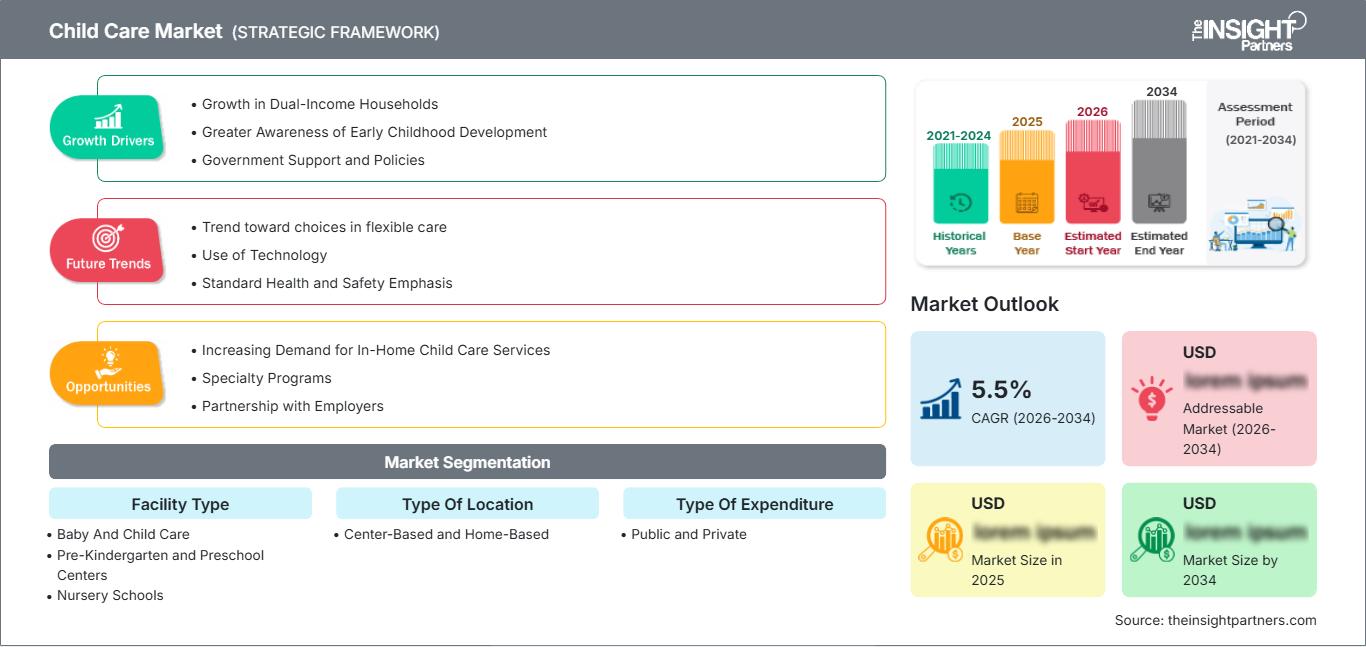
The Child Care Market was valued at US$ 72.53 Billion in 2025 and is projected to reach US$ 118.26 Billion by 2034, registering a CAGR of 5.58% during 2026–2034. Expansion is supported by rising workforce participation among parents, greater demand for structured early learning, growing employer involvement in family benefits, and public investment in childcare accessibility. Provider consolidation, digital administration, flexible scheduling, and curriculum-led service differentiation are also strengthening organized care delivery.
Across North America, the Child Care Market size is expected to expand at a CAGR of ~4% through 2034. Demand is underpinned by persistent care shortages, high household reliance on dual incomes, and employer-sponsored programs that support workforce attendance and retention. Greater use of backup care, public pre-K partnerships, and technology-enabled enrollment is improving utilization, although labor availability, educator compensation, and facility operating costs continue to constrain capacity.
The demand for Child Care Market growth is very much tied up with the employment status of the parent, commuter habits, the income level of the family, the birth cohort, and the availability of informal family childcare. Families are beginning to consider factors such as reliability, safety, location, quality of education, and scheduling flexibility, aside from cost, when choosing childcare providers. The findings of the Child Care Market Report reveal that there is competition within the variables of density of centers, teacher retention rates, curriculum quality, parents' experiences, and relationships with employers. The supply side of the business is fragmented due to the local delivery nature and labor intensity of child care. Licensed supply can increase when childcare providers obtain an appropriate location, appropriate personnel, licensing, and enrollment. Infant care, in particular, is limited due to fewer children per educator ratio. The childcare provider utilizes waitlist, capacity management by age group, staggered enrollment, and cross-selling of preschool and school-age services.
The Child Care Market Report reveals that the strongest employer sponsorship is seen in Bright Horizons Family Solutions Inc., KinderCare Learning Companies, Inc., and Learning Care Group, Inc. have a wide coverage of the US, Primrose School Franchising Company LLC operates based on franchising while Goodstart Early Learning Ltd and G8 Education Limited dominate the Australian market. Investment decisions are determined by ownership models in which scaled businesses can invest in technology, central purchasing, compliance programs, and branding, while community businesses are competing through their community reputation and customized programming. This diversity is further achieved by Spring Education Group, KU Children’s Services, PLASP Child Care Services, and JP Holdings, Inc. through premium education, university-based, nonprofit delivery, and Asia respectively.
Child Care Market Assessment and Insights
Regional Outlook
- North America: ~39% of the global market in 2025 | ~4% CAGR through 2034. Market position: North America leads through high household spending, extensive licensed-center infrastructure, employer-sponsored care, premium tuition models, and established operators capable of delivering standardized services across multiple locations.
- US: ~85% of North American market revenue in 2025 | ~4% CAGR through 2034. Market position: The US dominates North America through a large working-parent population, broad private-provider participation, public pre-K contracting, workplace childcare programs, and sustained demand for infant, preschool, and school-age services.
- Europe: ~30% of the global market in 2025 | ~5% CAGR through 2034. Market position: Europe combines mature public early-years systems with private supplementary provision. The UK leads commercial revenue, while Germany and France support capacity through public financing and municipal or employer-linked programs.
- Asia Pacific: ~23% of the global market in 2025 | ~8% CAGR through 2034. Market position: Asia Pacific is the fastest-growing region, supported by urbanization, formalization of childcare, expanding middle-income households, and policy measures in China, Japan, India, South Korea, and Australia.
Segment Outlook
- Center-Based: ~72% Share in 2025 | ~5% CAGR through 2034. Market position: Center-based services lead because licensed facilities can combine supervision, structured learning, meals, safeguarding, and age-specific programs while offering scalable capacity and consistent operating standards.
- Private: ~63% Share in 2025 | ~6% CAGR through 2034. Market position: Private expenditure is expanding as families seek convenient locations, extended operating hours, specialized curricula, smaller groups, digital communication, and care options that supplement limited public capacity.
Competitive Coverage
Bright Horizons Family Solutions Inc., KinderCare Learning Companies, Inc., Goodstart Early Learning Ltd, Primrose School Franchising Company LLC, G8 Education Limited, Learning Care Group, Inc., Spring Education Group, KU Children’s Services, PLASP Child Care Services, JP Holdings, Inc.
Methodology
The Insight Partners follows Data Collection & Secondary Research, Primary Research, Data Analysis, and Data Triangulation & Final Review to validate market estimates and insights.
Source: The Insight Partners' analysis based on proprietary research, government publications, company annual reports, investor presentations, industry databases, and expert interviews.
Child Care Market Trends
Technology-Enabled Capacity and Family Experience
Child Care Market trends will increasingly reflect integrated software for waitlists, enrollment, billing, subsidies, room utilization, staff scheduling, incident reporting, and parent communication. The next stage of adoption will move beyond digitizing paperwork toward predicting vacancies, matching age transitions with classroom capacity, and identifying staffing requirements before enrollment opportunities are lost. Digital portfolios and secure updates will also influence family satisfaction by making daily activities and developmental progress more visible. Larger operators can deploy common platforms across networks, while smaller centers may use subscription software to gain comparable capabilities. Technology will support administration rather than replace educators, with privacy, cybersecurity, consent, and safeguarding remaining essential procurement considerations.
Flexible Networks Beyond Full-Time Enrollment
Future service models will combine full-time centers with backup care, part-week attendance, employer reserves, holiday programs, and school-age services. This structure responds to hybrid work and variable schedules without requiring every family to purchase a conventional five-day place. Network models can direct demand across owned centers, partner providers, and approved home-based caregivers, improving geographic coverage. Commercial success will depend on real-time availability, consistent vetting, transparent pricing, and reliable service standards. Providers that aggregate fragmented capacity may generate incremental utilization while helping employers offer benefits across distributed workforces. The model also creates opportunities for insurers, software vendors, and workforce-benefit administrators to participate in the childcare ecosystem.
Child Care Market Growth Factors
Rising Workforce Dependence on Reliable Care
Families where the parents work need childcare that is consistent with commuting, full-time employment, shift work, and hybrid work schedules. Lack of such childcare results in absenteeism, inefficiency, and turnover of employees among the employers. It therefore provides the company with the economic motive to invest in childcare that is on-site, near-site, back-up, or network-based. For providers, this presents itself as an advantage in terms of demand from the company, quicker occupancy, and lower reliance on household acquisition. It is especially relevant in proximity to hospitals, industrial complexes, universities, and corporate offices where unconventional scheduling leaves regular nursery hours inadequate.
Growing Recognition of Early Learning Outcomes
There is more of an emphasis today on childcare being a developmental service for young kids rather than just supervision. There is a move towards purchasing criteria that emphasize teacher qualifications, program design, exposure to languages, social-emotional development, development tracking, and school preparedness. Childcare providers may compete by offering evidence-based programs and communicating effectively about their children’s development. Market implications include increased demand for preschool-related programs, increased expectations regarding training of staff, and improved integration between the two systems. Providers should find a balance between learning activities and age-appropriate play without over-standardization. Good quality and parent involvement increase chances of maintaining enrollment and partnering in publicly-funded pre-K or institutions.
Public Funding and Affordability Intervention
Subsidies, tax breaks, vouchers, public pre-school arrangements, and operational subsidies increase the amount of households that can afford formal care. Money can also help to ensure stable usage from families that may not afford sustainable fees based on income level alone. This process is crucial as child care costs are driven by labor and cannot be cut down without ratio changes. Efficient subsidies allow for increased demand visibility, increased use of licensed facilities, and provision of care for families of all economic backgrounds. Yet, the speed of payment, complications in eligibility requirements, and capped fees might affect operator participation.
Child Care Market Opportunities
Expansion in Underserved Urban Growth Corridors
Population growth frequently outpaces childcare infrastructure in new residential districts and secondary cities. Investors can use birth registrations, housing completions, school pipelines, employer locations, waiting lists, and commuting data to identify capacity gaps before selecting sites. The Child Care Market Forecasts support a disciplined cluster strategy in which operators build several centers within manageable recruiting and supervision distance rather than pursuing isolated locations. Partnerships with residential developers, hospitals, universities, and business parks can reduce customer acquisition costs and provide suitable premises. Returns depend on phased staffing, achievable tuition, licensing timelines, and realistic occupancy ramp-up rather than headline population growth alone.
Employer-Sponsored and Public-Private Partnerships
Employers and governments offer routes to demand aggregation and revenue stability. Providers can design reserved-place agreements, backup-care subscriptions, on-site centers, public preschool classrooms, or management contracts tailored to institutional requirements. These arrangements allow organizations to improve employee retention or expand community access without developing internal childcare expertise. The opportunity is strongest for operators with proven safeguarding, reporting, workforce management, and multi-site delivery. Investment priorities include contract management, interoperable billing, educator recruitment, and measurable service outcomes. Providers should diversify counterparties and ensure contract rates reflect wage inflation, occupancy risk, extended operating hours, and compliance obligations.
Segmentation Analysis
Facility Type
Facility type defines service intensity, age coverage, curriculum expectations, staffing ratios, and center economics across the Child Care Market scope. Operators align room configuration, educator qualifications, safeguarding procedures, learning resources, and scheduling with children’s developmental stages. Pre-kindergarten and preschool centers are projected to record a ~6% CAGR during 2026–2034 as families and governments increasingly treat early learning as preparation for formal schooling.
- Baby And Child Care: These facilities emphasize dependable supervision, feeding, rest routines, hygiene, developmental play, and close family communication. Demand is strongest among working households requiring full-day services for infants and toddlers before eligibility for formal preschool programs.
- Pre-Kindergarten and Preschool Centers: Education-oriented centers provide structured play, language development, early numeracy, socialization, and school-readiness activities. Their strategic relevance increases where governments purchase preschool places or families seek measurable developmental preparation.
- Nursery Schools: Nursery schools combine care with introductory learning in a classroom environment. They are positioned between informal supervision and formal preschool, attracting families that prioritize social interaction, routine building, and gradual transition into organized education.
Type Of Location
Type of location segment in the child care market influences provider scale, convenience, operating control, caregiver ratios, and parental trust. Demand is shaped by commuting distance, neighborhood density, workplace concentration, available real estate, and preference for institutional or domestic settings. Center-based provision is expected to expand at a ~5% CAGR through 2034 as operators use standardized procedures, specialist rooms, trained teams, and centralized administration to support consistent delivery.
- Center-Based: Dedicated centers offer greater capacity, age-specific classrooms, outdoor or activity space, formal curricula, and extended operating schedules. They are particularly relevant in urban locations where demand can sustain multiple rooms and specialized staff.
- Home-Based: Home-based care appeals to families seeking smaller groups, neighborhood proximity, flexible arrangements, and a domestic setting. Expansion depends on registration frameworks, caregiver professionalization, insurance access, and mechanisms that help parents assess service quality.
Type Of Expenditure
Expenditure type segment in the child care market determines who funds care, how prices are set, and which households can access formal services. Public financing expands inclusion and supports policy goals related to employment and early education, while private spending enables differentiated curricula, longer hours, and premium environments. Private expenditure is projected to register a ~6% CAGR during 2026–2034 as households and employers purchase services beyond publicly funded coverage.
- Public: Public expenditure includes subsidies, vouchers, municipal provision, preschool procurement, and operating grants. Its importance is greatest where governments use early-years services to improve school readiness, workforce participation, social inclusion, and access for lower-income families.
- Private: Private expenditure includes household tuition and employer-financed care. Buyers prioritize location, operating hours, safeguarding, educator continuity, communication, enrichment programs, and reliable availability, creating scope for premium and specialized service models.
Opportunity Snapshot
| Type Of Location | Revenue Contribution | Trend Tag | Adoption Stage |
| Center-Based | High | Integrated Learning | Mature |
| Home-Based | Medium | Neighborhood Care | Scaling |
Regional Insights
North America Child Care Market
North America made up ~39% of the worldwide market revenue in 2025, and its growth is estimated at ~4% CAGR until 2034. The market share of Child Care is due to large tuition fees, licensed care services, numerous employers involved, and high demand for structured care from infancy through preschool. The center-based Child Care is commercially relevant in urban and suburban employment areas.
The growth is constrained by mature provider presence and ongoing costs pressures. Such factors as educator salaries, rents, insurance, food, and costs associated with licensing and compliance may reduce profit margins, and the shortage of qualified workers makes licensed rooms unaccessible. Therefore, growth is focused on increasing occupancy rates, partnering with employers, establishing back-up care programs, pre-K programs for public authorities, and locating centers in areas of residential growth.
U.S. Child Care Market
North America has been the main source of revenue for the US which comprised around 85% of total North American revenue in 2025. It is anticipated that the market in the region will experience growth at ~4% CAGR until 2034. The positioning of the US market can be attributed to private tuition, employer-provided benefits, federal and state support, municipal pre-K purchases, and demand from parents seeking reliable daycare for their children.
Bright Horizons Family Solutions Inc., KinderCare Learning Companies, Inc., Learning Care Group, Inc., Primrose School Franchising Company LLC, and Spring Education Group have an established network or franchising model. Providers are introducing digital registration, parent communication, program tracking, and flexible attendance systems. The greatest growth prospects exist when there is a demand concentration in residential development, hospital chains, universities, and large employers.
Europe Child Care Market
In 2025, Europe accounted for about 30% of the Child Care Market Share and is estimated to have a growth rate of about 5% CAGR between 2025-2034. Publicly funded early childhood education is well established, yet there is still room for commercial growth in out-of-school hours care, workplace facilities, bilingual schools, premium nursery schools, and services to children under the age of universal preschool.
The United Kingdom is the top country in Europe in terms of commercial childcare revenue due to wide-ranging private nursery schools, employer needs, and high fee exposure. Operators do however have to contend with salary demands, fluctuating occupancy rates, and quality demands arising from inspections. In Germany, growth has been driven by legal entitlement and municipal requirements.
Formal participation is relatively low in Italy and Spain compared to several northern European schemes for children at such an early age, which presents opportunities for provision due to increased work force participation of women and urban needs. Providers will need to adjust according to national funding, educational qualifications, languages, and procurement policies of the local authorities. There will be more investment in densely populated urban areas where proximity is valued.
APAC Child Care Market
Asia Pacific accounted for ~23% of global revenue in 2025 and is expected to register a ~8% CAGR through 2034, making it the fastest-growing region. China is the leading country in Asia Pacific by revenue, supported by its urban population, private preschool base, and demand for structured early education.
Demographic challenges notwithstanding, Japan and South Korea need childcare services that will help working parents cope. The long-term prospect for India lies in its cities as a result of formalized childcare facilities tied to employers, and for Australia, which has a well-developed subsidy-based system, Goodstart Early Learning Ltd., G8 Education Limited, and KU Children’s Services serve as examples.
Middle East & Africa Child Care Market
The Middle East & Africa market is projected to grow at a ~6% CAGR through 2034. The UAE is the leading country in the Middle East & Africa for commercial revenue, supported by expatriate households, private education expenditure, premium nurseries, and concentrated urban development. Saudi Arabia is gaining relevance as workforce participation and education investment increase.
In South Africa, there is a wide but segmented ecosystem of providers covering formal centers and community-based service delivery. In the rest of MEA, the barriers to formalization of services include cost, availability of teachers, regulation issues, and infrastructure availability. The most promising areas include business districts, residential compounds, hospitals, schools, and big infrastructure projects.
Child Care Market Report Scope
| Report Attribute | Details |
|---|---|
| Market size in 2025 | US$ 72.53 Billion |
| Market Size by 2034 | US$ 118.26 Billion |
| Global CAGR (2026 - 2034) | 5.58% |
| Historical Data | 2021-2024 |
| Forecast period | 2026-2034 |
| Segments Covered | Facility Type, Type Of Location, Type Of Expenditure, Geography |
| Region scope | North America, Europe, Asia-Pacific, South and Central America, Middle East and Africa |
Recent Developments
- August 2026: KinderCare Learning Companies, Inc. – The company reported progress in expanding early childhood and school-age offerings while optimizing its center footprint. Its second-quarter update highlighted new before- and after-school sites and continued alignment of center capacity with changing family demand, illustrating how large operators are balancing network expansion with enrollment and operating-cost management.
- March 2026: Goodstart Early Learning Ltd – Goodstart highlighted its 2025 Centre of the Year, a 90-place Shell Cove facility assessed as exceeding expectations across all seven quality areas. The development demonstrates continued operator investment in safety culture, educator capability, inclusive learning, family partnerships, and continuous quality improvement within Australia’s regulated early-learning system.
- October 2025: Bright Horizons Family Solutions Inc. – Bright Horizons reported increased enrollment and margin improvement in full-service operations, alongside higher utilization in backup care supported by a broader owned and third-party provider network. The update reinforces the strategic importance of employer-sponsored childcare and flexible care capacity for serving working families across multiple locations.
Frequently Asked Questions

Recent Reports






