
Liquid Handling Equipment Market Share, Trends & Demand Outlook 2034
Coverage: By Product Type (Liquid Handling Pumps [Syringe Pumps, Peristaltic Pumps, Piston Pumps, Diaphragm Pumps, and Others], Liquid Handling Components [Workstations, Dispensing Modules, Flow Sensors, Fluidic Manifolds, Valves, and Tubing and Connectors] and Consumables [Pipette Tips, Reagent Reservoirs, Microplates, and Tubes and Accessories]), Modality (Automated Liquid Handling, Semi Automated Liquid Handling and Manual Liquid Handling), System Configuration (Benchtop, Standalone and Integrated Robotic Platforms), Workflow (Sample Preparation, Reagent Dispensing, Serial Dilution, Plate Replication and Reformatting, and Others), Technology (Air Displacement Technology, Positive Displacement Technology, Acoustic Liquid Handling, Disposable Tip-Based Systems, and Non-Contact Dispensing Systems), Application (Drug Discovery and Development [Chromatography (HPLC or UHPLC), Stem Cell Research and Analysis, Density and Analytical Measurement, Genomics and Proteomics, and Others] and Clinical Diagnostics [PCR, Molecular Diagnostics and Others]), End User (Pharmaceutical and Biotechnology Companies, IVD Device Manufacturers, Clinical and Diagnostic Laboratories, Academic and Research Institutes, CROs and CDMOs, Analytical Instrument Manufacturers, and Others), and Geography (North America, Europe, Asia Pacific, Middle East & Africa, and South & Central America)
- Status : Published
- Report Code : TIPRE00044095
- Category : Life Sciences
- No. of Pages : 578
- Available Report Formats :


- Last update date : November 10, 2026


2025 Market Size
US$ 6,395.16 Mn
Base year value
2034 Forecast
US$ 11,101.73 Mn
Projected by 2034
CAGR 2026-2034
6.3 %
Growth rate
Addressable Market
US$ 79,095.18 Mn
(2026-2034)
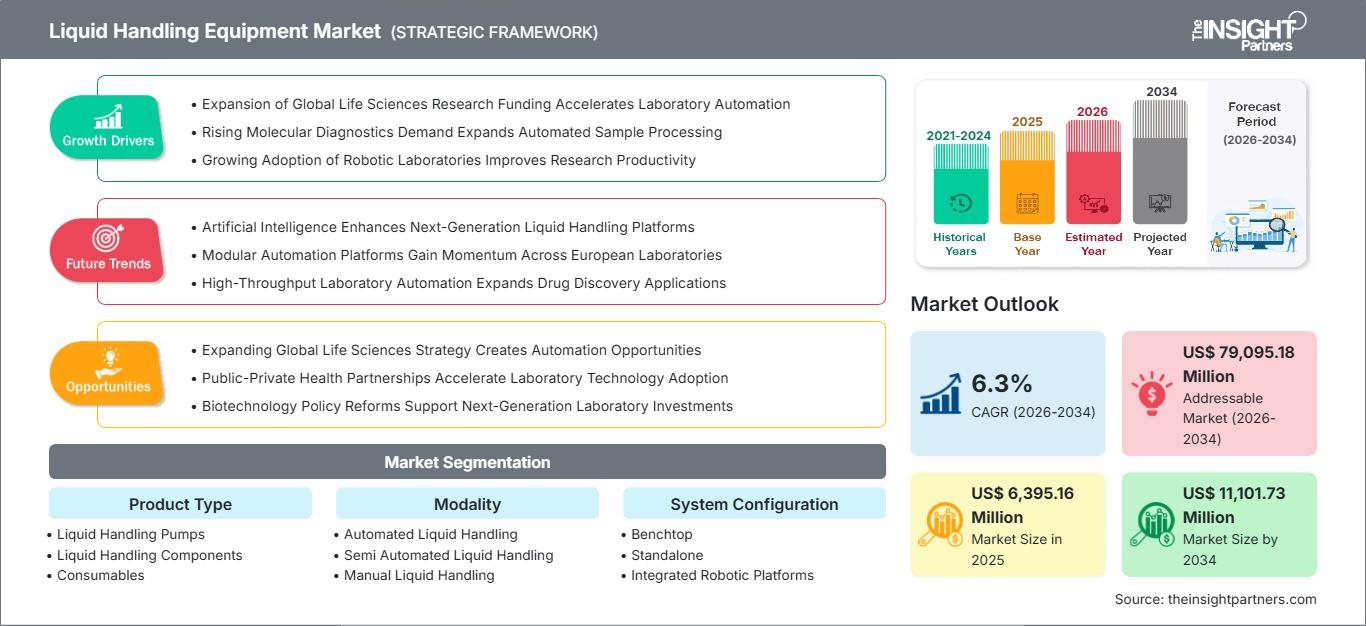
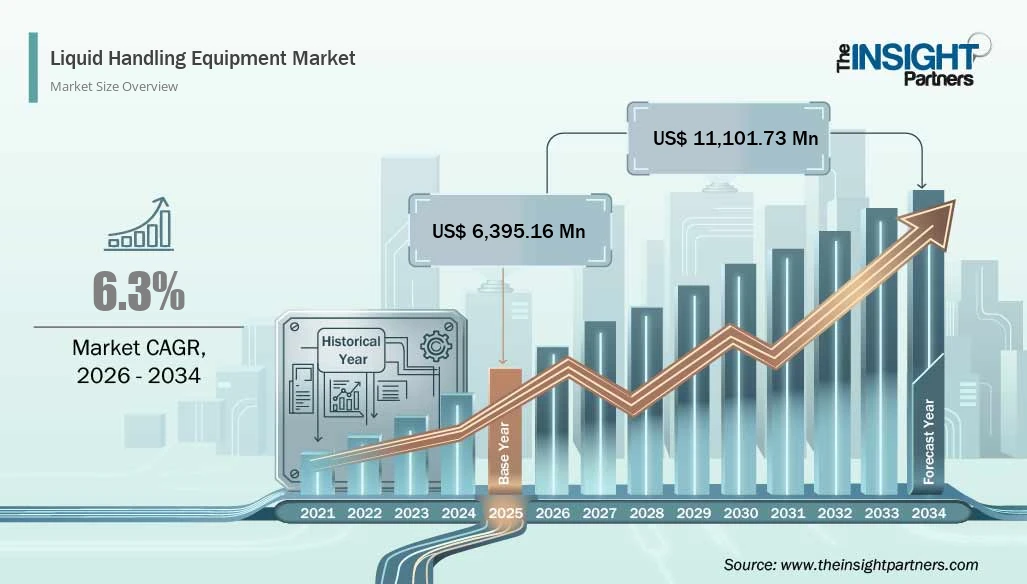
The Global Liquid Handling Equipment Market was valued at US$ 6,395.16 million in 2025 and is projected to reach US$ 11,101.73 million by 2034, expanding at a 6.3% CAGR during 2026–2034. Growth is supported by increasing laboratory automation, higher sample throughput requirements, expansion of pharmaceutical and biotechnology research, and demand for accurate and reproducible liquid transfer. Rising adoption of automated workflows across drug discovery, clinical diagnostics, genomics, proteomics, and analytical testing is also strengthening equipment demand.
North America continues to remain one of the prominent centers for product demand owing to the presence of well-established markets for pharmaceuticals and biotechnology, advanced infrastructure for R&D activities, and substantial use of lab automation systems in the region. The market for North America is forecasted to grow at around ~5% CAGR till 2034.
Liquid Handling Equipment Market Assessment and Insights
Regional Outlook
- North America: ~36% of the global market in 2025 | ~5% CAGR through 2034. Market position: North America holds the largest regional position, supported by mature pharmaceutical R&D, extensive clinical laboratory networks, advanced automation infrastructure, and strong demand for reproducible sample preparation and high-throughput workflows.
- US: ~82% of North American market revenue in 2025 | ~5% CAGR through 2034. Market position: The US dominates North American demand through its concentration of pharmaceutical companies, biotechnology firms, academic laboratories, CROs, and diagnostic facilities, with automation widely deployed across genomics, drug discovery, and molecular testing.
- Europe: ~29% of the global market in 2025 | ~6% CAGR through 2034. Market position: Europe represents a mature automation market, led by Germany within Europe, followed by the UK, France, Italy, and Spain, with strong pharmaceutical manufacturing, research infrastructure, and laboratory quality requirements.
- Asia Pacific: ~25% of the global market in 2025 | ~8% CAGR through 2034. Market position: Asia Pacific is the fastest-growing region, supported by expanding pharmaceutical manufacturing, biotechnology investment, diagnostics, and laboratory modernization, with China representing the leading country in Asia Pacific and Japan, South Korea, India, and Australia contributing significantly.
Segment Outlook
- Modality: ~54% Share in 2025 | ~8% CAGR through 2034. Market position: Modality leads because laboratories increasingly transition from manual liquid transfer toward automated platforms that improve throughput, precision, process consistency, and integration with broader laboratory automation environments.
- System Configuration: ~29% Share in 2025 | ~9% CAGR through 2034. Market position: System Configuration represents the high-growth segment as laboratories increasingly connect liquid handling with robotics, analytical instruments, storage systems, and workflow software to create scalable, integrated laboratory environments.
Competitive Coverage
Thermo Fisher Scientific Inc., Danaher Corporation, Eppendorf SE, INTEGRA Biosciences AG, Tecan Trading AG, Sartorius AG, Hamilton Company, Analytik Jena GmbH+Co. KG, Corning Incorporated, Gilson Inc.
Methodology
The Insight Partners follows Data Collection & Secondary Research, Primary Research, Data Analysis, and Data Triangulation & Final Review to validate market estimates and insights.
Source: The Insight Partners' analysis based on proprietary research, government publications, company annual reports, investor presentations, industry databases, and expert interviews.
The scope of laboratory liquid handling equipment has changed from mostly manual pipetting to electronic, semi-automated, and full automated systems, which have become more sophisticated over time. The development of equipment includes aspects such as dispensing accuracy, flexibility of the deck layout, reduction of dead volume, minimizing contamination, software compatibility, and compatibility with various laboratory consumables. Growing utilization of microplate experiments, miniaturized reactions, molecular workflow applications, and high-throughput screening have led to the growing need for equipment capable of processing large volumes of samples with reproducibility. Manufacturing approaches have become more flexible with modular platforms adaptable to varying throughput requirements.
In the coming years, investments are expected to grow in emerging laboratory markets due to growing manufacturing of pharmaceutical products, development of biotechnology, growth of clinical testing and research, and growth of contract research organizations. The establishment of research facilities in the public sector and funding by the private sector into genomics, biologics, precision medicine, and diagnostics will encourage laboratories to upgrade their sample processing capacity. The increasing demand for traceability and consistency in processes will facilitate the implementation of automation.
Liquid Handling Equipment Market Report Scope
| Report Attribute | Details |
|---|---|
| Market size in 2025 | US$ 6,395.16 Million |
| Market Size by 2034 | US$ 11,101.73 Million |
| Global CAGR (2026 - 2034) | 6.3% |
| Historical Data | 2021-2024 |
| Forecast period | 2026-2034 |
Liquid Handling Equipment Market Analysis
The growth of the Global Liquid Handling Equipment Market is highly linked with the rising complexities in lab work processes. There is an increase in need for accurate liquid transfers due to the growing number of pharmaceutical discovery programs, genomics tests, molecular diagnostics, proteomics and analytical labs. Thus, suppliers offer their products based on high accuracy, throughput, flexibility, software and integration with laboratory information systems. The demand is highest in cases when there is a repetition of operations that create restrictions on lab workers and may lead to errors.
The value chain consists of pumps, valves, sensors, fluidics, pipetting, robotic, electronics, liquid handling systems, consumables, software for workflows, integration and maintenance. It depends on component availability and production capacities and the performance is defined by applications. Suppliers that have wide component range may benefit from vertical integration while specialized suppliers compete with precise dispensing, acoustic solutions, modularity or special automation.
Competitive landscape of the Global Liquid Handling Equipment Market includes both diverse laboratory technology suppliers and automation specialists. Thermo Fisher Scientific Inc. offers liquid handling in addition to laboratory equipment and workflows, while Danaher Corporation supplies automation via its businesses working with research and diagnostic laboratories. Eppendorf SE, INTEGRA Biosciences AG, Tecan Trading AG, Sartorius AG, Hamilton Company, Analytik Jena GmbH + Co. KG, Corning Incorporated, and Gilson Inc. cater to diverse needs for manual, automated, dispensing, consumables, and workflow integration requirements.
Increasingly, investment has been moving towards connectivity automation, software, workflow integration, and application-specific platforms as opposed to dispensing equipment alone. Evidence is in the recent developments. Tecan launched its Veya platform and improved robotic workcell offerings, while Hamilton enhanced its liquid handling and integration capabilities through acquisitions and partnerships. It would seem that competition will continue moving in this direction.
● REPORT CUSTOMIZATION
Tailor This Report To Align With Your Specific Business Requirements
This report can be customized to align precisely with your business objectives, scope, and target markets. Customization options include tailored segmentation, geography, competitive analysis, and strategic insights to support informed decision-making.
Customize This Report →WHAT YOU CAN ADJUST
- ● Segmentations
- ● Geography
- ● Competitive Analysis
- ● Language Preferences
Liquid Handling Equipment Market: Strategic Insights
Regional Insights
North America Global Liquid Handling Equipment Market
North America accounted for approximately ~36% of the global market in 2025 and is expected to expand at ~5% CAGR through 2034. The region benefits from a large installed base of laboratory automation, extensive pharmaceutical and biotechnology R&D, and sophisticated clinical and diagnostic infrastructure. The US represents the principal demand center because of its concentration of drug discovery programs, genomics laboratories, CROs, CDMOs, and research institutions.
Contribution of Canada includes research into drugs, academic research in science, research into biotechnology, and laboratory automation. The demand in the area is growing due to the increasing need for automation related to sample preparation, molecule tests, next generation sequencing, etc. Key players have robust presence across North America. The maturity of laboratory industry in the region enables the integration of equipment and software and robotic systems.
U.S. Global Liquid Handling Equipment Market
The US represented approximately ~82% of North American market revenue in 2025 and is modeled to grow at ~5% CAGR through 2034. Its position reflects the country's extensive pharmaceutical and biotechnology base, high research expenditure, large diagnostic laboratory networks, and concentration of major equipment suppliers. Automation is particularly relevant to laboratories processing large numbers of samples under standardized protocols.
The demand ranges from drug discovery to genomics, proteomics, molecular diagnosis, analysis and bioprocess engineering. Thermo Fisher Scientific Inc., Danaher Corporation, Hamilton Company, Eppendorf SE, Tecan Trading AG are some examples of companies providing such equipment. It is due to the fact that this country stresses reproduction, data integrity and laboratory performance that manual methods are increasingly replaced by automation and semi-automation techniques.
Europe Global Liquid Handling Equipment Market
Europe represented approximately ~29% of the global market in 2025 and is projected to grow at ~6% CAGR through 2034. Germany is the leading country in Europe, supported by a strong pharmaceutical and biotechnology base, advanced engineering capabilities, research institutions, and established laboratory automation demand. The UK also contributes significantly through pharmaceutical research, genomics, clinical research, and academic laboratories.
France and Italy benefit from pharmaceutical manufacturing, diagnostics, and public research infrastructure, while Spain is developing laboratory capacity through biotechnology, clinical research, and healthcare modernization. Across the region, demand is supported by increasing automation of sample preparation and analytical workflows. European laboratories also place strong emphasis on traceability, standardized procedures, contamination control, and equipment interoperability. These requirements favor platforms capable of integrating hardware, software, consumables, and laboratory information systems.
APAC Global Liquid Handling Equipment Market
Asia Pacific represented approximately ~25% of the global market in 2025 and is expected to register ~8% CAGR through 2034, making it the fastest-growing region. China is the leading country in Asia Pacific, supported by pharmaceutical manufacturing, biotechnology investment, diagnostics expansion, and laboratory modernization. Japan and South Korea provide mature technology and research ecosystems, while India is expanding pharmaceutical R&D and clinical testing capacity.
Australia contributes through biomedical research, genomics, and academic infrastructure. Regional demand is increasingly influenced by localization of pharmaceutical and biotechnology activities, national research programs, and investment in high-throughput laboratories. Expansion of precision medicine and molecular diagnostics is also increasing the requirement for automated sample processing and reproducible liquid transfer.
Middle East & Africa Global Liquid Handling Equipment Market
The Middle East and Africa market is projected to grow at approximately ~7% CAGR through 2034. Saudi Arabia represents the leading country in the Middle East and Africa where laboratory modernization, healthcare investment, biotechnology initiatives, and research infrastructure development are supporting demand. The UAE is also expanding advanced diagnostic and research capabilities through healthcare and technology investment.
South Africa remains an important market through pharmaceutical research, academic institutions, clinical laboratories, and public health testing. Rest of MEA demand is developing as diagnostic infrastructure and biomedical research capabilities improve. Energy and infrastructure investment in Gulf economies provides additional support for new healthcare facilities and laboratory capacity, while African markets remain more focused on practical, scalable systems suited to diagnostic and research applications.
Segmentation Analysis
Product Type
Product Type represents the equipment, fluid-management hardware, and consumable ecosystem required for liquid transfer operations. Demand is influenced by increasing automation, assay miniaturization, throughput requirements, and the need to maintain consistent fluid movement across laboratory workflows. Equipment manufacturers increasingly emphasize compatibility across platforms and application flexibility. Within the category, pipette tips are expected to post approximately ~7% CAGR during 2026–2034, supported by recurring consumption in automated and manual workflows.
- Liquid Handling Pumps: Pump technologies provide controlled movement of liquids and are essential where accurate flow, dosing, and repeatable transfer are required. Selection depends on viscosity, volume, pressure, chemical compatibility, and application-specific precision requirements.
- Liquid Handling Components: Components form the functional infrastructure connecting pumps, dispensing mechanisms, sensing technologies, and fluid paths. Their demand rises as systems become more modular, integrated, and configurable.
- Consumables: Consumables generate recurring demand because liquid handling workflows require application-specific disposable or replaceable materials. Standardization and compatibility with automated equipment are increasingly important purchasing considerations.
Modality
Modality reflects the level of automation used for liquid transfer and is central to laboratory productivity, reproducibility, and labor utilization. Automation adoption is increasing as laboratories process more samples and seek consistent execution of repetitive protocols. Within this category, automated liquid handling is expected to expand at approximately ~8% CAGR during 2026–2034, supported by high-throughput research and diagnostic workflows.
- Automated Liquid Handling: Automated systems execute programmed liquid transfer with limited operator intervention, improving repeatability and enabling integration with robotics, instruments, and laboratory software.
- Semi Automated Liquid Handling: Semi-automated platforms reduce repetitive manual work while retaining operator involvement, making them attractive to laboratories transitioning gradually toward automation.
- Manual Liquid Handling: Manual systems remain important for low-throughput laboratories, flexible experimental work, and applications where automation economics or workflow variability do not justify automated equipment.
System Configuration
System Configuration determines how equipment is physically deployed and integrated into laboratory workflows. Demand is increasingly shifting toward architectures that balance footprint, throughput, flexibility, and interoperability. Integrated robotic platforms are expected to achieve approximately ~9% CAGR during 2026–2034 as laboratories seek end-to-end automation and coordinated instrument operation.
- Benchtop: Benchtop systems provide compact automation suited to laboratories with space constraints, moderate throughput requirements, and a need for accessible workflow automation.
- Standalone: Standalone systems perform defined liquid handling tasks without extensive robotic integration and remain useful where laboratories prioritize straightforward deployment and application-specific automation.
- Integrated Robotic Platforms: Integrated platforms combine liquid handling with robotics, analytical instruments, storage, and workflow software, enabling coordinated automation across multiple laboratory process steps.
Workflow
Workflow segmentation reflects the laboratory processes in which liquid handling equipment creates operational value. Demand is strongest where repetitive transfers, standardized protocols, and high sample volumes create measurable productivity benefits. Increasing complexity in molecular workflows and analytical testing is encouraging laboratories to connect multiple process stages and reduce manual intervention.
- Sample Preparation: Sample preparation automation improves consistency in pre-analytical processes and supports nucleic acid extraction, assay preparation, dilution, and downstream analytical workflows.
- Reagent Dispensing: Reagent dispensing systems provide controlled distribution of reagents across plates or samples, improving consistency and reducing repetitive manual operations.
- Serial Dilution: Serial dilution automation supports accurate concentration preparation for assays, screening, and analytical testing where repeatable dilution steps are essential.
- Plate Replication and Reformatting: Plate replication and reformatting enable transfer between different plate configurations, supporting screening, genomics, and laboratory workflows requiring standardized sample movement.
- Others: Other workflows include specialized transfer, aliquoting, pooling, normalization, and application-specific processes that require programmable liquid movement.
Technology
Technology segmentation captures the fluid-transfer principles used to achieve required accuracy, throughput, and compatibility. Technology selection depends on liquid properties, volume requirements, contamination considerations, dispensing speed, and application economics. Increasing workflow complexity is encouraging equipment providers to offer multiple technologies within configurable platforms.
- Air Displacement Technology: Air displacement systems provide flexible pipetting for broad laboratory applications and remain widely used because of their versatility and compatibility with common liquid handling workflows.
- Positive Displacement Technology: Positive displacement systems are suited to challenging liquids and applications where direct mechanical displacement improves accuracy across varying liquid characteristics.
- Acoustic Liquid Handling: Acoustic technologies enable contact-free transfer of very small liquid volumes, supporting miniaturized assays, screening, and applications where reagent conservation is important.
- Disposable Tip-Based Systems: Disposable tip systems support contamination control by separating samples through replaceable fluid-contact components and are widely used in molecular and diagnostic workflows.
- Non-Contact Dispensing Systems: Non-contact systems reduce physical contact between dispensing hardware and samples, supporting high-throughput workflows and applications requiring reduced contamination risk.
Application
Application demand is concentrated in pharmaceutical research and clinical diagnostics, where liquid handling contributes directly to sample processing, assay preparation, and analytical throughput. Increasing adoption of genomics, proteomics, molecular diagnostics, and advanced drug discovery is broadening the requirement for accurate and reproducible liquid transfer across laboratory workflows.
- Drug Discovery and Development: Drug discovery workflows require scalable sample preparation, compound handling, screening, and analytical processing, making automation valuable for improving throughput and experimental consistency.
- Clinical Diagnostics: Clinical diagnostics increasingly rely on standardized sample preparation and molecular workflows, creating demand for equipment that supports throughput, traceability, and contamination control.
End User
End users determine purchasing requirements according to throughput, regulatory environment, workflow complexity, laboratory scale, and integration needs. Pharmaceutical and biotechnology organizations, clinical laboratories, CROs, and CDMOs are important demand centers because they operate repetitive workflows and require scalable equipment. Analytical instrument manufacturers are also important OEM and integration customers, while academic laboratories support demand for flexible and modular platforms.
- Pharmaceutical and Biotechnology Companies: These organizations use liquid handling across discovery, assay development, genomics, biologics, formulation, and process development, creating demand for scalable and reproducible automation.
- IVD Device Manufacturers: IVD manufacturers integrate liquid handling into diagnostic platforms and production workflows where precision, consistency, and controlled reagent movement are essential.
- Clinical and Diagnostic Laboratories: Clinical laboratories use liquid handling for sample preparation and testing workflows, with automation helping address throughput, staffing, reproducibility, and contamination requirements.
- Academic and Research Institutes: Research institutes value flexible systems capable of supporting diverse experimental protocols, particularly where funding, laboratory space, and workflow requirements vary.
- CROs and CDMOs: CROs and CDMOs require scalable automation to process multiple client projects and sample types while maintaining standardized protocols and turnaround times.
- Analytical Instrument Manufacturers: Instrument manufacturers incorporate liquid handling capabilities into analytical workflows or develop compatible automation to create integrated laboratory solutions.
- Others: Other users include food, environmental, agricultural, forensic, and public-sector laboratories requiring controlled liquid transfer for specialized testing and research.
Opportunity Snapshot
| End User | Revenue Contribution | Trend Tag | Adoption Stage |
|---|---|---|---|
| Pharmaceutical and Biotechnology Companies | High | Drug Screening | Mature |
| IVD Device Manufacturers | Medium | Assay Automation | Scaling |
| Clinical and Diagnostic Laboratories | High | Molecular Testing | Scaling |
| Academic and Research Institutes | Medium | Research Automation | Scaling |
| CROs and CDMOs | High | Outsourced R&D | Mature |
| Analytical Instrument Manufacturers | Medium | Workflow Integration | Scaling |
| Others | Low | Specialty Testing | Emerging |
Liquid Handling Equipment Market Growth Drivers and Impact Analysis
Expansion of High-Throughput Pharmaceutical and Genomics Workflows
The rise in sample volumes being used in drug discovery, genomics, proteomics, and molecular diagnostics is driving laboratories towards automating the process of liquid transfer. These workflows need uniform dispensing, fast plate handling, precision in diluting and sample preparation which gives an operational motive behind the purchase of such devices. In pharmaceutical and biotechnology laboratories, there is a growing need for equipment that could handle different assays and protocols without requiring much manual input. The same is true for genomic workflows that involve repeated steps of reagent addition, normalization, pooling and plate handling. Such a motive works well in favor of equipment manufacturers who have flexible systems as opposed to dedicated systems.
Increasing Integration of Laboratory Automation and Digital Workflows
As liquid handling technology integrates itself with robotics, analysis tools, incubators, plate readers, storage solutions, and laboratory informatics tools, equipment is gaining more than just being a simple liquid handling tool. It enables labs to connect different stages of processes and remove manual connections that could potentially cause any problems. Informatics functionality enables the use of protocols management, scheduling of instruments, sample management, and traceability. This kind of approach is especially valuable in pharmaceuticals or diagnostics, when standardization of processes is an important issue. Manufacturers are therefore competing among themselves for interoperability, application software, and system integration capabilities. Such trends as move to connected lab solutions make the equipment configuration of a higher value, which benefits only such equipment vendors.
Growth of Clinical Diagnostics and Molecular Testing Capacity
Growth in the use of molecular diagnostics, infectious diseases testing, oncology testing, and genomic testing means an increased need for labs that require replicable sample preparation and reagent manipulation processes. Clinics have to reconcile capacity, precision, cleanliness, TATs, and availability of staff members in their operations. These needs can be addressed through the process of liquid handling by automating repetitive tasks in the lab. The opportunity does not only exist in the case of larger reference labs due to the fact that small, but automated systems could also serve smaller diagnostic labs with lower throughput needs. In vitro diagnostics instrument manufacturers could take advantage of having exact liquid transfer as part of diagnostic instruments and processes, and the clinics could adopt equipment that has been configured in line with the evolving test menu.
Liquid Handling Equipment Market Future Trends
AI-Enabled Workflow Optimization and Adaptive Automation
There is going to be an increasing role of artificial intelligence in programming, monitoring, and optimization of liquid handling equipment. Instead of confining the automation to pre-set sequences, the future would see the use of data collected by instruments, sensors, workflow software, and laboratory information systems to detect any deviations and optimize the parameters. Automated scheduling would enhance the efficiency of the equipment through coordination of different protocols and reduction of the idle time between the processing steps. Predictive analysis could also be used to detect the conditions of the equipment that could affect the dispensing process before any failure interferes with the workflow. For laboratories working in multi-instrument environment, adaptive automation would provide enhanced resource management and better workflow performance.
Expansion of Modular and Low-Volume Liquid Handling Platforms
Future equipment innovation will focus on modular systems design and dispensing in smaller volumes, since laboratories will be seeking more flexibility and efficient use of reagents. Through miniaturization and advanced screening procedures, the quantity of biological samples and expensive reagents used in each experiment can be minimized, thus making precise low volume transfer more critical. Modular systems can also enable laboratories to incorporate dispensing, pipetting, robotic or analytical functionality depending on their future needs. The idea is very important for small and medium size laboratories that do not have enough funds or space to build large automation systems.
Liquid Handling Equipment Market Opportunities
Integrated Platforms for Emerging Pharmaceutical and Biotechnology Hubs
Opportunities for the establishment of automation ecosystems in developing pharma and biotech facilities in Asia-Pacific countries and select Middle-Eastern markets exist. The expansion in the area of biopharmaceutical production, clinical research, genomics, and diagnostics is leading to creation of new laboratories where automation can be introduced irrespective of legacy facilities. The suppliers should target such regions using miniaturized platforms, regional customer support, application-based workflow development, and scalable architectures. The collaboration with pharmaceutical companies, CROs, universities, and regional distribution partners would increase adoption of automation in such regions through demonstrated productivity gains. The most attractive regions would be those regions where modernization of laboratories happens along with new facilities being built.
Automation Solutions for Outsourced Research and Testing
The market offers several growth areas, including contract research organizations (CROs), contract development and manufacturing organizations (CDMOs), analytical laboratories, and specialized testing providers. Workflows at these organizations frequently include different customers, samples, and throughput levels. To maximize efficiency of equipment investments, CROs/CDMOs could look for systems able to easily transition between various protocols while ensuring consistent executions.
Modular automation solutions capable of rapid method deployment, effective workflow scheduling, and integration with analytical instruments allow users to optimize equipment use as they move through varied projects. Equipment suppliers could create application-focused packages that combine appropriate hardware, consumables, software, and validated protocols into turnkey solutions. Growing trends around outsourcing drug discovery, analytics, genomics, and bioprocess development suggest such companies will need more flexible automation infrastructure — giving rise to opportunities for vendors who emphasize system flexibility and rapid deployment capabilities.
Recent Developments
- March 2026: Hamilton Company announced a co-marketing agreement with Aplex Bio to automate Hyperplex PCR assay kits on Hamilton robotic platforms. The collaboration combines automated liquid handling with high-plex molecular testing and is designed to support scalable detection workflows, demonstrating continued expansion of liquid handling into advanced molecular diagnostic applications.
- January 2026: Thermo Fisher Scientific Inc. announced a strategic collaboration with NVIDIA focused on applying artificial intelligence to scientific instrumentation and laboratory automation. The initiative is intended to improve automation, accuracy, connectivity, and laboratory performance, reinforcing the industry's movement toward digitally connected and intelligent laboratory workflows.
- December 2025: Tecan Trading AG announced the acquisition of Wako Automation assets, including scheduling software and selected hardware modules, to expand its robotic workcell offering. The transaction strengthens integration capabilities around liquid handling platforms and supports Tecan's strategy of addressing increasingly complex automated laboratory workflows.
Frequently Asked Questions

- Comprehensive Market Sizing and Forecast Analysis
- Detailed Segmentation Analysis
- In-Depth Market Dynamics Assessment
- Regional and Country-Level Insights
- Competitive Landscape and Company Benchmarking
- Strategic Business Intelligence
Recent Reports
Testimonials

The Insight Partners provided valuable market intelligence that supported our global go-to-market strategy. Their team was professional, responsive, and attentive to our feedback, providing thoughtful analysis and helpful methodological clarifications throughout the project.
Junmo Kim Chief Financial Officer (CFO), Enertech Co., Ltd.
The Insight Partners' SCADA System Market report is comprehensive, with valuable insights on current trends and future forecasts. The team was highly professional, responsive, and supportive throughout. We are very satisfied and highly recommend their services.
RAN KEDEM Partner, Reali Technologies LTDs
I requested a report on a very specific software market and the team produced the report in a few days. The information was very relevant and well presented. I then requested some changes and additions to the report. The team was again very responsive and I got the final report in less than a week.
JEAN-HERVE JENN Chairman, Future Analytica
We worked with The Insight Partners for an important market study and forecast. They gave us clear insights into opportunities and risks, which helped shape our plans. Their research was easy to use and based on solid data. It helped us make smart, confident decisions. We highly recommend them.
PIYUSH NAGPAL Sr. Vice President, High Beam Global
The Insight Partners delivered insightful, well-structured market research with strong domain expertise. Their team was professional and responsive throughout. The user-friendly website made accessing industry reports seamless. We highly recommend them for reliable, high-quality research services
YUKIHIKO ADACHI CEO, Deep Blue, LLC.
This is the first time I have purchased a market report from The Insight Partners.While I was unsure at first, I visited their web site and felt more comfortable to take the risk and purchase a market report.I am completely satisfied with the quality of the report and customer service. I had several questions and comments with the initial report, but after a couple of dialogs over email with their analyst I believe I have a report that I can use as input to our strategic planning process.Thank you so much for taking the extra time and making this a positive experience.I will definitely recommend your service to others and you will be my first call when we need further market data.
JOHN SUZUKI President and Chief Executive Officer, Board Director, BK Technologies
I wish to appreciate your support and the professionalism you displayed in the course of attending to my request for information regarding to infectious disease IVD market in Nigeria. I appreciate your patience, your guidance, and the fact that you were willing to offer a discount, which eventually made it possible for us to close a deal. I look forward to engaging The Insight Partners in the future, all thanks to the impression you have created in me as a result of this first encounter.
DR CHIJIOKE ONYIA MANAGING DIRECTOR, PineCrest Healthcare Ltd.Reason to Buy
- Informed Decision-Making
- Understanding Market Dynamics
- Competitive Analysis
- Identifying Emerging Markets
- Customer Insights
- Market Forecasts
- Risk Mitigation
- Boosting Operational Efficiency
- Strategic Planning
- Investment Justification
- Tracking Industry Innovations
- Aligning with Regulatory Trends





 Get Free Sample for