
Demand Response Management System Market Growth, Size & Forecast by 2034
Coverage: By Services (Curtailment Services, System Integration and Consulting Services, Managed Services, and Support and Maintenance), Application (Residential, Commercial, and Industrial), End-user (Energy and Power, Manufacturing, Agriculture, and Others), and Geography
- Status : Data Released
- Report Code : TIPRE00009855
- Category : Technology, Media and Telecommunications
- No. of Pages : 150
- Available Report Formats :


- Last update date : June 11, 2026


2025 Market Size
US$ 12.73 Bn
Base year value
2034 Forecast
US$ 47.36 Bn
Projected by 2034
CAGR 2026-2034
15.71 %
Growth rate
Addressable Market
US$ 254.87 Bn
(2026-2034)
The global Demand Response Management System (DRMS) market size is projected to reach US$ 47.36 billion by 2034 from US$ 12.73 billion in 2025. The market is anticipated to register a CAGR of 15.71% during the forecast period 2026–2034.
Key market dynamics include a heightening global focus on grid stability amid the rise of intermittent renewable energy, increasing electricity price volatility, and a significant shift toward decentralized power grids. Additionally, the market is expected to benefit from the growing popularity of virtual power plants, expansion in smart city infrastructure across emerging economies, and the increasing inclusion of automated demand response in high-value industrial segments like manufacturing and data centers.
Demand Response Management System Market Analysis
The demand response management system market analysis shows a shift toward high-value digital energy solutions as utilities prioritize real-time flexibility and peak load reduction. The market is diversifying into traditional utility-led curtailment programs and high-growth AI-exclusive optimization platforms in North America and Europe. Strategic opportunities are emerging in specialty electric vehicle-to-grid integration and battery storage orchestration, where the ability to manage distributed energy resources compared to centralized alternatives offers a clear competitive advantage. The market growth depends on cybersecurity integrity for grid communications and cloud-computing efficiency for data processing. Competitive differentiation now stands out depending on branding that tells a story and highlights environmental sustainability, reduced carbon footprints, and being able to track energy savings in real-time. This approach helps software providers charge higher prices in a market with many technology suppliers.
Demand Response Management System Market Overview
Grid optimization solutions have evolved from niche utility tools to mainstream lifestyle and business essentials. The market includes smart home thermostats, commercial building energy management, and large-scale industrial curtailment systems. Both global technology companies and energy-as-a-service startups compete in this market, using communication protocols such as OpenADR and Zigbee. Growing demand for convenient cost-saving options among price-sensitive consumers in North America and Europe has increased the popularity of demand response as a portable wellness solution for the power grid. North America leads in revenue due to its established deregulated energy markets, while Asia-Pacific is advancing in infrastructure innovation and retail adoption. The US market is the most developed, driven by policy-focused regulators and the broad availability of smart metering hardware. Competition among brands is fueling greater platform variety and the inclusion of advanced features like predictive load forecasting, machine learning, and blockchain-based energy trading.
Market Research Highlights
- Global market for Demand Response Management System was valued at US$ 12.73 Billion in 2025
- Annual market size is expected to reach US$ 47.36 Billion by 2034
- Total addressable market (TAM) during 2026-2034 is projected to reach approximately US$ 254.87 Billion
- Market is anticipated to register a CAGR of 15.71% during the forecast period
- The United States represents a key market, supported by Enhancing energy efficiency through advanced demand response solutions., Increasing regulatory support for demand response initiatives and programs., Promoting renewable energy integration via effective demand management strategies., as well as evolving industry dynamics
- Market analysis covers North America, Europe, Asia-Pacific, South and Central America, Middle East and Africa, with growth evaluated across the forecast period
- Market opportunities such as Leveraging AI for predictive analytics in energy management., Developing mobile apps for real-time energy consumption tracking., Integrating IoT devices for enhanced demand response capabilities. are expected to influence market dynamics and addressable market
- Report profiles industry participants, including ABB, Eaton Corporation Inc., Enel X, General Electric, Honeywell International Inc., Johnson Controls International plc, Mitsubishi Electric Corporation, Oracle Corporation, Schneider Electric SE, Siemens AG, while analyzing competitive strategies and innovation developments
-
Source: The Insight Partners' analysis based on proprietary research, government publications, company annual reports, investor presentations, industry databases, and expert interviews.
● REPORT CUSTOMIZATION
Tailor This Report To Align With Your Specific Business Requirements
This report can be customized to align precisely with your business objectives, scope, and target markets. Customization options include tailored segmentation, geography, competitive analysis, and strategic insights to support informed decision-making.
Customize This Report →WHAT YOU CAN ADJUST
- ● Segmentations
- ● Geography
- ● Competitive Analysis
- ● Language Preferences
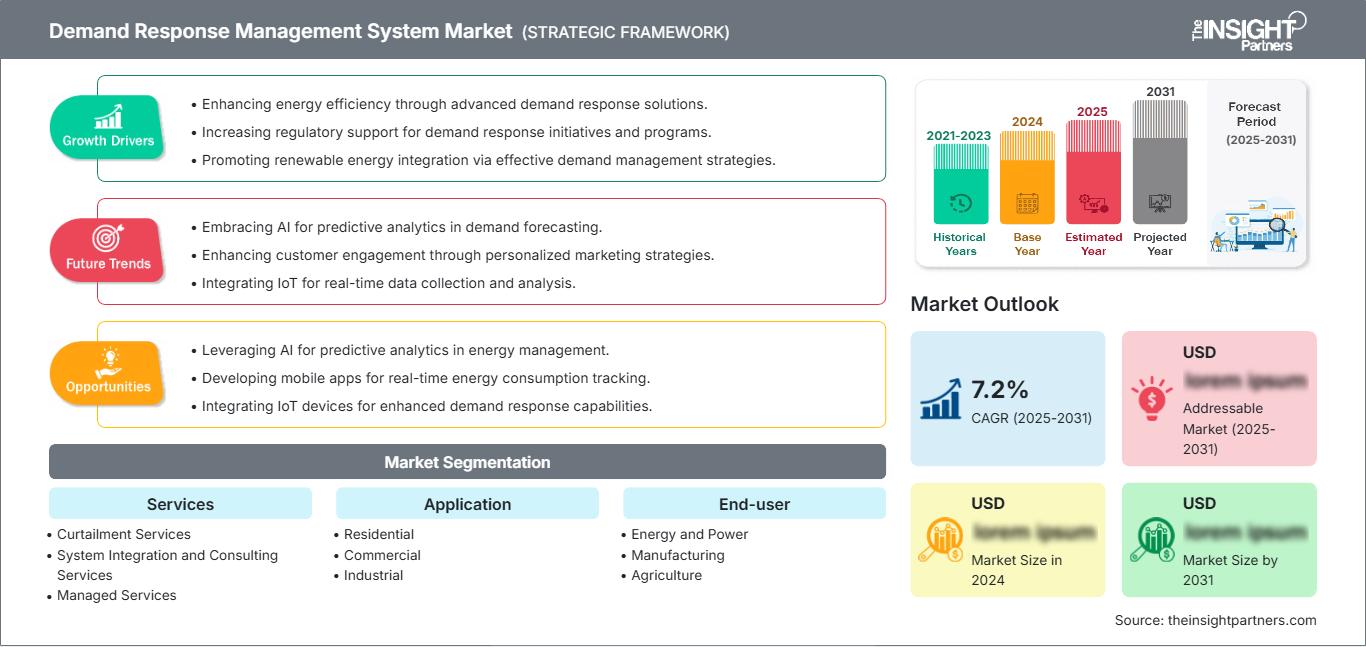
Demand Response Management System Market: Strategic Insights
-
Get Top Key Market Trends of this report.This FREE sample will include data analysis, ranging from market trends to estimates and forecasts.
Demand Response Management System Market Drivers and Opportunities
Market Drivers:
- Rising Integration of Variable Renewable Energy: As solar and wind power become dominant, DRMS provides the necessary flexibility to balance supply spikes and drops, driving its popularity among grid operators.
- Cost Optimization for High-Energy Users: The expansion of industrial automation and smart manufacturing has sustained high demand for curtailment inputs. As businesses trade up to digital energy management, demand response continues to see stable volume gains.
- Rapid Expansion of Smart City and IoT Infrastructure: Digital connectivity has removed traditional geographic barriers for grid services. This is particularly evident in the rapid adoption of cloud-based DRMS and connected appliances in regions like Asia-Pacific and North America.
Market Opportunities:
- Expansion into Electric Vehicle Ecosystems: Beyond traditional load shedding, DRMS offers significant opportunities in managed EV charging and vehicle-to-grid services for residential and fleet owners.
- Growth in Emerging APAC Corridors: Forming strategic partnerships between technology providers and state-owned utilities may facilitate access to high-margin market segments in China and India, where demand for premium, reliable power is increasing.
- Diversification into Sustainable Energy Certifications: There is a growing opportunity for providers to target specific demographics through certifications such as Carbon Neutral, ESG-compliant, and Green Energy, as seen in recent successful retail expansions in the North American market.
Demand Response Management System Market Report Segmentation Analysis
The Demand Response Management System Market share is analyzed across various segments to provide a clearer understanding of its structure, growth potential, and emerging trends. Below is the standard segmentation approach used in most industry reports:
By Services:
- Curtailment Services: The dominant volume driver, particularly within the traditional industrial and commercial sectors, due to established payout structures and immediate impact on peak load reduction.
- System Integration and Consulting Services: A fast-growing niche that aligns with global digitization trends. It is increasingly preferred by utilities that prioritize seamless interoperability with legacy grid hardware.
- Managed Services: Offers a comprehensive approach to program management, enabling utilities to outsource the enrollment and operation of demand response events to third-party experts.
- Support and Maintenance: Ensures the long-term reliability of installed software and hardware, providing a steady stream of recurring revenue for service providers.
By Application:
- Industrial: Represents the largest share globally, anchored by energy-intensive operations in manufacturing and mining that offer high curtailment capacity.
- Commercial: Focuses on optimizing HVAC and lighting in large office buildings and retail centers, benefiting from the expansion of smart building standards.
- Residential: The fastest-rising channel, especially for smart home brands and D2C energy apps, enabling cross-border energy efficiency.
By End-user:
- Energy and Power: Remains the primary channel for grid-balancing solutions, benefiting from the expansion of wholesale electricity markets and ancillary services.
- Manufacturing: A high-growth segment where demand response is used to hedge against peak electricity prices and support lean production goals.
- Agriculture: Offers a select but growing range of opportunities in irrigation management and cold storage load shifting in rural markets.
- Others: Includes public infrastructure, healthcare facilities, and educational campuses seeking to lower operational energy costs.
By Geography:
- North America
- Europe
- Asia Pacific
- South & Central America
- Middle East & Africa
Demand Response Management System Market Report Scope
| Report Attribute | Details |
|---|---|
| Market size in 2025 | US$ 12.73 Billion |
| Market Size by 2034 | US$ 47.36 Billion |
| Global CAGR (2026 - 2034) | 15.71% |
| Historical Data | 2021-2024 |
| Forecast period | 2026-2034 |
| Segments Covered |
By Services
|
| Regions and Countries Covered |
North America
|
| Market leaders and key company profiles |
|
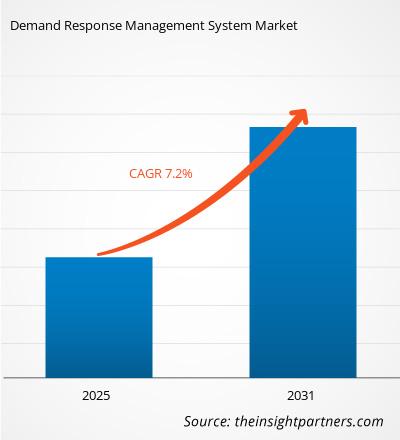
Demand Response Management System Market Players Density: Understanding Its Impact on Business Dynamics
The Demand Response Management System Market is growing rapidly, driven by increasing end-user demand due to factors such as evolving consumer preferences, technological advancements, and greater awareness of the product's benefits. As demand rises, businesses are expanding their offerings, innovating to meet consumer needs, and capitalizing on emerging trends, which further fuels market growth.
Demand Response Management System Market Share Analysis by Geography
Asia-Pacific is expected to grow fastest in the coming years. Emerging markets in South & Central America, the Middle East, and Africa also have many untapped opportunities for grid technology providers and energy management manufacturers to expand.
The demand response management system market is undergoing a significant transformation, moving from a traditional emergency measure to a global high-value digital asset. Growth is driven by the rising prevalence of grid congestion, a surge in decentralized energy demand, and the expansion of smart infrastructure. Below is a summary of market share and trends by region:
1. North America
- Market Share: Holds the largest share globally, driven by sophisticated wholesale markets and high penetration of smart thermostats.
- Key Drivers:
- Rising consumer preference for high-tech, automated energy management solutions
- Mainstreaming of demand response in high-end utility programs like those in California and Texas
- Increased deployment of electric vehicle charging infrastructure and residential battery storage
- Trends: Scaling of virtual power plant participation and the successful adoption of demand-side flexibility to avoid costly new power plant construction.
2. Europe
- Market Share: A major regional player, anchored by deep-seated climate targets and the integration of large-scale offshore wind energy.
- Key Drivers:
- High demand for flexibility to balance the volatile supply from renewable energy sources
- Established regulatory frameworks for cross-border energy trading and grid balancing
- Robust government support for energy efficiency and the electrification of heating
- Trends: A strategic shift toward prioritizing automated demand response over manual curtailment to meet the demands of a highly digitized European energy market.
3. Asia-Pacific
- Market Share: The fastest-growing region, with China and India acting as the primary markets for the entire continent, particularly for smart meter hardware.
- Key Drivers:
- Massive consumer base seeking premium, reliable power in rapidly growing urban centers
- Government-supported agricultural and industrial initiatives focused on high-value smart grids
- Rapid urbanization leading to a preference for westernized luxury energy management apps
- Trends: Heavy reliance on cloud platforms and B2B contracts for high-end energy management used in the manufacturing and data center industries.
4. South and Central America
- Market Share: Emerging market with a growing energy management in countries like Brazil and Chile.
- Key Drivers:
- Increasing awareness of the cost-saving benefits of demand response for large industrial users
- Modernization of aging electrical grids into commercial-grade smart systems
- Rising interest in sustainable energy diets among middle-to-high income segments
- Trends: Growth of boutique energy consulting brands and the introduction of local demand response programs to differentiate from traditional power supply models.
5. Middle East and Africa
- Market Share: Developing market with deep roots in state-led infrastructure, transitioning toward formalized commercial energy production.
- Key Drivers:
- Traditional presence of energy-intensive cooling loads in regional desert climates
- High demand for stable power in high-growth tourism and industrial zones
- Strategic investments in smart agriculture to improve local energy security and reduce waste
- Trends: Implementation of modern metering and digital control technologies to formalize the energy market, coupled with a focus on high-efficiency systems for the industrial segment.
High Market Density and Competition
Competition is intensifying due to the presence of established leaders such as Schneider Electric SE, Siemens AG, and Honeywell International Inc. Regional technology experts and niche players like AutoGrid Systems (USA) and Enel X (Italy), alongside North American innovators such as CPower and Itron Inc., also contribute to a diverse and rapidly expanding market landscape.
This competitive environment pushes vendors to differentiate through:
- Technological Sophistication: Positioning DRMS as a superior digital alternative to traditional peaker plants by emphasizing its higher speed, precision, and AI-driven automation for cost-conscious utilities.
- Solution Diversification: Demand response products now include more than just load shedding. Companies offer probiotic-style healthy grid services like frequency regulation, voltage support, and high-end predictive maintenance for transformers.
- Vertical Integration: Producers manage the entire value chain, from building smart meters to developing proprietary cloud software. This approach ensures quality, transparency, and meets ethical data standards.
- Advanced Processing: New processing technologies, like edge computing and high-speed telemetry, help create high-quality energy data used in financial trading and grid planning worldwide.
Opportunities and Strategic Moves
- Partner with high-end industrial channels and digital platforms to tap into the surging demand for energy-flexible and sustainable production in Asia-Pacific and North American markets.
- Incorporate sustainable software practices and green data center certifications to appeal to environmentally conscious millennials and Gen Z decision-makers seeking ethical energy alternatives.
Major Companies operating in the Demand Response Management System Market are:
- ABB
- Eaton Corporation Inc.
- Enel X
- General Electric
- Honeywell International Inc.
- Johnson Controls International plc
- Mitsubishi Electric Corporation
- Oracle Corporation
- Schneider Electric SE
- Siemens AG
Disclaimer: The companies listed above are not ranked in any particular order.
Demand Response Management System Market News and Recent Developments
- In March 2025, ABB presents InSite Energy Pro for intuitive, multi-site energy management. ABB Ability™ InSite Energy Pro, a cloud-based energy management platform, delivers actionable insights and automated optimization from a single, intuitive interface. InSite Energy Pro leverages real-time analytics and benchmarking to facilitate informed decision-making, optimize demand response, and cut energy costs.
- In March 2025, Oracle announced new Oracle Utilities Network Management System (NMS) features to help control room operators and program managers manage distributed energy resources (DERs) throughout their lifecycle. These ADMS enhancements help utilities alleviate grid stress through better demand response and DER management while optimizing performance using both front-of-the-meter and behind-the-meter data and tools. Innovations also help users address increasing extreme weather events with rapid response, restoration, and decentralization.
Demand Response Management System Market Report Coverage and Deliverables
The Demand Response Management System Market Size and Forecast (2021–2034) report provides a detailed analysis of the market covering below areas:
- Demand Response Management System Market size and forecast at global, regional, and country levels for all the key market segments covered under the scope
- Demand Response Management System Market trends, as well as market dynamics such as drivers, restraints, and key opportunities
- Detailed PEST and SWOT analysis
- Demand Response Management System Market analysis covering key market trends, global and regional framework, major players, regulations, and recent market developments
- Industry landscape and competition analysis covering market concentration, heat map analysis, prominent players, and recent developments in the Demand Response Management System Market.
- Detailed company profiles
Frequently Asked Questions

- Comprehensive Market Sizing and Forecast Analysis
- Detailed Segmentation Analysis
- In-Depth Market Dynamics Assessment
- Regional and Country-Level Insights
- Competitive Landscape and Company Benchmarking
- Strategic Business Intelligence
Recent Reports
Testimonials

The Insight Partners provided valuable market intelligence that supported our global go-to-market strategy. Their team was professional, responsive, and attentive to our feedback, providing thoughtful analysis and helpful methodological clarifications throughout the project.
Junmo Kim Chief Financial Officer (CFO), Enertech Co., Ltd.
The Insight Partners' SCADA System Market report is comprehensive, with valuable insights on current trends and future forecasts. The team was highly professional, responsive, and supportive throughout. We are very satisfied and highly recommend their services.
RAN KEDEM Partner, Reali Technologies LTDs
I requested a report on a very specific software market and the team produced the report in a few days. The information was very relevant and well presented. I then requested some changes and additions to the report. The team was again very responsive and I got the final report in less than a week.
JEAN-HERVE JENN Chairman, Future Analytica
We worked with The Insight Partners for an important market study and forecast. They gave us clear insights into opportunities and risks, which helped shape our plans. Their research was easy to use and based on solid data. It helped us make smart, confident decisions. We highly recommend them.
PIYUSH NAGPAL Sr. Vice President, High Beam Global
The Insight Partners delivered insightful, well-structured market research with strong domain expertise. Their team was professional and responsive throughout. The user-friendly website made accessing industry reports seamless. We highly recommend them for reliable, high-quality research services
YUKIHIKO ADACHI CEO, Deep Blue, LLC.
This is the first time I have purchased a market report from The Insight Partners.While I was unsure at first, I visited their web site and felt more comfortable to take the risk and purchase a market report.I am completely satisfied with the quality of the report and customer service. I had several questions and comments with the initial report, but after a couple of dialogs over email with their analyst I believe I have a report that I can use as input to our strategic planning process.Thank you so much for taking the extra time and making this a positive experience.I will definitely recommend your service to others and you will be my first call when we need further market data.
JOHN SUZUKI President and Chief Executive Officer, Board Director, BK Technologies
I wish to appreciate your support and the professionalism you displayed in the course of attending to my request for information regarding to infectious disease IVD market in Nigeria. I appreciate your patience, your guidance, and the fact that you were willing to offer a discount, which eventually made it possible for us to close a deal. I look forward to engaging The Insight Partners in the future, all thanks to the impression you have created in me as a result of this first encounter.
DR CHIJIOKE ONYIA MANAGING DIRECTOR, PineCrest Healthcare Ltd.Reason to Buy
- Informed Decision-Making
- Understanding Market Dynamics
- Competitive Analysis
- Identifying Emerging Markets
- Customer Insights
- Market Forecasts
- Risk Mitigation
- Boosting Operational Efficiency
- Strategic Planning
- Investment Justification
- Tracking Industry Innovations
- Aligning with Regulatory Trends





 Get Free Sample for