
Injection Molding Automation Solutions Market Growth, Size & Forecast by 2034
Coverage: By Component (Hardware, Software and Services); Hardware Type (Robots, Handling System, Automation Cells, Conveyors, and Others); Software Type (Manufacturing Execution Systems (MES), SCADA, Customer Portal, IoT-based Monitoring and Analytics Platform, AI-based Process Optimization, and Others); Software By Deployment Model (Cloud (SaaS) and On-Premises); Services Type (Maintenance and After-Sales Support, Consulting and Process Optimization Services, System Integration and Implementation, Training Services, and Platform-Based or Data-Driven Services); Industry (Automotive, Packaging, Medical and Healthcare, Electronics, Consumer Goods, and Others), and Geography (North America, Asia Pacific, South and Central America)
- Status : Published
- Report Code : TIPRE00043440
- Category : Technology, Media and Telecommunications
- No. of Pages : 607
- Available Report Formats :


- Last update date : June 08, 2026


2025 Market Size
US$ 10.04 Bn
Base year value
2034 Forecast
US$ 20.70 Bn
Projected by 2034
CAGR 2026-2034
8.4 %
Growth rate
Addressable Market
US$ 138.20 Bn
(2026-2034)
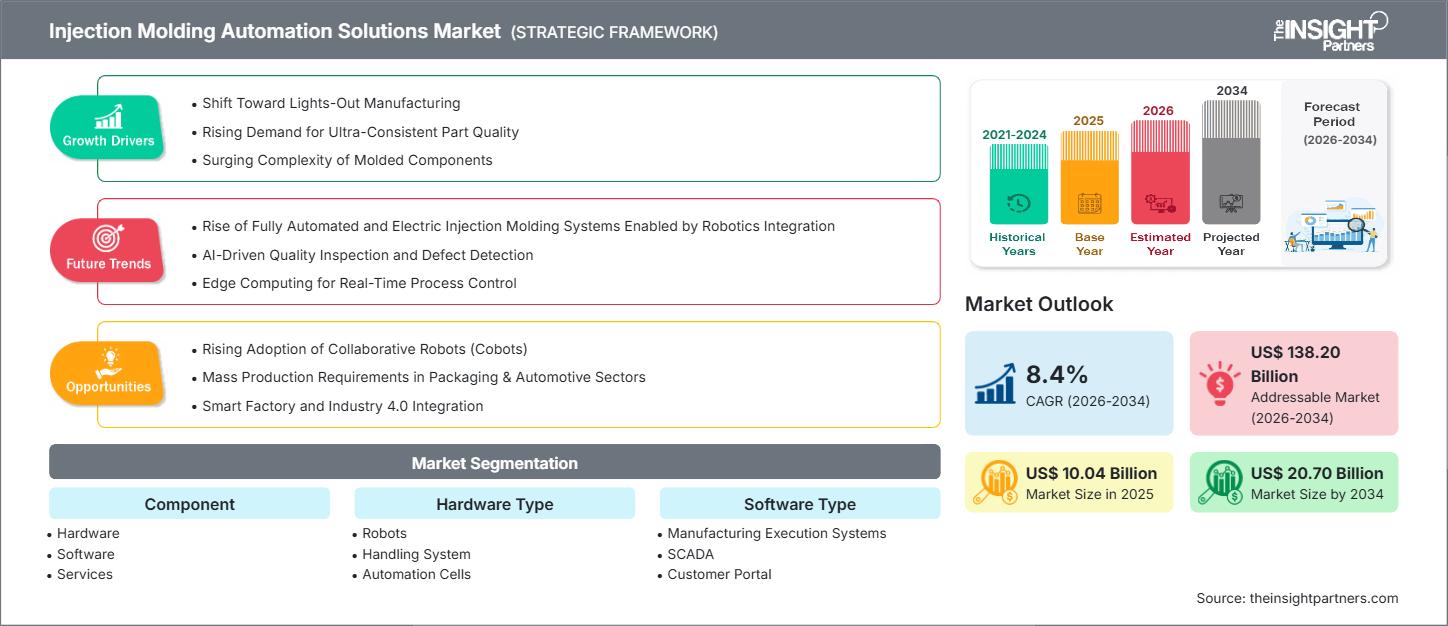
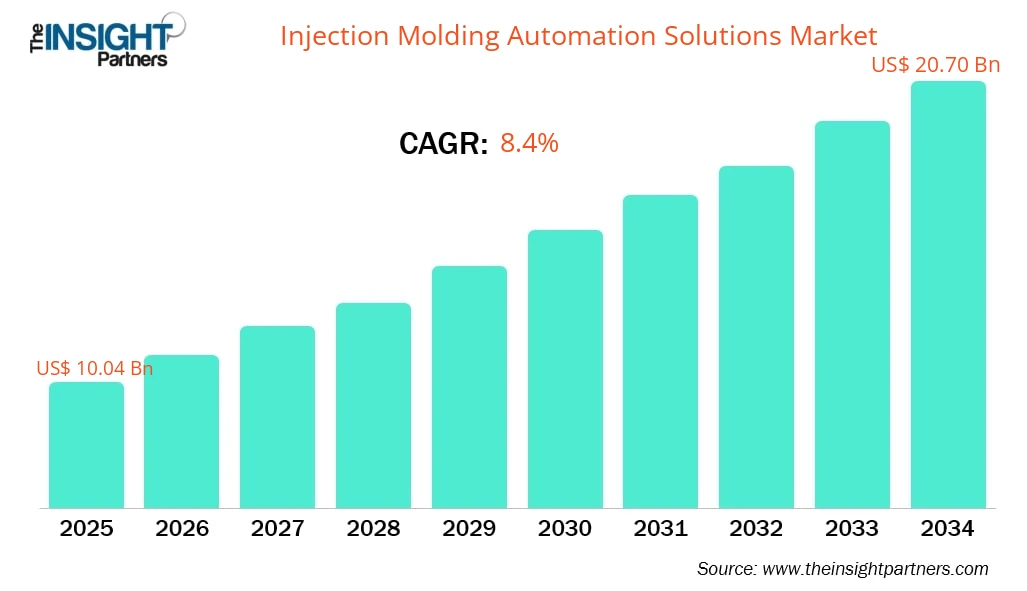
The Injection Molding Automation Solutions Market is projected to grow from US$ 10,047.75 million in 2025 to US$ 20,708.45 million by 2034, registering a CAGR of 8.4% during the forecast period (2026–2034).
Injection Molding Automation Solutions Market Analysis
The injection molding automation solutions market is driven by factors such as the shift toward lights-out manufacturing, rising demand for ultra-consistent part quality, growing complexity of molded components, mass production requirements in the packaging and automotive sectors, smart factory and Industry 4.0 integration, and AI-driven quality inspection and defect detection. However, the market faces restraints, including high upfront capital expenditure for robotic integration, complex system integration with legacy machinery, and a shortage of skilled robotics programmers and technicians. Key opportunities in the market include the rising adoption of collaborative robots (cobots). Major trends shaping the industry include the rise of fully automated and electric injection molding systems enabled by robotics integration and the increasing adoption of edge computing for real-time process control.
Injection Molding Automation Solutions Market Overview
Robotic systems, sensors, software, and intelligent control technologies are integrated with injection molding equipment to create autonomous manufacturing processes. In modern production environments, robots are used for a range of tasks such as mold loading and unloading, part extraction, insert placement, trimming, assembly, and quality inspection. Automation systems coordinate machine parameters such as temperature, pressure, and cycle timing to ensure consistent output. This integration eliminates the variability associated with manual operations, improving product quality, reducing cycle times, and minimizing material waste. Advanced systems combine robotics with machine vision, AI-based defect detection, and real-time process monitoring, enabling inline quality control and immediate correction of process deviations without stopping production.
Market Research Highlights
- Asia Pacific dominated the market with 37.7% share in 2025.
- Asia Pacific is poised to grow at a CAGR of 9.6% over the forecast period.
- United States market is projected to grow at a CAGR of 7.4% over the forecast period.
- By Component, the Hardware segment accounted for the largest market share of 52.9% in 2025.
- By Hardware Type, the Automation Cells segment is anticipated to witness the fastest growth, registering a CAGR of 9.6% over the forecast period
- By Software Type, the Manufacturing Execution Systems (MES) segment accounted for the largest market share of 35.4% in 2025.
- By Software By Deployment Model, the On-Premises segment is anticipated to witness the fastest growth, registering a CAGR of 11.2% over the forecast period
- By Services Type, the Maintenance and After-Sales Support segment accounted for the largest market share of 36.9% in 2025.
- By Industry, the Electronics segment is anticipated to witness the fastest growth, registering a CAGR of 10.3% over the forecast period
- By Automotive By Component, the Hardware segment accounted for the largest market share of 54.9% in 2025.
- By Packaging By Component, the Software segment is anticipated to witness the fastest growth, registering a CAGR of 8.2% over the forecast period
- By Medical And Healthcare By Component, the Hardware segment accounted for the largest market share of 51.9% in 2025.
- By Electronics By Component, the Software segment is anticipated to witness the fastest growth, registering a CAGR of 11.6% over the forecast period
- By Consumer Goods By Component, the Hardware segment accounted for the largest market share of 51% in 2025.
- By Others By Component, the Hardware segment is anticipated to witness the fastest growth, registering a CAGR of 6.1% over the forecast period
- The report profiles key industry players such as ABB Ltd, Autodesk Inc, Haitian International Holdings Limited, KraussMaffei Group GmbH, Yaskawa Electric Corp, Husky Technologies, ENGEL AUSTRIA GmbH, Sumitomo (SHI) Demag Plastics Machinery GmbH, ARBURG GmbH + Co KG, Milacron Holdings, LLC, while also analyzing key developments in novel ideas, disruptive products, and innovative services that could reshape the future market and reveal emerging themes across the industry.
Source: The Insight Partners' analysis based on proprietary research, government publications, company annual reports, investor presentations, industry databases, and expert interviews.
● REPORT CUSTOMIZATION
Tailor This Report To Align With Your Specific Business Requirements
This report can be customized to align precisely with your business objectives, scope, and target markets. Customization options include tailored segmentation, geography, competitive analysis, and strategic insights to support informed decision-making.
Customize This Report →WHAT YOU CAN ADJUST
- ● Segmentations
- ● Geography
- ● Competitive Analysis
- ● Language Preferences
Injection Molding Automation Solutions Market: Strategic Insights
-
Get Top Key Market Trends of this report.This FREE sample will include data analysis, ranging from market trends to estimates and forecasts.
Injection Molding Automation Solutions Market Drivers and Opportunities
Market Drivers:
- Shift Toward Lights-Out Manufacturing: The shift toward lights-out manufacturing is changing how production environments are designed and operated. Emerging from the principles of Industry 4.0, this concept refers to fully autonomous factories where production continues without human intervention, making traditional requirements such as lighting and worker-centric infrastructure unnecessary. In injection molding, this transformation is impactful because the process itself is repetitive, precision-driven, and well-suited for automation.
- Demand for Ultra-Consistent Part Quality: In injection molding, product quality and consistency define profitability. Even minor defects such as dimensional inaccuracy, surface blemishes, or internal stress can lead to high rejection rates, which increase material waste as well as slow down production cycles and inflate overall costs. Manufacturers are adopting robotics and automation to achieve a level of consistency that manual processes cannot deliver.
Market Opportunities:
- Adoption of Collaborative Robots (Cobots): Cobots were limited to simple pick-and-place or low-load applications due to constraints in speed, payload, and durability. However, this boundary is dissolving as modern cobots are now being deployed in complex, high-precision manufacturing environments, including injection molding lines. They are handling tasks such as mold part extraction, insert placement, inline inspection, and secondary finishing operations—functions that were once dominated by conventional industrial robots.
- Mass Production Requirements in Packaging and Automotive Sectors: Packaging and automotive industries operate on extremely high-volume production models where even minor inefficiencies can lead to significant cost escalations. In packaging, the need for lightweight, durable, and high-speed production of plastic containers, caps, and films requires injection molding systems that can run continuously with minimal variation. Automotive manufacturing depends on the large-scale production of interior and exterior plastic components that must meet strict quality and safety standards.
Injection Molding Automation Solutions Market Report Segmentation Analysis
The injection molding automation solutions market is categorized into distinct segments to understand its structure, growth prospects, and emerging trends. Below is the standard segmentation approach used in industry reports:
By Component:
- Hardware: Hardware represents the largest share of the market. In injection molding environments, hardware includes industrial robots (6-axis robots, SCARA robots, Cartesian robots), end-of-arm tooling (EOAT), conveyors, sensors, vision cameras, and complete automation cells that integrate with injection molding machines.
- Software: Software in injection molding automation acts as the intelligent control layer that coordinates all hardware components and ensures the entire production process runs safely and with minimal waste.
- Services: Services are a critical enabler in robotics and automation in the injection molding market. This segment includes consulting services, integration services, and support services, each playing a different role in ensuring successful automation deployment.
By Software Deployment Type:
- Cloud: Cloud-based deployment in injection molding automation refers to software systems that are hosted on remote servers and accessed via the internet, through subscription-based SaaS models.
- On-Premise: On-premises deployment refers to software systems that are installed and operated directly within the manufacturer’s IT infrastructure or factory environment, rather than being hosted externally.
By Hardware Type:
- Robots
- Handling System
- Automation Cells
- Conveyors
- Others
By Software Type:
- Manufacturing Execution Systems (MES)
- SCADA
- Customer Portal
- IoT-based Monitoring and Analytics Platform
- AI-based Process Optimization
- Others
By Services Type:
- Maintenance and After-Sales Support
- Consulting and Process Optimization Services
- System Integration and Implementation
- Training Services
- Platform-Based or Data-Driven Services
By Industry:
- Automotive
- Packaging
- Medical and Healthcare
- Electronics
- Consumer Goods
- Others
By Geography:
- North America
- Europe
- Asia Pacific
- Middle East & Africa
- South & Central America
Injection Molding Automation Solutions Market Report Scope
| Report Attribute | Details |
|---|---|
| Market size in 2025 | US$ 10.04 Billion |
| Market Size by 2034 | US$ 20.70 Billion |
| Global CAGR (2026 - 2034) | 8.4% |
| Historical Data | 2021-2024 |
| Forecast period | 2026-2034 |
| Segments Covered |
By Component
|
| Regions and Countries Covered |
North America
|
| Market leaders and key company profiles |
|
Injection Molding Automation Solutions Market Players Density: Understanding Its Impact on Business Dynamics
The Injection Molding Automation Solutions Market is growing rapidly, driven by increasing end-user demand due to factors such as evolving consumer preferences, technological advancements, and greater awareness of the product's benefits. As demand rises, businesses are expanding their offerings, innovating to meet consumer needs, and capitalizing on emerging trends, which further fuels market growth.
Injection Molding Automation Solutions Market Share Analysis by Geography
The injection molding automation solutions market in Asia Pacific is experiencing rapid growth. The market in APAC is driven by massive manufacturing capacity, strong government support for automation, and dominance in electronics and automotive production. Nations such as China, Japan, South Korea, and India are investing in smart factories and robotics integration. There is a shift from low-cost labor dependence to high-efficiency automated production, especially in consumer electronics, automotive components, and packaging industries. Governments across the region promote Industry 4.0 initiatives, subsidies, and industrial modernization programs, accelerating the adoption of robotic systems in new and legacy molding machines. The presence of global electronics supply chains also demands high-speed, high-precision automation.
The injection molding automation solutions market growth differs in each region due to variations in industrial maturity, digital adoption levels, and manufacturing infrastructure development. Below is a summary of market share and trends by region:
1. North America
- Market Share: Holds a significant portion of the global market
- Key Drivers:
- Strong adoption of smart manufacturing and Industry 4.0 technologies: The increasing adoption of Industry 4.0 technologies is driving the injection molding automation solutions market by enabling real-time monitoring, predictive maintenance, robotic integration, and enhanced production efficiency across manufacturing facilities.
- High demand for precision manufacturing and reduced production downtime
- Advanced robotics and industrial automation infrastructure
- Trends: Growing integration of AI-powered robotics, machine vision systems, and cloud-based monitoring platforms to improve production accuracy, reduce waste, and enhance operational efficiency in injection molding operations.
2. Europe
- Market Share: Holds a substantial share in the global injection molding automation solutions market
- Key Drivers:
- Strong focus on advanced manufacturing and industrial automation: The strong emphasis on advanced manufacturing technologies is driving the injection molding automation solutions market by increasing the adoption of robotics, smart sensors, and automated production systems to enhance efficiency, precision, and product quality across industries.
- Growing demand for energy-efficient and sustainable production processes
- Presence of established automotive, packaging, and medical device industries
- Trends: Increasing integration of AI-driven process optimization, machine vision inspection systems, and energy-efficient robotic automation to support sustainable and high-precision manufacturing operations.
3. Asia Pacific
- Market Share: Fastest-growing region with dominant market share
- Key Drivers:
- Rapid industrialization and expansion of manufacturing industries: Industrialization is accelerating the demand for injection molding automation solutions by increasing the need for high-volume production, operational efficiency, and automated quality control across automotive, packaging, electronics, and consumer goods industries.
- Government initiatives promoting smart factories and industrial automation
- Increased adoption of robotic automation in plastic manufacturing facilities
- Trends: Increasing deployment of collaborative robots (cobots), IIoT-enabled molding systems, and energy-efficient automation technologies to support scalable and cost-effective manufacturing operations in emerging economies.
4. Middle East & Africa
- Market Share: Emerging market with increasing growth potential
- Key Drivers:
- Rising industrial diversification and manufacturing investments: Industrial diversification initiatives are supporting the injection molding automation solutions market by encouraging the development of local manufacturing capabilities and increasing the adoption of automated production technologies across various industries.
- Growing adoption of automation technologies in the packaging and consumer goods sectors
- Increasing focus on improving production efficiency and reducing operational costs
- Trends: Implementation of smart factory technologies, robotic material handling systems, and cloud-based production monitoring solutions to enhance manufacturing productivity and operational visibility across the region.
5. South & Central America
- Market Share: A growing market with steady progress
- Key Drivers:
- Increasing modernization of manufacturing facilities: Manufacturing modernization is boosting the injection molding automation solutions market by encouraging industries to adopt automated systems for improving production speed, minimizing manual intervention, and enhancing product consistency.
- Rising investments in industrial automation and robotics
- Growing focus on improving operational efficiency and reducing labor costs
- Trends: Gradual adoption of hybrid automation systems combining robotic handling, centralized monitoring, and cloud-based analytics to improve production flexibility and process optimization.
High Market Density and Competition
Competition is intense due to the presence of major global players such as KraussMaffei Group GmbH, ENGEL AUSTRIA GmbH, ARBURG GmbH + Co KG, Haitian Plastics Machinery Group Co., Ltd., Sumitomo (SHI) Demag Plastics Machinery GmbH, ABB Ltd., Yaskawa Electric Corporation, Milacron, Autodesk Inc., and Husky Injection Molding Systems.
This high level of competition urges companies to stand out by offering:
- Advanced robotic automation and material handling solutions
- Real-time production monitoring and predictive maintenance capabilities
- Seamless integration with IIoT, MES, ERP, and smart factory systems
- AI-driven process optimization and quality inspection technologies
- Energy-efficient and high-speed automation systems for improved productivity
Opportunities and Strategic Moves
- The injection molding automation solutions market offers growth through smart factories, cloud adoption, and AI integration, enabling scalable, efficient manufacturing operations and improved production visibility across global industries.
- Companies focus on partnerships, acquisitions, and innovation in cloud and AI-enabled MES solutions, enhancing product portfolios, expanding global reach, and delivering industry-specific, flexible manufacturing execution capabilities.
Other companies analyzed during the course of research
- Sepro Group
- Wittmann Battenfeld GmbH
- Nissei Plastic Industrial Co., Ltd.
- Fanuc Corporation
- Toshiba Machine Co., Ltd.
- Shibaura Machine Co., Ltd.
- KUKA AG
- Siemens AG
- Mitsubishi Electric Corporation
- Omron Corporation
Injection Molding Automation Solutions Market News and Recent Developments
- Haitian Plastics Machinery enters into an agreement to purchase automatic processing lines : In April 2026, Haitian International and its wholly owned subsidiary, Haitian Plastics Machinery, entered into an agreement to acquire automatic processing lines, CNC turning machines, machining centers, and related equipment from affiliated company Haitian Precision for approximately RMB173.39 million. The acquired equipment was intended to support the production of parts and components used in the group’s plastic injection molding machines. The consideration was settled in installments using internal funds.
- FANUC introduces a new series of injection molding machines to the market : In August 2025, FANUC introduced a new series of injection molding machines to the market. The flexible, fast, and cost-saving ROBOSHOT SC series retained the compact footprint of its predecessor while accommodating larger and deeper molds. Mold shops and general manufacturers of plastic products benefited from faster operating speeds, a wider range of injection unit combinations, new energy-saving features, and enhanced AI functionality.
Injection Molding Automation Solutions Market Report Coverage and Deliverables
The "Injection Molding Automation Solutions Market Size and Forecast (2021–2034)" report provides a detailed analysis of the market covering below areas:
- Injection Molding Automation Solutions Market size and forecast at global, regional, and country levels for all the key market segments covered under the scope
- Injection Molding Automation Solutions Market trends, as well as market dynamics such as drivers, restraints, and key opportunities
- Detailed PEST and SWOT analysis
- Injection Molding Automation Solutions Market analysis covering key market trends, global and regional framework, major players, regulations, and recent market developments
- Industry landscape and competition analysis covering market concentration, heat map analysis, prominent players, and recent developments for the Injection Molding Automation Solutions Market
- Detailed company profiles
Frequently Asked Questions
The shift toward lights-out manufacturing is changing how production environments are designed and operated. Emerging from the principles of Industry 4.0, this concept refers to fully autonomous factories where production continues without human intervention, making traditional requirements such as lighting and worker-centric infrastructure unnecessary. In injection molding, this transformation is impactful because the process itself is repetitive, precision-driven, and well-suited for automation.
2. Demand for Ultra-Consistent Part Quality:
In injection molding, product quality and consistency define profitability. Even minor defects such as dimensional inaccuracy, surface blemishes, or internal stress can lead to high rejection rates, which increase material waste as well as slow down production cycles and inflate overall costs.
1. High Upfront Capital Expenditure for Robotic Integration: Integrating automation into injection molding operations involves substantial initial investment, including the cost of industrial robots, end-of-arm tooling, control systems, safety infrastructure, and software platforms. Beyond the hardware, manufacturers must invest in system design, engineering, installation, and commissioning, all of which add to the financial burden.
2. Complex System Integration with Legacy Machinery: Manufacturing facilities, particularly those established years ago, operate with older machines that were not originally designed to support advanced automation or digital connectivity. Retrofitting these systems with robotics requires extensive customization, including mechanical modifications, additional sensors, and the implementation of new control interfaces.
1. Integration of Industry 4.0 and Smart Manufacturing
2. Growing Adoption of Robotics and Cobots
3. AI-Based Process Optimization and Predictive Maintenance
4. Increasing Deployment of Machine Vision Systems
5. Rising Demand for Energy-Efficient and Sustainable Manufacturing
6. Expansion of Digital Twin and Simulation Technologies

- Comprehensive Market Sizing and Forecast Analysis
- Detailed Segmentation Analysis
- In-Depth Market Dynamics Assessment
- Regional and Country-Level Insights
- Competitive Landscape and Company Benchmarking
- Strategic Business Intelligence
Recent Reports
Testimonials

The Insight Partners provided valuable market intelligence that supported our global go-to-market strategy. Their team was professional, responsive, and attentive to our feedback, providing thoughtful analysis and helpful methodological clarifications throughout the project.
Junmo Kim Chief Financial Officer (CFO), Enertech Co., Ltd.
The Insight Partners' SCADA System Market report is comprehensive, with valuable insights on current trends and future forecasts. The team was highly professional, responsive, and supportive throughout. We are very satisfied and highly recommend their services.
RAN KEDEM Partner, Reali Technologies LTDs
I requested a report on a very specific software market and the team produced the report in a few days. The information was very relevant and well presented. I then requested some changes and additions to the report. The team was again very responsive and I got the final report in less than a week.
JEAN-HERVE JENN Chairman, Future Analytica
We worked with The Insight Partners for an important market study and forecast. They gave us clear insights into opportunities and risks, which helped shape our plans. Their research was easy to use and based on solid data. It helped us make smart, confident decisions. We highly recommend them.
PIYUSH NAGPAL Sr. Vice President, High Beam Global
The Insight Partners delivered insightful, well-structured market research with strong domain expertise. Their team was professional and responsive throughout. The user-friendly website made accessing industry reports seamless. We highly recommend them for reliable, high-quality research services
YUKIHIKO ADACHI CEO, Deep Blue, LLC.
This is the first time I have purchased a market report from The Insight Partners.While I was unsure at first, I visited their web site and felt more comfortable to take the risk and purchase a market report.I am completely satisfied with the quality of the report and customer service. I had several questions and comments with the initial report, but after a couple of dialogs over email with their analyst I believe I have a report that I can use as input to our strategic planning process.Thank you so much for taking the extra time and making this a positive experience.I will definitely recommend your service to others and you will be my first call when we need further market data.
JOHN SUZUKI President and Chief Executive Officer, Board Director, BK Technologies
I wish to appreciate your support and the professionalism you displayed in the course of attending to my request for information regarding to infectious disease IVD market in Nigeria. I appreciate your patience, your guidance, and the fact that you were willing to offer a discount, which eventually made it possible for us to close a deal. I look forward to engaging The Insight Partners in the future, all thanks to the impression you have created in me as a result of this first encounter.
DR CHIJIOKE ONYIA MANAGING DIRECTOR, PineCrest Healthcare Ltd.Reason to Buy
- Informed Decision-Making
- Understanding Market Dynamics
- Competitive Analysis
- Identifying Emerging Markets
- Customer Insights
- Market Forecasts
- Risk Mitigation
- Boosting Operational Efficiency
- Strategic Planning
- Investment Justification
- Tracking Industry Innovations
- Aligning with Regulatory Trends





 Get Free Sample for