
Die Cutting Machine Market Size, Share & Trends by 2034
Coverage: by Type (Flat Die Cutting Machine, Rotary Die Cutting Machine, Others); Technology (Metal-to-Metal, Slitting, Kiss Cutting, Scoring); Industry Vertical (Pharmaceutical, Textile, Automobile, Manufacturing, Others) , and Geography (North America, Europe, Asia Pacific, and South and Central America)
- Status : Data Released
- Report Code : TIPRE00007954
- Category : Manufacturing and Construction
- No. of Pages : 150
- Available Report Formats :


- Last update date : November 09, 2026


2025 Market Size
US$ 13.56 Bn
Base year value
2034 Forecast
US$ 25.91 Bn
Projected by 2034
CAGR 2026-2034
7.46 %
Growth rate
Addressable Market
US$ 177.91 Bn
(2026-2034)
The Die Cutting Machine Market was valued at US$ 13.56 Billion in 2025 and is projected to reach US$ 25.91 Billion by 2034, registering a CAGR of 7.46% during 2026–2034. The market covers equipment used to cut, crease, score, slit, and kiss-cut paperboard, films, textiles, foams, adhesives, metals, and composite substrates for pharmaceutical, textile, automobile, manufacturing, and other industrial applications.
North America is expected to expand at an estimated ~7% CAGR through 2034 as converters modernize aging finishing lines and manufacturers adopt connected equipment for shorter runs, tighter tolerances, and lower waste. The Die Cutting Machine Market size in the region is also supported by resilient pharmaceutical labeling, corrugated e-commerce packaging, automotive component conversion, and investment in automated material handling that improves throughput despite skilled-labor constraints.
Die Cutting Machine Market Assessment and Insights
Regional Outlook
- North America: ~31% of the global market in 2025 | ~7% CAGR through 2034. Market position: The region ranks second, supported by packaging automation, pharmaceutical compliance, established converting capacity, and replacement of mechanically intensive equipment with connected, servo-controlled platforms.
- US: ~82% of North American market revenue in 2025 | ~7% CAGR through 2034. Market position: The country leads North America through its broad converter base, high automation spending, medical manufacturing, label innovation, and demand for precision-cut automotive and industrial components.
- Europe: ~27% of the global market in 2025 | ~6% CAGR through 2034. Market position: Mature packaging clusters and strict material-efficiency requirements sustain demand, with Germany leading and Italy, France, the UK, and Spain contributing specialized converting capacity.
- Asia Pacific: ~35% of the global market in 2025 | ~9% CAGR through 2034. Market position: The largest and fastest-growing region benefits from Chinese equipment production, Indian packaging investment, and advanced Japanese and South Korean electronics and label conversion.
Segment Outlook
- Type: ~44% Share in 2025 | ~8% CAGR through 2034. Market position: Type is the largest main segment because machine architecture defines production speed, format flexibility, tooling economics, and suitability for sheet-fed or roll-fed converting.
- Technology: ~32% Share in 2025 | ~9% CAGR through 2034. Market position: Technology records the highest growth as converters combine slitting, kiss cutting, scoring, inspection, and digital controls in modular lines.
Competitive Coverage
Bobst Group SA, Cerutti Group, Delta ModTech, Duplo Corporation, Hannan Products Corporation, Heidelberger Druckmaschinen AG, LARTEC-J, S.L., Sanwa Ltd., Shanghai Yawa Printing Machinery Co., Ltd., Young Shin Machinery Co., Ltd.
Methodology
The Insight Partners follows Data Collection & Secondary Research, Primary Research, Data Analysis, and Data Triangulation & Final Review to validate market estimates and insights.
Source: The Insight Partners' analysis based on proprietary research, government publications, company annual reports, investor presentations, industry databases, and expert interviews.
Die‑cutting machines are used to be single presses that were fixed by hand. Now they are machines that can register automatically strip off the waste blank the shape inspect the cut and log data about the production. Sheet‑fed flatbed machines are still the choice for folding cartons and corrugated boxes. Rotary machines are needed for roll‑to‑roll work such as labels, tapes, medical patches and technical parts. Production economics depend on make‑ready, tools that last long the ability to use many different substrates and good waste handling. Because of this suppliers of die‑cutting machines are spending money on basic cutting power and more on controls, modular stations, remote monitoring and engineering that keeps quality high even for short and varied runs.
From now until 2034 the biggest growth will be in Asia‑Pacific, the Middle East and some Africa factories. Europe and North America will focus more on replacing machines retrofitting them and selling service. New laws about pharmaceutical traceability rules for packaging and lighter‑weight car design are pushing more use of scoring and kiss cutting. Capital spending will go to machines that can handle recycled fiber, thin film, pressure‑sensitive sheets and multi‑ply materials, with changeover. This gives converters a chance to serve high‑mix customers with the same set of equipment.
Die Cutting Machine Market Report Scope
| Report Attribute | Details |
|---|---|
| Market size in 2025 | US$ 13.56 Billion |
| Market Size by 2034 | US$ 25.91 Billion |
| Global CAGR (2026 - 2034) | 7.46% |
| Historical Data | 2021-2024 |
| Forecast period | 2026-2034 |
Die Cutting Machine Market Analysis
The demand comes from areas like packaging, labels, special fabrics, car insulation, seals, medical devices and industrial layers. Growth in the die cutting machine market happens because of types of shapes and materials not just the amount being cut. More options mean the need for setups, tight alignment and exact cutting depth. The group involved includes makers of steel rules and rotary dies builders of machines companies that provide automation, suppliers of materials people who process the materials and the people who use the machines. Customers are now looking at the cost for each finished product, which includes the cost of tools, waste, workers, power and unexpected breaks in work.
The way supplies work is different for each type of machine. Companies in Europe and Japan are known for their accuracy, control systems and support over time. Companies in China are making automated flatbed machines easier to get. Experts in machines stand out because of how flexible their systems are and how they handle materials. Long times needed to test and approve machines in the medicine and car industries help the companies in place.. New ways that are open and can be changed easily offer chances, for other companies that provide parts or software.
The Die Cutting Machine Market Report shows a competitive field with many strong application niches. Bobst Group SA and Heidelberger Druckmaschinen AG focus on folding‑carton and packaging converters while Delta ModTech targets roll‑to‑roll systems, for medical, battery, RFID and label production. Duplo Corporation serves print finishing and Shanghai Yawa Printing Machinery Co., Ltd. Sanwa Ltd. And Young Shin Machinery Co., Ltd. Broaden regional equipment choice.
Investment is moving toward automation packages that reduce operator touchpoints and toward application centers that shorten customer trials. Strategic positioning depends on service tooling partnerships, controls expertise and the ability to validate difficult substrates. Cerutti Group, Hannan Products Corporation and LARTEC‑J S.L. Remain relevant where process specialization and configured systems influence purchasing decisions.
● REPORT CUSTOMIZATION
Tailor This Report To Align With Your Specific Business Requirements
This report can be customized to align precisely with your business objectives, scope, and target markets. Customization options include tailored segmentation, geography, competitive analysis, and strategic insights to support informed decision-making.
Customize This Report →WHAT YOU CAN ADJUST
- ● Segmentations
- ● Geography
- ● Competitive Analysis
- ● Language Preferences
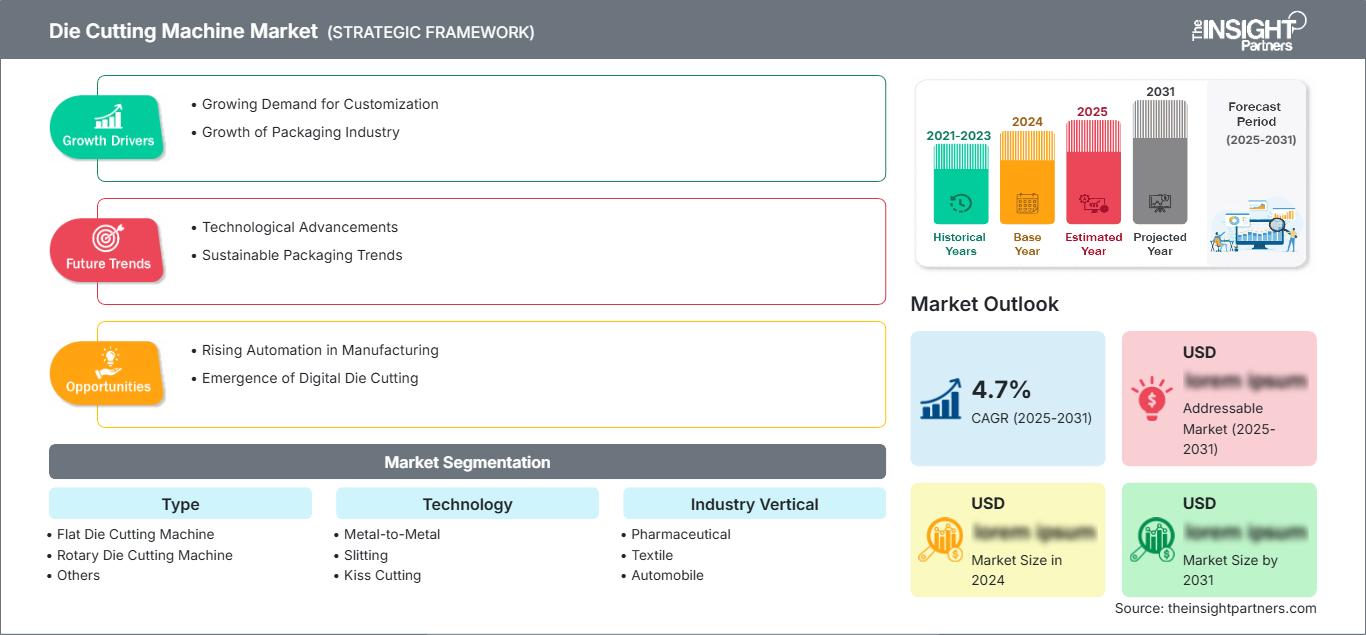
Die Cutting Machine Market: Strategic Insights
Regional Insights
North America Die Cutting Machine Market
North America is expected to grow at seven percent compound annual growth rate until the year 2034 driven by demand for replacement of equipment in folding carton, labels, corrugated packaging, medical converting and industrial tapes. The share of the die cutting machine market in this region shows that many businesses already own these machines and continue to spend on automation, not new installations. Buyers look for machines that can change over quickly give diagnostics use machine vision and handle materials safely to deal with fewer workers and keep profit margins. U.S. And Canadian converters are also changing converter equipment to use paperboard, thinner films and high‑barrier laminates. Pharmaceutical serialization, direct‑to‑consumer packaging and local component production help with cutting and scoring. Having service coverage and easy access to tooling is still very important because downtime can cost more, than the savings from buying a cheaper machine.
U.S. Die Cutting Machine Market
The United States takes up around 82 percent of the North American Die Cutting Machine Market Share in 2025. Is expected to grow at around 7 percent each year until 2034. Its strong position is because of a commercial-print and packaging industry, big healthcare manufacturing areas, automotive supply chains and ongoing investments in warehouse-ready corrugated formats. More and more the need for die cutting includes stripping, blanking, slitting, inspection and data capture together.
Bobst Group SA, Delta ModTech, Duplo Corporation, Hannan Products Corporation and Heidelberger Druckmaschinen AG have partner-driven presence in the market. Uses include cartons and labels well as diagnostic parts, wearable patches, foam gaskets and battery materials. Buyers like systems that can add stations when production goes up which helps reduce the risk of choosing a system that is too limited, in design.
Europe Die Cutting Machine Market
Europe represents 27 percent of global revenue in 2025 and is expected to grow by about 6 percent each year until 2034. Germany is the leading country in Europe supported by machinery engineering, automotive production, pharmaceutical packaging and a complex converter network. Rules about being able to recycle and using material encourage machines that can handle fiber-based materials and thinner thicknesses without harming the print quality or the crease quality.
Italy brings packaging-machinery design and converting expertise while France keeps demand high through cosmetics, luxury boxes, food packaging and medical products. The UK market focuses on digital print finishing, small runs of boxes, labels and online shopping needs. Spain has a packaging industry that sells a lot and also works with the car and textile sectors. In all these countries energy use, worker safety and having records of production are more and more important when deciding what machines to buy.
European suppliers still have benefits when it comes to quality flatbed engineering, control systems and support after the sale but competition on price is getting harder. Converters are now looking at how productive the machinesre, over their whole life not just how fast they can run. Upgrades, guessing when maintenance is needed and making tools better help keep machines going longer while still being able to move towards more automation.
APAC Die Cutting Machine Market
Asia Pacific holds ~35% of global revenue in 2025 and is the fastest-growing region at ~9% CAGR through 2034. China is the leading country in Asia Pacific, combining machinery production with immense packaging, electronics, textile, and automotive demand. India adds greenfield carton and pharmaceutical-packaging investment, while Japan and South Korea support precision label, electronics, and battery applications.
Australia contributes demand for food, beverage, logistics, and digitally printed packaging. Regional policy support for manufacturing localization, export competitiveness, and automation accelerates adoption, but equipment choices remain price-sensitive. Suppliers with local service, operator training, and adaptable financing are best placed to convert first-time automation buyers.
Middle East & Africa Die Cutting Machine Market
The Middle East & Africa is projected to expand at ~8% CAGR through 2034. Saudi Arabia is the leading country in the Middle East & Africa where industrial diversification, pharmaceutical localization, and consumer-goods investment create equipment demand. The UAE serves as a packaging, trade, and re-export hub with strong requirements for premium cartons and labels.
South Africa anchors the region’s established converting base, while the Rest of MEA offers selective opportunities tied to food processing, logistics, and local manufacturing. Energy availability and industrial-zone infrastructure can support new plants, although financing, imported tooling, and after-sales coverage remain adoption constraints.
Segmentation Analysis
Type
The Type main segment is projected to grow at ~8% CAGR during 2026–2034. It captures the Die Cutting Machine Market scope across sheet-fed, web-fed, and specialized configurations, with selection governed by run length, substrate, format, tolerance, and downstream handling. Flat systems remain essential for cartons and thick board, while rotary equipment gains where continuous output and multilayer web conversion improve unit economics.
- Flat Die Cutting Machine: Preferred for folding cartons, corrugated sheets, and rigid substrates because high tonnage, accurate registration, stripping, and blanking support complex layouts and premium package quality.
- Rotary Die Cutting Machine: Strategically important for labels, adhesive components, medical products, and high-volume packaging, offering continuous processing, stable repeatability, and integration with printing, lamination, inspection, and rewinding.
Technology
The Technology main segment in the Die Cutting Machine Market is forecast to advance at ~9% CAGR during 2026–2034. Growth reflects the move from single-step cutting toward configurable process chains that combine material separation, partial-depth cutting, folding preparation, and quality control. Technology choice depends on edge quality, liner protection, registration tolerance, substrate compressibility, and whether parts must remain indexed for automated assembly.
- Metal-to-Metal: Used when clean through-cuts and dimensional control are critical, particularly for technical components and multilayer laminates, but tooling alignment and wear management require disciplined process control.
- Slitting: Supports roll-width optimization and inline finishing for labels, films, tapes, textiles, and battery materials, reducing secondary handling while enabling multiple finished lanes from a common web.
- Kiss Cutting: Central to pressure-sensitive labels, medical patches, protective films, and adhesive parts because it cuts the face material while preserving the release liner for transport and automated placement.
- Scoring: Creates controlled fold lines in cartons and engineered sheet products, improving forming consistency and reducing cracking when converters shift toward recycled fiber, coated board, or lightweight structures.
Industry Vertical
The Industry Vertical segment in the Die Cutting Machine Market is expected to expand at ~8% CAGR during 2026–2034. Purchasing is increasingly application-led, with regulated sectors emphasizing traceability and validation while general manufacturing prioritizes flexibility and uptime. Equipment builders therefore pair common mechanical platforms with sector-specific web handling, cleanroom compatibility, extraction, inspection, and software.
- Pharmaceutical: Demand centers on cartons, labels, tamper-evident components, diagnostic consumables, and wearable patches, where repeatability, contamination control, serialized workflows, and documented process settings support compliance.
- Textile: Die cutting enables repeatable shapes from fabrics, foams, nonwovens, and technical laminates for apparel, filtration, insulation, and protective products, with nesting efficiency and edge quality affecting material yield.
- Automobile: Applications include gaskets, acoustic insulation, adhesive tapes, thermal barriers, seals, and interior components, making tight tolerances, multilayer conversion, and integration with automated assembly strategically important.
- Manufacturing: General industrial users process rubber, cork, fiber, plastics, abrasives, and composites for seals, spacers, protective parts, and assembly aids, favoring adaptable systems that accommodate frequent job changes.
Opportunity Snapshot
| Industry Vertical | Revenue Contribution | Trend Tag | Adoption Stage |
| Pharmaceutical | High | Wearable Converting | Scaling |
| Textile | Medium | Technical Fabrics | Scaling |
| Automobile | High | Lightweight Gaskets | Mature |
| Manufacturing | High | Flexible Automation | Mature |
| Others | Low | Specialty Materials | Emerging |
Die Cutting Machine Market Growth Drivers and Impact Analysis
Packaging Automation and SKU Proliferation
Brand owners are adding package options, seasonal designs, versions in different languages and formats for online shopping, which means there are more changes even if overall sales go up a little. This makes the economics for converters focus more on automation like alignment, quick tool changes, continuous feeding, removing layers and digital job recall. The market for Die Cutting Machines gets better because finishing can become a problem after digital or traditional printing. Machines that cut down on setup sheets and the need for workers to do things improve how much the factory can produce and make shorter runs profitable. This is especially true for folding cartons, cardboard displays and labels where exact measurementsre important for gluing, packing and things that machines can read.
Expansion of Regulated Medical and Pharmaceutical Converting
pharmaceutical packaging, parts for tests patches for the skin products for wounds and labels for devices need exact cutting depth consistent alignment, clean paths for materials and records of settings. These needs help sell expensive rotary and flexible converting machines that do printing, layering, light cutting, checking and rewinding. It takes longer to sell these machines. It also makes it harder for customers to switch and adds more value after the sale. Companies that can offer help with checking, setups that work in areas and software that tracks everything can handle more valuable uses. In life this trend increases the need not just for new machines but also for systems that can see manage tools keep machines working well and offer service deals for all the machines already in use.
Material Efficiency and Workforce Constraints
Converters are being asked to use material while still making the same amount of products with fewer experienced workers. Materials like paper, thinner plastic and complicated layers can change in how stiff they are how they look and how they compress, which makes manual adjustments not as good. Systems that control movement set pressure automatically use cameras to check and predict when maintenance is needed help keep production steady and cut down on waste. The reason to use these machines is clear when looking at how many sheetsre made each hour how long it takes to change jobs and how long tools last not just how fast the machine can go. This helps companies that can mix parts with easy-to-use controls support from far away and data about the process especially in older markets where replacing machines needs to show real savings, on workers and materials.
Die Cutting Machine Market Future Trends
Connected, Self-Correcting Converting Cells
Die Cutting Machine Market trends will increasingly center on closed-loop production rather than isolated machine automation. Vision systems will compare print, cut, and crease positions in real time, while controls adjust register, tension, and pressure within defined limits. Equipment data will feed maintenance planning and job costing, allowing converters to identify recurring waste sources across fleets. Human operators will remain essential for tooling and process approval, but interfaces will guide setup and flag deviations earlier. The commercial implication is a shift toward software-enabled service revenue, interoperable controls, and cybersecurity expectations, especially where customer audits require production records.
Hybrid Tooling for Short and Long Runs
Future lines will combine conventional dies for stable, high-volume work with laser or digitally controlled cutting for prototypes, versioned jobs, and intricate features. Hybrid capability reduces dependence on a single tooling model and lets converters route work according to run length, material response, edge quality, and delivery time. Modular stations will be particularly valuable in labels, medical components, and specialty packaging, where designs change quickly but repeat orders still justify physical dies. Adoption will depend on laser safety, extraction, energy use, and substrate compatibility, so conventional rotary and flatbed systems will evolve alongside digital alternatives rather than being abruptly displaced.
Die Cutting Machine Market Opportunities
Localized Service and Retrofit Platforms
A large installed base in mature markets creates an opportunity to upgrade controls, guarding, inspection, registration, and data connectivity without replacing the entire press. Suppliers can package audits, retrofit hardware, operator training, and multi-year maintenance into outcome-based proposals. Die Cutting Machine Market Forecasts support this approach because replacement cycles remain uneven and many converters need incremental productivity gains before committing to new lines. Local spare-parts availability and application engineers can be as influential as machine specifications, giving regional partners and specialist integrators a defensible role alongside global equipment manufacturers.
Application-Specific Lines for Emerging Manufacturing Hubs
Greenfield converters in India, Southeast Asia, the Gulf, and parts of Africa need equipment matched to local substrates, operator skills, financing conditions, and service networks. Opportunity lies in standardized platforms configured for pharmaceutical cartons, corrugated commerce packs, textile components, or automotive tapes rather than one universal machine. Vendors can reduce adoption risk through demonstration trials, modular capacity expansion, leasing, and training partnerships. Local assembly or component stocking can shorten lead times and improve tender competitiveness. The strongest projects will connect machine capability to a defined downstream customer base instead of relying on broad manufacturing growth alone.
Recent Developments
- October 2025: Heidelberger Druckmaschinen AG announced the first Indian installation of the MK Masterwork Ecocut 106 CS at Saroj Art Printers in Mumbai. The die-cutting and stripping system supports pharmaceutical carton work through non-stop feeding and delivery, built-in waste stripping, quick makeready, and compatibility with varied folding-carton materials
- April 2025: Delta ModTech showcased 15 machines at its Minnesota technology event, including advanced laser die cutting, high-speed RFID insertion, medical-device packaging, battery-electrode coating, the Intelli-Mod HMI, and ModTech CONNECT manufacturing execution capabilities. The demonstrations highlighted modular automation across labels, medical, automotive, battery, and fuel-cell applications
Frequently Asked Questions

- Comprehensive Market Sizing and Forecast Analysis
- Detailed Segmentation Analysis
- In-Depth Market Dynamics Assessment
- Regional and Country-Level Insights
- Competitive Landscape and Company Benchmarking
- Strategic Business Intelligence
Recent Reports
Testimonials

The Insight Partners provided valuable market intelligence that supported our global go-to-market strategy. Their team was professional, responsive, and attentive to our feedback, providing thoughtful analysis and helpful methodological clarifications throughout the project.
Junmo Kim Chief Financial Officer (CFO), Enertech Co., Ltd.
The Insight Partners' SCADA System Market report is comprehensive, with valuable insights on current trends and future forecasts. The team was highly professional, responsive, and supportive throughout. We are very satisfied and highly recommend their services.
RAN KEDEM Partner, Reali Technologies LTDs
I requested a report on a very specific software market and the team produced the report in a few days. The information was very relevant and well presented. I then requested some changes and additions to the report. The team was again very responsive and I got the final report in less than a week.
JEAN-HERVE JENN Chairman, Future Analytica
We worked with The Insight Partners for an important market study and forecast. They gave us clear insights into opportunities and risks, which helped shape our plans. Their research was easy to use and based on solid data. It helped us make smart, confident decisions. We highly recommend them.
PIYUSH NAGPAL Sr. Vice President, High Beam Global
The Insight Partners delivered insightful, well-structured market research with strong domain expertise. Their team was professional and responsive throughout. The user-friendly website made accessing industry reports seamless. We highly recommend them for reliable, high-quality research services
YUKIHIKO ADACHI CEO, Deep Blue, LLC.
This is the first time I have purchased a market report from The Insight Partners.While I was unsure at first, I visited their web site and felt more comfortable to take the risk and purchase a market report.I am completely satisfied with the quality of the report and customer service. I had several questions and comments with the initial report, but after a couple of dialogs over email with their analyst I believe I have a report that I can use as input to our strategic planning process.Thank you so much for taking the extra time and making this a positive experience.I will definitely recommend your service to others and you will be my first call when we need further market data.
JOHN SUZUKI President and Chief Executive Officer, Board Director, BK Technologies
I wish to appreciate your support and the professionalism you displayed in the course of attending to my request for information regarding to infectious disease IVD market in Nigeria. I appreciate your patience, your guidance, and the fact that you were willing to offer a discount, which eventually made it possible for us to close a deal. I look forward to engaging The Insight Partners in the future, all thanks to the impression you have created in me as a result of this first encounter.
DR CHIJIOKE ONYIA MANAGING DIRECTOR, PineCrest Healthcare Ltd.Reason to Buy
- Informed Decision-Making
- Understanding Market Dynamics
- Competitive Analysis
- Identifying Emerging Markets
- Customer Insights
- Market Forecasts
- Risk Mitigation
- Boosting Operational Efficiency
- Strategic Planning
- Investment Justification
- Tracking Industry Innovations
- Aligning with Regulatory Trends





 Get Free Sample for