
Lithium-Ion Battery Binders Market Growth, Size & Forecast by 2034
Lithium-Ion Battery Binders Market Size and Forecasts (2021 - 2034), Global and Regional Share, Trends, and Growth Opportunity Analysis Report Coverage : by Type (Anode and Cathode); Material (PVDF, CMC, PMMA, SBR); End Use (Automotive, Consumer Electronics, Energy Storage, Industrial); and Geography (North America, Europe, Asia Pacific, and South and Central America)
- Status : Data Released
- Report Code : TIPRE00040443
- Category : Chemicals and Materials
- No. of Pages : 150
- Available Report Formats :


- Last update date : July 15, 2026


2025 Market Size
US$ 2.44 Bn
Base year value
2034 Forecast
US$ 11.91 Bn
Projected by 2034
CAGR 2026-2034
19.26 %
Growth rate
Addressable Market
US$ 58.63 Bn
(2026-2034)
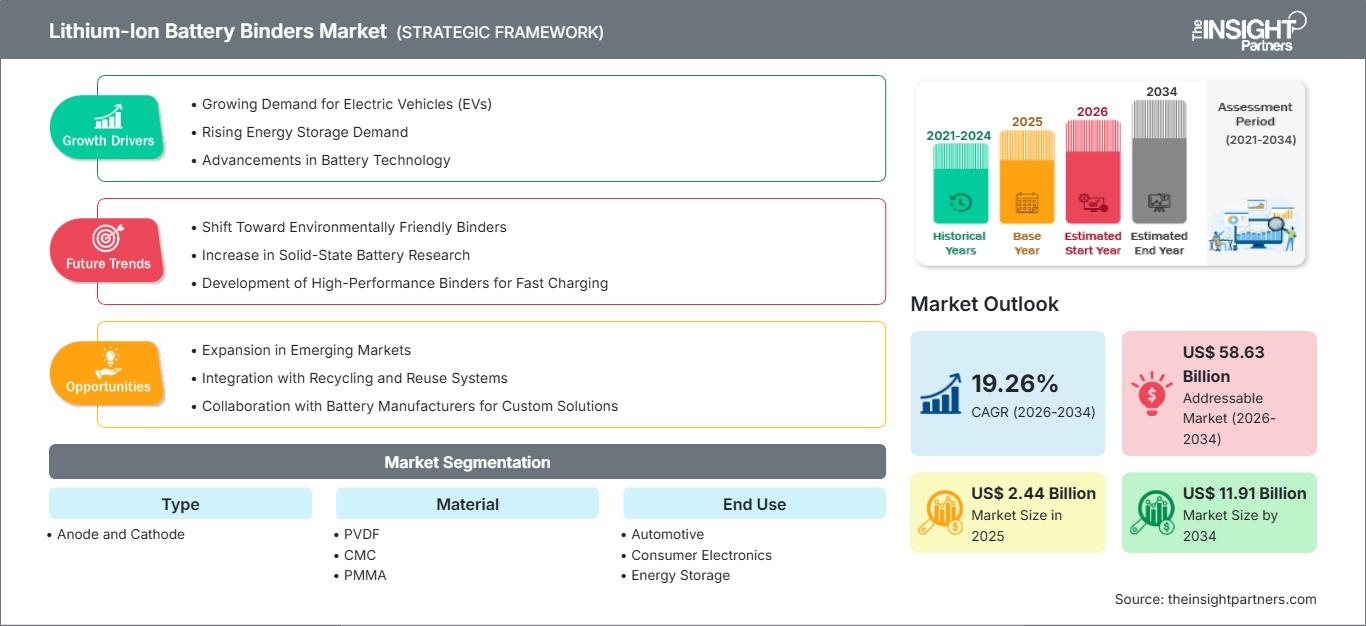
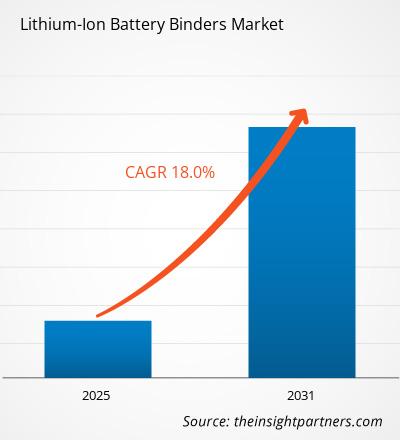
The lithium-ion battery binders market was valued at US$ 2.44 Billion in 2025 and is projected to reach US$ 11.91 Billion by 2034, expanding at a CAGR of 19.26% during 2026–2034. The market will benefit from advances in battery technology, higher volumes of electric vehicle manufacturing, and growing investments in stationary energy storage solutions. Ongoing innovations in binder technology which enhance electrode adherence, cycle performance, and manufacturing are improving commercialization in both automotive, consumer electronics, and industrial batteries.
North America remains well positioned with efforts to manufacture batteries domestically, local supply chains, and clean energy policies. The lithium-ion battery binders market size is expanding steadily across the region as investments in gigafactories, battery recycling infrastructure, and advanced material production increase. The regional market is anticipated to register a CAGR of 17.5–18.8% during 2026–2034, supported by rising demand from electric mobility and grid-scale energy storage projects.
Lithium-Ion Battery Binders Market Assessment and Insights
- North America: Accounted for 28–32% share in 2025 and is expected to expand at a CAGR of 17.5–18.8% during 2026–2034. Regional growth is supported by expanding battery manufacturing capacity, federal incentives for clean energy technologies, and increasing localization of critical battery material supply chains.
- U.S.: Represented 74–78% of the North American lithium-ion battery binders market in 2025 and is projected to grow at a CAGR of 17.8–19.0% during 2026–2034. Strong investments in electric vehicle battery plants and advanced electrode material manufacturing continue to support long-term expansion.
- Europe: Held 24–28% share in 2025 and is anticipated to register a CAGR of 18.2–19.5% during 2026–2034. Germany, France, Sweden, and the UK remain leading contributors owing to battery manufacturing investments and stringent vehicle electrification policies.
- Asia Pacific: Accounted for 38–42% share in 2025 and is forecast to grow at a CAGR of 20.2–21.5% during 2026–2034. China, Japan, South Korea, and India continue to dominate regional demand through integrated battery supply chains and expanding electric mobility production.
- Largest Segment: Cathode accounted for 56–60% lithium-ion battery binders market share in 2025 and is expected to grow at a CAGR of 18.8–20.0% during 2026–2034, supported by increasing production of high-energy-density battery chemistries.
- High Growth Segment: Energy Storage represented 18–22% market share in 2025 and is projected to record the fastest CAGR of 21.5–22.8% during 2026–2034, driven by accelerating deployment of renewable energy storage systems and utility-scale battery projects.
- Key companies analyzed in detail: Arkema SA, Syensqo SA, LG Chem Ltd., ENEOS Corporation, ZEON Corporation, Ashland Inc., BASF SE, Daikin Industries, Ltd., DuPont de Nemours, Inc., and Kureha Corporation.
Source: The Insight Partners' analysis based on proprietary research, government publications, company annual reports, investor presentations, industry databases, and expert interviews.
There have been significant advancements in electrode materials engineering in an effort by the battery manufacturers to achieve greater energy densities, long cycle life, and enhanced safety measures. The current state of binders is evolving from traditional formulas to advanced polymer binders that maintain structural stability even when exposed to rigorous electrochemical environment. There has been more emphasis on using aqueous binders, optimal slurries rheology and suitability to silicon-anode materials.
More investments in battery manufacturing plants in North America, Europe, and Asia-Pacific regions are expected to change the dynamics of production over the next ten years. With government initiatives to develop localized supply chains for batteries and the rise in commercialization of advanced lithium-ion chemistries, the conditions become conducive for material suppliers. Moreover, more collaborations are expected to take place among battery manufacturers, chemical firms, and research institutions.
Lithium-Ion Battery Binders Market Report Scope
| Report Attribute | Details |
|---|---|
| Market size in 2025 | US$ 2.44 Billion |
| Market Size by 2034 | US$ 11.91 Billion |
| Global CAGR (2026 - 2034) | 19.26% |
| Historical Data | 2021-2024 |
| Forecast period | 2026-2034 |
Lithium-Ion Battery Binders Market Analysis
The rapid expansion of electric mobility, renewable energy integration, and portable electronic devices continues to support lithium-ion battery binders market growth worldwide. Binders in batteries serve a critical function in terms of holding the electrodes together, ensuring better pathways for conductivity and increasing cycling stability in the charging process. As companies opt for silicon anodes and high nickel cathodes, the need for sophisticated binders that can handle volume changes is rising. At the same time, investments in local production of raw materials and battery manufacturing are making supply chains more robust while minimizing dependency on imported specialty chemicals.
In the value chain of batteries, specialty chemical suppliers work closely with battery cell makers, electrode suppliers and research institutions to improve binders' formulas for new types of batteries. Technological innovations in polymers, solvent elimination techniques and aqueous processes enhance manufacturing efficiency and help comply with environmental regulations.
Differences from competitors are becoming more important due to the product innovations, strategic alliances, economies of scale, and supply chains that are integrated regionally. Based on the analysis of lithium-ion battery binders market, one can state that material producers keep increasing production capacity by developing binder solutions for fast-charging batteries, high capacity silicon anodes, and new generation cathode materials. In addition, there are some efforts in research that are oriented toward improving electrolyte compatibility, thermal stability, and cycle performance requirements in batteries.
Major players such as Arkema SA, Syensqo SA, LG Chem Ltd., ENEOS Corporation, ZEON Corporation, Ashland Inc., BASF SE, Daikin Industries, Ltd., DuPont de Nemours, Inc., and Kureha Corporation remain competitive by implementing their innovative product development, strategic alliance, license technology, and capacity expansion. The companies pay much attention to sustainable manufacturing, high-performance polymer science, and strategic relationships with the battery manufacturers.
● REPORT CUSTOMIZATION
Tailor This Report To Align With Your Specific Business Requirements
This report can be customized to align precisely with your business objectives, scope, and target markets. Customization options include tailored segmentation, geography, competitive analysis, and strategic insights to support informed decision-making.
Customize This Report →WHAT YOU CAN ADJUST
- ● Segmentations
- ● Geography
- ● Competitive Analysis
- ● Language Preferences
Lithium-Ion Battery Binders Market: Strategic Insights
Regional Insights
North America Lithium-Ion Battery Binders Market
North America accounted for 28–32% of the global market in 2025 and is projected to expand at a CAGR of 17.5–18.8% during 2026–2034. The lithium-ion battery binders market share in the region continues to strengthen with growing investments in domestic battery manufacturing, increasing localization of critical material supply chains, and supportive government incentives encouraging clean energy technologies. Expansion of gigafactories across the United States and Canada is creating sustained demand for advanced electrode materials and specialty binder formulations.
Sustainable production techniques have become more and more important for regional manufacturers; these include water-based binders and fluorine-free materials as per changing environmental regulations. The collaboration among battery makers, chemical makers, and research organizations is speeding up the adoption of high-performance binders that can accommodate silicon-rich anode and high-nickel cathode batteries.
U.S. Lithium-Ion Battery Binders Market
The U.S. represented 74–78% of the North American market in 2025 and is anticipated to grow at a CAGR of 17.8–19.0% during 2026–2034. Federal incentives supporting domestic battery manufacturing, combined with substantial investments in electric vehicle production and stationary energy storage systems, continue to reinforce national demand for advanced battery materials. Increasing battery cell manufacturing capacity is also encouraging localized procurement of binder materials and specialty polymers.
Key chemical suppliers and battery makers have enhanced their local production capacities using long-term supply deals and collaborative research initiatives. Increasing use of battery chemistries offering high capacities for various industries such as automobiles, consumer goods, and industries is likely to spur innovations in polymers, which help in improving the electrode’s longevity and charging ability.
Europe Lithium-Ion Battery Binders Market
Europe constituted 24–28% of the global market share in 2025 and will maintain a CAGR of 18.2–19.5% from 2026 to 2034. Germany is the dominant country regionally because of the already existing automotive industry base, growing gigafactories, and considerable investments in advanced battery materials. Government-led industrial policies and sustainability policies are still encouraging regional production of the lithium-ion batteries' component parts.
In the UK, more investments are being made into battery innovations and recycling technology and next-generation cells manufacturing. France continues backing the development of the battery value chain through industrial partnerships, while Italy and Spain increase involvement in the production of EVs and energy storage systems. These countries together are helping to make Europe competitive through localized production and advanced battery material development.
APAC Lithium-Ion Battery Binders Market
Asia Pacific held the major share of 38-42% in the total market size in 2025 and will record the highest regional CAGR of 20.2-21.5% during 2026-2034. China is at the top of regional consumption because of huge battery production facilities, whereas Japan and South Korea dominate the global scene in innovative battery materials.
India and Australia are emerging as potential regions with increased investments in electric vehicles, mining of critical minerals, and manufacturing of batteries within the country.
Middle East & Africa Lithium-Ion Battery Binders Market
Middle East & Africa is likely to see consistent growth in the forecast period with an increase in investments in clean energy infrastructure and battery-assisted renewable energy projects. The regional market is likely to grow at a CAGR of 15.8–17.0% in 2026–2034 due to gradual diversification and electrification efforts.
Both Saudi Arabia and UAE have been focusing on manufacturing and energy transition projects whereas South Africa has been benefiting from its mineral resources to drive battery material chains. Deployment of renewable energy projects along with infrastructure modernization in Rest of MEA will provide more opportunities to advanced battery material providers.
Segmentation Analysis
Type
The Type segment is expected to record a CAGR of 19.0–20.2% during 2026–2034. The lithium-ion battery binders market scope continues to expand as electrode manufacturers increasingly adopt specialized binder formulations tailored for anode and cathode performance requirements. Continuous improvements in electrode durability, mechanical strength, and electrochemical stability are encouraging wider adoption of advanced polymer binders across electric vehicles, energy storage systems, and high-performance consumer electronics.
- Anode: Demand is increasing with the adoption of silicon-enhanced and graphite-based anodes requiring flexible binders capable of accommodating volume expansion while maintaining electrode integrity during repeated charging and discharging cycles.
- Cathode: Cathode binders remain strategically important because they improve adhesion, chemical stability, and long-term cycling performance in high-energy-density battery chemistries used across automotive and stationary energy storage applications.
Material
The Material segment is anticipated to grow at a CAGR of 19.5–20.8% during 2026–2034. Material innovation remains a critical competitive factor as manufacturers balance electrochemical performance, environmental compliance, processing efficiency, and production cost. Growing preference for water-based processing and sustainable manufacturing technologies is driving continuous development of next-generation binder materials.
- PVDF: Widely utilized due to its excellent chemical resistance, thermal stability, and compatibility with high-performance cathode materials, making it a preferred choice for premium lithium-ion battery manufacturing.
- CMC: Increasingly adopted for anode applications because of its water-based processing capability, strong adhesion characteristics, and contribution to environmentally sustainable electrode manufacturing processes.
- PMMA: Offers desirable mechanical properties and enhanced electrode stability, supporting specialized battery applications requiring improved structural integrity and long operational life.
- SBR: Frequently combined with CMC in anode formulations to improve flexibility, adhesion strength, and cycling durability while supporting efficient large-scale manufacturing operations.
End Use
The End Use segment is projected to expand at a CAGR of 20.0–21.3% during 2026–2034 as electrification accelerates across transportation, industrial operations, portable electronics, and renewable energy storage. Increasing battery production capacity worldwide continues supporting long-term demand for advanced binder materials capable of meeting evolving performance requirements.
- Automotive: Represents the largest consumption segment as electric vehicle manufacturers continue increasing battery production capacity, emphasizing higher energy density, extended driving range, and improved battery safety.
- Consumer Electronics: Maintains consistent demand through ongoing innovation in smartphones, laptops, tablets, wearable devices, and other portable electronic products requiring compact, high-performance batteries.
- Energy Storage: Utility-scale battery installations and renewable energy integration are accelerating adoption of advanced binder materials supporting long-duration storage, high cycling performance, and operational reliability.
- Industrial: Industrial equipment, material handling systems, backup power solutions, and specialized machinery continue expanding battery utilization, creating sustained opportunities for durable electrode binder technologies.
Opportunity Snapshot
| End Use | Revenue Contribution | Trend Tag | Adoption Stage |
| Automotive | High | EV Batteries | Mature |
| Consumer Electronics | Medium | Portable Devices | Mature |
| Energy Storage | High | Grid Storage | Scaling |
| Industrial | Medium | Material Handling | Emerging |
Lithium-Ion Battery Binders Market Growth Drivers and Impact Analysis
Expansion of Global Electric Vehicle Battery Manufacturing
Electrification of personal and commercial transportations is leading to an increase in the need for highly effective electrodes which includes highly efficient binders. The government of North America, Europe, and Asia Pacific is still encouraging domestic battery production by way of production incentives, localization and investment in critical mineral supply chain. Meanwhile, battery producers are ramping up gigafactory capacity to ensure a steady supply of batteries for electric cars in order to get the binders which can provide enhanced adhesion, mechanical strength and better cycle life. This scenario is prompting chemical companies to come up with new polymer formulations that are enabling rapid charging, increased energy density and better manufacturing efficiency. The trend of increasing battery production is likely to help them gain a competitive advantage in the coming years.
Growing Adoption of Renewable Energy Storage Systems
Large battery energy storage systems have become a vital part of contemporary electric grids due to growth in renewable energy production across the globe. Solar and wind energy projects need efficient energy storage solutions which will be able to operate stably throughout many charge and discharge cycles. The necessity leads to greater demands on binder materials which will guarantee electrodes' stability under continuous use. Upgrading of grids, decentralized power production, and development of energy storage projects create new prospects for manufacturers of battery materials. On the other hand, state policy which stimulates renewable energy production and ensures energy security results in increased deployment of high capacity lithium-ion batteries.
Advancements in High-Energy Battery Chemistries
The industry participants are working towards the commercialization of silicon-based anodes, nickel-rich cathodes, and other advanced chemistries that would help boost the energy density and charging ability. The advanced generation of the electrodes would be subjected to higher levels of mechanical stress due to which the importance of the binders becomes all the more important. Hence, the material producers are making huge investments in research in order to produce binders that would have increased elasticity, thermal stability, electrolyte compatibility, and processability. The innovations taking place in the field of polymer chemistry have helped the manufacturers to prolong the battery life by limiting the degradation of the electrodes.
Lithium-Ion Battery Binders Market Future Trends
Transition Toward Sustainable Water-Based Binder Technologies
With environmental regulation and sustainable initiatives playing their part, battery manufacturers are shifting from solvent-based manufacturing techniques to the use of water-based binders technology as far as possible. The lithium-ion battery binders market trends are more aligned with the industry’s preference for eco-friendly manufacturing that would help minimize the release of volatile organic compounds in the atmosphere along with reducing production cost. Suppliers of material are still working on making new formulations of aqueous binders that provide equal strength and stability to conventional materials.
Integration of Artificial Intelligence in Battery Material Development
There is tremendous potential that artificial intelligence and digital materials engineering can bring to R&D processes within the battery materials industry. Due to advanced computer modeling, researchers will be able to assess properties of polymers, develop binder systems, and determine their electrochemical characteristics before conducting any physical laboratory tests. These methods decrease time required for R&D processes and cut down expenses related to experiments. Moreover, digital manufacturing allows predicting quality and optimizing processes in order to provide better consistency during production. In the course of further development, AI-assisted materials development is likely to become a major competitive advantage of specialty chemical companies.
Lithium-Ion Battery Binders Market Opportunities
Expansion of Localized Battery Material Manufacturing Ecosystems
Governments and individual investors are now backing the development of battery supply chains locally in order to decrease dependency on imports and increase industrial resilience. The lithium-ion battery binders market forecasts show that there will be constant investment opportunities for specialty chemical companies producing their products regionally near gigafactories for batteries. Regional production helps save transport costs, shorten delivery times, and promote cooperation between chemical providers and manufacturers of batteries. Those companies that will be able to provide research and technical assistance along with their production in the regions of battery plants are likely to get long-term supply contracts.
Commercialization of Next-Generation Silicon-Dominant Batteries
There are many promising chances for suppliers who produce binders because of silicon-enriched and silicon-based anode materials used in batteries which need special polymers that will allow volume expansion while charging the batteries. Suppliers who are producing their own special binders with flexibility and adhesion properties will be able to differentiate themselves from other companies because of the growing popularity of the new batteries by automobile manufacturers. The strategic collaboration between suppliers of the binders and automobile manufacturers as well as battery researchers will speed up the commercialization process of the new batteries.
Recent Developments
- June 2026: Arkema successfully started up its 15% PVDF capacity expansion in North America. This capacity expansion in Calvert City, Kentucky, strengthens the Group’s leadership in PVDF. This investment of around 20 million US dollars will support the growing demand for energy storage systems and semiconductors, as well as data center rapid expansion.
- June 2026: Reliance Industries expanded its renewable energy efforts by increasing the battery capacity targets threefold and bagging a huge $3 billion contract to export green ammonia. Thus, India has established itself as a key player in the renewable energy space.
Frequently Asked Questions

- Comprehensive Market Sizing and Forecast Analysis
- Detailed Segmentation Analysis
- In-Depth Market Dynamics Assessment
- Regional and Country-Level Insights
- Competitive Landscape and Company Benchmarking
- Strategic Business Intelligence
Recent Reports
Testimonials

The Insight Partners' SCADA System Market report is comprehensive, with valuable insights on current trends and future forecasts. The team was highly professional, responsive, and supportive throughout. We are very satisfied and highly recommend their services.
RAN KEDEM Partner, Reali Technologies LTDs
I requested a report on a very specific software market and the team produced the report in a few days. The information was very relevant and well presented. I then requested some changes and additions to the report. The team was again very responsive and I got the final report in less than a week.
JEAN-HERVE JENN Chairman, Future Analytica
We worked with The Insight Partners for an important market study and forecast. They gave us clear insights into opportunities and risks, which helped shape our plans. Their research was easy to use and based on solid data. It helped us make smart, confident decisions. We highly recommend them.
PIYUSH NAGPAL Sr. Vice President, High Beam Global
The Insight Partners delivered insightful, well-structured market research with strong domain expertise. Their team was professional and responsive throughout. The user-friendly website made accessing industry reports seamless. We highly recommend them for reliable, high-quality research services
YUKIHIKO ADACHI CEO, Deep Blue, LLC.
This is the first time I have purchased a market report from The Insight Partners.While I was unsure at first, I visited their web site and felt more comfortable to take the risk and purchase a market report.I am completely satisfied with the quality of the report and customer service. I had several questions and comments with the initial report, but after a couple of dialogs over email with their analyst I believe I have a report that I can use as input to our strategic planning process.Thank you so much for taking the extra time and making this a positive experience.I will definitely recommend your service to others and you will be my first call when we need further market data.
JOHN SUZUKI President and Chief Executive Officer, Board Director, BK Technologies
I wish to appreciate your support and the professionalism you displayed in the course of attending to my request for information regarding to infectious disease IVD market in Nigeria. I appreciate your patience, your guidance, and the fact that you were willing to offer a discount, which eventually made it possible for us to close a deal. I look forward to engaging The Insight Partners in the future, all thanks to the impression you have created in me as a result of this first encounter.
DR CHIJIOKE ONYIA MANAGING DIRECTOR, PineCrest Healthcare Ltd.Reason to Buy
- Informed Decision-Making
- Understanding Market Dynamics
- Competitive Analysis
- Identifying Emerging Markets
- Customer Insights
- Market Forecasts
- Risk Mitigation
- Boosting Operational Efficiency
- Strategic Planning
- Investment Justification
- Tracking Industry Innovations
- Aligning with Regulatory Trends





 Get Free Sample for