
熱交換器市場:予測、動向、市場シェアレポート
熱交換器市場規模と予測(2021年~2034年)、世界および地域別シェア、トレンド、成長機会分析レポート 対象範囲:タイプ別(シェルアンドチューブ式、プレートアンドフレーム式、空冷式、その他)、用途別(石油・ガス、発電、HVAC・冷凍、化学、食品・飲料、その他)、地域別(北米、欧州、アジア太平洋、南米・中米)
- ステータス : 公開されたデータ
- レポートコード : TIPRE00006221
- カテゴリー : エレクトロニクスおよび半導体
- ページ数 : 150
- 利用可能なレポート形式 :


- 最終更新日 : September 10, 2026


2025 Market Size
US$ 21.92 Bn
Base year value
2034 Forecast
US$ 32.31 Bn
Projected by 2034
CAGR 2026-2034
4.41 %
Growth rate
Addressable Market
US$ 246.31 Bn
(2026-2034)
The global Heat Exchangers market was valued at US$ 21.92 billion in 2025 and is expected to reach US$ 32.31 billion by 2034; it is estimated to record a CAGR of 4.41% during 2026-2034.
Heat Exchangers Market Assessment and Insights
- North America: North America held 20–22% share in 2025 and is expected to grow at a 4.4–4.8% CAGR during 2026–2034, supported by industrial replacement, energy infrastructure, advanced refrigeration, and data-center cooling requirements.
- US: The US represented 82–85% of North American demand in 2025 and is forecast to expand at a 4.5–4.9% CAGR through 2034, led by industrial, energy, and cooling applications.
- Europe: Europe accounted for 24–26% share in 2025 and is projected to register a 4.3–4.7% CAGR, with Germany, the UK, France, Italy, and Spain supporting efficiency upgrades and industrial modernization.
- Asia Pacific: Asia Pacific represented 30–32% share in 2025 and is projected to grow at a 5.4–5.8% CAGR, led by China, Japan, South Korea, India, and Australia across industrial and infrastructure applications.
- Largest Segment: Shell and Tube represented a 40–42% market share in 2025 and is forecast to grow at a 5.4–5.8% CAGR through 2034, retaining leadership in demanding process duties.
- High Growth Segment: Plate and Frame accounted for 26–29% share in 2025 and is expected to register a 6.0–6.5% CAGR, supported by compact designs and high thermal effectiveness.
- Key companies analyzed in detail: Aggreko plc, Alfa Laval AB, API Heat Transfer, Cummins Inc., Danfoss A/S, Doosan Corporation, GEA Group AG, IHI Corporation, Kelvion Holding GmbH, Xylem Inc.
Source: The Insight Partners' analysis based on proprietary research, government publications, company annual reports, investor presentations, industry databases, and expert interviews.
Heat Exchangers Market trends away from standard thermal equipment to custom-engineered applications focusing on compactness, servicability, energy efficiency, and material compatibility. Shell-and-tube arrangements continue to be important for high-pressure applications, while plate-type solutions become popular in applications where space-saving and cleaning needs play an important role. Processed technologies include automation of fabrication process, metallurgy development, computational engineering, and enhanced quality control, enabling manufacturers to fine-tune thermal duty, pressure drop, fouling protection, and lifetime performance.
Future development of heat exchangers will become more related to developing economies, electrification, heat recovery, and infrastructural needs for high-efficiency cooling. Pressure on regulatory bodies on energy efficiency and environmental protection could enhance the economic case for heat recovery projects and replacement of thermal equipment. In addition, manufacturers start building up regional manufacturing and servicing capabilities to shorten the delivery time. Such developments are expected to create favorable conditions for ongoing investments in process equipment and encourage customers to assess their thermal resources based on total cost of ownership rather than initial price.
Heat Exchangers Market Report Scope
| Report Attribute | Details |
|---|---|
| Market size in 2025 | US$ 21.92 Billion |
| Market Size by 2034 | US$ 32.31 Billion |
| Global CAGR (2026 - 2034) | 4.41% |
| Historical Data | 2021-2024 |
| Forecast period | 2026-2034 |
Heat Exchangers Market Analysis
Heat Exchangers Market depends significantly on capital spending in the oil & gas, power generation, chemicals, HVAC and refrigeration, and food processing industries. Demand is driven by engineering specifications with respect to heat duty, pressure, temperatures, fluids used, risk of corrosion, potential for fouling, pressure drop and maintenance. Then the supply chain includes manufacturers of materials, fabricators, engineering companies, installers, commissioning engineers, and aftermarket services.
The supply chain considerations will be based on the availability of tubing, plates, frames, seals, fans, forgings, specialized alloys, and manufacturing processes. Specialized alloys, such as stainless steel, duplex steel, nickel alloys, and coatings are applied for the purpose of operating in difficult conditions, while ordinary alloys will result in faster deliveries. Purchase decisions will take into account energy efficiency, maintenance, cleaning schedules, and spare parts availability.
The Heat Exchangers Market Report shows a competitive environment based on distinctions in competency in thermal engineering, range of products, production capacities, applications, geography, and after-sales services. Alfa Laval AB and Danfoss A/S have good positions in the markets of compact and plate heat exchangers, while Kelvion Holding GmbH specializes in custom thermal engineering. API Heat Transfer, GEA Group AG, IHI Corporation, and Xylem Inc. provide customized industrial heat exchangers, while Aggreko plc, Cummins Inc., and Doosan Corporation operate in this field within their wider portfolios of equipment and services related to energy production.
Investments in thermal engineering solutions, localized production, configurability, materials, and specialization in cooling are gaining increasing importance. Positioning occurs through retrofits, condition monitoring, service agreements, and replacement programs. Competitive advantage comes from the combination of platform standardization and application customization. Companies that can expedite the engineering process without jeopardizing certification and quality service will perform better in projects and in industrial businesses.
● REPORT CUSTOMIZATION
Tailor This Report To Align With Your Specific Business Requirements
This report can be customized to align precisely with your business objectives, scope, and target markets. Customization options include tailored segmentation, geography, competitive analysis, and strategic insights to support informed decision-making.
Customize This Report →WHAT YOU CAN ADJUST
- ● Segmentations
- ● Geography
- ● Competitive Analysis
- ● Language Preferences
Heat Exchangers Market:
要件に合わせてレポートをカスタマイズ
レポートの一部、国レベルの分析、Excelデータパックなどを含め、スタートアップ&大学向けに特別オファーや割引もご利用いただけます(無償)
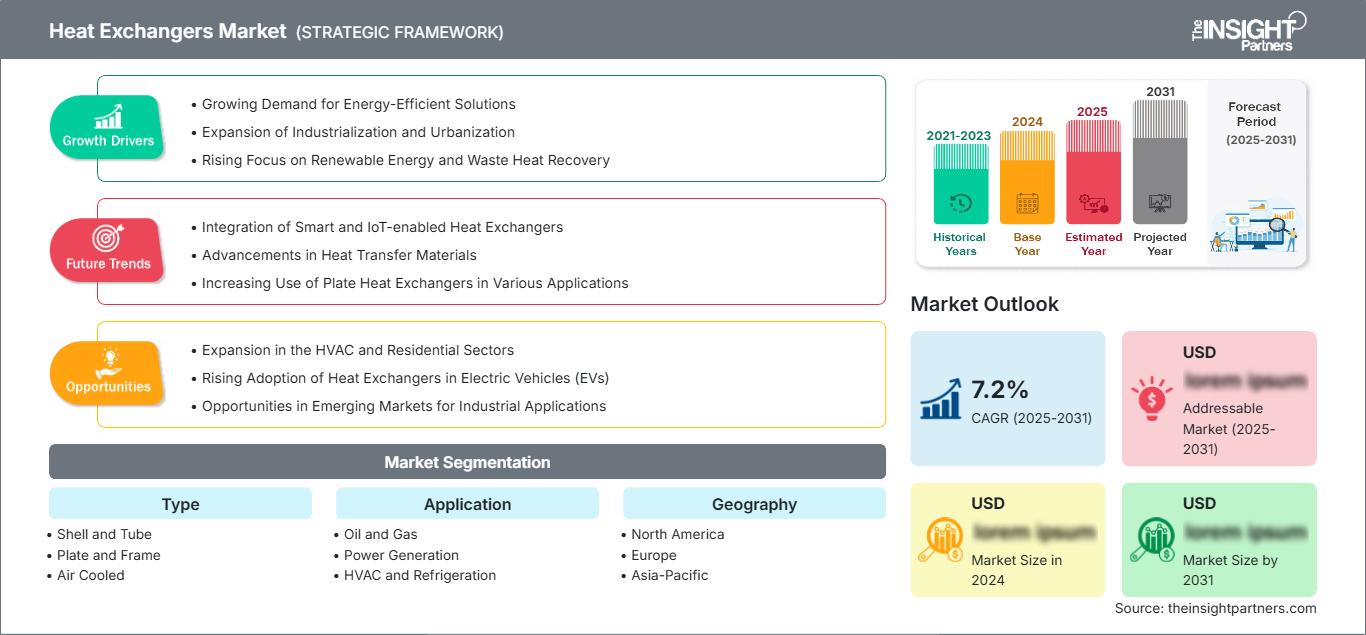
熱交換器市場: 戦略的洞察
-
このレポートの主要な市場動向を入手してください。この無料サンプルには、市場動向から見積もりや予測に至るまでのデータ分析が含まれます。
Regional Insights
North America Heat Exchangers Market
North America had a 20-22% share in 2025 and is expected to grow at a 4.4-4.8% CAGR until 2034. US holds most of the regional demand while Canada contributes to other demands in energy, mining, food processing, and industrial sectors. Refining, natural gas transmission systems, chemicals, electricity generation and commercial cooling provide opportunities for replacement and new installations. Building new data centers creates an additional demand for liquid and facility cooling systems.
The Heat Exchangers Market share in North America is also fueled by modernization of existing machinery and consideration of the energy intensity of the equipment. Increasingly, operators need equipment with lower pressure drop, heat recovery, resistance to corrosion and serviceability. Demand is highest where thermal equipment impacts the continuity of production or building operation. Regional demand prefers equipment providers that offer regional engineering, manufacturing, installation, testing and spare parts as procurement is directly related to economic performance.
U.S. Heat Exchangers Market
The US constituted 82-85% of the North American consumption in 2025, and is estimated to register a growth of 4.5-4.9% CAGR until 2034. Some of the main application areas are refining, LNG, chemicals, power generation, HVAC, refrigeration, food processing, and data centers. Replacement demand will continue to remain high since there will always be a need for maintenance and thermal performance optimization of already established industrial plants.
Companies in operation include Cummins Inc., Danfoss A/S, API Heat Transfer, Xylem Inc., and Aggreko plc. In terms of equipment size, corrosion resistance, control and ability to handle varying loads, smaller equipment is being preferred by customers. The growing demand for liquid cooling systems due to the construction of new data centers and decarbonization of industries is adding to the demand for thermal fluid heaters.
Europe Heat Exchangers Market
Europe held 24–26% share in 2025 and is expected to register a 4.3–4.7% CAGR through 2034. Germany is the leading country, followed by the UK, France, Italy, and Spain. Regional demand is supported by industrial modernization, district energy, energy-efficiency measures, process electrification, and replacement of aging equipment. The Heat Exchangers Market combines mature installed-base demand with emerging opportunities in industrial heat recovery.
There are significant standards that are available in Germany for chemicals, machinery, food processing, power, and manufacturing. UK will gain from modernization of energy infrastructure, district heating, commercial HVAC systems, and industrial projects. France combines power sector standards with industrial processes. There are good HVAC, refrigeration, food processing, and manufacturing standards in Italy. Spain gets its support from food production, industrial cooling, energy infrastructure, and modernization of commercial buildings.
APAC Heat Exchangers Market
APAC accounted for 30–32% market share in 2025 and is expected to grow at a CAGR of 5.4–5.8% during 2034, which makes it the largest regional market. The largest regional markets include China, Japan, South Korea, India, and Australia. Demand is driven by capacity expansion, manufacturing, chemical production, refining, power generation, and HVAC applications.
Policies promoting industrial efficiency, infrastructure, urbanization, and energy transition contribute to rising demand. China leads the pack in terms of country markets, while India is witnessing growth in the areas of refining, petrochemicals, food processing, power generation, and commercial refrigeration. Japan and South Korea have a concentration on manufacturing and efficiency. On the other hand, Australia has demand drivers in mining, LNG, energy, and infrastructure projects.
Middle East & Africa Heat Exchangers Market
The Middle East and Africa segment is forecasted to grow with a 5.2-5.6% CAGR until 2034. The demand drivers in the region include Saudi Arabia, the UAE, and South Africa. The key application markets are refinery, petrochemical, power generation, desalination, mining, and infrastructure projects.
The climate conditions in the area have an effect on the specifications of the equipment that need to be used for the process. Saudi Arabia and the UAE have large energy and infrastructure spending in the country. South Africa makes its contribution to the demand with the mining and power market.
Segmentation Analysis
Type
Type segment in the Heat Exchangers Market remains a critical selection criterion because pressure, temperature, fouling, footprint, fluid compatibility, and maintenance requirements vary considerably between applications. The segment is expected to grow at a 4.8–5.2% CAGR during 2026–2034. Shell and tube retains broad industrial acceptance, while plate and frame gains importance where compactness, efficiency, and accessibility provide operational advantages.
- Shell and Tube: This configuration retains the strongest position in large process installations because of pressure tolerance, broad temperature capability, established engineering practices, and suitability for oil and gas, power, and chemical services.
- Plate and Frame: Compact construction, high thermal effectiveness, modular capacity, and convenient plate access support adoption in HVAC, refrigeration, food processing, and industrial duties requiring frequent inspection or cleaning.
- Air Cooled: Air-cooled systems are strategically important where cooling-water availability is constrained, particularly in refineries, petrochemical plants, power installations, and arid industrial environments requiring reduced water dependence.
Application
Application segment in the Heat Exchangers Market demand spans energy, process industries, building services, refrigeration, and food manufacturing. The segment is expected to expand at a 5.0–5.4% CAGR during 2026–2034. Thermal equipment is integral to heating, cooling, condensation, evaporation, and recovery operations, making application conditions central to product selection and engineering specifications.
- Oil and Gas: Refining, gas processing, LNG, and petrochemical facilities require durable thermal systems for condensation, cooling, heating, separation, and recovery duties across continuous operations.
- Power Generation: Power facilities use heat exchangers for steam-cycle cooling, auxiliary systems, feedwater applications, and thermal integration where reliability and controlled heat transfer are essential.
- HVAC and Refrigeration: Commercial buildings, industrial facilities, supermarkets, and cold-chain infrastructure favor compact equipment that improves thermal performance while accommodating refrigerant changes and variable operating loads.
- Chemical: Chemical producers require application-specific equipment capable of handling corrosive fluids, elevated temperatures, pressure variation, and contamination controls across diverse production stages.
- Food and Beverage: Hygienic construction, cleanability, compatible materials, and dependable temperature control make heat exchangers important for pasteurization, brewing, dairy, beverage, and related processing operations.
Opportunity Snapshot
|
Application |
Revenue Contribution (High/Medium/Low) |
Trend Tag (MAX 2 words) |
Adoption Stage (Emerging/Scaling/Mature) |
|
Oil and Gas |
High |
Refinery Upgrades |
Mature |
|
Power Generation |
High |
Thermal Recovery |
Mature |
|
HVAC and Refrigeration |
High |
Efficient Cooling |
Scaling |
|
Chemical |
High |
Process Integration |
Mature |
|
Food and Beverage |
Medium |
Hygienic Processing |
Scaling |
|
Others |
Medium |
Industrial Retrofit |
Scaling |
Heat Exchangers Market Growth Drivers and Impact Analysis
Industrial Energy Efficiency Is Raising Thermal Recovery Priorities
Industrial operators increasingly evaluate thermal equipment through lifecycle economics rather than purchase price alone. Heat recovery can reduce externally supplied energy where hot and cold process streams can be integrated, improving operating economics in refining, chemicals, food processing, and power applications. This is encouraging replacement of inefficient or degraded equipment with better-matched systems. Purchasing decisions increasingly consider thermal effectiveness, pressure-drop management, fouling behavior, materials, and expected service life. The impact extends across the value chain because equipment manufacturers can differentiate through engineering, monitoring, and retrofit capability. For end users, measurable reductions in energy use and maintenance exposure can strengthen replacement cases even where production capacity is unchanged. Consequently, efficiency-led projects can provide a recurring source of demand alongside greenfield industrial investment and capacity expansion.
Industrial Electrification Is Expanding Heat-Pump-Linked Applications
Electrification is creating new opportunities for heat exchangers in the field of industrial heat pumps, commercial heating, refrigeration, and process energy applications. In order for the system operator to become less reliant on combustion, the thermal equipment needs to transfer energy in a highly efficient way regardless of changing working conditions. The plate design offers a number of benefits in packaged systems, as it is compact yet effective. The use of refrigerant will influence the specifications through the need for different pressure and temperature ratings, as well as materials. The Heat Exchangers Market is therefore broadened to cover the construction of buildings, cold chains, supermarkets, and industrial heat pump applications. Heat exchangers will have to be integrated with compressors, pumps, valves, controls, and refrigerants.
Data-Center Expansion Is Creating High-Performance Cooling Demand
Data-center expansion is creating a specialized cooling requirement characterized by high heat density, continuous operation, limited downtime tolerance, and stringent energy-performance objectives. Liquid cooling is gaining importance as computing loads rise, requiring compact heat exchangers within cooling distribution units and facility water loops. Procurement emphasizes low pressure drop, temperature stability, redundancy, serviceability, and predictable performance. This application differs from many traditional industrial markets because thermal equipment directly affects digital infrastructure availability and electricity consumption. Suppliers with scalable manufacturing, proven cooling technologies, and monitoring capabilities can target a differentiated infrastructure niche. Existing facilities also provide retrofit potential as processor density increases and cooling architectures are upgraded. The opportunity therefore includes both greenfield installations and modernization of operating data centers, creating a broader equipment pipeline than new construction alone.
Heat Exchangers Market Future Trends
Digital Thermal Monitoring Will Move Toward Predictive Maintenance
Heat Exchangers Market trends are likely to include greater deployment of sensors, connected controls, and analytical software that track temperature differences, pressure drop, flow behavior, and fouling indicators. Operators can use these measurements to identify declining performance and schedule maintenance according to actual equipment condition rather than fixed intervals. Digital models may support remote commissioning, performance benchmarking, fault detection, and comparison of assets across multiple facilities. Adoption should be strongest among operators managing geographically distributed equipment where inspection costs and downtime risks are high. Over time, condition-based service could become a meaningful differentiator for suppliers because software-enabled monitoring creates recurring customer interaction after installation. Manufacturers may also use aggregated operating data to improve future designs, optimize maintenance recommendations, and identify recurring failure modes across application environments.
Advanced Materials Will Support More Severe Operating Environments
Material development is expected to become more important as equipment encounters higher temperatures, corrosive fluids, alternative fuels, and demanding process chemistries. Nickel alloys, duplex stainless steels, protective coatings, improved joining methods, and specialized surface treatments can extend operating envelopes where conventional materials face corrosion or fatigue limitations. Hydrogen, carbon capture, advanced chemical processing, and high-efficiency power systems may introduce additional compatibility requirements. Manufacturers must nevertheless balance performance benefits against material cost, fabrication complexity, and supply availability. Computational engineering can assist material selection by evaluating temperature gradients, stress concentration, corrosion exposure, and expected service life before fabrication. This trend should increase collaboration among equipment manufacturers, material suppliers, EPC contractors, and end users during specification. It may also create opportunities for specialized suppliers with expertise in severe-service applications.
Heat Exchangers Market Opportunities
Localized Manufacturing Can Improve Project Responsiveness
Localized manufacturing represents an attractive opportunity for suppliers seeking shorter delivery cycles, lower logistics exposure, and stronger aftermarket coverage in industrial growth markets. Regional fabrication, assembly, testing, and service capabilities can improve responsiveness when customers require customized equipment or rapid replacement components. India, Southeast Asia, the Middle East, and selected Latin American economies offer opportunities because industrial capacity and infrastructure are expanding simultaneously. Localization can also support domestic procurement requirements and relationships with EPC contractors. The strongest models are likely to combine standardized global engineering with regionally adapted production and service. This approach preserves design consistency while improving access to local materials, certification processes, labor, and customer specifications. Heat Exchangers Market Forecasts can therefore be influenced by the pace at which suppliers balance global scale with regional responsiveness.
Waste-Heat Recovery Creates Retrofit-Led Investment Potential
Waste-heat recovery offers an investment pathway where facilities reject significant thermal energy through exhaust gases, cooling circuits, condensers, or process streams. Retrofit projects can improve energy utilization without requiring complete replacement of existing production assets, making them relevant to refineries, chemicals, food processing, metals, district energy, and large commercial facilities. Project economics depend on temperature levels, contamination, fouling, pressure constraints, operating schedules, and the ability to use recovered energy effectively. Suppliers can strengthen value propositions by integrating heat exchangers with controls, pumps, heat pumps, and storage systems. Modular packages may help operators phase investments and measure savings before wider deployment. As industrial energy-management priorities become more rigorous, recovery projects can increasingly compete with capacity investments for capital allocation because they address both operating efficiency and resource utilization.
Recent Developments
- September 2025: Alfa Laval Aalborg Header-Coil A/S, a joint venture between heat exchanger manufacturers Alfa Laval and Aalborg CSP, has launched its first product in energy storage. The header-and-coil heat exchanger is specifically designed for use in large-scale thermal energy storage systems, offering high thermal efficiency, a compact footprint, and high reliability under cyclic operating conditions.
- September 2025: Danfoss is proud to announce the launch of our hygienic gasketed plate heat exchangers, designed to redefine hygienic processing across multiple industries. Engineered with precision and care, these heat exchangers meet the most stringent hygienic requirements, utilizing FDA-compliant materials to guarantee the highest quality in your end products.
- January 2024: Tranter recently won a large order for post combustion carbon capture application. The order is for six (6) large plate and frame heat exchangers in stainless steel and 254 SMO with EPDM gaskets that will be used for heat recovery and vent condensers in the removal process of CO2 from a gas stream, carried out by absorption in a continuous process with regenerable solvents.
Frequently Asked Questions

Naveenは、カスタム、シンジケート、コンサルティングの各プロジェクトにおいて9年以上の実績を持つ、経験豊富な市場調査およびコンサルティングのプロフェッショナルです。現在はアソシエイトバイスプレジデントを務め、プロジェクトバリューチェーン全体にわたるステークホルダー管理を成功させ、100件以上の調査レポートと30件以上のコンサルティング案件を執筆しています。産業および政府機関のプロジェクトに幅広く携わり、クライアントの成功とデータに基づく意思決定に大きく貢献しています。
Naveenは、カルナータカ州VTUで電子通信工学の学位を取得し、マニパル大学でマーケティング&オペレーションズのMBAを取得しています。IEEEの会員として9年間活動し、会議や技術シンポジウムへの参加、セクションレベルおよび地域レベルでのボランティア活動に積極的に取り組んでいます。現職以前は、IndustryARCでアソシエイト戦略コンサルタント、Hewlett Packard(HP Global)で産業用サーバーコンサルタントを務めていました。
- 包括的な市場規模および予測分析
- 詳細なセグメンテーション分析
- 市場動向(ダイナミクス)の徹底的な評価
- 地域および国別のインサイト
- 競争環境および企業ベンチマーク
- 戦略的ビジネスインテリジェンス
お客様の声

The Insight Partnersは、当社のグローバルな市場参入戦略を支える有益な市場インテリジェンスを提供してくれました。同社のチームはプロフェッショナルかつ迅速に対応し、こちらのフィードバックにも丁寧に耳を傾け、プロジェクト全体を通じて、思慮深い分析や手法に関する有益な説明を行ってくれました。
Junmo Kim 最高財務責任者(CFO), エナテック株式会社
Insight PartnersのSCADAシステム市場レポートは包括的で、現在のトレンドと将来の予測に関する貴重な洞察が含まれています。チームは終始、非常にプロフェッショナルで、対応が早く、サポートも充実していました。私たちは彼らのサービスに非常に満足しており、強くお勧めします。
ラン・ケデム パートナー, レアリテクノロジーズ株式会社
非常に特殊なソフトウェア市場に関するレポートを依頼したところ、チームは数日でレポートを作成してくれました。情報は非常に関連性が高く、分かりやすくまとめられていました。その後、レポートにいくつか修正と追加を依頼しましたが、チームは非常に迅速に対応し、1週間も経たないうちに最終レポートを受け取ることができました。
ジャン=エルヴェ・ジェン 会長, フューチャー・アナリティカ
重要な市場調査と予測のために、The Insight Partnersと協力しました。彼らは機会とリスクに関する明確な洞察を提供し、私たちの計画策定に役立ちました。彼らの調査は使いやすく、確かなデータに基づいており、賢明で自信に満ちた意思決定に役立ちました。彼らを強くお勧めします。
ピユーシュ・ナグパル 上級副社長, ハイビームグローバル
Insight Partnersは、深い専門知識に基づき、洞察力に富み、構造化された市場調査を提供しました。チームは終始プロフェッショナルで、対応力も抜群でした。ユーザーフレンドリーなウェブサイトにより、業界レポートへのアクセスもスムーズでした。信頼性の高い高品質な調査サービスをお探しなら、Insight Partnersを強くお勧めします。
安達幸彦 最高経営責任者(CEO), ディープブルーLLC。
The Insight Partnersから市場レポートを購入するのは今回が初めてです。最初は不安でしたが、ウェブサイトを見て、リスクを負ってでも購入してみようという気持ちになりました。レポートの品質とカスタマーサービスには大変満足しています。最初のレポートにはいくつか質問やコメントがありましたが、アナリストとメールで何度かやり取りした結果、戦略策定プロセスへのインプットとして活用できるレポートが完成しました。貴重なお時間を割いていただき、貴重な体験をさせていただき、誠にありがとうございました。他の方にもぜひお勧めしたいですし、今後さらに市場データが必要になった際には、まずThe Insight Partnersにご連絡させていただきます。
ジョン・スズキ 社長兼最高経営責任者、取締役, BKテクノロジーズ
ナイジェリアの感染症IVD市場に関する情報提供依頼に対し、ご対応いただいた際、ご尽力とプロフェッショナルな姿勢に深く感謝申し上げます。忍耐強く、的確なアドバイスをいただき、また、最終的に取引成立に至った割引のご提供にも深く感謝申し上げます。今回の最初の出会いで得た強い印象のおかげで、今後もThe Insight Partnersとの連携を心待ちにしております。
チジオケ博士 オニア マネージングディレクター, パインクレストヘルスケア株式会社購入理由
- 情報に基づいた意思決定
- 市場動向の理解
- 競合分析
- 顧客インサイト
- 市場予測
- リスク軽減
- 戦略計画
- 投資の正当性
- 新興市場の特定
- マーケティング戦略の強化
- 業務効率の向上
- 規制動向への対応




















 無料サンプルを入手 -