
전력 임대 시장: 규모·성장·전망 2034
전력 임대 시장 규모 및 전망(2021년~2034년), 글로벌 및 지역별 점유율, 트렌드 및 성장 기회 분석 보고서 내용: 연료 유형별(디젤, 가스, 기타), 전력 용량별(50kW 미만, 51kW~500kW, 500kW 이상), 용도별(피크 부하 저감, 연속 전력 공급, 비상 전력 공급), 최종 사용자별(석유 및 가스, 금속 및 광업, 산업, 건설, 기타), 지역별(북미, 유럽, 아시아 태평양, 남미 및 중미)
- 상태 : 데이터 공개
- 보고서 코드 : TIPRE00016453
- 범주 : 전자 및 반도체
- 페이지 수 : 150
- 사용 가능한 보고서 형식 :


- 최종 업데이트 일자 : October 13, 2026


2025년 시장 규모
117 억 3 천만 달러
기준연도 값
2034년 전망
184억 6 천만 달러
2034년까지 예상됨
2026-2034년 연평균 성장률
5.17 %
성장률
공략 가능 시장
1,369 억 8 천만 달러
(2026-2034)
전력 임대 시장은 건설, 산업, 광업, 석유 및 가스, 인프라 활동 전반에 걸친 임시, 예비, 피크 부하 및 지속적인 전력 수요를 중심으로 형성되어 있습니다. 시장 규모는 2025년 117억 3천만 달러 , 2034년 184억 6천만 달러 로 예상되며 , 2026년부터 2034년까지 연평균 5.17%의 성장률을 보일 것으로 전망됩니다 . 수요는 전력망 제약, 프로젝트 기반 전력 수요, 장비 유연성, 그리고 대규모 초기 발전 투자 회피 필요성에 의해 점점 더 큰 영향을 받고 있습니다.
북미 지역은 노후화된 전력망 인프라, 데이터 센터 확장, 제조업 투자, 극한 기상 대비 태세, 건설 활동 등에 힘입어 구조적으로 견고한 전망을 보이고 있습니다. 전력 임대 시장 규모는 신속한 구축과 확장 가능한 발전 용량을 원하는 고객들에 의해 뒷받침되고 있습니다. 북미 지역의 연평균 성장률(CAGR)은 2026년에서 2034년 사이에 5.3~5.8% 로 추정되며 , 디젤 발전이 여전히 중요한 위치를 차지하는 가운데 가스 및 하이브리드 시스템의 전략적 중요성이 커지고 있습니다.
전력 임대 시장 평가 및 분석
- 북미: 북미는 2025년에 전력 임대 시장에서 23~26%의 점유율을 차지할 것으로 예상되며 , 2026년부터 2034년까지 연평균 5.3~5.8%의 성장률을 보일 것으로 전망됩니다 . 전력망 현대화, 데이터 센터, 제조 시설 및 악천후 대비 역량 강화가 지속적인 임대 수요를 뒷받침하고 있습니다.
- 미국: 미국은 2025년에 북미 전체 인구의 80~83%를 차지할 것으로 예상되며 , 인프라 투자와 증가하는 비상 전력 수요에 힘입어 2026년부터 2034년까지 연평균 5.2~5.7%의 성장률을 보일 것으로 전망 됩니다.
- 유럽: 유럽은 2025년에 18~20%의 시장 점유율을 차지할 것으로 예상되며 , 2026년부터 2034년까지 연평균 4.7~5.2%의 성장률을 보일 것으로 전망됩니다. 독일, 영국, 프랑스, 이탈리아, 스페인은 산업 활동, 건설, 그리고 전력망 유연성 확보를 통해 수요를 충족하고 있습니다.
- 아시아 태평양 지역: 아시아 태평양 지역은 2025년에 34~38%의 시장 점유율을 차지할 것으로 예상되며 , 2026년부터 2034년까지 연평균 6.2~7.1%의 성장률을 보일 것으로 전망됩니다 . 중국, 인도, 일본, 한국, 호주는 산업 확장, 인프라 프로젝트, 광업, 전력 수요 증가의 혜택을 받고 있습니다.
- 가장 큰 부문: 디젤 차량이 가장 큰 부문으로, 2025년에는 65~70%의 시장 점유율을 차지할 것으로 예상되며 , 2026년부터 2034년까지 연평균 4.8~5.2%의 성장률을 보일 것으로 전망됩니다. 이는 디젤 차량의 공급량과 성숙한 렌탈 인프라를 반영한 결과입니다.
- High Growth Segment: Peak Shaving represents an estimated 18–23% market share in 2025, with a 7.0–8.0% CAGR from 2026 to 2034, supported by load-management requirements and volatile electricity costs.
- Key companies analyzed in detail: Atlas Copco AB, Aggreko plc, Ashtead Group plc, Bredenoord B.V., Bowman Power Group Limited, Caterpillar Inc., Cummins Inc., Kohler Co., One Source Equipment Rentals, Inc., Wacker Neuson SE.
Source: The Insight Partners' analysis based on proprietary research, government publications, company annual reports, investor presentations, industry databases, and expert interviews.
From hiring traditional diesel generator sets, the industry has now moved on to energy modules including generators, transformers, load banks, distribution apparatus, remote monitoring systems, and in most cases battery storage. The rental fleets have been designed to be portable, environmentally friendly, fuel-efficient, synchronizable, and quick to deploy. The digital control system enables the operator to track usage, fuel consumption, maintenance schedules, and loading patterns, thus improving the productivity of the fleet while minimizing unnecessary operating time at temporary sites.
Future demand in the power rental Market is projected to move past the traditionally known applications in construction and emergency backup purposes. The data centers, semiconductor plants, renewable energy installations, utility installations, mining operations, and even industrial growths are increasingly requiring bridge power during commissioning or network upgrade. The emerging markets will continue to present significant opportunities for deployment as the development of infrastructure could precede permanent power grid installation.
Power Rental Market Report Scope
| Report Attribute | Details |
|---|---|
| Market size in 2025 | US$ 11.73 Billion |
| Market Size by 2034 | US$ 18.46 Billion |
| Global CAGR (2026 - 2034) | 5.17% |
| Historical Data | 2021-2024 |
| Forecast period | 2026-2034 |
Power Rental Market Analysis
Growth in the power rental market is directly tied to the economics of temporary electricity. Renters do not need to make heavy financial investments upfront while matching generation capacity to the length of the project and load requirements. The rental industry works alongside manufacturers of the engines, alternators, control systems, and emission control systems. This approach leads to faster deployment in cases where there is no immediate connection available.
The supply side of power rental Market is affected by factors such as fleet availability, equipment standardization, transport capabilities, and regulatory requirements. The diesel generators are commonly used due to easy access to fuel and the ability to work with heavy loads, whereas the gas generators become more attractive in places where there is existing fuel infrastructure and stricter emission requirements. Rental companies are also developing modular designs that link several generator sets and allow varying the capacity.
The power rental market report suggests a competitive industry structure featuring international rental experts, equipment manufacturers, and fleet operators. Aggreko stresses temporary energy solutions, remote monitoring, and hybrid technologies, while Atlas Copco specializes in integration of generator and battery technologies. Ashtead Group is featured through its extensive rental network in the U.S. thanks to United Rentals, while Caterpillar and Cummins support the industry through their technologies of power generation and dealer network.
Priorities of investment are changing in favor of fleet renewal, digital monitoring, low-emission equipment, and hybrid technologies instead of just expanding traditional fleet of generators. Bredenoord specializes in mobile energy solutions and emission control technologies, while Wacker Neuson contributes through compact mobile generators. Kohler and Bowman Power bring technologies of generation and energy efficiency. One Source Equipment Rentals improves the regional rental ecosystem, while competitive advantage lies in reliability, logistics, responsiveness, and operating costs.
● REPORT CUSTOMIZATION
Tailor This Report To Align With Your Specific Business Requirements
This report can be customized to align precisely with your business objectives, scope, and target markets. Customization options include tailored segmentation, geography, competitive analysis, and strategic insights to support informed decision-making.
Customize This Report →WHAT YOU CAN ADJUST
- ● Segmentations
- ● Geography
- ● Competitive Analysis
- ● Language Preferences
Power Rental Market:
요구 사항에 맞게 이 보고서를 사용자 정의하십시오.
이 보고서의 일부, 국가 수준 분석, Excel 데이터 팩을 포함하여 모든 보고서에 대한 사용자 정의를 무료로 받을 수 있을 뿐만 아니라 스타트업 및 대학을 위한 훌륭한 제안 및 할인을 이용할 수 있습니다
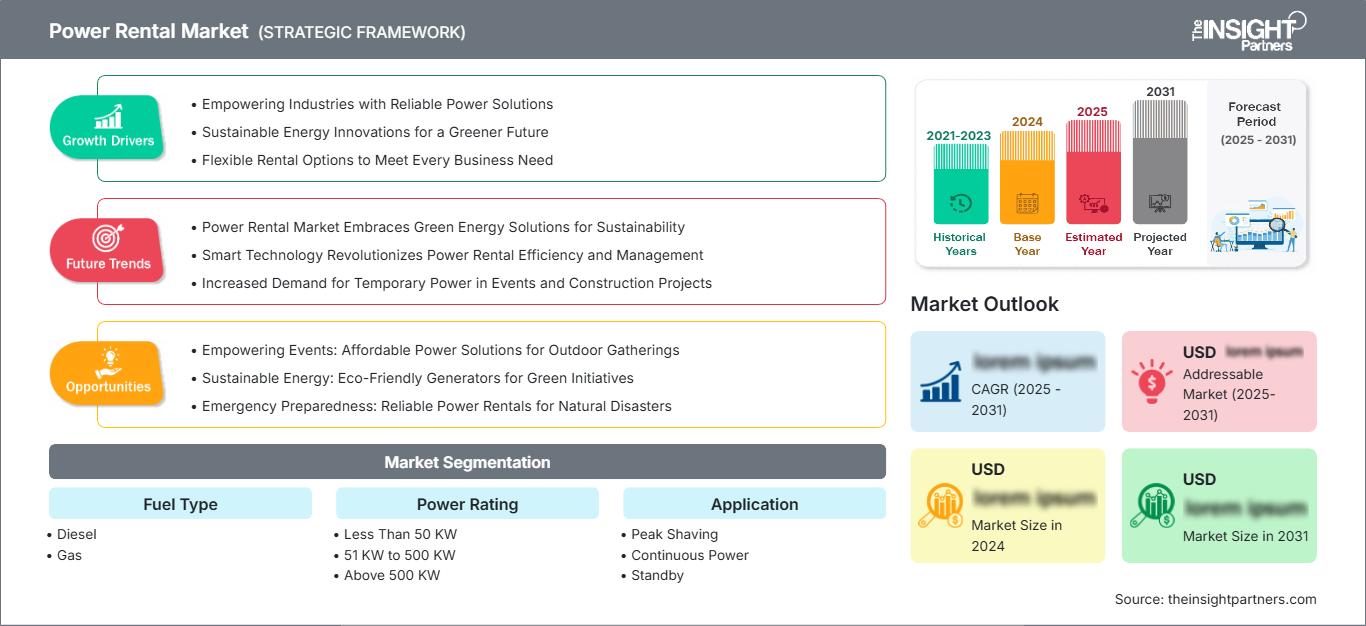
전력 임대 시장: 전략적 통찰력
-
이 보고서의 주요 주요 시장 동향을 확인하세요.이 무료 샘플에는 시장 동향부터 추정 및 예측에 이르기까지 데이터 분석이 포함됩니다.
Regional Insights
North America power rental market
North America is estimated to account for 23–26% share in 2025 and is expected to expand at a 5.3–5.8% CAGR through 2034. The US dominates regional demand, followed by Canada. Aging distribution infrastructure, severe-weather events, data-center construction, and industrial reshoring create requirements for temporary generation during upgrades, commissioning, outages, and capacity constraints.
The rental market will also benefit from manufacturing investment in semiconductors, batteries, electric vehicles, and sophisticated factories. Modern construction companies prefer equipment that is scalable as the load conditions change from excavation to erection to commissioning and installation. Gas and hybrid power units are being considered due to reduced emissions. The equipment provider that can move equipment from one construction site to another has an advantage with a national distribution network because it allows central monitoring and optimization of usage.
U.S. power rental Market
The U.S. represents approximately 80–83% of North America share in 2025 and is expected to grow at a 5.2–5.7% CAGR through 2034. Temporary power generation is a regular need for many facilities such as data centers, factories, power supply stations, building projects, hospitals, and emergency response situations. The presence of robust infrastructure of equipment rentals facilitates fast implementation in several states.
There is a trend towards the use of more capacity-intensive equipment and generator systems operating in tandem. The electricity consumption grew by approximately 2% in 2025, with data centers accounting for a large share of new consumption. Among companies supplying rental services and equipment to industries and infrastructure organizations there are Aggreko, Caterpillar, Cummins, and Ashtead Group.
Europe power rental Market
Europe is estimated to represent 18–20% share in 2025, growing at a 4.7–5.2% CAGR through 2034. Germany ranks as the leading national participant, backed by industries, construction, upgrading of infrastructure, and strict standards for efficiency in temporary power. United Kingdom, France, Italy, and Spain represent additional significant sources of demand in the construction, manufacturing, utilities, events, and energy segments.
United Kingdom possesses both advanced equipment rental capabilities and demand for reliable temporary power in construction and utility maintenance activities. Germany profits from industrial upgrading and emission-conscious rental fleets. France and Italy provide demand in infrastructure, manufacturing, and events sectors, and Spain represents an area with potential connected to construction, installation of renewables, and flexible grid operations. European regulation policies encourage Stage V compliance, hybrids, quiet equipment, and cleaner fuels.
APAC power rental Market
APAC holds an estimated 34–38% share in 2025 and is projected to expand at a 6.2–7.1% CAGR through 2034. China ranks at the top, followed by India, Japan, South Korea, and Australia. Industries, mining, construction, utilities, and distant infrastructure projects will be key demand sectors.
Industry growth and unreliable grid services foster rental, while infrastructure programs at the national level provide specific project requirements. India is taking advantage of increased energy demand and infrastructure construction activities, while China’s industry, along with huge construction and mining sectors, make the country a leading market. In Australia, demand is high due to mining activities in remote areas, where hybrid energy systems can save the use of diesel generators.
Middle East & Africa power rental Market
Middle East and Africa demand is supported by oil and gas operations, construction, mining, utilities, and remote infrastructure. Saudi Arabia leads regional requirements, with the UAE and South Africa also representing important deployment centers. The regional CAGR is estimated at 5.0–5.6% through 2034 as large projects require reliable temporary electricity.
The kingdom of Saudi Arabia has significant investments in infrastructure and industrial projects, while the United Arab Emirates focuses on construction projects, events, utilities, and commercial activities. South Africa needs regular services related to the power supply and industrial projects. The other Middle Eastern and African nations rely on renting solutions since there is limited grid infrastructure available in these countries.

Segmentation Analysis
Fuel Type
Fuel Type is expected to expand at a 4.8–5.2% CAGR from 2026 to 2034. Diesel remains the principal choice because of established infrastructure, portability, high-load capability, and widespread fuel availability. Gas is gaining strategic importance where pipeline access, emissions targets, and long operating periods justify cleaner generation. Rental companies increasingly combine conventional fuels with batteries to reduce inefficient low-load operation.
- Diesel: Diesel retains the dominant position because rental fleets, fueling infrastructure, service expertise, and equipment availability are mature. It remains particularly important for construction, mining, oil and gas, emergency backup, and remote applications.
- Gas: Gas demand is supported by customers seeking lower local emissions and longer operating cycles. Its strategic importance is strongest at sites with dependable gas infrastructure and sustained loads.
Power Rating
Power Rating is projected to register a 5.1–5.6% CAGR from 2026 to 2034. Demand is becoming more segmented as rental customers require precise capacity matching rather than oversized equipment. Higher-rated systems are increasingly relevant for industrial projects, data centers, mining operations, utilities, and large construction sites requiring synchronized generation.
- 50kW 미만: 소형 장치는 휴대성과 간편한 운송이 중요한 소규모 건설 현장, 상업 시설, 행사, 임시 사무실 및 지역 백업 요구 사항에 적합합니다.
- 51kW ~ 500kW: 중형 용량의 제품은 건설, 산업 현장, 소매 시설 및 임시 기반 시설 등 다양한 고객층에 적합하며, 중간 정도 또는 가변적인 부하에 유연하게 적용할 수 있습니다.
- 500kW 이상: 대형 발전 설비는 산업 시설, 광산, 공공 시설, 석유 및 가스 현장, 확장 가능한 발전이 필요한 주요 건설 프로젝트 등에서 지속적인 전력 공급 및 비상 전력 공급에 전략적으로 중요합니다.
애플리케이션
해당 애플리케이션은 2026년부터 2034년까지 연평균 5.8~6.4% 성장할 것으로 예상됩니다 . 원격 및 독립형 운영에는 지속적인 전력 공급이 중요하며, 비상 전력 시스템은 정전으로부터 핵심 활동을 보호합니다. 고객들이 수요 요금, 제한된 전력망 용량 및 변동적인 전력 부하를 관리함에 따라 피크 부하 저감 기술은 전략적으로 중요한 위치를 차지하고 있습니다.
- 피크 부하 저감: 피크 부하 저감은 수요에 따른 전기 요금 절감을 원하는 상업 및 산업 사용자에게 도움이 됩니다. 임대 발전기는 영구적인 발전 설비 없이도 고부하 시간대에 전력망을 보완할 수 있습니다.
- 지속적인 전력 공급: 지속적인 전력 공급은 외딴 광산, 석유 및 가스 시설, 인프라 프로젝트, 그리고 전력망 접근이 불가능하거나 지속적인 운영에 필요한 전력량이 부족한 현장에 제공됩니다.
- 비상 시스템: 비상 시스템은 전력망 중단, 계획된 유지 보수, 악천후 및 신속한 전력 복구가 필요한 일시적인 기반 시설 장애 발생 시 중요한 운영을 보호합니다.
최종 사용자
최종 사용자 수요는 2026년부터 2034년까지 연평균 5.4~6.0% 성장할 것으로 예상됩니다 . 건설 부문은 프로젝트 일정이 영구적인 전기 연결보다 앞서 진행되는 경우가 많기 때문에 여전히 중요한 소비처입니다. 산업, 광업, 석유 및 가스 고객은 더 높은 신뢰성, 특수 장비 및 장기 서비스 계약을 요구합니다.
- 석유 및 가스: 임대 발전은 시추, 처리, 시운전, 유지 보수, 파이프라인 운영 및 영구 전력 인프라를 이용할 수 없거나 경제성이 떨어지는 원격 시설을 지원합니다.
- 금속 및 광업: 광산 운영에서는 분쇄, 환기, 가공, 캠프, 통신 및 임시 용량 확보를 위해, 특히 전력망 접근이 제한적인 외딴 지역에서 임대 전력을 사용합니다.
- 산업 부문: 산업 시설은 확장, 유지 보수, 시운전, 전력망 업그레이드 및 생산 연속성에 영향을 미치는 용량 제약 기간 동안 임시 발전이 필요합니다.
- 건설 현장: 건설 현장은 주요 적용 분야 중 하나입니다. 프로젝트 단계 전반에 걸쳐 전력 수요가 변화하기 때문에 이동 가능하고 확장 가능하며 서비스 지원이 제공되는 발전 설비에 대한 수요가 발생합니다.
기회 개요
|
최종 사용자 |
수익 기여도 (높음/중간/낮음) |
트렌드 데이 |
입양 단계 |
|---|---|---|---|
|
석유 및 가스 |
높은 |
원격 전원 |
성숙한 |
|
금속 및 광업 |
높은 |
광산 전력화 |
확장 |
|
산업 |
높은 |
부하 유연성 |
확장 |
|
건설 |
높은 |
사이트 파워 |
성숙한 |
전력 임대 시장 성장 동인 및 영향 분석
전력망 신뢰성 및 임시 용량 요구 사항
전력 회사들이 노후화된 기반 시설, 극한 기상 현상 위험, 송전 제약, 그리고 증가하는 전력 수요를 관리함에 따라 전력망의 안정성은 점점 더 중요한 상업적 고려 사항이 되고 있습니다. 임대 발전은 변전소, 배전선, 그리고 영구 발전 설비의 업그레이드 기간 동안 신속한 전력 공급 공백 해소를 제공합니다. 이러한 효과는 정전으로 인해 막대한 생산 손실이 발생할 수 있는 건설, 공공 시설, 의료, 제조 및 상업 시설에서 특히 두드러집니다. 임대 사업자는 고객이 프로젝트 종료 후 활용도가 떨어질 수 있는 장비를 구매하는 대신 정해진 기간 동안만 전력을 공급받을 수 있다는 점에서 이점을 얻습니다. 또한, 이 모델은 단계적 시운전을 지원하여 영구 연결이 완료되기 전에 전력 공급을 시작할 수 있도록 합니다. 전력망 현대화 프로그램은 장기간의 건설 기간을 필요로 하기 때문에 임시 발전 수요는 비상 비용으로만 처리되는 것이 아니라 프로젝트 예산에 포함될 수 있습니다.
데이터 센터 및 전력 집약적 산업의 확장
데이터 센터, 반도체 시설, 배터리 공장 및 첨단 제조 시설은 여러 선진국에서 전력 수요를 증가시키고 있습니다. 국제에너지기구(IEA)는 2025년까지 전 세계 데이터 센터 전력 소비량이 약 17% 증가할 것으로 예상하며, 특히 미국 데이터 센터가 국가적 수요 증가분의 상당 부분을 차지할 것으로 전망했습니다. 이러한 시설들은 건설, 시운전, 유지보수 및 전력망 연계 단계에서 안정적인 전력 공급을 필요로 합니다. 임대 서비스 제공업체는 영구적인 인프라 구축을 기다리지 않고도 동기식 발전기, 변압기, 부하 뱅크 및 임시 배전 시스템을 제공할 수 있습니다. 이는 더 높은 용량의 장비 사용과 장기 임대 계약 체결의 기회를 창출합니다. 이러한 영향은 데이터 센터를 넘어 반도체 제조, 배터리 생산 및 산업 전력화에도 유사하게 적용되는 임시 전력 용량 수요를 충족합니다. 엔지니어링 역량을 갖춘 공급업체는 개별 발전기를 제공하는 것보다 완전한 임시 전력 시스템을 제공함으로써 더 큰 가치를 창출할 수 있습니다.
항공기 현대화 및 저배출 장비
유럽, 북미, 그리고 점차 아시아 태평양 지역 전반에 걸쳐 환경 규제가 장비 운영 경제성을 변화시키고 있습니다. 임대 업체들은 특히 도심 건설 현장과 산업 지역에서 점점 더 엄격해지는 배출가스 규제에 맞춰 장비 활용도를 균형 있게 유지해야 합니다. 최신 엔진, Stage V 및 동급 기술, 가스 발전, 하이브리드 시스템, 배터리 저장 장치, 지능형 부하 관리 시스템 등은 연료 소비와 운영 중 배출가스를 줄일 수 있습니다. 임대 업체 입장에서는 장비 현대화를 통해 규제가 적용되는 환경에서 최신 장비의 활용도를 높여 경쟁력을 강화할 수 있습니다. 고객은 특수 장비를 구매하지 않고도 현장 요구 사항을 충족하는 장비를 이용할 수 있다는 이점을 누릴 수 있습니다. 따라서 이러한 변화는 양면적인 영향을 미칩니다. 규제는 노후 장비 교체를 장려하는 반면, 기술 발전은 임대 업체가 연료 절감, 소음 감소, 원격 진단, 통합 에너지 관리 등을 통해 차별화를 꾀할 수 있도록 합니다.
전력 임대 시장의 미래 동향
하이브리드 렌탈 차량 구성이 표준 프로젝트 설계로 자리 잡고 있습니다.
전력 임대 시장의 추세는 독립형 디젤 장비보다는 통합형 발전기 및 배터리 패키지로 이동하고 있습니다. 하이브리드 시스템은 효율적인 부하 지점에 더 가깝게 발전기를 가동할 수 있으며, 배터리는 단기적인 피크 부하를 흡수하고 예비 전력을 제공하며 불필요한 엔진 가동을 줄여줍니다. 장기적으로 임대 장비는 기존 발전기와 함께 컨테이너형 배터리 시스템, 태양광 모듈, 지능형 컨트롤러 및 원격 에너지 관리 소프트웨어를 표준화할 가능성이 높습니다. 이러한 구성은 건설, 광업, 통신 및 원격 산업 현장에 특히 적합할 것입니다. 고객은 임대 계약에서 배출량, 연료 소비량 및 소음 기준치를 더욱 구체적으로 명시할 수 있습니다. 동기화된 하드웨어와 소프트웨어를 제공할 수 있는 공급업체는 전체 임시 에너지 시스템을 관리하고 변화하는 프로젝트 단계 전반에 걸쳐 장비 활용도를 최적화할 수 있는 더 큰 기회를 얻게 될 것입니다.
디지털 차량 관리 시스템은 경쟁 구도를 활용도 중심으로 전환시키고 있습니다.
미래의 경쟁은 단순히 보유 발전기 규모보다는 임대 회사가 자산을 얼마나 효율적으로 관리하는가에 점점 더 좌우될 것입니다. 연결된 발전기는 가동 시간, 연료량, 부하 프로파일, 경보, 위치 정보 및 유지보수 지표를 전송할 수 있습니다. 인공지능과 예측 분석은 이러한 데이터를 활용하여 활용도가 낮은 발전기를 식별하고, 서비스 요구 사항을 예측하며, 장비 재배치를 권장할 수 있습니다. 고객은 연료 소비량과 운영 성능에 대한 더 명확한 가시성을 확보하여 보다 정확한 프로젝트 예산 책정을 할 수 있습니다. 장기적으로는 디지털 플랫폼이 발전기들을 배터리, 태양광 시스템, 전력망 연결 및 건물 관리 시스템과 연결할 수 있습니다. 이를 통해 프로젝트 조건에 따라 용량이 동적으로 배분되는 통합된 임시 에너지 생태계가 구축되어 활용도를 높이고 불필요한 연료 소비와 서비스 중단을 줄일 수 있습니다.
전력 임대 시장 기회
산업 프로젝트를 위한 통합 에너지 서비스
전력 임대 시장 전망에 따르면 산업 고객을 위한 장비 임대에서 통합 에너지 서비스 계약으로의 전환 기회가 있습니다. 공급업체는 발전기, 배터리, 변압기, 부하 뱅크, 연료 관리, 원격 모니터링, 유지 보수 및 엔지니어링을 하나의 상업 패키지로 결합할 수 있습니다. 이러한 계약은 복잡한 시운전 또는 확장 프로그램을 관리하는 고객의 조달 복잡성을 줄여줍니다. 가장 큰 기회는 프로젝트 수명 주기 동안 전력 수요가 크게 변하는 경우에 있습니다. 공급업체는 초기에는 소규모 시스템을 구축하고, 건설 중에 용량을 추가하고, 운영 중에 하이브리드 또는 계통 연계형 구성으로 전환할 수 있습니다. 이러한 접근 방식은 또한 반복적인 서비스 수익을 창출하고 장비 활용률을 향상시킵니다. 투자는 모듈형 장비, 디지털 제어, 엔지니어링 역량 및 여러 사업장을 보유한 산업 고객을 지원할 수 있는 지역 물류 네트워크에 집중해야 합니다.
원격 재생 에너지 및 광업 프로젝트를 위한 임대 솔루션
원격 재생 에너지 설비 및 광산 개발은 영구적인 전력망 연결이 비용이 많이 들거나, 시간이 오래 걸리거나, 기술적으로 불가능할 수 있기 때문에 매력적인 기회를 제공합니다. 임대 설비 제공업체는 모듈형 발전 설비를 활용하여 건설 및 초기 운영을 지원하고, 고객이 태양광 및 배터리를 통합한 하이브리드 시스템으로 전환할 수 있도록 지원할 수 있습니다. 광산 프로젝트 또한 탐사, 처리 시설 확장, 유지 보수 및 시운전 기간 동안 임시 용량 관리를 위해 임대 자산을 활용할 수 있습니다. 이러한 기회는 특히 호주, 아프리카, 인도 및 동남아시아 일부 지역에서 원격 산업 활동과 재생 에너지 도입이 동시에 진행되는 경우에 더욱 두드러집니다. 제공업체는 연료 최적화, 배터리 저장 장치, 원격 모니터링 및 고온 장비가 통합된 패키지를 개발해야 합니다. 유연한 계약 구조를 통해 고객의 초기 투자 비용을 줄이는 동시에 생산량 및 영구 에너지 인프라의 발전에 따라 용량을 조정할 수 있습니다.
자주 묻는 질문

Naveen은 12년 이상의 경력을 보유한 시장조사 및 경영 컨설팅 전문가로, 다양한 산업 분야에서 전략적 시장조사(Strategic Research), 시장 정보 분석(Market Intelligence), 비즈니스 자문(Business Advisory) 솔루션을 제공해 온 풍부한 경험과 전문성을 갖추고 있습니다. 주요 전문 분야는 전자(Electronics), 기술(Technology), 산업 자동화(Industrial Automation), 은행·금융서비스·보험(BFSI), 자동차(Automotive), 항공우주(Aerospace) 등으로 폭넓게 구성되어 있습니다. 특히 시장 평가(Market Assessment), 경쟁 정보 분석(Competitive Intelligence), 산업 벤치마킹(Industry Benchmarking), 성장 전략 수립(Growth Strategy), 시장 진입 분석(Market Entry Analysis), 사업 기회 평가(Business Opportunity Evaluation) 분야에서 높은 전문성을 보유하고 있습니다. 이러한 폭넓은 산업 지식과 전략적 분석 역량을 바탕으로 기업이 새로운 시장 기회를 발굴하고 효과적인 비즈니스 전략을 수립할 수 있도록 지원하고 있습니다.
현재 부사장보(Associate Vice President)로서 Naveen은 복잡하고 전문성이 요구되는 시장조사 및 경영 컨설팅 프로젝트를 총괄하고, 주요 이해관계자와의 관계를 관리하며, 프로젝트의 초기 기획부터 실행 및 최종 결과물 제공에 이르기까지 전 과정을 책임지고 있습니다. 다양한 산업과 지역의 고객사를 대상으로 여러 시장조사 및 컨설팅 프로젝트를 성공적으로 수행해 왔으며, 이를 통해 기업이 새로운 성장 기회를 식별하고, 시장 내 경쟁 구도와 산업별 역학 관계를 심층적으로 이해하며, 투자 잠재력을 평가하고, 데이터에 기반한 합리적인 전략적 의사결정을 내릴 수 있도록 지원해 왔습니다. 체계적이고 결과 중심적인 컨설팅 접근 방식을 통해 고객사의 시장 경쟁력을 강화하고 지속 가능한 사업 성장을 위한 전략적 방향을 제시하고 있습니다.
Naveen은 인도 카르나타카주에 위치한 비스베스바라야 공과대학교(Visvesvaraya Technological University, VTU)에서 전자통신공학(Electronics & Communication Engineering) 학사 학위를 취득했으며, 마니팔 대학교(Manipal University)에서 마케팅 및 운영관리(Marketing & Operations) 전공 경영학 석사(MBA) 학위를 취득했습니다. 탄탄한 기술적 전문 지식과 다양한 산업에 대한 폭넓은 이해, 풍부한 전략 컨설팅 경험을 결합하여 복잡한 시장 데이터를 실질적인 비즈니스 가치가 있는 전략적 인사이트와 실행 가능한 권고안으로 전환하는 역량을 갖추고 있습니다. 이를 통해 고객사가 새로운 성장 기회를 발굴하고, 시장 내 경쟁 우위를 강화하며, 장기적인 사업 전략을 효과적으로 수립할 수 있도록 지원하고 있습니다.
- 포괄적인 시장 규모 산정 및 전망 분석
- 상세 시장 세분화 분석
- 심층적인 시장 동향 및 요인 분석
- 지역 및 국가별 인사이트
- 경쟁 구도 및 기업 벤치마킹
- 전략적 비즈니스 인텔리전스
사용 후기

The Insight Partners는 당사의 글로벌 시장 진출 전략을 뒷받침하는 가치 있는 시장 정보를 제공했습니다. 담당 팀은 전문적이고 신속하게 대응했으며 당사의 의견을 세심하게 반영했습니다. 또한 프로젝트 전반에 걸쳐 깊이 있는 분석과 유용한 방법론적 설명을 제공했습니다.
Junmo Kim 최고재무책임자(CFO), Enertech Co., Ltd.
Insight Partners의 SCADA 시스템 시장 보고서는 포괄적이며, 현재 동향과 미래 전망에 대한 귀중한 통찰력을 제공합니다. 팀은 매우 전문적이고, 신속하게 대응하며, 처음부터 끝까지 지원해 주었습니다. 저희는 매우 만족하며 Insight Partners의 서비스를 적극 추천합니다.
란 케뎀 파트너, Reali Technologies LTDs
아주 구체적인 소프트웨어 시장에 대한 보고서를 요청했는데, 팀에서 며칠 만에 보고서를 작성해 주셨습니다. 정보는 매우 관련성이 높고 잘 정리되어 있었습니다. 그 후 보고서에 몇 가지 수정과 추가 사항을 요청했습니다. 팀원들의 응답도 매우 빨랐고, 일주일도 채 되지 않아 최종 보고서를 받았습니다.
장-에르브 젠 의장, 퓨처 애널리티카
The Insight Partners와 함께 중요한 시장 조사 및 예측 작업을 진행했습니다. Insight Partners는 기회와 위험에 대한 명확한 통찰력을 제공하여 계획을 세우는 데 큰 도움이 되었습니다. The Insight Partners의 조사는 사용하기 쉬웠고, 탄탄한 데이터를 기반으로 했습니다. 덕분에 현명하고 자신 있는 결정을 내릴 수 있었습니다. The Insight Partners를 강력 추천합니다.
피유시 나그팔 수석 부사장, 하이빔 글로벌
Insight Partners는 탄탄한 분야 전문성을 바탕으로 통찰력 있고 체계적인 시장 조사를 제공했습니다. Insight Partners 팀은 처음부터 끝까지 전문적이고 신속하게 대응했습니다. 사용자 친화적인 웹사이트 덕분에 업계 보고서에 쉽게 접근할 수 있었습니다. 신뢰할 수 있고 고품질의 조사 서비스를 원하신다면 Insight Partners를 강력 추천합니다.
아다치 유키히코 대표이사, 딥블루 주식회사
The Insight Partners에서 시장 보고서를 구매한 것은 이번이 처음입니다. 처음에는 확신이 없었지만, 웹사이트를 방문하고 나서 위험을 감수하고 시장 보고서를 구매하는 것이 더 편하다는 것을 알게 되었습니다. 보고서의 품질과 고객 서비스에 매우 만족합니다. 처음 보고서를 보고 몇 가지 질문과 의견이 있었지만, 분석가와 이메일로 몇 차례 대화를 나눈 후, 전략 기획 과정에 참고할 수 있는 보고서를 확보했다고 생각합니다. 시간을 내어 긍정적인 경험을 선사해 주셔서 정말 감사합니다. 다른 사람들에게도 귀사의 서비스를 적극 추천할 것이며, 추가적인 시장 데이터가 필요할 때면 가장 먼저 귀사에 연락하겠습니다.
존 스즈키 사장 겸 최고 경영자, 이사회 이사, BK 테크놀로지스
나이지리아 감염성 질환 IVD 시장 관련 정보 요청에 응해 주신 귀사의 지원과 전문성에 감사드립니다. 귀사의 인내심과 지도, 그리고 할인 혜택을 기꺼이 제공해 주셔서 결국 계약을 성사시킬 수 있었습니다. 첫 만남을 통해 귀사가 저에게 심어주신 좋은 인상을 바탕으로 앞으로도 The Insight Partners와 함께할 수 있기를 기대합니다.
치지오케 박사 오니아 전무이사, 파인크레스트 헬스케어 유한회사구매 이유
- 정보에 기반한 의사 결정
- 시장 역학 이해
- 경쟁 분석
- 고객 인사이트
- 시장 예측
- 위험 완화
- 전략 기획
- 투자 타당성 분석
- 신흥 시장 파악
- 마케팅 전략 강화
- 운영 효율성 향상
- 규제 동향에 발맞춰 대응



















 무료 샘플 받기 -