
Power Rental Market Size, Demand & Growth by 2034
Coverage: By Fuel Type (Diesel, Gas, Others); Power Rating (Less Than 50 KW, 51 KW to 500 KW, Above 500 KW); Application (Peak Shaving, Continuous Power, Standby); End User (Oil and Gas, Metal and Mining, Industrial, Construction, Others) , and Geography (North America, Europe, Asia Pacific, and South and Central America)
- Status : Data Released
- Report Code : TIPRE00016453
- Category : Electronics and Semiconductor
- No. of Pages : 150
- Available Report Formats :


- Last update date : October 13, 2026


2025 Market Size
US$ 11.73 Bn
Base year value
2034 Forecast
US$ 18.46 Bn
Projected by 2034
CAGR 2026-2034
5.17 %
Growth rate
Addressable Market
US$ 136.98 Bn
(2026-2034)
The power rental market is positioned around temporary, standby, peak-load, and continuous electricity requirements across construction, industrial, mining, oil and gas, and infrastructure activities. The market size is projected at US$ 11.73 Billion in 2025 and US$ 18.46 Billion by 2034, registering a CAGR of 5.17% from 2026 to 2034. Demand is increasingly shaped by grid constraints, project-based electricity requirements, equipment flexibility, and the need to avoid large upfront generation investments.
North America presents a structurally resilient outlook, supported by aging grid infrastructure, data-center expansion, manufacturing investment, extreme-weather preparedness, and construction activity. The power rental market size is supported by customers seeking rapid deployment and scalable generation capacity. The regional CAGR is estimated at 5.3–5.8% between 2026 and 2034, with diesel remaining important while gas and hybrid systems gain strategic relevance.
Power Rental Market Assessment and Insights
- North America: North America is expected to hold a 23–26% power rental market share in 2025, with a 5.3–5.8% CAGR between 2026 and 2034. Grid modernization, data centers, manufacturing facilities, and severe-weather resilience support sustained rental requirements.
- US: The US is estimated to represent 80–83% of North America in 2025, expanding at a 5.2–5.7% CAGR between 2026 and 2034, supported by infrastructure investment and rising backup-power requirements.
- Europe: Europe is estimated at a 18–20% share in 2025, with a 4.7–5.2% CAGR between 2026 and 2034. Germany, the UK, France, Italy, and Spain support demand through industrial activity, construction, and grid flexibility requirements.
- Asia Pacific: Asia Pacific is estimated at a 34–38% share in 2025, advancing at a 6.2–7.1% CAGR between 2026 and 2034. China, India, Japan, South Korea, and Australia benefit from industrial expansion, infrastructure projects, mining, and electricity demand growth.
- Largest Segment: Diesel is the largest segment, with a 65–70% market share in 2025 and a 4.8–5.2% CAGR from 2026 to 2034, reflecting availability and mature rental infrastructure.
- High Growth Segment: Peak Shaving represents an estimated 18–23% market share in 2025, with a 7.0–8.0% CAGR from 2026 to 2034, supported by load-management requirements and volatile electricity costs.
- Key companies analyzed in detail: Atlas Copco AB, Aggreko plc, Ashtead Group plc, Bredenoord B.V., Bowman Power Group Limited, Caterpillar Inc., Cummins Inc., Kohler Co., One Source Equipment Rentals, Inc., Wacker Neuson SE.
Source: The Insight Partners' analysis based on proprietary research, government publications, company annual reports, investor presentations, industry databases, and expert interviews.
From hiring traditional diesel generator sets, the industry has now moved on to energy modules including generators, transformers, load banks, distribution apparatus, remote monitoring systems, and in most cases battery storage. The rental fleets have been designed to be portable, environmentally friendly, fuel-efficient, synchronizable, and quick to deploy. The digital control system enables the operator to track usage, fuel consumption, maintenance schedules, and loading patterns, thus improving the productivity of the fleet while minimizing unnecessary operating time at temporary sites.
Future demand in the power rental Market is projected to move past the traditionally known applications in construction and emergency backup purposes. The data centers, semiconductor plants, renewable energy installations, utility installations, mining operations, and even industrial growths are increasingly requiring bridge power during commissioning or network upgrade. The emerging markets will continue to present significant opportunities for deployment as the development of infrastructure could precede permanent power grid installation.
Power Rental Market Report Scope
| Report Attribute | Details |
|---|---|
| Market size in 2025 | US$ 11.73 Billion |
| Market Size by 2034 | US$ 18.46 Billion |
| Global CAGR (2026 - 2034) | 5.17% |
| Historical Data | 2021-2024 |
| Forecast period | 2026-2034 |
Power Rental Market Analysis
Growth in the power rental market is directly tied to the economics of temporary electricity. Renters do not need to make heavy financial investments upfront while matching generation capacity to the length of the project and load requirements. The rental industry works alongside manufacturers of the engines, alternators, control systems, and emission control systems. This approach leads to faster deployment in cases where there is no immediate connection available.
The supply side of power rental Market is affected by factors such as fleet availability, equipment standardization, transport capabilities, and regulatory requirements. The diesel generators are commonly used due to easy access to fuel and the ability to work with heavy loads, whereas the gas generators become more attractive in places where there is existing fuel infrastructure and stricter emission requirements. Rental companies are also developing modular designs that link several generator sets and allow varying the capacity.
The power rental market report suggests a competitive industry structure featuring international rental experts, equipment manufacturers, and fleet operators. Aggreko stresses temporary energy solutions, remote monitoring, and hybrid technologies, while Atlas Copco specializes in integration of generator and battery technologies. Ashtead Group is featured through its extensive rental network in the U.S. thanks to United Rentals, while Caterpillar and Cummins support the industry through their technologies of power generation and dealer network.
Priorities of investment are changing in favor of fleet renewal, digital monitoring, low-emission equipment, and hybrid technologies instead of just expanding traditional fleet of generators. Bredenoord specializes in mobile energy solutions and emission control technologies, while Wacker Neuson contributes through compact mobile generators. Kohler and Bowman Power bring technologies of generation and energy efficiency. One Source Equipment Rentals improves the regional rental ecosystem, while competitive advantage lies in reliability, logistics, responsiveness, and operating costs.
● REPORT CUSTOMIZATION
Tailor This Report To Align With Your Specific Business Requirements
This report can be customized to align precisely with your business objectives, scope, and target markets. Customization options include tailored segmentation, geography, competitive analysis, and strategic insights to support informed decision-making.
Customize This Report →WHAT YOU CAN ADJUST
- ● Segmentations
- ● Geography
- ● Competitive Analysis
- ● Language Preferences
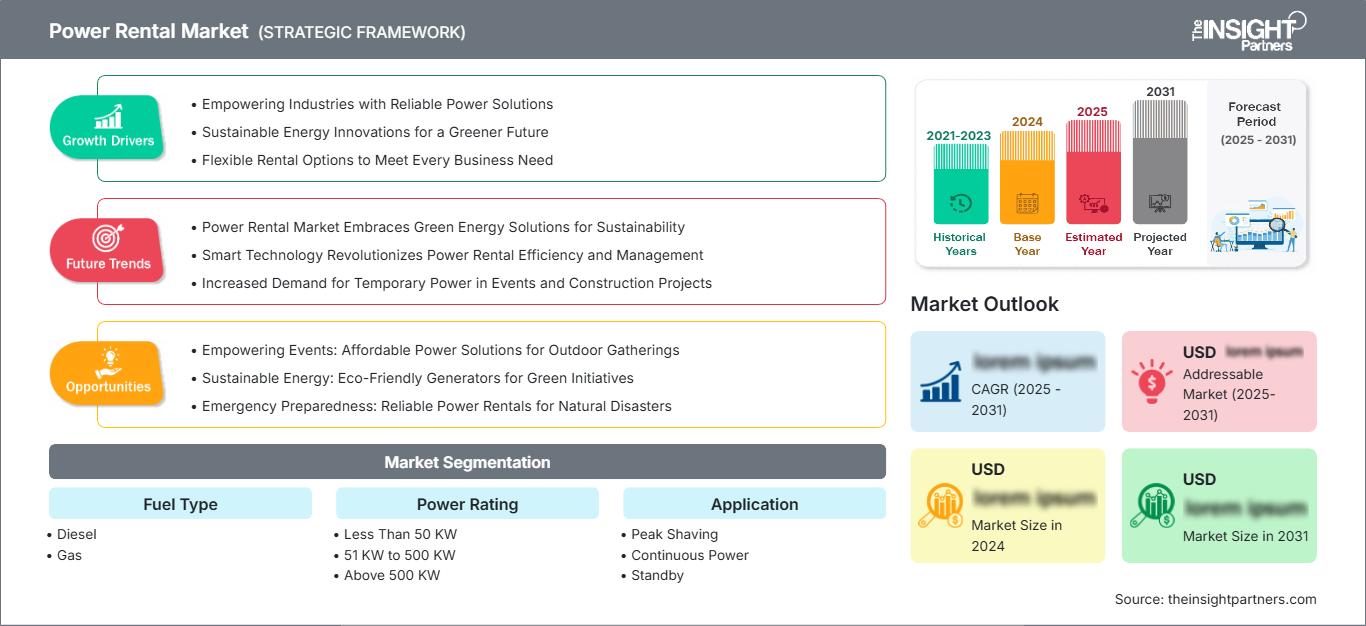
Power Rental Market: Strategic Insights
Regional Insights
North America power rental market
North America is estimated to account for 23–26% share in 2025 and is expected to expand at a 5.3–5.8% CAGR through 2034. The US dominates regional demand, followed by Canada. Aging distribution infrastructure, severe-weather events, data-center construction, and industrial reshoring create requirements for temporary generation during upgrades, commissioning, outages, and capacity constraints.
The rental market will also benefit from manufacturing investment in semiconductors, batteries, electric vehicles, and sophisticated factories. Modern construction companies prefer equipment that is scalable as the load conditions change from excavation to erection to commissioning and installation. Gas and hybrid power units are being considered due to reduced emissions. The equipment provider that can move equipment from one construction site to another has an advantage with a national distribution network because it allows central monitoring and optimization of usage.
U.S. power rental Market
The U.S. represents approximately 80–83% of North America share in 2025 and is expected to grow at a 5.2–5.7% CAGR through 2034. Temporary power generation is a regular need for many facilities such as data centers, factories, power supply stations, building projects, hospitals, and emergency response situations. The presence of robust infrastructure of equipment rentals facilitates fast implementation in several states.
There is a trend towards the use of more capacity-intensive equipment and generator systems operating in tandem. The electricity consumption grew by approximately 2% in 2025, with data centers accounting for a large share of new consumption. Among companies supplying rental services and equipment to industries and infrastructure organizations there are Aggreko, Caterpillar, Cummins, and Ashtead Group.
Europe power rental Market
Europe is estimated to represent 18–20% share in 2025, growing at a 4.7–5.2% CAGR through 2034. Germany ranks as the leading national participant, backed by industries, construction, upgrading of infrastructure, and strict standards for efficiency in temporary power. United Kingdom, France, Italy, and Spain represent additional significant sources of demand in the construction, manufacturing, utilities, events, and energy segments.
United Kingdom possesses both advanced equipment rental capabilities and demand for reliable temporary power in construction and utility maintenance activities. Germany profits from industrial upgrading and emission-conscious rental fleets. France and Italy provide demand in infrastructure, manufacturing, and events sectors, and Spain represents an area with potential connected to construction, installation of renewables, and flexible grid operations. European regulation policies encourage Stage V compliance, hybrids, quiet equipment, and cleaner fuels.
APAC power rental Market
APAC holds an estimated 34–38% share in 2025 and is projected to expand at a 6.2–7.1% CAGR through 2034. China ranks at the top, followed by India, Japan, South Korea, and Australia. Industries, mining, construction, utilities, and distant infrastructure projects will be key demand sectors.
Industry growth and unreliable grid services foster rental, while infrastructure programs at the national level provide specific project requirements. India is taking advantage of increased energy demand and infrastructure construction activities, while China’s industry, along with huge construction and mining sectors, make the country a leading market. In Australia, demand is high due to mining activities in remote areas, where hybrid energy systems can save the use of diesel generators.
Middle East & Africa power rental Market
Middle East and Africa demand is supported by oil and gas operations, construction, mining, utilities, and remote infrastructure. Saudi Arabia leads regional requirements, with the UAE and South Africa also representing important deployment centers. The regional CAGR is estimated at 5.0–5.6% through 2034 as large projects require reliable temporary electricity.
The kingdom of Saudi Arabia has significant investments in infrastructure and industrial projects, while the United Arab Emirates focuses on construction projects, events, utilities, and commercial activities. South Africa needs regular services related to the power supply and industrial projects. The other Middle Eastern and African nations rely on renting solutions since there is limited grid infrastructure available in these countries.

Segmentation Analysis
Fuel Type
Fuel Type is expected to expand at a 4.8–5.2% CAGR from 2026 to 2034. Diesel remains the principal choice because of established infrastructure, portability, high-load capability, and widespread fuel availability. Gas is gaining strategic importance where pipeline access, emissions targets, and long operating periods justify cleaner generation. Rental companies increasingly combine conventional fuels with batteries to reduce inefficient low-load operation.
- Diesel: Diesel retains the dominant position because rental fleets, fueling infrastructure, service expertise, and equipment availability are mature. It remains particularly important for construction, mining, oil and gas, emergency backup, and remote applications.
- Gas: Gas demand is supported by customers seeking lower local emissions and longer operating cycles. Its strategic importance is strongest at sites with dependable gas infrastructure and sustained loads.
Power Rating
Power Rating is projected to register a 5.1–5.6% CAGR from 2026 to 2034. Demand is becoming more segmented as rental customers require precise capacity matching rather than oversized equipment. Higher-rated systems are increasingly relevant for industrial projects, data centers, mining operations, utilities, and large construction sites requiring synchronized generation.
- Less Than 50 KW: Compact units address smaller construction activities, commercial facilities, events, temporary offices, and localized backup requirements where portability and easy transportation are priorities.
- 51 KW to 500 KW: Mid-range units serve a broad customer base, offering flexible deployment for construction, industrial operations, retail facilities, and temporary infrastructure with moderate and variable loads.
- Above 500 KW: Large units are strategically important for continuous and standby requirements at industrial facilities, mines, utilities, oil and gas sites, and major construction projects requiring scalable generation.
Application
Application is expected to grow at a 5.8–6.4% CAGR from 2026 to 2034. Continuous power remains important for remote and off-grid operations, while standby systems protect critical activities against outages. Peak shaving is gaining strategic attention as customers manage demand charges, constrained grid capacity, and variable electricity loads.
- Peak Shaving: Peak shaving supports commercial and industrial users seeking to reduce demand-related electricity costs. Rental generators can supplement the grid during high-load intervals without requiring permanent generation assets.
- Continuous Power: Continuous power serves remote mines, oil and gas facilities, infrastructure projects, and sites where grid access is unavailable or insufficient for sustained operations.
- Standby: Standby systems protect critical operations during grid interruptions, planned maintenance, severe weather events, and temporary infrastructure failures requiring rapid restoration of electricity.
End User
End User demand is forecast to grow at a 5.4–6.0% CAGR from 2026 to 2034. Construction remains a significant consumer because project schedules often precede permanent electrical connections. Industrial, mining, and oil and gas customers require higher reliability, specialized equipment, and long-duration service arrangements.
- Oil and Gas: Rental generation supports drilling, processing, commissioning, maintenance, pipeline operations, and remote facilities where permanent power infrastructure may be unavailable or uneconomical.
- Metal and Mining: Mining operations use rental power for crushing, ventilation, processing, camps, communications, and temporary capacity, particularly at remote sites with limited grid access.
- Industrial: Industrial facilities require temporary generation during expansion, maintenance, commissioning, grid upgrades, and periods of capacity constraints affecting production continuity.
- Construction: Construction sites represent a major application because electricity requirements evolve throughout project phases, creating demand for transportable, scalable, and service-supported generation equipment.
Opportunity Snapshot
| End User | Revenue Contribution (High/Medium/Low) | Trend Tag | Adoption Stage |
|---|---|---|---|
| Oil and Gas | High | Remote Power | Mature |
| Metal and Mining | High | Mine Electrification | Scaling |
| Industrial | High | Load Flexibility | Scaling |
| Construction | High | Site Power | Mature |
Power Rental Market Growth Drivers and Impact Analysis
Grid reliability and temporary capacity requirements
Grid reliability is becoming a stronger commercial consideration as utilities manage aging infrastructure, extreme-weather risks, transmission constraints, and rising electricity loads. Rental generation provides a rapid bridge while substations, distribution lines, and permanent generation assets are upgraded. The impact is particularly visible in construction, utilities, healthcare, manufacturing, and commercial facilities where outages can create disproportionate production losses. Rental operators benefit because customers can procure capacity for defined periods instead of purchasing equipment that may remain underutilized after a project ends. The model also supports staged commissioning, allowing electricity supply to begin before permanent connections are completed. As grid modernization programs require extended construction periods, demand for temporary generation can become embedded in project budgets rather than treated only as an emergency expense.
Expansion of data centers and power-intensive industries
Data centers, semiconductor facilities, battery plants, and advanced manufacturing operations are increasing electricity requirements in several developed economies. The IEA reports that data-center electricity consumption increased around 17% globally in 2025, while US data centers represented a substantial portion of national demand growth. These facilities require dependable power during construction, commissioning, maintenance, and grid interconnection stages. Rental providers can supply synchronized generator fleets, transformers, load banks, and temporary distribution systems without waiting for permanent infrastructure. This creates opportunities for higher-capacity equipment and longer rental contracts. The impact extends beyond data centers because semiconductor fabrication, battery manufacturing, and industrial electrification create similar temporary capacity requirements. Providers with engineering capabilities can capture greater value by delivering complete temporary electrical systems rather than individual generators.
Fleet modernization and lower-emission equipment
Environmental requirements are changing fleet economics across Europe, North America, and increasingly Asia Pacific. Rental companies must balance equipment utilization with increasingly stringent emissions requirements, particularly in urban construction and industrial areas. Newer engines, Stage V and equivalent technologies, gas generation, hybrid systems, battery storage, and intelligent load management can reduce fuel consumption and operating emissions. For rental providers, modernization also improves fleet competitiveness because newer equipment can command stronger utilization in regulated applications. Customers benefit from equipment that meets site-specific requirements without purchasing specialized assets. The commercial impact is therefore two-sided: regulations encourage replacement of older units while technology improvements allow rental companies to differentiate through fuel savings, lower noise, remote diagnostics, and integrated energy management.
Power Rental Market Future Trends
Hybrid rental fleets become standard project architecture
The power rental market trends are moving toward integrated generator and battery packages rather than standalone diesel equipment. Hybrid systems can operate generators closer to efficient loading points while batteries absorb short-duration peaks, provide spinning reserve, and reduce unnecessary engine cycling. Over time, rental fleets are likely to standardize containerized battery systems, solar modules, intelligent controllers, and remote energy-management software alongside conventional generators. This configuration will be particularly relevant for construction, mining, telecommunications, and remote industrial operations. Customers may increasingly specify emissions, fuel consumption, and noise thresholds within rental contracts. Suppliers able to provide synchronized hardware and software will have stronger opportunities to manage entire temporary energy systems and optimize equipment utilization throughout changing project phases.
Digital fleet management shifts competition toward utilization
Future competition will increasingly depend on how effectively rental companies manage assets rather than simply how large their fleets are. Connected generators can transmit operating hours, fuel levels, load profiles, alarms, location information, and maintenance indicators. Artificial intelligence and predictive analytics can use these data to identify underutilized units, forecast service requirements, and recommend equipment relocation. Customers can receive clearer visibility into fuel consumption and operating performance, supporting more precise project budgeting. Over the longer term, digital platforms may connect generator fleets with batteries, solar systems, grid connections, and building-management systems. This creates an integrated temporary energy ecosystem in which capacity is dynamically dispatched according to project conditions, improving utilization while reducing unnecessary fuel consumption and service interruptions.
Power Rental Market Opportunities
Integrated energy-as-a-service for industrial projects
The power rental market Forecasts indicate an opportunity to move beyond equipment leasing toward integrated energy-as-a-service contracts for industrial customers. Providers can combine generators, batteries, transformers, load banks, fuel management, remote monitoring, maintenance, and engineering into one commercial package. Such contracts can reduce procurement complexity for customers managing complex commissioning or expansion programs. The strongest opportunity exists where electricity requirements change materially during a project lifecycle. Suppliers can initially deploy smaller systems, add capacity during construction, and transition toward hybrid or grid-supported configurations during operations. This approach also creates recurring service revenue and improves equipment utilization. Investment should focus on modular equipment, digital controls, engineering capabilities, and regional logistics networks capable of supporting multi-site industrial customers.
Rental solutions for remote renewable and mining projects
Remote renewable installations and mining developments present an attractive opportunity because permanent grid connections can be expensive, slow, or technically impractical. Rental providers can support construction and early operations using modular generation before transitioning customers toward hybrid systems incorporating solar and batteries. Mining projects can also use rental assets to manage temporary capacity during exploration, processing expansion, maintenance, and commissioning. The opportunity is especially relevant in Australia, Africa, India, and parts of Southeast Asia where remote industrial activity coincides with renewable deployment. Providers should develop packages that integrate fuel optimization, battery storage, remote monitoring, and high-temperature equipment. Flexible contract structures can reduce customer capital requirements while allowing capacity to be adjusted as production volumes and permanent energy infrastructure evolve.
Frequently Asked Questions

- Comprehensive Market Sizing and Forecast Analysis
- Detailed Segmentation Analysis
- In-Depth Market Dynamics Assessment
- Regional and Country-Level Insights
- Competitive Landscape and Company Benchmarking
- Strategic Business Intelligence
Recent Reports
Testimonials

The Insight Partners provided valuable market intelligence that supported our global go-to-market strategy. Their team was professional, responsive, and attentive to our feedback, providing thoughtful analysis and helpful methodological clarifications throughout the project.
Junmo Kim Chief Financial Officer (CFO), Enertech Co., Ltd.
The Insight Partners' SCADA System Market report is comprehensive, with valuable insights on current trends and future forecasts. The team was highly professional, responsive, and supportive throughout. We are very satisfied and highly recommend their services.
RAN KEDEM Partner, Reali Technologies LTDs
I requested a report on a very specific software market and the team produced the report in a few days. The information was very relevant and well presented. I then requested some changes and additions to the report. The team was again very responsive and I got the final report in less than a week.
JEAN-HERVE JENN Chairman, Future Analytica
We worked with The Insight Partners for an important market study and forecast. They gave us clear insights into opportunities and risks, which helped shape our plans. Their research was easy to use and based on solid data. It helped us make smart, confident decisions. We highly recommend them.
PIYUSH NAGPAL Sr. Vice President, High Beam Global
The Insight Partners delivered insightful, well-structured market research with strong domain expertise. Their team was professional and responsive throughout. The user-friendly website made accessing industry reports seamless. We highly recommend them for reliable, high-quality research services
YUKIHIKO ADACHI CEO, Deep Blue, LLC.
This is the first time I have purchased a market report from The Insight Partners.While I was unsure at first, I visited their web site and felt more comfortable to take the risk and purchase a market report.I am completely satisfied with the quality of the report and customer service. I had several questions and comments with the initial report, but after a couple of dialogs over email with their analyst I believe I have a report that I can use as input to our strategic planning process.Thank you so much for taking the extra time and making this a positive experience.I will definitely recommend your service to others and you will be my first call when we need further market data.
JOHN SUZUKI President and Chief Executive Officer, Board Director, BK Technologies
I wish to appreciate your support and the professionalism you displayed in the course of attending to my request for information regarding to infectious disease IVD market in Nigeria. I appreciate your patience, your guidance, and the fact that you were willing to offer a discount, which eventually made it possible for us to close a deal. I look forward to engaging The Insight Partners in the future, all thanks to the impression you have created in me as a result of this first encounter.
DR CHIJIOKE ONYIA MANAGING DIRECTOR, PineCrest Healthcare Ltd.Reason to Buy
- Informed Decision-Making
- Understanding Market Dynamics
- Competitive Analysis
- Identifying Emerging Markets
- Customer Insights
- Market Forecasts
- Risk Mitigation
- Boosting Operational Efficiency
- Strategic Planning
- Investment Justification
- Tracking Industry Innovations
- Aligning with Regulatory Trends





 Get Free Sample for