
3D Applications in Healthcare Market Size, Share & Forecast by 2034
Coverage: by Type (Prosthetics, Bioprinting/ Tissue Engineering, Implants, Imaging, and Others), Product (Selective Laser Sintering, Thermal Inkjet, Fused Deposition Modelling and Others), and Geography (North America, Europe, Asia Pacific, and South and Central America)
- Status : Data Released
- Report Code : TIPRE00003094
- Category : Life Sciences
- No. of Pages : 150
- Available Report Formats :


- Last update date : June 23, 2026


2025 Market Size
US$ 2.42 Bn
Base year value
2034 Forecast
US$ 6.58 Bn
Projected by 2034
CAGR 2026-2034
11.77 %
Growth rate
Addressable Market
US$ 39.58 Bn
(2026-2034)
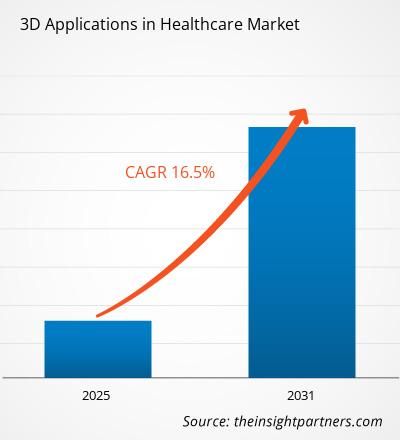
The 3D Applications in Healthcare Market is witnessing a significant transformation as healthcare providers increasingly adopt additive manufacturing technologies for personalized patient care, surgical planning, and advanced medical device production. The market was valued at US$ 2.42 Billion in 2025 and is projected to reach US$ 6.58 Billion by 2034, expanding at a CAGR of 11.77% during 2026–2034. Rising demand for patient-specific implants, customized prosthetics, and precision medical solutions continues to accelerate adoption across hospitals, laboratories, and medical device manufacturers.
North America remains a pivotal contributor to the 3D Applications in Healthcare Market, supported by advanced healthcare infrastructure, favorable reimbursement pathways, and strong innovation ecosystems. The regional market is anticipated to expand at an estimated CAGR of approximately 11.2% through 2034. Increasing investments in personalized medicine, growing utilization of 3D-printed anatomical models, and widespread adoption of digital surgical planning solutions are strengthening the region’s competitive position.
3D Applications in Healthcare Market Assessment and Insights
- Market Size (2025): US$ 2.42 Billion
- Market Size (2034): US$ 6.58 Billion
- CAGR (2026–2034): 11.77%
- Leading Region: North America
- Fastest-Growing Region: Asia Pacific
- Leading Segment: Prosthetics
- Key Innovation/Competitive Trend: Patient-specific bioprinting and AI-integrated surgical modeling
Source: The Insight Partners' analysis based on proprietary research, government publications, company annual reports, investor presentations, industry databases, and expert interviews.
The market has progressed from niche prototyping applications toward clinically integrated healthcare solutions. Advances in imaging technologies, material science, and regulatory frameworks have enabled 3D printing platforms to deliver greater accuracy, reproducibility, and scalability. Healthcare providers increasingly employ these technologies to improve surgical outcomes while reducing procedural complexity and treatment timelines.
Future expansion will be shaped by advances in tissue engineering, regenerative medicine, and decentralized manufacturing models. Hospitals are increasingly establishing point-of-care 3D printing facilities, enabling rapid production of patient-specific devices. As healthcare systems prioritize precision medicine and operational efficiency, adoption is expected to broaden across multiple clinical specialties.
3D Applications in Healthcare Market Report Scope
| Report Attribute | Details |
|---|---|
| Market size in 2025 | US$ 2.42 Billion |
| Market Size by 2034 | US$ 6.58 Billion |
| Global CAGR (2026 - 2034) | 11.77% |
| Historical Data | 2021-2024 |
| Forecast period | 2026-2034 |
3D Applications in Healthcare Market Analysis
Growing demand for personalized treatment approaches is fundamentally reshaping healthcare manufacturing processes. Healthcare institutions are utilizing 3D technologies to create customized implants, prosthetics, dental devices, and surgical guides tailored to individual patient anatomy. This capability improves clinical precision while reducing complications associated with standardized devices.
The value chain encompasses software developers, imaging technology providers, material suppliers, printer manufacturers, healthcare institutions, and regulatory bodies. Collaboration among these stakeholders supports continuous innovation and facilitates commercialization of increasingly sophisticated healthcare applications.
Competition is characterized by technological differentiation, regulatory expertise, and application-specific specialization. Companies such as 3D Systems, Inc, Stratasys Ltd, Materialise NV, SLM Solutions Group AG, Organovo Holdings, Inc., PRODWAYS GROUP, Nano Dimension, ExOne, ENVISIONTEC, INC, and CELLINK AB are expanding healthcare portfolios through product innovation and strategic partnerships.
Investment activity remains concentrated in bioprinting, tissue engineering, and advanced implant manufacturing. Market participants are allocating resources toward automation, software integration, and novel biomaterials to strengthen competitive positioning. Long-term success increasingly depends on the ability to combine manufacturing efficiency with clinical validation and regulatory compliance.
● REPORT CUSTOMIZATION
Tailor This Report To Align With Your Specific Business Requirements
This report can be customized to align precisely with your business objectives, scope, and target markets. Customization options include tailored segmentation, geography, competitive analysis, and strategic insights to support informed decision-making.
Customize This Report →WHAT YOU CAN ADJUST
- ● Segmentations
- ● Geography
- ● Competitive Analysis
- ● Language Preferences
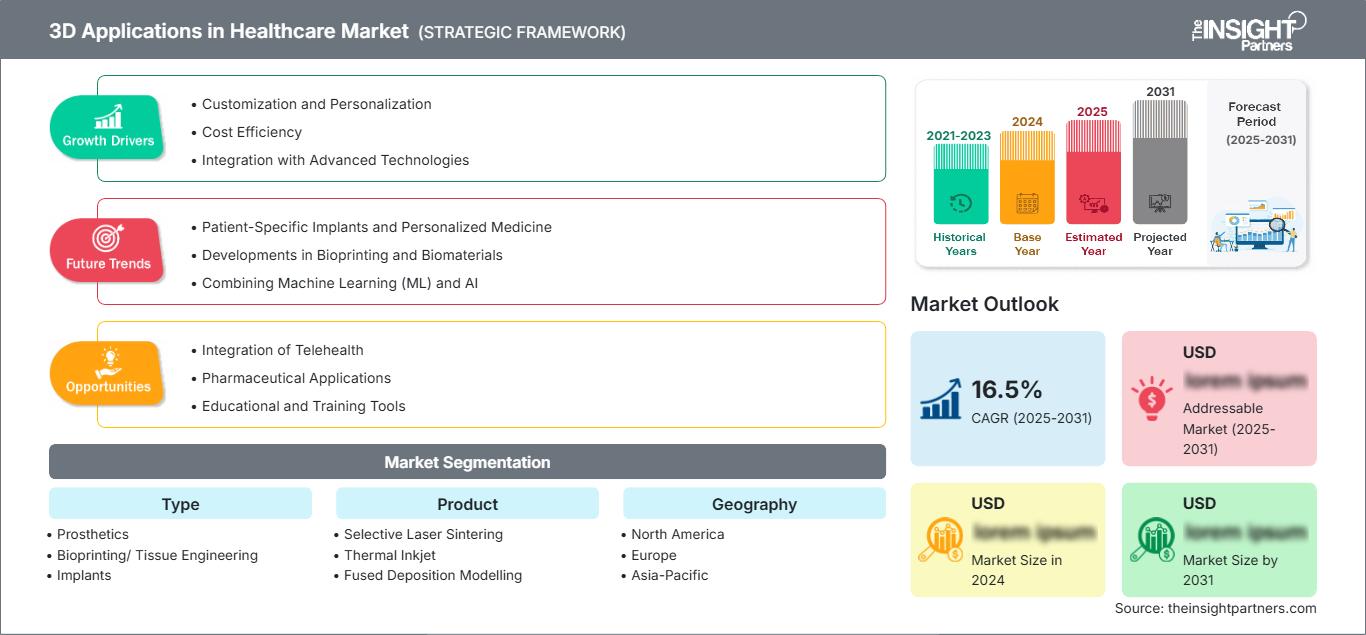
3D Applications in Healthcare Market: Strategic Insights
Regional Insights
North America 3D Applications in Healthcare Market
North America accounts for the largest share of the global market and is expected to maintain leadership throughout the forecast period, supported by an estimated CAGR of 11.2%. Strong adoption of personalized healthcare technologies, advanced hospital networks, and robust research funding create favorable conditions for market expansion.
The region benefits from close collaboration between healthcare institutions, medical device manufacturers, and technology developers. The growing use of patient-specific implants, surgical planning models, and bioprinted tissues continues to drive commercialization opportunities across orthopedic, dental, and reconstructive procedures.
U.S. 3D Applications in Healthcare Market
The U.S. represents approximately 75–80% of the North American market and is projected to expand at a CAGR exceeding 11%. The country's leadership position is supported by extensive healthcare spending, strong regulatory pathways, and a highly developed medical technology ecosystem.
Major industry participants maintain substantial operational footprints across the U.S., supporting continuous innovation in implant manufacturing, dental applications, and surgical simulation. Hospitals increasingly integrate 3D printing laboratories into clinical workflows, enabling rapid development of anatomical models and customized treatment solutions.
Europe 3D Applications in Healthcare Market
Europe accounts for approximately 25–30% of global revenue and continues to demonstrate strong adoption of advanced healthcare manufacturing technologies. The regional market is projected to expand at a CAGR of nearly 11%, supported by favorable research initiatives and increasing investments in precision medicine.
Germany remains the leading country within the European market due to its strong medical device manufacturing capabilities and advanced industrial base. The country's healthcare providers increasingly adopt customized implant solutions and digital surgical planning technologies.
The UK, France, Italy, and Spain are experiencing growing utilization of healthcare-focused additive manufacturing solutions. Research institutions across these countries are actively exploring tissue engineering, bioprinting, and regenerative medicine applications, supporting long-term market development.
APAC 3D Applications in Healthcare Market
Asia Pacific is expected to register the fastest growth, with a CAGR approaching 13%. The region currently contributes approximately 20–25% of global revenue and benefits from expanding healthcare infrastructure, increasing healthcare expenditure, and supportive government initiatives.
China leads regional demand owing to substantial investments in medical technology innovation and domestic manufacturing capabilities. The country continues to expand applications across dental, orthopedic, and surgical planning segments.
Japan, South Korea, India, and Australia are also strengthening market participation through research funding, digital healthcare adoption, and growing acceptance of personalized medical devices. Policy initiatives promoting healthcare modernization further support adoption.
Middle East & Africa 3D Applications in Healthcare Market
The Middle East & Africa market is gradually expanding as healthcare systems pursue modernization initiatives and advanced medical technologies. The region is expected to register a CAGR exceeding 10% during the forecast period.
Saudi Arabia leads regional adoption, supported by healthcare transformation programs and increasing investments in specialized medical facilities. The UAE is also actively integrating advanced digital healthcare technologies into clinical environments.
South Africa and the broader MEA region are witnessing growing interest in customized implants, surgical planning tools, and medical education applications. Expanding healthcare infrastructure and technology partnerships continue to support long-term development opportunities.
Segmentation Analysis
Type
- Prosthetics: Customized prosthetic devices remain the largest application area, enabling personalized fit, improved functionality, reduced manufacturing timelines, and enhanced patient comfort across orthopedic and rehabilitation settings.
- Bioprinting/Tissue Engineering: Rapid advancements in biomaterials and regenerative medicine are driving adoption for tissue scaffolds, organ models, and experimental therapeutic applications supporting future healthcare innovation.
- Implants: Patient-specific implants improve anatomical compatibility and surgical outcomes while supporting complex orthopedic, craniofacial, and spinal reconstruction procedures requiring high-precision manufacturing.
- Imaging: Three-dimensional visualization technologies facilitate preoperative planning, clinician training, diagnostic accuracy improvement, and enhanced communication between medical professionals and patients.
Product
- Selective Laser Sintering: Widely used for manufacturing durable and complex medical components requiring high precision, material flexibility, and strong mechanical performance characteristics.
- Thermal Inkjet: Increasingly utilized in bioprinting applications where controlled deposition of biological materials supports tissue engineering and regenerative medicine research activities.
- Fused Deposition Modelling: Cost-effective technology widely adopted for anatomical models, educational applications, and customized healthcare devices requiring rapid prototyping capabilities.
Opportunity Snapshot
| Product | Revenue Contribution | Trend Tag | Adoption Stage |
| Selective Laser Sintering | High | Custom Implants | Mature |
| Thermal Inkjet | Medium | Bioprinting | Scaling |
| Fused Deposition Modelling | High | Surgical Models | Mature |
| Others | Low | Material Innovation | Emerging |
3D Applications in Healthcare Market Growth Drivers and Impact Analysis
Growing Demand for Personalized Medical Solutions
Personalization has become a defining trend across modern healthcare systems. Traditional manufacturing methods often struggle to accommodate patient-specific anatomical requirements, creating opportunities for 3D technologies to deliver customized solutions. Healthcare providers increasingly utilize personalized implants, prosthetics, and surgical guides that align precisely with individual patient characteristics. This capability improves treatment outcomes, reduces surgical complications, and enhances patient satisfaction.
The impact extends beyond clinical performance. Customized manufacturing reduces inventory requirements and minimizes waste associated with conventional production methods. As healthcare systems emphasize precision medicine and value-based care, demand for patient-specific solutions continues to rise. This driver influences purchasing decisions among hospitals, medical device manufacturers, and healthcare providers while creating sustained demand for advanced additive manufacturing technologies.
Expansion of Bioprinting and Regenerative Medicine Research
Research efforts focused on tissue engineering and regenerative medicine are significantly expanding the scope of healthcare-focused additive manufacturing. Bioprinting technologies are enabling researchers to develop complex tissue structures, disease models, and experimental therapeutic solutions with increasing sophistication. Growing investments from academic institutions, biotechnology firms, and healthcare organizations are accelerating technological advancement.
The market impact is substantial because bioprinting extends additive manufacturing beyond device production into biological applications. While commercial adoption remains in relatively early stages, continued research progress is attracting investment and fostering collaboration across scientific disciplines. This evolving ecosystem is expected to generate new revenue streams and reshape future healthcare treatment paradigms.
Rising Adoption of Surgical Planning and Point-of-Care Manufacturing
Healthcare institutions increasingly recognize the value of 3D-printed anatomical models and point-of-care manufacturing capabilities. Surgeons utilize patient-specific models to improve procedural planning, reduce operating room time, and enhance surgical precision. These benefits are particularly relevant for complex orthopedic, cardiovascular, and reconstructive procedures.
Point-of-care manufacturing enables healthcare providers to produce customized devices closer to the patient, reducing lead times and improving responsiveness. The growing establishment of hospital-based 3D printing laboratories reflects a broader shift toward decentralized healthcare manufacturing. This trend supports stronger clinical integration and creates sustained demand for software, printers, materials, and specialized expertise.
3D Applications in Healthcare Market Future Trends
Integration of Artificial Intelligence with Medical 3D Printing
Artificial intelligence is increasingly being integrated into healthcare-focused additive manufacturing workflows. AI-driven design optimization, automated segmentation of medical imaging data, and predictive manufacturing analytics are improving efficiency throughout the production process. These capabilities reduce manual intervention while enhancing consistency and accuracy.
Future developments are expected to support fully automated workflows connecting imaging, design, manufacturing, and clinical deployment. Healthcare providers will increasingly leverage AI-enhanced systems to accelerate personalized treatment development. The convergence of AI and additive manufacturing is likely to strengthen scalability and expand adoption across additional medical specialties.
Transition Toward Functional Bioprinted Tissues
Bioprinting, at long last, has moved from a concept explored in lab experiments to the production of tissues and implants in a clinical context. Researchers are advancing technologies capable of printing vascular tissues, implantable cells, and implants that are bioactive, as well as the next generation of regenerative medicine systems.
In the future, refinements to print processes and bioprinting materials are expected to result in greater advances and new products. Eventually, patients, doctors, scientists, and regulators anticipate greater application of printed tissues for the testing of drugs, models to test how diseases affect living organisms, and even as replacements for tissue in the body. Despite the regulatory and technological hurdles that may need to be cleared, the continued trend of investment in bioprinting technology implies its promise in the healthcare sector of additive manufacturing.
3D Applications in Healthcare Market Opportunities
Expansion of Healthcare Manufacturing in Emerging Markets
Emerging economies are investing heavily in healthcare modernization and medical technology adoption. Many healthcare systems face challenges associated with limited access to customized medical devices and specialized manufacturing capabilities. Additive manufacturing offers a practical solution by enabling localized production and reducing reliance on complex supply chains.
Investment opportunities span equipment implementation, training, software systems, and material creation. Companies that offer a scalable, affordable product line for local health needs are well-positioned. Collaborative agreements with hospital systems, academic centers, and government entities can fast-track adoption and secure long-term competitive advantages.
Commercialization of Advanced Tissue Engineering Platforms
Commercialization of tissue engineering and regenerative medicine technologies offers great promise in the long run. Innovations in the field of biomaterials, cellular growth processes, and bioprinting are opening up possibilities for the creation of next-generation health care products and services.
Organizations engaging in translational research and clinical studies can reap first-mover benefits in the future when the process of commercialization gets underway. Cooperation between biotech companies and healthcare organizations will spur innovations and lead to the development of novel solutions and significant revenue generation.
Recent Developments
- August 2025: 3D Systems Corporation reported that its regenerative medicine collaboration with United Therapeutics achieved a new human lung manufacturing milestone. The advancement reflects continuing progress in bioprinting and tissue engineering, reinforcing industry efforts to develop functional biological structures through additive manufacturing technologies.
- March 2025: Materialise NV announced that its bioresorbable 3D-printed tracheobronchial splint entered a pivotal FDA clinical trial in collaboration with the University of Michigan. The study aims to evaluate a novel implant designed for pediatric airway conditions and represents a significant milestone in healthcare-focused additive manufacturing and regenerative medicine.
- April, 2024: 3D Systems announced the Food and Drug Administration (FDA) has provided 510(k) clearance for its 3D-printed, patient-specific cranial implant solution, VSP PEEK Cranial Implant. VSP PEEK Cranial Implant includes a complete FDA-cleared workflow comprising segmentation and 3D modeling software, the 3D Systems EXT 220 MED 3D printer, Evonik VESTAKEEP i4 3DF PEEK (polyether ether ketone), and a predefined production process. 3D-printed PEEK implants using the EXT 220 MED have been successfully demonstrated in nearly 40 cranioplasties across Europe in recent months.
Frequently Asked Questions

- Comprehensive Market Sizing and Forecast Analysis
- Detailed Segmentation Analysis
- In-Depth Market Dynamics Assessment
- Regional and Country-Level Insights
- Competitive Landscape and Company Benchmarking
- Strategic Business Intelligence
Recent Reports
Testimonials

The Insight Partners' SCADA System Market report is comprehensive, with valuable insights on current trends and future forecasts. The team was highly professional, responsive, and supportive throughout. We are very satisfied and highly recommend their services.
RAN KEDEM Partner, Reali Technologies LTDs
I requested a report on a very specific software market and the team produced the report in a few days. The information was very relevant and well presented. I then requested some changes and additions to the report. The team was again very responsive and I got the final report in less than a week.
JEAN-HERVE JENN Chairman, Future Analytica
We worked with The Insight Partners for an important market study and forecast. They gave us clear insights into opportunities and risks, which helped shape our plans. Their research was easy to use and based on solid data. It helped us make smart, confident decisions. We highly recommend them.
PIYUSH NAGPAL Sr. Vice President, High Beam Global
The Insight Partners delivered insightful, well-structured market research with strong domain expertise. Their team was professional and responsive throughout. The user-friendly website made accessing industry reports seamless. We highly recommend them for reliable, high-quality research services
YUKIHIKO ADACHI CEO, Deep Blue, LLC.
This is the first time I have purchased a market report from The Insight Partners.While I was unsure at first, I visited their web site and felt more comfortable to take the risk and purchase a market report.I am completely satisfied with the quality of the report and customer service. I had several questions and comments with the initial report, but after a couple of dialogs over email with their analyst I believe I have a report that I can use as input to our strategic planning process.Thank you so much for taking the extra time and making this a positive experience.I will definitely recommend your service to others and you will be my first call when we need further market data.
JOHN SUZUKI President and Chief Executive Officer, Board Director, BK Technologies
I wish to appreciate your support and the professionalism you displayed in the course of attending to my request for information regarding to infectious disease IVD market in Nigeria. I appreciate your patience, your guidance, and the fact that you were willing to offer a discount, which eventually made it possible for us to close a deal. I look forward to engaging The Insight Partners in the future, all thanks to the impression you have created in me as a result of this first encounter.
DR CHIJIOKE ONYIA MANAGING DIRECTOR, PineCrest Healthcare Ltd.Reason to Buy
- Informed Decision-Making
- Understanding Market Dynamics
- Competitive Analysis
- Identifying Emerging Markets
- Customer Insights
- Market Forecasts
- Risk Mitigation
- Boosting Operational Efficiency
- Strategic Planning
- Investment Justification
- Tracking Industry Innovations
- Aligning with Regulatory Trends





 Get Free Sample for