
3D Concrete Printing Market Growth, Demand & Size by 2034
Coverage: by Concrete Type (Ready-mix, High-density, Precast, Shotcrete); Product Type (Walls, Floors and Roofs, Panels and Lintels, Staircases, Others); End Users (Residential, Commercial, Infrastructural, Architectural) , and Geography (North America, Europe, Asia Pacific, and South and Central America)
- Status : Data Released
- Report Code : TIPRE00006600
- Category : Manufacturing and Construction
- No. of Pages : 150
- Available Report Formats :


- Last update date : July 13, 2026


2025 Market Size
US$ 810.0 Mn
Base year value
2034 Forecast
US$ 16,210.38 Mn
Projected by 2034
CAGR 2026-2034
39.51 %
Growth rate
Addressable Market
US$ 54,397.25 Mn
(2026-2034)
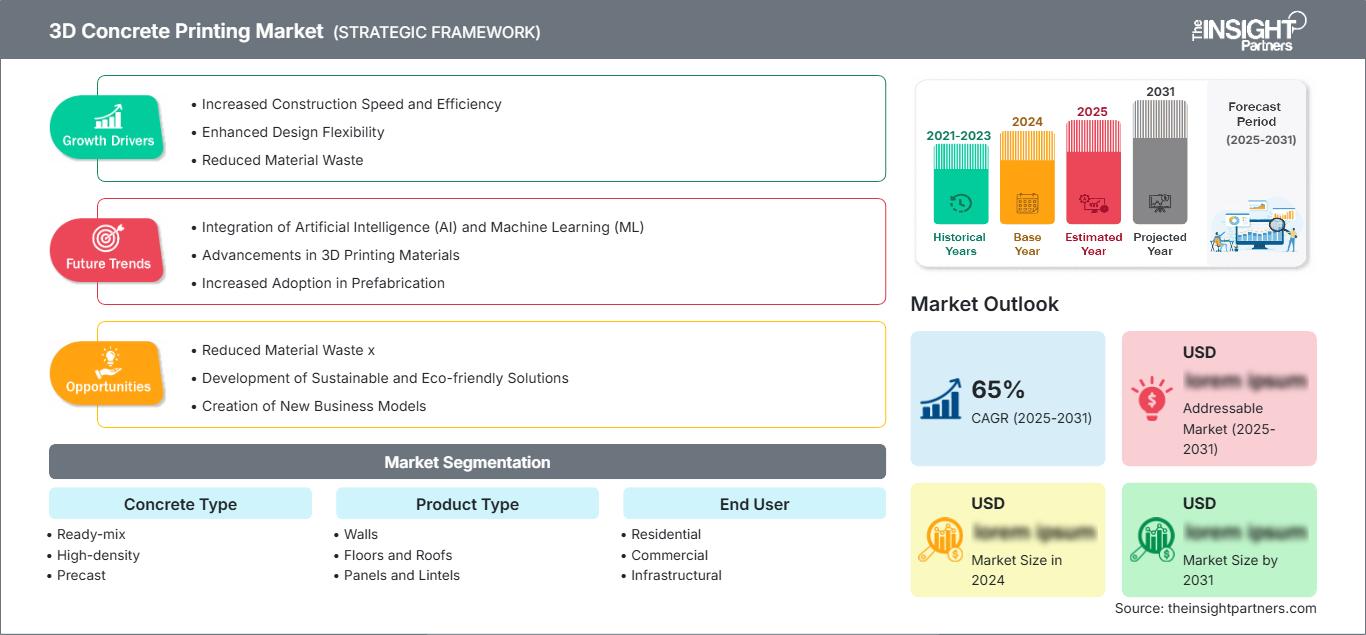
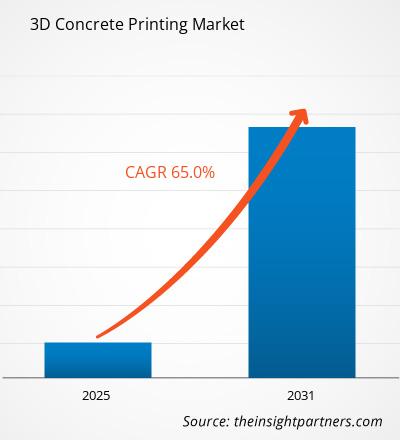
The global 3D Concrete Printing market was valued at US$ 810 million in 2025 and is expected to reach US$ 16210.38 million by 2034; it is estimated to record a CAGR of 39.51% during 2026-2034.
3D Concrete Printing Market Assessment and Insights
- North America: Share in 2025 stood at 30–33%, with CAGR between 2026 – 2034 of 42–46%, supported by automated construction pilots, labor shortages, and clearer code pathways.
- US: The U.S. represented 78–82% of North America 3d concrete printing market in 2025 and is growing at 43–47% CAGR, led by residential and commercial printing projects.
- Europe: Share in 2025 stood at 25–28%, with CAGR between 2026 – 2034 of 40–44%; the UK, Germany, France, and the Netherlands lead deployment.
- Asia Pacific: Share in 2025 reached 29–32%, with CAGR between 2026 – 2034 of 47–51%, led by China, Japan, India, South Korea, and Australia.
- Largest Segment: Walls held 39–43% 3d concrete printing market share in 2025 and is expected to grow at 43–47% CAGR due to direct structural relevance.
- High Growth Segment: Infrastructural end use held 17–20% 3d concrete printing market share in 2025 and is expected to grow at 49–53% CAGR as civil pilots scale.
- Key companies analyzed in detail: Carillion plc, DUS Architects, Heidelberg Materials AG, Holcim Ltd, Monolite UK Ltd, Putzmeister Concrete Machines Pvt. Ltd., Sika AG, Skanska UK Plc, XtreeE, Yingchuang Building Technique (Shanghai) Co., Ltd., COBOD International A/S, ICON Technology, Inc., Apis Cor Inc., CyBe Construction B.V.
Source: The Insight Partners' analysis based on proprietary research, government publications, company annual reports, investor presentations, industry databases, and expert interviews.
The 3d concrete printing market has moved from experimental single-wall demonstrations toward integrated construction systems combining printable mixes, gantry equipment, robotic arms, digital design files, and site-based quality controls. More and more, contractors are measuring the performance of 3D concrete printing methods that require a lot of formwork, labor, and waste. The most significant trend towards production involves building walls, panels, and façades that have been proven to meet structural standards and reinforced conventionally.
Progress in terms of adoption will be driven by APAC housing needs, North American building codes, and low-carbon European construction initiatives. New territories are piloting construction in order to measure the costs, speed, and resilience, while investment interests lie in the efficiency of machinery, printable mixes, and construction-as-a-service approaches.
The 3d concrete printing market scope is widening as public agencies, developers, and engineering firms align automation with safety approval, workforce constraints, and sustainability targets.
3D Concrete Printing Market Report Scope
| Report Attribute | Details |
|---|---|
| Market size in 2025 | US$ 810.0 Million |
| Market Size by 2034 | US$ 16,210.38 Million |
| Global CAGR (2026 - 2034) | 39.51% |
| Historical Data | 2021-2024 |
| Forecast period | 2026-2034 |
3D Concrete Printing Market Analysis
Demand is based on quick delivery, lesser reliance on limited site labor, and more efficient use of materials. The value chain involves cement companies, admixture manufacturers, printer OEMs, building information modeling software vendors, engineering consultants, and construction companies. The printable concrete has to achieve a balance between pumpability, open time, layerability, and early strength, thereby making material science vital to its adoption.
Supply conditions are still unbalanced because of differences in equipment prices, operator training needs, and certification requirements depending on the countries involved. Nonetheless, 3d concrete printing sizes are growing due to standardized wall systems, pre-cast elements, and hybrid of-site/onsite printing that minimize risks involved. Utilization is seen to be higher when printing similar components for many projects is possible by construction companies.
The competitive landscape in the 3d concrete printing market report includes cement majors, construction groups, robotics specialists, and dedicated additive-construction firms. Heidelberg Materials AG, Holcim Ltd, Sika AG, COBOD International A/S, ICON Technology, Inc., XtreeE, Apis Cor Inc., and CyBe Construction B.V. compete through material certification, printer scalability, partnerships, and project evidence rather than pure hardware differentiation.
Investments are moving towards holistic ecosystems comprised of equipment leasing, print services, proprietary mortars, and digital construction designs. Strategic positioning should be inclined towards organizations that have the capability to convert demonstrations into insured and permissible repetitive builds. The 3d concrete printing analysis will thus depend on code acceptance, supply chain readiness, material testing, and partnerships with traditional contractors.
● REPORT CUSTOMIZATION
Tailor This Report To Align With Your Specific Business Requirements
This report can be customized to align precisely with your business objectives, scope, and target markets. Customization options include tailored segmentation, geography, competitive analysis, and strategic insights to support informed decision-making.
Customize This Report →WHAT YOU CAN ADJUST
- ● Segmentations
- ● Geography
- ● Competitive Analysis
- ● Language Preferences
3D Concrete Printing Market: Strategic Insights
Regional Insights
North America 3d concrete printing
North America accounted for 30–33% 3d concrete printing market share in 2025 and is projected to grow at 42–46% CAGR from 2026 to 2034. Demand is shaped by housing shortages, high construction wages, military construction interest, and commercial pilots using automated wall systems. Code bodies are also advancing guidance for 3D automated concrete walls, improving permitting confidence.
Adoption is mostly seen in the United States, with Canada supporting through innovations in sustainable concrete production and modular construction. The region has a good amount of venture capital, specialized contractors, and partnerships between printer providers and developers. The share of 3D concrete printing in North America will continue to be high as earlier projects create reference designs for scaling up.
U.S. 3d concrete printing Market
The U.S. represented 78–82% of North America 3d concrete printing market in 2025 and is projected to grow at 43–47% CAGR through 2034. Demand is strongest in affordable housing, defense-related structures, disaster-resilient buildings, retail extensions, and demonstration neighborhoods. ICON Technology, Inc., COBOD International A/S partners, Apis Cor Inc., and material suppliers support the ecosystem.
It is apparent from the application trend that the industry is moving away from building prototypes to constructing communities and walls, along with combination of printing and conventional systems. However, even permit regulations vary from one state to another. Standards are becoming more defined and inspections are successful which makes lenders, insurance companies, and developers more confident. United States is the benchmark for the region due to the visibility of projects.
Europe 3d concrete printing Market
Europe held 25–28% 3d concrete printing market share in 2025 and is projected to grow at 40–44% CAGR. The UK leads through commercial construction trials, public-sector interest, and construction productivity programs involving Skanska UK Plc and specialized engineering partners.
Germany represents one of the top countries owing to the development of its cement chemistry, machinery engineering, and standard-based construction approach. Heidelberg Materials AG, Sika AG, and automation companies promote validation of printable materials in walls, panels, and architecture.
France, Italy, and Spain offer contributions in the form of architectural implementations, concept of infrastructure repair, and low carbon buildings. The role of XtreeE company has been instrumental in making France an important contributor to structural and architectural printing.
APAC 3d concrete printing Market
APAC accounted for 29–32% 3d concrete printing market share in 2025 and is projected to grow at 47–51% CAGR. China leads regional deployment through large-scale urbanization, prefabrication capacity, and companies such as Yingchuang Building Technique (Shanghai) Co., Ltd.
Japan and South Korea focus on automation, earthquake-conscious designing, and robotic precision in construction. India is exploring the potential of printing houses and infrastructure elements due to the increasing demands in the cities.
In Australia, adoption is facilitated by the need for remote construction, mining infrastructure, and sustainable construction efforts. Favorable policies regarding industrialized construction and low-labor intensity on-site facilitate regional 3D concrete printing development.
Middle East & Africa 3d concrete printing Market
The Middle East & Africa 3d concrete printing market is projected to grow at 44–48% CAGR through 2034. Saudi Arabia is the leading country, supported by megaprojects, industrialized construction, and demand for rapid infrastructure delivery.
The UAE is still in the process of printing municipalities buildings, villas, and public properties through digital construction processes. Energy-based infrastructure and logistic centers present other applications for the technology.
South Africa, along with the remainder of MEA countries, is in an earlier stage of adopting the technology and is mainly concerned with affordable housing, resilient construction, and remote site building.
Segmentation Analysis
Concrete Type
The concrete type segment is projected to grow at 43–47% CAGR from 2026 to 2034. Demand depends on mix design that supports extrusion, rapid setting, interlayer bonding, and durability. Suppliers are prioritizing printable formulations that reduce rebound, shrinkage, and pumping risk while meeting structural requirements for walls, panels, and load-bearing elements.
- Ready-mix concrete holds strategic value because it aligns with existing batching networks and contractor procurement habits, enabling faster commercialization where local plants can adjust rheology for printer compatibility.
- High-density concrete supports specialized applications requiring shielding, mass, or durability, but adoption depends on pumpability, nozzle wear, and validation against project-specific structural and safety requirements.
- Precast concrete benefits from controlled factory conditions, making it suitable for repeatable printed components, quality inspection, and integration with modular construction programs.
- Shotcrete overlaps with additive placement in repair, tunneling, and vertical surface applications, creating opportunities where robotic deposition can improve accuracy and reduce rebound.
Product Type
The product type segment is projected to grow at 44–48% CAGR from 2026 to 2034. Walls dominate because they are direct, repetitive, and easier to demonstrate in permitted structures. Floors, roofs, panels, lintels, and staircases will gain traction as printers, reinforcement strategies, and finishing systems become more standardized.
- Walls remain the core printed element because they reduce formwork, enable curved geometries, and offer visible schedule advantages across residential and commercial projects.
- Floors and roofs require stronger integration with reinforcement, services, waterproofing, and load design, making adoption more selective but important for full-building automation.
- Panels and lintels suit factory production, repeatable quality checks, and architectural customization, supporting façade, opening, and modular assembly strategies.
- Staircases benefit from design freedom and reduced mold complexity, especially in architectural projects where customized geometry increases conventional fabrication cost.
End User
The end user segment is projected to grow at 45–49% CAGR from 2026 to 2034. Residential applications currently drive visibility, while commercial and infrastructural demand will determine scale. Architectural users expand premium design applications, but broader adoption depends on developers proving repeatability, cost control, and compliance across multiple projects.
- Residential demand is shaped by affordable housing, disaster recovery, and faster community development, making it the most visible route for public acceptance and permitting confidence.
- Commercial users adopt printed walls and extensions where speed, branding flexibility, and reduced disruption improve project economics for retail, hospitality, and institutional properties.
- Infrastructural users represent the fastest strategic opportunity as printed drainage, retaining, utility, and transport components move from trials toward repeatable civil procurement.
- Architectural users value complex geometry, bespoke façades, and low-volume customization, helping demonstrate design capability even when project volumes remain comparatively limited.
Opportunity Snapshot
| End User | Revenue Contribution | Trend Tag | Adoption Stage |
| Residential | High | Affordable Housing | Scaling |
| Commercial | Medium | Retail Extensions | Scaling |
| Infrastructural | Medium | Civil Components | Emerging |
| Architectural | Low | Custom Façades | Emerging |
3D Concrete Printing Market Growth Drivers and Impact Analysis
Labor Shortages Accelerate Construction Automation
Restrictions of construction labor force are making developers and contractors take into consideration the technology of automated placement systems that lower the reliance on big teams of workers. It works most effectively in places where the labor force is expensive, aging, and under time pressure. 3D concrete printing The process of adoption becomes more efficient when printing machines perform routine construction of walls with smaller teams of supervised workers. In this case, professionals can concentrate on reinforcement and finishing.
Material Efficiency Supports Low-Waste Building
The pressure is on developers to reduce waste, embodied carbon dioxide, and site disruption while ensuring that structural strength is still achieved. In additive manufacturing, materials are used precisely as digitally designed; there is no need for formwork, and less concrete will be used. The commercial implications of the technology are seen in walls, panels, and structures where complex shapes will require molds and much cutting work. Cement producers and admixtures producers are working on mixes that can be printed while meeting strength and durability needs.
Code Development Improves Project Bankability
Uncertainty has been a major hurdle to the growth of structural 3D printing. As codes and standards organizations formulate qualification criteria for concrete wall and structural printing, designers have more paths to gaining acceptance, insurability, and financing. It increases the bankability of such technology since investors and the government want proof of performance, inspections, and liability guidelines. The codes-related trends for 3d concrete printing will be the most important factor influencing how fast certain regions adopt the technology beyond demonstrations into actual purchases.
3D Concrete Printing Market Future Trends
Hybrid Printed-Conventional Construction Becomes Standard
A key 3d concrete printing market trend is that future projects are likely to combine printed walls, conventional foundations, prefabricated reinforcement, mechanical systems, and traditional finishes rather than replacing the full construction process. This hybrid model reduces risk because contractors can automate the most repetitive or geometry-sensitive portions while retaining familiar trades for regulated assemblies. It also supports phased adoption by municipalities and insurers. Over time, digital design files, sensor-based quality monitoring, and standardized print recipes will help hybrid construction become a normal procurement option for housing and commercial buildings.
Printable Low-Carbon Binders Gain Priority
Material innovation will shift from basic printability toward verified low-carbon performance. Cement producers and admixture specialists are expected to develop blends using supplementary cementitious materials, optimized particle packing, and accelerators that maintain open time and layer stability. This trend is strategically important because public infrastructure and green-building programs increasingly evaluate embodied carbon. Companies that can document structural performance, durability, and carbon reduction in printable mixes will gain stronger positions in competitive tenders and developer-led sustainability programs.
3D Concrete Printing Market Opportunities
Infrastructure Components Offer Repeatable Scale
Infrastructure presents an actionable opportunity because many components are repeatable, performance-based, and suitable for factory or near-site production. Drainage units, retaining elements, utility structures, barriers, and bridge-related components can be printed with consistent geometry and inspected before installation. Contractors and public agencies can start with non-critical or semi-structural elements, then expand to higher-value civil assets after validation. This pathway can improve equipment utilization, reduce mold inventories, and create procurement models that reward speed, customization, and lower site disruption.
Affordable Housing Programs Create Deployment Platforms
Public and private affordable housing programs can turn scattered demonstrations into repeatable deployment platforms. The opportunity lies in standardizing home layouts, wall designs, reinforcement details, and inspection protocols across multiple units. This improves printer utilization and reduces learning-curve costs. Developers can also use printed construction to shorten schedules in regions facing land, labor, and financing pressures. Partnerships among municipalities, material suppliers, printer OEMs, and builders will be essential to convert technology pilots into scalable housing delivery models.
Recent Developments
- February 2025: COBOD International A/S — industry coverage reported continued expansion of 3D construction printing projects and commercial adoption, including systems used for large printed buildings and infrastructure-related demonstrations, reinforcing the role of gantry platforms in scaling additive construction.
- February 2025: Alquist 3D — U.S. construction coverage highlighted 3D-printed commercial additions for Walmart locations, showing that printed concrete walls are moving beyond homes into retail and commercial property extensions requiring permitting, inspection, and schedule discipline.
- 2024: ICON Technology, Inc. — the company continued advancing printed residential communities and automated construction systems in the U.S., strengthening market confidence in repeatable housing applications, robotics-enabled wall production, and integrated design-to-build workflows.
Frequently Asked Questions

- Comprehensive Market Sizing and Forecast Analysis
- Detailed Segmentation Analysis
- In-Depth Market Dynamics Assessment
- Regional and Country-Level Insights
- Competitive Landscape and Company Benchmarking
- Strategic Business Intelligence
Recent Reports
Testimonials

The Insight Partners' SCADA System Market report is comprehensive, with valuable insights on current trends and future forecasts. The team was highly professional, responsive, and supportive throughout. We are very satisfied and highly recommend their services.
RAN KEDEM Partner, Reali Technologies LTDs
I requested a report on a very specific software market and the team produced the report in a few days. The information was very relevant and well presented. I then requested some changes and additions to the report. The team was again very responsive and I got the final report in less than a week.
JEAN-HERVE JENN Chairman, Future Analytica
We worked with The Insight Partners for an important market study and forecast. They gave us clear insights into opportunities and risks, which helped shape our plans. Their research was easy to use and based on solid data. It helped us make smart, confident decisions. We highly recommend them.
PIYUSH NAGPAL Sr. Vice President, High Beam Global
The Insight Partners delivered insightful, well-structured market research with strong domain expertise. Their team was professional and responsive throughout. The user-friendly website made accessing industry reports seamless. We highly recommend them for reliable, high-quality research services
YUKIHIKO ADACHI CEO, Deep Blue, LLC.
This is the first time I have purchased a market report from The Insight Partners.While I was unsure at first, I visited their web site and felt more comfortable to take the risk and purchase a market report.I am completely satisfied with the quality of the report and customer service. I had several questions and comments with the initial report, but after a couple of dialogs over email with their analyst I believe I have a report that I can use as input to our strategic planning process.Thank you so much for taking the extra time and making this a positive experience.I will definitely recommend your service to others and you will be my first call when we need further market data.
JOHN SUZUKI President and Chief Executive Officer, Board Director, BK Technologies
I wish to appreciate your support and the professionalism you displayed in the course of attending to my request for information regarding to infectious disease IVD market in Nigeria. I appreciate your patience, your guidance, and the fact that you were willing to offer a discount, which eventually made it possible for us to close a deal. I look forward to engaging The Insight Partners in the future, all thanks to the impression you have created in me as a result of this first encounter.
DR CHIJIOKE ONYIA MANAGING DIRECTOR, PineCrest Healthcare Ltd.Reason to Buy
- Informed Decision-Making
- Understanding Market Dynamics
- Competitive Analysis
- Identifying Emerging Markets
- Customer Insights
- Market Forecasts
- Risk Mitigation
- Boosting Operational Efficiency
- Strategic Planning
- Investment Justification
- Tracking Industry Innovations
- Aligning with Regulatory Trends





 Get Free Sample for