
3D Semiconductor Packaging Market Size, Demand & Growth by 2034
Coverage: by Technology (3D Wire Bonded, 3D Through Silicon Via (TSV), 3D Package on Package (PoP), 3D Fan Out Based, Others); Material (Organic Substrate, Bonding Wire, Encapsulation Resins, Ceramic Packages, Leadframe, Others); End-user (Electronics, Automotive and Transportation, Healthcare, IT and Telecommunication, Aerospace and Defense, Others) , and Geography (North America, Europe, Asia Pacific, and South and Central America)
- Status : Data Released
- Report Code : TIPRE00008258
- Category : Electronics and Semiconductor
- No. of Pages : 150
- Available Report Formats :


- Last update date : July 15, 2026


2025 Market Size
US$ 15.74 Bn
Base year value
2034 Forecast
US$ 75.6 Bn
Projected by 2034
CAGR 2026-2034
19.05 %
Growth rate
Addressable Market
US$ 374.14 Bn
(2026-2034)
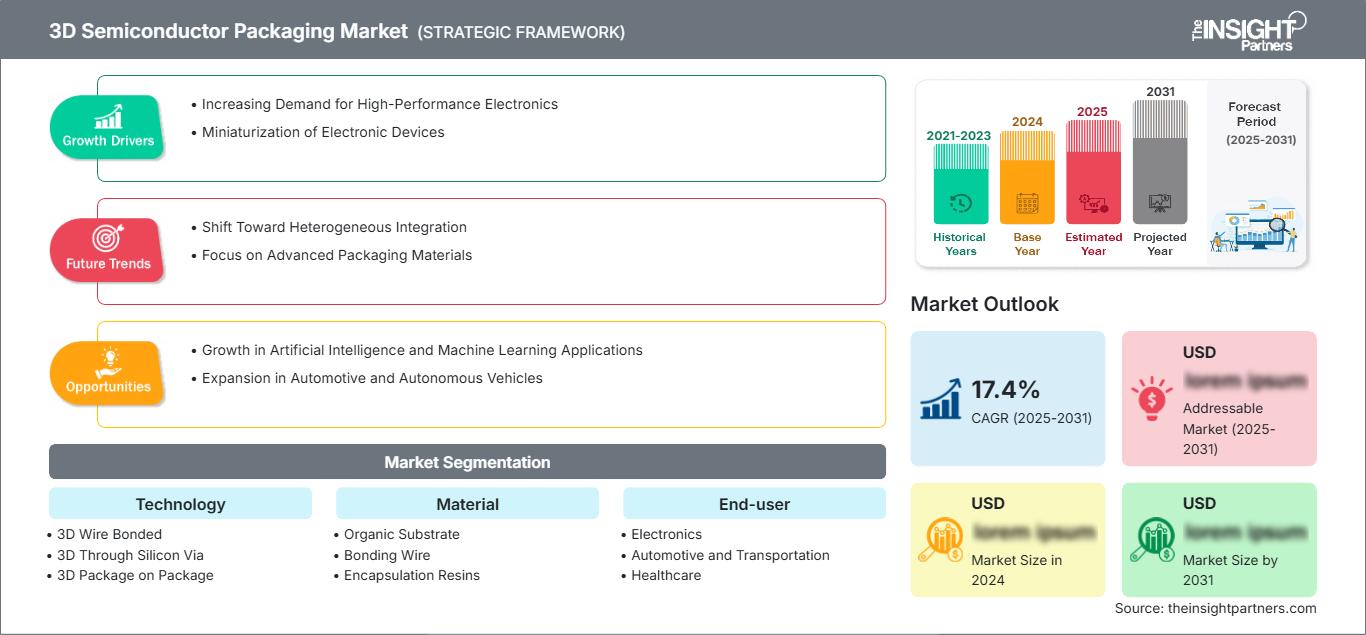
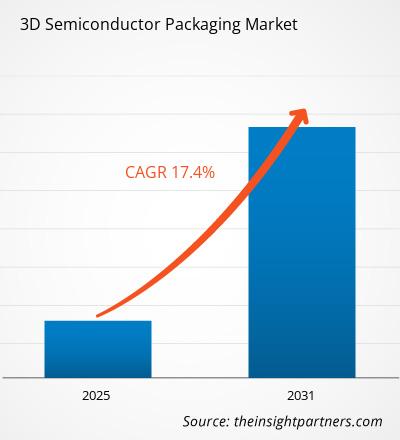
The 3D Semiconductor Packaging market is valued at US$ 15.74 Billion in 2025 and is projected to reach US$ 75.6 Billion by 2034, advancing at a CAGR of 19.05% during 2026–2034. Demand is supported by stacked logic-memory integration, compact electronics, high-bandwidth computing, and semiconductor architectures that use packaging to improve performance, power efficiency, and product footprint.
North America 3D Semiconductor Packaging market is expected to grow at 18.2%–19.4% from 2026 to 2034, supported by AI data-center investment, advanced processor design, defense electronics, and domestic semiconductor programs. Regional demand is reinforced by local assembly-test expansion, chiplet adoption, and high-value applications that require tighter integration, trusted supply, and thermal reliability across computing, telecom, automotive, and aerospace systems.
3D Semiconductor Packaging Market Assessment and Insights
- North America: The region held 27%–31% share in 2025 and is growing at 18.2%–19.4% CAGR between 2026–2034, driven by AI infrastructure, defense electronics, domestic packaging capacity, and chiplet design activity.
- US: The US market represented 80%–87% of North America in 2025 and is growing at 18.5%–19.8% CAGR between 2026–2034, led by AI, telecom, aerospace, and advanced processor programs.
- Europe: Europe market held 14%–18% share in 2025 and is growing at 15.8%–17.0% CAGR between 2026–2034, with Germany, the UK, France, Italy, and Spain leading adoption across automotive, industrial, aerospace, and telecom electronics.
- Asia Pacific: Asia Pacific held 47%–52% of the 3D Semiconductor Packaging market size in 2025 and is growing at 19.5%–20.8% CAGR between 2026–2034, led by Taiwan, China, Japan, South Korea, and India through foundry, OSAT, memory, materials, and electronics manufacturing strength.
- Largest Segment: Technology led by 3D Through Silicon Via accounted for 32%–37% market share in 2025 and is growing at 18.8%–20.2% CAGR between 2026–2034, supported by HBM and advanced logic-memory integration.
- High Growth Segment: End-user demand from IT and Telecommunications held 21%–25% 3D Semiconductor Packaging market share in 2025 and is growing at 20.1%–21.6% CAGR between 2026–2034 as AI servers, optical networking, and 5G systems scale.
- Key companies analyzed in detail: Amkor Technology, Inc.; ASE Technology Holding Co., Ltd.; International Business Machines Corporation; Intel Corporation; JCET Group Co., Ltd.; Qualcomm Technologies, Inc.; Siliconware Precision Industries Co., Ltd.; STMicroelectronics N.V.; SUSS MicroTec SE; Taiwan Semiconductor Manufacturing Company Limited.
Source: The Insight Partners' analysis based on proprietary research, government publications, company annual reports, investor presentations, industry databases, and expert interviews.
The 3D Semiconductor Packaging market report has evolved from conventional package miniaturization toward heterogeneous integration, where interconnect density, thermal behavior, and die partitioning influence final semiconductor performance. Wire-bonded stacks remain relevant in cost-sensitive electronics, while TSV, fan-out, and package-on-package formats are increasingly selected for bandwidth-intensive processors, image sensors, MEMS, and memory-rich designs. Production dynamics are shifting toward earlier collaboration among design teams, foundries, OSATs, substrate suppliers, and test providers.
Forward demand will broaden as India, Southeast Asia, Eastern Europe, and the Gulf invest in electronics manufacturing, telecom networks, cloud infrastructure, and strategic semiconductor programs. Policy support for supply-chain resilience, energy-efficient computing, defense electronics, and medical technology will improve the 3D Semiconductor Packaging scope. Investment will concentrate on hybrid bonding, advanced substrates, thermal materials, and co-design workflows that reduce qualification risk for complex multi-die systems.
3D Semiconductor Packaging Market Report Scope
| Report Attribute | Details |
|---|---|
| Market size in 2025 | US$ 15.74 Billion |
| Market Size by 2034 | US$ 75.6 Billion |
| Global CAGR (2026 - 2034) | 19.05% |
| Historical Data | 2021-2024 |
| Forecast period | 2026-2034 |
3D Semiconductor Packaging Market Analysis
Demand is rising because AI accelerators, 5G infrastructure, connected vehicles, premium smartphones, and portable medical systems need shorter signal paths and higher bandwidth density. The market converts package architecture into a system-level performance lever by reducing parasitic losses, improving form factor, and enabling dissimilar dies to operate as one functional module.
The value chain spans wafer thinning, TSV formation, redistribution layers, bonding wire, organic substrates, ceramic packages, encapsulation resins, leadframes, inspection, and final test. Supply dynamics depend on known-good-die availability, substrate lead times, cleanroom capacity, and thermal qualification. This makes 3D Semiconductor Packaging market analysis increasingly tied to ecosystem coordination rather than assembly cost alone.
Competition is led by companies that can combine design enablement, yield control, and high-volume execution. Taiwan Semiconductor Manufacturing Company Limited influences foundry-linked advanced packaging, Intel Corporation advances EMIB and Foveros integration, while ASE Technology Holding Co., Ltd., Amkor Technology, Inc., and JCET Group Co., Ltd. compete through outsourced assembly-test scale and customer proximity.
Positioning strategy is influenced by International Business Machines Corporation research, Qualcomm Technologies, Inc. mobile and edge computing demands, STMicroelectronics N.V. automotive and sensing technologies, Siliconware Precision Industries Co., Ltd. assembly technology capabilities, and SUSS MicroTec SE process equipment. Capital investments will be in panel-level fan-out, hybrid bonding, testing, and thermally aware packaging.
● REPORT CUSTOMIZATION
Tailor This Report To Align With Your Specific Business Requirements
This report can be customized to align precisely with your business objectives, scope, and target markets. Customization options include tailored segmentation, geography, competitive analysis, and strategic insights to support informed decision-making.
Customize This Report →WHAT YOU CAN ADJUST
- ● Segmentations
- ● Geography
- ● Competitive Analysis
- ● Language Preferences
3D Semiconductor Packaging Market: Strategic Insights
Regional Insights
North America 3D Semiconductor Packaging Market
North America 3D Semiconductor Packaging market held 27%–31% share in 2025 and is projected to grow at 18.2%–19.4% CAGR through 2034. Demand is supported by hyperscale AI computing, defense electronics, aerospace systems, telecom modernization, and policy-backed semiconductor manufacturing. The US CHIPS framework and private investment are drawing increasing attention to domestic advanced packaging and test capacity.
Regional customers have been asking for supply chain security, support for co-design, and high-quality thermal performance over long product lifecycles. Intel Corporation, Amkor Technology, Inc., International Business Machines Corporation, and Qualcomm Technologies, Inc. enhance regional abilities in processor packaging, assembly, research, and applications development. Market share within North America is also driven by advanced medical devices, automotive electronics, and aerospace programs.
U.S. 3D Semiconductor Packaging Market
The US 3D Semiconductor Packaging market accounted for 80%–87% of North American demand in 2025, with an 18.5%- 19.8% CAGR. Applications that consume 3D packaging include AI accelerators, HPC networking, defense systems, aerospace electronics, medical equipment, and premium consumer products. The technology trends in applications include stacking with TSVs, package-on-package, and fan-out packaging.
Company presence is strengthened by Intel Corporation’s packaging technology roadmap, Amkor Technology, Inc.'s Arizona operations, International Business Machines Corporation’s research capabilities, and Qualcomm Technologies, Inc.'s needs in mobile edge computing. Purchasing decisions are determined by access to capacity, die protection, substrate availability, testing capabilities, and reliability data for AI, telecommunications, automotive, and military electronics.
Europe 3D Semiconductor Packaging Market
Europe 3D Semiconductor Packaging market held 14%–18% share in 2025 and is expected to grow at 15.8%–17.0% CAGR. Germany is the dominant market player because of automotive electronics, industrial automation, embedded controls, and power management platforms. Local customers prefer solutions that fulfill functional safety, thermal stability, and long-lifecycle qualification criteria.
The UK 3D Semiconductor Packaging market draws on expertise in telecom research, artificial intelligence hardware, defense electronics, and semiconductor technology engineering. In Germany, the market is seeing greater adoption of automotive computing, industrial automation, and sensor-laden industrial machinery. European designs are manufactured by Asian foundries and OSATs in large volumes while being tightly controlled with respect to reliability specifications.
The involvement of France, Italy, and Spain is based on their requirements for aerospace, medical instruments, telecom infrastructure, and industrial electronics. France is good at defense and avionics, Italy at medical instruments and automation, and Spain at telecom infrastructure. Development is carried out cautiously, as customers opt for qualification over platforms.
APAC 3D Semiconductor Packaging Market
APAC 3D Semiconductor Packaging market held 47%–52% share in 2025 and is projected to grow at 19.5%–20.8% CAGR, with Taiwan leading through foundry-linked packaging, OSAT density, and supplier proximity. China contributes electronics manufacturing and telecom demand, while Japan provides materials, substrates, equipment, and optoelectronic expertise.
The importance of South Korea lies in its role within the memory integration and logic memory ecosystem, which provides high bandwidth for artificial intelligence and data-usage systems. India is transforming through electronic manufacturing, telecommunications, and design services, while Australia provides specific demand from defense, research, and specialized industrial systems.
Drivers on the industry and government sides include semiconductors, 5G connectivity, export-focused electronic manufacturing, artificial intelligence infrastructure, and manufacturing incentives. Some of the firms that support the region include Taiwanese Semiconductor Manufacturing Company Limited, ASE Technology Holding Co. Ltd., Siliconware Precision Industries Co. Ltd., JCET Group Co. Ltd., and SUSS MicroTec SE.
Middle East & Africa 3D Semiconductor Packaging Market
Middle East & Africa 3D Semiconductor Packaging market is projected to grow at 13.8%–15.2% CAGR. The UAE is the leading country, supported by cloud infrastructure, telecom modernization, electronics distribution, and digital government programs. Saudi Arabia is gaining relevance through smart-city projects, industrial diversification, and energy-sector automation.
Adoption is determined by energy and infrastructure considerations. Compact electronics that offer high-performance computing and sensor capabilities are required in oil and gas automation, utility grids, airport control, transport systems, and secure communications. Advanced packaging would help enhance performance in tough processors, imaging systems, MEMS, and networking equipment.
The opportunities in South Africa and the other MEA nations include telecom equipment, medical devices, industrial controls, and defense electronics. Local semiconductor production capacity is limited, which does not allow for direct production; however, demand for packaged chips will increase due to the expansion of 5G and power infrastructure.
Segmentation Analysis
Technology
Technology is projected to grow at 18.6%–20.1% CAGR during 2026–2034. Adoption is shaped by bandwidth needs, die-stacking maturity, substrate availability, and thermal design. The 3D Semiconductor Packaging growth profile differs by format because wire bonding supports cost-sensitive assemblies, while TSV, fan-out, and package-on-package designs address higher-performance applications.
- 3D Wire Bonded remains important for cost-controlled stacked memory, sensors, and mature electronics where proven reliability, established assembly infrastructure, and lower process complexity outweigh the need for ultra-fine vertical interconnects.
- 3D Through Silicon Via leads high-performance adoption by enabling dense vertical interconnects between logic, memory, and sensor dies, supporting HBM, image sensors, AI accelerators, and compact system-in-package architectures.
- 3D Package on Package is widely used where mobile, wearable, and compact consumer devices require layered integration of processors and memory while maintaining board efficiency and flexible manufacturing flows.
- 3D Fan Out Based packaging supports thinner profiles, redistribution density, and improved electrical performance, making it strategically relevant for mobile processors, RF modules, AI edge devices, and advanced heterogeneous integration.
Material
Material demand is projected to grow at 17.8%–19.3% CAGR during 2026–2034. Performance depends on substrate flatness, bonding integrity, thermal resistance, moisture protection, and mechanical stability. Material suppliers are becoming strategic partners because yield, reliability, and package thickness are strongly affected by resins, wires, ceramics, leadframes, and organic substrates.
- Organic Substrate holds a central position in high-volume packages because it balances routing density, manufacturability, and cost for processors, memory modules, RF devices, and compact consumer electronics.
- Bonding Wire remains relevant in mature stacked packages and cost-sensitive electronics, especially where suppliers prioritize established reliability, broad equipment availability, and stable process control over maximum interconnect density.
- Encapsulation Resins protect stacked dies from moisture, mechanical stress, and contamination, making them important for reliability in automotive electronics, industrial modules, medical devices, and portable consumer products.
- Ceramic Packages support high-reliability applications in aerospace, defense, power electronics, and harsh environments where thermal stability, hermeticity, and mechanical strength are more important than lowest package cost.
- Leadframe demand continues in selected packages where cost efficiency, thermal conduction, and proven assembly flows are required for sensors, discrete components, analog devices, and automotive-grade electronics.
End-user
End-user demand is projected to grow at 18.9%–20.4% CAGR during 2026–2034. Electronics remains volume-intensive, while IT and telecommunications create the strongest high-value pull through AI servers, optical networking, and 5G systems. Automotive, healthcare, aerospace, and defense adoption depends on reliability, qualification cycles, and compact system integration.
- Electronics generates broad demand through smartphones, wearables, gaming devices, notebooks, cameras, and smart home products that require thinner packages, stronger memory bandwidth, efficient sensing, and improved battery performance.
- Automotive and Transportation adoption is rising in ADAS, radar, infotainment, electrification, imaging, and vehicle compute platforms where reliability, thermal stability, and long qualification cycles influence package selection.
- Healthcare uses advanced packaging in portable diagnostics, imaging probes, implantable electronics, wearables, and patient-monitoring devices where low power, compact footprint, and dependable signal accuracy are commercially important.
- IT and Telecommunications demand is high because AI servers, switches, base stations, optical modules, and edge infrastructure require bandwidth-rich packages with strong signal integrity and energy-efficient compute density.
- Aerospace and Defense applications prioritize rugged, secure, and high-reliability electronics for radar, avionics, secure communications, sensing, and mission systems where trusted packaging and operational durability are critical.
Opportunity Snapshot
| End-user | Revenue Contribution | Trend Tag | Adoption Stage |
| Electronics | High | Compact Devices | Mature |
| Automotive and Transportation | Medium | ADAS Compute | Scaling |
| Healthcare | Low | Portable Diagnostics | Emerging |
| IT and Telecommunication | High | AI Networking | Scaling |
| Aerospace and Defense | Medium | Trusted Systems | Scaling |
3D Semiconductor Packaging Market Growth Drivers and Impact Analysis
AI and HBM Integration Expand Advanced Package Demand
The growing popularity of AI accelerators has led to increased interest in interposers, through-silicon vias (TSVs), fan-outs, and high-bandwidth memory integration, driven by the need for fast communication between memory and logic in training and inference engines. Advanced packaging technology will bring compute and memory closer together, enabling higher bandwidth per watt and larger model sizes. The effect is seen in reservations, substrate purchases, bonders’ requirements, and tighter cooperation between foundries, OSATs, memory suppliers, and hyperscale customers.
Chiplet Architectures Improve Scaling Economics
Chiplets allow semiconductor companies to combine optimized dies rather than manufacturing every function on a single large monolithic chip. Logic, analog, RF, memory, and sensor-interface blocks can be produced on suitable nodes and integrated through 2.5D or 3D packaging. The market impact includes better yield economics, reusable intellectual property, lower design risk, and faster product differentiation across telecom, automotive, consumer electronics, and high-performance computing platforms.
Miniaturization Strengthens Pull from Electronics End Uses
Increased functionality in reduced space is necessary for smartphones, wearables, medical devices, automotive components, and compact military electronics. With 3D packaging technology, there is better signal quality, shorter interconnection distances, sensor stacking, and the ability to use thinner components without sacrificing reliability. The demand generated by this factor has expanded to include devices beyond leading-edge CPUs, as many electronic products now rely on package design for battery life, thermal stability, durability, and differentiated product design.
3D Semiconductor Packaging Market Future Trends
Hybrid Bonding Moves Toward Broader Commercialization
Hybrid bonding will emerge as a key trend because traditional microbump technology is constrained by pitch and power. Direct bonding of copper could enable smaller interconnect spacing, lower resistance, and thin stacking for logic, memory, imaging, and sensor functions. Success will be contingent on surface conditioning, alignment, inspection, cleanliness, and yield management. Suppliers that offer proven hybrid bonding technology, along with design guidelines and reliability data, will be favored in future chiplet and memory designs.
Thermal-Aware Co-Design Becomes Commercially Decisive
Thermal management will influence packaging choices, as heat is concentrated across multiple dies in logic, memory, interconnects, and substrates. 3D Semiconductor Packaging market trends suggest that in the coming programs, there will be increased focus on thermal interface materials, heat spreaders, backside power, and packaging architecture at the very beginning of design, rather than at the end of the qualification process. Suppliers that can demonstrate stability under high loads will have an advantage in AI infrastructure, telecommunications equipment, automotive safety devices, and other critical applications.
3D Semiconductor Packaging Market Opportunities
Localized Advanced Packaging Capacity Improves Resilience
A major opportunity lies in geographically diversified advanced packaging capacity for AI, telecom, automotive, defense, and medical electronics. Customers increasingly view packaging availability as a strategic risk because assembly, testing, substrates, or interposer delays can hold back product launches. Regional capacity can reduce logistics exposure, improve engineering collaboration, meet trusted supply requirements, and accelerate qualification between design teams and packaging engineers.
Application-Specific Platforms Unlock Vertical Demand
Chiplets and packaging architectures targeted at specific applications open up investment opportunities in the telecoms, automotive, medical devices, imaging, and industrial automation markets. The 3D Semiconductor Packaging market forecast relies on the need for high performance, long availability cycles, and differentiation through integration, without the overhead of developing a full-custom silicon chip for each product tier. Suppliers can capture demand by offering reference designs, package design kits, validated thermal models, reliability libraries, and qualification services that reduce customer development risk.
Recent Developments
- June 2026: Taiwan Semiconductor Manufacturing Company Limited and Amkor Technology, Inc. The companies announced a 10-year agreement for advanced packaging and testing services in Arizona, supporting a more integrated US supply chain for high-performance computing, artificial intelligence, and advanced electronics customers. The agreement links TSMC wafer manufacturing with Amkor’s planned packaging campus.
- May 2026: Advanced Semiconductor Engineering, Inc. — ASE launched an automated 310 mm by 310 mm panel-level packaging production line designed to accelerate AI innovation. The platform supports FOCoS and FOCoS-Bridge packaging, improves usable area versus round wafers, and is expected to enter production in the first half of 2027.
- November 2025: Intel Corporation — Intel published its Foveros Direct 3D technology brief, describing direct copper-to-copper hybrid bonding with sub-10 micron interconnect pitch for AI, high-performance computing, and advanced mobile applications. The technology supports vertical die stacking and heterogeneous integration for bandwidth, power efficiency, and compact form factors.
Frequently Asked Questions

- Comprehensive Market Sizing and Forecast Analysis
- Detailed Segmentation Analysis
- In-Depth Market Dynamics Assessment
- Regional and Country-Level Insights
- Competitive Landscape and Company Benchmarking
- Strategic Business Intelligence
Recent Reports
Testimonials

The Insight Partners' SCADA System Market report is comprehensive, with valuable insights on current trends and future forecasts. The team was highly professional, responsive, and supportive throughout. We are very satisfied and highly recommend their services.
RAN KEDEM Partner, Reali Technologies LTDs
I requested a report on a very specific software market and the team produced the report in a few days. The information was very relevant and well presented. I then requested some changes and additions to the report. The team was again very responsive and I got the final report in less than a week.
JEAN-HERVE JENN Chairman, Future Analytica
We worked with The Insight Partners for an important market study and forecast. They gave us clear insights into opportunities and risks, which helped shape our plans. Their research was easy to use and based on solid data. It helped us make smart, confident decisions. We highly recommend them.
PIYUSH NAGPAL Sr. Vice President, High Beam Global
The Insight Partners delivered insightful, well-structured market research with strong domain expertise. Their team was professional and responsive throughout. The user-friendly website made accessing industry reports seamless. We highly recommend them for reliable, high-quality research services
YUKIHIKO ADACHI CEO, Deep Blue, LLC.
This is the first time I have purchased a market report from The Insight Partners.While I was unsure at first, I visited their web site and felt more comfortable to take the risk and purchase a market report.I am completely satisfied with the quality of the report and customer service. I had several questions and comments with the initial report, but after a couple of dialogs over email with their analyst I believe I have a report that I can use as input to our strategic planning process.Thank you so much for taking the extra time and making this a positive experience.I will definitely recommend your service to others and you will be my first call when we need further market data.
JOHN SUZUKI President and Chief Executive Officer, Board Director, BK Technologies
I wish to appreciate your support and the professionalism you displayed in the course of attending to my request for information regarding to infectious disease IVD market in Nigeria. I appreciate your patience, your guidance, and the fact that you were willing to offer a discount, which eventually made it possible for us to close a deal. I look forward to engaging The Insight Partners in the future, all thanks to the impression you have created in me as a result of this first encounter.
DR CHIJIOKE ONYIA MANAGING DIRECTOR, PineCrest Healthcare Ltd.Reason to Buy
- Informed Decision-Making
- Understanding Market Dynamics
- Competitive Analysis
- Identifying Emerging Markets
- Customer Insights
- Market Forecasts
- Risk Mitigation
- Boosting Operational Efficiency
- Strategic Planning
- Investment Justification
- Tracking Industry Innovations
- Aligning with Regulatory Trends





 Get Free Sample for