
Image Sensor Semiconductor Market Growth, Share & Trends by 2034
Image Sensor Semiconductor Market Size and Forecasts (2021–2034), Global and Regional Share, Trends, and Growth Opportunity Analysis Report Coverage : By Technique (2D,3D), Type (CMOS, CCD, Hybrid), Imaging (Digital, Infrared), Array (Linear, Area Scan), Spectrum (Visible, Non-visible), Technology (Shutter, Time of Flight), Resolution (1.3-3, 5-10, 12-16)
- Status : Data Released
- Report Code : TIPRE00039469
- Category : Electronics and Semiconductor
- No. of Pages : 150
- Available Report Formats :


- Last update date : September 18, 2026


2025 Market Size
US$ 33.97 Bn
Base year value
2034 Forecast
US$ 68.71 Bn
Projected by 2034
CAGR 2026-2034
8.14 %
Growth rate
Addressable Market
US$ 461.42 Bn
(2026-2034)
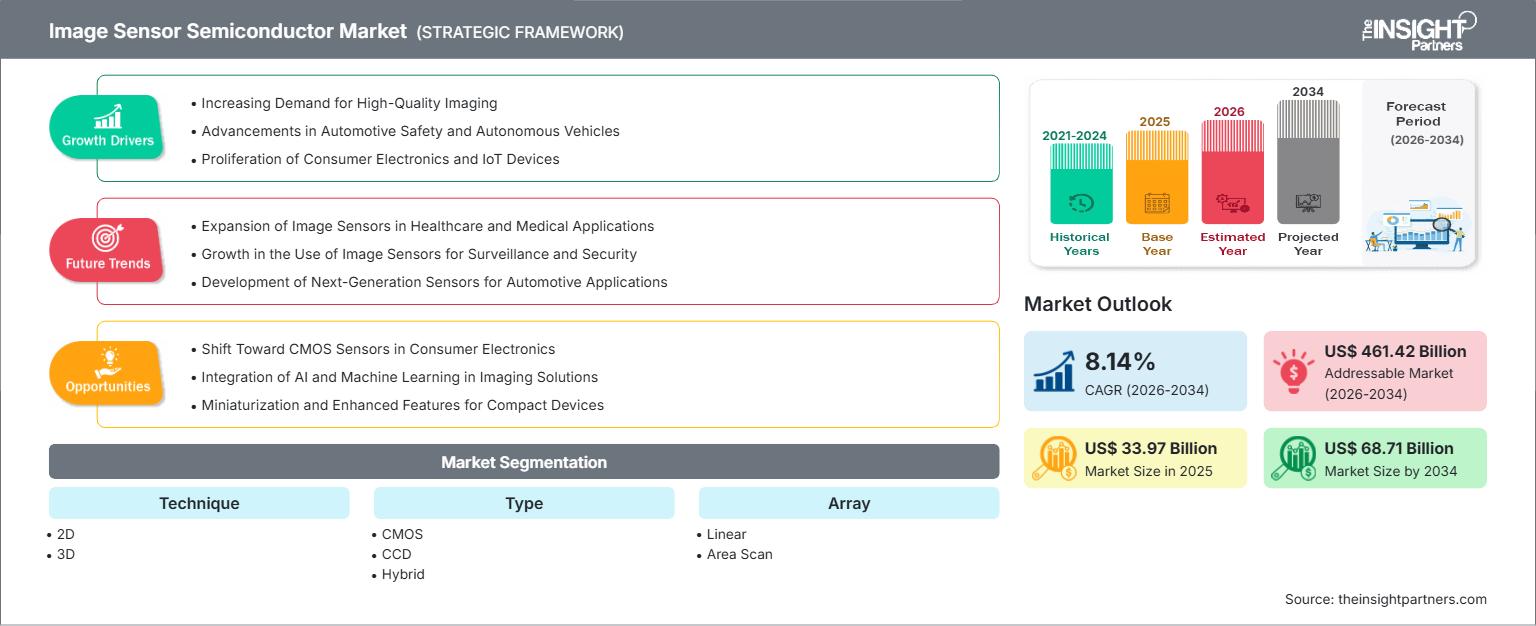
The Image Sensor Semiconductor Market is valued at US$ 33.97 Billion in 2025 and is projected to reach US$ 68.71 Billion by 2034, registering a 8.14% CAGR during 2026–2034. Growth drivers include smartphones, automotive perception, machine vision applications, surveillance, medical imaging, robotics, and consumer electronics. Demand for high resolution, low light sensitivity, dynamic range, miniaturization, and built-in intelligence capabilities is changing the sensor design paradigm and business dynamics.
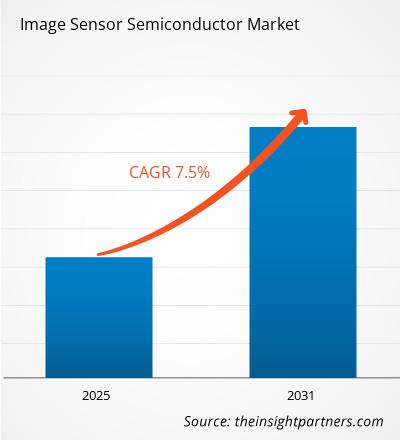
The North American region continues to be an important hub for innovations and deployments in this segment, where the Image Sensor Semiconductor Market size is driven by automotive electronics, industrial automation, aerospace imaging, defense systems, healthcare equipment, and artificial intelligence platforms. Geographic growth projections from 2026 to 2034 are at a CAGR of 7.5–8.0%.
Image Sensor Semiconductor Market Assessment and Insights
- North America is estimated to hold a 19–22% share in 2025 and is expected to grow at a 7.5–8.0% CAGR between 2026–2034, supported by automotive perception, industrial automation, healthcare imaging, and AI-enabled vision systems.
- US accounts for approximately 84–87% of North American revenue in 2025 and is projected to expand at a 7.6–8.1% CAGR during 2026–2034, supported by automotive, defense, healthcare, and industrial applications.
- Europe represents approximately 18–21% share in 2025 and is forecast to grow at a 7.0–7.6% CAGR during 2026–2034, with Germany, France, the UK, Italy, and Spain providing demand across automotive, industrial, and medical imaging.
- Asia Pacific represents approximately 47–50% share in 2025 and is anticipated to register a 8.8–9.4% CAGR during 2026–2034, led by China, Japan, South Korea, India, and Taiwan across consumer electronics and automotive production.
- Largest Segment CMOS holds approximately 82–86% market share in 2025 and is expected to grow at a 8.3–8.8% CAGR during 2026–2034, supported by broad integration and manufacturing scale.
- High Growth Segment 3D represents approximately 14–18% market share in 2025 and is projected to expand at a 10.0–10.8% CAGR during 2026–2034, driven by depth perception and spatial computing.
- Key companies analyzed in detail: Sony Semiconductor Solutions Corporation, Samsung Electronics Co., Ltd., OMNIVISION Technologies, Inc., Semiconductor Components Industries, LLC, STMicroelectronics N.V., GalaxyCore Shanghai Limited Corporation, Hamamatsu Photonics K.K., Infineon Technologies AG, Canon Inc., and Teledyne Technologies Incorporated.
Source: The Insight Partners' analysis based on proprietary research, government publications, company annual reports, investor presentations, industry databases, and expert interviews.
The Image Sensor Semiconductor Market is transitioning from the traditional approach of pixel capture to a new approach involving stacked architecture, backside illumination, global shutter configuration, time-of-flight sensors, and increasingly smart image sensor interface design. The semiconductor industry is looking to put more focus on the areas of pixel scaling, wafer efficiency, packaging, and heterogeneous integration. CMOS continues to prevail in terms of structural dominance due to its scalability and low power consumption and good system integration.
Going forward, growth will have to be driven by automotive and robotics, industrial inspection, medical devices, and spatial computing segments instead of just the smartphone segment. With investments being made in edge artificial intelligence, the sensors would be required to provide better quality of information and lesser need for data transport and power consumption. Demand visibility through automotive safety and industrial automation initiatives. Diversified regional supply chain could play a role in the decision-making process as well.
Image Sensor Semiconductor Market Report Scope
| Report Attribute | Details |
|---|---|
| Market size in 2025 | US$ 33.97 Billion |
| Market Size by 2034 | US$ 68.71 Billion |
| Global CAGR (2026 - 2034) | 8.14% |
| Historical Data | 2021-2024 |
| Forecast period | 2026-2034 |
Image Sensor Semiconductor Market Analysis
Growth in the Image Sensor Semiconductor market is being driven by increasing content of cameras in mobile phones, cars, factories, healthcare, drones, and smart infrastructure. The supply chain includes processes related to the design of the pixel, wafer fabrication, photodiode treatment, readout, packaging, optics integration, image processing, module production, and qualification of original equipment manufacturers. Increased complexity of sensors makes design collaboration more crucial between the semiconductor providers, camera-module providers, Tier-1 automotive providers, and end-device makers.
There is a huge difference in demand characteristics for different applications. Consumers of smartphone camera sensors care about resolution, pixel size, dynamic range, auto-focus, and low power consumption, while consumers of automotive camera sensors care about reliability, ability to work in high temperatures, low light sensitivity, flicker suppression, and functional safety. For industrial sensors, global shutters, high motion precision, spectral sensitivity, and long life cycles matter most.
The Image Sensor Semiconductor Market report reveals that there is a concentration of market power among Sony Semiconductor Solutions Corporation, Samsung Electronics Co., Ltd., and OMNIVISION Technologies, Inc., which have prominent positions in high-volume CMOS applications. On the other hand, Semiconductor Components Industries, LLC and STMicroelectronics N.V. have high exposure to the automotive, industrial, and embedded sensing market. GalaxyCore Shanghai Limited Corporation is penetrating into chosen mobile and automotive markets, while Hamamatsu Photonics K.K. has expertise in scientific and precision imaging.
The competitive positioning of companies is becoming more dependent on process technology, customer qualifications, intellectual property, manufacturing capabilities, and application performance. Sony is progressing with stacked and high-resolution architecture technology, Samsung continues to innovate in pixel miniaturization, and OMNIVISION is increasing its presence in automotive and machine vision applications. STMicroelectronics focuses on low-power global shutter sensing and edge intelligence. The market is therefore becoming favorable for those firms that can innovate semiconductors in addition to applications software.
● REPORT CUSTOMIZATION
Tailor This Report To Align With Your Specific Business Requirements
This report can be customized to align precisely with your business objectives, scope, and target markets. Customization options include tailored segmentation, geography, competitive analysis, and strategic insights to support informed decision-making.
Customize This Report →WHAT YOU CAN ADJUST
- ● Segmentations
- ● Geography
- ● Competitive Analysis
- ● Language Preferences
Image Sensor Semiconductor Market: Strategic Insights
Regional Insights
North America Image Sensor Semiconductor Market
North America is estimated to have 19-22% Image Sensor Semiconductor Market share in 2025 and is expected to grow at a 7.5-8.0% CAGR between 2026-2034. Demand drivers include applications such as automotive electronics, defense imaging, medical equipment, factory automation, robotics, and security. North America is also a big player in terms of investments into artificial intelligence and edge computing.
US leads the region in consumption, whereas Canada supports demand through industrial, automotive, aerospace, and scientific applications. There is an increased need for sensors that can operate in challenging lighting and temperature environments. In particular, automotive perception, autonomy, and machine vision segments are significant since they rely on capturing images at high frame rates.
U.S. Image Sensor Semiconductor Market
The U.S. constitutes 84-87% of the North America’s revenue share in 2025 and is anticipated to experience a growth rate of 7.6-8.1% CAGR between 2026 and 2034. There is diversity in application demands from automotive, military, healthcare, aerospace, logistics, and industrial automation segments. Global suppliers are equipped with technological expertise and client relations in all these applications.
Increasing needs in applications focus on high dynamic range, depth measurement capabilities, infrared detection, lower latency, and embedded processing. In the automotive camera systems, there is a requirement for reliable sensing in varying lighting conditions whereas industrial clients seek determinism in imaging and supply continuity of components. Sensitivity and precision are necessary in healthcare and scientific instruments.
Europe Image Sensor Semiconductor Market
The region of Europe holds around an 18-21% market share in 2025 and is projected to grow at 7.0-7.6% CAGR between 2026 and 2034, where Germany emerges as the major country. Demand will come from automotive production, automation, healthcare, and scientific imaging.
For the UK, it is aerospace, military, healthcare, and research imaging applications, whereas Germany is driven by automotive and machine vision industry needs. The countries of France derive demand from aerospace, automotive, and medical applications. In addition to this, Italy and Spain contribute with their industrial machinery, automotive production, logistics, and security applications. The European adoption is becoming increasingly driven by vehicle safety, factory digitization, and energy-efficient edge computing devices, which require sensing capabilities with high imaging but low processing and power consumption.
APAC Image Sensor Semiconductor Market
APAC represents approximately 47–50% share in 2025 and is projected to grow at a 8.8–9.4% CAGR during 2026–2034, with China serving as the leading country. Japan, South Korea, India, and Taiwan reinforce the region through semiconductor manufacturing, consumer electronics, automotive production, and industrial automation.
Strengths of China are vast electronics production capabilities and automotive technology development. Japan is still relevant in sensors and precision imaging technologies, and South Korea has semiconductor and smartphone expertise. India is building up electronics and automotive manufacturing capabilities, and Taiwan is contributing to semiconductor electronics production. Industrial digitization, localization of electronics, and automotive electronics penetration will maintain demand in the region.
Middle East & Africa Image Sensor Semiconductor Market
The Middle East and Africa is expected to grow at a CAGR of 7.0-7.6% between 2026-2034, with the UAE and Saudi Arabia being the major markets of this region. Smart city initiatives, security systems, energy infrastructure, logistics, health care, and transportation have several uses for smart camera solutions.
Mining activities in South Africa, industrial automation systems, security initiatives, and health care contribute to the growth of the segment. Opportunities in the Rest of MEA add value to the growth. The increasing need to monitor and inspect difficult environments in energy infrastructure can add to the growing demand for the use of imaging sensors.
Segmentation Analysis
Technique
Technique is projected to grow at a 8.7–9.2% CAGR during 2026–2034. Conventional two-dimensional imaging remains the volume foundation, while three-dimensional sensing is gaining importance in automotive perception, robotics, augmented reality, industrial measurement, and spatial computing. The Image Sensor Semiconductor Market scope is therefore expanding from image capture toward depth and environmental perception.
- 2D remains the primary imaging technique for smartphones, surveillance, industrial cameras, medical equipment, and conventional machine vision, where color, contrast, resolution, and low-light performance remain central requirements.
- 3D supports depth perception, object measurement, spatial mapping, gesture recognition, robotics, and automotive applications, making it strategically important as machines increasingly interpret physical environments.
Type
Type is forecast to expand at a 8.0–8.5% CAGR during 2026–2034. CMOS maintains the broadest commercial adoption because of manufacturing scalability and integration advantages. CCD remains relevant in specialized applications, while hybrid architectures address emerging performance requirements involving multiple sensing modes.
- CMOS dominates high-volume applications because it combines low power consumption, rapid readout, compact integration, and compatibility with advanced semiconductor manufacturing processes.
- CCD remains relevant in scientific, astronomical, industrial, and specialized imaging where high image uniformity, sensitivity, or established instrument architectures justify continued use.
- Hybrid architectures combine characteristics of multiple sensing or readout approaches, providing opportunities for specialized applications requiring enhanced dynamic range, spectral response, or operational flexibility.
Array
Array is expected to register a 7.9–8.4% CAGR during 2026–2034. Area scan devices remain central to image capture across consumer and industrial cameras, while linear arrays retain importance in scanning, inspection, spectroscopy, and document-processing equipment.
- Linear arrays support continuous scanning and measurement applications, including industrial inspection, document systems, spectroscopy, and conveyor-based imaging where sequential line capture is advantageous.
- Area Scan arrays support conventional photographic and machine-vision applications by capturing two-dimensional scenes simultaneously, making them central to smartphones, automotive cameras, surveillance, robotics, and medical devices.
Spectrum
Spectrum is projected to grow at a 8.6–9.1% CAGR during 2026–2034. Visible sensing remains the foundation of mainstream imaging, while non-visible technologies are gaining traction in industrial inspection, agriculture, medical diagnostics, automotive sensing, and scientific applications. Broader spectral capabilities are expanding the value of captured data.
- Visible sensors serve mainstream photography, surveillance, automotive cameras, consumer electronics, and machine vision, with continued improvements in resolution, color fidelity, dynamic range, and low-light performance.
- Non-visible sensing covers infrared and related wavelengths used for thermal analysis, night vision, spectroscopy, industrial inspection, medical applications, and specialized environmental monitoring.
Opportunity Snapshot
| Application | Revenue Contribution (High/Medium/Low) | Trend Tag (MAX 2 words) | Adoption Stage (Emerging/Scaling/Mature) |
| Smartphones | High | Multi-Camera | Mature |
| Automotive Vision | High | ADAS Cameras | Scaling |
| Industrial Vision | Medium | Edge Inspection | Scaling |
| Security Surveillance | High | AI Cameras | Mature |
| Medical Imaging | Medium | Diagnostic Imaging | Scaling |
| Robotics | Medium | Spatial Vision | Scaling |
| Consumer Devices | High | Smart Imaging | Mature |
Image Sensor Semiconductor Market Growth Drivers and Impact Analysis
Rising Camera Content in Advanced Automotive Systems
Automotive platforms are incorporating more cameras for surround view, driver monitoring, parking assistance, object recognition, and automated driving functions. This increases sensor content per vehicle and raises performance requirements for dynamic range, low-light capture, flicker mitigation, and temperature reliability. The commercial impact extends beyond unit volumes because automotive qualification creates longer product lifecycles and greater emphasis on dependable supply. Sensor suppliers are therefore developing dedicated automotive portfolios rather than adapting consumer products directly. Demand is also broadening from premium vehicles toward mainstream models as electronic safety features become more common. Suppliers with strong relationships across automotive Tier-1 companies can benefit from design wins that remain in production for multiple years. The resulting demand provides a structurally attractive application base for CMOS manufacturers and specialist imaging companies.
Expansion of Industrial Machine Vision and Robotics
Factories are deploying cameras for inspection, measurement, quality control, robotic guidance, and predictive maintenance, creating demand for sensors that capture fast-moving objects without distortion. Global shutter architectures are particularly useful where motion accuracy is important, while infrared and specialized spectral sensing can reveal characteristics that ordinary visible cameras cannot capture. Edge artificial intelligence is also changing sensor requirements by encouraging lower power consumption and more efficient data handling. Industrial customers often value component longevity and predictable supply, which can create opportunities for suppliers with stable product roadmaps. Robotics introduces additional requirements for depth perception, low latency, and compact camera modules. As factories become more automated, image sensors are increasingly treated as core perception components rather than simple imaging peripherals, supporting sustained investment in specialized sensor designs.
Growth of High-Resolution Consumer Imaging
Smartphones, tablets, wearable devices, and connected cameras continue to demand smaller pixels, higher resolution, better autofocus, stronger low-light performance, and wider dynamic range. Manufacturers are responding through backside illumination, stacked architectures, advanced on-chip lenses, computational photography support, and increasingly sophisticated pixel designs. Competitive pressure is shifting from megapixel counts alone toward usable image quality under difficult lighting and motion conditions. Higher-resolution sensors can also support digital zoom and cropping without sacrificing as much detail, increasing their value in premium devices. At the same time, compact packaging remains important because camera modules compete for limited device space. The commercial effect is a continuing need for advanced process technology and manufacturing scale. Suppliers that can improve performance without materially increasing module size or power consumption can secure stronger positions in premium device programs.
Image Sensor Semiconductor Market Future Trends
Sensor-Level Intelligence and Edge Processing
Future sensor architectures are expected to incorporate more intelligence close to the point of image capture. Processing functions can reduce unnecessary data movement, lower latency, and improve responsiveness in battery-powered or bandwidth-constrained devices. This direction will encourage sensors with integrated statistical outputs, specialized processing, smarter wake-up functions, and interfaces optimized for edge artificial intelligence. The Image Sensor Semiconductor Market trends are therefore moving toward perception-oriented components rather than passive pixel arrays. Automotive, robotics, wearables, and smart-home devices can benefit because decisions increasingly need to occur locally. Manufacturers are likely to differentiate through power efficiency, embedded functionality, and software compatibility. This evolution may also shift competition toward system-level partnerships, where sensor suppliers collaborate with microcontroller, processor, camera-module, and software companies to deliver validated development platforms.
Expansion of Multispectral and Non-Visible Imaging
Non-visible imaging is expected to gain importance as industries seek information that conventional RGB cameras cannot provide. Near-infrared, short-wave infrared, and other specialized sensing approaches can support inspection, moisture detection, agricultural monitoring, medical analysis, semiconductor manufacturing, and environmental measurement. Future adoption will depend on lower component costs, compact modules, improved sensitivity, and accessible processing software. Sensor suppliers are likely to pursue application-specific architectures that combine spectral selectivity with conventional imaging rather than treating each wavelength as a separate system. Automotive systems may also use non-visible sensing to improve perception under darkness or challenging weather. As more industries quantify the value of information beyond visible imagery, specialized sensors can move from research-oriented deployments toward commercial production. This expansion provides a broader addressable opportunity beyond mainstream camera applications.
Image Sensor Semiconductor Market Opportunities
Automotive and Industrial Sensor Platforms
Automotive and industrial customers offer attractive opportunities for suppliers that can provide complete sensing platforms rather than individual components. Automotive platforms require validated devices, long-term supply, functional reliability, and compatibility with camera modules and processing systems. Industrial customers similarly value deterministic performance, long product availability, and integration support. The Image Sensor Semiconductor Market Forecasts indicate that these applications can provide a growing counterbalance to mature consumer-device demand. Suppliers can invest in global-shutter, high-dynamic-range, infrared, and depth technologies while building application engineering teams around major customers. Partnerships with Tier-1 automotive suppliers, robotics developers, and machine-vision companies can accelerate qualification. The strongest commercial opportunities are likely to emerge where sensor performance directly affects system functionality and where switching suppliers after qualification involves substantial engineering costs.
Specialized Imaging for Healthcare and Scientific Instruments
Healthcare and scientific applications offer opportunities for differentiated sensors where sensitivity, spectral response, image uniformity, and measurement accuracy matter more than mass-market economics. Medical endoscopy, microscopy, laboratory instruments, life-science systems, spectroscopy, and scientific cameras can require architectures that differ substantially from consumer imaging. Suppliers can pursue these markets through specialized packaging, extended product lifecycles, application engineering, and close collaboration with instrument manufacturers. Regulatory requirements can lengthen qualification cycles, but successful designs may remain in production for extended periods. The opportunity is particularly relevant for companies with expertise in non-visible wavelengths, high sensitivity, low-noise operation, or precision measurement. Developing reference designs and software tools can lower integration barriers for equipment manufacturers and help semiconductor suppliers move higher in the imaging value chain.
Recent Developments
- June 2026: Sony Semiconductor Solutions Corporation (Sony) announced the upcoming release, mass-production, and shipment of the IMX711 direct conversion charge-integrating X-ray CMOS image sensor.
- October 2025: STMicroelectronics (NYSE: STM), a global semiconductor leader serving customers across the spectrum of electronics applications, introduces a new family of 5MP CMOS image sensors: VD1943, VB1943, VD5943, and VB5943. These advanced ST BrightSense sensors are designed to accelerate the development of innovative vision applications across industries, including advanced industrial automation with enhanced machine and robotic vision, next-generation security including biometric identification and traffic management, and smart retail applications such as inventory management and automated checkout.
- October 2025: Sony Semiconductor Solutions Corporation (Sony) announced the upcoming release of the IMX828, the industry’s first*1 CMOS image sensor for automotive applications with a built-in MIPI A-PHY interface. There are multiple high-speed transmission interface standards for automotive applications. This product is the first in the industry*1 to include the interface in the image sensor.
Frequently Asked Questions

- Comprehensive Market Sizing and Forecast Analysis
- Detailed Segmentation Analysis
- In-Depth Market Dynamics Assessment
- Regional and Country-Level Insights
- Competitive Landscape and Company Benchmarking
- Strategic Business Intelligence
Recent Reports
Testimonials

The Insight Partners' SCADA System Market report is comprehensive, with valuable insights on current trends and future forecasts. The team was highly professional, responsive, and supportive throughout. We are very satisfied and highly recommend their services.
RAN KEDEM Partner, Reali Technologies LTDs
I requested a report on a very specific software market and the team produced the report in a few days. The information was very relevant and well presented. I then requested some changes and additions to the report. The team was again very responsive and I got the final report in less than a week.
JEAN-HERVE JENN Chairman, Future Analytica
We worked with The Insight Partners for an important market study and forecast. They gave us clear insights into opportunities and risks, which helped shape our plans. Their research was easy to use and based on solid data. It helped us make smart, confident decisions. We highly recommend them.
PIYUSH NAGPAL Sr. Vice President, High Beam Global
The Insight Partners delivered insightful, well-structured market research with strong domain expertise. Their team was professional and responsive throughout. The user-friendly website made accessing industry reports seamless. We highly recommend them for reliable, high-quality research services
YUKIHIKO ADACHI CEO, Deep Blue, LLC.
This is the first time I have purchased a market report from The Insight Partners.While I was unsure at first, I visited their web site and felt more comfortable to take the risk and purchase a market report.I am completely satisfied with the quality of the report and customer service. I had several questions and comments with the initial report, but after a couple of dialogs over email with their analyst I believe I have a report that I can use as input to our strategic planning process.Thank you so much for taking the extra time and making this a positive experience.I will definitely recommend your service to others and you will be my first call when we need further market data.
JOHN SUZUKI President and Chief Executive Officer, Board Director, BK Technologies
I wish to appreciate your support and the professionalism you displayed in the course of attending to my request for information regarding to infectious disease IVD market in Nigeria. I appreciate your patience, your guidance, and the fact that you were willing to offer a discount, which eventually made it possible for us to close a deal. I look forward to engaging The Insight Partners in the future, all thanks to the impression you have created in me as a result of this first encounter.
DR CHIJIOKE ONYIA MANAGING DIRECTOR, PineCrest Healthcare Ltd.Reason to Buy
- Informed Decision-Making
- Understanding Market Dynamics
- Competitive Analysis
- Identifying Emerging Markets
- Customer Insights
- Market Forecasts
- Risk Mitigation
- Boosting Operational Efficiency
- Strategic Planning
- Investment Justification
- Tracking Industry Innovations
- Aligning with Regulatory Trends





 Get Free Sample for