
Agricultural Sprayer Equipment Market Growth, Size & Forecast by 2034
Coverage: By Type (Hand Held, Self-Propelled, Tractor Mounted, Trailed, and Others); Operation (Manually Operated, Battery Operated, and Fuel Operated Sprayers); Capacity (Low Volume, Medium Volume, and High Volume), and Geography (North America, Europe, Asia Pacific, and South and Central America)
- Status : Data Released
- Report Code : TIPRE00007011
- Category : Manufacturing and Construction
- No. of Pages : 150
- Available Report Formats :


- Last update date : July 13, 2026


2025 Market Size
US$ 670.70 Mn
Base year value
2034 Forecast
US$ 1,003.43 Mn
Projected by 2034
CAGR 2026-2034
4.58 %
Growth rate
Addressable Market
US$ 7,601.74 Mn
(2026-2034)
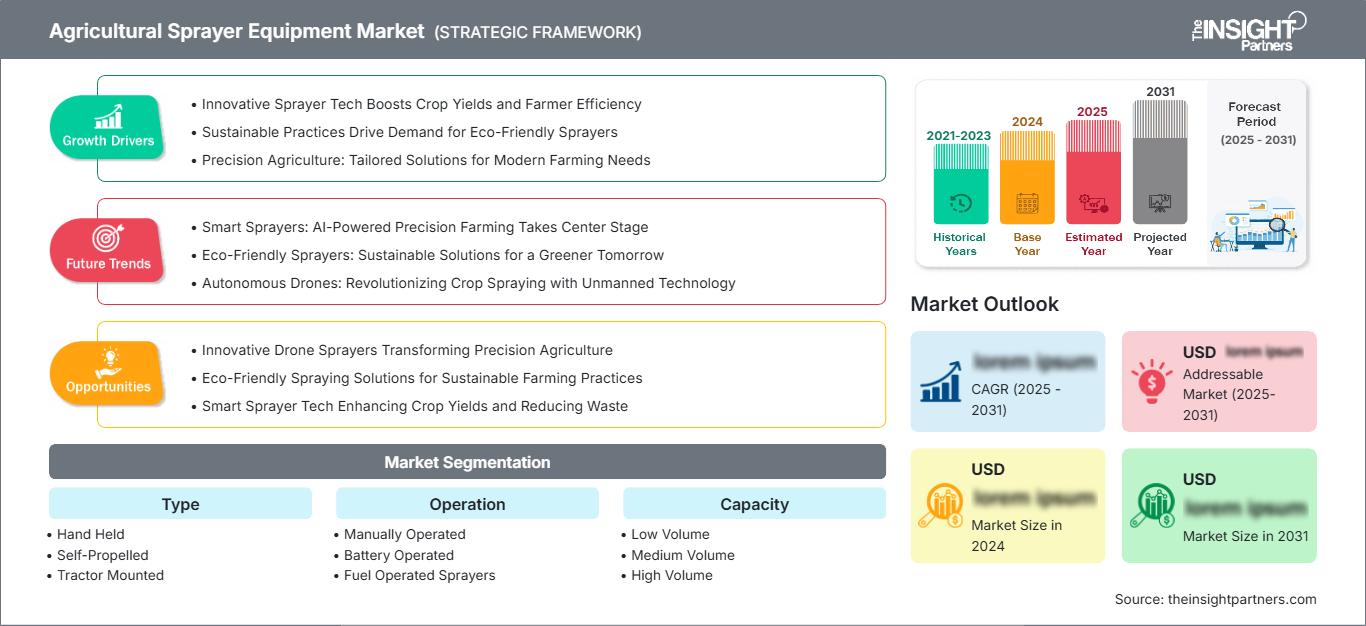
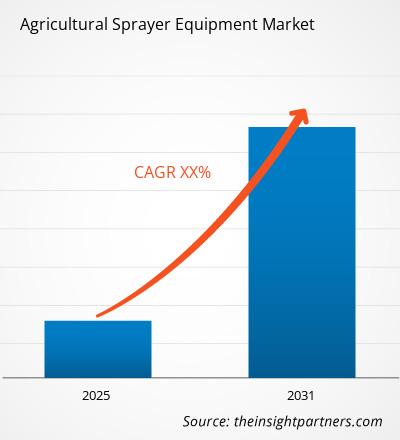
The agricultural sprayer equipment market size was estimated at US$ 670.70 Million in 2025 and is projected to reach US$ 1,003.43 Million by 2034. The market is expected to achieve a CAGR of 4.58% during the forecast period 2026–2034. Growth drivers include farmers' requirements for precise crop protection applications, reduced chemical waste, and efficient operations for crops grown on farms.
According to the Agricultural Sprayer Equipment Market report, in North America, the market is expected to grow at a CAGR of 4.2–4.7% from 2026 to 2034, driven by large farms, intensive replacement rate for existing sprayers, and application-focused technology. Farmers in the USA and Canada are demanding machines that can reduce herbicide use, improve operator safety, and integrate with fleet management software.
Agricultural Sprayer Equipment Market Assessment and Insights
- North America accounted for 28–31% Agricultural Sprayer Equipment Market share in 2025 and is expected to grow at a CAGR of 4.2–4.7% between 2026–2034, led by advanced farms replacing broadcast sprayers with connected, low-drift platforms.
- The US represented 78–82% of North America in 2025 and is projected to grow at a CAGR of 4.1–4.6% between 2026–2034, reflecting strong commercial-row-crop application demand.
- Europe held 22–25% share in 2025 and is projected to expand at a CAGR of 3.8–4.3% between 2026–2034, with Germany, France, Italy, Spain, and the UK leading adoption.
- Asia Pacific accounted for 30–34% share in 2025 and is forecast to grow at a CAGR of 5.0–5.6% between 2026–2034, supported by China, India, Japan, South Korea, and Australia.
- Tractor Mounted was the largest segment, with 34–38% market share in 2025 and a CAGR of 4.1–4.6% during 2026–2034, due to broad compatibility with mid-sized farms.
- Battery Operated Sprayers was the high growth segment, with 18–22% market share in 2025 and a CAGR of 6.2–6.8% during 2026–2034, driven by low-noise and low-maintenance use.
- Key companies analyzed in detail: Ag Spray Equipment, Inc.; AGCO Corporation; ANDREAS STIHL AG & Co. KG; Bucher Industries AG; Deere & Company; EXEL Industries SA; M.I.T.R.A. Agro Equipments Pvt. Ltd.; Máquinas Agrícolas Jacto S.A.; SZ DJI Technology Co., Ltd.; CNH Industrial N.V.; and HARDI International A/S.
Source: The Insight Partners' analysis based on proprietary research, government publications, company annual reports, investor presentations, industry databases, and expert interviews.
The Agricultural Sprayer Equipment has moved away from manual knapsack sprayers toward tractor-mounted, self-propelled, and drone sprayers, as well as sensor-enabled sprayers that enhance droplet control and application tracking. Agricultural sprayer equipment market trends include the influence of electronics on the production process, nozzle manufacturing, tank material quality, and local services. This agricultural sprayer equipment market profile highlights the need for manufacturers to maintain balance between affordable and cost-effective sprayers for small farmers and sophisticated sprayers for larger farms that need to reduce costs and increase field efficiency.
The agricultural sprayer equipment market forecast indicates that the market growth is expected to be driven by mechanization programs in Asia, water efficient crop protection sprayers in arid areas, and restrictions related to pesticide drift in advanced countries. The agricultural sprayer equipment investments will shift towards battery-operated sprayers, automatic guidance technology, boom height control, and digital maintenance.
Agricultural Sprayer Equipment Market Report Scope
| Report Attribute | Details |
|---|---|
| Market size in 2025 | US$ 670.70 Million |
| Market Size by 2034 | US$ 1,003.43 Million |
| Global CAGR (2026 - 2034) | 4.58% |
| Historical Data | 2021-2024 |
| Forecast period | 2026-2034 |
Agricultural Sprayer Equipment Market Analysis
Demand is driven by yield protection, labor constraints, and rising prices of pesticides and fertilizers. Farmers are increasingly judging sprayer equipment not only by cost but also by accuracy, tank size, fuel efficiency, and serviceability. The equipment size of agricultural sprayers is also an indicator of the increasing demand of sprayers for short periods of pest control due to weather changes.
The value chain starts with component manufacturers that produce pumps, tanks, nozzles, batteries, engines, electronics, chassis, and interfaces. These are followed by OEM manufacturing, dealerships, after-sale services, and agronomists. Supply is influenced by steel prices, electronic parts, and availability. Dealer network plays a vital role because failure of sprayers during pest outbreaks affects the quality of yield and its value.
The competitive structure involves diversified farm equipment makers and specialized sprayer manufacturers. Amongst the former are Deere & Company, AGCO Corporation, CNH Industrial N.V., Bucher Industries AG, and EXEL Industries SA, which are competing in areas of connectivity, boom control systems, and sales and services networks, whereas the latter group includes Ag Spray Equipment, Inc., HARDI International A/S, Máquinas Agrícolas Jacto S.A., and M.I.T.R.A. Agro Equipments Pvt. Ltd.
Trends in investments indicate a distinct shift towards precision application systems, battery-driven systems, and aerial spraying systems. The technology horizon has been expanded significantly due to SZ DJI Technology Co., Ltd. The strategic positioning becomes dependent on the lifecycle economics such as chemical savings, operator safety, documentation, financing support, and local maintenance facilities.
● REPORT CUSTOMIZATION
Tailor This Report To Align With Your Specific Business Requirements
This report can be customized to align precisely with your business objectives, scope, and target markets. Customization options include tailored segmentation, geography, competitive analysis, and strategic insights to support informed decision-making.
Customize This Report →WHAT YOU CAN ADJUST
- ● Segmentations
- ● Geography
- ● Competitive Analysis
- ● Language Preferences
Agricultural Sprayer Equipment Market: Strategic Insights
Regional Insights
North America agricultural sprayer equipment market
North America accounted for 28-31% of the Agricultural Sprayer Equipment market in 2025 and is estimated to grow at a CAGR of 4.2-4.7% from 2026 to 2034. Large-scale farming operations, higher labor costs, and extensive pesticide use fuel the adoption of self-propelled and tractor-driven sprayers. The increasing adoption of precision agriculture is driven by reduced input waste, fewer trips, and improved field mapping.
Stability of the booms, nozzle shut-off capabilities, telematics, and customer support from dealers within the application window are preferred among buyers in North America. The North American market share of agricultural sprayer equipment depends on the area planted to corn, soybeans, wheat, cotton, and other specialty crops in the region. Sustainability initiatives that reduce chemical exposure are also influencing equipment selection.
U.S. agricultural sprayer equipment market
The US accounted for 78-82% of the North American region in 2025 and is projected to grow at a CAGR of 4.1-4.6% during 2026-2034. Demand in this market is driven by broadacre farming, where the performance of sprayers, spray capacity, and variable-rate control affect operating margins. Custom applicators have been an essential customer segment due to high usage that justifies the use of more advanced systems.
The presence of players is notable among companies such as Deere & Company, AGCO Corporation, CNH Industrial N.V., Ag Spray Equipment, Inc., and specialty dealerships. Usage trends include herbicide spraying, pulse width modulation, automatic section control, and linked job records. Growth in the market for agricultural sprayer equipment in the United States is attributed to cost savings in chemicals, labor availability, and farm consolidation.
Europe agricultural sprayer equipment market
Europe represented 22–25% share in 2025 and is forecast to grow at a CAGR of 3.8–4.3% during 2026–2034. Germany is the leading country, supported by high mechanization, strong machinery engineering, and strict pesticide-use controls. The UK Agricultural Sprayer Equipment market favors efficient mounted and trailed sprayers for cereals, oilseeds, and mixed farms.
Demand in Germany is influenced by precision application requirements, labor efficiency, and the adoption of boom control technology. France remains important for demand due to cereals, vineyards, and specialty farming, where minimizing drift and canopy spraying are essential. Equipment manufacturers compete on compliance, after-sales service, and compatibility with farm management systems.
Cultivation of vineyards, orchards, vegetables, and protected crops in France, Italy, and Spain helps support demand for specialized airflow and low-volume sprayers. Farm fragmentation in Italy creates the need for compact equipment, while water scarcity in Spain stimulates efficient application. Documentation and protection for operators become important for European buyers.
APAC agricultural sprayer equipment market
APAC held 30–34% share in 2025 and is expected to grow at a CAGR of 5.0–5.6% during 2026–2034. China is the leading country, supported by farm mechanization, drone spraying adoption, and consolidation of service providers.
India continues to favor handheld, battery-operated, and tractor-mounted sprayers because smallholder farms require affordable and serviceable machines. Japan and South Korea emphasize labor-saving technologies for aging farm populations and high-value crops.
Australia’s broadacre farms support higher-capacity sprayers, while Southeast Asian plantation crops create demand for portable and aerial solutions. Policy incentives, rural mechanization finance, and crop-loss reduction programs strengthen regional adoption.
Middle East & Africa agricultural sprayer equipment market
The Agricultural Sprayer Equipment market in Middle East & Africa is projected to grow at a CAGR of 4.6–5.1% during 2026–2034. South Africa is the leading country, supported by commercial farming, fruit exports, and established equipment channels.
Saudi Arabia and the UAE are investing in controlled-environment agriculture, irrigation efficiency, and food-security programs, creating demand for compact and precise sprayers. Energy-funded infrastructure also supports farm modernization.
Rest of MEA markets remain price-sensitive, but adoption improves where horticulture exports, plantation crops, and donor-backed mechanization programs increase equipment access. Service availability remains a decisive purchasing factor.
Segmentation Analysis
Type
The type segment is expected to grow at a CAGR of 4.3–4.8% during 2026–2034, reflecting demand across small farms, broadacre operations, orchards, and custom application services. Selection depends on farm size, crop type, terrain, labor availability, and capital budget. Buyers increasingly assess total cost per treated acre, not only machine price.
- Hand Held sprayers remain essential for small plots, nurseries, greenhouses, and spot treatment, where portability, affordability, and simple maintenance outweigh automation needs.
- Self-Propelled sprayers serve large farms and contractors requiring high field capacity, precise boom control, operator comfort, and integration with digital application records.
- Tractor Mounted sprayers dominate mid-sized farms because they use existing tractor fleets, offer flexible tank capacities, and support efficient crop-protection scheduling.
- Trailed sprayers support broadacre and mixed farms requiring larger tanks without the capital intensity of self-propelled machines, making them strategically important for replacement demand.
Operation
The operation segment is projected to grow at a CAGR of 4.5–5.0% during 2026–2034 as farms transition from manual application toward battery and fuel-powered systems. Adoption is influenced by labor cost, daily treated area, crop value, and power availability. Battery platforms are gaining relevance where emissions, noise, and maintenance simplicity influence procurement.
- Manually Operated sprayers are widely used by smallholders and horticulture operators because they provide low-cost access, simple repairs, and practical utility for localized spraying tasks.
- Battery Operated sprayers are expanding among vegetable, orchard, and greenhouse users seeking consistent pressure, lower fatigue, reduced noise, and easier operation for recurring applications.
- Fuel Operated Sprayers remain important for large fields and intensive spraying schedules where higher power, longer run time, and robust pumping capacity are required.
Opportunity Snapshot
| Type | Revenue Contribution | Trend Tag | Adoption Stage |
| Hand Held | Medium | Spot Spray | Mature |
| Self-Propelled | High | Targeted Spray | Scaling |
| Tractor Mounted | High | Fleet Fit | Mature |
| Trailed | Medium | Large Tank | Scaling |
Agricultural Sprayer Equipment Market Growth Drivers and Impact Analysis
Precision Application Reduces Input Waste
Precision application is increasingly becoming an economic factor, since herbicides, fungicides, and fertilizers constitute a significant share of production costs in any season. Section control, variable-rate application, nozzle shut-off, and camera-based weed recognition enable the user to spray chemicals only in the areas that need to be sprayed. Over-spraying and drift are minimized, and residue requirements and environmental regulations are met. This effect becomes more pronounced in row-crop production and horticultural applications, which involve repetitive spraying operations. Hence, higher end sprayers are now judged by cost saving per acre and documentation capability.
Farm Labor Constraints Accelerate Mechanization
The labor shortage has made the farmers use machines with higher efficiency and fewer operators to treat more hectares in one day. The use of self-propelled, tractor-mounted, or battery-operated machines may make the operation less labor-intensive, ensure greater process consistency, and increase the available time for spraying. This is particularly significant in places where there are elderly people working on the farms, shortage of temporary workers, or large-scale agricultural operations. Safety is improved by using machines, as their cabs prevent contact with the chemicals.
Sustainability Rules Strengthen Equipment Upgrades
The regulators and the food buyers are increasingly concerned about traceability of chemicals, reduction of drifts, protection of water, and operator safety. This is something that works for the sprayer, which has good control over droplet size, protected application, proper pressure control, and electronic documentation. Farmers who export their products or supply them to high-end food chains will be motivated to buy such spraying machines because documentation will play an important role in gaining market access. The operator will also benefit manufacturing companies that offer a combination of hardware and software, along with calibration and training.
Agricultural Sprayer Equipment Market Future Trends
Autonomous and Drone-Based Spraying Moves Mainstream
Spraying done autonomously using drones will be more complementary than substitutive to ground spraying equipment. Drones are ideal for spraying fragmented fields, wetlands, steep orchards, and emergency pest spraying where tractors are inefficient or inaccessible. Autonomous ground vehicles will be useful in performing repetitive tasks within controlled environments. Future trends in the agricultural spray equipment suggest that a hybrid model of services will arise, whereby farmers purchase regular sprayers but hire aerial or autonomous spraying when at their busiest.
Connected Maintenance Becomes a Differentiator
Connected maintenance will become more important as sprayers integrate pumps, sensors, controllers, batteries, engines, and software. Downtime during disease or pest outbreaks can create immediate crop losses, so predictive alerts, remote diagnostics, and dealer visibility into machine health will influence purchase decisions. Manufacturers that provide digital parts catalogs, service scheduling, and calibration support can strengthen customer retention. The trend is particularly relevant for high-utilization contractors and commercial farms that require reliable fleets across multiple application windows and crop stages.
Agricultural Sprayer Equipment Market Opportunities
Battery Platforms for Small and Specialty Farms
Battery-operated sprayers offer a practical opportunity because they address fatigue, inconsistent pressure, and maintenance issues associated with manual units. The strongest use cases include vegetables, greenhouses, orchards, nurseries, vineyards, and peri-urban farms where lower noise and emissions are valued. Manufacturers can differentiate through battery life, pump durability, ergonomic design, spare-parts availability, and affordable charging ecosystems. Dealers can also package training and maintenance kits for smallholders. This opportunity supports inclusive mechanization because battery sprayers deliver measurable productivity improvements without the investment threshold of tractor-mounted or self-propelled systems.
Service Models for Precision Spraying
Precision spraying creates an opportunity for application-as-a-service models in regions where growers cannot justify advanced equipment ownership. Contractors can deploy self-propelled sprayers, drones, and digitally calibrated tractor-mounted units across multiple farms, improving utilization and lowering customer barriers. OEMs can support this model through financing, telematics, training, and consumables partnerships. Agronomy firms may also integrate scouting, prescription maps, and application records into one service. The opportunity is strongest where crop values are high, labor is scarce, and compliance documentation is increasingly required by buyers.
Recent Developments
- November 2025: Deere & Company — John Deere reported that customers used See & Spray technology across more than 5 million acres during the 2025 growing season, reducing non-residual herbicide use by nearly 50% and saving nearly 31 million gallons of herbicide mix, reinforcing the commercial value of targeted spraying.
- July 2025: SZ DJI Technology Co., Ltd. — DJI Agriculture launched Agras T100, T70P, and T25P globally, with higher payloads for spraying, spreading, and lifting. The T100 supports 100 L spraying payloads and advanced sensing systems, strengthening drone-based crop-protection capacity for commercial farms and service providers.
- February 2024: Deere & Company — John Deere announced expanded availability of See & Spray Premium on model-year 2025 Hagie STS sprayers. The AI-powered system identifies weeds with boom-mounted cameras and activates individual nozzles, helping operators reduce post-emergence herbicide use and improve application documentation.
Frequently Asked Questions

- Comprehensive Market Sizing and Forecast Analysis
- Detailed Segmentation Analysis
- In-Depth Market Dynamics Assessment
- Regional and Country-Level Insights
- Competitive Landscape and Company Benchmarking
- Strategic Business Intelligence
Recent Reports
Testimonials

The Insight Partners' SCADA System Market report is comprehensive, with valuable insights on current trends and future forecasts. The team was highly professional, responsive, and supportive throughout. We are very satisfied and highly recommend their services.
RAN KEDEM Partner, Reali Technologies LTDs
I requested a report on a very specific software market and the team produced the report in a few days. The information was very relevant and well presented. I then requested some changes and additions to the report. The team was again very responsive and I got the final report in less than a week.
JEAN-HERVE JENN Chairman, Future Analytica
We worked with The Insight Partners for an important market study and forecast. They gave us clear insights into opportunities and risks, which helped shape our plans. Their research was easy to use and based on solid data. It helped us make smart, confident decisions. We highly recommend them.
PIYUSH NAGPAL Sr. Vice President, High Beam Global
The Insight Partners delivered insightful, well-structured market research with strong domain expertise. Their team was professional and responsive throughout. The user-friendly website made accessing industry reports seamless. We highly recommend them for reliable, high-quality research services
YUKIHIKO ADACHI CEO, Deep Blue, LLC.
This is the first time I have purchased a market report from The Insight Partners.While I was unsure at first, I visited their web site and felt more comfortable to take the risk and purchase a market report.I am completely satisfied with the quality of the report and customer service. I had several questions and comments with the initial report, but after a couple of dialogs over email with their analyst I believe I have a report that I can use as input to our strategic planning process.Thank you so much for taking the extra time and making this a positive experience.I will definitely recommend your service to others and you will be my first call when we need further market data.
JOHN SUZUKI President and Chief Executive Officer, Board Director, BK Technologies
I wish to appreciate your support and the professionalism you displayed in the course of attending to my request for information regarding to infectious disease IVD market in Nigeria. I appreciate your patience, your guidance, and the fact that you were willing to offer a discount, which eventually made it possible for us to close a deal. I look forward to engaging The Insight Partners in the future, all thanks to the impression you have created in me as a result of this first encounter.
DR CHIJIOKE ONYIA MANAGING DIRECTOR, PineCrest Healthcare Ltd.Reason to Buy
- Informed Decision-Making
- Understanding Market Dynamics
- Competitive Analysis
- Identifying Emerging Markets
- Customer Insights
- Market Forecasts
- Risk Mitigation
- Boosting Operational Efficiency
- Strategic Planning
- Investment Justification
- Tracking Industry Innovations
- Aligning with Regulatory Trends





 Get Free Sample for