
Airborne Optronics Market Growth, Demand & Size by 2034
Coverage: By System (Reconnaissance System, Targeting System, Search and Track System, Surveillance System, Countermeasure System); Technology (Multispectral, Hyperspectral); Application (Commercial, Military); Aircraft Type (Fixed Wing, Rotary Wing, Unmanned Aerial Vehicles) , and Geography (North America, Europe, Asia Pacific, and South and Central America)
- Status : Data Released
- Report Code : TIPRE00022906
- Category : Aerospace and Defense
- No. of Pages : 150
- Available Report Formats :


- Last update date : October 30, 2026


2025 Market Size
US$ 2.9 Bn
Base year value
2034 Forecast
US$ 7.89 Bn
Projected by 2034
CAGR 2026-2034
11.76 %
Growth rate
Addressable Market
US$ 47.40 Bn
(2026-2034)
The airborne optronics market was valued at US$ 2.9 Billion in 2025 and is expected to reach US$ 7.89 Billion by 2034, registering a CAGR of 11.76% during 2026–2034. The market covers airborne electro-optical and infrared systems used for reconnaissance, targeting, search and tracking, surveillance, and countermeasure functions across crewed and uncrewed aircraft. Its scope includes multispectral and hyperspectral technologies deployed in commercial and military aviation across fixed-wing aircraft, rotary-wing aircraft, and unmanned aerial vehicles.
Demand is increasingly shaped by the airborne optronics market size requirements of defense forces seeking persistent sensing, precision targeting, and improved situational awareness from increasingly compact payloads. North America is supported by established aerospace and defense supply chains, aircraft modernization programs, and sustained procurement of EO/IR capabilities. The regional market is modeled to expand at a CAGR of ~10% through 2034, supported by retrofit demand, sensor upgrades, and integration of advanced processing into existing aircraft architectures.
Airborne Optronics Market Assessment and Insights
Regional Outlook
- North America: ~38% of the global market in 2025 | ~10% CAGR through 2034. Market position: North America represents the largest regional revenue base, supported by extensive military aircraft fleets, advanced sensor-development capabilities, modernization programs, and established integration ecosystems spanning aircraft manufacturers, defense contractors, and specialized optronics suppliers.
- US: ~82% of North American market revenue in 2025 | ~10% CAGR through 2034. Market position: The US accounts for most North American demand because of its large fixed-wing and rotary-wing fleets, extensive UAV deployment, and continued investment in EO/IR targeting, surveillance, reconnaissance, and aircraft survivability systems.
- Europe: ~30% of the global market in 2025 | ~11% CAGR through 2034. Market position: Europe has a mature aerospace manufacturing base and an expanding requirement for sovereign sensing capabilities. France, Germany, the UK, Italy, and Spain support demand, with France modeled as the leading country in Europe through defense modernization and indigenous sensor programs.
- Asia Pacific: ~24% of the global market in 2025 | ~15% CAGR through 2034. Market position: Asia Pacific is the fastest-growing region as China, Japan, South Korea, India, and Australia expand airborne surveillance, unmanned systems, and indigenous aerospace capabilities. China is modeled as the leading country in Asia Pacific by installed platform demand and defense-industrial scale.
Segment Outlook
- System: ~46% Share in 2025 | ~11% CAGR through 2034. Market position: Reconnaissance, targeting, surveillance, and countermeasure functions require integrated sensing architectures rather than standalone cameras. System-level procurement therefore captures substantial value because stabilization, processing, tracking, designation, and platform integration are increasingly purchased as coordinated mission capabilities.
- Aircraft Type: ~17% Share in 2025 | ~17% CAGR through 2034. Market position: Aircraft Type is the high-growth main segment because unmanned aerial vehicles are expanding the addressable base for lightweight EO/IR payloads. Lower size, weight, and power requirements enable deployment on smaller platforms while retaining multispectral sensing and automated tracking functions.
Competitive Coverage
Northrop Grumman Corporation, Thales SA, Safran, Teledyne FLIR, Elbit Systems Ltd., RTX Corporation, Cubert GmbH, Leonardo S.p.A., Lockheed Martin Corporation, Stark Aerospace, Inc.
Methodology
The Insight Partners follows Data Collection & Secondary Research, Primary Research, Data Analysis, and Data Triangulation & Final Review to validate market estimates and insights.
Source: The Insight Partners' analysis based on proprietary research, government publications, company annual reports, investor presentations, industry databases, and expert interviews.
Airborne sensing has shifted from optical-based sensors to an integrated digital payload that integrates visible imagery, infrared sensing, laser, stabilization, processing, and communication capability. The trend increases the importance of systems with the ability to perform multiple mission functions using one payload architecture. Modern airborne optronics increasingly become modular, compact, and lightweight, while digital processing allows for tracking, enhancement, geolocation, and fusion of information. For example, the LITENING architecture by Northrop Grumman shows the growing trend towards multi-spectral sensing and upgrades, while Elbit Systems' airborne payload family consists of stabilized imagery, laser designations, and digital processing for fixed, rotary-wing, and unmanned aircraft.
The future will likely see an expansion of acquisitions to smaller UAVs, tactical aircraft, helicopters, and distributed airborne sensing architecture. On the other hand, there will be increased demand for sovereign electro-optical capabilities from European programs, while Asian aerospace industries will expand the production of systems and integration capability. Likely investment areas will include sensors that provide multi-spectral sensing, compact design, processing capability, and open interfaces. Policies aimed at ensuring availability of sovereign technology, supply chain, and interoperability may have impact on procurement decisions.
Airborne Optronics Market Report Scope
| Report Attribute | Details |
|---|---|
| Market size in 2025 | US$ 2.9 Billion |
| Market Size by 2034 | US$ 7.89 Billion |
| Global CAGR (2026 - 2034) | 11.76% |
| Historical Data | 2021-2024 |
| Forecast period | 2026-2034 |
Airborne Optronics Market Analysis
The demand for the airborne optronics market arises from the requirement to derive actionable visual and thermal data without being dependent solely on active emissions that might help in identifying the location of the platform. The military aircraft employs EO/IR sensors for reconnaissance purposes, target acquisition, precision designation, surveillance, and aircraft protection. Commercial applications, on the other hand, include inspection, search and rescue, environmental monitoring, and special aerial imagery. The supply chain involves raw optical materials, infrared detectors, imagers, lasers, processors, and stabilization units as well as payload systems integrators, aircraft manufacturers, mission systems providers, and maintenance providers.
The supply situation is becoming more and more dependent on the availability of SWIR, MWIR, and LWIR detectors, accurate optics, advanced processing technology, and small size stabilization mechanisms. The suppliers need to make sure that their products meet optical criteria without exceeding payload limitations of the aircrafts, as well as being environmentally qualified and having thermal management capabilities and lifecycle support. The rising prevalence of artificial intelligence-based analytics makes software and onboard computing important along with traditional optics.
The main differentiating factor in the airborne optronics market report includes the performance related to the capability of detection, stabilization, spectrum, processing, size, weight, power requirement, reliability and flexibility of integration. Northrop Grumman's involvement comes from EO/IR targeting systems, distributed aperture systems, and infrared countermeasures systems while Elbit Systems provides multispectral sensors for airborne intelligence, surveillance, and targeting missions. Safran and Leonardo contribute towards European programs in airborne sensors while Thales is a provider for electro-optical and mission system architecture. RTX Corporation, Lockheed Martin Corporation, Teledyne FLIR, Stark Aerospace, Cubert GmbH and Hensoldt AG are other players within sensing, imaging, integration and defense domains.
The investments are being increasingly made in the area of modularity and technology insertion. The upgradeable architecture enables the customer not to modify his aircraft extensively and gives him an option of introducing improvements in detectors, processors, algorithms, data links etc. Recent examples of Europe include Eurodrone and USA include EO/IR retrofit requirements where new-build and modernization programs co-exist. Suppliers with aircraft certification, manufacturing capability and integration expertise can leverage those capabilities to sustain long-life programs while specialist companies can cater to compact UAV and sensor specific niche segments.
● REPORT CUSTOMIZATION
Tailor This Report To Align With Your Specific Business Requirements
This report can be customized to align precisely with your business objectives, scope, and target markets. Customization options include tailored segmentation, geography, competitive analysis, and strategic insights to support informed decision-making.
Customize This Report →WHAT YOU CAN ADJUST
- ● Segmentations
- ● Geography
- ● Competitive Analysis
- ● Language Preferences
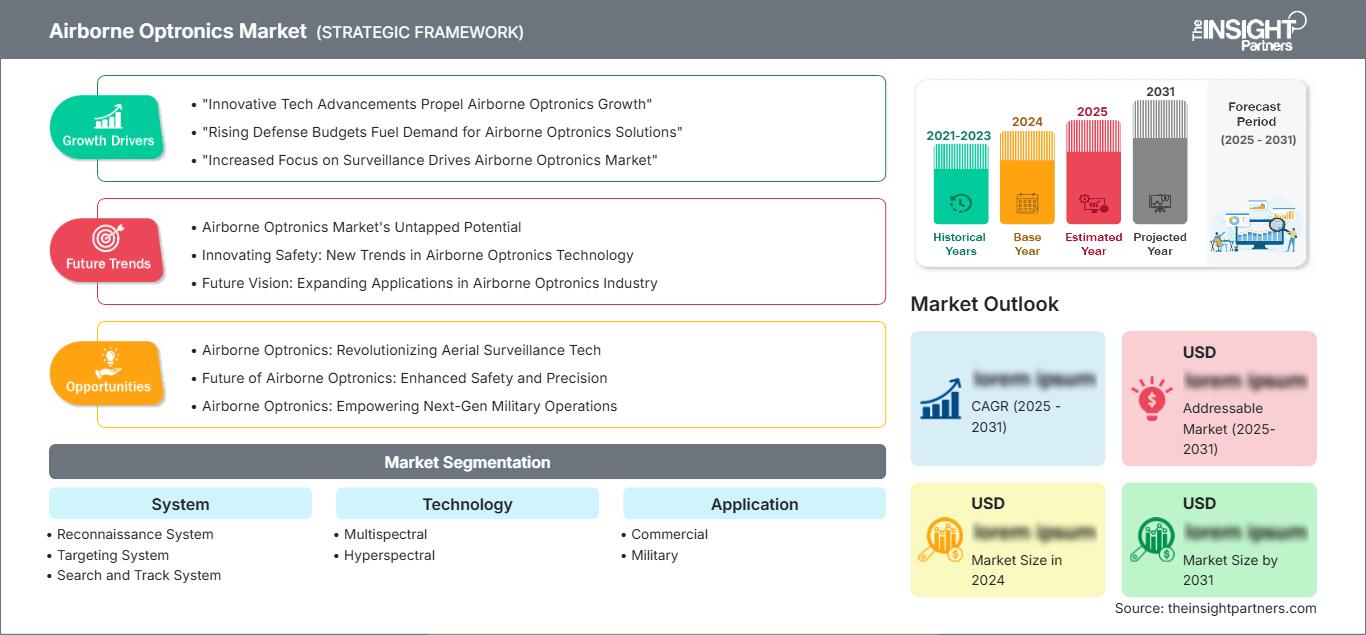
Airborne Optronics Market: Strategic Insights
Regional Insights
North America Airborne Optronics Market
North America is forecast to account for ~38% of revenue in the global airborne optronics market in 2025 and to grow at a CAGR of ~10% up to 2034. The region will be driven by its large inventory of military aircraft, UAV activities, and the presence of defense-electronic equipment manufacturing capabilities. US procurement programs include targeting pods, distributed aperture systems, missile warning systems, reconnaissance payloads, and helicopter EO/IR capability upgrade. These procurement programs generate demand not only for new builds but also retrofit applications.
The region is dominated by US as the main source of demand since defense agencies have fleets of different types of fixed-wing, rotary-wing, and unmanned aircraft, which need sensors capable of day-and-night targeting and reconnaissance. Besides aerospace manufacturing and special surveillance activities in Canada, cross-border supply chain generates demand for components and subsystems. Key players in the region include Northrop Grumman Corporation, RTX Corporation, Lockheed Martin Corporation, Teledyne FLIR, and Stark Aerospace. There will also be demand for lifecycle upgrades since modularity of EO/IR systems allows upgrading imaging and processing systems without aircraft replacement.
U.S. Airborne Optronics Market
The US is modeled to represent ~82% of North American airborne optronics market share in 2025 and to record a CAGR of ~10% through 2034. Its position reflects the scale of US military aviation, broad deployment of remotely piloted aircraft, and procurement of airborne sensing for targeting, intelligence, surveillance, reconnaissance, and aircraft protection. Modernization programs also create recurring demand for improved processors, detectors, stabilization, and software.
US market includes fighters and attack planes, special mission planes, helicopters, and unmanned aerial vehicles (UAVs). The capability of Northrop Grumman's LITENING and distributed aperture systems exemplifies the demand for multispectral and continually upgraded sensors. RTX Corporation is involved in EO/IR modernization and support programs, while Teledyne FLIR supplies imaging technologies and payloads. The demand is becoming increasingly related to interoperability and rapid technology insertion that enables users to enhance mission performance by upgrading payloads instead of buying new aircraft.
Europe Airborne Optronics Market
The European market accounted for ~30% share of the global airborne optronics market in 2025, and is projected to grow at a CAGR of ~11% from 2025 to 2034. France leads in the region because of its strong aerospace & defense industry and indigenous electro-optics capabilities. Germany contributes to the market through advanced defense electronics and sensors development. The UK maintains demand for the products through military aviation and surveillance and aircraft upgrade programs. Italy and Spain contribute through their participation in multinational aerospace programs and indigenous defense needs.
Increasing sovereign technology requirements and multinational platform development programs are influencing demand in Europe. For instance, the involvement of Safran in the EUROFLIR 610 program for the Eurodrone program represents the trend of long range multispectral airborne optronic sensors embedded in the next generation remotely piloted aircraft. The system consists of a multispectral telescope, line of sight stabilization and geolocation/desigation. Leonardo's involvement in the Eurodrone airborne mission system represents an example of the trend of embedding optronics in mission architectures. France, Germany, Italy, Spain and the UK thus matter as end user markets and producers.
The ecosystem of Europe also consists of Thales SA, Safran, Leonardo S.p.A. and Hensoldt AG, along with further involvement of Elbit Systems Ltd. and other specialized suppliers. Future needs will consist of interoperable payload, modular structure, low observable sensor system and miniaturized products for UAVs and helicopters. The needs of procurement may change according to national defense policy, but the fundamental need of aerial situational awareness will provide needs for various types of aircraft.
APAC Airborne Optronics Market
Asia Pacific represented ~24% of the global airborne optronics market in 2025 and is modeled to expand at a CAGR of ~15% through 2034, making it the fastest-growing region. China is modeled as the leading country in Asia Pacific, while Japan and South Korea maintain sophisticated aerospace and defense electronics capabilities. India is increasing indigenous aerospace production, and Australia is expanding advanced surveillance and defense-aircraft capabilities.
Regional demand is connected to UAV deployment, maritime surveillance, border monitoring, and modernization of tactical aircraft and helicopters. China and India are developing domestic aerospace and sensor supply chains, while Japan and South Korea emphasize advanced electronics and precision sensing. Australia adds demand through long-range surveillance and allied interoperability requirements. These conditions create opportunities for compact multispectral payloads, stabilized turrets, hyperspectral systems, and digitally connected sensors.
Middle East & Africa Airborne Optronics Market
The Middle East & Africa airborne optronics market share is modeled to expand at a CAGR of ~10% through 2034. Saudi Arabia is identified as the leading country in the Middle East & Africa region where defense procurement, UAV adoption, and aircraft modernization support demand. The UAE also maintains significant requirements for advanced surveillance and targeting systems through its defense-industrial development and aerospace programs.
South Africa contributes through aerospace engineering and security applications, while the rest of the Middle East & Africa presents opportunities associated with border surveillance, maritime monitoring, search and rescue, and infrastructure protection. Harsh operating environments increase the value of stabilized thermal imaging and ruggedized payloads capable of operating under dust, heat, and reduced visibility. Demand is therefore likely to favor reliable systems with integrated processing, long-range observation, and manageable maintenance requirements.
Segmentation Analysis
System
The System segment in the airborne optronics market is modeled to record a CAGR of ~11% during 2026–2034. Reconnaissance, targeting, search and track, surveillance, and countermeasure functions increasingly depend on integrated payload architectures combining optics, detectors, processors, stabilization, and software. System-level procurement captures this integration value and supports upgrades as aircraft operators seek improved mission capability without replacing entire platforms.
- Reconnaissance System: Reconnaissance systems prioritize persistent collection, high-resolution imaging, and geospatial awareness. Their strategic importance increases as aircraft and UAV operators require rapid intelligence generation across day and night operating conditions.
- Targeting System: Targeting systems combine imaging, tracking, laser functions, and geolocation to support precision engagement. Demand is shaped by requirements for faster target acquisition, improved identification, and integration with aircraft mission computers and weapons systems.
- Search and Track System: Search and track systems emphasize continuous detection and automated target following. Their value is particularly relevant to airborne surveillance and maritime missions where operators must monitor moving objects over extended periods.
- Surveillance System: Surveillance systems support broad-area monitoring, reconnaissance, and situational awareness. Multisensor architectures enable operators to combine visual and infrared information while maintaining coverage across changing lighting and weather conditions.
- Countermeasure System: Countermeasure systems use infrared and related sensing functions to detect and respond to threats. Integration with aircraft survivability architectures makes processing speed, reliability, and rapid threat recognition strategically important.
Technology
The Technology segment in the airborne optronics market is modeled to record a CAGR of ~13% during 2026–2034. Multispectral sensing remains central to airborne imaging because combining visible and infrared channels improves target detection across lighting and atmospheric conditions. Hyperspectral technology adds greater spectral discrimination and can support specialized identification tasks, although integration complexity and processing requirements influence adoption.
- Multispectral: Multispectral systems combine multiple wavelength bands to improve observation and identification. Their broad applicability across targeting, reconnaissance, surveillance, and UAV payloads supports continued adoption where users require day-night performance in a compact architecture.
- Hyperspectral: Hyperspectral systems capture more detailed spectral information than conventional multispectral payloads. Their strategic importance is strongest in specialized intelligence and detection applications where material discrimination or subtle spectral signatures justify greater sensor and processing complexity.
Application
The Application segment in the airborne optronics market is modeled to record a CAGR of ~11% during 2026–2034. Military users represent the core demand base because airborne sensing directly supports reconnaissance, targeting, surveillance, and aircraft survivability. Commercial applications are narrower but provide opportunities in inspection, environmental observation, emergency response, and specialized aerial imaging.
- Commercial: Commercial applications include aerial inspection, search and rescue, environmental monitoring, and specialized imaging. Adoption depends on payload economics, regulatory requirements, aircraft endurance, image quality, and the ability to integrate sensors without materially reducing useful payload capacity.
- Military: Military applications require persistent sensing, target identification, precision designation, and operation in degraded conditions. Procurement increasingly favors systems combining multiple spectral bands, onboard processing, stabilization, and digital connectivity within standardized aircraft interfaces.
Aircraft Type
The Aircraft Type segment in the airborne optronics market is modeled to record a CAGR of ~17% during 2026–2034. UAV adoption is expanding the addressable market for compact payloads because unmanned platforms can carry stabilized EO/IR systems across reconnaissance, surveillance, targeting, and security missions. Fixed-wing and rotary-wing aircraft remain important because of their larger installed bases and higher payload capacity.
- Fixed Wing: Fixed-wing aircraft support long-range surveillance, targeting, reconnaissance, and mission-specialized sensing. Their payload capacity permits larger optical assemblies and multisensor architectures, while modernization programs create recurring demand for improved imaging and processing.
- Rotary Wing: Rotary-wing platforms require compact, stabilized payloads that maintain performance despite vibration and dynamic flight conditions. Helicopter applications include surveillance, search and rescue, targeting, and pilot assistance, creating demand for lightweight integrated EO/IR systems.
- Unmanned Aerial Vehicles: UAVs are an important expansion platform for airborne optronics because compact payloads can deliver persistent sensing at lower platform size and operating cost. Requirements increasingly center on low SWaP, autonomous tracking, onboard analytics, and modular integration.
Opportunity Snapshot
| Application | Revenue Contribution | Trend Tag | Adoption Stage |
| Commercial | Low | Aerial Inspection | Scaling |
| Military | High | Precision ISR | Mature |
Airborne Optronics Market Growth Drivers and Impact Analysis
Expansion of Persistent Airborne Intelligence and Surveillance
The expansion of persistent intelligence, surveillance, and reconnaissance missions is increasing the operational requirement for sensors capable of continuous observation across day, night, and degraded-visibility conditions. EO/IR payloads provide a passive sensing option that can complement radar and electronic intelligence systems while supporting target recognition and geolocation. UAV proliferation strengthens this mechanism because smaller aircraft can carry compact stabilized payloads for extended missions. The resulting demand is shifting product requirements toward lighter systems with greater spectral coverage, automated tracking, and onboard processing. Suppliers that can reduce payload size without sacrificing detection and identification performance can address more aircraft classes. This driver also supports retrofit activity because existing platforms can gain improved surveillance capability through payload replacement or software and processor upgrades rather than complete aircraft redesign.
Aircraft Modernization and Retrofit Demand
Aircraft modernization is creating a recurring demand channel because EO/IR systems face continuous technology evolution even when the aircraft platform remains operational for decades. Detector sensitivity, image processing, stabilization, laser functions, and data connectivity can improve faster than aircraft structures and propulsion systems. Operators therefore have an incentive to replace or upgrade mission payloads during scheduled modernization cycles. Podded and modular architectures can reduce integration complexity by allowing capability improvements without extensive airframe modification. This mechanism is particularly relevant for large military fleets where extending aircraft service life is economically important. Suppliers with installed systems can benefit from upgrade programs because compatibility, certification knowledge, maintenance infrastructure, and established interfaces reduce transition risk. The market impact extends beyond new sensor sales to software, integration, testing, sustainment, and replacement components.
Integration of Multispectral Sensing and Digital Processing
The integration of multiple spectral channels with digital processing is changing the architecture of airborne sensing systems. Visible, SWIR, MWIR, and other infrared channels can provide complementary information under different illumination and atmospheric conditions. Processing algorithms can combine these inputs to improve detection, recognition, tracking, and image usability. This creates demand for higher-performance processors, compact electronics, precision stabilization, and software capable of handling large volumes of sensor data. The impact is especially strong in systems designed for UAVs and tactical aircraft, where payload space and power availability are constrained. Integrated architectures also enable manufacturers to differentiate through algorithms and software updates rather than relying exclusively on optical hardware. As a result, value is shifting toward complete sensing solutions that combine optics, detectors, electronics, software, and platform interfaces.
Airborne Optronics Market Future Trends
AI-Enabled Multisensor Image Processing
AI-enabled processing is expected to become more deeply embedded in airborne optronics as operators seek faster interpretation of increasingly complex imagery. Instead of transmitting all raw sensor data for processing at a remote location, future payloads can increasingly perform detection, classification, tracking, image enhancement, and prioritization at or near the edge. This approach can reduce communication burden and improve response time in bandwidth-constrained environments. Multispectral systems are particularly suited to this trend because algorithms can correlate information from visible and infrared channels to improve target recognition. The transition will require validated training data, processor-efficient models, cybersecurity, and human-machine interfaces that allow operators to understand automated outputs. Suppliers that integrate AI capabilities without materially increasing payload size, power consumption, or certification burden can address growing demand for intelligent airborne sensing.
Distributed and Networked Airborne Sensing Architectures
Future airborne sensing architectures are likely to distribute sensing functions across multiple platforms rather than relying on a single high-value sensor. UAV swarms, crewed-uncrewed teaming, distributed aperture systems, and networked mission payloads can combine observations from different positions and spectral channels. This architecture can improve coverage and resilience while allowing individual platforms to carry smaller payloads. It also increases the importance of secure data links, common interfaces, time synchronization, and interoperable mission software. Sensor suppliers will increasingly need to design payloads that function as network nodes rather than isolated instruments. For aircraft operators, this can enable scalable sensing capacity in which additional UAVs or modular payloads expand coverage without requiring a proportional increase in large aircraft. The airborne optronics market trend is therefore expected to influence both hardware architecture and the software layer connecting airborne sensors.
Airborne Optronics Market Opportunities
Compact EO/IR Payloads for Unmanned Aircraft
Compact payloads for UAVs represent an important commercial opportunity because unmanned platforms continue to broaden the range of airborne missions that require persistent sensing. The addressable opportunity includes small stabilized turrets, multispectral cameras, infrared sensors, laser rangefinders, and integrated processing units designed for strict size, weight, and power constraints. Suppliers can differentiate through lightweight construction, stabilization accuracy, automatic tracking, low power consumption, and simplified platform integration. The opportunity also extends to software because UAV operators increasingly require onboard target detection and image exploitation. Partnerships between established defense companies and specialist sensor manufacturers can accelerate development by combining certification experience with compact optical engineering. Products that are platform-agnostic and configurable across multiple UAV classes can address a broader customer base while reducing dependence on a single aircraft program.
European Sovereign Airborne Sensing Programs
European defense modernization and sovereign technology initiatives create opportunities in the airborne optronics market forecast for companies capable of supplying domestically supported airborne sensing solutions. Multinational programs such as Eurodrone require integration across several industrial participants, creating demand for stabilized multispectral systems, mission processors, interfaces, and long-term support. European users also have requirements for surveillance and targeting across fixed-wing aircraft, helicopters, and UAVs. Suppliers can pursue opportunities through local manufacturing, technology partnerships, subsystem specialization, and participation in platform-level development programs. The strategic opportunity extends beyond initial payload deliveries because aircraft programs create lifecycle requirements for upgrades, maintenance, spares, and software. Companies that can demonstrate interoperability with European mission architectures and maintain secure supply chains may be positioned to participate in multiple programs rather than relying on one platform.
Frequently Asked Questions

- Comprehensive Market Sizing and Forecast Analysis
- Detailed Segmentation Analysis
- In-Depth Market Dynamics Assessment
- Regional and Country-Level Insights
- Competitive Landscape and Company Benchmarking
- Strategic Business Intelligence
Recent Reports
Testimonials

The Insight Partners provided valuable market intelligence that supported our global go-to-market strategy. Their team was professional, responsive, and attentive to our feedback, providing thoughtful analysis and helpful methodological clarifications throughout the project.
Junmo Kim Chief Financial Officer (CFO), Enertech Co., Ltd.
The Insight Partners' SCADA System Market report is comprehensive, with valuable insights on current trends and future forecasts. The team was highly professional, responsive, and supportive throughout. We are very satisfied and highly recommend their services.
RAN KEDEM Partner, Reali Technologies LTDs
I requested a report on a very specific software market and the team produced the report in a few days. The information was very relevant and well presented. I then requested some changes and additions to the report. The team was again very responsive and I got the final report in less than a week.
JEAN-HERVE JENN Chairman, Future Analytica
We worked with The Insight Partners for an important market study and forecast. They gave us clear insights into opportunities and risks, which helped shape our plans. Their research was easy to use and based on solid data. It helped us make smart, confident decisions. We highly recommend them.
PIYUSH NAGPAL Sr. Vice President, High Beam Global
The Insight Partners delivered insightful, well-structured market research with strong domain expertise. Their team was professional and responsive throughout. The user-friendly website made accessing industry reports seamless. We highly recommend them for reliable, high-quality research services
YUKIHIKO ADACHI CEO, Deep Blue, LLC.
This is the first time I have purchased a market report from The Insight Partners.While I was unsure at first, I visited their web site and felt more comfortable to take the risk and purchase a market report.I am completely satisfied with the quality of the report and customer service. I had several questions and comments with the initial report, but after a couple of dialogs over email with their analyst I believe I have a report that I can use as input to our strategic planning process.Thank you so much for taking the extra time and making this a positive experience.I will definitely recommend your service to others and you will be my first call when we need further market data.
JOHN SUZUKI President and Chief Executive Officer, Board Director, BK Technologies
I wish to appreciate your support and the professionalism you displayed in the course of attending to my request for information regarding to infectious disease IVD market in Nigeria. I appreciate your patience, your guidance, and the fact that you were willing to offer a discount, which eventually made it possible for us to close a deal. I look forward to engaging The Insight Partners in the future, all thanks to the impression you have created in me as a result of this first encounter.
DR CHIJIOKE ONYIA MANAGING DIRECTOR, PineCrest Healthcare Ltd.Reason to Buy
- Informed Decision-Making
- Understanding Market Dynamics
- Competitive Analysis
- Identifying Emerging Markets
- Customer Insights
- Market Forecasts
- Risk Mitigation
- Boosting Operational Efficiency
- Strategic Planning
- Investment Justification
- Tracking Industry Innovations
- Aligning with Regulatory Trends





 Get Free Sample for