
Aircraft Sewage Management Systems Market Trends, Demand & Growth by 2034
Coverage: By System (Vacuum Waste Systems, Recirculating Blue Water Systems, Potable Water Systems, Others); Aircraft (Military Transport Aircraft, General Aviation Aircraft, Commercial Aviation Aircraft) , and Geography (North America, Europe, Asia Pacific, and South and Central America)
- Status : Data Released
- Report Code : TIPRE00021923
- Category : Aerospace and Defense
- No. of Pages : 150
- Available Report Formats :


- Last update date : November 03, 2026


2025 Market Size
US$ 560.29 Mn
Base year value
2034 Forecast
US$ 819.25 Mn
Projected by 2034
CAGR 2026-2034
4.31 %
Growth rate
Addressable Market
US$ 6,264.11 Mn
(2026-2034)
The aircraft sewage management systems market is shaped by aircraft deliveries, fleet utilization, cabin retrofit activity, maintenance requirements, and continuing demand for lighter, reliable onboard waste-handling equipment. The market is projected to expand from US$ 560.29 Million in 2025 to US$ 819.25 Million by 2034, representing a CAGR of 4.31% from 2026 to 2034. Increasing passenger traffic, aircraft fleet renewal, retrofit programs, and improvements in vacuum-based waste handling are supporting demand for integrated systems.
The aircraft sewage management systems market size in North America is supported by a large installed commercial aircraft base, substantial MRO activity, and continued replacement of legacy cabin equipment. North American demand is expected to progress at a modeled CAGR of ~4% through 2034, supported by fleet modernization, retrofit adoption, stringent maintenance requirements, and demand for lightweight equipment that reduces operating and lifecycle costs.
Aircraft Sewage Management Systems Market Assessment and Insights
Regional Outlook
- North America: ~37% of the global aircraft sewage management systems market share in 2025 | ~4% CAGR through 2034. Market position: North America maintains the largest regional position because of its extensive commercial and military aircraft base, mature MRO ecosystem, established cabin-system suppliers, and sustained retrofit activity across aging and newly delivered fleets.
- US: ~78% of North American market revenue in 2025 | ~4% CAGR through 2034. Market position: The US represents the largest country market within North America, supported by major airlines, aircraft manufacturers, defense programs, MRO providers, and established suppliers of vacuum waste, water, lavatory, and cabin equipment.
- Europe: ~30% of the global market in 2025 | ~4% CAGR through 2034. Market position: Europe has a mature installed base and strong aircraft manufacturing and MRO capabilities. Germany represents the leading country in Europe, with France, the UK, Italy, and Spain providing additional demand through commercial, military, and retrofit applications.
- Asia Pacific: ~25% of the global market in 2025 | ~6% CAGR through 2034. Market position: Asia Pacific is the fastest-growing region as expanding passenger fleets, rising air connectivity, aircraft manufacturing activity, and infrastructure investment increase requirements for onboard sanitation and water-waste equipment. China is the leading country in Asia Pacific.
Segment Outlook
- Vacuum Waste Systems: ~48% Share in 2025 | ~5% CAGR through 2034. Market position: Vacuum Waste Systems lead because they are closely integrated with aircraft lavatories and offer efficient waste removal, lower water consumption, compact architecture, and established compatibility with commercial aircraft line-fit and retrofit programs.
- Potable Water Systems: ~29% Share in 2025 | ~6% CAGR through 2034. Market position: Potable Water Systems represent the high-growth segment as airlines and aircraft manufacturers emphasize reliable water distribution, lightweight components, improved hygiene, and efficient cabin-service infrastructure across expanding fleets and upgraded aircraft interiors.
Competitive Coverage
Albany International Corp, BLAUKAISER, Collins Aerospace, L3Harris Technologies, Inc., MT Aerospace AG, The Yokohama Rubber Co., Ltd., Schrader T+A Fahrzeugbau GmbH & Co. KG, Safran, von Oertzen GmbH, W.R. Davis Engineering Limited
Methodology
The Insight Partners follows Data Collection & Secondary Research, Primary Research, Data Analysis, and Data Triangulation & Final Review to validate market estimates and insights.
Source: The Insight Partners' analysis based on proprietary research, government publications, company annual reports, investor presentations, industry databases, and expert interviews.
Sewage management technology for aircraft has progressed from rather rudimentary chemically driven and gravity based solutions towards comprehensive vacuum, tank, sensing, drainage, and water management systems. Recent generations of products make increasing use of lightweight composite materials, improved sealing systems, integrated sensors, and modular line replaceable units to ease maintenance operations. The vacuum technology has gained special significance since it can lower water consumption levels and enable compact routing of piping in cramped aircraft. Supplier capabilities have expanded from component-level solutions to system integration and certification services, as well as aftermarket support and retrofits, integrating cabin system design closer with aircraft economics.
Up until 2034, the forecast picture will be driven more and more by growth in aircraft fleet size in the Asia-Pacific region, as well as by modernization programs in the well-established aviation industry. Manufacturers and carriers focus more and more on cabin efficiency, hygiene, maintainability, and weight saving. Development of new aircraft fleets takes place alongside extended service life of part of the current fleet, resulting in the need for replacement of equipment not only from line fit but also from the aftermarket.
Aircraft Sewage Management Systems Market Report Scope
| Report Attribute | Details |
|---|---|
| Market size in 2025 | US$ 560.29 Million |
| Market Size by 2034 | US$ 819.25 Million |
| Global CAGR (2026 - 2034) | 4.31% |
| Historical Data | 2021-2024 |
| Forecast period | 2026-2034 |
Aircraft Sewage Management Systems Market Analysis
Demand in the aircraft sewage management systems market is fundamentally connected to the number of aircraft in service, aircraft utilization, passenger volumes, and the frequency of cabin refurbishment. The ecosystem spans aircraft OEMs, cabin-system integrators, component manufacturers, airlines, lessors, MRO providers, and specialized airport-service companies. Suppliers must satisfy stringent aerospace qualification requirements while balancing weight, reliability, serviceability, corrosion resistance, and installation constraints. This makes certification capability and long-term aftermarket support important competitive factors alongside product design.
Supply in the aircraft sewage management systems market is determined by the production schedule, availability of aircraft parts, aerospace materials, and the capacity of suppliers to ensure consistent quality in the highly regulated programs. Newly delivered aircraft will provide new line-fit possibilities, while existing aircraft would create replacements and retrofitting needs. Due to the long-lasting imbalance between supply and demand in the industry, maintenance and life-extension needs became an important factor for suppliers. With increased life spans of the airplanes that airlines keep in use, suppliers can gain more demand from replacing lavatories, vacuum generators, tanks, valves, sensors, and water systems components.
The competition within the aircraft sewage management systems market is based on the capability of providing integrated solutions, experience with certifications, reliability, weight saving, and lifetime support. Collins Aerospace has the wide range of water and waste management products, and Safran integrates cabin solutions with water and waste management solutions. The Yokohama Rubber Co., Ltd. has the developed capabilities in lavatory modules and water tanks, and W.R. Davis Engineering Limited produces the aircraft water tanks and aerospace components.
With a growing inclination to invest in technologies that have the ability to decrease maintenance time, increase reliability, and decrease the weight of aircraft, supplier positioning will be dependent on the combination of engineering knowledge and production scalability. The retrofit technology will be crucial since users can prolong their aircraft's life span without the need to wait for the delivery of new aircraft.
● REPORT CUSTOMIZATION
Tailor This Report To Align With Your Specific Business Requirements
This report can be customized to align precisely with your business objectives, scope, and target markets. Customization options include tailored segmentation, geography, competitive analysis, and strategic insights to support informed decision-making.
Customize This Report →WHAT YOU CAN ADJUST
- ● Segmentations
- ● Geography
- ● Competitive Analysis
- ● Language Preferences
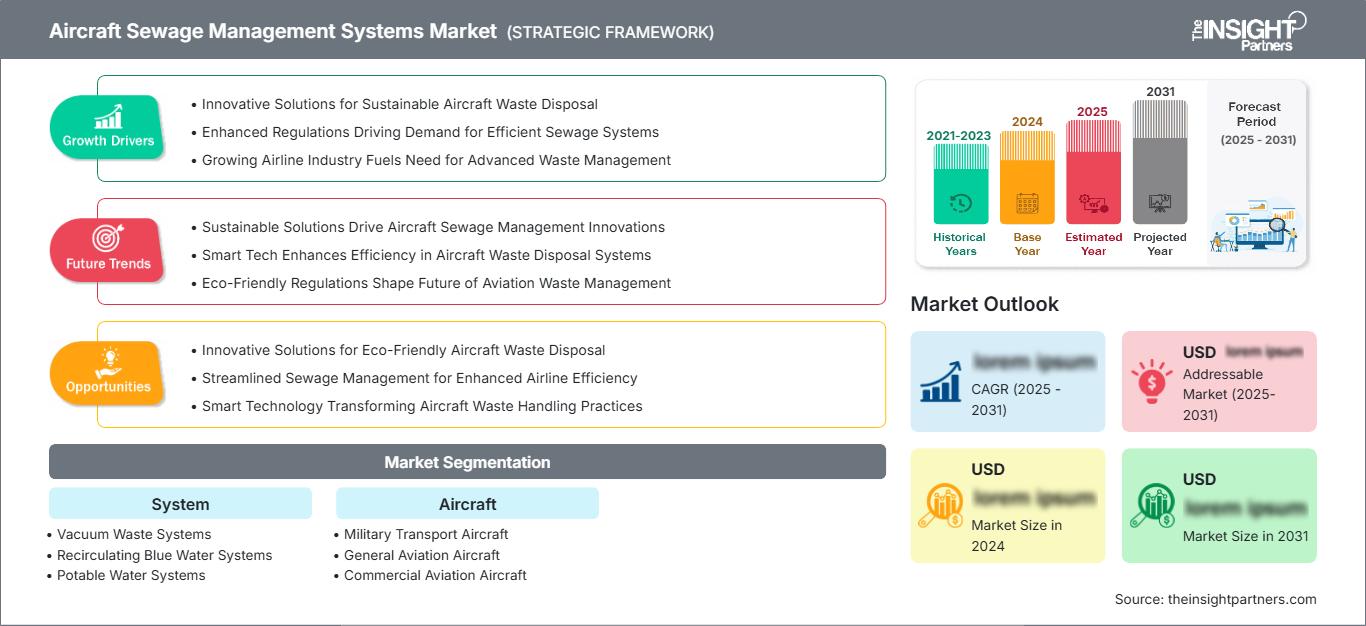
Aircraft Sewage Management Systems Market: Strategic Insights
Regional Insights
North America aircraft sewage management systems market
North America represented ~37% of the global aircraft sewage management systems market in 2025 and is expected to expand at ~4% CAGR through 2034. The region benefits from a large installed aircraft fleet, extensive airline networks, mature MRO infrastructure, and strong aerospace manufacturing capabilities. The US accounts for the majority of regional demand, while Canada contributes through commercial aviation, specialized aerospace production, and maintenance activity. Replacement of legacy cabin equipment provides an important recurring demand stream.
The regional market is also supported by the prevalence of retrofit programs for lavatories and water-waste components. Airlines seek equipment that can improve reliability while minimizing turnaround and maintenance requirements. Collins Aerospace has a significant presence in water and waste systems, while L3Harris Technologies, Inc., Albany International Corp, and W.R. Davis Engineering Limited contribute broader aerospace technologies and component capabilities. Continued aircraft utilization and fleet renewal should sustain demand through the forecast period.
U.S. aircraft sewage management systems market
The US represented ~78% of North American aircraft sewage management systems market revenue in 2025 and is projected to grow at ~4% CAGR through 2034. Its position reflects the scale of the US airline industry, extensive aircraft fleet, defense aviation activity, and concentration of aerospace manufacturers, cabin-system suppliers, and MRO organizations. Commercial aviation provides the largest recurring requirement, while military transport and general aviation create specialized equipment demand.
The market also benefits from a substantial installed base requiring replacement and refurbishment. Collins Aerospace supplies vacuum waste and water systems for multiple aircraft platforms, while W.R. Davis Engineering Limited manufactures pressurized aircraft water tanks. Albany International Corp and L3Harris Technologies, Inc. add aerospace engineering capabilities across adjacent applications. Retrofit programs are strategically relevant because operators can improve lavatory functionality and reliability while extending the economic life of existing aircraft.
Europe aircraft sewage management systems market
Europe accounted for ~30% of the global aircraft sewage management systems market in 2025 and is expected to register ~4% CAGR through 2034. Germany is the leading country in Europe, supported by its aerospace manufacturing base, component suppliers, MRO capabilities, and established aviation infrastructure. France also represents a major demand center because of its aircraft manufacturing and aerospace-equipment ecosystem. The UK contributes through airlines, MRO providers, and aerospace engineering, while Italy and Spain add demand through aircraft production, maintenance, and expanding commercial aviation activity.
Germany's industrial base supports specialized suppliers such as Schrader T+A Fahrzeugbau GmbH & Co. KG, while France is closely connected with Safran's aircraft cabin and water-waste activities. European operators increasingly balance new-aircraft procurement with refurbishment of existing fleets, supporting both line-fit and retrofit channels. Environmental efficiency, cabin hygiene, equipment reliability, and weight reduction remain important purchasing considerations.
The region's mature certification environment also favors suppliers capable of maintaining consistent aerospace quality and documentation. Replacement cycles for tanks, valves, sensors, lavatory components, and related equipment provide recurring aftermarket opportunities. European aircraft manufacturers' large order backlogs support future line-fit demand, although supply-chain constraints can shift the timing of component deliveries.
APAC aircraft sewage management systems market
The aircraft sewage management systems market forecast shows that Asia Pacific accounted for ~25% of the global market in 2025 and is expected to expand at ~6% CAGR through 2034, making it the fastest-growing region. China is the leading country in Asia Pacific, supported by fleet expansion, domestic aerospace development, and rising demand for air connectivity. Japan and South Korea maintain sophisticated aerospace manufacturing and airline ecosystems, while India is expanding aviation infrastructure and fleet capacity.
Australia contributes through a geographically dispersed aviation network and an established commercial and general aviation base. Increasing aircraft deliveries, cabin refurbishment, and MRO investments are expanding demand for efficient water-waste equipment. Suppliers that can localize support, provide certified replacement parts, and integrate lightweight systems with regional aircraft platforms are positioned to participate in the region's expanding installed base.
Middle East & Africa aircraft sewage management systems market
The Middle East and Africa is expected to grow at ~5% CAGR through 2034. Saudi Arabia and the UAE are important demand centers in the Middle East because of large airline fleets, airport infrastructure investment, aircraft acquisition programs, and ambitions to expand international aviation connectivity. The UAE has a particularly developed aviation ecosystem supported by major airlines, airports, MRO capabilities, and widebody operations.
South Africa represents an established African aviation market, while the Rest of MEA includes airlines and airport systems at varying stages of fleet and infrastructure development. New aircraft procurement and cabin refurbishment provide opportunities for system suppliers, while high aircraft utilization increases the importance of reliable waste handling and maintainable components. Energy-intensive airport infrastructure and long-haul operations also increase attention to lightweight and efficient onboard systems.
Segmentation Analysis
System
The System segment represents the core technical architecture of onboard sanitation and water handling, making system integration, reliability, weight, maintainability, and certification central purchasing considerations. Demand is supported by new aircraft production as well as retrofit and replacement programs. Vacuum Waste Systems remain the largest individual sub-segment and are expected to record ~5% CAGR through 2034 as airlines prioritize efficient waste evacuation and lower water requirements.
- Vacuum Waste Systems: These systems provide controlled waste evacuation from aircraft lavatories and are closely associated with vacuum toilets, generators, tanks, sensors, valves, and associated piping. Their established architecture supports extensive line-fit and retrofit applications.
- Recirculating Blue Water Systems: Recirculating configurations support efficient water management where aircraft operators seek reduced consumption and optimized cabin-service infrastructure. Adoption depends on aircraft configuration, operational requirements, hygiene considerations, and system-level integration constraints.
- Potable Water Systems: Potable water equipment distributes and manages onboard water for passenger and crew requirements. Demand is supported by fleet expansion, hygiene requirements, lightweight component development, and replacement of aging tanks, valves, pumps, and distribution components.
Aircraft
The Aircraft segment determines system configuration according to aircraft mission, cabin architecture, operating cycle, passenger capacity, and maintenance requirements. Commercial operators generate substantial recurring demand because of fleet scale and high utilization, while military and general aviation platforms require customized solutions. Procurement increasingly considers system weight, reliability, certification, installation complexity, and access to replacement components over the aircraft lifecycle.
- Military Transport Aircraft: Military transport platforms require robust systems capable of operating under demanding mission profiles. Equipment selection emphasizes durability, maintainability, secure integration, and reliable operation across varied environmental and deployment conditions.
- General Aviation Aircraft: General aviation applications cover diverse aircraft configurations and operating patterns. Demand is influenced by aircraft size, mission requirements, cabin amenities, refurbishment activity, and the need for compact systems suitable for space-constrained installations.
- Commercial Aviation Aircraft: Commercial aircraft represent a major demand base because of large fleet volumes and intensive utilization. Airlines prioritize reliable lavatory operation, low maintenance burden, lightweight architecture, and retrofit compatibility across frequently operated aircraft platforms.
Opportunity Snapshot
| System | Revenue Contribution | Trend Tag | Adoption Stage |
|---|---|---|---|
| Vacuum Waste Systems | High | Vacuum Efficiency | Mature |
| Recirculating Blue Water Systems | Medium | Water Reuse | Scaling |
| Potable Water Systems | High | Hygiene Systems | Scaling |
Aircraft Sewage Management Systems Market Growth Drivers and Impact Analysis
Expansion of Commercial Aircraft Fleets and Passenger Traffic
Growing passenger demand creates direct requirements for reliable onboard sanitation infrastructure because every additional aircraft and higher utilization cycle increases the operating exposure of lavatory and water-waste equipment. Global passenger demand increased 5.3% in 2025, while international demand increased 7.1%, supporting continued pressure for additional capacity. Aircraft manufacturers also maintained substantial delivery activity, while large order backlogs indicate sustained future fleet requirements. For sewage-management suppliers, the effect is twofold: new aircraft create line-fit opportunities, while higher utilization accelerates component wear and replacement requirements. Airlines therefore increasingly value equipment that combines reliability with rapid maintenance and lower lifecycle costs. The resulting demand extends across vacuum generators, tanks, sensors, lavatory systems, drainage components, and potable-water equipment.
Aircraft Retrofit and Fleet Life Extension
Aircraft supply constraints and longer fleet operating lives are creating an important aftermarket mechanism for sewage-management equipment. Airlines have retained aircraft longer when new-aircraft deliveries have been delayed, increasing the relevance of replacement and retrofit programs. The average global fleet age reached about 15 years in recent industry reporting, reinforcing the need for refurbishment and component replacement. Retrofit demand allows operators to improve lavatory functionality, reduce maintenance exposure, and introduce lightweight components without replacing the entire aircraft. Suppliers with certified solutions for established aircraft platforms can therefore access recurring aftermarket revenue in addition to new-aircraft programs. The opportunity is particularly relevant for vacuum toilets, waste tanks, sensors, valves, and water-system components where legacy equipment can be replaced during scheduled cabin refurbishment.
Lightweight Equipment and Maintenance Efficiency
Weight reduction and maintenance efficiency are increasingly important because aircraft operators seek lower operating costs while maintaining cabin-service reliability. Modern vacuum waste systems can combine composite structures, compact components, integrated sensing, and simplified access to reduce maintenance complexity. Collins Aerospace, for example, describes vacuum equipment designed around lower weight and simplified on-aircraft maintenance. Such designs can influence procurement decisions because savings accumulate across repeated flight cycles and maintenance events. Lightweight materials also create opportunities for suppliers with expertise in aerospace composites and advanced manufacturing. As airlines compare new equipment against legacy architectures, the value proposition increasingly extends beyond initial acquisition price to installation time, component life, maintenance labor, aircraft weight, water consumption, and availability of replacement parts.
Aircraft Sewage Management Systems Market Future Trends
Integrated Digital Monitoring of Water and Waste Equipment
The aircraft sewage management systems market trends indicate that aircraft sanitation systems are likely to become more connected as airlines and OEMs seek better visibility into component condition and maintenance requirements. Sensors can monitor tank levels, system states, valve operation, pressure conditions, and other parameters that influence serviceability. Future architectures may increasingly connect these measurements with broader aircraft maintenance and cabin-management systems, enabling condition-based intervention rather than relying solely on fixed replacement intervals. The commercial value lies in reducing unscheduled maintenance, improving troubleshooting, and increasing component availability. Integration will require qualified sensors, secure data interfaces, robust electronics, and certification appropriate to aircraft environments. Suppliers able to combine mechanical equipment with reliable monitoring capabilities may therefore gain differentiation as airlines place greater emphasis on predictive maintenance and lifecycle optimization.
Greater Use of Lightweight and Resource-Efficient Architectures
Future aircraft sewage-management designs are likely to emphasize lower weight, lower water consumption, compact installation, and improved maintainability simultaneously. Composite tanks, polymer components, efficient vacuum architectures, and optimized piping can help reduce structural and operational burdens while preserving required durability. Resource efficiency is particularly relevant for aircraft operating long sectors, where water weight and system reliability affect operating economics. Aircraft manufacturers are also under pressure to improve overall aircraft efficiency, encouraging subsystem suppliers to demonstrate measurable contributions rather than treating cabin equipment as isolated hardware. Over time, procurement may increasingly favor modular systems that combine multiple functions while reducing installation complexity. The trend should support suppliers with capabilities in aerospace composites, advanced molding, sensors, system integration, and certified retrofit solutions.
Aircraft Sewage Management Systems Market Opportunities
Retrofit Platforms for Aging Commercial Fleets
Retrofit programs provide an attractive commercial opportunity because a large installed aircraft base requires periodic cabin refurbishment even when aircraft remain in service for many years. Suppliers can target replacement of legacy vacuum toilets, waste tanks, sensors, valves, drainage components, and potable-water equipment with certified lightweight alternatives. Retrofit packages that minimize aircraft downtime can be particularly valuable to airlines because cabin modifications must be coordinated with tightly managed maintenance schedules. Companies with established certification records for widely operated aircraft platforms can use this installed base to build recurring aftermarket demand. Partnerships with MRO providers and cabin integrators can broaden market access, while modular replacement packages can simplify installation across different aircraft configurations. This opportunity is distinct from new-aircraft procurement because purchasing decisions are driven primarily by lifecycle economics and maintenance needs.
Localized Supply and MRO Support in Asia Pacific
Asia Pacific offers an opportunity to establish localized distribution, engineering support, repair capability, and component inventories close to expanding airline fleets. China, India, Japan, South Korea, and Australia have different aviation structures, but each supports requirements for reliable cabin equipment and timely replacement parts. Regional availability can reduce aircraft downtime and mitigate logistical challenges associated with importing specialized aerospace components. Suppliers can pursue partnerships with MRO organizations, airlines, aircraft manufacturers, and cabin integrators while developing regional technical-support capabilities. Localization also allows vendors to adapt service packages to fleet mix and regulatory requirements without changing the fundamental certified architecture. As aircraft fleets expand, the commercial opportunity should increasingly encompass not only equipment sales but also repair, overhaul, replacement parts, engineering services, and lifecycle support.
Frequently Asked Questions

- Comprehensive Market Sizing and Forecast Analysis
- Detailed Segmentation Analysis
- In-Depth Market Dynamics Assessment
- Regional and Country-Level Insights
- Competitive Landscape and Company Benchmarking
- Strategic Business Intelligence
Recent Reports
Testimonials

The Insight Partners provided valuable market intelligence that supported our global go-to-market strategy. Their team was professional, responsive, and attentive to our feedback, providing thoughtful analysis and helpful methodological clarifications throughout the project.
Junmo Kim Chief Financial Officer (CFO), Enertech Co., Ltd.
The Insight Partners' SCADA System Market report is comprehensive, with valuable insights on current trends and future forecasts. The team was highly professional, responsive, and supportive throughout. We are very satisfied and highly recommend their services.
RAN KEDEM Partner, Reali Technologies LTDs
I requested a report on a very specific software market and the team produced the report in a few days. The information was very relevant and well presented. I then requested some changes and additions to the report. The team was again very responsive and I got the final report in less than a week.
JEAN-HERVE JENN Chairman, Future Analytica
We worked with The Insight Partners for an important market study and forecast. They gave us clear insights into opportunities and risks, which helped shape our plans. Their research was easy to use and based on solid data. It helped us make smart, confident decisions. We highly recommend them.
PIYUSH NAGPAL Sr. Vice President, High Beam Global
The Insight Partners delivered insightful, well-structured market research with strong domain expertise. Their team was professional and responsive throughout. The user-friendly website made accessing industry reports seamless. We highly recommend them for reliable, high-quality research services
YUKIHIKO ADACHI CEO, Deep Blue, LLC.
This is the first time I have purchased a market report from The Insight Partners.While I was unsure at first, I visited their web site and felt more comfortable to take the risk and purchase a market report.I am completely satisfied with the quality of the report and customer service. I had several questions and comments with the initial report, but after a couple of dialogs over email with their analyst I believe I have a report that I can use as input to our strategic planning process.Thank you so much for taking the extra time and making this a positive experience.I will definitely recommend your service to others and you will be my first call when we need further market data.
JOHN SUZUKI President and Chief Executive Officer, Board Director, BK Technologies
I wish to appreciate your support and the professionalism you displayed in the course of attending to my request for information regarding to infectious disease IVD market in Nigeria. I appreciate your patience, your guidance, and the fact that you were willing to offer a discount, which eventually made it possible for us to close a deal. I look forward to engaging The Insight Partners in the future, all thanks to the impression you have created in me as a result of this first encounter.
DR CHIJIOKE ONYIA MANAGING DIRECTOR, PineCrest Healthcare Ltd.Reason to Buy
- Informed Decision-Making
- Understanding Market Dynamics
- Competitive Analysis
- Identifying Emerging Markets
- Customer Insights
- Market Forecasts
- Risk Mitigation
- Boosting Operational Efficiency
- Strategic Planning
- Investment Justification
- Tracking Industry Innovations
- Aligning with Regulatory Trends





 Get Free Sample for