
Blood Pressure Cuffs Professional Market Share, Demand & Growth by 2034
Coverage: By Type (Disposable blood pressure cuffs and Reusable pressure cuffs); End-user (Hospitals, Home healthcare, Ambulatory Surgical, Clinics and others , and Geography (North America, Europe, Asia Pacific, and South and Central America)
- Status : Data Released
- Report Code : TIPRE00027651
- Category : Life Sciences
- No. of Pages : 150
- Available Report Formats :


- Last update date : July 29, 2026


2025 Market Size
US$ 1.98 Bn
Base year value
2034 Forecast
US$ 3.54 Bn
Projected by 2034
CAGR 2026-2034
7.53 %
Growth rate
Addressable Market
US$ 26.07 Bn
(2026-2034)
The Blood Pressure Cuffs Professional Market size was estimated at US$ 1.98 Billion in 2025 and is expected to reach US$ 3.54 Billion by 2034, with a CAGR of 7.53% from 2026 to 2034. The market is growing due to the fact that professional care environment requires accurate, appropriatelvital-signs compatible cuffs for routine vital signs monitoring, permonitoringtive monitoring, chronic disease check-up, and patient triage.
In North America, the Blood Pressure Cuffs Professional Market is driven by intense clinical monitoring requirements, organized hospital purchasing, and increased focus on home-based chronic care management programs. It is estimated that the regional market would register a CAGR of 6.8–7.4% during 2026 to 2034.
Blood Pressure Cuffs Professional Market Assessment and Insights
- North America captured 36–39% Blood Pressure Cuffs Professional market share in 2025 and is growing at a CAGR between 2026–2034 of 6.8–7.4%, supported by hospital replacement demand, outpatient monitoring, and home healthcare expansion.
- US represented 78–82% of North America in 2025 and is growing at a CAGR between 2026–2034 of 6.9–7.5%, driven by ASC adoption, hospital standardization, and chronic disease management.
- Europe held 26–29% share in 2025 and is growing at a CAGR between 2026–2034 of 6.4–7.0%, led by Germany, the UK, and France through regulated procurement and cardiovascular screening.
- Asia Pacific accounted for 23–26% share in 2025 and is growing at a CAGR between 2026–2034 of 8.2–8.9%, with China, India, Japan, South Korea, and Australia expanding monitoring capacity.
- Largest Segment hospitals held 48–52% market share in 2025, growing at a CAGR between 2026–2034 of 6.9–7.6%, due to intensive daily use across acute care.
- High Growth Segment home healthcare held 16–19% market share in 2025, growing at a CAGR between 2026–2034 of 8.7–9.4%, supported by remote monitoring and post-discharge programs.
- Key companies analyzed in detail: GE HealthCare Technologies Inc., SunTech Medical, Inc., Koninklijke Philips N.V., Spacelabs Healthcare Inc., Masimo Corporation, Cardinal Health, Inc., Smiths Group plc, Microlife Corporation, CONMED Corporation, American Diagnostic Corporation.
Source: The Insight Partners' analysis based on proprietary research, government publications, company annual reports, investor presentations, industry databases, and expert interviews.
The shift from generalized use of cuffs to clinically valid, size-specific and infection-conscious portfolio has occurred in clinical practice. Infection-conscious materials, connectors, bladder designs, labeling, and patient comfort are some aspects that cuff manufacturers are working on, along with aligning their products with automated monitors in emergency, operating theater, ward, clinic, and home care settings. Production approaches will be influenced by the need for bulk supply and disposable cuffs in isolation-sensitive environments.
During the forecast period, the newly developed health care systems will give more importance to standard vital signs measurement than to other specialty cuff portfolio. The focus of regulations on measurement accuracy, infection control, patient safety, and preventive cardiac care will drive investments. The suppliers' performance will be influenced by quality, documentation, regional availability and product compatibility with multi-parameter monitoring systems.
Blood Pressure Cuffs Professional Market Report Scope
| Report Attribute | Details |
|---|---|
| Market size in 2025 | US$ 1.98 Billion |
| Market Size by 2034 | US$ 3.54 Billion |
| Global CAGR (2026 - 2034) | 7.53% |
| Historical Data | 2021-2024 |
| Forecast period | 2026-2034 |
Blood Pressure Cuffs Professional Market Analysis
The market growth depends on the need for hypertension screenings, surgery monitoring, and re-supply of cycled products used in intensive care facilities. Hospitals, clinics, ambulatory facilities, and even at-home care providers require cuffs that eliminate measurement errors and suit different patients and fit with current monitors. The disposable variants help protect against infection-prone departments, but the reusable ones are still indispensable because of washing procedures and cost efficiency.
The chain includes raw materials suppliers for cuffs, producers of bladder components, connector producers, monitor original equipment manufacturers, distributors, and care service providers. Favorable conditions in the supply environment will be those who have capability to provide various sizes, proper packaging, compatible hoses and quick replenishment. The WHO guidelines for cardiovascular diseases and hypertension programs indirectly drive demand for professional products.
Competitive rivalry has increased as the study of the Blood Pressure Cuffs Professional Market shifts from product availability to performance, purchase effectiveness, and compatibility. These include GE HealthCare Technologies Inc., Koninklijke Philips N.V., Spacelabs Healthcare Inc., and Masimo Corporation that dominate the integrated monitoring ecosystem, as well as SunTech Medical, Inc., Microlife Corporation, and American Diagnostic Corporation.
Companies that offer their blood pressure cuffs with monitoring systems and distribution channels are favored by investment trends. The hospital and home channel supply strength offered by Cardinal Health, Inc., the specialty clinical environment offered by Smiths Group plc, and procedural care offered by CONMED Corporation are examples of competitive positioning. Suppliers with product rationalization services and standard connectors will enhance institutional retention.
● REPORT CUSTOMIZATION
Tailor This Report To Align With Your Specific Business Requirements
This report can be customized to align precisely with your business objectives, scope, and target markets. Customization options include tailored segmentation, geography, competitive analysis, and strategic insights to support informed decision-making.
Customize This Report →WHAT YOU CAN ADJUST
- ● Segmentations
- ● Geography
- ● Competitive Analysis
- ● Language Preferences
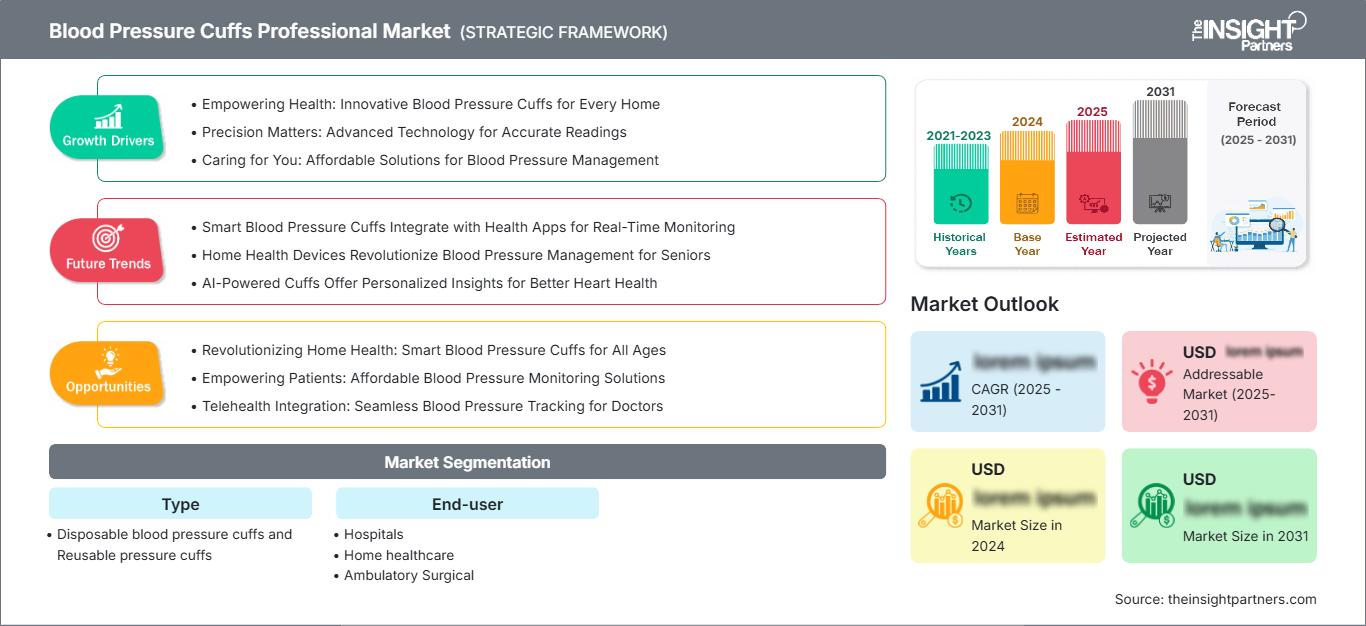
Blood Pressure Cuffs Professional Market: Strategic Insights
Regional Insights
North America Blood Pressure Cuffs Professional Market
The market share for North America was recorded at 36-39% in 2025 and will grow in the forecast period (2026-2034) with CAGR from 6.8-7.4%. The blood pressure cuff professional market shares are driven by a high number of patient monitoring devices in use, organized procurement processes within hospitals, peri-operative care practices, and increased adoption of home health care. Most needed are adult, pediatric, neonatal, large adult, disposable, and reusable types of cuffs.
Factors contributing to structural growth include an increase in ambulatory surgeries, disease management, and quality reporting that keep vital sign capturing crucial for care documentation. Group purchasing organizations drive standards for cuffs through bundling accessories with patient monitoring contracts. Increasing demand is for cuffs with defined sizes, durable materials, and connectors alignment to avoid any measuring errors.
U.S. Blood Pressure Cuffs Professional Market
The U.S. represented 78–82% of North America in 2025 and is expected to grow at a CAGR range of 6.9–7.5% during 2026–2034. Hospitals remain the main demand center because emergency departments, intensive care, operating rooms, recovery units, and labor care require continuous monitoring accessories. GE HealthCare Technologies Inc., Cardinal Health, Inc., SunTech Medical, Inc., Spacelabs Healthcare Inc., and American Diagnostic Corporation maintain strong channel presence.
The application trend is divided between disposable cuffs for infection-sensitive applications and reusable cuffs for routine use in general medicine. Ambulatory Surgical centers require dependable cuffs for pre-operative, intra-operative, and post-operative monitoring. Moreover, due to the growth in home care, the need for cuffs that can handle repeated measurements, are comfortable, and allow clinician supervised remote monitoring is increasing.
Europe Blood Pressure Cuffs Professional Market
Europe was responsible for a 26-29% market share in 2025 and is expected to experience growth at a CAGR rate of 6.4-7.0% from 2026-2034. Germany is the dominant country with a robust hospital infrastructure, procurement policies, and good cardiovascular monitoring measures. The UK creates demand through community diagnostic centers, standardization by NHS, and infection prevention programs in hospitals and outpatients facilities.
Germany prefers validated cuffs that integrate with the monitor and operate in high acuity environments. The UK adopts reusable cuffs in primary care and disposable cuffs in riskier units. France, Italy, and Spain drive growth through their aging populations, hospital infrastructure development, management of high blood pressure, and the expansion of outpatient pathways, where lifecycle costs and material safety considerations guide procurement processes.
APAC Blood Pressure Cuffs Professional Market
In 2025, APAC held a 23–26% market share and is expected to grow with a CAGR of 8.2–8.9% between 2026 and 2034. The major country in the region is China due to hospital growth, domestic device development, cardiovascular screening, and increased acquisition of monitoring accessories. In addition, Japan and South Korea place emphasis on quality and interconnectivity, and India and Australia drive growth in the region with private hospitals and telemedicine-associated care.
Noncommunicable disease screening, universal health coverage programs, and healthcare development in secondary cities are policy-related drivers. Industry drivers include manufacturing capabilities and wider distribution of cuffs. Regional growth is rapid because of growing procedure volume, adoption of home care, and realization of the importance of proper cuff size in clinical measurement.
Middle East & Africa Blood Pressure Cuffs Professional Market
The Middle East & Africa is expected to expand at a CAGR of 6.1% to 6.8% during 2026-2034, with Saudi Arabia driving regional demand. Investments in UAE hospitals, private healthcare facilities in South Africa, and government initiatives in the rest of MEA drive the purchase of reusable and disposable blood pressure cuff products.
Healthcare infrastructure of Gulf nations gets aided by hospital upgrade efforts, while that of African nations remains price sensitive but increasingly concerned about availability of basic monitoring equipment. Manufacturers with distribution channels, training, and stock availability can avoid downtime. Demand is high in regions where imported monitors need compatible cuffs and in regions that have tertiary hospitals.
Segmentation Analysis
Type
The Type segment is projected to grow at a CAGR range of 7.0–7.8% during 2026–2034. Blood Pressure Cuffs Professional Market scope covers disposable and reusable formats, with purchasing decisions shaped by infection risk, care setting, cleaning labor, procedure volume, and monitor compatibility. Providers increasingly use mixed portfolios, applying disposable cuffs in high-risk departments and reusable cuffs in routine care where durability and cost control matter.
- Disposable blood pressure cuffs support single-patient use in intensive care, emergency, operating room, neonatal, and isolation settings, where reducing cross-contamination risk and shortening cleaning workflows are strategic purchasing considerations.
- Reusable pressure cuffs remain widely used in hospitals, clinics, and home healthcare because they offer lower per-use cost, broad sizing, durable construction, and compatibility with routine vital signs workflows.
End-user
The End-user segment is projected to grow at a CAGR range of 7.3–8.1% during 2026–2034. Hospitals generate the highest revenue contribution due to heavy monitoring frequency, but home healthcare and ambulatory surgical settings are becoming more strategic. Clinics require accurate, durable cuffs for diagnosis and follow-up, while decentralized care increases demand for professional accessories outside traditional inpatient environments.
- Hospitals generate high-volume replacement demand across emergency, critical care, inpatient, operating room, recovery, and labor units, making them the most influential channel for standardized cuff procurement.
- Home healthcare is scaling as chronic disease management, remote patient monitoring, and post-discharge programs require comfortable, validated cuffs that support repeated measurement under clinician guidance.
- Ambulatory Surgical settings require reliable cuffs for preoperative assessment, intraoperative monitoring, and recovery workflows, with demand tied to outpatient procedural growth and efficient patient turnover.
- Clinics depend on durable cuffs for hypertension screening, cardiology visits, occupational health checks, and primary care follow-up where measurement consistency influences diagnosis and treatment decisions.
Opportunity Snapshot
| Segment Name | Revenue Contribution | Trend Tag | Adoption Stage |
| Hospitals | High | Standard Protocols | Mature |
| Home healthcare | Medium | Remote Care | Scaling |
| Ambulatory Surgical | Medium | Procedure Shift | Scaling |
| Clinics | Medium | Screening Access | Mature |
Blood Pressure Cuffs Professional Market Growth Drivers and Impact Analysis
Hypertension Screening and Measurement Accuracy
The role of hypertension in cardiovascular disease prevention according to WHO standards makes an exact cuff measurement highly important in hospitals, clinics, pharmacies, and even at home where someone supervises. Thus, buyers pay special attention to the validation of cuffs, reliable construction of the bladder, size, and compatibility of cuffs with automated devices. The influence of the driver is reflected in the growing need for the full cuff family for adult patients, children, newborns, large adult patients, and other special purposes. An incorrect cuff size may misinterpret the result and lead to an incorrect diagnosis or treatment, which is why facilities tend to standardize procurement and training processes.
Infection Prevention Across High-Acuity Settings
Infection prevention policies are increasing the strategic role of disposable cuffs in emergency departments, intensive care, operating rooms, neonatal units, and isolation areas. Reusable cuffs remain important in general wards, but facilities are separating product use by patient risk, cleaning burden, and department workflow. This creates a more disciplined purchasing model where disposable and reusable formats are selected together rather than treated as substitutes. Market impact appears in higher single-patient-use volumes, demand for packaging efficiency, and preference for suppliers that support consistent availability across multiple sizes. Manufacturers also gain from premium reusable cuffs designed to withstand repeated disinfection. Providers benefit when product selection lowers contamination risk without creating supply shortages or connector inconsistency.
Expansion of Outpatient and Home-Based Care
Care delivery is shifting toward ambulatory surgical centers, clinics, and home healthcare, increasing the need for professional-grade cuffs beyond inpatient hospitals. Outpatient procedures require reliable perioperative monitoring accessories, while home programs need cuffs that patients or caregivers can use repeatedly with minimal instruction. This driver changes market access because demand is increasingly distributed across provider networks, DME suppliers, remote monitoring firms, and clinic groups. Product requirements also differ from acute care, with stronger emphasis on comfort, easy sizing, clear markings, and compatibility with compact monitors. Suppliers that combine clinical accuracy, patient-friendly design, and broad channel distribution can capture incremental demand as post-discharge monitoring and chronic disease follow-up become more structured.
Blood Pressure Cuffs Professional Market Future Trends
Connected Monitoring Ecosystems
Blood Pressure Cuffs Professional Market trends indicate that cuffs will be assessed as part of connected monitoring ecosystems rather than treated only as replaceable accessories. Hospitals are integrating vital signs readings into electronic health records, central stations, and analytics platforms, increasing demand for cuffs and connectors that perform consistently across device fleets. Future procurement should favor suppliers that reduce workflow friction, document compatibility, and support multiparameter platforms. This trend can improve inventory management by enabling providers to standardize fewer cuff families across departments. Over the long term, data reliability, interoperability, and clinical workflow fit will carry more weight than basic unit price in institutional purchasing decisions.
Patient-Specific Sizing and Comfort Design
Future cuff design will increasingly focus on patient morphology, comfort, and measurement consistency. Rising diversity in arm circumference requires more precise size ranges, clearer index markings, better materials, and cuffs that maintain placement during movement. Pediatric and neonatal care will push demand for softer materials and low-pressure performance. Procurement teams are expected to evaluate cuffs by error reduction, staff usability, patient experience, and cleaning durability. This trend should encourage better labeling, improved fastening systems, and specialized product families. Suppliers that combine fit accuracy with durable design will be better positioned across acute care, clinics, and home-supervised monitoring programs.
Blood Pressure Cuffs Professional Market Opportunities
Standardized Procurement Across Integrated Care Networks
Integrated delivery networks can create meaningful opportunities by standardizing cuff portfolios across hospitals, clinics, ambulatory surgical centers, and home healthcare programs. Blood Pressure Cuffs Professional Market Forecasts indicate buyers will increasingly seek fewer qualified vendors, consolidated connectors, predictable inventory, and training support. Manufacturers can respond with bundled contracts covering disposable cuffs, reusable cuffs, hoses, adapters, labeling guides, and replacement schedules. This approach reduces clinical variation, lowers mismatch risk, and improves staff confidence across care sites. The strongest opportunity lies in evidence-backed product rationalization that improves measurement reliability while simplifying procurement. Suppliers with broad portfolios and regional stock depth can secure recurring demand through long-term institutional agreements.
Emerging Healthcare Infrastructure Expansion
Emerging markets present investment opportunities as governments and private hospital groups expand diagnostic, surgical, and chronic disease management capacity. Suppliers can build growth by localizing distribution, training clinicians on appropriate cuff sizing, and offering tiered portfolios that balance affordability with professional quality. Demand is particularly attractive in secondary cities where hospitals are upgrading vital signs monitoring and clinics are expanding hypertension screening. Partnerships with regional distributors, monitor OEMs, and public procurement agencies can improve market access. Companies that provide durable reusable cuffs for routine care and disposable options for high-risk departments can address both cost control and infection prevention expectations, strengthening long-term positioning.
Recent Developments
- October 2025: GE HealthCare Technologies Inc. announced CE mark receipt for its Carevance patient monitor, adding advanced patient monitoring capabilities and a Cardiac Output Insights feature for perioperative hemodynamic management. The development supports broader European deployment of monitoring platforms that use compatible accessories, including blood pressure cuffs, across acute care and surgical workflows.
- September 2025: Koninklijke Philips N.V. and Masimo Corporation renewed their multi-year strategic collaboration to advance patient monitoring measurement technologies. The agreement focuses on integrating Masimo sensor technologies into Philips multiparameter monitoring platforms, supporting connected care, interoperability, and next-generation monitoring solutions used in bedside, central station, and wearable care settings.
- April 2025: Cardinal Health, Inc. completed the acquisition of Advanced Diabetes Supply Group, strengthening its at-Home Solutions business and direct-to-patient medical supply reach. The transaction expanded Cardinal Health’s chronic care distribution capabilities and improved its positioning in home-based medical product channels relevant to remote monitoring ecosystems.
Frequently Asked Questions

- Comprehensive Market Sizing and Forecast Analysis
- Detailed Segmentation Analysis
- In-Depth Market Dynamics Assessment
- Regional and Country-Level Insights
- Competitive Landscape and Company Benchmarking
- Strategic Business Intelligence
Recent Reports
Testimonials

The Insight Partners' SCADA System Market report is comprehensive, with valuable insights on current trends and future forecasts. The team was highly professional, responsive, and supportive throughout. We are very satisfied and highly recommend their services.
RAN KEDEM Partner, Reali Technologies LTDs
I requested a report on a very specific software market and the team produced the report in a few days. The information was very relevant and well presented. I then requested some changes and additions to the report. The team was again very responsive and I got the final report in less than a week.
JEAN-HERVE JENN Chairman, Future Analytica
We worked with The Insight Partners for an important market study and forecast. They gave us clear insights into opportunities and risks, which helped shape our plans. Their research was easy to use and based on solid data. It helped us make smart, confident decisions. We highly recommend them.
PIYUSH NAGPAL Sr. Vice President, High Beam Global
The Insight Partners delivered insightful, well-structured market research with strong domain expertise. Their team was professional and responsive throughout. The user-friendly website made accessing industry reports seamless. We highly recommend them for reliable, high-quality research services
YUKIHIKO ADACHI CEO, Deep Blue, LLC.
This is the first time I have purchased a market report from The Insight Partners.While I was unsure at first, I visited their web site and felt more comfortable to take the risk and purchase a market report.I am completely satisfied with the quality of the report and customer service. I had several questions and comments with the initial report, but after a couple of dialogs over email with their analyst I believe I have a report that I can use as input to our strategic planning process.Thank you so much for taking the extra time and making this a positive experience.I will definitely recommend your service to others and you will be my first call when we need further market data.
JOHN SUZUKI President and Chief Executive Officer, Board Director, BK Technologies
I wish to appreciate your support and the professionalism you displayed in the course of attending to my request for information regarding to infectious disease IVD market in Nigeria. I appreciate your patience, your guidance, and the fact that you were willing to offer a discount, which eventually made it possible for us to close a deal. I look forward to engaging The Insight Partners in the future, all thanks to the impression you have created in me as a result of this first encounter.
DR CHIJIOKE ONYIA MANAGING DIRECTOR, PineCrest Healthcare Ltd.Reason to Buy
- Informed Decision-Making
- Understanding Market Dynamics
- Competitive Analysis
- Identifying Emerging Markets
- Customer Insights
- Market Forecasts
- Risk Mitigation
- Boosting Operational Efficiency
- Strategic Planning
- Investment Justification
- Tracking Industry Innovations
- Aligning with Regulatory Trends





 Get Free Sample for