
Compressed Air Nozzles Market Size, Growth & Demand by 2034
Coverage: by Air Nozzles Type (Flat jet nozzles, Round jet nozzles, Cluster nozzle, Air Mag Air Nozzles, Cone Shaped Air Nozzles, Ring Ionizer-Ionizing Nozzles, Laval Effect Nozzle, Spray nozzle); Application (Part Cleaning, Chip Removal, Part Drying, Liquid Blow Off, Part Cooling, Material Conveying, Part Ejection, Fiber Conveying, Air Assist); End-use Industry (Oil and Gas, Food and Beverages, Energy, Agricultural, Aerospace and Defense, Electronics and Consumer Goods, Chemicals, Automotive, Healthcare, Others) , and Geography (North America, Europe, Asia Pacific, and South and Central America)
- Status : Data Released
- Report Code : TIPRE00009303
- Category : Manufacturing and Construction
- No. of Pages : 150
- Available Report Formats :


- Last update date : November 09, 2026


2025 Market Size
US$ 2.58 Bn
Base year value
2034 Forecast
US$ 3.91 Bn
Projected by 2034
CAGR 2026-2034
4.73 %
Growth rate
Addressable Market
US$ 29.46 Bn
(2026-2034)
The Compressed Air Nozzles Market was valued at US$ 2.58 Billion in 2025 and is projected to reach US$ 3.91 Billion by 2034, expanding at a CAGR of 4.73% during 2026–2034. Demand reflects the role of engineered nozzles in directing high-velocity air for cleaning, drying, cooling, conveying, ejection, and static-control duties across automated production environments.
North America is expected to advance at a modeled ~4% CAGR through 2034 as manufacturers replace open pipes with safer, lower-consumption engineered outlets. The Compressed Air Nozzles Market size is supported by automotive reshoring, electronics investment, and plant-level energy audits that prioritize verifiable reductions in compressed-air leakage, noise, and operating cost.
Compressed Air Nozzles Market Assessment and Insights
Regional Outlook
- North America: ~25% of the global Compressed Air Nozzles Market share in 2025 | ~4% CAGR through 2034. Market position: The region ranks third, supported by OSHA-aligned blow-off practices, high automation intensity, and replacement of inefficient open tubes in automotive, food, and precision manufacturing.
- US: ~76% of North American market revenue in 2025 | ~4% CAGR through 2034. Market position: The country leads North America through broad vendor coverage, energy-audit activity, and demand for compliant cleaning, chip removal, drying, and electronics assembly solutions.
- Europe: ~27% of the global market in 2025 | ~4% CAGR through 2034. Market position: Mature machinery, automotive, and food-processing bases sustain replacement demand, with Germany leading Europe and Italy, France, the UK, and Spain providing diversified application demand.
- Asia Pacific: ~39% of the global market in 2025 | ~6% CAGR through 2034. Market position: Asia Pacific is the fastest-growing and largest region as China, Japan, South Korea, and India expand electronics, automotive, and general manufacturing capacity.
Segment Outlook
- Flat jet nozzles: ~31% Share in 2025 | ~5% CAGR through 2034. Market position: Broad, uniform air patterns suit conveyor drying, strip cleaning, and wide-surface blow-off, supporting repeatable results with fewer outlets.
- Electronics and Consumer Goods: ~18% Share in 2025 | ~7% CAGR through 2034. Market position: Miniaturized components, contamination control, static management, and automated handling increase demand for precise, low-force, clean-air solutions.
Competitive Coverage
Atul Engineering Works, Eurospray Spray and Filter Technology, S.L., EXAIR LLC, H. IKEUCHI & Co., Ltd., KJN Enterprises, Knight Pneumatics, Lechler India Pvt. Ltd., Nex Flow Air Products Corp., Silvent AB, Spraying Systems Co.
Methodology
The Insight Partners follows Data Collection & Secondary Research, Primary Research, Data Analysis, and Data Triangulation & Final Review to validate market estimates and insights.
Source: The Insight Partners' analysis based on proprietary research, government publications, company annual reports, investor presentations, industry databases, and expert interviews.
Engineered air blow-off devices have developed from crude drilled pipe outlets into devices which entrain surrounding air, form a reproducible jet and avoid dead end pressure. Engineering companies have tended to offer flat, round, cluster, Laval, and ionizing devices in combination with stainless steel, plastics and flexible mounting arrangements. Production has also moved towards specialized ranges, CAD-based selection and air consumption measurements. This has enabled nozzles to be matched to automatic cells, hygiene and high temperature processes instead of viewing blow-off as a generic service.
Over the period to 2034, spending is expected to go into Asia Pacific capacity build-up along with North American and European brownfield expansion programs. Increased cost of power supply, occupational noise regulations, air audits and contaminant control will encourage use of engineered products. Buyers will compare total air requirement, noise level, maintenance issues, material compatibility and installation cost and give opportunity to engineering companies who can demonstrate performance at operating pressure and distance in line.
Compressed Air Nozzles Market Report Scope
| Report Attribute | Details |
|---|---|
| Market size in 2025 | US$ 2.58 Billion |
| Market Size by 2034 | US$ 3.91 Billion |
| Global CAGR (2026 - 2034) | 4.73% |
| Historical Data | 2021-2024 |
| Forecast period | 2026-2034 |
Compressed Air Nozzles Market Analysis
Compressed Air Nozzles market growth is motivated by the cost of manufacturing the air and the need for repeatable force without waste. The demand starts with the plant engineering departments and the machine manufacturers before going through the distributors and pneumatic system integrators and ending at the maintenance-driven replacement cycles. The ecosystem of compressed air nozzles includes nozzle body, precise orifice, fittings, manifolds, regulator, and mounting hardware.
The supply factors are favorable to those vendors who fit their patterns and forces to the required standards. Those nozzles made from stainless steel are for corrosive and sanitary applications, and polymer ones are for scratch-sensitive and electrical-sensitive processes. Local availability and application knowledge are still important due to inefficient sizing.
The Compressed Air Nozzles Market research reveals a highly fragmented competition involving global spraying players as well as regional air nozzle suppliers. The companies which compete in terms of energy saving solutions, safety standards, and performance data include EXAIR LLC, Silvent AB, Spraying Systems Co., H. IKEUCHI & Co., Ltd., and Nex Flow Air Products Corp., whereas Lechler India Pvt. Ltd., KJN Enterprises, Knight Pneumatics, Atul Engineering Works, and Eurospray Spray and Filter Technology, S.L. increase the availability.
The key investments are targeted towards multi-Laval geometry, ionization technology, compatibility with clean room, and configurability. In addition, positioning is focused less on product pricing and more on cost-saving potential, noise reduction, up time, and process quality. Companies which combine audit service, quick replacements, and configuration software will be able to protect profit margins while serving OEM and retrofit needs.
● REPORT CUSTOMIZATION
Tailor This Report To Align With Your Specific Business Requirements
This report can be customized to align precisely with your business objectives, scope, and target markets. Customization options include tailored segmentation, geography, competitive analysis, and strategic insights to support informed decision-making.
Customize This Report →WHAT YOU CAN ADJUST
- ● Segmentations
- ● Geography
- ● Competitive Analysis
- ● Language Preferences
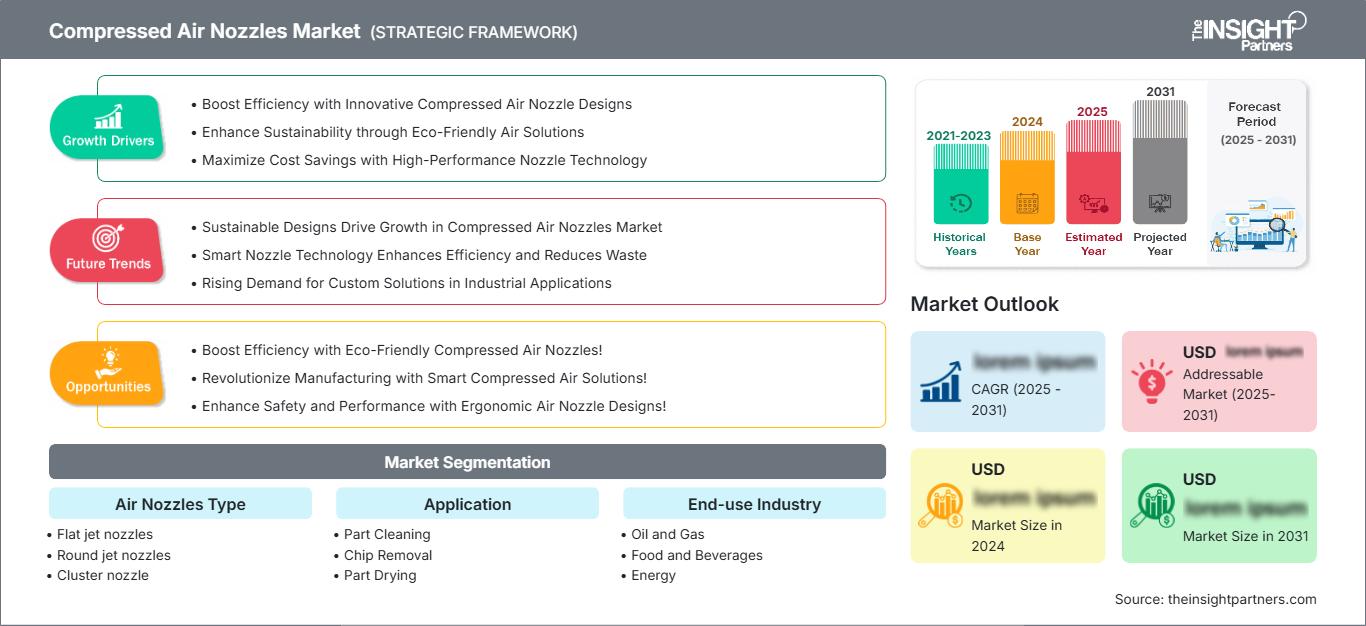
Compressed Air Nozzles Market: Strategic Insights
Regional Insights
North America Compressed Air Nozzles Market
North America is modeled to expand at ~4% CAGR through 2034. Advanced manufacturing constrains volume growth potential, but economics of replacement continue to be good where there are inefficiencies due to open pipe or oversized discharge nozzles that lead to waste of compressed air. Pressure and noise regulations from OSHA, energy management, and automatic machining justify selection of engineered nozzles.
Diversified needs are expected in automotive, aerospace, food processing, medical devices, and electronic sectors. Market share of the Compressed Air Nozzles in the region will be sustained by engineering capability and distribution channels within the country. Increasingly, buyers expect information about force, flow, and sound before standardization of components.
U.S. Compressed Air Nozzles Market
The U.S. represents ~76% of North American revenue in 2025 and is projected to grow at ~4% CAGR through 2034. This is a consequence of a sizable existing base of pneumatic products, the continuous buying of maintenance items, and the implementation of automated manufacturing cells. Cleaning parts, removing chips, blowoff with liquid, and part ejection still represent its primary applications.
EXAIR LLC, Spraying Systems Co., Silvent AB, and Nex Flow Air Products Corp. continue to have an active product and application presence in the country. Applications in electronics and medical assembly have heightened interest in ionizing and clean process nozzles, whereas metalworking applications seek durable outlets that can generate force without generating excessive noise or dead end pressure.
Europe Compressed Air Nozzles Market
Europe holds a modeled ~27% global share in 2025 and is projected to record ~4% CAGR through 2034. Machinery, automotive, packaging, food, chemicals, and metals industries in the region provide steady retrofit opportunities. Energy savings and noise reduction make it advisable for the plants to upgrade their ad hoc blow-offs with calibrated solutions.
Germany is the largest country in Europe owing to its machine tool, automotive, and industrial equipment industries. Italy makes its contribution through packaging machinery, food processing, and automation; France through aerospace, automotive, and consumer goods applications. The UK helps through manufacturing and maintenance of specialized products; and Spain gains from automotive assembly and food manufacturing.
European manufacturers differentiate themselves with the quality of materials used, low noise geometry, and application engineering. Silvent AB, Eurospray Spray and Filter Technology, S.L., and others manufacture nozzles for customers concerned with total cost of ownership and regulatory compliance. The market growth will be driven by replacements, not expansion.
APAC Compressed Air Nozzles Market
Asia Pacific accounts for a modeled ~39% global share in 2025 and is the fastest-growing region at ~6% CAGR through 2034. China is the leading country in Asia Pacific, supported by its scale in electronics, automotive, machinery, batteries, and consumer goods. Japan and South Korea add precision automation and semiconductor demand.
India’s manufacturing localization and factory investment broaden the addressable base, while Australia contributes mining, food, and maintenance applications. H. IKEUCHI & Co., Ltd. and regional distributors benefit from demand for efficient, low-noise blow-off as plants pursue energy productivity and consistent quality.
Middle East & Africa Compressed Air Nozzles Market
The Middle East & Africa market is projected to grow at ~5% CAGR through 2034. Oil and gas maintenance, petrochemicals, food processing, metals, utilities, and infrastructure projects create demand for durable nozzles, especially where dust, heat, and corrosion shape material selection.
Saudi Arabia is positioned as the leading country in the Middle East & Africa through industrial diversification and energy projects, with the UAE adding logistics and advanced manufacturing. South Africa supports mining and food applications. Across the rest of MEA, distributor availability and maintenance capability remain key adoption constraints.
Segmentation Analysis
Air Nozzles Type
The Air Nozzles Type segment is modeled to expand at ~5% CAGR during 2026–2034. The Compressed Air Nozzles Market scope covers geometries that balance force, pattern width, entrainment, noise, static control, and air consumption. Selection depends on target shape, standoff distance, available pressure, material compatibility, and whether the process needs concentrated impact or broad coverage.
- Flat jet nozzles: Their wide, even pattern supports conveyor drying, strip cleaning, and surface blow-off while reducing the number of outlets required.
- Round jet nozzles: Concentrated streams suit localized cleaning, recesses, ejection, and pinpoint cooling where impact must be directed into a small area.
- Cluster nozzle: Multiple outlets combine higher force with broader reach, serving heavy chip removal, long-distance blow-off, and demanding material-handling duties.
- Air Mag Air Nozzles: Magnetic mounting enables rapid repositioning on machinery, supporting temporary setups, maintenance work, trials, and flexible production cells.
- Cone Shaped Air Nozzles: Conical patterns distribute air around irregular parts and cavities, helping remove debris or moisture from complex three-dimensional surfaces.
- Ring Ionizer-Ionizing Nozzles: Ionized airflow neutralizes static while dislodging particles, making this format strategically important in electronics, packaging, optics, and clean assembly.
- Laval Effect Nozzle: Laval geometry converts pressure into a focused high-velocity stream, improving usable force and reach for intensive industrial blow-off.
- Spray nozzle: Combined air and fluid delivery supports atomization, cooling, coating, humidification, and dust control where controlled droplet formation is required.
Application
The Application segment is projected to grow at ~5% CAGR during 2026–2034. Demand is anchored in repetitive production tasks where airflow replaces contact tools or manual handling. Buyers prioritize stable force, precise pattern, low consumption, and safe operation, with growth linked to automated inspection, high-speed conveyors, and process-quality requirements.
- Part Cleaning: Engineered jets remove loose particles before coating, assembly, or inspection, improving repeatability without direct mechanical contact.
- Chip Removal: Focused outlets clear swarf from machine tools and fixtures, reducing recutting risk and supporting unattended machining cycles.
- Part Drying: Uniform air patterns accelerate moisture removal after washing, helping prevent spotting, corrosion, and bottlenecks before downstream processing.
- Liquid Blow Off: High-velocity air strips coolant, rinse water, or process liquid from surfaces, reducing carryover and recovery losses.
- Part Cooling: Directed airflow lowers localized temperature on molded, machined, or assembled components where contact cooling is impractical.
- Material Conveying: Air streams move lightweight products, trim, powders, or scrap through compact routes without complex mechanical conveying hardware.
- Part Ejection: Timed jets separate accepted or rejected items at speed, supporting packaging, sorting, and automated quality-control lines.
- Fiber Conveying: Controlled airflow guides threads, filaments, and light fibers through textile or converting processes while limiting physical contact.
- Air Assist: Supplemental jets stabilize cutting, coating, combustion, separation, or feeding processes, making airflow a configurable production aid.
End-use Industry
The End-use Industry segment is modeled to advance at ~5% CAGR during 2026–2034. Adoption follows manufacturing output, automation intensity, contamination control, and the financial case for lowering compressed-air use. Electronics and Consumer Goods is the high-growth area, while automotive, food, energy, and process industries sustain broad installed-base demand.
- Oil and Gas: Rugged nozzles support cleaning, cooling, drying, and maintenance around processing assets where corrosion resistance and reliability are critical.
- Food and Beverages: Hygienic materials and repeatable drying serve container, conveyor, and packaging lines while reducing retained moisture and contamination risk.
- Energy: Utilities and equipment manufacturers use directed air for component cleaning, cooling, assembly, and maintenance across conventional and renewable systems.
- Agricultural: Nozzles assist sorting, cleaning, drying, and pneumatic movement of products where simple, non-contact handling improves throughput.
- Aerospace and Defense: Precision cleaning and controlled blow-off support tight-tolerance components, composites, coatings, and maintenance under demanding quality requirements.
- Electronics and Consumer Goods: Static control, gentle cleaning, and compact automation make specialized outlets important for boards, displays, appliances, and packaged products.
- Chemicals: Resistant materials enable cleaning, cooling, drying, and conveying where aggressive environments and process compatibility govern equipment selection.
- Automotive: Machining, welding, painting, assembly, and battery production create extensive demand for chip removal, drying, cooling, and part handling.
- Healthcare: Clean processing, medical-device assembly, packaging, and laboratory workflows favor precise, low-contamination airflow and compatible construction materials.
Opportunity Snapshot
| End-use Industry | Revenue Contribution | Trend Tag | Adoption Stage |
| Oil and Gas | Medium | Corrosion Retrofit | Mature |
| Food and Beverages | High | Hygienic Drying | Scaling |
| Energy | Medium | Utility Maintenance | Scaling |
| Agricultural | Low | Air Sorting | Emerging |
| Aerospace and Defense | Medium | Precision Cleaning | Scaling |
| Electronics and Consumer Goods | High | Static Control | Scaling |
| Chemicals | Medium | Resistant Materials | Mature |
| Automotive | High | Battery Lines | Mature |
| Healthcare | Medium | Clean Assembly | Scaling |
Compressed Air Nozzles Market Growth Drivers and Impact Analysis
Energy Cost Reduction Through Engineered Airflow
Air is an expensive utility in the plant because it requires electrical power to be generated, conditioned, distributed, and even lost before getting to its point of application. Engineered nozzles increase the efficiency of the work done by each air unit through the intake of air and creation of a jet. The vendor reports show great savings compared to pipe outlets; the degree of saving depends on the pressure, distance, usage, and maintenance. Its effect in the market is mainly felt in plants with many blow-off points, and with each little saving at each point, the total savings add up. There will also be energy audits, which will make a purchase possible.
Automation Requires Repeatable Non-contact Handling
There should be a consistent performance of airflow in robotic cells and fast conveyors. Carefully located nozzles can serve to clean sensors, chip removal, rejection of defective products, cooling of local surfaces, and handling of lightweight parts without any mechanical interaction. Such versatility results in shorter changeovers and less wear and tear than using brushes or moving actuators. Influence of this factor on the Compressed Air Nozzles Market is that the product will move from a commodity fitting to a specified part with specific information about its force, pattern, standoff, and connections. Machine manufacturers can build the system into their machines, while users get more reliable quality. Thus, demand depends on industrial automation and retrofits.
Safety, Noise, and Process Quality Standards
The use of improvised open tubes may cause high levels of dead-end pressure, high noise level, and unpredictable trajectories of debris. Nozzles designed for safety have protected discharge openings and escape routes and they help to reduce noise level without compromising the effectiveness of the stream. In the U.S., OSHA regulations guide blow-off devices; worldwide, hearing conservation and energy management policies of companies help to drive a similar purchasing decision. Quality factors become an additional motivator, as control of airflow makes cleaning process easier, faster, and safer for products. There is a positive effect of the market from the audit results not only because of compliance but also because of the standardized nozzle design which helps maintenance personnel replicate approved designs on other lines.
Compressed Air Nozzles Market Future Trends
Sensor-led Air Management and Closed-loop Control
The Compressed Air Nozzles Market trends will see growing linkage between point-of-use hardware, flow measurement, pressure measurement, machine status, and maintenance data. Instead of working continuously, nozzle banks will only work when the presence of parts occurs and adjust to the lowest effective pressure level. Closed loop control will enable plants to recognize drift due to blocked nozzles, misalignment or upstream pressure change. Such evolution could shift the buying decision criteria from nozzle price to lifecycle performance. The manufacturers will adapt to such trends through development of configurable manifold, selection database, and instructions. System Integrators will package nozzles along with valves and sensors. Adoption will be strong in high volume lines where seconds of air flow wasted become material energy costs.
Application-specific Materials and Multiphysics Design
Future portfolios will use simulation and rapid prototyping to optimize entrainment, turbulence, pattern uniformity, and sound for specific duties. Stainless steel will remain important in hygienic and high-temperature environments, while PEEK, PVDF, dissipative polymers, and soft materials address chemical resistance, nonconductivity, scratch prevention, and cleanroom suitability. Ionizing nozzles are likely to gain relevance in electronics and precision packaging as static-sensitive components proliferate. Multi-Laval and broad flat designs will evolve around validated force-to-consumption ratios rather than maximum flow alone. The commercial implication is greater product differentiation, but also more demanding application engineering because material, geometry, pressure, and distance must be evaluated as one system.
Compressed Air Nozzles Market Opportunities
Plant-wide Retrofit Programs for Open-pipe Blow-off
The largest near-term opportunity is a structured audit-to-retrofit service for factories still using drilled pipes, unrestricted tubes, or oversized nozzles. Providers can map each point, record pressure and duty cycle, specify a safer engineered alternative, and verify post-installation consumption. Compressed Air Nozzles Market Forecasts support investments that convert energy savings into short payback projects without replacing the compressor. Attractive targets include automotive machining, metal fabrication, food packaging, and consumer-goods lines with many continuous outlets. Vendors can improve conversion by offering trial kits, magnetic mounts, standardized manifolds, and documented before-and-after measurements. This model also creates recurring demand for replacement parts, expansion lines, and periodic compressed-air optimization reviews.
Precision Airflow for Electronics and Clean Manufacturing
Electronics, medical devices, optics, batteries, and laboratory production create opportunity for compact nozzles that remove particles without damaging sensitive surfaces. Ionized airflow addresses static accumulation, while dissipative or nonmetallic bodies support electrically sensitive work. Suppliers can invest in clean-compatible materials, low-particle assembly, rapid static-decay performance, and mounting solutions that fit benchtops or enclosed automation. Partnerships with machine builders and contamination-control specialists can accelerate qualification because nozzle performance must align with filtration, grounding, and process validation. The opportunity is especially strong in Asia Pacific’s electronics ecosystem and in North American and European reshoring projects, where customers value documented cleanliness, repeatability, and traceable component specifications.
Recent Developments
- March 2025: H. IKEUCHI & Co., Ltd. released an updated air-nozzle catalog covering compressed-air and blower-driven TAIFUJet products, with application guidance, comparative energy data, and automation examples. The portfolio highlights flat, round, slit, amplifier, and blow-gun configurations for plant efficiency and noise reduction
- November 2024: Silvent AB expanded visibility of its X20 multi-Laval air nozzle, a high-force stainless design intended to deliver a concentrated jet with reduced turbulence. The product supports heavy-duty blow-off where users require stronger impact, lower noise, and more efficient conversion of compressed-air pressure
Frequently Asked Questions

- Comprehensive Market Sizing and Forecast Analysis
- Detailed Segmentation Analysis
- In-Depth Market Dynamics Assessment
- Regional and Country-Level Insights
- Competitive Landscape and Company Benchmarking
- Strategic Business Intelligence
Recent Reports
Testimonials

The Insight Partners provided valuable market intelligence that supported our global go-to-market strategy. Their team was professional, responsive, and attentive to our feedback, providing thoughtful analysis and helpful methodological clarifications throughout the project.
Junmo Kim Chief Financial Officer (CFO), Enertech Co., Ltd.
The Insight Partners' SCADA System Market report is comprehensive, with valuable insights on current trends and future forecasts. The team was highly professional, responsive, and supportive throughout. We are very satisfied and highly recommend their services.
RAN KEDEM Partner, Reali Technologies LTDs
I requested a report on a very specific software market and the team produced the report in a few days. The information was very relevant and well presented. I then requested some changes and additions to the report. The team was again very responsive and I got the final report in less than a week.
JEAN-HERVE JENN Chairman, Future Analytica
We worked with The Insight Partners for an important market study and forecast. They gave us clear insights into opportunities and risks, which helped shape our plans. Their research was easy to use and based on solid data. It helped us make smart, confident decisions. We highly recommend them.
PIYUSH NAGPAL Sr. Vice President, High Beam Global
The Insight Partners delivered insightful, well-structured market research with strong domain expertise. Their team was professional and responsive throughout. The user-friendly website made accessing industry reports seamless. We highly recommend them for reliable, high-quality research services
YUKIHIKO ADACHI CEO, Deep Blue, LLC.
This is the first time I have purchased a market report from The Insight Partners.While I was unsure at first, I visited their web site and felt more comfortable to take the risk and purchase a market report.I am completely satisfied with the quality of the report and customer service. I had several questions and comments with the initial report, but after a couple of dialogs over email with their analyst I believe I have a report that I can use as input to our strategic planning process.Thank you so much for taking the extra time and making this a positive experience.I will definitely recommend your service to others and you will be my first call when we need further market data.
JOHN SUZUKI President and Chief Executive Officer, Board Director, BK Technologies
I wish to appreciate your support and the professionalism you displayed in the course of attending to my request for information regarding to infectious disease IVD market in Nigeria. I appreciate your patience, your guidance, and the fact that you were willing to offer a discount, which eventually made it possible for us to close a deal. I look forward to engaging The Insight Partners in the future, all thanks to the impression you have created in me as a result of this first encounter.
DR CHIJIOKE ONYIA MANAGING DIRECTOR, PineCrest Healthcare Ltd.Reason to Buy
- Informed Decision-Making
- Understanding Market Dynamics
- Competitive Analysis
- Identifying Emerging Markets
- Customer Insights
- Market Forecasts
- Risk Mitigation
- Boosting Operational Efficiency
- Strategic Planning
- Investment Justification
- Tracking Industry Innovations
- Aligning with Regulatory Trends





 Get Free Sample for