
Gantry Crane Market Size, Share & Demand by 2034
Coverage: By Type (Full Gantry Crane, Semi Gantry Crane, Truss Gantry Crane, Portable Gantry Crane); Operation (Manual, Automatic); Lifting Capacity (Below 30 Tons, 30-50 Tons, Above 50 Tons); End-user (Automotive, Metal and Mining, Construction, Warehouses, Aerospace, Utility, Shipyards and Ports, Others) , and Geography (North America, Europe, Asia Pacific, and South and Central America)
- Status : Data Released
- Report Code : TIPRE00018744
- Category : Manufacturing and Construction
- No. of Pages : 150
- Available Report Formats :


- Last update date : July 28, 2026


2025 Market Size
US$ 1.64 Bn
Base year value
2034 Forecast
US$ 1.89 Bn
Projected by 2034
CAGR 2026-2034
1.59 %
Growth rate
Addressable Market
US$ 15.98 Bn
(2026-2034)
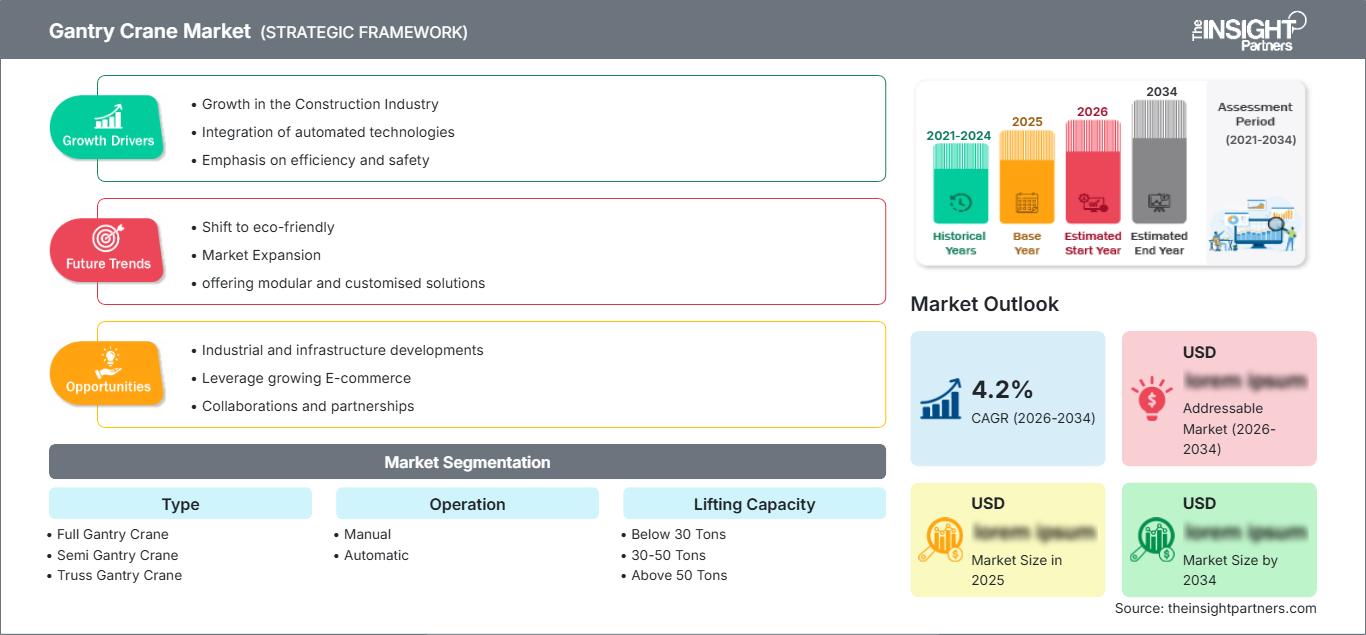
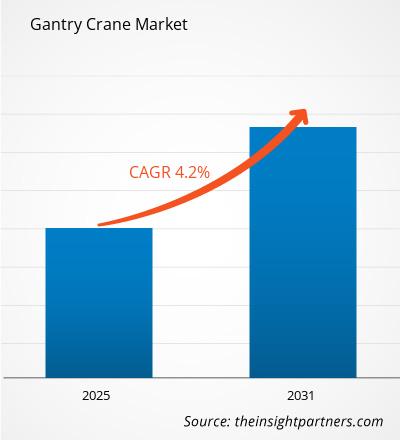
The global Gantry Crane market was valued at US$ 1.64 billion in 2025 and is expected to reach US$ 1.89 billion by 2034; it is estimated to record a CAGR of 1.59% during 2026-2034.
Gantry Crane Market Assessment and Insights
- North America accounted for 27–30% gantry crane market share in 2025 and is projected to grow at a CAGR range of 1.6–2.0% during 2026–2034, led by ports, warehouses, and manufacturing reshoring.
- US represented 78–82% of North America in 2025 and is expected to grow at 1.6–2.0% CAGR, backed by logistics hubs and defense shipbuilding.
- Europe held 24–27% share in 2025 and is forecast to expand at 1.4–1.8% CAGR, with Germany, the UK, France, Italy, and Spain leading industrial procurement.
- Asia Pacific captured 34–37% share in 2025 and is projected to grow at 1.9–2.3% CAGR, led by China, Japan, South Korea, India, and Australia.
- Largest Segment Full Gantry Crane held 38–42% market share in 2025 and is expected to grow at 1.5–1.9% CAGR due to port, shipyard, and fabrication demand.
- High Growth Segment Automatic operation held 24–28% market share in 2025 and is expected to expand at 2.2–2.6% CAGR as remote monitoring and automation improve safety.
- Key companies analyzed in detail: Aicrane Machinery Group, JASO Industrial Cranes, Konecranes Oyj, Liebherr-International Deutschland GmbH, Mi-Jack Products Inc., SANY Group Co., Ltd., Spanco, Inc., Shanghai Zhenhua Heavy Industries Co., Ltd. (ZPMC), Terex Corporation, Gorbel Inc., Street Crane Company Limited, ABUS Kransysteme GmbH, Kocks Krane International GmbH
Source: The Insight Partners' analysis based on proprietary research, government publications, company annual reports, investor presentations, industry databases, and expert interviews.
Crane procurement trends within the industrial market are pushing the gantry crane market away from generic lifting equipment towards an engineered crane with condition monitoring, anti-sway system, variable frequency drives, and special designed structures. Dynamics within the production process still depend on the availability of steel and electrical components, as well as fabrication capabilities in the region. Customization is increasing due to the need for corrosion resistance, greater duty cycle and modular installation that minimizes civil work.
Demand within the future will depend on logistics corridors, industrial park development, renewable energy construction, and ports' electrification. Buyers within India, Southeast Asia, the Gulf and North America will be looking for crane types that will minimize downtime and increase operator safety. Pressure on safety and environmental factors is promoting electric drive systems, automated travel system, and lifecycle service contracts. These will ensure stability within the growth trend.
Gantry Crane Market Report Scope
| Report Attribute | Details |
|---|---|
| Market size in 2025 | US$ 1.64 Billion |
| Market Size by 2034 | US$ 1.89 Billion |
| Global CAGR (2026 - 2034) | 1.59% |
| Historical Data | 2021-2024 |
| Forecast period | 2026-2034 |
Gantry Crane Market Analysis
Gantry crane market growth drivers include yard configuration, prefabrication, metal loads, and heavy warehouse operations. According to UNCTAD, there was an increase of 2.2% in maritime trade volume in 2024, and for 2025, there were expectations of further slow growth, hence increased focus on yard productivity and resilience in handling. Thus, purchasers need to balance investments in additional capacities with reliability improvements aimed at prolonging crane operational life and mitigating congestion.
Value chain players include steel structure fabricators, hoists, controls, drives, wheels, and installation contractors. The supply base remains regional since it is expensive to ship crane structures. But standardized hoists, electric packages, and remote diagnostics kits have become increasingly available globally, hence allowing domestic producers and international OEMs to compete on expertise and commissioning capability.
The market analysis of the gantry crane industry is characterized by a competitive environment where global port machinery companies battle against specialist industrial cranes producers. The rivalry is between Konecranes Oyj, Liebherr-International Deutschland GmbH, Shanghai Zhenhua Heavy Industries Co., Ltd. (ZPMC), Terex Corporation, and SANY Group Co., Ltd. in the segment of high-capacity cranes and their automation, while Spanco, Inc., Gorbel Inc., Street Crane Company Limited, ABUS Kransysteme GmbH, and Kocks Krane International GmbH target factory applications and workshop cranes.
Electrification of drives, digital maintenance systems, and modular solutions are the areas where investment flows. Mi-Jack Products Inc. continues to be significant in the area of intermodal and travel lifts, Aicrane Machinery Group, and JASO Industrial Cranes cater to cost-conscious and project-based needs. Strategic positioning is being built on the basis of installed base services, automation potential, safety standards, and compact crane configurations.
● REPORT CUSTOMIZATION
Tailor This Report To Align With Your Specific Business Requirements
This report can be customized to align precisely with your business objectives, scope, and target markets. Customization options include tailored segmentation, geography, competitive analysis, and strategic insights to support informed decision-making.
Customize This Report →WHAT YOU CAN ADJUST
- ● Segmentations
- ● Geography
- ● Competitive Analysis
- ● Language Preferences
Gantry Crane Market: Strategic Insights
Regional Insights
North America gantry crane market
North America captured 27-30% market share in 2025 owing to the development in port operations, intermodal rail yards, manufacturing driven by reshoring, and automated warehouses. The CAGR for North America during 2026-2034 is forecast at 1.6-2.0% as crane purchasers seek safer lifting, reduced maintenance needs, and electric drives.
High demand exists in the United States and Canada due to replacement cycles in steel service centers, aerospace assembly, ports, and utilities. According to IATA, there was air cargo demand growth of 3.4% in 2025, supporting logistics investments, which indirectly boosts material handling systems in freight logistics and valuable manufacturing supply chains.
U.S. Gantry Crane Market
The United States accounted for 78% to 82% of North America in 2025 and is projected to experience a 1.6% to 2.0% CAGR. The applications in the region are focused on intermodal facilities, shipyards, military manufacturing industries, precast concrete, metals industries, and large-scale distribution centers. Full-gantry cranes are preferred outdoors and portable gantry cranes indoors for maintenance-sensitive industries.
There are several firms active in this region, including Mi-Jack Products Inc., Spanco, Inc., Gorbel Inc., and Terex Corporation. Gantry cranes have gained traction in the United States owing to their government investments, resiliency plans at ports, and factory automation plans, although costs of steel, installation costs, and permits can hinder larger projects.
Europe Gantry Crane Market
The share of Europe in 2025 was between 24–27%, with a forecast of expansion at a CAGR of 1.4-1.8%. Germany was the major country that had an advantage of its demands of machinery, automotive, metals, and port engineering. The replacement of old cranes in the construction, aerospace, and warehouse industry in the UK provided steady growth.
France, Italy, and Spain are the countries providing contributions in terms of shipyards, rail infrastructure, utilities, and industrial modernization. The companies, such as ABUS Kransysteme GmbH, Street Crane Company Limited, Kocks Krane International GmbH, Liebherr-International Deutschland GmbH, and Konecranes Oyj, improve the supplier market of the region.
APAC Gantry Crane Market
APAC accounted for 34% to 37% of the total shares in 2025 and is estimated to exhibit a CAGR of 1.9% to 2.3%, driven by China. China, Japan, South Korea, India, and Australia contribute to demand with their port operations, shipbuilding yards, steel industries, mining activities, and industrial corridors.
Companies like Shanghai Zhenhua Heavy Industries Co., Ltd. (ZPMC), SANY Group Co., Ltd., and local manufactures in the region benefit from local production volumes and exports. Government support to logistics centers, port development, renewable energy equipment, and automation keeps APAC as the biggest opportunity in the region for the gantry cranes market.
Middle East & Africa Gantry Crane Market
Middle East & Africa is expected to grow at a 1.7–2.1% CAGR, with Saudi Arabia leading demand. Saudi Arabia and the UAE are investing in ports, logistics zones, energy projects, and industrial cities, while South Africa supports demand through mining, utilities, and port maintenance.
Rest of MEA demand remains project-based, linked to oil and gas logistics, construction, and mineral processing. Crane suppliers must manage harsh operating environments, aftersales coverage, and financing constraints. Electrified and corrosion-resistant systems are gaining attention where port operators and industrial buyers seek longer lifecycle value.
Segmentation Analysis
Type
Type is expected to grow at a 1.5–2.0% CAGR during 2026–2034. The gantry crane market scope across type reflects the balance between permanent heavy-duty installations and flexible lifting systems for temporary or constrained sites. Full systems dominate high-capacity outdoor yards, while portable and truss formats address maintenance, construction, and lower-duty industrial needs.
- Full Gantry Crane serves ports, shipyards, steel yards, and precast facilities where high span, high capacity, and independent runway structures justify higher capital expenditure.
- Semi Gantry Crane is used where one side can run on an existing building structure, reducing civil work while supporting repetitive industrial handling.
- Truss Gantry Crane suits outdoor applications requiring wind resistance, lower structural weight, and cost-effective spans for construction, utilities, and fabrication yards.
- Portable Gantry Crane supports maintenance shops, warehouses, and small manufacturing sites needing movable lifting equipment without permanent runway installation.
Operation
Operation is projected to grow at a 1.8–2.3% CAGR during 2026–2034. Manual systems remain common in low-duty applications, but automatic and semi-automatic controls are gaining share where safety, cycle consistency, and labor efficiency matter. Remote diagnostics, anti-sway software, and programmable travel paths are becoming differentiators in premium installations.
- Manual operation remains relevant for smaller workshops, low-frequency lifts, and cost-sensitive buyers that prioritize simplicity, operator familiarity, and lower maintenance requirements.
- Automatic operation is scaling in ports, warehouses, and manufacturing yards where repeatable movements, reduced human exposure, and data-enabled maintenance improve productivity.
Lifting Capacity
Lifting Capacity is forecast to expand at a 1.6–2.1% CAGR during 2026–2034. Demand below 30 tons is broadest by unit count, while 30-50 ton systems serve industrial yards and medium fabrication. Above 50 tons remains project-driven but strategically important because ports, shipyards, mining, and heavy engineering require high-value custom cranes.
- Below 30 Tons addresses warehouses, small manufacturers, utilities, and maintenance shops where operational flexibility and lower installed cost are primary purchase criteria.
- 30-50 Tons supports steel service centers, precast plants, rail maintenance, and machinery assembly where repeat lifts require stronger hoists and durable structures.
- Above 50 Tons is concentrated in ports, shipyards, mining equipment yards, and heavy fabrication where engineering customization and safety systems drive supplier selection.
End-user
End-user is expected to grow at a 1.7–2.2% CAGR during 2026–2034. Ports and shipyards remain high-value buyers, while warehouses and construction sites increase unit demand for portable and semi gantry systems. Automotive, aerospace, utilities, metals, and mining users focus on precision handling, worker safety, and uptime in maintenance-heavy environments.
- Automotive users deploy cranes for tooling, dies, components, and assembly support where controlled lifting improves plant safety and production continuity.
- Metal and Mining facilities require rugged cranes for coils, slabs, castings, and heavy equipment, making durability and duty classification central to procurement.
- Construction demand is linked to precast concrete, modular building, bridge components, and temporary yards where mobility and rapid setup are valuable.
- Warehouses use lighter gantry systems for maintenance, bulky goods handling, and production-adjacent logistics where forklifts cannot safely manage suspended loads.
- Aerospace facilities require precision lifting for tooling, engines, fuselage sections, and maintenance operations where controlled movement reduces damage risk.
- Utility buyers use gantry cranes for transformers, turbines, pumps, and grid infrastructure equipment, emphasizing reliability during outage and maintenance windows.
- Shipyards and Ports remain strategically important due to container handling, vessel construction, repair, and heavy module movement across outdoor yards.
Opportunity Snapshot
| Segment Name | Revenue Contribution | Trend Tag | Adoption Stage |
| Automotive | Medium | Tool Handling | Mature |
| Metal and Mining | High | Heavy Fabrication | Mature |
| Construction | Medium | Precast Lifting | Scaling |
| Warehouses | Medium | Flexible Handling | Scaling |
| Aerospace | Low | Precision Lift | Scaling |
| Utility | Medium | Grid Maintenance | Mature |
| Shipyards and Ports | High | Yard Automation | Mature |
Gantry Crane Market Growth Drivers and Impact Analysis
Port and Intermodal Yard Modernization
The port operators and intermodal facilities are facing growing pressure to increase container flows regardless of disruptions in routes, irregular ship schedules, and limited land availability. As UNCTAD states, maritime trade is increasingly affected by the re-routed traffic, port disruption and digitization which makes efficient yard management even more valuable. It translates into demand for railway, rubber tire and fully automatic gantries equipped with electric engines, anti sway system and remote monitoring. The effect is most significant where terminal operators cannot increase their land area and need to increase cargo flow per hectare. This creates a need to replace old cranes lacking automation interface and energy efficient drive system.
Industrial Reshoring and Heavy Manufacturing Upgrades
In response to shorter value chains, greater inventory buffers, and local manufacturing of machine tools, vehicles, energy equipment, and fabricated metals, manufacturers are restructuring their plants accordingly. Such a scenario requires efficient lifting solutions that are able to deal with heavy loads while not necessarily being dependent on forklift trucks or crane installations attached to the plant’s roof. In the case of brownfield projects, gantry cranes are an appealing choice because they require fewer structural modifications than bridge cranes. The changes can be noticed in automotive tooling, aerospace maintenance, metal fabrication, and utilities equipment handling operations.
Safety, Electrification, and Lifecycle Cost Discipline
Workplace safety requirements and energy efficiency targets are changing crane specification. Buyers increasingly compare total cost of ownership, including maintenance access, operator exposure, downtime, energy consumption, and parts availability. Electric drives, overload protection, anti-collision systems, and condition monitoring reduce operational risk, especially in multi-shift facilities and outdoor yards. The commercial impact is a shift from lowest-price procurement toward engineered packages with service support. This benefits established OEMs and specialists with installed-base relationships, while also encouraging retrofit activity. Safety and lifecycle economics help sustain demand even when new construction spending slows.
Gantry Crane Market Future Trends
Automation-Ready Crane Architectures
The most important gantry crane market trends will center on automation-ready structures rather than fully autonomous deployment everywhere. Buyers are expected to specify cranes with programmable logic controllers, sensors, remote monitoring, collision avoidance, and integration pathways for yard management systems. This allows operators to begin with assisted operation and later add higher automation levels as labor models and capital budgets evolve. The trend will be strongest in ports, intermodal yards, warehouses, and high-volume fabrication plants. Suppliers able to provide open digital interfaces, cybersecurity controls, and upgradeable software will gain strategic advantage over vendors offering mechanically capable but digitally isolated systems.
Low-Emission and Modular Lifting Systems
Electrification will broaden beyond major ports into warehouses, utilities, construction yards, and industrial maintenance sites. Buyers will increasingly seek cranes that reduce diesel use, simplify energy management, and meet internal sustainability targets. Modular gantry systems will also gain relevance because they can be relocated, expanded, or reconfigured as facility layouts change. This trend aligns with shorter project cycles and demand uncertainty, especially in construction and contract manufacturing. Suppliers that combine lighter structures, efficient drives, standardized components, and easy service access can capture replacement demand from customers seeking both environmental performance and operational flexibility.
Gantry Crane Market Opportunities
Retrofit Programs for Installed Crane Bases
The gantry crane market forecasts point to steady replacement demand, making retrofit programs a practical opportunity for OEMs and service specialists. Many industrial users operate structurally sound cranes that lack modern drives, radio controls, overload protection, or condition monitoring. Retrofitting can extend asset life at lower capital cost than full replacement, especially in factories where downtime is expensive. Attractive targets include steel yards, ship repair facilities, utilities, and older warehouses. Suppliers should package audits, safety upgrades, control modernization, and maintenance contracts into phased programs. This approach converts fragmented aftermarket demand into recurring revenue while helping buyers meet safety and productivity objectives.
Project-Specific Cranes for Emerging Industrial Corridors
Emerging industrial corridors in India, Southeast Asia, the Gulf, and selected African markets create opportunities for project-specific cranes tailored to logistics parks, renewable energy components, mining support, and port-linked manufacturing. Buyers in these locations often need robust equipment, local installation support, and financing flexibility rather than highly standardized premium systems. International suppliers can partner with local fabricators to reduce transport cost and improve service response. The opportunity is especially relevant for semi gantry and truss designs where site conditions vary. Winning strategies will combine engineering customization, training, spare parts planning, and compliance with international safety standards.
Recent Developments
- November 2025: EK, a Wisconsin-based manufacturer specializing in large backup generators, fuel tanks, and enclosures, has recently expanded its lifting and material handling capabilities with the addition of a Shuttlelift SL75 rubber-tired gantry crane. This new addition supports the company’s continued growth and ongoing transition toward producing fully finished products.
- August 2024: Konecranes launched its flagship Konecranes X-series industrial crane, the successor to its popular CXT model with a new compact design and safe, reliable technology thanks to its wireless upgrade capabilities that can adapt to customer needs now and in the future. The Konecranes X-series stands out not only for its lean, state-of-the-art electrical architecture but also for its connectivity
Frequently Asked Questions

- Comprehensive Market Sizing and Forecast Analysis
- Detailed Segmentation Analysis
- In-Depth Market Dynamics Assessment
- Regional and Country-Level Insights
- Competitive Landscape and Company Benchmarking
- Strategic Business Intelligence
Recent Reports
Testimonials

The Insight Partners' SCADA System Market report is comprehensive, with valuable insights on current trends and future forecasts. The team was highly professional, responsive, and supportive throughout. We are very satisfied and highly recommend their services.
RAN KEDEM Partner, Reali Technologies LTDs
I requested a report on a very specific software market and the team produced the report in a few days. The information was very relevant and well presented. I then requested some changes and additions to the report. The team was again very responsive and I got the final report in less than a week.
JEAN-HERVE JENN Chairman, Future Analytica
We worked with The Insight Partners for an important market study and forecast. They gave us clear insights into opportunities and risks, which helped shape our plans. Their research was easy to use and based on solid data. It helped us make smart, confident decisions. We highly recommend them.
PIYUSH NAGPAL Sr. Vice President, High Beam Global
The Insight Partners delivered insightful, well-structured market research with strong domain expertise. Their team was professional and responsive throughout. The user-friendly website made accessing industry reports seamless. We highly recommend them for reliable, high-quality research services
YUKIHIKO ADACHI CEO, Deep Blue, LLC.
This is the first time I have purchased a market report from The Insight Partners.While I was unsure at first, I visited their web site and felt more comfortable to take the risk and purchase a market report.I am completely satisfied with the quality of the report and customer service. I had several questions and comments with the initial report, but after a couple of dialogs over email with their analyst I believe I have a report that I can use as input to our strategic planning process.Thank you so much for taking the extra time and making this a positive experience.I will definitely recommend your service to others and you will be my first call when we need further market data.
JOHN SUZUKI President and Chief Executive Officer, Board Director, BK Technologies
I wish to appreciate your support and the professionalism you displayed in the course of attending to my request for information regarding to infectious disease IVD market in Nigeria. I appreciate your patience, your guidance, and the fact that you were willing to offer a discount, which eventually made it possible for us to close a deal. I look forward to engaging The Insight Partners in the future, all thanks to the impression you have created in me as a result of this first encounter.
DR CHIJIOKE ONYIA MANAGING DIRECTOR, PineCrest Healthcare Ltd.Reason to Buy
- Informed Decision-Making
- Understanding Market Dynamics
- Competitive Analysis
- Identifying Emerging Markets
- Customer Insights
- Market Forecasts
- Risk Mitigation
- Boosting Operational Efficiency
- Strategic Planning
- Investment Justification
- Tracking Industry Innovations
- Aligning with Regulatory Trends





 Get Free Sample for