
Geothermal Drill Bits Market Growth, Demand & Size by 2034
Coverage: By Type (Tricone, PDC, and Others); Deployment (Onshore and Offshore), , and by Geography (North America, Europe, Asia Pacific, and South and Central America)
- Status : Data Released
- Report Code : TIPRE00006989
- Category : Manufacturing and Construction
- No. of Pages : 150
- Available Report Formats :


- Last update date : November 11, 2026


2025 Market Size
US$ 3.66 Bn
Base year value
2034 Forecast
US$ 5.99 Bn
Projected by 2034
CAGR 2026-2034
5.63 %
Growth rate
Addressable Market
US$ 43.75 Bn
(2026-2034)
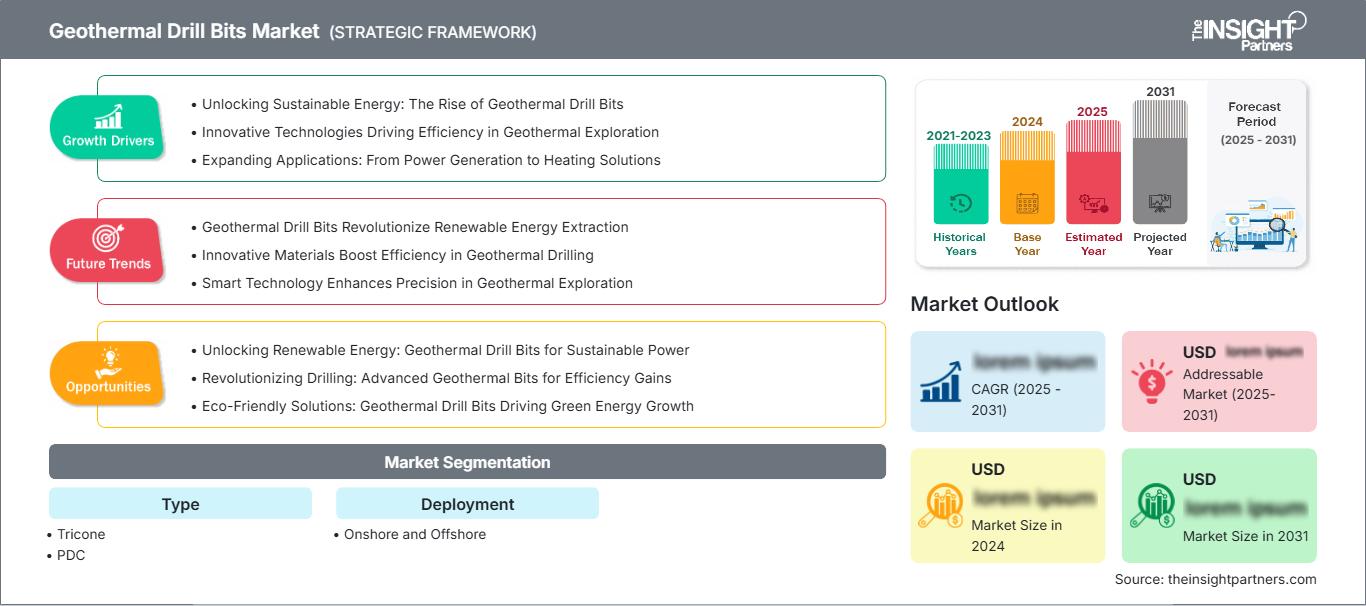
The Geothermal Drill Bits Market revenue was valued at US$ 3.66 Billion in 2025 and is projected to reach US$ 5.99 Billion by 2034, expanding at a 5.63% CAGR during 2026–2034. Demand is anchored in longer, hotter wells that require durable cutting structures, stable hydraulics, and predictable penetration through abrasive formations. The market includes tricone and polycrystalline diamond compact technologies deployed in onshore and offshore geothermal drilling programs.
North America is expected to expand at ~6% CAGR through 2034 as enhanced geothermal systems move from pilots toward repeatable field development and operators transfer horizontal-drilling expertise from oil and gas. The Geothermal Drill Bits Market size opportunity is reinforced by federal demonstration funding, rising demand for firm clean power, and the need to reduce well construction cost through longer bit runs, higher penetration rates, and fewer trips.
Geothermal Drill Bits Market Assessment and Insights
Regional Outlook
- North America: ~35% of the global market in 2025 | ~6% CAGR through 2034. Market position: The region leads through deep drilling capability, an established oilfield service base, EGS demonstrations, and procurement focused on lowering cost per drilled metre.
- US: ~82% of North American market revenue in 2025 | ~7% CAGR through 2034. Market position: Federal laboratories, Utah and Nevada projects, and horizontal well designs support technology testing and commercial demand.
- Europe: ~28% of the global market in 2025 | ~5% CAGR through 2034. Market position: A mature district-heating base supports replacement demand, while Germany, France, Italy, and the UK advance deeper heat and power wells.
- Asia Pacific: ~25% of the global market in 2025 | ~8% CAGR through 2034. Market position: The fastest-growing region benefits from Indonesian field expansion, Japanese resource development, Chinese heating demand, and Australian EGS investment.
Segment Outlook
- Tricone: ~58% Share in 2025 | ~5% CAGR through 2034. Market position: Broad formation tolerance, field familiarity, and dependable performance in fractured hard rock sustain leadership across conventional geothermal wells.
- PDC: ~42% Share in 2025 | ~7% CAGR through 2034. Market position: Improved cutters, cooling, and application-specific design raise footage per run in hard, abrasive, and directional intervals.
Competitive Coverage
America West Drilling Supply, Inc., Baker Hughes Company, Bit Brokers International Ltd., Blast Hole Bit Company, LLC, Epiroc AB, Halliburton Company, NOV Inc., SLB, Torquato Drilling Accessories, Varel Energy Solutions
Methodology
The Insight Partners follows Data Collection & Secondary Research, Primary Research, Data Analysis, and Data Triangulation & Final Review to validate market estimates and insights.
Source: The Insight Partners' analysis based on proprietary research, government publications, company annual reports, investor presentations, industry databases, and expert interviews.
The move in geothermal drilling technology is away from making adjustments to traditional oilfield bits and towards developing bits specific to geothermal operations. Tricone bits are crucial where impact resistance and variation in formations exist, while PDC bits increasingly incorporate shaped cutters, optimized blade geometries and fluid flow dynamics. Digital dull grading and downhole data enable an iterative design process that reduces the time required to move from field failures to design improvements. Hence manufacturing focuses on cutters, bearing materials, metallurgy and regional quick-service support rather than price point alone.
From now to 2034, innovation must expand beyond volcanic zones where the focus is on closed loop systems and enhanced geothermal systems that operate in sedimentary basins and hot rock formations. Public sector risk sharing and green energy purchasing programs along with increased electricity demand from data centers will help make these projects more financially viable. The suppliers who can link their bit technology with directional drilling and well simulation technologies stand to gain more value.
Geothermal Drill Bits Market Report Scope
| Report Attribute | Details |
|---|---|
| Market size in 2025 | US$ 3.66 Billion |
| Market Size by 2034 | US$ 5.99 Billion |
| Global CAGR (2026 - 2034) | 5.63% |
| Historical Data | 2021-2024 |
| Forecast period | 2026-2034 |
Geothermal Drill Bits Market Analysis
Growth of Geothermal Drill Bits Market results from the requirement of creating more production and injection wells without any downtime. The higher the footage drilled, the higher the demand for bits; however, value comes into play when high heat, abrasion, vibration, and fracturing reduce bit longevity. Manufacturers focus on rate of penetration, steering capabilities, and durability since every run results in more rig time.
The ecosystem consists of diamond and carbide materials, steel body, bearing components, nozzles, design software, manufacturing, distribution, drilling contractors, and geothermal drillers. Supply chain reliability is based on specialized materials and specialized manufacturing capabilities. Local services such as maintenance, inspection, and application engineering increase supply and enable changes to design based on offset well data.
Geothermal Drill Bits Market analysis shows competition shifting from the range of drill bits to a measure of cost per metre. Baker Hughes Company and SLB use their subsurface and drilling integration capabilities, whereas Halliburton Company and NOV Inc. use their well-construction platforms. Epiroc AB, Varel Energy Solutions, and niche distributors compete using hard-rock experience, responsiveness, and right-fit inventory.
Investments are being made in simulations, shaped cutting structures, thermal resistant elastomers and bearings, and field validation. Oilfield-scale suppliers can invest in qualification programs, but specialists can protect themselves by offering quick customizations. Strategic positioning will be about documented field performance in igneous rock, geographic proximity to hot basins, and relationships that turn performance into design.
● REPORT CUSTOMIZATION
Tailor This Report To Align With Your Specific Business Requirements
This report can be customized to align precisely with your business objectives, scope, and target markets. Customization options include tailored segmentation, geography, competitive analysis, and strategic insights to support informed decision-making.
Customize This Report →WHAT YOU CAN ADJUST
- ● Segmentations
- ● Geography
- ● Competitive Analysis
- ● Language Preferences
Geothermal Drill Bits Market: Strategic Insights
Regional Insights
North America Geothermal Drill Bits Market
North America is projected to record ~6% CAGR through 2034. The area blends traditional hydrothermal activity seen in the western United States and new EGS innovations, including the use of horizontal drilling, stimulation in multiple stages, and advanced subsurface modeling. This necessitates bits with the ability to keep gauge, reduce vibration, and provide directional control in laterals.
Opportunity is gained in Canada through western sedimentary basins and remote heat utilization, while Mexico utilizes its traditional volcanic sources. Geothermal Drill Bits Market shares within North America benefit from the presence of extensive oilfield infrastructure, repair facilities, and labs that test high-temperature drilling systems. However, commercialization of the market is affected by risks associated with exploration, permitting, and the level of field development activities.
U.S. Geothermal Drill Bits Market
The US represents ~82% of North American revenue in 2025 and is expected to grow at ~7% CAGR through 2034. Operating experience and drilling activity take place primarily in Nevada, California, and Utah. The use of EGS wells involves increased bit penetration rates due to the fact that a combination of injection and production wells can involve both a deep vertical and lateral section through solid rock.
Products or drilling systems can be purchased from Baker Hughes Company, Halliburton Company, SLB, NOV Inc., and special distributors. Trends in applications are related to the development of PDC and hybrid bit designs in cases where rock is stable enough for shearing actions; tricone bits are still critical for heterogeneous and fractured rock.
Europe Geothermal Drill Bits Market
Europe accounts for ~28% of global revenue in 2025 and is expected to expand at ~5% CAGR through 2034. Germany is the strongest country in Europe, having district heating policy, heat plans in municipalities and aquifers drilling projects. In France, geothermal heating in the Paris Basin, together with new interest in electricity generation and lithium brine production are seen.
In Italy, the extensive technical background from years of geothermal electricity generation ensures the demand for replacement projects and development. The United Kingdom is developing a smaller pipeline in terms of mine water heating, sedimentary formations and selected deep projects. Spain is at an earlier stage, and the potential is determined by island resources and decarbonization plans.
The European procurement considers well integrity, environmental impact assessment, noise issues and consistent project delivery. This approach supports application engineering and proven technology. The activities may vary, as the projects are regionally approved and costly, but the policy value of dispatchable renewable heating justifies deeper wells and special cutting technologies.
APAC Geothermal Drill Bits Market
Asia Pacific holds ~25% of global revenue in 2025 and is the fastest-growing region at ~8% CAGR through 2034. In Asia Pacific, Indonesia is the dominant player, owing to its vast geological resources, operational expertise, and ongoing development pipeline. While Japan has technical capability coupled with permitting and social challenges, China focuses on geothermal heating. India is assessing the potential of direct use and power generation, South Korea focuses on technology development, and Australia has returned to EGS and basin resources.
Regional demand will benefit bits which can withstand igneous formations, lost circulation zones, and high temperatures. Joint venture efforts between international service companies and regional developers will fast track design transfer and validation.
Middle East & Africa Geothermal Drill Bits Market
The Middle East and Africa are forecast to expand at ~7% CAGR through 2034. The most prominent geothermal country in the ME&A region is Kenya, which boasts power projects and seasoned drilling projects. Saudi Arabia and UAE are studying subsurface heat as part of their overall energy diversification plans, but South Africa still focuses on its explorations and direct use potential.
It takes concessional financing, resource validation, and drilling infrastructure to spur growth. East Africa has pipeline projects that may help create recurring business, whereas Gulf countries could leverage the existing oilfield services environment. Vendors that offer products, combined with training, inventory management, and field support, would be more competitive in environments where logistics and rig time impact well economics.
Segmentation Analysis
Type
Type is expected to grow at ~6% CAGR during 2026–2034. The Geothermal Drill Bits Market scope covers tricone and PDC products selected according to lithology, temperature, directional requirements, hydraulics, and target footage. Operators increasingly compare total run economics, including penetration, trips, dull condition, and borehole quality, rather than purchase price. Continued cutter and bearing improvements should widen the economic envelope for both technologies.
- Tricone: The largest type remains strategically important in hard, fractured, and interbedded formations where crushing action, toughness, and operating familiarity provide predictable performance. It also supports top-hole and intervals with uncertain geology.
- PDC: PDC demand rises in competent rock and directional sections as shaped cutters, thermal management, and refined blade layouts improve durability. The technology is central to longer runs and transferable EGS drilling practices.
Deployment
Deployment is projected to expand at ~6% CAGR during 2026–2034. Onshore activity dominates because most commercial hydrothermal fields, district-heating projects, and current EGS demonstrations are land based. Offshore concepts remain less mature but offer access to subsurface expertise, existing infrastructure, and high-quality heat resources. Economics depend on rig rates, logistics, well count, and the ability to adapt proven bit designs to geothermal temperature and rock conditions.
- Onshore: Onshore drilling provides the principal revenue base through conventional fields, direct-use systems, and EGS pilots. Easier site access, lower rig mobilization cost, and established service networks support frequent bit replacement and customization.
- Offshore: Offshore geothermal remains emerging, with strategic relevance in repurposed wells, island systems, and subsea concepts. High intervention cost elevates reliability requirements and favours tools with validated endurance and tightly planned hydraulics.
Opportunity Snapshot
| Deployment | Revenue Contribution | Trend Tag | Adoption Stage |
| Onshore | High | EGS Scaleup | Scaling |
| Offshore | Low | Well Reuse | Emerging |
Geothermal Drill Bits Market Growth Drivers and Impact Analysis
Expansion of Enhanced Geothermal Systems
EGS expands the addressable resource beyond naturally permeable hydrothermal fields by creating engineered flow paths in hot rock. Its well architecture can require deeper vertical sections, directional build, and long laterals, increasing total drilled footage and the technical burden on cutting structures. Transfer of oil and gas workflows improves steering, vibration management, and data interpretation, while geothermal conditions still require higher thermal tolerance. As demonstrations progress toward multiwell developments, procurement can shift from one-off tooling to repeatable bit programs. The principal market impact is a larger premium segment for application-specific PDC, tricone, and hybrid designs supported by offset analysis and continuous field learning.
Need to Reduce Well Construction Cost
Drilling is a major source of geothermal project risk because uncertain geology, lost circulation, hard rock, and high temperature can extend rig days. A bit that drills farther at a stable penetration rate can eliminate trips, reduce thermal cycling, and protect the project schedule. This changes purchasing behaviour: developers and contractors increasingly assess cost per metre and total section time alongside tool price. Suppliers that document run performance and provide on-site parameter guidance can therefore capture value even when their products carry a premium. The impact is stronger demand for durable cutters, protected gauge structures, optimized nozzles, and bearings engineered for geothermal heat and shock loading.
Demand for Firm Low-Carbon Heat and Power
Geothermal generation and direct heat can operate independently of weather, complementing variable renewable power and supporting industrial or district-heating loads. Electrification, energy security concerns, and around-the-clock electricity needs encourage governments and utilities to consider geothermal projects where subsurface conditions are suitable. Each bankable project creates demand across exploration, appraisal, production, and injection wells. The effect on bits is not uniform: early exploration favours flexible, lower-risk drilling approaches, while field development rewards standardized designs and inventory planning. This creates a portfolio advantage for vendors able to serve several hole sizes and formations while maintaining consistent technical support across project phases.
Geothermal Drill Bits Market Future Trends
Data-Driven, Formation-Specific Bit Design
Geothermal Drill Bits Market trends increasingly point to digital design loops that combine offset-well records, dull analysis, vibration data, and simulation. Rather than relying on a general hard-rock product, suppliers will tailor cutter placement, blade count, cone geometry, gauge protection, and hydraulics to a specific interval. Digital twins can screen alternatives before manufacturing, while field data can support rapid redesign after each run. The result should be fewer trial-and-error deployments and clearer performance accountability. Adoption will be strongest in multiwell projects where learning can be reused, giving integrated service providers and responsive specialists an advantage over vendors that sell standardized hardware without analytical support.
Higher-Temperature Materials and Hybrid Cutting Systems
Deeper targets and superhot concepts will push seals, bearings, cutters, brazing systems, and electronics beyond conventional operating envelopes. Research will focus on thermally stable diamond, advanced carbides, improved cooling, and metal components that retain strength under cycling. Hybrid cutting systems can combine shearing efficiency with roller-cone toughness where formations vary sharply. Commercial adoption will depend on whether higher acquisition cost is offset by longer footage and fewer trips. Qualification standards, controlled testing, and transparent field evidence will grow in importance because failure at depth carries outsized cost. Suppliers that coordinate materials engineering with hydraulics and drilling parameters should be best positioned.
Geothermal Drill Bits Market Opportunities
Build Integrated EGS Drilling Packages
The strongest near-term opportunity is to package bits with directional planning, parameter optimization, downhole measurement, and post-run analysis. Geothermal Drill Bits Market Forecasts depend on EGS developers proving repeatable well economics, so suppliers can create value by reducing variability rather than offering a standalone tool. Investment priorities include libraries of formation responses, local application engineers, rapid design iterations, and performance-based commercial models. Partnerships with developers and drilling contractors can secure early access to field data and embed preferred designs across later well pads. The approach also allows premium technology to be justified through section time, footage, and avoided trips.
Expand Regional Service and Remanufacturing
Geothermal basins are geographically dispersed, and project schedules can be disrupted when specialized tools or repair capability must cross borders. Vendors can invest in regional inventories, inspection, cutter replacement, bearing assessment, and technical training near active fields in Indonesia, East Africa, Europe, and the western US. Local service reduces lead time and gives manufacturers better visibility into failure modes. Joint facilities or certified distributor networks can lower capital requirements while preserving quality control. The opportunity is especially relevant for smaller developers that cannot hold extensive inventory but still need dependable access to application-matched products and field troubleshooting.
Recent Developments
- October 2025: SLB entered an agreement with Ormat Technologies to accelerate integrated hydrothermal and enhanced geothermal assets, including an EGS pilot at an Ormat site. The initiative connects subsurface engineering, well construction, plant development, and operations, creating a platform to validate commercially repeatable drilling and completion workflows.
- June 2025: Halliburton Company – received a contract from GeoFrame Energy to plan and design demonstration wells for a geothermal and direct lithium extraction project in East Texas. The wells target the Smackover Formation, with work planned from late 2025, combining geothermal power potential and battery-grade lithium production.
Frequently Asked Questions

- Comprehensive Market Sizing and Forecast Analysis
- Detailed Segmentation Analysis
- In-Depth Market Dynamics Assessment
- Regional and Country-Level Insights
- Competitive Landscape and Company Benchmarking
- Strategic Business Intelligence
Recent Reports
Testimonials

The Insight Partners provided valuable market intelligence that supported our global go-to-market strategy. Their team was professional, responsive, and attentive to our feedback, providing thoughtful analysis and helpful methodological clarifications throughout the project.
Junmo Kim Chief Financial Officer (CFO), Enertech Co., Ltd.
The Insight Partners' SCADA System Market report is comprehensive, with valuable insights on current trends and future forecasts. The team was highly professional, responsive, and supportive throughout. We are very satisfied and highly recommend their services.
RAN KEDEM Partner, Reali Technologies LTDs
I requested a report on a very specific software market and the team produced the report in a few days. The information was very relevant and well presented. I then requested some changes and additions to the report. The team was again very responsive and I got the final report in less than a week.
JEAN-HERVE JENN Chairman, Future Analytica
We worked with The Insight Partners for an important market study and forecast. They gave us clear insights into opportunities and risks, which helped shape our plans. Their research was easy to use and based on solid data. It helped us make smart, confident decisions. We highly recommend them.
PIYUSH NAGPAL Sr. Vice President, High Beam Global
The Insight Partners delivered insightful, well-structured market research with strong domain expertise. Their team was professional and responsive throughout. The user-friendly website made accessing industry reports seamless. We highly recommend them for reliable, high-quality research services
YUKIHIKO ADACHI CEO, Deep Blue, LLC.
This is the first time I have purchased a market report from The Insight Partners.While I was unsure at first, I visited their web site and felt more comfortable to take the risk and purchase a market report.I am completely satisfied with the quality of the report and customer service. I had several questions and comments with the initial report, but after a couple of dialogs over email with their analyst I believe I have a report that I can use as input to our strategic planning process.Thank you so much for taking the extra time and making this a positive experience.I will definitely recommend your service to others and you will be my first call when we need further market data.
JOHN SUZUKI President and Chief Executive Officer, Board Director, BK Technologies
I wish to appreciate your support and the professionalism you displayed in the course of attending to my request for information regarding to infectious disease IVD market in Nigeria. I appreciate your patience, your guidance, and the fact that you were willing to offer a discount, which eventually made it possible for us to close a deal. I look forward to engaging The Insight Partners in the future, all thanks to the impression you have created in me as a result of this first encounter.
DR CHIJIOKE ONYIA MANAGING DIRECTOR, PineCrest Healthcare Ltd.Reason to Buy
- Informed Decision-Making
- Understanding Market Dynamics
- Competitive Analysis
- Identifying Emerging Markets
- Customer Insights
- Market Forecasts
- Risk Mitigation
- Boosting Operational Efficiency
- Strategic Planning
- Investment Justification
- Tracking Industry Innovations
- Aligning with Regulatory Trends





 Get Free Sample for