
Hammer Crusher Market Trends, Share & Demand by 2034
Coverage: by Type (Small, Medium, Large); Application (Limestone and Cement Industry, Refractory Materials Plant, Plaster Industry, Others) , and Geography (North America, Europe, Asia Pacific, and South and Central America)
- Status : Data Released
- Report Code : TIPRE00010317
- Category : Manufacturing and Construction
- No. of Pages : 150
- Available Report Formats :


- Last update date : November 09, 2026


2025 Market Size
US$ 1.94 Bn
Base year value
2034 Forecast
US$ 2.93 Bn
Projected by 2034
CAGR 2026-2034
4.71 %
Growth rate
Addressable Market
US$ 22.13 Bn
(2026-2034)
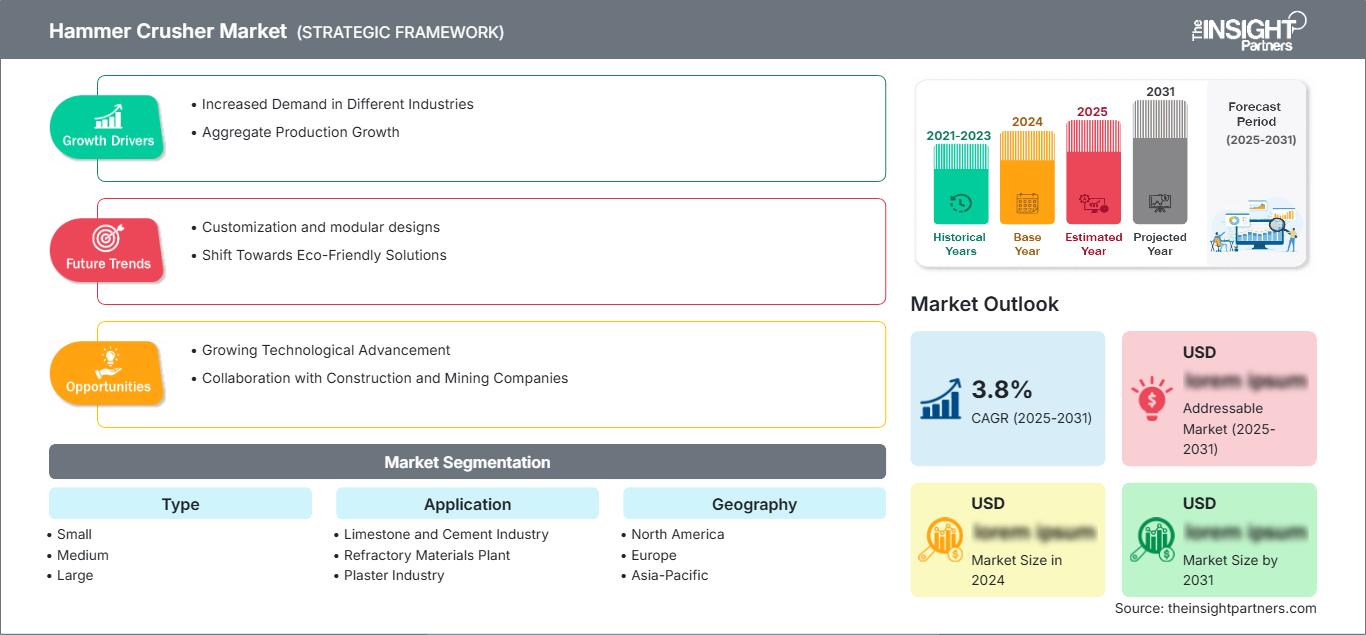
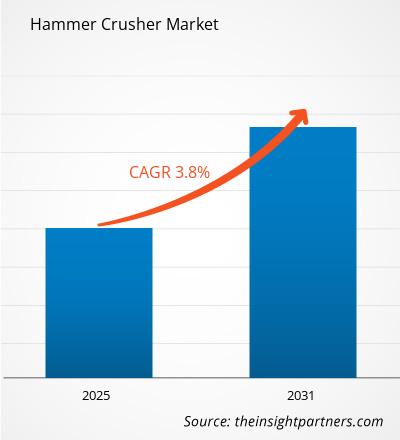
The Hammer Crusher Market is projected to increase from US$ 1.94 Billion in 2025 to US$ 2.93 Billion by 2034, registering a CAGR of 4.71% during 2026–2034. The market covers small, medium, and large machines used across limestone and cement plants, refractory materials facilities, plaster production, and other industrial mineral-processing applications. Demand reflects new crushing-line installations, capacity upgrades, equipment replacement, and recurring purchases of rotors, hammers, liners, grates, controls, and lifecycle services.
Across North America, the Hammer Crusher Market size is expected to advance at a modeled ~4% CAGR through 2034. Infrastructure rehabilitation supports aggregate and cement demand, while operators are replacing aging crushing assets to improve uptime, product-size control, dust management, and maintenance safety. Adoption remains selective because hammer machines compete with jaw, cone, roll, and impact alternatives, but they retain a strong position where limestone, gypsum, coal, and other friable materials require high reduction ratios in compact flowsheets.
Hammer Crusher Market Assessment and Insights
Regional Outlook
- North America: ~21% of the global market in 2025 | ~4% CAGR through 2034. Market position: The region ranks behind Asia Pacific and Europe, with demand anchored by quarry modernization, cement-plant maintenance, recycled aggregate processing, and replacement of aging industrial crushing equipment.
- US: ~81% of North American market revenue in 2025 | ~4% CAGR through 2034. Market position: The US leads North America through its broad aggregate, cement, mining, and industrial-mineral base, supported by established OEM service networks and demand for safer, digitally monitored crushing systems.
- Europe: ~26% of the global market in 2025 | ~4% CAGR through 2034. Market position: Europe combines a mature installed base with strong machinery engineering. Germany leads the region, while the UK, France, Italy, and Spain support replacement, efficiency, and circular-material projects.
- Asia Pacific: ~39% of the global market in 2025 | ~6% CAGR through 2034. Market position: Asia Pacific is the largest and fastest-growing region, supported by cement capacity, infrastructure investment, mining, and local equipment production. China leads, while India and Southeast Asia add new demand.
Segment Outlook
- Application: ~58% Share in 2025 | ~5% CAGR through 2034. Market position: Application leads because crusher selection is driven by process duty, with limestone and cement plants representing the broadest recurring requirement for primary and secondary reduction.
- Type: ~42% Share in 2025 | ~5% CAGR through 2034. Market position: Type gains from capacity-specific replacement and expansion, as operators select small, medium, or large machines according to feed size, throughput, footprint, and downstream mill requirements.
Competitive Coverage
EARTHTECHNICA Co., Ltd., FLSmidth A/S, General Machinery, Jiangxi Shicheng Mine Machinery Factory, Kurimoto, Ltd., McLanahan Corporation, MEKA Crushing Screening and Concrete Batching Technologies Inc., Shandong Xinhai Mining Technology & Equipment Inc., Tecpro Systems Limited, Williams Patent Crusher and Pulverizer Co., Inc.
Methodology
The Insight Partners follows Data Collection & Secondary Research, Primary Research, Data Analysis, and Data Triangulation & Final Review to validate market estimates and insights.
Source: The Insight Partners' analysis based on proprietary research, government publications, company annual reports, investor presentations, industry databases, and expert interviews.
The hammer crusher sector has evolved into a complex system where the rotor speed can be manipulated, grates can be controlled, hydraulic access can be facilitated, high wear alloys used, vibration monitored and controlled feeding/screening systems used. When looking at different materials, low to medium abrasive materials (limestone, gypsum, coal and clay) will be favourable to impact, shear and attrition. However, high abrasive materials may require a different principle in crushing. This means that an application focused product with steady feeding, replaceable wear components and maintaining particle size will be beneficial in the market place.
As we move through to 2034 investment will be driven by more capacity in the cement, minerals and infrastructure sectors across Asia Pacific, Middle East and selected African markets. In mature economies there will be a focus on replacement and retrofit systems. Dust control will become standard, therefore companies offering products with smaller footprint one stage solutions, where suitable feedstock is available, will be favoured. This will be to meet environmental regulations, worker safety expectations and recycled material targets. Companies with local service, metallurgy knowledge and good spare parts will gain a greater percentage of spend.
Hammer Crusher Market Report Scope
| Report Attribute | Details |
|---|---|
| Market size in 2025 | US$ 1.94 Billion |
| Market Size by 2034 | US$ 2.93 Billion |
| Global CAGR (2026 - 2034) | 4.71% |
| Historical Data | 2021-2024 |
| Forecast period | 2026-2034 |
Hammer Crusher Market Analysis
The Hammer Crusher Market is driven by the need to process feedstock in the construction industry, prepare raw materials for cement, mine development and processing of industrial minerals. Customers will choose hammer equipment when they need high reduction ratios, controlled max size and the ability to crush friable feeds. The demand of the market is less about how many units are needed but more about the severity of the application, tonnes per hour, feed moisture, abrasiveness and fines production required.
The supply chain consists of Alloy Steel, Casting, Motors, Bearings, Drives, Hydraulic, Controls, Machine Builders, EPC, Distributors, Quarries, Cement Manufacturers and Service Teams. Performance will depend on rotor balance, hammer metallurgy, grate availability and local field support. Customers are now looking for lower total cost per tonne, taking into account power, wear usage, downtime and downstream grinding.
The Hammer Crusher Market Report highlights many companies globally. FLSmidth A/S will provide solutions for high capacity applications in the cement industry. EARTHTECHNICA Co., Ltd. and Kurimoto, Ltd. will provide proven Japanese crushing systems. McLanahan Corporation and Williams Patent Crusher and Pulverizer Co., Inc. will provide industrial hammer mill systems.
MEKA Crushing Screening and Concrete Batching Technologies Inc., General Machinery, Jiangxi Shicheng Mine Machinery Factory, Shandong Xinhai Mining Technology & Equipment Inc. and Tecpro Systems Limited will provide a wider regional solution. Investment will be made in hydraulic access, reversible rotors, condition monitoring, optimised linings and modular controls. To gain competitive advantage in this market you must have sizing based on testing, local wear spares and feeding, screening, conveying and dust systems that can be integrated with the crusher.
● REPORT CUSTOMIZATION
Tailor This Report To Align With Your Specific Business Requirements
This report can be customized to align precisely with your business objectives, scope, and target markets. Customization options include tailored segmentation, geography, competitive analysis, and strategic insights to support informed decision-making.
Customize This Report →WHAT YOU CAN ADJUST
- ● Segmentations
- ● Geography
- ● Competitive Analysis
- ● Language Preferences
Hammer Crusher Market: Strategic Insights
Regional Insights
North America Hammer Crusher Market
North America is set to grow at ~4% CAGR through 2034. The Hammer Crusher Market Share will be driven by the large amount of installed crushers operating in the region, particularly within the limestone, cement, coal handling, aggregates and industrial minerals industries. Infrastructure projects are driving demand for crushed materials. Replacements will be driven by safer access, reduced vibration, predictable wear, and improved compatibility with screening and conveying. As there are many other technologies to choose from, purchasing is highly controlled. The largest applications are within the aggregates, mining and cement industries in Canada. Additional growth will also come from Mexico with additions to cement capacity and industrial demand for export. Value can be maintained by suppliers that can offer testing, spares stock, rotor rebuilds and remote diagnostics. Regulation has increased as awareness has increased around silica exposure, protection, particulate capture and noise.
U.S. Hammer Crusher Market
The U.S. makes up ~81% of North American Hammer Crusher Market Share in 2025 and is expected to grow at ~4% CAGR through 2034. The U.S is the largest country in North America, with large volumes of quarrying, cement, aggregates, coal and specialist minerals. Public infrastructure schemes are supporting demand. However, capital projects can be affected by cement and construction cycles. Replacements will be driven by reducing downtime, final product sizes and reducing the burden on the downstream mill. McLanahan Corporation and Williams Patent Crusher and Pulverizer Co., Inc. offer local engineering and service. Larger cement and mining applications will be driven by FLSmidth A/S. Trends are towards heavy duty rotors, reversible wear plates, hydraulics, vibration monitoring and pre-screening to prevent oversized material creating excess fines. Smaller and medium sized units are used for sampling, pilot and specialist applications. Large units are used for quarrying and cement.
Europe Hammer Crusher Market
Europe makes up ~26% of global revenue in 2025 and is expected to grow at ~4% CAGR through 2034. The large installed base means the focus is on reconditioning, energy efficiency, safety and compliance. Decarbonisation of cement can cause changes in raw mixes, so it is important to review your crusher when adding alternative raw materials or increasing supplementary cementitious material. Selective crushing will be encouraged due to the demand from recovery of construction waste. Careful consideration is needed to match hammer crushers to the risk of contamination and reinforcement.
Germany is the largest country within Europe due to the engineering and minerals processing industry, cement and high standards required. The UK will have a mix of quarry replacements and recycled aggregate applications. France will drive demand with cement and infrastructure. Italy will benefit from equipment engineering, lime, ceramics and stone applications. Spain will have demand for cement, gypsum, quarrying and export oriented construction materials.
Customers in Europe will want evidence to show the crusher meets noise, particulate, protection and maintenance requirements. Wear, energy per tonne, spares availability and ease of upgrading controls will be key selling points. Due to the high lost opportunity cost of downtime within production, modular drives, hydraulics and condition based servicing is becoming an important feature. Engineering companies that can validate variable feeds and integrate separation upstream will have the edge over stand alone suppliers.
APAC Hammer Crusher Market
Asia Pacific makes up ~39% of global revenue in 2025 and is the fastest growing region, growing at ~6% CAGR through 2034. China is the largest country in Asia Pacific due to the large volume of cement, mining, equipment manufacturing and infrastructure. Additional demand will come from India with demand from roads, housing, cement, coal and minerals processing. Local manufacture means there will be a variety of price points and capacities.
Japan and South Korea are driven by energy efficient controls, precise engineering and replacement of older equipment. Australia offers quarrying and mining applications, with high demands for safety, reliability and support in remote locations. Urbanisation, local manufacturing policies, industrial areas and localised spares are driving investment in the region. The market is very competitive, so it is important to have application engineering and life cycle service.
Middle East & Africa Hammer Crusher Market
The Middle East & Africa is expected to grow at ~5% CAGR through 2034. Saudi Arabia is the largest country due to the large infrastructure, cement, quarrying and diversification of industry. UAE will add demand from aggregates, cement and recycled construction materials. Specifications will be influenced by abrasive particulates, heat and continuous running.
South Africa will lead the sub-Sahara market. Mining, cement, coal and established engineering will drive demand. Demand from the rest of MEA will be project driven and be affected by finance, imported components and technician availability. Machines can be encouraged by offering durable equipment, simple controls, modular wear solutions, training and critical spares stock. Energy efficient solutions will be important if power is limited or expensive.
Segmentation Analysis
Type
Type is expected to expand at ~5% CAGR during 2026–2034 in the Hammer Crusher Market. Machine selection reflects feed size, material hardness, required throughput, installation footprint, motor power, and maintenance capability. The Hammer Crusher Market scope spans compact units for controlled batches through large continuous machines integrated with quarry and cement lines. Replacement decisions increasingly compare capital cost with wear consumption, energy use, downtime, and downstream grinding performance.
- Small: Small crushers serve laboratories, sampling systems, pilot plants, recycling workshops, and low-volume mineral processing. Their strategic value lies in compact integration, lower capital exposure, and flexible adjustment where feed rates are limited and product specifications change frequently.
- Medium: Medium machines address regional quarries, gypsum and lime plants, industrial minerals, and smaller cement operations. They balance throughput with serviceability, making them attractive for staged modernization, secondary duties, and facilities without heavy-lift maintenance infrastructure.
- Large: Large crushers support continuous limestone, cement, coal, and high-volume mineral-processing lines. Buyers prioritize rotor integrity, high-capacity feeding, hydraulic access, predictable wear, and assured spare-part support because downtime can constrain an entire production chain.
Application
Application is projected to grow at ~5% CAGR during 2026–2034 in the Hammer Crusher Market. Material behavior and downstream product requirements determine whether hammer crushing offers the lowest cost per tonne. Limestone and cement duties provide the broadest installed base, while refractory and plaster plants require tighter control over contamination, moisture, and particle size. Growth favors suppliers able to test representative feed, configure grates and hammers, and guarantee integration with conveying and screening.
- Limestone and Cement Industry: This application leads demand because limestone reduction is fundamental to clinker and lime preparation. High reduction ratios, compact layouts, and the ability to handle mixed clay-bearing feed can reduce intermediate equipment when abrasiveness remains manageable.
- Refractory Materials Plant: Refractory producers require controlled preparation of minerals and recycled brick fractions. Equipment selection emphasizes contamination control, wear metallurgy, consistent sizing, and maintainable designs suited to batch changes and specialized, higher-value material streams.
- Plaster Industry: Gypsum and plaster operations favor hammer crushing for friable feed and fine-product generation. Moisture management, grate condition, dust capture, and stable rotor speed are critical to preserving throughput and avoiding buildup or inconsistent downstream calcination feed.
Opportunity Snapshot
| Application | Revenue Contribution | Trend Tag | Adoption Stage |
| Limestone and Cement Industry | High | Quarry Modernization | Mature |
| Refractory Materials Plant | Medium | Material Recovery | Scaling |
| Plaster Industry | Medium | Gypsum Efficiency | Mature |
| Others | Low | Niche Processing | Emerging |
Hammer Crusher Market Growth Drivers and Impact Analysis
Infrastructure and Cement Capacity Expansion
Roads, railways, housing, utilities, and industrial construction require cement and processed aggregates, linking crusher demand to material-production capacity rather than directly to finished construction spending. Hammer machines are particularly relevant where quarries feed friable limestone, clay-bearing rock, or gypsum into cement and lime operations. Their ability to combine impact, shear, and attrition can deliver a high reduction ratio within a compact arrangement. The market impact is strongest in greenfield and debottlenecking projects where one properly engineered stage can reduce conveying, foundations, and intermediate equipment. However, purchase decisions remain feed-specific: excessive abrasiveness can raise wear cost, while uncontrolled moisture can impair grate performance. Suppliers that demonstrate representative material tests and whole-line economics are better positioned than vendors competing only on rated throughput.
Replacement of Aging Crushing Assets
Many quarries and process plants operate mechanically durable crushers whose controls, guarding, dust interfaces, and maintenance access no longer meet current operating expectations. Replacement and retrofit spending grows when unplanned shutdowns, obsolete components, or inconsistent product size impose costs elsewhere in the plant. Newer machines can incorporate hydraulic casing opening, reversible rotors, improved liners, balanced assemblies, variable-speed drives, and sensors for vibration and bearing condition. These features do not eliminate wear, but they make wear more predictable and shorten planned interventions. The market effect is a steady service-led revenue stream across mature regions, including rotors, hammers, grates, bearings, controls, and field labor. Vendors with installed-base records and local inventories can capture projects even when customers defer full capacity expansion.
Pressure to Lower Processing Cost per Tonne
Crushing economics extend beyond motor power. Feed preparation, fines generation, wear consumption, recirculating load, downstream milling energy, and maintenance labor determine the true cost per tonne. A hammer crusher can create value when its reduction ratio removes another stage or shifts work from a less efficient mill, but it can destroy value if unsuitable feed accelerates wear or produces an unwanted fines fraction. Operators are therefore using tighter application studies, pre-screening, tramp protection, and adjustable rotor and grate configurations. This discipline supports demand for engineered packages rather than generic equipment. Commercially, suppliers that quantify throughput, gradation, wear intervals, and maintenance hours can justify premium designs and service agreements, while poorly specified low-cost machines face higher rejection and replacement risk.
Hammer Crusher Market Future Trends
Sensor-Based Wear and Condition Intelligence
Hammer Crusher Market trends will increasingly center on sensors and analytics that convert vibration, temperature, motor load, acoustic response, and operating hours into maintenance decisions. Future systems should distinguish normal feed variability from rotor imbalance, bearing deterioration, grate blockage, or progressive hammer wear. The operational objective is not autonomous crushing but earlier intervention and better shutdown planning. Adoption will begin with large continuous-duty machines because downtime carries the greatest cost, then extend to medium units through lower-cost edge devices. Suppliers will need robust sensors, transparent alarm logic, and secure interfaces that connect with existing plant systems. Commercial acceptance will depend on proving fewer unplanned stops and more complete use of wear parts, not simply adding dashboards.
Adaptive Crushing for Variable and Circular Feedstocks
Recycled minerals, alternative cement raw materials, demolition fractions, and variable quarry benches will place greater emphasis on adaptable machine settings. Future crusher packages are likely to coordinate feeder rate, rotor speed, grate opening, and upstream screening according to moisture, hardness, and desired product distribution. This flexibility can widen the addressable feed envelope without treating every material as a fixed recipe. Wear-resistant castings and modular internal components will remain central because circular feedstocks may contain contaminants or irregular particles. The strategic implication is a shift from selling a static machine toward supplying configurable processing capability. Vendors that combine laboratory testing, controls, metallurgy, and field service can support this transition while maintaining clear operating limits for unsuitable abrasive or tramp-laden feed.
Hammer Crusher Market Opportunities
Phased Modernization in Emerging Cement Corridors
New and expanding cement corridors in India, Southeast Asia, the Middle East, and Africa create opportunities for localized machine supply, wear parts, and commissioning. Hammer Crusher Market Forecasts support phased investment where operators first replace constrained primary or secondary equipment, then add feeders, screens, dust controls, and digital monitoring. Suppliers should establish application laboratories, certified service partners, and regional inventories before pursuing volume sales. Financing and modular installation packages can reduce project risk for mid-sized producers. Designs must address local feed variability, power quality, ambient heat, and maintenance skills. The most defensible opportunity lies in delivering a complete duty guarantee and lifecycle support, not merely exporting a standard crusher with limited adaptation.
Installed-Base Retrofits and Performance Contracts
The installed base offers recurring opportunity through rotor rebuilds, upgraded hammers, improved grates, hydraulic opening systems, guards, sensors, drives, and dust connections. A structured audit can identify whether a retrofit will restore capacity, improve gradation, or reduce shutdown time, and when full replacement is economically preferable. Vendors can package inspections, wear forecasting, critical spares, operator training, and scheduled service into multi-year agreements linked to availability or cost-per-tonne targets. This model lowers capital barriers for customers and creates steadier supplier revenue. Success requires accurate machine records, compatibility across older designs, and field technicians capable of working safely within mixed-vendor plants. Transparent baseline measurements are essential to avoid performance claims that feed variability cannot support.
Recent Developments
- October 2026: ENERPAT proudly introduces its next-generation Steel Crusher – the MSA-H Series Horizontal Hammer Mill. Engineered for heavy-duty scrap metal processing, this advanced machine transforms scrap steel, aluminum castings, and automotive shells into high-purity, reusable metal granules, driving circular economy goals.
- March 2026: McLanahan Corporation is excited to announce the launch of its newest recycling crusher, the Renew Impact Crusher. It is designed for the C&D recycling of asphalt, concrete, and rubble, as well as virgin aggregate crushing applications.
- September 2025: Weir, a global leader in mining technology, has launched a new range of ENDURON jaw and cone crushers, developed in close collaboration with customers to address their most pressing operational challenges. This customer-first approach has resulted in equipment that enhances safety, boosts productivity, simplifies maintenance, and supports sustainability goals.
Frequently Asked Questions

- Comprehensive Market Sizing and Forecast Analysis
- Detailed Segmentation Analysis
- In-Depth Market Dynamics Assessment
- Regional and Country-Level Insights
- Competitive Landscape and Company Benchmarking
- Strategic Business Intelligence
Recent Reports
Testimonials

The Insight Partners provided valuable market intelligence that supported our global go-to-market strategy. Their team was professional, responsive, and attentive to our feedback, providing thoughtful analysis and helpful methodological clarifications throughout the project.
Junmo Kim Chief Financial Officer (CFO), Enertech Co., Ltd.
The Insight Partners' SCADA System Market report is comprehensive, with valuable insights on current trends and future forecasts. The team was highly professional, responsive, and supportive throughout. We are very satisfied and highly recommend their services.
RAN KEDEM Partner, Reali Technologies LTDs
I requested a report on a very specific software market and the team produced the report in a few days. The information was very relevant and well presented. I then requested some changes and additions to the report. The team was again very responsive and I got the final report in less than a week.
JEAN-HERVE JENN Chairman, Future Analytica
We worked with The Insight Partners for an important market study and forecast. They gave us clear insights into opportunities and risks, which helped shape our plans. Their research was easy to use and based on solid data. It helped us make smart, confident decisions. We highly recommend them.
PIYUSH NAGPAL Sr. Vice President, High Beam Global
The Insight Partners delivered insightful, well-structured market research with strong domain expertise. Their team was professional and responsive throughout. The user-friendly website made accessing industry reports seamless. We highly recommend them for reliable, high-quality research services
YUKIHIKO ADACHI CEO, Deep Blue, LLC.
This is the first time I have purchased a market report from The Insight Partners.While I was unsure at first, I visited their web site and felt more comfortable to take the risk and purchase a market report.I am completely satisfied with the quality of the report and customer service. I had several questions and comments with the initial report, but after a couple of dialogs over email with their analyst I believe I have a report that I can use as input to our strategic planning process.Thank you so much for taking the extra time and making this a positive experience.I will definitely recommend your service to others and you will be my first call when we need further market data.
JOHN SUZUKI President and Chief Executive Officer, Board Director, BK Technologies
I wish to appreciate your support and the professionalism you displayed in the course of attending to my request for information regarding to infectious disease IVD market in Nigeria. I appreciate your patience, your guidance, and the fact that you were willing to offer a discount, which eventually made it possible for us to close a deal. I look forward to engaging The Insight Partners in the future, all thanks to the impression you have created in me as a result of this first encounter.
DR CHIJIOKE ONYIA MANAGING DIRECTOR, PineCrest Healthcare Ltd.Reason to Buy
- Informed Decision-Making
- Understanding Market Dynamics
- Competitive Analysis
- Identifying Emerging Markets
- Customer Insights
- Market Forecasts
- Risk Mitigation
- Boosting Operational Efficiency
- Strategic Planning
- Investment Justification
- Tracking Industry Innovations
- Aligning with Regulatory Trends





 Get Free Sample for