
Hand Pallet Truck Market Growth, Trends & Demand by 2034
Coverage: By Capacity (Below 1.5 Tons, 1.5-3 Tons, Above 3 Tons); Type (Manual, Powered); End-user (Freight and Logistics, Retail Stores, Wholesale Distribution, Manufacturing, Others), and Geography (North America, Europe, Asia Pacific, and South and Central America)
- Status : Data Released
- Report Code : TIPRE00014733
- Category : Manufacturing and Construction
- No. of Pages : 150
- Available Report Formats :


- Last update date : August 17, 2026


2025 Market Size
US$ 3.6 Bn
Base year value
2034 Forecast
US$ 5.25 Bn
Projected by 2034
CAGR 2026-2034
4.29 %
Growth rate
Addressable Market
US$ 40.21 Bn
(2026-2034)
The hand pallet truck market is projected to increase from US$ 3.6 Billion in 2025 to US$ 5.25 Billion by 2034, registering a CAGR of 4.29% during 2026–2034. Demand is supported by recurring pallet movement needs across freight terminals, retail backrooms, wholesale depots, and manufacturing floors, where compact load-handling equipment remains essential for short-distance material flow and low-cost productivity gains.
Across North America, the hand pallet truck market size is shaped by replacement demand, tighter warehouse labor availability, and steady investment in regional distribution capacity. The region is expected to grow at a CAGR of 3.8–4.3% during 2026–2034, with powered walkie units gaining traction where operators need higher throughput, safer dock handling, and lower physical strain in dense fulfillment environments.
Hand Pallet Truck Market Assessment and Insights
- North America: The region accounted for 26–29% share in 2025 and is growing at a CAGR of 3.8–4.3% during 2026–2034, supported by warehouse modernization, retail replenishment, and third-party logistics expansion.
- US: The US represented 76–80% of North America in 2025 and is growing at a CAGR of 3.9–4.4% during 2026–2034, led by omnichannel distribution.
- Europe: Europe held 24–27% share in 2025 and is growing at a CAGR of 3.6–4.1% during 2026–2034, with Germany, the UK, France, Italy, and Spain leading replacement cycles.
- Asia Pacific: Asia Pacific accounted for 34–38% share in 2025 and is growing at a CAGR of 4.7–5.3% during 2026–2034, led by China, Japan, South Korea, India, and Australia.
- Largest Segment: Manual trucks held 58–62% market share in 2025, growing at a CAGR of 3.4–3.9% during 2026–2034 due to low acquisition cost.
- High Growth Segment: Powered trucks held 38–42% market share in 2025, growing at a CAGR of 5.1–5.7% during 2026–2034 as lithium-ion adoption improves usability.
- Key companies analyzed in detail: Crown Equipment Corporation, Godrej Material Handling, Hyster-Yale Materials Handling, Inc., Jungheinrich AG, KION Group AG, Linde Material Handling GmbH, Mitsubishi Logisnext Americas Inc., The Raymond Corporation, Toyota Industries Corporation, and Hyundai Material Handling.
Source: The Insight Partners' analysis based on proprietary research, government publications, company annual reports, investor presentations, industry databases, and expert interviews.
Product evolution in the hand pallet truck market has moved from basic hydraulic lift frames toward more ergonomic handles, sealed pump designs, corrosion-resistant finishes, weighing variants, and compact powered platforms. Production trends are evolving as well since manufacturers around the world try to find a balance between standardizing steel construction and providing regional assembly along with local distribution, dealers' stock, and efficient after-sales service. All of this will assist customers in minimizing downtime and in choosing the equipment according to the width of aisles, the weight of pallets, the quality of floor surfaces, and other requirements related to safety.
The future demand will be formed in part by the new logistics routes, cold storage warehouses, and small retail chains that require equipment at reasonable prices prior to automating their systems. Workplace safety concerns, along with risks associated with manual handling and energy efficiency of the warehouse fleet, will drive the demand for updating the existing equipment.
Hand Pallet Truck Market Report Scope
| Report Attribute | Details |
|---|---|
| Market size in 2025 | US$ 3.6 Billion |
| Market Size by 2034 | US$ 5.25 Billion |
| Global CAGR (2026 - 2034) | 4.29% |
| Historical Data | 2021-2024 |
| Forecast period | 2026-2034 |
Hand Pallet Truck Market Analysis
The hand pallet truck market growth is linked to palletized freight intensity, warehouse densification, and the need to move unit loads without committing capital to forklifts. Logistics users consider dock-to-rack movements, retail outlets prefer compact versions for stocking purposes, and manufacturers utilize them for line-side transport. There is moderate fragmentation in the supply side, where international firms compete with local producers based on factors such as price, service, lead time, and consistency in load ratings.
Inputs, such as steel, hydraulics, wheels, and batteries, affect prices, whereas availability depends on dealerships that serve small and medium customers. Value chain involves sourcing of inputs, welding of frames, pumping installation, testing, distribution, and maintenance of equipment. Cost of ownership includes considerations such as wheel usage, hydraulic maintenance, battery changeover, and exposure to risks of being down because of frequent use.
Market Analysis demonstrates a competitive environment dominated by Toyota Industries Corporation, Crown Equipment Corporation, Jungheinrich AG, KION Group AG, and Hyster-Yale Materials Handling Inc., while Godrej Material Handling and Hyundai Material Handling enhance geographical presence. At the same time, The Raymond Corporation and Mitsubishi Logisnext Americas Inc. bring value in North American warehouse distribution channels, especially when it comes to the combination of powered pallet handling with fleets.
Capital investments are now being made in favor of walkie trucks driven by lithium-ion batteries, small trucks and aisle cleaners, as well as fleet utilization enabled by telemetry systems. Competitive advantage is determined through reliability, dealer network, warranties, and ergonomic features of products instead of price. Large customers seek to have fewer suppliers due to the standardization of training, maintenance, and safety practices.
● REPORT CUSTOMIZATION
Tailor This Report To Align With Your Specific Business Requirements
This report can be customized to align precisely with your business objectives, scope, and target markets. Customization options include tailored segmentation, geography, competitive analysis, and strategic insights to support informed decision-making.
Customize This Report →WHAT YOU CAN ADJUST
- ● Segmentations
- ● Geography
- ● Competitive Analysis
- ● Language Preferences
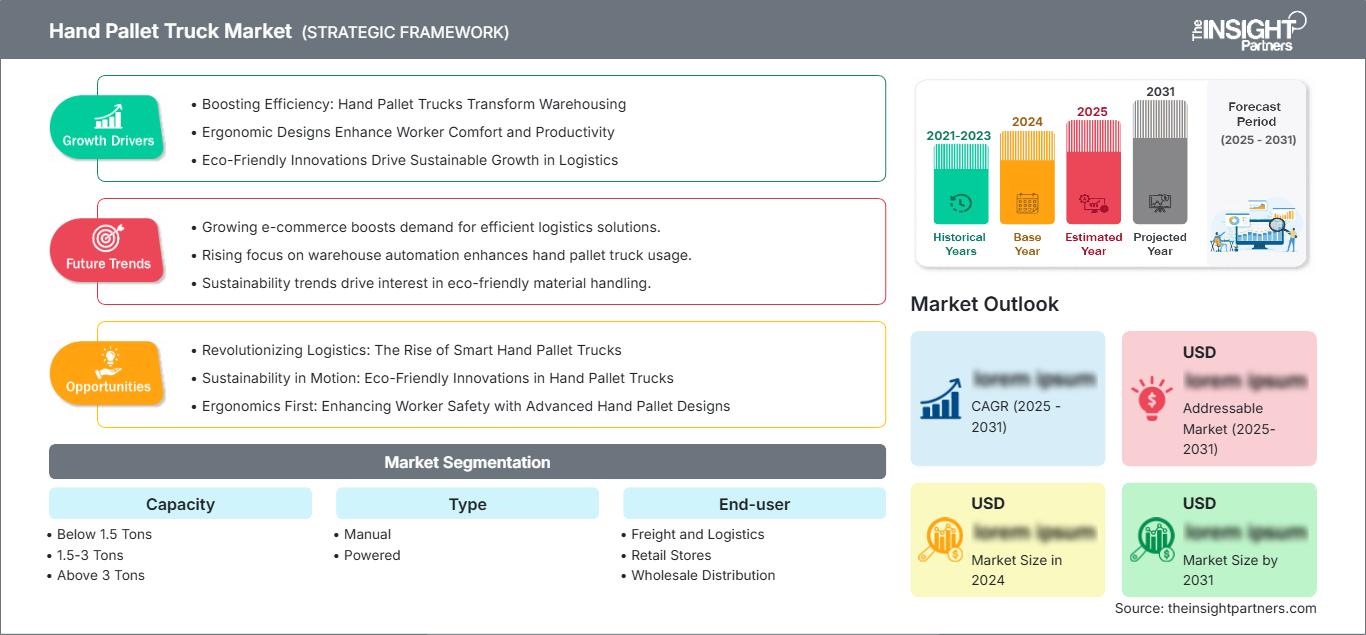
Hand Pallet Truck Market: Strategic Insights
Regional Insights
North America hand pallet truck market
North America held 26–29% of 2025 revenue and is expected to grow at a CAGR of 3.8–4.3% during 2026–2034. The regional hand pallet truck market share is supported by large distribution networks, frequent retail replenishment, and replacement of aging manual fleets. The greatest demand comes from food distribution centers, parcels, wholesale clubs, and manufacturing plants that have to use dependable low lifts.
The adoption of walkie-powered devices is becoming more prevalent in situations where labor issues, crowded docks, and increased pallet turns make such devices worth the additional cost. The figures provided by the Industrial Truck Association show the significance of lift equipment in the economy of the United States.
U.S. Hand Pallet Truck Market
The US represented 76–80% of North America in 2025 and is forecast to grow at a CAGR of 3.9–4.4% during 2026–2034. Large retailers, e-commerce operators, foodservice distributors, and third-party logistics companies generate recurring replacement cycles. Application trends favor powered low-lift trucks in high-turn facilities and manual units in retail backrooms, service depots, and smaller warehouses.
Company presence is broad, with Toyota Industries Corporation, The Raymond Corporation, Crown Equipment Corporation, Hyster-Yale Materials Handling, Inc., and Mitsubishi Logisnext Americas Inc. operating through established dealer and service networks. Buyers emphasize uptime, safety training, and availability of parts, making national support capabilities important for multi-site logistics operations.
Europe Hand Pallet Truck Market
Europe accounted for 24–27% share in 2025 and is projected to grow at a CAGR of 3.6–4.1% during 2026–2034. Germany leads regional demand due to manufacturing density, intralogistics investment, and strong supplier presence. The UK benefits from grocery logistics, parcel networks, and retail warehousing, where compact equipment supports rapid replenishment and dock handling.
France, Italy, and Spain add demand through food processing, wholesale distribution, automotive supply chains, and export-oriented manufacturing. European buyers show a higher preference for ergonomic design, noise reduction, and electric assistance in regulated work environments. Jungheinrich AG, KION Group AG, and Linde Material Handling GmbH hold strong regional visibility through product breadth and service infrastructure.
APAC Hand Pallet Truck Market
APAC held 34–38% share in 2025 and is expected to grow at a CAGR of 4.7–5.3% during 2026–2034, making it the leading regional demand pool. China is leading in terms of manufacturing and warehouse expansion. In contrast, Japan and South Korea are leading in the demand for smaller, yet more efficient equipment due to their limited spaces.
India and Australia contribute to the growth of the industry through logistics parks, retail upgrades, and cold chain investment. Industrial corridors, export manufacturing and e-commerce are supported by policy, which boosts palletized cargo movements.
Middle East & Africa Hand Pallet Truck Market
The Middle East & Africa is forecast to grow at a CAGR of 4.0–4.6% during 2026–2034. Saudi Arabia and the UAE drive the demand via logistics parks, port-related warehousing, retail distribution, and infrastructure projects linked to economic diversification strategies. The power unit segment benefits from high-temperature and high-volume operations.
South Africa drives the demand via retail, mining supply chains, and industrial distribution, whereas the Rest of MEA is price-sensitive and uses manual trucks. Energy, construction, and food logistics drive the replacement demand, though dealerships and spare parts determine brand choice.
Segmentation Analysis
Capacity
The capacity segment is expected to grow at a CAGR of 4.0–4.6% during 2026–2034. The market scope across capacity bands reflects different load profiles, floor conditions, and operator practices. Buyers select lighter units for retail and narrow spaces, mid-capacity trucks for general logistics, and higher-capacity models for manufacturing, wholesale, and heavy goods movement.
- Below 1.5 Tons: Demand is concentrated in retail stores, light warehousing, pharmaceuticals, and small distribution points where maneuverability, low purchase cost, and easier operator handling are more important than heavy load capability.
- 1.5-3 Tons: This remains the mainstream capacity band because it fits standard palletized goods, dock transfers, and warehouse replenishment tasks while balancing durability, safety, purchase price, and broad application flexibility.
- Above 3 Tons: Higher-capacity models serve manufacturing, metal products, building materials, and bulk wholesale operations where reinforced frames, robust hydraulics, and careful floor compatibility determine long-term equipment performance.
Type
The type segment is projected to grow at a CAGR of 4.2–4.8% during 2026–2034. Manual models dominate cost-sensitive usage, while powered variants expand in facilities facing labor shortages, repetitive movement, and higher safety expectations. Product choice increasingly depends on pallet turns per shift, travel distance, charging access, maintenance skills, and total operating cost.
- Manual: Manual trucks remain the largest segment because they are inexpensive, simple to maintain, and adequate for intermittent pallet movement in retail, small warehouses, manufacturing cells, and wholesale locations.
- Powered: Powered trucks gain strategic importance in busy distribution centers, dock areas, and cold-chain facilities by reducing operator fatigue, improving travel consistency, and supporting longer movement cycles per shift.
End-user
The end-user segment is expected to grow at a CAGR of 4.1–4.7% during 2026–2034. Demand patterns differ by throughput intensity and service expectations. Logistics buyers prioritize uptime and fleet consistency, retailers focus on compact handling, wholesalers need durable mid-capacity equipment, and manufacturers require safe movement between receiving, storage, and production lines.
- Freight and Logistics: Operators use pallet trucks for loading bays, cross-docks, parcel facilities, and short internal moves, making durability, service support, and fleet standardization critical procurement factors.
- Retail Stores: Retail adoption is driven by backroom replenishment, receiving areas, and store-level pallet movement, where compact size, quiet operation, easy steering, and staff safety remain central.
- Wholesale Distribution: Wholesale users require reliable equipment for mixed-SKU movement, pallet staging, and order assembly, with mid-capacity trucks supporting frequent handling across large floor areas.
- Manufacturing: Manufacturing facilities deploy pallet trucks for raw material transfer, work-in-process movement, and finished-goods staging, where load stability, floor compatibility, and operator training influence equipment choice.
Opportunity Snapshot
| Segment Name | Revenue Contribution | Trend Tag | Adoption Stage |
| Freight and Logistics | High | Dock Flow | Mature |
| Retail Stores | Medium | Backroom Handling | Scaling |
| Wholesale Distribution | Medium | Bulk Movement | Mature |
| Manufacturing | High | Line Supply | Mature |
Hand Pallet Truck Market Growth Drivers and Impact Analysis
Expansion of palletized logistics networks
Palletized freight remains central to regional distribution because it standardizes movement across trucks, warehouses, retail docks, and factory receiving areas. As e-commerce, food distribution, and wholesale networks add smaller nodes closer to consumers, the number of short internal pallet moves rises. This supports demand for affordable trucks that can operate in confined areas without forklift certification burdens, supporting the Hand Pallet Truck Market forecast. The real-world impact is strongest among small and mid-sized warehouses that need immediate productivity improvements, predictable maintenance, and equipment that can be deployed across shifts with limited infrastructure changes.
Labor pressure and safety requirements
A shortage of workers in warehouses and more emphasis on reducing musculoskeletal injuries are affecting the choice of equipment. While manual trucks are needed, prospective buyers are looking for equipment that will help in minimizing fatigue caused by repetitive actions through ergonomically designed handles, good wheels, braking and assistance in driving. Safety officers also look for equipment that will assist in handling the pallets safely at docks, ramp areas and crowded aisles. The result has been a gradual move from procurement based on pricing only to life-cycle assessment.
Growth of modern retail and cold-chain facilities
Modern retail and cold chain operations have created a need for unique pallet handling solutions. Food retailing, pharmaceuticals, quick service restaurant support, and refrigerated transport require small-scale, dependable equipment to transport goods effectively in cold environments such as cold rooms, loading docks, and store back areas. Corrosion protection, battery life, and cleaning become more significant factors. In terms of market impact, there will be increased sales of stainless, galvanized, compact, and electric versions, which meet the needs of these applications.
Hand Pallet Truck Market Future Trends
Compact lithium-ion powered handling
Compact lithium-ion powered trucks will shape the hand pallet truck market trends as buyers seek equipment between basic manual jacks and larger forklifts. With smaller batteries, opportunity charging and less maintenance, powered equipment becomes feasible for use in retail, deliveries and small warehouses. During the forecast period, the manufacturers would be keen on offering lightweight frames, smaller turning radiuses, user-friendly controls and low-speed handling. This trend will result in increased usage of powered equipment among users who have not used such equipment before due to cost and other challenges.
Application-specific configurations
Product differentiation in the future will focus more on application-specific design, as opposed to catalog extension. There will be an increased demand for forks that have reduced profiles, weighing scale trucks, galvanized frames, quiet wheels, long-forks and high-lift designs that will help solve particular problems. For suppliers that have modulated platforms, they will be able to cater to particular needs without the need for complicated inventory management. This will be favorable to both manufacturers and consumers, especially those involved in food processing, pharmaceuticals, packaging and specialized wholesaling businesses.
Hand Pallet Truck Market Opportunities
Dealer-led fleet replacement programs
The hand pallet truck market forecast indicates that dealers can create value by turning fragmented replacement purchases into structured fleet programs. Small and medium-sized customers have mixed-age fleets with varying safety levels, diverse spare parts inventory, and poor maintenance history. An alternative plan of auditing the condition of the fleet, choosing common models, scheduling maintenance, and providing financing can minimize downtime and increase compliance. The manufacturer gains the advantage of a steady stream of orders, and the customer receives better planning of its assets. This situation is particularly appropriate for North America and Europe.
Emerging-market warehouse formalization
The development of logistics parks, industrial corridors, and organized retail formats within emerging markets presents an opening for suppliers to convert customers from using informal handling methods. Manual trucks can be introduced first, followed by compact powered units, in a way that operations are conducted safely and efficiently without having to invest in full automation. Local manufacturing, durable design, and funding options will play key roles in adoption. In Asia Pacific, the Middle East, and some African regions, suppliers offering cost-effective solutions with after-sales support will cultivate customer loyalty.
Recent Developments
- June 2026: The Raymond Corporation expanded its Raymond Basics product line with a lithium-ion walkie pallet truck designed as an accessible solution for everyday warehouse operations. The launch targets users seeking lower-maintenance powered pallet handling for routine movement, supporting broader adoption of electric walkie equipment in cost-sensitive facilities.
- September 2025: Jungheinrich AG launched AntOn by Jungheinrich, an entry-level material handling brand that includes the PTL 1.5 lithium-ion pallet truck. The product line targets cost-conscious warehouse and transport users while combining simplified operation with lithium-ion power, supporting expansion in Europe, Asia Pacific, and Latin America.
Frequently Asked Questions

- Comprehensive Market Sizing and Forecast Analysis
- Detailed Segmentation Analysis
- In-Depth Market Dynamics Assessment
- Regional and Country-Level Insights
- Competitive Landscape and Company Benchmarking
- Strategic Business Intelligence
Recent Reports
Testimonials

The Insight Partners' SCADA System Market report is comprehensive, with valuable insights on current trends and future forecasts. The team was highly professional, responsive, and supportive throughout. We are very satisfied and highly recommend their services.
RAN KEDEM Partner, Reali Technologies LTDs
I requested a report on a very specific software market and the team produced the report in a few days. The information was very relevant and well presented. I then requested some changes and additions to the report. The team was again very responsive and I got the final report in less than a week.
JEAN-HERVE JENN Chairman, Future Analytica
We worked with The Insight Partners for an important market study and forecast. They gave us clear insights into opportunities and risks, which helped shape our plans. Their research was easy to use and based on solid data. It helped us make smart, confident decisions. We highly recommend them.
PIYUSH NAGPAL Sr. Vice President, High Beam Global
The Insight Partners delivered insightful, well-structured market research with strong domain expertise. Their team was professional and responsive throughout. The user-friendly website made accessing industry reports seamless. We highly recommend them for reliable, high-quality research services
YUKIHIKO ADACHI CEO, Deep Blue, LLC.
This is the first time I have purchased a market report from The Insight Partners.While I was unsure at first, I visited their web site and felt more comfortable to take the risk and purchase a market report.I am completely satisfied with the quality of the report and customer service. I had several questions and comments with the initial report, but after a couple of dialogs over email with their analyst I believe I have a report that I can use as input to our strategic planning process.Thank you so much for taking the extra time and making this a positive experience.I will definitely recommend your service to others and you will be my first call when we need further market data.
JOHN SUZUKI President and Chief Executive Officer, Board Director, BK Technologies
I wish to appreciate your support and the professionalism you displayed in the course of attending to my request for information regarding to infectious disease IVD market in Nigeria. I appreciate your patience, your guidance, and the fact that you were willing to offer a discount, which eventually made it possible for us to close a deal. I look forward to engaging The Insight Partners in the future, all thanks to the impression you have created in me as a result of this first encounter.
DR CHIJIOKE ONYIA MANAGING DIRECTOR, PineCrest Healthcare Ltd.Reason to Buy
- Informed Decision-Making
- Understanding Market Dynamics
- Competitive Analysis
- Identifying Emerging Markets
- Customer Insights
- Market Forecasts
- Risk Mitigation
- Boosting Operational Efficiency
- Strategic Planning
- Investment Justification
- Tracking Industry Innovations
- Aligning with Regulatory Trends





 Get Free Sample for