
Mining Lubricants Market Size, Share & Trends by 2034
Coverage: by Type (Oil-Based Lubricants, Synthetic Lubricants, Bio-Based Lubricants); Product Type (Hydraulic Oils, Gear Oils, Greases, Others); Application (Coal Mining, Iron Ore Mining, Precious Metals Mining, Industrial Metals Mining, Others); and Geography (North America, Europe, Asia Pacific, and South and Central America)
- Status : Data Released
- Report Code : TIPRE00009230
- Category : Chemicals and Materials
- No. of Pages : 150
- Available Report Formats :


- Last update date : August 14, 2026


2025 Market Size
US$ 4.7 Bn
Base year value
2034 Forecast
US$ 9.64 Bn
Projected by 2034
CAGR 2026-2034
8.29 %
Growth rate
Addressable Market
US$ 64.33 Bn
(2026-2034)
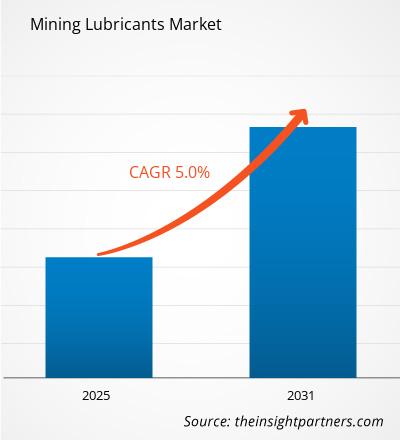
The mining lubricants market was valued at US$ 4.7 Billion in 2025 and is projected to reach US$ 9.64 Billion by 2034, registering a CAGR of 8.29% during 2026–2034. Increasing mining investments, higher equipment usage, and the requirement of increasing the reliability of the equipment are expected to drive the market demand for better performing lubricants in both surface and underground mines. Moreover, new developments in the formulation of lubricants to increase the efficiency of the equipment, decrease maintenance requirements, and minimize downtime will positively impact the market.
In North America, increasing investment in the extraction of minerals, copper, lithium, and rare earth metals along with the modernization of mining fleets will drive the mining lubricants market size in the region. As operators in the region are using synthetic and premium oils to extend the life of their mining equipment, the market in North America is projected to witness a CAGR of 7.8%-8.4% from 2026 to 2034.
Mining Lubricants Market Assessment and Insights
- North America: The region accounted for 31–34% share in 2025 and is projected to expand at a CAGR of 7.8–8.4% during 2026–2034. Growth is supported by critical mineral mining projects, equipment modernization, and increased adoption of premium lubricants across Canada and the United States.
- U.S.: The country represented 70–74% of the North American market in 2025 and is anticipated to grow at a CAGR of 7.7–8.3% during 2026–2034, driven by copper, gold, industrial mineral, and aggregates mining together with expanding autonomous mining operations.
- Europe: Europe held 23–26% share in 2025 and is expected to record a CAGR of 7.4–8.0% during 2026–2034. Sweden, Finland, Germany, and Poland remain key contributors due to advanced mining equipment deployment, sustainability initiatives, and demand for high-performance industrial lubricants.
- Asia Pacific: Asia Pacific captured 34–37% share in 2025 and is forecast to grow at a CAGR of 8.9–9.5% during 2026–2034. China, Australia, India, and Indonesia continue to lead regional demand through expanding coal, iron ore, bauxite, and critical mineral production.
- Largest Segment: Oil-Based Lubricants accounted for 56–60% market share in 2025 and are projected to expand at a CAGR of 7.8–8.3% during 2026–2034, supported by their broad compatibility with heavy-duty mining equipment and cost-effective performance.
- High Growth Segment: Synthetic Lubricants represented 24–28% market share in 2025 and are expected to register a CAGR of 9.4–10.0% during 2026–2034, owing to superior oxidation resistance, extended drain intervals, and increasing adoption in automated mining fleets.
- Key companies analyzed in detail: BP p.l.c., Chevron Corporation, Exxon Mobil Corporation, FUCHS SE, Idemitsu Kosan Co., Ltd., PetroChina Company Limited, Quaker Houghton, Shell plc, China Petroleum & Chemical Corporation (Sinopec), TotalEnergies SE.
Source: The Insight Partners' analysis based on proprietary research, government publications, company annual reports, investor presentations, industry databases, and expert interviews.
The developments in the field of mining include increasing sizes and depths of mines and automation of mines, which calls for lubricants that can keep the equipment functioning even at high pressures, changes in temperature levels and operating cycles. With innovations in base oil and additive technologies as well as the development of condition-monitoring systems, it is possible to extend the lifespan of the lubricants as well as reduce the number of maintenance procedures. The manufacturers of equipment also promote use of premium formulations to reduce equipment wear and to increase efficiency, motivating the miners to abandon traditional lubrication methods and adopt life cycle-based maintenance systems.
In the future, the growth of the mining lubricants market is expected due to the growing investment in the projects related to mining of lithium, nickel, copper and rare earth in such regions as Asia Pacific, North America, Latin America and Africa. State policies supporting the mining of minerals within the country and environmental requirements create a demand for bio-lubricants and lubricants with reduced emissions as well as digital lubrication management systems.
Mining Lubricants Market Report Scope
| Report Attribute | Details |
|---|---|
| Market size in 2025 | US$ 4.7 Billion |
| Market Size by 2034 | US$ 9.64 Billion |
| Global CAGR (2026 - 2034) | 8.29% |
| Historical Data | 2021-2024 |
| Forecast period | 2026-2034 |
Mining Lubricants Market Analysis
Continued focus on efficiency, reliability, and cost reduction in equipment maintenance in the mining industry drives the need for state-of-the-art lubrication solutions. Growth in the mining lubricants market is facilitated by increasing production of such metals as copper, lithium, iron ores, nickel, and other minerals necessary for renewable energy generation and EV infrastructure. Increasing equipment productivity in open pit and underground mines drives increased use of heavy-duty lubricants able to withstand significant loads and prolonged operation periods under harsh conditions. The growing emphasis on providing lubricants manufacturers with technical support, lubricant condition control, and predictive maintenance solutions allows optimizing equipment productivity and avoiding unexpected malfunctions.
Increasing integration of the value chain through collaboration between raw materials producers, additive manufacturers, lubricant formulators, equipment OEMs, distributors, and mining companies promotes optimal use of lubricants. Lubricant supply dynamics depend on availability of crude oil, production of specialty additives, logistics efficiency, and regional environmental regulations. Increasing popularity of synthetic and bio-lubricants affects procurement policies of the companies, and localized manufacturing and distribution of lubricants help companies better satisfy their needs in remote locations.
The level of competitiveness still remains high, with the mining lubricants market report revealing that there is a strong focus of suppliers operating in the global lubricants market towards product innovations, OEM approvals, digital lubrication solutions, and sustainability to improve market positioning. The players such as Shell plc, Exxon Mobil Corporation, Chevron Corporation, BP p.l.c., TotalEnergies SE, FUCHS SE, Quaker Houghton, Idemitsu Kosan Co., Ltd., PetroChina Company Limited, and China Petroleum & Chemical Corporation (Sinopec) keep enhancing their high-quality lubricants’ portfolio, designed specifically for heavy mining equipment. Strategic cooperation with mining and equipment companies helps to retain customers and build strong supply deals.
Strategic investments will continue to be targeted at expansion of the blending capacities, improving the infrastructure of regional distribution networks, and developing more efficient formulas with extended drain intervals. Digital solutions for fleet management, monitoring the conditions of lubricants, and predictive maintenance become key competitive advantages which will help lubricants producers to offer additional value beyond their traditional products. In pursuit of productivity and reduced total cost of ownership, mining companies will drive the development of integrated services and new types of lubricants within the industry.
● REPORT CUSTOMIZATION
Tailor This Report To Align With Your Specific Business Requirements
This report can be customized to align precisely with your business objectives, scope, and target markets. Customization options include tailored segmentation, geography, competitive analysis, and strategic insights to support informed decision-making.
Customize This Report →WHAT YOU CAN ADJUST
- ● Segmentations
- ● Geography
- ● Competitive Analysis
- ● Language Preferences
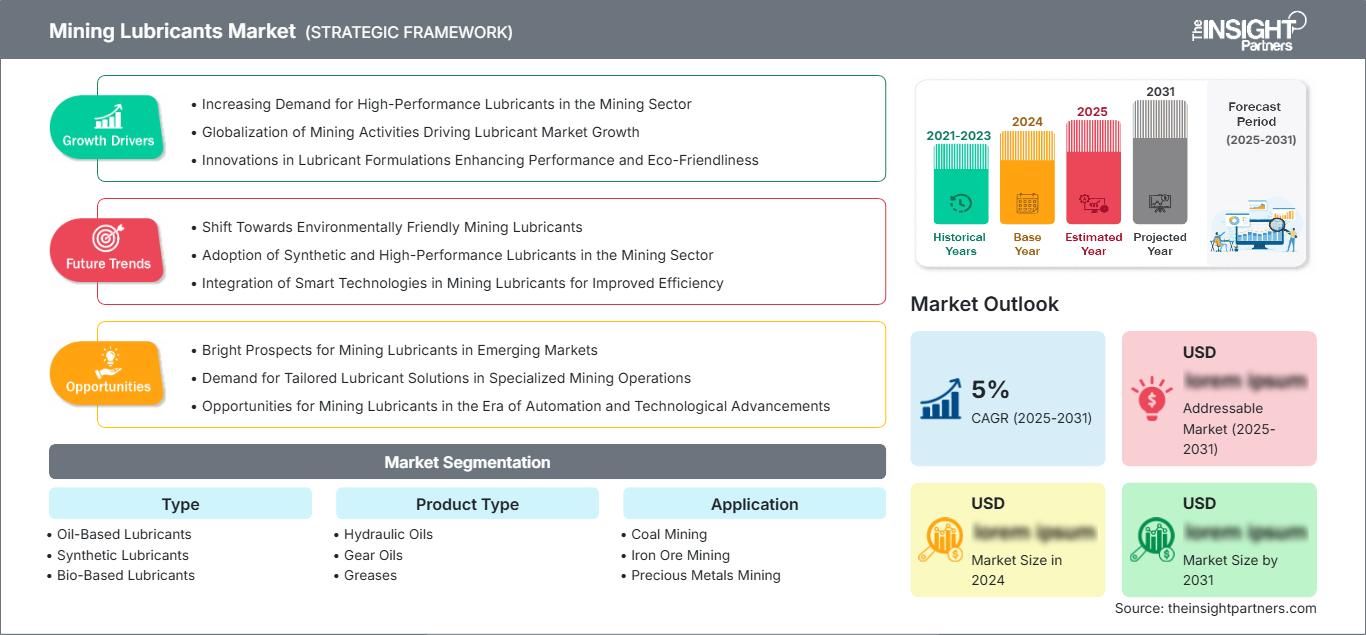
Mining Lubricants Market: Strategic Insights
Regional Insights
North America Mining Lubricants Market
North America in mining lubricants market share stood at 31-34% in 2025 and it is anticipated to witness a CAGR of 7.8-8.4% during 2026-2034. The region is gaining from a large number of extractions of copper, gold, iron ore, potash, and critical minerals along with modernization of mining fleet and automation in the large mines. Mining companies have been purchasing advanced lubricants that increase equipment productivity, lower downtime, and prolong maintenance of excavators, haul trucks, crushers, and drilling machines.
United States and Canada continue dominating the market in terms of contribution while Mexico is growing in production of silver and copper. Growth in autonomous haulage systems and predictive maintenance solutions is driving the use of synthetic hydraulic oils, gear oils, and greases. Growing environmental concerns and sustainability drive are also contributing in increasing demand for lubricants with better biodegradability, longer durability, and energy efficiency among others.
U.S. Mining Lubricants Market
The US was projected to hold 70–74% of North America’s market share in 2025 and is expected to witness growth at a CAGR of 7.7–8.3% during 2026-2034. Various government programs for producing lithium, copper, rare earth elements, and battery metals locally are leading to investments in mining ventures. This country has a good number of lubricant manufacturers, equipment OEMs, and mining services companies which are fueling innovation in lubricants required for harsh conditions.
Use of automated mining equipment and fleet management software for mining operations is increasing the demand for high-quality synthetic lubricants with higher drain intervals and oxidation resistance. The adoption of oil condition monitoring and predictive maintenance systems by leading mining operations is adding to the demand for advanced lubricants in the country. All these factors are further making this country a leading market for mining lubricants in North America.
Europe Mining Lubricants Market
In 2025, Europe was estimated to account for 23-26% of the global market share and will likely grow at a CAGR of 7.4-8.0% during 2026-2034. Environmental concerns, stringent industrial regulations, and investment in critical minerals remain important drivers of demand in the region. Mining in Europe led by countries such as Sweden and Finland due to production of iron ore and critical minerals, and Germany through lubricant manufacturing, mining equipment technology, and innovations.
The UK has been making investments in critical mineral exploration and mine rehabilitation projects, which presents lucrative business prospects for premium lubricant providers. Lubricant providers in Germany benefit from its established industrial manufacturing sector as well as internationally acclaimed lubricant providers that serve mining equipment applications. Countries of France, Italy, and Spain contribute to the demand in the region due to industrial mineral extraction, equipment manufacturing, and sustainable practices that encourage adoption of eco-friendly lubricants.
APAC Mining Lubricants Market
Asia Pacific accounted for 34–37% of the global market in 2025 and is expected to record the fastest expansion with a CAGR of 8.9–9.5% during 2026–2034. China remains the leading regional market, followed by Australia, India, and Indonesia, supported by large-scale production of coal, iron ore, bauxite, lithium, and other strategic minerals.
While Japan and South Korea offer their contributions via high-end lubrication technology and mining machinery manufacture, Australia will keep pushing its investments in autonomous mining operations and critical minerals extraction. Government backing for local mineral production coupled with increased equipment usage is set to keep lubricant demand up in the region.
Middle East & Africa Mining Lubricants Market
The Middle East & Africa market is projected to expand at a CAGR of 8.0–8.6% during 2026–2034. Saudi Arabia and the United Arab Emirates are increasing investments in mineral exploration and industrial diversification, while South Africa remains the region's largest mining economy with substantial production of platinum group metals, gold, manganese, and coal.
The construction of mining facilities in Africa along with the rising interest in exploring battery minerals in some African countries is likely to drive the demand for lubricants. Lubricant suppliers are enhancing their regional distribution and technical service offerings to meet the demanding operating conditions of mining operations.
Segmentation Analysis
Type
The Type segment is expected to register a CAGR of 8.3–8.8% during 2026–2034. The mining lubricants market scope continues to expand with increasing demand for application-specific formulations that improve equipment efficiency, reduce wear, and extend maintenance intervals under severe mining conditions. Growing automation, higher operating temperatures, and stringent sustainability requirements are accelerating the transition toward advanced synthetic and bio-based lubricant technologies, while oil-based products continue to dominate owing to their broad compatibility and cost-effectiveness.
- Oil-Based Lubricants: The largest product category, widely adopted across haul trucks, excavators, drilling equipment, and crushers due to proven performance, cost efficiency, extensive OEM approvals, and established supply chains supporting both surface and underground mining operations.
- Synthetic Lubricants: Increasingly preferred for high-temperature and high-load mining applications because of superior oxidation stability, extended drain intervals, enhanced fuel efficiency, and compatibility with automated mining fleets operating under demanding environmental conditions.
- Bio-Based Lubricants: Adoption is gradually increasing as mining operators pursue sustainability goals and comply with environmental regulations. These lubricants are particularly suitable for environmentally sensitive mining sites where spill prevention and biodegradability are major operational priorities.
Product Type
The Product Type segment is anticipated to grow at a CAGR of 8.1–8.6% during 2026–2034. Product demand is closely aligned with equipment operating conditions, maintenance schedules, and component protection requirements. Mining companies increasingly utilize specialized lubricant formulations to maximize equipment availability, improve operational efficiency, and minimize unexpected maintenance costs across diverse mining environments.
- Hydraulic Oils: Essential for hydraulic excavators, loaders, drills, and mobile mining equipment, offering high-pressure stability, corrosion protection, and reliable performance under continuous heavy-duty operating conditions.
- Gear Oils: Used extensively in gearboxes, transmissions, and final drives, providing excellent load-carrying capacity, wear protection, and thermal stability for heavy mining machinery operating under severe mechanical stress.
- Greases: Critical for bearings, pins, bushings, conveyors, and rotating components exposed to dust, moisture, vibration, and shock loads, helping reduce wear and extend equipment service life.
- Others: Includes compressor oils, engine oils, transmission fluids, and specialty lubricants designed for auxiliary mining equipment requiring application-specific lubrication and enhanced operational reliability.
Application
The Application segment is projected to expand at a CAGR of 8.5–9.0% during 2026–2034. Lubricant demand varies according to mining methods, mineral characteristics, equipment utilization, and operational intensity. Rising global demand for critical minerals, steelmaking materials, and energy resources continues to increase lubricant consumption across both established and emerging mining operations.
- Coal Mining: Maintains significant lubricant demand due to continuous operation of conveyors, longwall mining systems, drilling equipment, and heavy mobile machinery requiring reliable lubrication under dusty operating environments.
- Iron Ore Mining: Represents one of the largest application areas, supported by high-capacity haul trucks, crushers, conveyors, and beneficiation equipment operating continuously across large open-pit mining operations.
- Precious Metals Mining: Requires premium lubricants capable of maintaining performance under extreme environmental conditions encountered in underground gold, silver, platinum, and other precious metal extraction activities.
- Industrial Metals Mining: Supported by growing production of copper, nickel, zinc, aluminum, and lithium required for renewable energy systems, electric vehicles, and modern infrastructure development.
- Others: Includes mining of phosphate, potash, rare earth elements, aggregates, and industrial minerals, each requiring specialized lubrication solutions matched to unique operational conditions.
Opportunity Snapshot
| Application | Revenue Contribution | Trend Tag | Adoption Stage |
|---|---|---|---|
| Coal Mining | High | Mine Automation | Mature |
| Iron Ore Mining | High | High Capacity | Mature |
| Precious Metals Mining | Medium | Deep Mining | Scaling |
| Industrial Metals Mining | High | Critical Minerals | Scaling |
| Others | Medium | Resource Expansion | Emerging |
Mining Lubricants Market Growth Drivers and Impact Analysis
Expansion of Critical Mineral Mining Projects
Global investments in lithium, copper, nickel, cobalt, and rare earth mining are increasing rapidly as governments and private companies strengthen supply chains for electric vehicles, renewable energy systems, and advanced electronics. New mines and capacity expansions require large fleets of excavators, haul trucks, drills, crushers, and conveyors that operate continuously under harsh conditions. These operating environments increase demand for premium lubricants capable of minimizing wear, extending equipment life, and reducing maintenance downtime. Growing exploration activities in Australia, Canada, Chile, Indonesia, and several African countries are further supporting lubricant consumption. As mining operations become larger and more automated, suppliers are introducing advanced lubricant formulations and condition-monitoring services that improve operational efficiency while lowering the total cost of equipment ownership.
Growing Adoption of Automated and High-Performance Mining Equipment
Mining companies are increasingly deploying autonomous haulage systems, intelligent drilling equipment, remote-controlled loaders, and digital fleet management platforms to improve productivity and worker safety. These technologically advanced machines require lubricants with superior oxidation stability, thermal resistance, and extended drain intervals to maintain performance during continuous operation. Equipment manufacturers are also recommending premium synthetic lubricants that enhance component durability while reducing energy losses and maintenance frequency. The integration of predictive maintenance technologies and oil condition monitoring is enabling operators to optimize lubricant replacement schedules and prevent unexpected equipment failures. These developments are encouraging mining companies to transition from conventional lubrication practices toward value-added lubrication management strategies that support higher operational reliability.
Stricter Sustainability and Equipment Efficiency Requirements
Mining operators are increasingly aligning maintenance practices with corporate sustainability objectives and environmental regulations. This transition is driving demand for lubricants that improve fuel efficiency, reduce greenhouse gas emissions, minimize waste oil generation, and offer longer operational life. Bio-based lubricants and advanced synthetic formulations are gaining greater acceptance in environmentally sensitive mining locations where spill prevention and ecological protection receive higher priority. At the same time, lubricant manufacturers continue investing in additive technologies that improve biodegradability without compromising equipment protection. As environmental performance becomes an important procurement criterion, suppliers capable of delivering sustainable lubrication solutions alongside technical service support are expected to strengthen their competitive position across both developed and emerging mining regions.
Mining Lubricants Market Future Trends
Digital Lubrication Management and Predictive Maintenance
The mining lubricants market trends increasingly reflect the adoption of digital maintenance platforms that combine sensor-based oil monitoring, predictive analytics, and cloud-based fleet management. Mining operators are utilizing real-time lubricant condition data to optimize maintenance schedules, reduce unnecessary oil changes, and improve equipment availability. Integration of artificial intelligence with lubrication management is expected to enhance asset reliability, lower maintenance expenditure, and support data-driven operational decisions across large mining fleets.
Expansion of High-Performance Synthetic and Bio-Based Lubricants
Demand for advanced lubricant technologies is expected to accelerate as mining companies seek longer drain intervals, improved thermal stability, and lower environmental impact. Synthetic lubricants will continue gaining market share in high-load applications, while bio-based alternatives are expected to achieve stronger adoption in environmentally regulated mining operations. Continuous research into additive chemistry and renewable base oils will further improve product performance and sustainability.
Mining Lubricants Market Opportunities
Growth Opportunities in Battery Mineral Mining
Rapid expansion of lithium, nickel, cobalt, graphite, and copper mining presents significant opportunities for lubricant manufacturers. New extraction and processing facilities require reliable lubrication solutions for heavy equipment operating under demanding conditions. Mining lubricants market Forecasts indicate that suppliers investing in application-specific synthetic lubricants, digital monitoring services, and localized technical support will be well positioned to secure long-term supply agreements with expanding battery mineral producers across Asia Pacific, Latin America, Africa, and North America.
Development of Environmentally Sustainable Lubrication Solutions
Increasing environmental regulations are creating opportunities for manufacturers to commercialize biodegradable, low-toxicity, and extended-life lubricant formulations. Companies capable of combining sustainable chemistry with superior equipment protection can differentiate themselves in both mature and emerging mining markets. Investments in renewable base oils, advanced additive technologies, and lifecycle service offerings are expected to strengthen long-term competitiveness while helping mining operators achieve sustainability targets without compromising operational efficiency.
Recent Developments
- January 2025: Graphene Manufacturing Group Ltd announced that Blackwoods will distribute GMG Products in Australia. Blackwoods will distribute GMG's liquid graphene products: G LUBRICANT and THERMAL-XR. Blackwoods is Australia's leading supplier of industrial and safety solutions, supporting businesses of all sizes across mining, manufacturing, construction, transport, government, utilities and other critical industries.
- June 2026: Valvoline Global Operations, The Original Motor Oil1, worldwide leader in automotive and industrial solutions, announced the start of commercial business operations for the newly formed Valvoline Arabia Lubricants Company (ValCo). The launch of ValCo brings together Valvoline Global's portfolio of lubricant technologies, products and technical expertise with localized commercial and functional capabilities to support customers in Saudi Arabia and across the region.
Frequently Asked Questions

- Comprehensive Market Sizing and Forecast Analysis
- Detailed Segmentation Analysis
- In-Depth Market Dynamics Assessment
- Regional and Country-Level Insights
- Competitive Landscape and Company Benchmarking
- Strategic Business Intelligence
Recent Reports
Testimonials

The Insight Partners' SCADA System Market report is comprehensive, with valuable insights on current trends and future forecasts. The team was highly professional, responsive, and supportive throughout. We are very satisfied and highly recommend their services.
RAN KEDEM Partner, Reali Technologies LTDs
I requested a report on a very specific software market and the team produced the report in a few days. The information was very relevant and well presented. I then requested some changes and additions to the report. The team was again very responsive and I got the final report in less than a week.
JEAN-HERVE JENN Chairman, Future Analytica
We worked with The Insight Partners for an important market study and forecast. They gave us clear insights into opportunities and risks, which helped shape our plans. Their research was easy to use and based on solid data. It helped us make smart, confident decisions. We highly recommend them.
PIYUSH NAGPAL Sr. Vice President, High Beam Global
The Insight Partners delivered insightful, well-structured market research with strong domain expertise. Their team was professional and responsive throughout. The user-friendly website made accessing industry reports seamless. We highly recommend them for reliable, high-quality research services
YUKIHIKO ADACHI CEO, Deep Blue, LLC.
This is the first time I have purchased a market report from The Insight Partners.While I was unsure at first, I visited their web site and felt more comfortable to take the risk and purchase a market report.I am completely satisfied with the quality of the report and customer service. I had several questions and comments with the initial report, but after a couple of dialogs over email with their analyst I believe I have a report that I can use as input to our strategic planning process.Thank you so much for taking the extra time and making this a positive experience.I will definitely recommend your service to others and you will be my first call when we need further market data.
JOHN SUZUKI President and Chief Executive Officer, Board Director, BK Technologies
I wish to appreciate your support and the professionalism you displayed in the course of attending to my request for information regarding to infectious disease IVD market in Nigeria. I appreciate your patience, your guidance, and the fact that you were willing to offer a discount, which eventually made it possible for us to close a deal. I look forward to engaging The Insight Partners in the future, all thanks to the impression you have created in me as a result of this first encounter.
DR CHIJIOKE ONYIA MANAGING DIRECTOR, PineCrest Healthcare Ltd.Reason to Buy
- Informed Decision-Making
- Understanding Market Dynamics
- Competitive Analysis
- Identifying Emerging Markets
- Customer Insights
- Market Forecasts
- Risk Mitigation
- Boosting Operational Efficiency
- Strategic Planning
- Investment Justification
- Tracking Industry Innovations
- Aligning with Regulatory Trends





 Get Free Sample for