
Specialty Enzymes Market Share, Demand & Growth by 2034
Coverage: By Type (Carbohydrase, Proteases, Lipases, Polymerases and Nucleases, Others); Source (Microorganisms, Plant, Animal); Application (Food and Beverages, Research and Biotechnology, Pharmaceuticals & Nutraceuticals , Others) , and Geography (North America, Europe, Asia Pacific, and South and Central America)
- Status : Data Released
- Report Code : TIPRE00020380
- Category : Food and Beverages
- No. of Pages : 150
- Available Report Formats :


- Last update date : November 13, 2026


2025 Market Size
US$ 6.35 Bn
Base year value
2034 Forecast
US$ 11.78 Bn
Projected by 2034
CAGR 2026-2034
7.10 %
Growth rate
Addressable Market
US$ 81.80 Bn
(2026-2034)
The Specialty Enzymes Market was valued at US$ 6.35 billion in 2025 and is projected to reach US$ 11.78 billion by 2034, expanding at a CAGR of 7.10% during 2026–2034. Growth is supported by increasing demand for biocatalysis, rising pharmaceutical and biotechnology research activity, wider adoption of enzyme-based food processing, and industrial efforts to improve resource efficiency. Advances in protein engineering, microbial fermentation, and enzyme stabilization are also broadening the range of commercial processes in which specialty enzymes can deliver technical and economic benefits.
The North American market is supported by established biotechnology capabilities, pharmaceutical manufacturing infrastructure, and sustained demand for high-performance ingredients across food processing and industrial applications. A defensible planning estimate places regional growth at approximately 6% CAGR through 2034, reflecting an established industrial base and continued investment in specialized biocatalysts. Demand is reinforced by pharmaceutical process development, research laboratory requirements, and manufacturers seeking greater selectivity and lower operating burdens. Commercial adoption will depend on application-specific performance, regulatory suitability, production consistency, and the ability of enzyme suppliers to demonstrate measurable benefits within existing manufacturing workflows.
Specialty Enzymes Market Assessment and Insights
Regional Outlook
- North America: ~35% of the global Specialty Enzymes Market share in 2025 | ~6% CAGR through 2034. Market position: North America is estimated to hold the largest regional share, supported by pharmaceutical research, biotechnology commercialization, advanced food processing, and established enzyme suppliers. High-value applications support demand, although market maturity moderates the projected growth rate.
- US: ~85% of North American market revenue in 2025 | ~6% CAGR through 2034. Market position: The United States is the dominant national market within North America because of its pharmaceutical innovation ecosystem, biotechnology investment, and established research infrastructure. Demand spans biocatalysis, molecular biology, food ingredients, and specialized manufacturing processes.
- Europe: ~27% of the global market in 2025 | ~6% CAGR through 2034. Market position: Europe remains a mature market with established enzyme production, industrial biotechnology, and food-processing capabilities. Germany is estimated to be the leading country in Europe, supported by its industrial base, chemical expertise, and concentration of biotechnology-related activities.
- Asia Pacific: ~30% of the global market in 2025 | ~9% CAGR through 2034. Market position: Asia Pacific is expected to be the fastest-growing region, driven by expanding pharmaceutical production, biotechnology research, food manufacturing, and localized industrial capacity. China and Japan are important markets, while India and South Korea provide additional opportunities through manufacturing expansion and research investment.
Segment Outlook
- Food and Beverages: ~38% share in 2025 | ~7% CAGR through 2034. Market position: Food and beverages is estimated to be the largest application segment, reflecting recurring demand for processing aids, ingredient modification, product consistency, and yield improvement across established manufacturing operations.
- Research and Biotechnology: ~24% share in 2025 | ~10% CAGR through 2034. Market position: Research and biotechnology is modeled as a high-growth application segment because of demand for molecular biology reagents, specialized biocatalysts, and enzymes used in developing and optimizing advanced biological processes.
Competitive Coverage
BASF, Advanced Enzymes, Amano Enzymes, Biocatalysts, Codexis, DuPont, Dyadic International, Novozymes, Roche Holding, International Flavors & Fragrances (IFF).
Methodology
The Insight Partners follows Data Collection & Secondary Research, Primary Research, Data Analysis, and Data Triangulation & Final Review to validate market estimates and insights.
Source: The Insight Partners' analysis based on proprietary research, government publications, company annual reports, investor presentations, industry databases, and expert interviews.
Specialty Enzyme market has transitioned from traditional biological process to catalyst design for specific applications in order to achieve higher levels of product performance. Advances in the areas of microbial strain design, fermentation process control, separation techniques and protein engineering have made the use of enzymes in reactions more feasible commercially. Enzyme manufacturers are increasingly looking at performance in real operational conditions, rather than just laboratory performance, as factors such as pH resistance, thermostability, substrate selectivity and chemical compatibility influence suitability for industrial applications. The move has driven the specialty enzyme companies to integrate enzyme development with formulation, technical service and application testing.
The future holds the promise of geographic growth and process localization impacting competitiveness. Asian Pacific manufacturers have made plans for investing in drug manufacture, biotech systems, and food processing, making way for suppliers offering reliable regional services. There could be the use of biological manufacturing in developed nations as a result of industrial decarbonization, efficiency of resources, and interest in biological manufacturing. Regulations for food ingredients, drug manufacture, and biotechnology will play a crucial role in determining the commercialization period. The best prospects will lie in validated process economics, quality manufacture, and commercial scalability.
Specialty Enzymes Market Report Scope
| Report Attribute | Details |
|---|---|
| Market size in 2025 | US$ 6.35 Billion |
| Market Size by 2034 | US$ 11.78 Billion |
| Global CAGR (2026 - 2034) | 7.10% |
| Historical Data | 2021-2024 |
| Forecast period | 2026-2034 |
Specialty Enzymes Market Analysis
Growth in the Specialty Enzymes Market is driven by the demand for selective reactions, high-quality outputs and efficient material conversions. In the food industry, enzymes are used to optimize processing and improve product uniformity, and pharmaceutical companies use custom biocatalysts for sophisticated synthesis procedures. Biotech companies require enzymes with known activity and reproducibility, and technical performance and batch-to-batch consistency are key purchase drivers. The needs of customers vary depending on their applications; for some, large volume and competitiveness in price matter most, while others prefer purity, specificity, documentation and custom performance.
The supply chain begins with enzyme discovery or selection, followed by strain or protein development, fermentation or biological production, recovery, purification, formulation, quality tests and distribution. Different parties such as research organizations, contract manufacturers, formulators, pharmaceuticals and food producers influence the specifications throughout the process. Supply economics are dictated by yield of fermentation, availability of feedstock, efficiency of recovery, facility utilization and quality testing requirements. Companies that integrate reliable production with application development may reduce qualification efforts and chances for repeat business.
The Competition in the Specialty Enzymes Industry involves diversified chemical and biotech companies, traditional enzyme producers, as well as companies dedicated to engineered catalysts. The strengths of BASF and DuPont include industry formulation experience and customers base, while those of Advanced Enzymes, Amano Enzymes, and Biocatalysts are their specialization in enzymes and their applications. Novozymes, which is now linked to the Novonesis brand as a result of the merger of Novozymes and Chr. Hansen, possesses a wide biosolution base. Codexis distinguishes itself with its enzyme engineering and biocatalytic production, while the strength of Dyadic International includes its platform for microbial expression.
Increasingly, investment decisions are being made based on expected uses in commerce of the enzyme, and not just based on discovery potential. This means that suppliers are now evaluating the qualification times for customers, manufacturing capacity, differentiation, intellectual property, and cost-effectiveness of process replacement. Partnerships may help to share costs of development and provide existing manufacturing or distribution channels. On the part of the buyers, supplier selection involves the same considerations of reliable supply, technical information, and reproducibility between batches. Companies which link their engineering and application work with scalable manufacturing are well placed.
● REPORT CUSTOMIZATION
Tailor This Report To Align With Your Specific Business Requirements
This report can be customized to align precisely with your business objectives, scope, and target markets. Customization options include tailored segmentation, geography, competitive analysis, and strategic insights to support informed decision-making.
Customize This Report →WHAT YOU CAN ADJUST
- ● Segmentations
- ● Geography
- ● Competitive Analysis
- ● Language Preferences
Specialty Enzymes Market: Strategic Insights
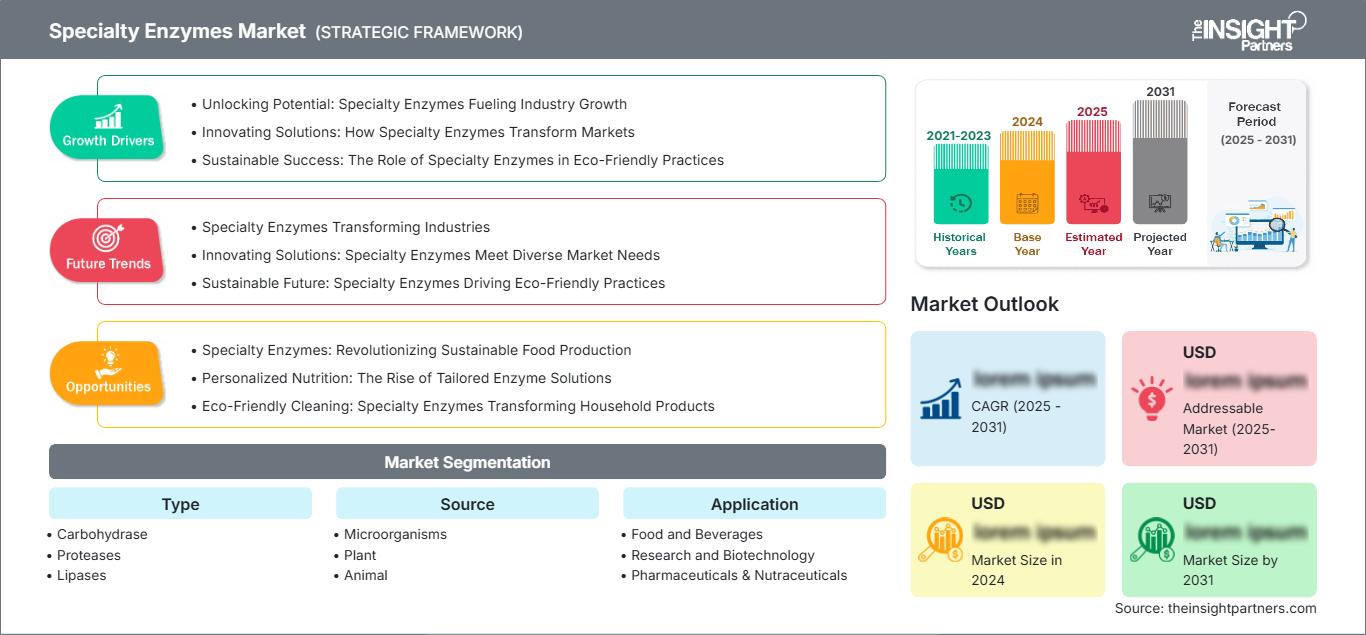
Regional Insights
North America Specialty Enzymes Market
North America is estimated to account for ~35% of global Specialty Enzymes Market revenue in 2025, with a modeled CAGR of ~6% through 2034. The region has a strong foundation in pharmaceuticals research, biotechnology commercialization, advanced food manufacturing technology, and customers who can judge specialized enzyme technologies. The demand is driven by applications that need high reproducibility and documentation, especially where enzymes are used in validated processes. There are also well-established sales networks and customers with research and development budgets in place.
The United States is the biggest national demand base in the region, whereas Canada provides demand through biotechnology research, food processing, and industrial applications. Buyers in the region tend to assess enzyme technologies through trials, cost of use, and testing of compatibility before using them commercially. This results in demand for technical services and special formulation services. Future growth will be tied to pharmaceuticals innovation, research activities, and selected industrial applications of biocatalysis. The forecasted rate is due to a mature customer base, where there will be demand in new applications, performance enhancement, and substitution of less efficient processes.
U.S. Specialty Enzymes Market
The United States is modeled to represent ~85% of North American Specialty Enzymes Market revenue in 2025 and is expected to expand at a CAGR of ~6% through 2034. The enzyme’s placement is defined by the magnitude of research conducted in the areas of pharmaceuticals and biotechnology, existing laboratory supply lines, and manufacturing. The market spans the areas of molecular biology and diagnostics all the way through the pharmaceutical synthesis and processing of foods. Customers tend to demand reliable enzyme activity, availability, technical documentation, and technical assistance to mitigate the risk of implementation.
Competitors include Codexis, Roche Holding, and diversified companies serving the biotechnology, pharmaceutical, and industrial markets. Demand comes from laboratories conducting research and biotechnology companies developing drugs requiring the enzymes as part of nucleic acid manipulations, analysis, and experimental processes. Manufacturing facilities have an interest in consistent performance and economic manufacturability in case a biological catalyst needs to reliably work over larger amounts of production. Advancements in biotechnology will allow the expansion of the enzyme applications, but commercial adoption requires testing by the customer and manufacturability.
Europe Specialty Enzymes Market
Europe is estimated to account for ~27% of global Specialty Enzymes Market revenue in 2025 and is projected to grow at a CAGR of ~6% through 2034. Germany is modeled as the leading country in Europe because of its established chemical and industrial biotechnology base, extensive food-processing activities, and concentration of specialist manufacturing capabilities. European demand also benefits from the presence of enzyme developers and suppliers serving household care, pharmaceutical, food, and industrial applications. Market maturity supports recurring demand, while new process applications provide incremental opportunities.
The industrial environment in Germany favors the use of enzymes in processes within chemicals manufacture, ingredient production, and manufacturing processes that need specific catalyzing agents. The United Kingdom plays a role in biotech research, life science development, and pharmaceutical process engineering. France has demand for enzymes within food production, industrial biotechnology, and pharmaceutical manufacturing. On the other hand, the food processing industry in Italy provides the market for enzymes in order to enhance consistency and processing efficiencies. The Spanish industry is composed of food manufacturing, agricultural processing and other industrial applications.
The European customers usually evaluate the performance of enzymes in conjunction with product safety, documentation and manufacturing capability, and environmental aspects of the entire process. Qualification and regulatory compliance may delay the process of commercialization especially if there are tight control processes involved. The suppliers should be able to demonstrate reliable performance in industrial applications and assist customers to understand the process efficiencies. Growth will be driven by formulation needs, the development of new routes in biocatalysis and optimization of existing manufacturing processes.
APAC Specialty Enzymes Market
Asia Pacific is modeled to represent ~30% of the global Specialty Enzymes Market in 2025 and is projected to register a CAGR of ~9% through 2034, making it the fastest-growing region in this outlook. China is identified as the leading country in Asia Pacific by market scale, supported by its extensive manufacturing base, biotechnology development, and food-processing industry. Expanding pharmaceutical production and increasing technical capabilities also create opportunities for suppliers that can deliver application-specific products with dependable quality.
Japan has an established specialty chemicals and life-sciences ecosystem, while South Korea contributes through biotechnology, pharmaceutical development, and advanced manufacturing. India's pharmaceutical industry, research capabilities, and food-processing expansion provide additional demand potential. Australia offers opportunities through research, biotechnology, food production, and selected industrial applications. Across the region, localization of manufacturing and greater access to technical expertise may support wider adoption. Public investment in biotechnology, industrial modernization, and research infrastructure can reinforce demand, although pricing sensitivity, regulatory differences, and uneven technical capacity will influence the pace of commercialization in individual countries.
Middle East & Africa Specialty Enzymes Market
The Middle East and Africa Specialty Enzymes Market is expected to grow at a modeled CAGR of ~8% through 2034. Demand is developing from a smaller base than in North America and Europe, with opportunities linked to food manufacturing, pharmaceutical supply chains, industrial diversification, and improved access to biotechnology products. Saudi Arabia and the United Arab Emirates are relevant markets as investment in industrial infrastructure and economic diversification creates opportunities for specialized manufacturing inputs. South Africa contributes through food processing, life-science activity, and established industrial and laboratory demand.
Saudi Arabia is a plausible leading country in the Middle East & Africa region by commercial opportunity, given its industrial diversification agenda, food-security priorities, and investment in domestic production capabilities. The UAE offers a regional distribution and trade platform, while South Africa provides an established base for selected laboratory, pharmaceutical, and food applications. Across the broader region, energy costs, water availability, cold-chain requirements for some products, and the maturity of manufacturing infrastructure affect adoption. Enzyme suppliers can improve market access through local distributors, technical support, and formulations suited to customer operating conditions.
Segmentation Analysis
Type
Type is a key purchasing dimension because enzyme function determines substrate compatibility, process performance, and suitability for the customer's intended use. Demand depends on reaction selectivity, operating conditions, formulation stability, and the cost of achieving a required result. Adoption is supported by enzyme engineering and better characterization of process requirements, which allow suppliers to tailor products for specialized applications. Within this category, proteases are expected to expand at a modeled CAGR of ~7% during 2026–2034, supported by their broad relevance to protein processing and selected industrial and life-science workflows.
- Carbohydrase: Carbohydrases support the breakdown or modification of carbohydrate substrates and are relevant to food processing, ingredient preparation, and other applications involving starches or complex sugars. Their commercial value depends on substrate specificity and processing conditions.
- Proteases: Proteases catalyze protein breakdown and modification, supporting applications that require controlled changes in protein structure. Buyers assess activity, selectivity, formulation compatibility, and performance consistency when integrating these enzymes into production workflows.
- Lipases: Lipases act on fats and oils and are used where controlled lipid modification or hydrolysis is required. Their utility depends on substrate access, reaction conditions, and the desired balance between performance and processing cost.
- Polymerases and Nucleases: These enzymes are important in molecular biology, nucleic-acid analysis, and biotechnology workflows. Performance requirements commonly include high specificity, reliable activity, low contamination risk, and reproducible results across experiments or production batches.
- Others: This category captures specialty enzyme functions not represented by the other listed types. Its relevance depends on customer-specific processes and applications that require a defined catalytic activity unavailable from conventional enzyme offerings.
Source
Source influences production consistency, scalability, enzyme characteristics, and the economics of commercial supply. Manufacturers select production routes according to the required protein properties, regulatory considerations, yield, downstream recovery requirements, and the reliability of raw materials. Microbial production is expected to expand at a modeled CAGR of ~8% during 2026–2034, reflecting the potential for controlled fermentation, strain improvement, and scalable manufacturing. Source selection nevertheless remains application-dependent, since the production platform must meet the required quality specifications and deliver acceptable performance under intended operating conditions.
- Microorganisms: Microbial sources are important for scalable enzyme manufacturing because fermentation systems can support controlled production and strain optimization. Commercial suitability depends on productivity, recovery efficiency, batch consistency, and the characteristics of the resulting enzyme.
- Plant: Plant-derived enzymes serve applications where their functional properties align with processing requirements and customer specifications. Supply considerations include raw-material availability, seasonal variability, extraction efficiency, and the need to maintain consistent activity between production batches.
- Animal: Animal-derived enzymes remain relevant to selected applications requiring specific catalytic characteristics. Commercial adoption depends on source availability, processing controls, traceability, and compatibility with customer requirements concerning product origin and intended use.
Application
Application determines the technical specifications, purchasing criteria, and commercial qualification pathway for specialty enzymes. Customers differ in their tolerance for variability, the level of documentation required, and the time needed to validate a new product. Food and beverages is modeled as the largest application sub-segment, with an estimated ~7% CAGR during 2026–2034, reflecting recurring demand across established processing operations. Research and biotechnology is modeled to grow at ~10% during the same period, supported by expanding use of specialized enzymes in research and advanced biological workflows.
- Food and Beverages: Food manufacturers use enzymes to support processing efficiency, product consistency, ingredient modification, and selected quality improvements. Adoption depends on functional performance, regulatory suitability, compatibility with formulations, and the economics of incorporating enzymes into existing production lines.
- Research and Biotechnology: This sub-segment includes enzymes used in molecular biology, experimental workflows, and biotechnology development. Purchasing decisions emphasize reproducibility, defined specifications, dependable availability, and suitability for specialized research protocols or emerging biological processes.
- Pharmaceuticals & Nutraceuticals: Pharmaceutical and nutraceutical applications require enzymes suited to controlled manufacturing, ingredient development, and selected biological processes. Quality documentation, traceability, process validation, and reliable performance are particularly important where product specifications and production controls are demanding.
- Others: This category includes applications outside the specifically listed areas, including selected industrial processes and other specialized uses. Demand depends on the performance advantage an enzyme can demonstrate within a particular workflow and on the availability of a viable commercial supply route.
Opportunity Snapshot
| Application | Revenue Contribution | Trend Tag | Adoption Stage |
| Food and Beverages | High | Processing Efficiency | Mature |
| Research and Biotechnology | Medium | Molecular Biology | Scaling |
| Pharmaceuticals & Nutraceuticals | Medium | Biocatalytic Synthesis | Scaling |
| Others | Low | Process Optimization | Emerging |
Specialty Enzymes Market Growth Drivers and Impact Analysis
Increasing Demand for Efficient and Selective Manufacturing Processes
Manufacturers are evaluating specialty enzymes as alternatives to conventional processing methods when catalytic selectivity can improve product quality or simplify reaction steps. Enzymes operate under conditions suited to particular biological reactions and can reduce unwanted by-products when the catalyst is correctly matched to the substrate. The commercial impact depends on the full process rather than enzyme price alone. Buyers consider raw-material conversion, reaction time, downstream purification, energy requirements, and product yield when calculating total cost. Suppliers must therefore demonstrate performance using representative process conditions and provide guidance on dosing, stability, and operating parameters. Where the resulting process is more efficient, an enzyme may justify a higher purchase price through lower overall production costs. Adoption remains selective because some applications require extensive validation or cannot achieve the necessary performance using available enzyme formulations.
Expansion of Pharmaceutical and Biotechnology Research
Pharmaceutical development and biotechnology research require enzymes that can perform precise reactions under tightly controlled conditions. Enzymes used in molecular biology, analytical workflows, and biocatalytic synthesis must meet specifications for activity, purity, stability, and batch consistency. As biological research moves from exploratory work toward process development, suppliers can serve multiple stages of the customer lifecycle, from laboratory evaluation to commercial manufacturing. However, progression between stages is not automatic. A product that performs well at laboratory scale may require further engineering, formulation changes, or process validation before it can be used in production. Suppliers with technical support and reproducible manufacturing capabilities can reduce the effort customers expend on qualification. This driver is especially relevant to specialist developers that combine enzyme engineering with process-development services and application-specific product design.
Rising Requirements for Consistent Food Processing and Ingredient Quality
Food manufacturers operate under requirements for consistent texture, composition, processing performance, and finished-product quality. Specialty enzymes can help control particular transformations within a production process, making their selection relevant to both operational efficiency and product specifications. Adoption depends on the food matrix, processing conditions, applicable food regulations, and the ability to maintain performance across different production batches. Manufacturers also assess formulation compatibility and the practical consequences of introducing an enzyme into existing equipment and workflows. Suppliers that offer technical trials and clear usage guidance can help food processors evaluate potential benefits without disrupting established operations. This driver supports demand for application-specific products, although commercial success remains contingent on demonstrated performance, customer acceptance, and a cost structure that fits the economics of the finished product.
Specialty Enzymes Market Future Trends
AI-Assisted Enzyme Engineering
The Specialty Enzymes Market trends toward increasingly data-driven enzyme discovery, with computational modeling, machine learning, and high-throughput screening helping developers evaluate candidate proteins more efficiently. These tools can help identify promising sequence changes, predict selected structural properties, and prioritize laboratory experiments. They do not eliminate the need for experimental validation, because actual catalytic performance depends on substrate interactions, operating conditions, protein stability, and formulation. Over time, closer integration of computational design and experimental data could shorten selected development cycles and support enzymes tailored to narrower industrial requirements. Suppliers may differentiate through proprietary datasets, screening capabilities, and repeatable workflows that translate candidate designs into manufacturable products. Commercial value will depend on whether these approaches improve practical performance, lower development costs, or expand the range of processes suitable for enzymatic conversion.
Greater Emphasis on Formulation Stability and Application-Ready Products
Future product development is likely to place greater emphasis on enzymes that retain activity during storage, transport, and use in demanding process environments. Formulation choices can affect compatibility with other ingredients, resistance to temperature or pH variation, dosing accuracy, and shelf-life management. For customers, these characteristics influence inventory planning, operational reliability, and the risk of inconsistent process outcomes. Suppliers may increasingly combine enzyme selection with stabilizing ingredients, delivery formats, and application protocols suited to customer equipment. In pharmaceutical and biotechnology settings, documentation and reproducibility will remain central, while industrial customers may prioritize robust performance under variable operating conditions. This trend favors manufacturers that can demonstrate stability under realistic conditions and maintain consistent quality across batches. Product differentiation is therefore likely to extend beyond catalytic activity to include handling, storage, and process integration.
Specialty Enzymes Market Opportunities
Localized Production and Technical Support in Asia Pacific
Specialty Enzymes Market Forecasts point to commercial opportunities in markets where pharmaceutical manufacturing, food processing, and biotechnology capabilities are expanding. Suppliers can evaluate localized production, regional application laboratories, and technical partnerships to improve responsiveness to customers in Asia Pacific. Local presence may help shorten delivery routes, strengthen customer support, and adapt product specifications to regional manufacturing conditions. Investment decisions should nevertheless account for fermentation infrastructure, downstream purification capabilities, quality assurance, workforce expertise, and the availability of reliable feedstocks. A distribution agreement may offer a lower-risk entry route than a new manufacturing facility where demand remains uncertain. Partnerships with established manufacturers can also provide market access and practical application knowledge. The strongest investment cases will combine credible customer demand with a clear pathway to regulatory compliance, consistent production, and commercially sustainable utilization.
Custom Enzyme Development for High-Value Industrial and Therapeutic Processes
A second opportunity lies in customized enzymes designed for manufacturing steps where existing catalysts cannot meet required levels of selectivity, stability, or productivity. Pharmaceutical process developers and specialized industrial manufacturers may be willing to collaborate with suppliers when an improved catalyst can solve a clearly defined technical problem. Commercial models can include research agreements, development milestones, licensing, supply contracts, and ongoing technical services. Before committing capital, suppliers should evaluate the addressable customer process, the likelihood of successful scale-up, intellectual-property constraints, and the customer's willingness to qualify a replacement technology. Development pipelines should distinguish early-stage scientific potential from projects with a credible commercial route. Suppliers that link enzyme engineering to scale-up expertise and customer validation may build defensible positions in applications where process performance is more important than commodity pricing.
Recent Developments
- September 2, 2026: Novonesis announced a €600 million investment to expand its Patalganga site in India and build an advanced enzyme production facility. Expected to be fully operational in 2030, the facility is intended to increase production capacity and strengthen supply-network flexibility across applications including biofuels, household care, and food and beverages. The investment also incorporates measures to reduce water and energy consumption.
- September 28, 2026: Codexis, Inc. announced an agreement with a specialist small interfering RNA drug developer to use its ECO Synthesis manufacturing platform to create stereochemically defined siRNA. The agreement illustrates the company's focus on enzymatic RNA manufacturing and the application of engineered enzymes to complex therapeutic production. Commercial adoption will depend on demonstrating technical performance, manufacturing scalability, and suitability for customer development programs.
Frequently Asked Questions

- Comprehensive Market Sizing and Forecast Analysis
- Detailed Segmentation Analysis
- In-Depth Market Dynamics Assessment
- Regional and Country-Level Insights
- Competitive Landscape and Company Benchmarking
- Strategic Business Intelligence
Recent Reports
Testimonials

The Insight Partners provided valuable market intelligence that supported our global go-to-market strategy. Their team was professional, responsive, and attentive to our feedback, providing thoughtful analysis and helpful methodological clarifications throughout the project.
Junmo Kim Chief Financial Officer (CFO), Enertech Co., Ltd.
The Insight Partners' SCADA System Market report is comprehensive, with valuable insights on current trends and future forecasts. The team was highly professional, responsive, and supportive throughout. We are very satisfied and highly recommend their services.
RAN KEDEM Partner, Reali Technologies LTDs
I requested a report on a very specific software market and the team produced the report in a few days. The information was very relevant and well presented. I then requested some changes and additions to the report. The team was again very responsive and I got the final report in less than a week.
JEAN-HERVE JENN Chairman, Future Analytica
We worked with The Insight Partners for an important market study and forecast. They gave us clear insights into opportunities and risks, which helped shape our plans. Their research was easy to use and based on solid data. It helped us make smart, confident decisions. We highly recommend them.
PIYUSH NAGPAL Sr. Vice President, High Beam Global
The Insight Partners delivered insightful, well-structured market research with strong domain expertise. Their team was professional and responsive throughout. The user-friendly website made accessing industry reports seamless. We highly recommend them for reliable, high-quality research services
YUKIHIKO ADACHI CEO, Deep Blue, LLC.
This is the first time I have purchased a market report from The Insight Partners.While I was unsure at first, I visited their web site and felt more comfortable to take the risk and purchase a market report.I am completely satisfied with the quality of the report and customer service. I had several questions and comments with the initial report, but after a couple of dialogs over email with their analyst I believe I have a report that I can use as input to our strategic planning process.Thank you so much for taking the extra time and making this a positive experience.I will definitely recommend your service to others and you will be my first call when we need further market data.
JOHN SUZUKI President and Chief Executive Officer, Board Director, BK Technologies
I wish to appreciate your support and the professionalism you displayed in the course of attending to my request for information regarding to infectious disease IVD market in Nigeria. I appreciate your patience, your guidance, and the fact that you were willing to offer a discount, which eventually made it possible for us to close a deal. I look forward to engaging The Insight Partners in the future, all thanks to the impression you have created in me as a result of this first encounter.
DR CHIJIOKE ONYIA MANAGING DIRECTOR, PineCrest Healthcare Ltd.Reason to Buy
- Informed Decision-Making
- Understanding Market Dynamics
- Competitive Analysis
- Identifying Emerging Markets
- Customer Insights
- Market Forecasts
- Risk Mitigation
- Boosting Operational Efficiency
- Strategic Planning
- Investment Justification
- Tracking Industry Innovations
- Aligning with Regulatory Trends





 Get Free Sample for