
Food Additives Market Size & Demand Insights 2034
Coverage: By Product Type (Preservatives, Sweeteners, Flavor and Flavor Enhancers, Food Colors, Emulsifiers, Thickeners and Stabilizers, Enzymes, Acidulants, and Others), Source (Natural and Synthetic), Application (Bakery and Confectionery, Dairy and Frozen Desserts, Meat Poultry and Seafood, Breakfast Cereals, Beverages, Functional Food and Beverages, and Others), and Geography (North America, Europe, Asia Pacific, the Middle East and Africa, and South and Central America)
- Status : Published
- Report Code : TIPRE00022471
- Category : Food and Beverages
- No. of Pages : 556
- Available Report Formats :


- Last update date : October 06, 2026


2025 Market Size
US$ 127.84 Bn
Base year value
2034 Forecast
US$ 195.78 Bn
Projected by 2034
CAGR 2026-2034
4.8 %
Growth rate
Addressable Market
US$ 1,465.19 Bn
(2026-2034)
The Food Additives Market was valued at US$ 127.84 billion in 2025 and is projected to reach US$ 195.78 billion by 2034, expanding at a CAGR of 4.8% from 2026 to 2034. The market covers ingredients used to preserve, sweeten, color, stabilize, emulsify, thicken, acidify, and enhance the sensory characteristics of food and beverages. Demand is shaped by processed-food production, reformulation, food safety requirements, convenience consumption, and the development of functional and clean-label products.
North America is supported by a mature packaged-food ecosystem, extensive ingredient manufacturing capabilities, and continued reformulation across beverages, bakery, dairy, and functional food categories. The regional Food Additives Market Size is expected to record a ~4% CAGR through 2034, supported by demand for sugar reduction, shelf-life extension, texture management, and differentiated flavor systems. Regulatory scrutiny is also encouraging suppliers to improve documentation, traceability, and formulation efficiency while maintaining product performance.
Food Additives Market Assessment and Insights
Regional Outlook
- North America: ~27% of the global market in 2025 | ~4% CAGR through 2034. Market position: North America represents a large, mature market supported by sophisticated food processing, extensive convenience-food consumption, established ingredient suppliers, and continuous reformulation toward lower sugar, longer shelf life, improved texture, and functional nutritional profiles
- US: ~89% of North American market revenue in 2025 | ~4% CAGR through 2034. Market position: The US accounts for most North American demand, supported by its broad processed-food manufacturing base, innovation in reduced-sugar and functional formulations, and strong utilization of preservatives, sweeteners, flavors, emulsifiers, and texturizers across packaged foods and beverages
- Europe: ~24% of the global market in 2025 | ~3% CAGR through 2034. Market position: Europe is a mature market with extensive regulatory oversight and established demand for clean-label, natural, and reformulated ingredients. Germany, the UK, France, Italy, and Spain provide substantial demand, with Germany representing the leading country in Europe
- Asia Pacific: ~36% of the global market in 2025 | ~6% CAGR through 2034. Market position: Asia Pacific is the fastest-growing region, supported by expanding processed-food production, urbanization, changing diets, and investment in food manufacturing. China is the leading country in Asia Pacific, while India, Japan, South Korea, and Australia contribute through diverse applications and regulatory development
Segment Outlook
- Preservatives: ~20% Share in 2025 | ~5% CAGR through 2034. Market position: Preservatives represent the largest main segment because shelf-life management remains fundamental across processed foods, beverages, bakery products, dairy, meat, and sauces. Their importance is reinforced by distribution networks that increasingly require stable products across longer logistics and storage cycles
- Natural: ~38% Share in 2025 | ~6% CAGR through 2034. Market position: Natural additives represent the high-growth main segment as food manufacturers reformulate products around recognizable ingredients, plant-derived functionality, and consumer demand for simpler ingredient statements. Growth is supported by advances in extraction, fermentation, enzyme technology, and natural-color stabilization
Competitive Coverage
Cargill Incorporated, Archer-Daniels-Midland Company, DSM-Firmenich AG, Kerry Group plc, BASF SE, Givaudan SA, Tate & Lyle PLC, Ingredion Incorporated, International Flavors & Fragrances Inc., Olam Group Limited, Ajinomoto Co., Inc., Symrise AG, Bluegrass Ingredients, Inc., Jungbunzlauer Suisse AG, Synergy Flavors, Inc.
Methodology
The Insight Partners follows Data Collection & Secondary Research, Primary Research, Data Analysis, and Data Triangulation & Final Review to validate market estimates and insights.
Source: The Insight Partners' analysis based on proprietary research, government publications, company annual reports, investor presentations, industry databases, and expert interviews.
Food Additives Markets have shifted from functionality-led businesses to integrated formulation systems with functionalities such as preservation, sensory, texture, nutrition, and processing. Companies are increasingly using combinations of emulsifiers, stabilizers, enzymes, flavorings, sweeteners, and acidulants in order to ensure consistent performance with less complex formulations. In addition, formulations have also been geared towards specific applications through the development of bakery, dairy, beverage, meat, and plant-based systems. Fermentation, biotechnology, precision processing, and improved extraction methods have also increased the supply of naturally sourced ingredients for use by formulators.
In the future, investments will focus on the development of natural and multifunctional ingredients, regional manufacturing capabilities, applications laboratories, and technologies that facilitate reformulation without affecting the taste or texture of products. In addition, regulatory policies will play an important role in the development of products, especially in those instances where governments are evaluating permitted uses, exposures, labeling, and specifications. Future growth will also come from emerging markets in Asia Pacific and selected Middle Eastern countries because of increased processing capacity and need for standardized ingredients systems.
Food Additives Market Report Scope
| Report Attribute | Details |
|---|---|
| Market size in 2025 | US$ 127.84 Billion |
| Market Size by 2034 | US$ 195.78 Billion |
| Global CAGR (2026 - 2034) | 4.8% |
| Historical Data | 2021-2024 |
| Forecast period | 2026-2034 |
Food Additives Market Analysis
Demand is driven mainly by the needs of packaged food and beverage companies where shelf life, sensory characteristics, processing stability, and product differentiation are important considerations. The bakery and confectionery industry needs ingredient systems to control texture and freshness, while the beverages industry requires ingredients such as sweeteners, flavors, color, acidulants, and stabilizers. Preservative and oxidation control are important factors in meat, poultry, and seafood products. There is also increasing demand for functional food and beverage ingredients to enable nutritional positioning.
The supply chain begins at the sources of the materials used in agricultural products, minerals, fermentation, and petrochemical processes and continues through processing, purification, formulation, blending, quality control, distribution, and food production. Supply conditions differ depending upon the category of the ingredients used. Natural ingredients are likely to be more sensitive to crop supply and seasonality, while synthetic ingredients will rely more on chemical sources and energy prices.
Competitive Dynamics in the Food Additives Market Report involve large, diversified providers of ingredients along with dedicated ingredient manufacturers specializing in flavors, colors, sweeteners, enzymes, texturizers, and functional systems. The companies that operate in different categories of ingredients are Cargill Incorporated and Archer-Daniels-Midland Company, whereas the companies that possess capabilities in sensory and functional formulations are DSM-Firmenich AG, Givaudan SA, Symrise AG, and International Flavors & Fragrances Inc.
Funding is increasingly going into formulation, biotech, natural ingredients platforms, capacity upgrades, and regional application centers. There is enough activity from leading suppliers to show that positioning is becoming more focused not on individual ingredients, but on overall solutions dealing with taste, nutrition, texture, label requirements, and manufacturing efficiency all at once. Even smaller specialists like Bluegrass Ingredients, Inc., Jungbunzlauer Suisse AG, and Synergy Flavors, Inc. can compete on technical specialization and custom formulations.
● REPORT CUSTOMIZATION
Tailor This Report To Align With Your Specific Business Requirements
This report can be customized to align precisely with your business objectives, scope, and target markets. Customization options include tailored segmentation, geography, competitive analysis, and strategic insights to support informed decision-making.
Customize This Report →WHAT YOU CAN ADJUST
- ● Segmentations
- ● Geography
- ● Competitive Analysis
- ● Language Preferences
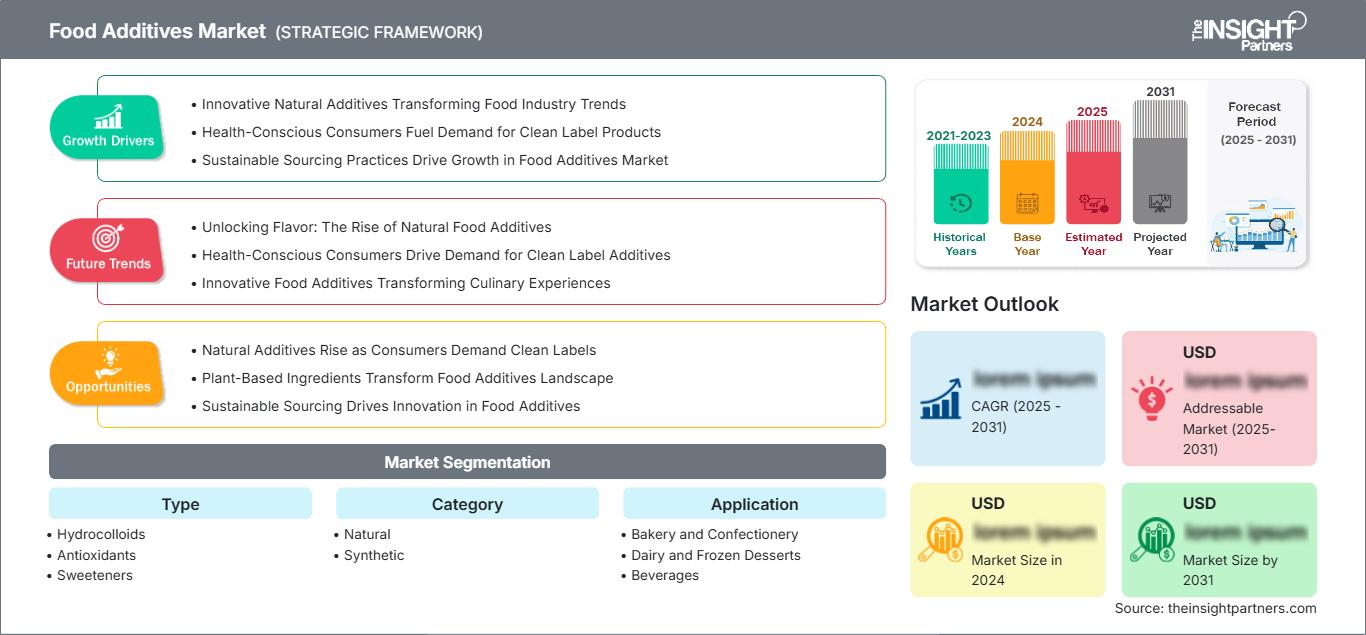
Food Additives Market: Strategic Insights
Regional Insights
North America Food Additives Market
North America comprises about 27% of the Food Additives Market Share in 2025 and will grow at a ~4% CAGR up to 2034. This is due to the well-established packed food industry, efficient networks for ingredient distribution, and usage of additives in drinks, bakery, dairy, sauces, processed meat, and convenience foods. Reformulation will remain one of the primary mechanisms of demand because manufacturers will cut down on sugar, reformulate fat system, extend the shelf life of their products, and improve nutritional positioning without compromising sensory quality.
The largest consumer of regional demand is the US, but Canada and Mexico represent additional opportunities as producers of food processing and cross-border supply chains. Regulatory requirements will force suppliers to have systems of safety, specifications, labeling, and traceability. North American producers will increasingly seek multifunctional ingredients able to replace a few components of a formulation or facilitate processing process. This will favor suppliers having technical application centers and comprehensive ingredient portfolios. Demand for natural colors, sweeteners from plants, texturizers, enzymes, and clean label preservative systems will complement the demand for conventional additives.
U.S. Food Additives Market
USA comprises nearly ~89% of the North American Food Additives Market revenue share in 2025 and is anticipated to expand at a ~4% CAGR till 2034. The positioning can be attributed to the extensive scope and diversity of food and beverage production within the country, which include packaged foods, beverages, bakery goods, dairy products, confections, sauces, and functional foods. Large-scale producers, such as Cargill Incorporated, Archer Daniels Midland Company, International Flavors & Fragrances Inc., and DSM-Firmenich AG are active in the market across various formulations.
Applications demand becomes more and more associated with the issues of sugar reduction, increased shelf life, sensory, and texture. Beverage producers need a range of sweeteners, flavors, colors, acidulants, and stabilizers, whereas bakery and dairy producers need emulsifiers, moisture binding agents, and consistency. The market also includes specialists that supply the formulations of the corresponding type. Innovation in natural ingredients, fermentation products, enzymes, and multifunctional systems creates new opportunities for ingredient suppliers.
Europe Food Additives Market
Europe represents ~24% of the global Food Additives Market in 2025 and is forecasted to achieve a ~3% CAGR until 2034. This is a mature market whose regulatory conditions will keep on defining product innovation, ingredients' use, and investments in the future. Germany is the leading country in Europe thanks to its extensive food manufacturing industry along with an active chemical and ingredient industry. The UK, France, Italy, and Spain represent important contributors thanks to their bakery, dairy, beverages, processed foods, and specialty food manufacturing industries.
The German economy benefits from its food manufacturing industry along with its extensive capability in chemicals and ingredients, while the UK has its formulation and branded-food manufacturing industries. In addition, France and Italy offer an important contribution with respect to demand from processed foods, bakery, dairy, confectionery, and premium foods, whereas Spain contributes with its demand from beverages, processed foods, and export-oriented foods. From a regulatory perspective, the situation in Europe pushes manufacturers to analyze the use of additives, their safety data sheets, and labeling.
APAC Food Additives Market
Asia Pacific represents ~36% of the global Food Additives Market in 2025 and is expected to expand at a ~6% CAGR through 2034, making it the fastest-growing region. China is the leading country in Asia Pacific because of its extensive food manufacturing base, large domestic consumption, and broad ingredient production capabilities. India is supported by expanding packaged-food and beverage manufacturing, while Japan and South Korea emphasize sophisticated formulation and functional food applications.
Australia’s contribution comes from their already existing food processing system and requirement of quality ingredients. Growth in the region is associated with urbanization, convenience eating, modern retail development, and an increase in processed food manufacturing. Modernization of the regulatory system has increased concerns about additives and their safe use. The different focus of formulations offered by countries such as China, India, Japan, and South Korea will necessitate formulators to develop formulations that suit their regulations and preferences.
Middle East & Africa Food Additives Market
The Middle East & Africa Food Additives Market is expected to expand at a ~5% CAGR through 2034. Saudi Arabia represents the leading country in the Middle East & Africa region where the strongest combination of food manufacturing investment, population growth, and industrial diversification supports ingredient demand. The UAE also plays an important distribution and food-processing role because of its logistics infrastructure and international trade connections.
Processed-food industry diversification can be considered to be one of the advantages that South Africa offers. The rest of MEA region has growing markets for packaged foods where penetration rates of packaged foods and production are becoming higher. Investment in food security, local processing, and logistics infrastructure contributes to the demand for preservatives, stabilizers, sweeteners, colors, and other additives. Energy availability and cost of production are still crucial in additive manufacturing.
Segmentation Analysis
Product Type
Product Type is divided into Preservatives, Sweeteners, Flavor and Flavor Enhancers, Food Colors, Emulsifiers, Thickeners and Stabilizers, Enzymes, Acidulants, and Others. The segment is projected to expand at a ~5% CAGR from 2026 to 2034. Demand remains broad because different additive functions address preservation, taste, appearance, processing stability, and texture across nearly every major processed-food category. Increasing formulation complexity is also encouraging suppliers to develop combinations and customized systems rather than isolated ingredients.
- Preservatives: Demand is closely tied to shelf-life requirements in processed foods, beverages, sauces, bakery products, and meat applications. Suppliers increasingly balance preservation performance with formulation, labeling, and regulatory requirements
- Sweeteners: Sweeteners support sugar reduction and calorie-management strategies across beverages, dairy, confectionery, and functional products. Formulators increasingly combine sweetening technologies to manage taste, mouthfeel, stability, and cost
- Flavor and Flavor Enhancers: These ingredients support sensory differentiation and compensate for formulation changes during sugar, salt, or fat reduction. Application expertise is particularly important for achieving consistent flavor perception across processing conditions
- Food Colors: Food colors remain important for visual identity and product consistency. Demand increasingly includes natural-source systems capable of delivering stable performance under different pH, heat, light, and storage conditions
- Emulsifiers: Emulsifiers help manufacturers manage dispersion, stability, texture, and processing efficiency. Their importance spans bakery, dairy, beverages, sauces, confectionery, and formulated foods
- Thickeners and Stabilizers: These ingredients provide viscosity, suspension, mouthfeel, and physical stability. They are widely used where manufacturers need consistent texture across processing, transportation, and storage
- Enzymes: Enzymes enable targeted biochemical functions and can improve processing efficiency, dough performance, texture, yield, and product consistency. Their use is expanding with more sophisticated formulation and processing approaches
- Acidulants: Acidulants regulate acidity, flavor balance, preservation conditions, and product stability. Their application extends across beverages, confectionery, sauces, dairy products, and processed foods
Source
Source comprises Natural and Synthetic and is projected to grow at a ~5% CAGR from 2026 to 2034. Natural ingredients are gaining strategic importance as manufacturers seek recognizable sources and reformulation options. Synthetic additives remain important because of their consistency, cost efficiency, established regulatory pathways, and reliable performance across large-scale food production.
- Natural: Natural-source additives are increasingly incorporated into reformulation strategies involving colors, sweeteners, preservatives, flavors, and texturizers. Processing advances are improving stability and functionality, although raw-material availability and cost remain important considerations
- Synthetic: Synthetic additives continue to support high-volume food production because standardized composition, predictable functionality, scalability, and established supply networks can provide efficient formulation performance across diverse applications
Application
Applications include Bakery and Confectionery, Dairy and Frozen Desserts, Meat Poultry and Seafood, Breakfast Cereals, Beverages, Functional Food and Beverages, and Others and is projected to grow at a ~5% CAGR from 2026 to 2034. Application demand reflects differences in processing conditions, shelf-life requirements, sensory expectations, and nutritional positioning. Beverages and functional food categories increasingly require integrated ingredient systems because product developers must manage taste, stability, nutrition, and labeling simultaneously.
- Bakery and Confectionery: Additives support dough handling, texture, moisture retention, shelf life, emulsification, flavor, and visual appeal. Reformulation and premium product development create demand for specialized ingredient systems
- Dairy and Frozen Desserts: Stabilizers, emulsifiers, sweeteners, flavors, colors, and texturizers help maintain consistency, creaminess, freeze-thaw stability, and sensory quality across refrigerated and frozen products
- Meat Poultry and Seafood: Preservation, oxidation control, texture, color, and processing consistency are key formulation requirements. Ingredient selection is closely linked with product safety, storage conditions, and consumer expectations
- Breakfast Cereals: Additives support flavor, color, texture, coating performance, and product stability. Reformulation toward higher fiber, reduced sugar, and functional positioning can increase formulation complexity
- Beverages: Beverages use multiple additive functions to balance sweetness, acidity, color, flavor, suspension, and stability. Sugar reduction and functional beverage development are important formulation themes
- Functional Food and Beverages: These products require ingredients that combine technological functionality with nutritional positioning. Formulators increasingly seek systems that maintain palatability while delivering targeted health-oriented characteristics
Opportunity Snapshot
| Application | Revenue Contribution | Trend Tag | Adoption Stage |
| Bakery and Confectionery | High | Clean Label | Mature |
| Dairy and Frozen Desserts | Medium | Texture Systems | Mature |
| Meat Poultry and Seafood | Medium | Shelf Life | Mature |
| Breakfast Cereals | Medium | Sugar Reduction | Scaling |
| Beverages | High | Reformulation | Mature |
| Functional Food and Beverages | High | Functional Nutrition | Scaling |
Food Additives Market Growth Drivers and Impact Analysis
Expansion of Processed and Convenience Food Manufacturing
Growth in processed and convenience food production increases the need for ingredients that maintain safety, consistency, sensory quality, and shelf life through manufacturing, distribution, and storage. Food additives allow manufacturers to control acidity, oxidation, microbial stability, viscosity, texture, color, and flavor while producing at industrial scale. The impact is strongest in beverages, bakery, dairy, sauces, ready-to-eat products, and processed meat, where standardized performance is essential. Expansion of modern retail and longer distribution networks further increases the value of preservation and stability technologies. For suppliers, this driver shifts demand toward application-specific systems capable of functioning under defined processing conditions rather than commodity ingredients alone. Manufacturers with broad portfolios can respond by combining several additive functions into integrated solutions that simplify formulation and improve production consistency.
Reformulation Toward Lower Sugar and Improved Nutritional Profiles
Reformulation is creating additional demand for sweeteners, flavors, stabilizers, emulsifiers, fibers, enzymes, and texturizers that can compensate for changes in conventional formulations. Reducing sugar can affect sweetness intensity, body, mouthfeel, browning, and product stability, requiring manufacturers to redesign several formulation elements simultaneously. Similar challenges arise when reducing fat, sodium, or certain synthetic ingredients. The resulting demand favors suppliers with strong application laboratories and sensory-development capabilities because replacement ingredients must deliver comparable consumer experiences rather than simply substitute one molecule for another. The impact extends beyond sweeteners into broader additive combinations. Ingredient companies able to provide complete reformulation systems can deepen customer relationships, shorten product-development cycles, and increase the value captured from each formulation project.
Stricter Food Safety and Ingredient Compliance Requirements
Food safety regulation is strengthening the technical requirements surrounding additive authorization, specifications, exposure assessment, labeling, and permitted-use levels. International and regional authorities continue reviewing additive safety and conditions of use, making regulatory capability an increasingly important competitive factor. The commercial impact is twofold. First, manufacturers require suppliers to provide reliable documentation, consistent specifications, and traceable raw materials. Second, regulatory changes can create opportunities for alternative ingredients when particular uses are restricted, reassessed, or subject to lower permitted levels. Suppliers with established regulatory teams and global compliance systems are better positioned to support customers operating across multiple jurisdictions. This environment also increases the importance of formulation flexibility, since food manufacturers need practical alternatives that preserve product performance while complying with changing national and international requirements.
Food Additives Market Future Trends
Precision Fermentation and Biotechnology-Based Ingredient Development
Precision fermentation and biotechnology in the Food Additives Market Trends are expected to broaden the range of ingredients that can be produced with controlled composition and scalable functionality. The technology can support development of sweetening, flavor, enzyme, color, and other functional ingredients while reducing dependence on certain conventional agricultural inputs. Commercial adoption will depend on regulatory acceptance, production economics, consumer perception, and the ability to achieve consistent functionality at industrial scale. Over time, biotechnology can also support ingredients designed for specific formulation challenges rather than broad commodity use. This may encourage suppliers to move toward platform technologies capable of producing multiple ingredient solutions from similar production infrastructure. Food manufacturers could benefit from improved supply resilience and more predictable quality, while ingredient suppliers may use fermentation capabilities to differentiate products through functionality, traceability, and production efficiency.
Multifunctional Clean-Label Systems and Formulation Simplification
Future product development is likely to favor multifunctional systems that perform several technological roles while supporting simpler ingredient statements. Instead of treating preservation, texture, flavor, and stability as completely separate formulation challenges, manufacturers can increasingly use optimized combinations that deliver multiple effects at lower formulation complexity. This approach is particularly relevant to bakery, beverages, dairy, plant-based foods, and functional products were removing or reducing individual ingredients can create secondary formulation problems. Application-specific systems can help manage these trade-offs by combining ingredients with complementary functionality. This trend may also encourage greater collaboration between ingredient suppliers and food manufacturers during product development, with suppliers contributing formulation expertise, sensory testing, processing validation, and regulatory support rather than supplying only individual additives.
Food Additives Market Opportunities
Regional Application Centers and Customized Ingredient Systems
Expansion of application centers in emerging food-processing markets can create opportunities for ingredient suppliers to localize product development and reduce formulation barriers. Food manufacturers in Asia Pacific, the Middle East, and other developing markets often face distinct raw-material, processing, regulatory, and consumer-preference conditions. Local technical centers can allow suppliers to test additives under regional manufacturing conditions and develop systems for specific product categories. This approach can shorten development cycles while strengthening customer retention. Opportunities in the Food Additives Market Forecast extend to distributors and contract manufacturers that can provide blending, technical support, regulatory documentation, and smaller batch customization. Suppliers that combine local application knowledge with global ingredient platforms can address fragmented demand without relying entirely on standardized products designed for mature markets.
Natural Ingredient Platforms and Reformulation Partnerships
Investment opportunities are emerging around natural colors, plant-derived sweeteners, fermentation-derived ingredients, natural preservation systems, and functional texturizers. The commercial opportunity is broader than supplying a single ingredient because reformulation often requires coordinated changes to taste, texture, stability, and processing. Suppliers can therefore develop partnerships with food manufacturers to test complete formulations and validate performance before commercialization. This model can create higher-value technical relationships and support recurring ingredient demand after successful product launches. Companies with access to diverse botanical, fermentation, and specialty processing technologies can also reduce dependence on a single ingredient category. As regulatory requirements and consumer preferences continue evolving, flexible natural ingredient platforms can provide manufacturers with alternatives that are adaptable across product categories and geographic markets.
Recent Developments
- July 2026: Ingredion Incorporated (NYSE: INGR), a leading global provider of ingredient solutions for food and beverage brands, will showcase several of its latest innovations at the IFT First 2026 expo in Chicago. Ingredion will feature a host of its solutions that focus on clean labels, texture, support for individuals using anti-obesity medications such as GLP-1 agonists, protein and fiber fortification, and sugar reduction. These nutrition-forward formulations are designed to improve the eating experience and meet consumer needs without trade-offs in texture or functionality
- July 2026: Bluegrass Ingredients will showcase trending applications and ingredient insights at IFT First in Chicago. We’ll have fusion-forward sample applications and will be hosting sit-downs with customers and prospects to talk through ingredient trends, reformulation insights and the ways we can move flavor forward
- June 2026: Ingredion Incorporated (NYSE: INGR), a leading global provider of ingredient solutions for the food, beverage and industrial markets, announced the acquisition of Benicaros, a patented, prebiotic fiber made from upcycled carrot pomace clinically shown to support immune health
Frequently Asked Questions

- Comprehensive Market Sizing and Forecast Analysis
- Detailed Segmentation Analysis
- In-Depth Market Dynamics Assessment
- Regional and Country-Level Insights
- Competitive Landscape and Company Benchmarking
- Strategic Business Intelligence
Recent Reports
Testimonials

The Insight Partners provided valuable market intelligence that supported our global go-to-market strategy. Their team was professional, responsive, and attentive to our feedback, providing thoughtful analysis and helpful methodological clarifications throughout the project.
Junmo Kim Chief Financial Officer (CFO), Enertech Co., Ltd.
The Insight Partners' SCADA System Market report is comprehensive, with valuable insights on current trends and future forecasts. The team was highly professional, responsive, and supportive throughout. We are very satisfied and highly recommend their services.
RAN KEDEM Partner, Reali Technologies LTDs
I requested a report on a very specific software market and the team produced the report in a few days. The information was very relevant and well presented. I then requested some changes and additions to the report. The team was again very responsive and I got the final report in less than a week.
JEAN-HERVE JENN Chairman, Future Analytica
We worked with The Insight Partners for an important market study and forecast. They gave us clear insights into opportunities and risks, which helped shape our plans. Their research was easy to use and based on solid data. It helped us make smart, confident decisions. We highly recommend them.
PIYUSH NAGPAL Sr. Vice President, High Beam Global
The Insight Partners delivered insightful, well-structured market research with strong domain expertise. Their team was professional and responsive throughout. The user-friendly website made accessing industry reports seamless. We highly recommend them for reliable, high-quality research services
YUKIHIKO ADACHI CEO, Deep Blue, LLC.
This is the first time I have purchased a market report from The Insight Partners.While I was unsure at first, I visited their web site and felt more comfortable to take the risk and purchase a market report.I am completely satisfied with the quality of the report and customer service. I had several questions and comments with the initial report, but after a couple of dialogs over email with their analyst I believe I have a report that I can use as input to our strategic planning process.Thank you so much for taking the extra time and making this a positive experience.I will definitely recommend your service to others and you will be my first call when we need further market data.
JOHN SUZUKI President and Chief Executive Officer, Board Director, BK Technologies
I wish to appreciate your support and the professionalism you displayed in the course of attending to my request for information regarding to infectious disease IVD market in Nigeria. I appreciate your patience, your guidance, and the fact that you were willing to offer a discount, which eventually made it possible for us to close a deal. I look forward to engaging The Insight Partners in the future, all thanks to the impression you have created in me as a result of this first encounter.
DR CHIJIOKE ONYIA MANAGING DIRECTOR, PineCrest Healthcare Ltd.Reason to Buy
- Informed Decision-Making
- Understanding Market Dynamics
- Competitive Analysis
- Identifying Emerging Markets
- Customer Insights
- Market Forecasts
- Risk Mitigation
- Boosting Operational Efficiency
- Strategic Planning
- Investment Justification
- Tracking Industry Innovations
- Aligning with Regulatory Trends





 Get Free Sample for