
Sustainable Manufacturing Market Growth, Trends & Demand by 2034
Sustainable Manufacturing Market Size and Forecasts (2021 - 2034), Global and Regional Share, Trends, and Growth Opportunity Analysis Report Coverage : By Offering (Recycled Lithium Ion Batteries, Recycled Metals, Recycled Plastics, Recycled Carbon Fiber, Natural Fiber Composites, Bioplastics & Biopolymers, Water Recycle & Reuse), Application (Aerospace, Automotive, Building and Construction, Energy, Chemicals, Marine, Packaging, Others)
- Status : Data Released
- Report Code : TIPRE00039643
- Category : Manufacturing and Construction
- No. of Pages : 150
- Available Report Formats :


- Last update date : November 12, 2026


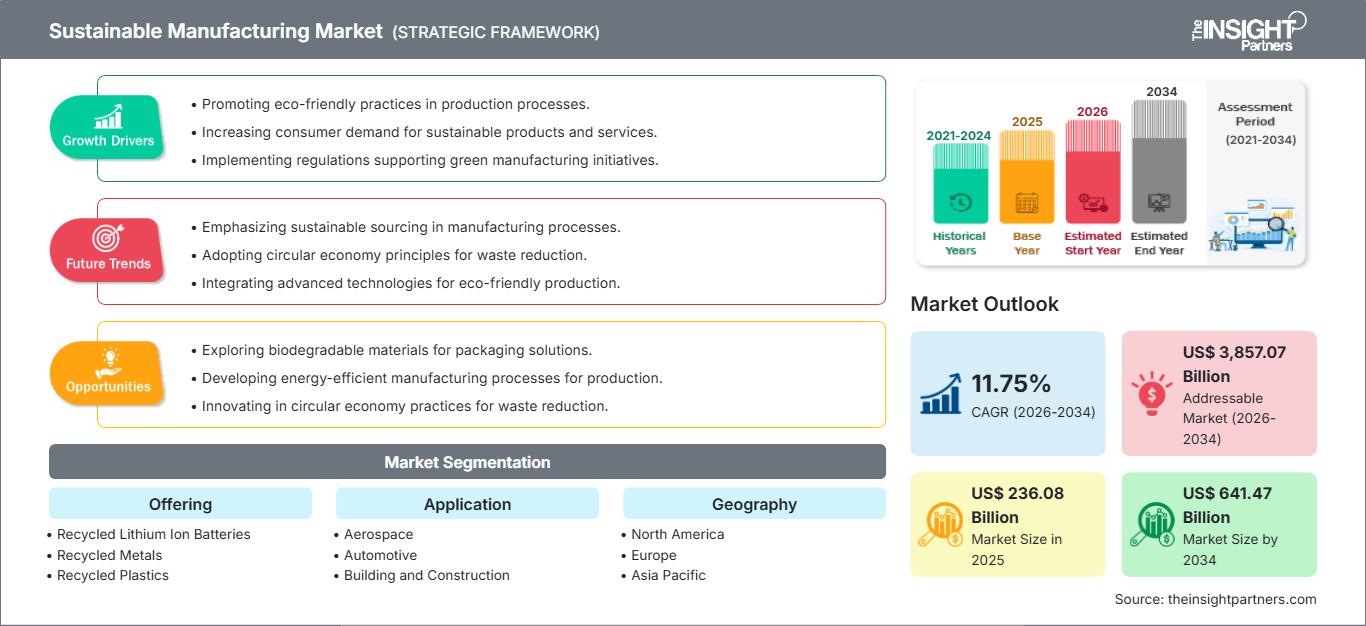
2025 Market Size
US$ 236.08 Bn
Base year value
2034 Forecast
US$ 641.47 Bn
Projected by 2034
CAGR 2026-2034
11.75 %
Growth rate
Addressable Market
US$ 3,857.07 Bn
(2026-2034)
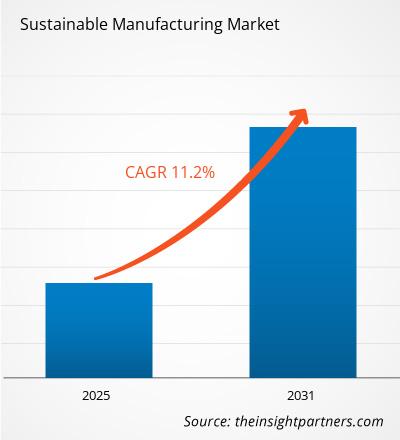
The Sustainable Manufacturing Market is valued at US$ 236.08 Billion in 2025 and is projected to reach US$ 641.47 Billion by 2034, registering a CAGR of 11.75% during 2026–2034. The market encompasses manufacturing-oriented solutions that reduce resource consumption, improve material circularity, recover valuable inputs, and support lower-impact production across industrial value chains.
North America is positioned as a major commercialization center, supported by investment in battery recycling, recycled polymers, low-carbon materials, industrial water reuse, and resource-efficient production. The regional outlook is reinforced by reshoring initiatives, industrial decarbonization programs, and increasing procurement emphasis on traceable secondary materials. The Sustainable Manufacturing Market size is therefore influenced by both environmental objectives and manufacturers' efforts to improve material security and operating resilience.
Sustainable Manufacturing Market Assessment and Insights
Regional Outlook
- North America: ~27% of the global Sustainable Manufacturing Market share in 2025 | ~10% CAGR through 2034. Market position: North America represents a major regional market, supported by advanced recycling infrastructure, battery supply-chain localization, industrial water-reuse projects, and increasing demand for secondary materials across automotive, energy, chemicals, and manufacturing applications.
- US: ~82% of North American market revenue in 2025 | ~10% CAGR through 2034. Market position: The US accounts for most North American demand, supported by domestic battery and metals processing, industrial decarbonization investments, advanced manufacturing projects, and corporate efforts to secure recycled inputs and reduce production-related resource intensity.
- Europe: ~29% of the global market in 2025 | ~10% CAGR through 2034. Market position: Europe has a mature sustainability ecosystem shaped by circular-economy regulation, recycled-content requirements, industrial decarbonization, and resource-efficiency programs. Germany leads Europe, supported by its industrial base, automotive manufacturing, chemicals production, and recycling infrastructure.
- Asia Pacific: ~32% of the global market in 2025 | ~14% CAGR through 2034. Market position: Asia Pacific is the fastest-growing regional market, driven by manufacturing scale, battery and electronics production, expanding recycling capacity, and sustainability investment. China leads Asia Pacific, while Japan, South Korea, India, and Australia support diversified demand.
Segment Outlook
- Recycled Metals: ~27% Share in 2025 | ~10% CAGR through 2034. Market position: Recycled metals lead the offering structure because automotive, construction, energy, aerospace, and industrial manufacturers can directly substitute secondary metals for selected primary inputs while improving resource efficiency and supply-chain resilience.
- Recycled Lithium Ion Batteries: ~15% Share in 2025 | ~16% CAGR through 2034. Market position: This is the high-growth offering as electric-vehicle and energy-storage deployment expands the future feedstock base. Battery recycling also provides a pathway to recover strategically important materials and strengthen regional circular supply chains.
Competitive Coverage
ACCUREC-Recycling GmbH, ArcelorMittal, Berry Global Inc., Biffa Limited, Braskem, Cirba Solutions, Dow Inc., Ecobat Battery, Veolia, Umicore
Methodology
The Insight Partners follows Data Collection & Secondary Research, Primary Research, Data Analysis, and Data Triangulation & Final Review to validate market estimates and insights.
Source: The Insight Partners' analysis based on proprietary research, government publications, company annual reports, investor presentations, industry databases, and expert interviews.
Sustainability in manufacturing has moved on from environmental initiatives to more integrated approaches that encompass resource management throughout the entire value chain from material supply through production, recovery, and finally industrial water management. The use of recycled metal and plastic materials provides downstream manufacturers with connections to recycling facilities, and battery recycling has become an important mechanism for recovering materials from electrification-generated waste. Natural fiber composites, bioplastic materials, biopolymer materials, recycled carbon fiber, and water reuse extend the market for sustainability through design-in of circular approaches.
In terms of future trends, there is going to be a focus on localizing the recycling capacity, closed-loop systems for materials, industrial water reuse, and traceability technologies of the recycled materials. There will also be regulatory requirements that make economic sense of sustainable production practices. As an example, in Europe, there are policies on circularity that relate product needs with secondary raw materials and recycling/reuse. This makes opportunities for technology suppliers and manufacturers who can demonstrate resource savings and high-quality secondary materials.
Sustainable Manufacturing Market Report Scope
| Report Attribute | Details |
|---|---|
| Market size in 2025 | US$ 236.08 Billion |
| Market Size by 2034 | US$ 641.47 Billion |
| Global CAGR (2026 - 2034) | 11.75% |
| Historical Data | 2021-2024 |
| Forecast period | 2026-2034 |
Sustainable Manufacturing Market Analysis
The demand drivers include attempts to achieve security, efficiency, and sustainability simultaneously on the part of the manufacturers. The value chain includes gathering, pre-processing, material extraction, refining, formulation, component making, manufacturing, and returning recycled materials back into production. Battery recycling involves special collection, disassembling, metallurgy, and material purification steps; plastic recycling involves sorting, washing, processing, and control of quality; water recycling and reuse involves additional capabilities in treatment, membranes, purification, and monitoring in the ecosystem.
The supply dynamics are quite diverse depending on the material type. Metal recycling can rely on the already existing networks for gathering and processing materials, whereas batteries and carbon fibers have a lot more technology input and growing amounts of feedstock. The evaluation of suppliers is based on their ability to deliver good-quality material with consistent performance, low energy intensity, and compatibility with production processes.
The competition is being shaped by the efficiency of the technology, geography of processing, availability of feedstock, and customers downstream of that process. ArcelorMittal is involved in efforts related to circular steel and resource efficiency, whereas Berry Global and Braskem deal with sustainable polymer value chains, which include recycling aspects. ACCUREC-Recycling GmbH, Cirba Solutions, Ecobat Battery, and Umicore are reinforcing the ecosystem of battery recycling. Veolia adds expertise in recycling and resource recovery along with industrial water, whereas Dow keeps on exploring the avenues of circular materials.
● REPORT CUSTOMIZATION
Tailor This Report To Align With Your Specific Business Requirements
This report can be customized to align precisely with your business objectives, scope, and target markets. Customization options include tailored segmentation, geography, competitive analysis, and strategic insights to support informed decision-making.
Customize This Report →WHAT YOU CAN ADJUST
- ● Segmentations
- ● Geography
- ● Competitive Analysis
- ● Language Preferences
Sustainable Manufacturing Market: Strategic Insights
Regional Insights
North America Sustainable Manufacturing Market
North America represented ~27% of the global market in 2025 and is projected to expand at a ~10% CAGR through 2034. The area has strengths in terms of its manufacturing potential and investment in resource-efficient industrial processes. The demand for batteries is shared between automotive, aerospace, energy, chemicals, packaging, and construction uses.
In North America, the United States serves as the major demand center for batteries due to battery manufacturing, industrial reshoring, recycling investment, and sustainable goals of the companies. Metals, mining, clean-technology, and resource processing potential of Canada help to satisfy demand for batteries in North America, as well as Mexico’s automotive and industrial manufacturing facilities.
U.S. Sustainable Manufacturing Market
The Sustainable Manufacturing Market forecast shows that the US accounted for ~82% of North American market revenue in 2025 and is expected to grow at a ~10% CAGR through 2034. The positioning of its location is based on the magnitude of the domestic production and investments for battery, metals, chemicals, automobile, and energy infrastructure. The companies now regard recycling and recovery as supply chain strategies, rather than just environmental efforts.
Some companies that operate in this area include Cirba Solutions, Ecobat Battery, Dow Inc., Veolia, and ArcelorMittal. The demand for applications in such cases is quite high, especially when the materials can be integrated into existing processes or where the availability of water affects the economics of operation. This means that there are commercial considerations apart from regulatory requirements in the US market.
Europe Sustainable Manufacturing Market
Europe represented ~29% of the global market in 2025 and is projected to register a ~10% CAGR through 2034. Germany is the leading country in Europe, supported by its large automotive and industrial manufacturing base, sophisticated recycling infrastructure, and strong emphasis on resource efficiency. France has opportunities in industrial water reuse, chemicals, aerospace, and circular materials, while the UK maintains substantial waste-management and recycling capabilities. Italy and Spain contribute through automotive, packaging, construction, manufacturing, and industrial-resource applications.
The European demand is closely associated with the regulations related to the circular economy and increased access to secondary raw materials. Regulations related to packaging, batteries, waste transports, recycling rates, and product sustainability create increasing ties between the product design and end-of-life recovery. As a result, the manufacturers in the region take into account availability, traceability, carbon footprint, and quality of recycled materials together with traditional procurement parameters.
Industrial density in Germany ensures that there are many customers of recycled metals, battery materials, polymers, and sustainable manufacturing technologies. In addition, France and Spain can be interesting markets regarding industrial and municipal water recycling solutions, while the Italian manufacturing industry creates demand for sustainable materials in automotive, machinery, packaging, and construction industries.
APAC Sustainable Manufacturing Market
Asia Pacific represented ~32% of the global market in 2025 and is expected to grow at a ~14% CAGR through 2034, making it the fastest-growing regional market. China is the leading country in Asia Pacific, supported by manufacturing scale, battery production, metals processing, plastics, electronics, and recycling capacity.
Japan and South Korea contribute advanced manufacturing and materials technologies, while India offers substantial long-term potential from expanding industrial production, automotive manufacturing, infrastructure, and waste-management modernization. Australia adds opportunities linked to minerals processing and resource recovery. Across the region, sustainability investments increasingly connect manufacturing expansion with material efficiency, recycling, water conservation, and domestic resource security.
Middle East & Africa Sustainable Manufacturing Market
Middle East & Africa is developing from a smaller base, with growth supported by industrial diversification, infrastructure development, resource efficiency, and water-security requirements. Saudi Arabia is the leading country in the Middle East & Africa market where industrial investment, petrochemical diversification, metals, construction, and resource-management programs create demand for sustainable manufacturing solutions.
The UAE is strengthening circular-economy and industrial sustainability initiatives, while South Africa provides an important base for metals, mining, manufacturing, and recycling activities. Water recycling and reuse is especially relevant across water-stressed markets, where industrial expansion must be balanced with limited freshwater resources. The region's development therefore depends on project economics, infrastructure availability, industrial localization, and the commercial value of recovered materials.
Segmentation Analysis
Offering
Offering is expected to expand at a ~11% CAGR during 2026–2034. The segment spans material-recovery and resource-efficiency solutions ranging from recycled batteries and metals to plastics, carbon fiber, natural-fiber composites, bioplastics, biopolymers, and water-reuse systems. Demand depends on feedstock availability, processing economics, material specifications, regulatory requirements, and manufacturers' ability to integrate recovered inputs without compromising product performance.
- Recycled Lithium Ion Batteries: Battery recycling is becoming strategically important as electrification expands. Demand centers on recovery of valuable battery materials, feedstock security, regulatory compliance, and closed-loop relationships between battery producers, recyclers, and automotive manufacturers.
- Recycled Metals: Recycled metals support automotive, construction, aerospace, energy, and industrial production by reducing dependence on primary material inputs. Established collection and processing infrastructure makes this category commercially accessible across mature manufacturing economies.
- Recycled Plastics: Recycled plastics are increasingly incorporated into packaging, automotive components, consumer products, and industrial applications. Quality consistency, contamination control, recycled-content requirements, and traceability influence adoption and supplier selection.
- Recycled Carbon Fiber: Recovered carbon fiber provides manufacturers with a pathway to reduce material waste from composite production and end-of-life components. Aerospace, automotive, and high-performance industrial applications create demand where material performance and weight reduction remain important.
- Natural Fiber Composites: Natural fiber composites combine renewable reinforcement materials with polymer matrices for selected automotive, construction, packaging, and industrial applications. Their strategic value comes from lower material intensity and potential substitution of conventional reinforcement materials.
- Bioplastics & Biopolymers: These materials provide alternatives for applications where renewable or biodegradable feedstocks can meet required performance specifications. Packaging remains an important adoption area, while automotive and industrial applications offer additional opportunities as formulations improve.
- Water Recycle & Reuse: Industrial water recovery reduces freshwater dependency and can improve resilience in water-stressed manufacturing locations. Treatment, purification, membrane, monitoring, and closed-loop systems support adoption across chemicals, energy, food-related processing, and other industrial operations.
Application
Application is projected to grow at a ~12% CAGR during 2026–2034. Automotive, energy, chemicals, packaging, construction, aerospace, and marine industries increasingly evaluate sustainable materials and resource-recovery systems as part of procurement and production planning. Adoption is strongest where material costs, regulatory requirements, resource constraints, or customer specifications provide a direct economic rationale.
- Aerospace: Aerospace applications emphasize lightweight materials, high-performance composites, traceability, and waste reduction. Recycled carbon fiber and advanced material recovery can support sustainability objectives while maintaining stringent performance requirements.
- Automotive: Automotive manufacturers are integrating recycled metals, plastics, battery materials, and composites into broader circularity strategies. Electrification further increases the relevance of battery recovery and material-loop management.
- Building and Construction: Construction provides substantial demand for recycled metals, plastics, composites, and resource-efficient water systems. Procurement standards and infrastructure investment can accelerate adoption where recycled materials meet performance and durability requirements.
- Energy: Energy applications include battery recycling, resource recovery, water management, and sustainable materials for infrastructure. Electrification and energy-storage deployment create additional opportunities for closed-loop material systems.
- Chemicals: Chemical manufacturers require feedstock security, process efficiency, and resource conservation. Recycled polymers, recovered materials, and water-reuse systems can reduce dependence on virgin inputs while supporting circular production models.
- Marine: Marine applications offer opportunities for recycled polymers, composites, metals, and resource-efficient production. Durability, corrosion resistance, and lifecycle performance remain important adoption criteria.
- Packaging: Packaging is a major application for recycled plastics and bioplastics. Recycled-content requirements, brand commitments, material efficiency, and waste-management improvements are strengthening demand for circular packaging inputs.
Opportunity Snapshot
| Application | Revenue Contribution | Trend Tag | Adoption Stage |
| Aerospace | Medium | Lightweight Composites | Scaling |
| Automotive | High | Battery Circularity | Scaling |
| Building and Construction | High | Recycled Materials | Scaling |
| Energy | High | Battery Recovery | Scaling |
| Chemicals | High | Circular Feedstocks | Scaling |
| Marine | Low | Composite Recovery | Emerging |
| Packaging | High | Recycled Plastics | Mature |
Sustainable Manufacturing Market Growth Drivers and Impact Analysis
Expansion of Circular Material Supply Chains
It is becoming more common for producers to build circular supply chains in order to minimize risk associated with primary resource volatility and to have access to recycled materials. Batteries recycling, metal recovery, polymers recycling and composites recovery enable the production system to recapture material value post-use. This affects procurement strategies since producers will be able to assess the recycled material based on its quality, availability, traceability, and performance over the life cycle of the product. For battery-reliant industries, local recovery becomes possible which also helps in minimizing dependency on raw material supply chains that are geographically constrained. Metal and plastic industries have an established collection and processing infrastructure for which integration becomes relatively easy in suitable applications.
Industrial Water Security and Resource Efficiency
Water access has become an increasingly critical factor in manufacturing, especially for operations that are located in areas where there is a lack of water or where they require substantial amounts of water for processing and cooling purposes. It is possible to decrease dependence on freshwater supplies and at the same time ensure continuity in production. It is easier to justify such investment when there is an increase in cost of water, stricter regulations regarding discharges or expansion limitations due to water availability issues. These technologies can also form a part of broader efficiency programs rather than be implemented separately as environmental infrastructures. Water reuse in industry applies mainly to chemicals, energy, metals, manufacturing, and other process-based industries.
Regulatory Pressure and Sustainable Procurement Requirements
Environmental regulation is increasingly affecting material selection, product design, recycling obligations, and procurement decisions. Circular-economy policies can create direct demand for secondary materials by establishing recycled-content expectations, producer responsibilities, or requirements governing product end-of-life. Sustainable procurement can reinforce these effects by favoring products with documented material provenance and lower environmental impacts. European policy provides a particularly developed framework, while North American and Asia Pacific markets are developing their own combinations of recycling, resource-efficiency, and industrial sustainability measures. Manufacturers respond by building traceability into sourcing and by forming partnerships with recyclers and material processors. This mechanism broadens sustainable manufacturing from a voluntary corporate objective into a more structured element of compliance, procurement, product development, and supply-chain management.
Sustainable Manufacturing Market Future Trends
Closed-Loop Manufacturing and Digital Material Traceability
The next stage of sustainable production is likely to involve tighter integration between physical recycling systems and digital traceability. Manufacturers increasingly need information on material origin, recycled content, processing history, quality, and end-of-life pathways. Digital records can connect suppliers, recyclers, manufacturers, and downstream users, making circular-material claims easier to verify and enabling more precise material management. Battery value chains are an early example because traceability can connect battery identity with material composition, performance, recycled content, and eventual recovery. Similar approaches can extend into polymers, metals, composites, and industrial components. Over time, digital traceability is likely to become part of procurement infrastructure rather than a standalone reporting function, improving supplier qualification and supporting higher-value closed-loop contracts.
Convergence of Recycling, Manufacturing, and Industrial Water Systems
The Sustainable Manufacturing Market trends indicate that sustainability solutions are increasingly moving toward integrated resource platforms in which material recovery, energy efficiency, water management, and production optimization are considered together. Recycling processes themselves consume water and energy, creating opportunities to improve their environmental performance through closed-loop utilities and process optimization. At manufacturing sites, recovered materials can be paired with water-reuse systems and resource-monitoring technologies to improve overall facility efficiency. This convergence is particularly relevant for large industrial campuses, battery plants, chemicals facilities, metals processing operations, and other resource-intensive production sites. Suppliers able to combine engineering, treatment, recovery, monitoring, and operational expertise may gain an advantage as manufacturers increasingly evaluate sustainability investments according to total facility performance rather than individual environmental projects.
Sustainable Manufacturing Market Opportunities
Localized Battery and Critical-Material Recovery Capacity
Battery recycling offers an important investment opportunity because electrification is creating a future stream of end-of-life batteries while manufacturers seek greater regional control over material supply. Opportunities extend beyond collection into preprocessing, lithium recovery, nickel and cobalt recovery, refining, black-mass processing, and reintegration of recovered materials into battery supply chains. Commercial viability depends on securing feedstock, achieving consistent recovery yields, meeting material specifications, and establishing downstream offtake relationships. Regional processing can also reduce logistics complexity and improve supply-chain resilience. Companies entering this area can differentiate through recovery efficiency, lower process energy requirements, flexible feedstock handling, and partnerships with automotive, battery, and energy-storage manufacturers. Strategic investment should therefore prioritize integrated ecosystems rather than isolated recycling capacity.
Industrial Water Reuse for Resource-Constrained Manufacturing Clusters
Industrial water reuse represents a commercial opportunity where manufacturing expansion is constrained by freshwater availability or wastewater-discharge requirements. Large industrial clusters can create sufficient demand to justify centralized treatment, recycling, and reuse infrastructure, while individual facilities can deploy closed-loop systems for cooling, process water, cleaning, and other suitable applications. The opportunity is particularly relevant to chemicals, energy, metals, electronics, and other water-intensive manufacturing activities. Providers can create value through modular treatment, advanced membranes, monitoring systems, and performance-based service models. Projects should be evaluated against local water economics, regulatory requirements, treatment complexity, and long-term industrial utilization. The strongest opportunities are likely to emerge where industrial expansion and water-security requirements occur simultaneously.
Recent Developments
- March 2026: ACCUREC-Recycling GmbH announced a milestone for lithium recycling following the December 2025 commissioning of its Krefeld facility. The company stated that its CLIMA technology recovers lithium from used batteries with a yield exceeding 95%, strengthening Europe's capacity to recover lithium domestically and supporting circular battery-material supply chains.
- April 2026: Veolia announced collaboration with Amazon to deploy wastewater reuse for data-center cooling in Mumbai. The initiative combines treated-wastewater reuse technologies with data-center capabilities and illustrates the expansion of industrial water reuse into rapidly growing digital infrastructure applications. The development highlights how water circularity is becoming linked with capacity expansion and operational resilience.
Frequently Asked Questions

- Comprehensive Market Sizing and Forecast Analysis
- Detailed Segmentation Analysis
- In-Depth Market Dynamics Assessment
- Regional and Country-Level Insights
- Competitive Landscape and Company Benchmarking
- Strategic Business Intelligence
Recent Reports
Testimonials

The Insight Partners provided valuable market intelligence that supported our global go-to-market strategy. Their team was professional, responsive, and attentive to our feedback, providing thoughtful analysis and helpful methodological clarifications throughout the project.
Junmo Kim Chief Financial Officer (CFO), Enertech Co., Ltd.
The Insight Partners' SCADA System Market report is comprehensive, with valuable insights on current trends and future forecasts. The team was highly professional, responsive, and supportive throughout. We are very satisfied and highly recommend their services.
RAN KEDEM Partner, Reali Technologies LTDs
I requested a report on a very specific software market and the team produced the report in a few days. The information was very relevant and well presented. I then requested some changes and additions to the report. The team was again very responsive and I got the final report in less than a week.
JEAN-HERVE JENN Chairman, Future Analytica
We worked with The Insight Partners for an important market study and forecast. They gave us clear insights into opportunities and risks, which helped shape our plans. Their research was easy to use and based on solid data. It helped us make smart, confident decisions. We highly recommend them.
PIYUSH NAGPAL Sr. Vice President, High Beam Global
The Insight Partners delivered insightful, well-structured market research with strong domain expertise. Their team was professional and responsive throughout. The user-friendly website made accessing industry reports seamless. We highly recommend them for reliable, high-quality research services
YUKIHIKO ADACHI CEO, Deep Blue, LLC.
This is the first time I have purchased a market report from The Insight Partners.While I was unsure at first, I visited their web site and felt more comfortable to take the risk and purchase a market report.I am completely satisfied with the quality of the report and customer service. I had several questions and comments with the initial report, but after a couple of dialogs over email with their analyst I believe I have a report that I can use as input to our strategic planning process.Thank you so much for taking the extra time and making this a positive experience.I will definitely recommend your service to others and you will be my first call when we need further market data.
JOHN SUZUKI President and Chief Executive Officer, Board Director, BK Technologies
I wish to appreciate your support and the professionalism you displayed in the course of attending to my request for information regarding to infectious disease IVD market in Nigeria. I appreciate your patience, your guidance, and the fact that you were willing to offer a discount, which eventually made it possible for us to close a deal. I look forward to engaging The Insight Partners in the future, all thanks to the impression you have created in me as a result of this first encounter.
DR CHIJIOKE ONYIA MANAGING DIRECTOR, PineCrest Healthcare Ltd.Reason to Buy
- Informed Decision-Making
- Understanding Market Dynamics
- Competitive Analysis
- Identifying Emerging Markets
- Customer Insights
- Market Forecasts
- Risk Mitigation
- Boosting Operational Efficiency
- Strategic Planning
- Investment Justification
- Tracking Industry Innovations
- Aligning with Regulatory Trends





 Get Free Sample for