
Activated Bleaching Earth Market Growth, Trends & Demand by 2034
Coverage: By Technology (Wet Process, Dry Process, Vapour-Phase Process); Application (Edible Oil and Fats, Mineral Oil and Lubricants, Cosmetics, Other Applications); and Geography (North America, Europe, Asia Pacific, South & Central America, and Middle East & Africa)
- Status : Data Released
- Report Code : TIPRE00017569
- Category : Chemicals and Materials
- No. of Pages : 150
- Available Report Formats :


- Last update date : June 11, 2026


2025 Market Size
US$ 2.90 Bn
Base year value
2034 Forecast
US$ 4.57 Bn
Projected by 2034
CAGR 2026-2034
5.19 %
Growth rate
Addressable Market
US$ 33.90 Bn
(2026-2034)
The global activated bleaching earth market size is projected to reach US$ 4.57 billion by 2034 from US$ 2.90 billion in 2025. The market is anticipated to register a CAGR of 5.19% during the forecast period 2026–2034.
Key market dynamics include a heightening global focus on refined edible oils, rising demand for high-purity biodiesel feedstocks, and a significant shift toward ultra-pure industrial lubricants. Additionally, the market is expected to benefit from the growing popularity of processed food consumption, expansion in large-scale refining hubs across emerging economies, and the increasing inclusion of activated clays in high-value segments like pharmaceuticals and specialty cosmetics.
Activated Bleaching Earth Market Analysis
The activated bleaching earth market analysis shifts toward high-efficiency adsorbent clays as refiners prioritize the removal of contaminants such as 3-MCPD and glycidyl esters. The market is a diversification in the supply chain, where refiners are moving away from general-purpose clays toward activity-specific grades tailored for high-pigment oils like rapeseed and sunflower. Strategic opportunities are emerging in biodiesel purification, where the ability to strip trace metals and phospholipids offers a clear competitive advantage. The analysis also notes that market expansion depends on acid-activation precision and filtration efficiency to minimize oil loss in spent earth. Competitive differentiation now stands out depending on technical support and customized clay formulations that highlight improved color removal and reduced chemical residue. This approach helps manufacturers maintain premium pricing in a landscape with numerous regional suppliers.
Activated Bleaching Earth Market Overview
Refining agents have advanced from basic filtering clays to high-performance functional adsorbents. The activated bleaching earth includes acid-activated bentonite, high-porosity sepiolite, and specialized attapulgite grades. Both global chemical leaders and regional mining companies compete in this market, using minerals such as montmorillonite. Growing demand for clear, odor-free vegetable oils among health-conscious consumers in Asia-Pacific and Europe has increased the popularity of activated bleaching earth as a critical purification solution. Asia-Pacific leads in revenue due to its established palm oil refining industry, while North America and Europe are advancing in bio-lubricant innovation and sustainable refining. The US market represents a highly developed segment characterized by rigorous safety standards and a robust industrial base. Demand is primarily sustained by the established food processing and the rapid expansion of renewable fuel initiatives. Competition among domestic brands fosters continuous innovation in high-purity grades for specialized manufacturing.
Market Assessment and Insights
- Global market for Activated Bleaching Earth was valued at US$ 2.90 Billion in 2025
- Annual market size is expected to reach US$ 4.57 Billion by 2034
- Total addressable market (TAM) during 2026-2034 is projected to reach approximately US$ 33.90 Billion
- Market is anticipated to register a CAGR of 5.19% during the forecast period
- The United States represents a key market, supported by Unlocking Potential: Activated Bleaching Earth Fuels Industry Growth, Sustainable Solutions: Eco-Friendly Practices Drive Market Expansion, Innovation at Work: New Technologies Boost Activated Bleaching Earth Demand, as well as evolving industry dynamics
- Market analysis covers North America, Europe, Asia-Pacific, South and Central America, Middle East and Africa, with growth evaluated across the forecast period
- Market opportunities such as Eco-Friendly Innovations Drive Activated Bleaching Earth Market Growth, Consumer Demand Fuels Sustainable Practices in Bleaching Earth, Advanced Technologies Transform Activated Bleaching Earth Production are expected to influence market dynamics and addressable market
- Report profiles industry participants, including AMC (UK) Limited, Ashapura Perfoclay Limited, BASF SE, Clariant International AG, HRP Industries, Korvi Activated Earth, Musim Mas Holdings, Oil-Dri Corporation of America, Refoil Earth Pvt. Ltd, Taiko Group of Companies, while analyzing competitive strategies and innovation developments
-
Source: The Insight Partners' analysis based on proprietary research, government publications, company annual reports, investor presentations, industry databases, and expert interviews.
● REPORT CUSTOMIZATION
Tailor This Report To Align With Your Specific Business Requirements
This report can be customized to align precisely with your business objectives, scope, and target markets. Customization options include tailored segmentation, geography, competitive analysis, and strategic insights to support informed decision-making.
Customize This Report →WHAT YOU CAN ADJUST
- ● Segmentations
- ● Geography
- ● Competitive Analysis
- ● Language Preferences
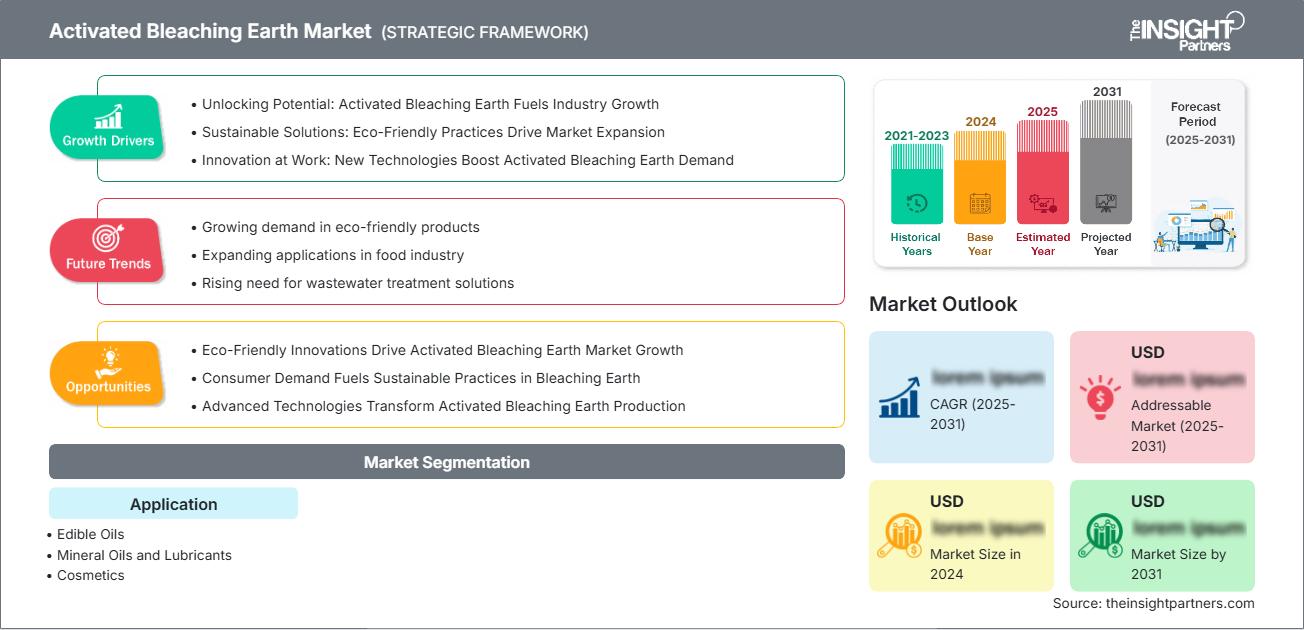
Activated Bleaching Earth Market: Strategic Insights
-
Get Top Key Market Trends of this report.This FREE sample will include data analysis, ranging from market trends to estimates and forecasts.
Activated Bleaching Earth Market Drivers and Opportunities
Market Drivers:
- Rising Consumption of Refined Edible Oils: The increasing global population and dietary shifts toward processed foods are driving the demand for high-quality vegetable oils, necessitating efficient bleaching earth for purification.
- Growth of the Biodiesel Industry: Stricter environmental mandates for renewable fuels have sustained high demand for activated bleaching earth to pre-treat feedstocks and remove impurities from bio-based oils.
- Advancements in Refining Technologies: The expansion of modernized oil refineries requires high-activity clays that can operate under diverse temperature and pressure conditions, boosting market adoption.
Market Opportunities:
- Expansion into Cosmetic and Pharmaceutical Refining: Beyond bulk oils, there are significant opportunities in refining high-end ingredients for the beauty and healthcare sectors, where ultra-low contaminant levels are mandatory.
- Growth in Sustainable Activation Processes: Developing eco-friendly activation methods that reduce wastewater and chemical effluent offers a competitive edge in environmentally regulated markets.
- Strategic Partnerships in Emerging Economies: Forming alliances between global clay producers and local oil refiners in South America and Africa can facilitate access to high-margin markets where infrastructure is modernizing.
Activated Bleaching Earth Market Report Segmentation Analysis
The activated bleaching earth market share is analyzed across various segments to provide a clearer understanding of its structure, growth potential, and emerging trends. Below is the standard segmentation approach used in most industry reports:
By Technology:
- Wet Process: This is the dominant technology, widely used in edible oil refining because it enhances the adsorption efficiency of the clay. It remains preferred for large-scale operations requiring maximum pigment removal.
- Dry Process: A fast-growing segment that aligns with global sustainability trends. It is increasingly preferred by refiners looking to reduce water consumption and minimize wastewater treatment costs.
- Vapour-Phase Process: An emerging niche technology often used in specific industrial applications and the treatment of specialty mineral oils to achieve high purity levels.
By Application:
- Edible Oil and Fats: The largest application segment, encompassing the purification of palm, soybean, sunflower, and rapeseed oils to meet global food-grade standards.
- Mineral Oil and Lubricants: A significant growth area focused on decoloring and purifying transformer oils, hydraulic fluids, and recycling used motor lubricants.
- Cosmetics: High-value segment where activated bleaching earth is used to refine natural oils and waxes used in high-end personal care products and anti-aging creams.
- Other Applications: Includes wastewater treatment, the pharmaceutical industry, and the purification of biofuels.
By Geography:
- North America
- Europe
- Asia Pacific
- South & Central America
- Middle East & Africa
Activated Bleaching Earth Market Report Scope
| Report Attribute | Details |
|---|---|
| Market size in 2025 | US$ 2.90 Billion |
| Market Size by 2034 | US$ 4.57 Billion |
| Global CAGR (2026 - 2034) | 5.19% |
| Historical Data | 2021-2024 |
| Forecast period | 2026-2034 |
| Segments Covered |
By Technology
|
| Regions and Countries Covered |
North America
|
| Market leaders and key company profiles |
|
Activated Bleaching Earth Market Players Density: Understanding Its Impact on Business Dynamics
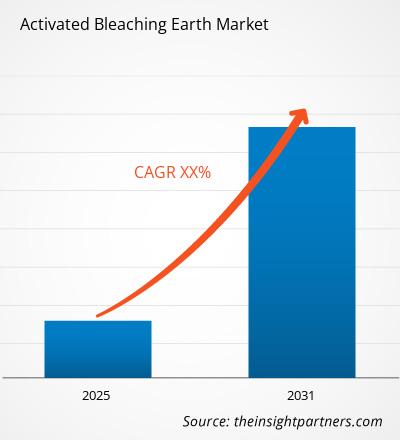
The Activated Bleaching Earth Market is growing rapidly, driven by increasing end-user demand due to factors such as evolving consumer preferences, technological advancements, and greater awareness of the product's benefits. As demand rises, businesses are expanding their offerings, innovating to meet consumer needs, and capitalizing on emerging trends, which further fuels market growth.
Activated Bleaching Earth Market Share Analysis by Geography
Asia-Pacific is expected to grow fastest in the coming years. Emerging markets in South & Central America, the Middle East, and Africa also have many untapped opportunities for premium mineral producers and industrial refiners to expand.
The activated bleaching earth market is undergoing a significant transformation, moving from a standard filtration commodity to a high-value industrial adsorbent. Growth is driven by the rising consumption of vegetable oils, a surge in biodiesel production, and the expansion of the high-performance lubricant. Below is a summary of market share and trends by region:
North America
- Market Share: A sophisticated segment representing global consumption, primarily driven by the United States.
- Key Drivers:
- High adoption of renewable diesel and biodiesel, requiring advanced pre-treatment of feedstocks.
- Strict FDA and EPA standards governing the purity of soybean and corn oils.
- Resurgence in industrial lubricant recycling and mineral oil purification.
- Trends: Increasing use of customized, low-dust granulated bleaching earths to improve refinery throughput and meet high-end industrial specifications.
Europe
- Market Share: A mature and stable market, anchored by high demand for premium refined oils and stringent food safety regulations.
- Key Drivers:
- Tightening EU mandates on contaminants like 3-MCPD and glycidyl esters in edible fats.
- Established processing infrastructure for high-value rapeseed and sunflower oils.
- Strong government focus on circular economy initiatives and sustainable mining.
- Trends: A strategic shift toward spent-earth regeneration and the development of bio-based activation agents to reduce the environmental footprint of the refining process.
Asia-Pacific
- Market Share: The dominant global region, with production originating in hubs like China, India, and Malaysia.
- Key Drivers:
- Massive edible oil refining capacity, with palm oil refiners alone consuming tons of clay.
- Rapid urbanization and rising disposable incomes are driving demand for Westernized packaged foods.
- Government-supported industrialization and manufacturing initiatives.
- Trends: Heavy reliance on B2B contracts for high-activity clays and the expansion of modular activation plants located near major oil-palm belts to reduce logistical costs.
South and Central America
- Market Share: The fastest-growing regional market by CAGR, led by the massive soybean and sunflower crops in Brazil and Argentina.
- Key Drivers:
- Growing awareness of refined oil stability and shelf-life requirements for the export market.
- Modernization of small-scale extraction units into commercial-grade refineries.
- Increasing use of bleaching earth in the purification of animal fats for biodiesel production.
- Trends: Growth of localized sourcing partnerships and the adoption of high-performance sepiolite clays to differentiate from standard bentonite-based products.
Middle East and Africa
- Market Share: A developing market with deep roots in regional oilseed production, now transitioning toward formalized large-scale refining.
- Key Drivers:
- High demand for shelf-stable cooking oils in arid climates.
- Strategic investments in domestic refining to improve food security and reduce import reliance.
- Rising industrial output in the lubricants and paraffin oil.
- Trends: Implementation of modern dry-bleaching technologies to save water and the focus on high-nutrient recovery from oil seeds.
High Market Density and Competition
Competition is intensifying due to the presence of established leaders such as Clariant AG, Taiko Group, and BASF SE. Regional experts and niche players like Ashapura Perfoclay Limited, Oil-Dri Corporation of America, and Musim Mas also contribute to a diverse market landscape.
This competitive environment pushes vendors to differentiate through:
- Technical Innovation: Positioned as superior solutions by offering low-oil-retention clays that save refiners money by reducing the amount of oil trapped in waste.
- Product Specialization: Companies offer specialized grades for different oil types, such as sunflower or palm, ensuring maximum color removal and oxidative stability.
- Supply Chain Control: Producers manage the entire process from clay mining to acid activation, ensuring quality, transparency, and consistency in supply.
Opportunities and Strategic Moves
- Partner with large-scale refineries and biodiesel producers to tap into the surging demand for high-purity, contaminant-free oils in Asia-Pacific and European markets.
- Incorporate sustainable waste management solutions and spent-earth recycling programs to appeal to environmentally conscious industrial clients and meet global landfill reduction targets.
Major Companies operating in the Activated Bleaching Earth Market are:
- AMC (UK) Limited
- Ashapura Perfoclay Limited
- BASF SE
- Clariant International AG
- HRP Industries
- Korvi Activated Earth
- Musim Mas Holdings
- Oil-Dri Corporation of America
- Refoil Earth Pvt. Ltd
- Taiko Group of Companies
Disclaimer: The companies listed above are not ranked in any particular order.
Activated Bleaching Earth Market News and Recent Developments
- In January 2025, Imerys finalized a €50 million deal to acquire Chemviron’s European diatomite and perlite business, adding three strategic mines in France and Italy to its global network. This move significantly enhances Imerys’ filtration segment by securing critical raw materials and expanding its reach within the activated bleaching earth market.
- In October 2024, Indonesia's 2024 crude palm oil output is estimated by the USDA at 47.5 million tons, with 11.96 million tons earmarked for biodiesel feedstock. This surge in production is a major driver for the activated bleaching earth sector, as it relies heavily on structural clay inputs to refine and purify CPO for food and fuel applications.
Activated Bleaching Earth Market Report Coverage and Deliverables
The Activated Bleaching Earth Market Size and Forecast (2021–2034) report provides a detailed analysis of the market covering below areas:
- Activated Bleaching Earth Market size and forecast at global, regional, and country levels for all the key market segments covered under the scope
- Activated Bleaching Earth Market trends, as well as market dynamics such as drivers, restraints, and key opportunities
- Detailed PEST and SWOT analysis
- Activated Bleaching Earth Market analysis covering key market trends, global and regional framework, major players, regulations, and recent market developments
- Industry landscape and competition analysis covering market concentration, heat map analysis, prominent players, and recent developments in the Activated Bleaching Earth Market.
- Detailed company profiles
Frequently Asked Questions

- Comprehensive Market Sizing and Forecast Analysis
- Detailed Segmentation Analysis
- In-Depth Market Dynamics Assessment
- Regional and Country-Level Insights
- Competitive Landscape and Company Benchmarking
- Strategic Business Intelligence
Recent Reports
Testimonials

The Insight Partners provided valuable market intelligence that supported our global go-to-market strategy. Their team was professional, responsive, and attentive to our feedback, providing thoughtful analysis and helpful methodological clarifications throughout the project.
Junmo Kim Chief Financial Officer (CFO), Enertech Co., Ltd.
The Insight Partners' SCADA System Market report is comprehensive, with valuable insights on current trends and future forecasts. The team was highly professional, responsive, and supportive throughout. We are very satisfied and highly recommend their services.
RAN KEDEM Partner, Reali Technologies LTDs
I requested a report on a very specific software market and the team produced the report in a few days. The information was very relevant and well presented. I then requested some changes and additions to the report. The team was again very responsive and I got the final report in less than a week.
JEAN-HERVE JENN Chairman, Future Analytica
We worked with The Insight Partners for an important market study and forecast. They gave us clear insights into opportunities and risks, which helped shape our plans. Their research was easy to use and based on solid data. It helped us make smart, confident decisions. We highly recommend them.
PIYUSH NAGPAL Sr. Vice President, High Beam Global
The Insight Partners delivered insightful, well-structured market research with strong domain expertise. Their team was professional and responsive throughout. The user-friendly website made accessing industry reports seamless. We highly recommend them for reliable, high-quality research services
YUKIHIKO ADACHI CEO, Deep Blue, LLC.
This is the first time I have purchased a market report from The Insight Partners.While I was unsure at first, I visited their web site and felt more comfortable to take the risk and purchase a market report.I am completely satisfied with the quality of the report and customer service. I had several questions and comments with the initial report, but after a couple of dialogs over email with their analyst I believe I have a report that I can use as input to our strategic planning process.Thank you so much for taking the extra time and making this a positive experience.I will definitely recommend your service to others and you will be my first call when we need further market data.
JOHN SUZUKI President and Chief Executive Officer, Board Director, BK Technologies
I wish to appreciate your support and the professionalism you displayed in the course of attending to my request for information regarding to infectious disease IVD market in Nigeria. I appreciate your patience, your guidance, and the fact that you were willing to offer a discount, which eventually made it possible for us to close a deal. I look forward to engaging The Insight Partners in the future, all thanks to the impression you have created in me as a result of this first encounter.
DR CHIJIOKE ONYIA MANAGING DIRECTOR, PineCrest Healthcare Ltd.Reason to Buy
- Informed Decision-Making
- Understanding Market Dynamics
- Competitive Analysis
- Identifying Emerging Markets
- Customer Insights
- Market Forecasts
- Risk Mitigation
- Boosting Operational Efficiency
- Strategic Planning
- Investment Justification
- Tracking Industry Innovations
- Aligning with Regulatory Trends





 Get Free Sample for