
Active Hemostatic Agents Market Growth, Share & Trends by 2034
Coverage: by Product Type (thrombin based hemostats, surgical sealants, combination products); End User (hospitals, ambulatory surgical centers, specialty clinics), and Geography (North America, Europe, Asia Pacific, and South and Central America)
- Status : Data Released
- Report Code : TIPRE00011954
- Category : Life Sciences
- No. of Pages : 150
- Available Report Formats :


- Last update date : July 22, 2026


2025 Market Size
US$ 6.44 Bn
Base year value
2034 Forecast
US$ 14.05 Bn
Projected by 2034
CAGR 2026-2034
9.05 %
Growth rate
Addressable Market
US$ 91.64 Bn
(2026-2034)
The global Active Hemostatic Agents market was valued at US$ 6.44 billion in 2025 and is expected to reach US$ 14.05 billion by 2034; it is estimated to record a CAGR of 9.05% during 2026-2034.
Active Hemostatic Agents Market Assessment and Insights
- North America held 39–42% share in 2025 and is projected to grow at a CAGR between 9.6–10.8% during 2026–2034, supported by advanced surgical infrastructure, procedure intensity, and biosurgery purchasing programs.
- US represented 82–86% of North America share in 2025 and is expected to grow at a CAGR between 9.4–10.6% during 2026–2034, driven by high-acuity surgical centers.
- Europe accounted for 26–29% share in 2025 and is forecast to grow at a CAGR between 8.7–9.8% during 2026–2034, led by Germany, France, the UK, Italy, and Spain.
- Asia Pacific captured 22–25% share in 2025 and is likely to grow at a CAGR between 11.2–12.6% during 2026–2034, with China, Japan, India, South Korea, and Australia leading adoption.
- Largest Segment Combination products recorded 44–48% market share in 2025 and are expected to grow at a CAGR between 10.4–11.6% during 2026–2034 due to stronger clinical versatility.
- High Growth Segment Ambulatory surgical centers held 12–15% market share in 2025 and are projected to grow at a CAGR between 11.8–13.2% during 2026–2034 as outpatient surgery expands.
- Key companies analyzed in detail: Baxter International Inc., Artivion, Inc., Ethicon, Inc., Integra LifeSciences Holdings Corporation, Medtronic plc, Pfizer Inc., B. Braun SE, CSL Behring LLC, Teleflex Incorporated, Stryker Corporation, Advanced Medical Solutions Group plc.
Source: The Insight Partners' analysis based on proprietary research, government publications, company annual reports, investor presentations, industry databases, and expert interviews.
Surgical bleeding control has moved from simple absorbent material to active ingredients that enhance the body’s coagulation system, which may include a biological/mechanical approach. The production process now focuses on thrombin supply, protein stability, sterilization techniques, room-temperature usability, and applicator ergonomics. The producers have now geared towards the production of ready to use matrices, patches, sealants and hybrid products to minimize preparation time and increase selection.
Future developments will be shaped by future capacity, value purchasing, and stricter documentation in the devices. The Asia Pacific and Gulf region health systems are focusing on developing tertiary care capacity, while Europe is changing its approach to MDR regulation in terms of evidence and post market surveillance. Hospitals prefer suppliers who can offer training, clinical studies, procedure based portfolio, and reliable logistic services for bioactive products.
Active Hemostatic Agents Market Report Scope
| Report Attribute | Details |
|---|---|
| Market size in 2025 | US$ 6.44 Billion |
| Market Size by 2034 | US$ 14.05 Billion |
| Global CAGR (2026 - 2034) | 9.05% |
| Historical Data | 2021-2024 |
| Forecast period | 2026-2034 |
Active Hemostatic Agents Market Analysis
Market growth drivers include increased surgical complexities, growing burden of trauma and the increased usage of anticoagulants by an aging population. The value chain includes biological material suppliers, sterilization providers, applicator manufacturers, buying group, surgeon users, and clinical educators. Supply considerations are weighted toward those able to produce consistent levels of thrombin, observe cold chain management where applicable, control the sterilization process, and rapidly replenish hospitals with high surgical activity.
Injuries are listed as one of the main causes of mortality and morbidity according to WHO figures. In addition, cardiovascular diseases continue to be the driving factor for the large number of surgical and intervention cases. Hemostatic agents are evaluated for their ability to lower the rate of re-operation, increase efficiency in the operating room, and decrease need for transfusions and ICU resources.
The active hemostatic agents market portrays a competitive scenario characterized by firms with broad surgical product lines and good hospital reach. Baxter International Inc., Ethicon, Inc., Medtronic plc, Integra LifeSciences Holdings Corporation, Pfizer Inc., and Artivion, Inc. offer thrombin matrices, sealants, collagen products, topical thrombin, and cardiovascular surgical adhesives. The category receives support from B. Braun SE, Teleflex Incorporated, Stryker Corporation, CSL Behring LLC, and Advanced Medical Solutions Group plc.
Research and development efforts focus on hemostatic products that achieve quick time to hemostasis with ease of preparation and greater tissue tolerance. Baxter International Inc. is advantaged through established use of FLOSEAL; Ethicon, Inc. develops biosurgery using patches while Artivion, Inc. remains relevant in cardiovascular sealants. Competitive positioning will largely be influenced by the following factors: evidence for difficult bleeding, surgeon training, hospital formulary availability, regulatory stability, and versatility of inpatient and outpatient surgeries.
● REPORT CUSTOMIZATION
Tailor This Report To Align With Your Specific Business Requirements
This report can be customized to align precisely with your business objectives, scope, and target markets. Customization options include tailored segmentation, geography, competitive analysis, and strategic insights to support informed decision-making.
Customize This Report →WHAT YOU CAN ADJUST
- ● Segmentations
- ● Geography
- ● Competitive Analysis
- ● Language Preferences
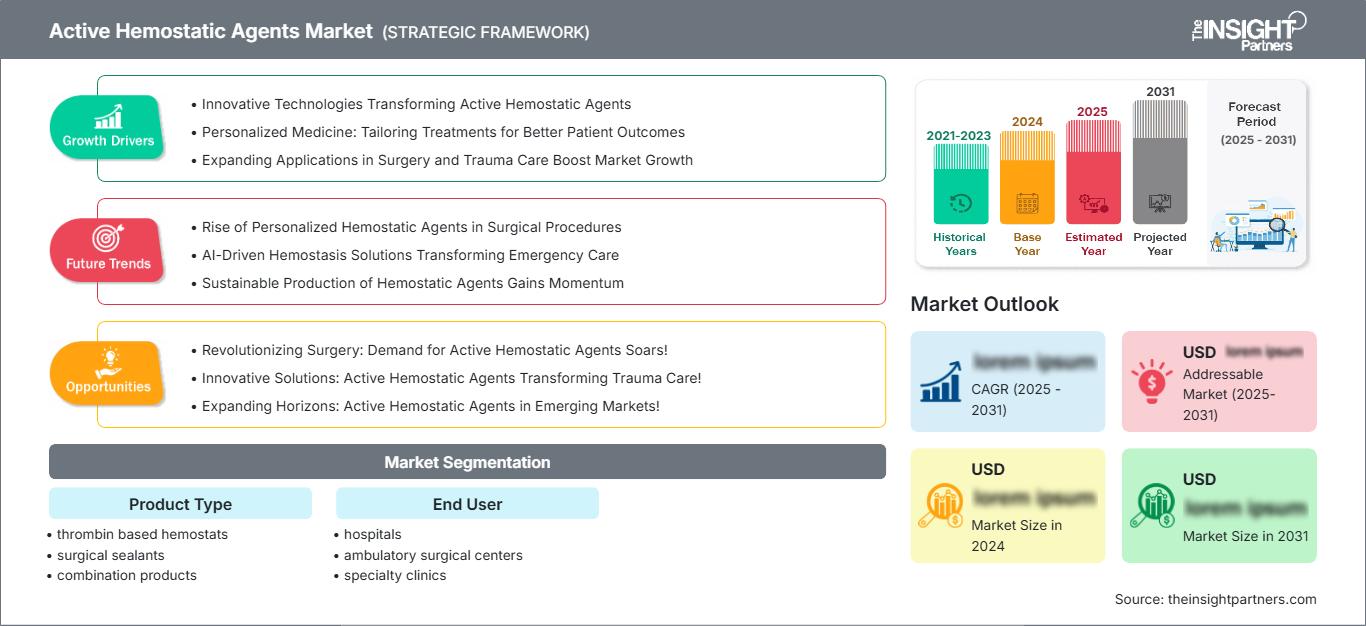
Active Hemostatic Agents Market: Strategic Insights
Regional Insights
North America Active hemostatic agents market
North America held 39–42% share in 2025 and is projected to grow at a CAGR between 9.6–10.8% during 2026–2034. The active hemostatic agents market share is anchored by high use of biologic and combination hemostats in cardiovascular, spine, orthopedic, liver, trauma, and robotic procedures. Hospitals assess these products against time saved, transfusion avoidance, and procedural reliability.
Adoption is driven by the strength of corporate presence, group-buying mechanisms, and surgeons’ familiarity with the surgeons' premium biosurgery product line. Baxter International Inc., Ethicon, Inc., Medtronic plc, Pfizer Inc., and Integra LifeSciences Holdings Corporation have maintained wide reach through hospitals and delivery systems. Purchasing organizations seek more information on clinical data, supply chain, training, and product applicability to bleeding management algorithms.
U.S. Active hemostatic agents market
The United States accounted for 82–86% of North America in 2025 and is forecast to grow at a CAGR of 9.4–10.6% from 2026 to 2034. Increased surgeries, trauma centers, transplant programs, and advanced heart surgery drive the need for thrombin matrices, sealants, and combinations on a regular basis. Complexity increases in procedures with elderly patients due to anticoagulation and other comorbid conditions.
There is significant company presence in clinical education, product support, and purchasing contracting. There is intense competition among Baxter International Inc. and Ethicon, Inc., in hospitals' portfolios of biosurgical devices, while Pfizer Inc. has importance in topically applied thrombin. Artivion, Inc. has relevance in cardiovascular sealants, and Medtronic plc can take advantage of procedure-related ties.
Europe Active hemostatic agents market
The Europe region had an active hemostatic agents market share of 26-29% in 2025 and is expected to grow at a CAGR of 8.7-9.8% from 2026 to 2034. The United Kingdom is taking steps towards improving surgical productivity through adoption of products that help in reducing delays and facilitating day-case surgery along with efficient theatre usage.
Germany is the top country for procedural specialization, cardiovascular surgery expertise, and hospital purchasing acumen. The German hospitals focus on technical expertise, evidence, and fitment into complex surgical workflow. Compliance with MDR regulations is increasingly becoming a differentiator as the hospitals prefer certified products and good post-market surveillance.
France, Italy, and Spain continue to be constant buyers with surgery in public hospitals, orthopedic procedures, oncological resections, and cardiovascular surgeries. The product choice is based on tendering practices, physician preferences, and hospitals' effort to standardize hemostats. Companies having local clinical training, regulatory expertise, and diverse product range will fare well compared to those offering narrow range of products.
APAC Active hemostatic agents market
APAC captured 22–25% share in 2025 and is projected to grow at a CAGR between 11.2–12.6% during 2026–2034. China is the leading country, supported by hospital construction, expanding surgical capacity, and wider availability of premium surgical consumables. Japan and South Korea show mature adoption in advanced surgery, while India is scaling private hospitals.
Australia remains quality-led, with strong clinical governance and specialist surgical networks. Policy drivers include universal coverage expansion, tertiary hospital investment, and growing trauma and cardiovascular care capacity. Industrial capability in China, Japan, South Korea, and India is also increasing local access to applicators, biomaterials, and distribution networks.
Middle East & Africa Active hemostatic agents market
The Middle East & Africa is expected to grow at a CAGR between 9.0–10.2% during 2026–2034. Saudi Arabia is the leading country due to medical city development, specialist surgical investment, and high funding for tertiary care. The UAE is expanding private hospital groups and attracting complex elective procedures.
South Africa remains the most established sub-Saharan market, supported by private hospitals and tertiary surgical centers. Rest of MEA demand is uneven but improving through trauma-care investment and public hospital modernization. Energy-sector revenues in Gulf economies continue to support healthcare infrastructure, while procurement is shifting toward evidence-based surgical technologies.
Segmentation Analysis
Product Type
Product Type is expected to grow at a CAGR between 10.0–11.4% during 2026–2034. The active hemostatic agents market scope across product type is shaped by procedure complexity, bleeding severity, tissue surface, preparation time, and surgeon handling preference. Combination products gain share because they can provide both biologic activity and mechanical support, while thrombin-based hemostats remain central to rapid clot formation in accessible bleeding fields.
- Thrombin based hemostats remain important because they directly support fibrin formation, making them useful for diffuse oozing, small-vessel bleeding, and adjunctive use with absorbable carriers.
- Surgical sealants serve specialized roles in cardiovascular, pulmonary, gastrointestinal, and tissue-sealing applications where surgeons require adhesion, leak prevention, and reinforcement beyond conventional hemostasis.
- Combination products dominate procurement because they connect active agents with matrices, patches, or carriers, helping surgeons manage irregular surfaces, moderate bleeding, and complex operative fields.
End-User
End User is projected to grow at a CAGR between 10.3–11.8% during 2026–2034. Hospitals remain the core demand base because they manage complex, high-risk, and emergency procedures that require advanced blood management. Ambulatory surgical centers are expanding as payer systems shift suitable procedures outside inpatient settings, while specialty clinics use selected products for targeted procedural bleeding control.
- Hospitals generate the largest demand through cardiovascular surgery, oncology resections, trauma, transplant, orthopedic procedures, spine surgery, and complex minimally invasive interventions requiring reliable hemostasis.
- Ambulatory surgical centers are gaining strategic importance as outpatient orthopedics, gynecology, ent, and general surgery increase the need for compact, fast-preparation bleeding-control products.
- Specialty clinics use selected agents in procedure-focused settings where predictable bleeding control, limited storage burden, and straightforward application support safe localized interventions.
Opportunity Snapshot
| End User | Revenue Contribution | Trend Tag | Adoption Stage |
| Hospitals | High | Complex Surgery | Mature |
| Ambulatory Surgical Centers | Medium | Outpatient Shift | Scaling |
| Specialty Clinics | Low | Procedure Care | Emerging |
Active Hemostatic Agents Market Growth Drivers and Impact Analysis
Rising surgical complexity and anticoagulant exposure
Older surgical patients increasingly present with cardiovascular disease, diabetes, renal impairment, cancer history, and anticoagulant or antiplatelet exposure, making bleeding control more complex than in routine procedures. Active hemostatic agents help surgeons manage diffuse oozing, difficult surfaces, and moderate bleeding when sutures or cautery are ineffective or impractical. This driver directly raises demand for thrombin matrices, sealant patches, and combination systems in hospitals handling tertiary care. The operational impact is measurable through reduced time spent controlling bleeding, lower transfusion exposure, and fewer disruptions during high-value procedures. Suppliers benefit when products are embedded in surgical protocols and supported by targeted training.
Hospital pressure to improve operating-room productivity
Operating rooms are among the highest-cost areas in a hospital, so delays caused by persistent bleeding can affect scheduling, staffing efficiency, anesthesia time, and postoperative resource use. Active hemostatic products are increasingly assessed as workflow tools rather than disposable add-ons. When a product shortens time to hemostasis in appropriate cases, hospitals can improve case flow and reduce downstream complications linked to bleeding. This driver supports premium products when clinical teams can demonstrate procedural value. Purchasing committees are therefore requesting data on preparation time, application success, waste reduction, and total episode cost. Vendors offering education and formulary guidance can gain durable adoption.
Expansion of minimally invasive and robotic procedures
Minimally invasive and robotic procedures create unique hemostasis challenges because surgeons operate through ports, narrow angles, and limited tactile feedback. Bleeding in these settings can interrupt visualization and force conversion to open surgery if not managed quickly. Active agents with flexible applicators, conformable matrices, and patch formats are therefore gaining importance. This driver expands use in gynecology, urology, colorectal, thoracic, and bariatric surgery. The market impact is strongest for products that can be delivered accurately, work on irregular tissue, and require minimal preparation. Manufacturers that design device-compatible delivery systems and train robotic teams can capture incremental demand.
Active Hemostatic Agents Market Future Trends
Procedure-specific hemostasis algorithms
The active hemostatic agents market trends are moving toward procedure-specific selection rather than broad product substitution. Hospitals are expected to develop algorithms that match bleeding type, anatomy, anticoagulation status, and surgical access with the most suitable thrombin, sealant, or combination product. This will reduce overuse, lower waste, and improve consistency across surgeons and service lines. Digital preference cards and operating-room supply analytics will support this transition by linking product selection to procedure history and outcomes. Vendors with broad portfolios, clinical educators, and health-economic evidence will be better positioned as hospitals standardize hemostasis decision-making.
Next-generation biologic and synthetic hybrid platforms
Future product development will increasingly combine biologic activity with engineered carriers, synthetic polymers, or controlled delivery systems. These platforms are intended to improve adhesion, reduce swelling, simplify preparation, and maintain performance in anticoagulated patients or wet surgical fields. Innovation will focus on rapid onset, predictable absorption, lower immunogenicity, and compatibility with minimally invasive delivery. Regulatory scrutiny will remain high because active agents interact with coagulation pathways and tissue healing. Companies that can demonstrate clear safety, biocompatibility, and clinical utility across defined procedures will gain advantage as surgeons seek more predictable bleeding-control tools.
Active Hemostatic Agents Market Opportunities
Bundled biosurgery contracting for hospital systems
Suppliers can expand by offering bundled hemostat portfolios covering thrombin, matrices, sealants, patches, applicators, staff training, and inventory support. active hemostatic agents market Forecasts indicate that large hospital networks will increasingly evaluate category-level value rather than individual product price. Bundling can reduce procurement complexity, improve product availability, and standardize bleeding-management pathways across service lines. The opportunity is strongest in integrated delivery networks managing cardiac, orthopedic, oncology, and trauma surgery. Vendors should support contracts with formulary analytics, wastage monitoring, clinical education, and outcome tracking to reinforce value and reduce substitution risk.
Outpatient surgery conversion and compact product formats
Ambulatory surgical centers offer a major opportunity as orthopedic, gynecologic, ENT, urology, and general procedures continue shifting outside inpatient hospitals. These sites need compact, easy-to-store, rapid-preparation products that fit smaller teams and tighter schedules. Suppliers can differentiate through room-temperature stability, low waste, intuitive applicators, and training materials designed for rotating staff. The opportunity requires pricing discipline because ambulatory centers operate under bundled or fixed reimbursement models. Companies that adapt packaging, case-size options, and distributor support for outpatient workflows can capture growth without relying solely on hospital premium portfolios.
Recent Developments
- June 2026: Medtronic plc submitted U.S. 510(k) filings to expand the Hugo robotic-assisted surgery system into general and gynecologic specialties and announced a pending filing for the LigaSure RAS Maryland instrument. The initiative strengthened Medtronic’s minimally invasive surgery strategy and supports procedural environments where controlled bleeding management and efficient instrument workflows remain important.
- June 2026: Artivion, Inc. announced U.S. FDA approval of the AMDS Hybrid Prosthesis for aortic surgery, reinforcing its focus on complex cardiovascular procedures. While the approval was not a topical hemostat launch, it strengthened Artivion’s cardiac surgery access, where BioGlue surgical sealant and related bleeding-control technologies remain strategically relevant to surgeons.
- November 2025: Baxter International Inc. received European Medical Device Regulation clearance for FLOSEAL Hemostatic Matrix, supporting continued availability of a widely used adjunct hemostatic product in Europe. The clearance reinforced Baxter’s compliance position under stricter regulatory requirements and helped hospitals maintain access to an established matrix used across multiple surgical bleeding scenarios.
Frequently Asked Questions

- Comprehensive Market Sizing and Forecast Analysis
- Detailed Segmentation Analysis
- In-Depth Market Dynamics Assessment
- Regional and Country-Level Insights
- Competitive Landscape and Company Benchmarking
- Strategic Business Intelligence
Recent Reports
Testimonials

The Insight Partners provided valuable market intelligence that supported our global go-to-market strategy. Their team was professional, responsive, and attentive to our feedback, providing thoughtful analysis and helpful methodological clarifications throughout the project.
Junmo Kim Chief Financial Officer (CFO), Enertech Co., Ltd.
The Insight Partners' SCADA System Market report is comprehensive, with valuable insights on current trends and future forecasts. The team was highly professional, responsive, and supportive throughout. We are very satisfied and highly recommend their services.
RAN KEDEM Partner, Reali Technologies LTDs
I requested a report on a very specific software market and the team produced the report in a few days. The information was very relevant and well presented. I then requested some changes and additions to the report. The team was again very responsive and I got the final report in less than a week.
JEAN-HERVE JENN Chairman, Future Analytica
We worked with The Insight Partners for an important market study and forecast. They gave us clear insights into opportunities and risks, which helped shape our plans. Their research was easy to use and based on solid data. It helped us make smart, confident decisions. We highly recommend them.
PIYUSH NAGPAL Sr. Vice President, High Beam Global
The Insight Partners delivered insightful, well-structured market research with strong domain expertise. Their team was professional and responsive throughout. The user-friendly website made accessing industry reports seamless. We highly recommend them for reliable, high-quality research services
YUKIHIKO ADACHI CEO, Deep Blue, LLC.
This is the first time I have purchased a market report from The Insight Partners.While I was unsure at first, I visited their web site and felt more comfortable to take the risk and purchase a market report.I am completely satisfied with the quality of the report and customer service. I had several questions and comments with the initial report, but after a couple of dialogs over email with their analyst I believe I have a report that I can use as input to our strategic planning process.Thank you so much for taking the extra time and making this a positive experience.I will definitely recommend your service to others and you will be my first call when we need further market data.
JOHN SUZUKI President and Chief Executive Officer, Board Director, BK Technologies
I wish to appreciate your support and the professionalism you displayed in the course of attending to my request for information regarding to infectious disease IVD market in Nigeria. I appreciate your patience, your guidance, and the fact that you were willing to offer a discount, which eventually made it possible for us to close a deal. I look forward to engaging The Insight Partners in the future, all thanks to the impression you have created in me as a result of this first encounter.
DR CHIJIOKE ONYIA MANAGING DIRECTOR, PineCrest Healthcare Ltd.Reason to Buy
- Informed Decision-Making
- Understanding Market Dynamics
- Competitive Analysis
- Identifying Emerging Markets
- Customer Insights
- Market Forecasts
- Risk Mitigation
- Boosting Operational Efficiency
- Strategic Planning
- Investment Justification
- Tracking Industry Innovations
- Aligning with Regulatory Trends





 Get Free Sample for