
Active Wound Care Market Size, Trends & Growth by 2034
Coverage: By Product Type ( Allograft, Synthetic Skin Grafts, Xenografts, Collagen Dressings, Amniotic Tissue Grafts, Growth Factors ); Wound Type ( Chronic Wounds, Acute Wound ); End User ( Hospitals, Clinics, Ambulatory Surgical Centers, Diagnostic Centers, Home Care Settings, Others ), and Geography (North America, Europe, Asia Pacific, and South and Central America)
- Status : Data Released
- Report Code : TIPRE00022286
- Category : Life Sciences
- No. of Pages : 150
- Available Report Formats :


- Last update date : July 30, 2026


2025 Market Size
US$ 2.31 Bn
Base year value
2034 Forecast
US$ 4.28 Bn
Projected by 2034
CAGR 2026-2034
7.09 %
Growth rate
Addressable Market
US$ 29.74 Bn
(2026-2034)
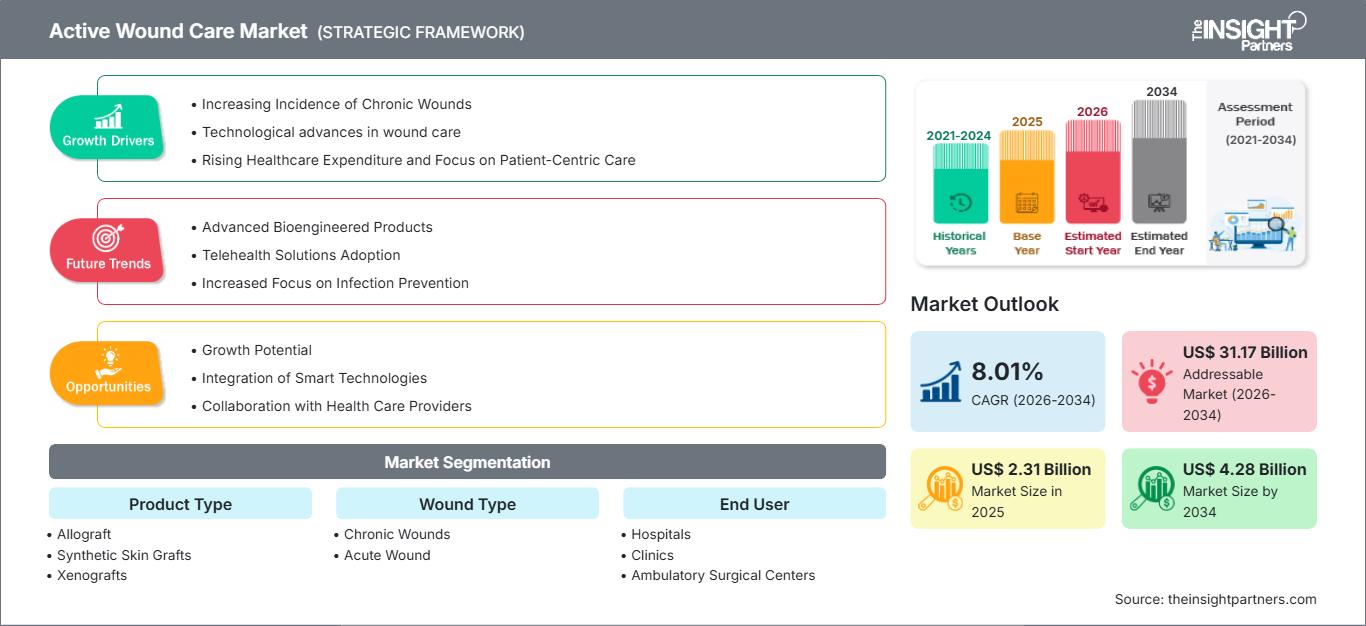
The Active Wound Care market was valued at US$ 2.31 billion in 2025 and is expected to reach US$ 4.28 billion by 2034; it is estimated to record a CAGR of 7.09% during 2026-2034.
Active Wound Care Market Assessment and Insights
- North America held 38–41% share in 2025 and is projected to grow at a CAGR between 2026–2034 of 7.6–8.3%, supported by advanced wound clinics, Medicare coverage pathways, and higher use of biologic grafts.
- US represented 86–89% of North America in 2025 and is expected to grow at a CAGR between 2026–2034 of 7.5–8.2%, led by diabetic foot ulcer care, burn centers, and surgical reconstruction demand.
- Europe accounted for 25–28% share in 2025 and is forecast to expand at a CAGR between 2026–2034 of 7.0–7.7%, with Germany, the UK, France, Italy, and Spain leading clinical adoption.
- Asia Pacific captured 21–24% share in 2025 and is projected to grow at a CAGR between 2026–2034 of 8.9–9.6%, driven by China, Japan, India, South Korea, and Australia.
- Largest Segment Collagen Dressings held 27–31% market share in 2025 and is expected to grow at a CAGR range of 7.4–8.1% during 2026–2034 due to broad chronic wound use.
- High Growth Segment Amniotic Tissue Grafts represented 16–20% share in 2025 and is forecast to grow at a CAGR range of 9.6–10.4% during 2026–2034 as placental matrices gain clinical evidence.
- Key companies analyzed in detail: Mölnlycke Health Care AB, Smith & Nephew plc, Medline Industries, LP, AVITA Medical, Inc., Convatec Group Plc, Plus Therapeutics, Inc., Human BioSciences, Inc., Stryker Corporation, Organogenesis Holdings Inc., and Wright Medical Group N.V.
Source: The Insight Partners' analysis based on proprietary research, government publications, company annual reports, investor presentations, industry databases, and expert interviews.
The market has evolved from passive wound coverage toward regenerative and biologically interactive products that influence extracellular matrix formation, cellular migration, moisture balance, and granulation. Production dynamics are shifting toward tighter tissue sourcing controls, validated sterilization, cold-chain management, and scalable biomanufacturing. The active wound care market is also becoming more evidence-driven as hospitals compare healing rates, treatment episodes, infection risk, and total episode cost across graft categories.
Forward-looking demand will be shaped by emerging wound clinics in the Asia Pacific, expanded limb-preservation networks, and regulatory scrutiny on skin substitute utilization. Investment is moving into placental tissue processing, collagen-based matrices, autologous cell systems, and hybrid wound protocols. Policy tailwinds around value-based care and preventable amputation reduction should support adoption in markets where payers recognize faster closure and fewer complications as measurable economic outcomes.
Active Wound Care Market Report Scope
| Report Attribute | Details |
|---|---|
| Market size in 2025 | US$ 2.31 Billion |
| Market Size by 2034 | US$ 4.28 Billion |
| Global CAGR (2026 - 2034) | 7.09% |
| Historical Data | 2021-2024 |
| Forecast period | 2026-2034 |
Active Wound Care Market Analysis
Demand is primarily anchored in diabetes, vascular disease, obesity, surgical complications, burns, and pressure injuries. The active wound care market growth is reinforced by the global diabetes burden, with the WHO reporting about 830 million people living with diabetes and IDF reporting 589 million adults aged 20–79 affected in 2024.
The value chain spans donor tissue procurement, biomaterial processing, cell-based technology, sterilization, clinical trials, hospital contracting, wound clinic distribution, and reimbursement documentation. Supply dynamics are becoming more specialized because biologic products require traceability, validated handling, clinician training, and predictable availability across acute and outpatient care settings.
The competitive landscape reflects a mix of multinational wound care suppliers and regenerative medicine specialists. The active wound care market analysis shows Mölnlycke Health Care AB, Smith & Nephew plc, Convatec Group Plc, Medline Industries, LP, and Stryker Corporation competing through hospital access, wound portfolio breadth, and clinician education.
Organogenesis Holdings Inc., AVITA Medical, Inc., Human BioSciences, Inc., Plus Therapeutics, Inc., and Wright Medical Group N.V. strengthen the specialist side through tissue engineering, cell delivery, graft science, and biologic know-how. Strategic positioning depends on evidence quality, payer acceptance, product consistency, and the ability to integrate with wound bed preparation, infection control, and follow-up protocols.
● REPORT CUSTOMIZATION
Tailor This Report To Align With Your Specific Business Requirements
This report can be customized to align precisely with your business objectives, scope, and target markets. Customization options include tailored segmentation, geography, competitive analysis, and strategic insights to support informed decision-making.
Customize This Report →WHAT YOU CAN ADJUST
- ● Segmentations
- ● Geography
- ● Competitive Analysis
- ● Language Preferences
Active Wound Care Market: Strategic Insights
Regional Insights
North America Active wound care Market
North America held 38–41% share in 2025 and is projected to grow at a CAGR of 7.6–8.3% during 2026–2034. The region benefits from wound centers, burn units, podiatry networks, and established use of advanced graft technologies for diabetic foot ulcers, venous leg ulcers, pressure injuries, and surgical wounds. Coverage documentation remains central to product selection.
The active wound care market share in North America is supported by high chronic wound treatment costs and a strong outpatient care base. AHRQ estimates pressure ulcers affect 2.5 million U.S. patients annually, while hospital-acquired pressure injury cost simulations have exceeded US$ 26.8 billion, reinforcing demand for faster closure and prevention-focused protocols.
U.S. Active wound care Market
The U.S. represented 86–89% of North America in 2025 and is expected to grow at a CAGR of 7.5–8.2% during 2026–2034. Its scope depends on the Medicare spending effect, widespread wound clinics, diabetic limb salvage initiatives, and quick access to placental allografts, collagen matrix, and cell technology used for skin reconstruction.
The company’s market position is robust, as companies like Organogenesis Holdings Inc., Smith & Nephew plc, Medline Industries, LP, AVITA Medical, Inc., Human BioSciences, Inc., Convatec Group Plc, Stryker Corporation, and Mölnlycke Health Care AB operate in the sector. The applications focus on diabetic foot ulcers, venous leg ulcers, burns, trauma wounds, and surgical wounds.
Europe Active wound care Market
Europe accounted for 25–28% share in 2025 and is expected to grow at a CAGR of 7.0–7.7% during 2026–2034. Reasons why Germany leads in adoption include wound care pathway structures, regulation of devices, and the hospital procurement process. In the case of the UK, there is an increased focus on reducing the community burden of wounds and efficiency in the outpatient pathways.
In Germany, adoption has been influenced by evaluation processes in the clinical sector, tendering processes, and wound specialists' centers. The demand is stable for collagen dressings, allografts, and synthetic grafts where there is evidence of healing, which ensures payers accept them. There is an increased focus in the UK on reducing long-term wounds in community settings for the products that reduce the length of wound management episode and nursing time.
In France, Italy, and Spain, adoption is growing through aging population, diabetes management and surgical wound care protocols. In France, there has been an evaluation of advanced materials in hospitals, whereas in Italy and Spain, there is increased use of biological products in specialized wound and vascular clinics.
APAC Active wound care Market
APAC held 21–24% share in 2025 and is projected to grow at a CAGR of 8.9–9.6% during 2026–2034. Reasons for dominance in the regional volume include the prevalence of diabetes, expansion of hospital facilities, and development of indigenous biomaterial capabilities, while Japan, South Korea, India, and Australia help increase acceptance of advanced wound products.
Drivers for the industry include local production, private hospitals' investments, and wider availability of specialist surgery. Diabetes control and aging care policies add weight to the demand. Japan and Australia have better acceptance of premium biological products, while India and Southeast Asia provide growth opportunities because of low-cost collagen, grafting options, and wound clinics.
Middle East & Africa Active wound care Market
The Middle East & Africa is projected to grow at a CAGR of 6.2–6.8% during 2026–2034. Saudi Arabia leads the market through tertiary hospitals, diabetes programs, and investments in healthcare infrastructure. The UAE is second in the market in terms of the use of premium wound care technology in private hospitals and specialized clinics.
South Africa drives the market in the African sub-region through surgical and chronic wound care networks. The rest of MEA faces access-related limitations in the market, with demand coming from government hospitals and urban-based private healthcare. Energy-fueled fiscal investments in healthcare infrastructure in the Gulf help drive the adoption of advanced grafting, burn, and wound care technology.
Segmentation Analysis
Product Type
The Product Type segment is expected to grow at a CAGR of 7.8–8.5% during 2026–2034. active wound care market scope across product categories is expanding as clinicians combine biological scaffolds, matrices, and cellular technologies with debridement, infection control, and compression or offloading. Adoption depends on wound etiology, reimbursement criteria, evidence strength, tissue availability, and ease of use in outpatient settings.
- Allograft products are strategically important for complex wounds requiring human tissue scaffolding. Demand is concentrated in diabetic ulcers, venous ulcers, burns, and surgical wounds, where native extracellular matrix supports repair.
- Synthetic Skin Grafts address consistency, availability, and lower donor variability. They are relevant where clinicians need standardized coverage, predictable storage, and scalable use across surgical and trauma settings.
- Xenografts support temporary wound coverage and biological protection, particularly in burns and acute defects. Their role remains practical where rapid coverage, availability, and cost control matter.
- Collagen Dressings hold the leading position because collagen supports matrix deposition, exudate management, and granulation. Their broad use across chronic wounds makes them central to protocol-based care.
- Amniotic Tissue Grafts are gaining strategic relevance due to growth factor content, anti-inflammatory characteristics, and placental matrix structure. Adoption is rising in outpatient wound centers.
- Growth Factors target stalled healing biology and are used selectively where wound bed preparation and patient selection support clinical benefit, especially in difficult chronic wounds.
Wound Type
The Wound Type segment is projected to grow at a CAGR of 7.7–8.4% during 2026–2034. Demand is shaped by wound duration, infection risk, tissue depth, vascular status, and care setting. Chronic wounds drive repeat utilization and reassessment, while acute wounds need faster closure, graft take, and reduced hospital stays after burns, trauma, and surgery.
- Chronic Wounds dominate demand due to diabetic foot ulcers, venous leg ulcers, and pressure injuries. Their long treatment cycles make biologic matrices and grafts strategically important for closure acceleration.
- Acute Wound applications include burns, traumatic defects, and surgical wounds. Demand is strongest where early tissue coverage reduces infection risk, operating room use, and inpatient resource burden.
End User
The End User segment is forecast to grow at a CAGR of 7.9–8.6% during 2026–2034. Hospitals remain important for burns, surgical wounds, and severe infections, while clinics and home care settings are gaining relevance as chronic wound care shifts outward. Adoption depends on reimbursement, clinician training, dressing change frequency, product storage, and follow-up capability.
- Hospitals generate high-value demand for burns, surgical defects, complex diabetic wounds, and infected wounds. They influence product protocols, formulary decisions, and evidence requirements across care networks.
- Clinics are central to chronic wound management, particularly diabetic foot ulcers and venous leg ulcers. Their recurring visit model supports graft application, debridement, and outcome tracking.
- Ambulatory Surgical Centers are gaining relevance for outpatient procedures, minor grafting, and surgical wound management where cost efficiency, shorter recovery, and standardized supply kits matter.
- Diagnostic Centers support referral pathways by identifying vascular, diabetic, or infectious contributors to nonhealing wounds. Their strategic value lies in earlier intervention and better patient stratification.
- Home Care Settings are expanding as payers encourage lower-cost care. Products used here need simpler application, safety, durable packaging, and coordination with nurses or caregivers.
Opportunity Snapshot
| Segment Name | Revenue Contribution | Trend Tag | Adoption Stage |
| Hospitals | High | Burn Coverage | Mature |
| Clinics | High | Ulcer Closure | Scaling |
| Ambulatory Surgical Centers | Medium | Outpatient Grafts | Scaling |
| Diagnostic Centers | Low | Vascular Triage | Emerging |
| Home Care Settings | Medium | Nurse Applied | Scaling |
| Others | Low | Referral Care | Emerging |
Active Wound Care Market Growth Drivers and Impact Analysis
Rising Diabetes and Chronic Wound Burden
Diabetic conditions act as an important structural driver due to neuropathy, vascular problems, infection risks, and delayed healing, which make the likelihood of developing foot ulcers and amputations higher. According to the IDF, there were 589 million adults who had diabetes in 2024, and the figure according to WHO was around 830 million, showing the wide scope of patients who will need care related to wounds. Active wound care becomes highly demanded due to the fact that care providers are looking for products to stimulate stalled wound healing, prevent wound recurrence, and save limbs.
Pressure Injury Costs and Hospital Quality Priorities
Injury by pressure continues to be a major hospital quality and economic problem, leading to the need for treatment strategies that promote quicker closure and reduction in complications. According to AHRQ, there are about 2.5 million patients who are affected each year in America, with the costs for pressure ulcers being around $9.1 to $11.6 billion each year. Economic modeling has also projected an estimate of more than $26.8 billion in pressure injury costs in U.S. hospitals. Such projections demonstrate the economic burden associated with severe wound injuries. The hospitals are motivated to develop strategies to enhance wound bed preparation, infection control, and closure strategies.
Expansion of Regenerative Medicine and Biomanufacturing Capacity
The increased spending on regenerative medicine production has helped boost the availability of these products. For instance, Organogenesis Holdings Inc. revealed plans of setting up a 122,000 square feet biomanufacturing plant in Rhode Island that would serve the purpose of producing wound care products, conducting R&D activities, as well as warehousing and future expansion projects. This is important because, among other reasons, these products need efficient production, traceability, quality control measures, and efficient distribution. The active wound care market will definitely be served well when producers can overcome problems such as shortages, reduced lead times, and increased clinical usage.
Active Wound Care Market Future Trends
Evidence-Led Biologic Product Selection
Evidence-led selection will define active wound care market trends as payers, hospitals, and clinicians scrutinize skin substitutes, allografts, and amniotic membranes more closely. Each product will require differentiation through clinical evidence, transparency in tissue handling, standardized application procedures, and economics demonstrating reduced application frequency or more rapid closure. The trend will involve a preference for vendors who link randomized evidence with real-world outcomes and reimbursement support without depending solely upon high pricing. Purchasing officers will be responsible for assessing the probability of healing, rate of recurrence, wastage, storage, and staffing costs. As payments become more sophisticated, formulary inclusion will become a function of clinical utility increasingly.
Cellular and Point-of-Care Skin Restoration
The use of regenerative medicine point-of-care systems is expected to increase in wound and burn care, as there is increasing interest in minimizing the use of donor tissue to close wounds. The use of autologous cell harvesters may assist in closing larger wounds using smaller donor areas, which will be useful in burns, trauma, and full-thickness skin defects. FDA documents indicate that the RECELL system is approved for thermal burn wounds and full-thickness skin defects, thus proving that it is useful in specialized care. The success of future use will depend on how easy it is to use, the training of surgeons, hospital finances, and compatibility with grafting.
Active Wound Care Market Opportunities
Outpatient Wound Centers and Limb Preservation Networks
The active wound care market Forecasts point to a strong opportunity in outpatient wound centers that manage diabetic foot ulcers, venous leg ulcers, and post-surgical wounds before complications require admission. The investors and manufacturers can facilitate this pathway by means of package protocols, clinician training, documentation systems, and product lines to cover debridement, matrix, grafts, and aftercare. The most compelling examples will be those that integrate vascular assessment, podiatry, infection control, and advanced grafting technologies. This pathway's commercial viability will hinge upon payer-driven proof, product predictability, and the support services that will allow clinics to prevent amputations, revisitations, and unnecessary transfers to hospitals.
Affordable Biologic Platforms for Emerging Markets
Emerging markets are a promising area where an affordable biological and collagen-based platform can be developed in accordance with local reimbursement and infrastructure capabilities. In countries such as India, Southeast Asia, some parts of Latin America, and Gulf countries, health care systems, there are growing numbers of diabetic patients, the development of private clinics, and awareness among clinicians about advanced wound treatment protocols. It is possible to increase the market presence of the products by providing them in different tiers, distributor education in local markets, and appropriate packaging that is suitable for various storage conditions.
Recent Developments
- April 2026: Mölnlycke Health Care AB published its 2025 annual report highlighting 4% organic sales growth, an initiated €115 million investment to expand Brunswick, USA manufacturing capacity, commencement of its first wound care manufacturing site in China, and broader global expansion supporting wound care supply resilience.
- May 2025: Smith & Nephew plc was selected to provide RENASYS TOUCH Negative Pressure Wound Therapy Systems under a single-award U.S. Department of Defense contract valued up to US$ 75 million over 10 years, supporting military providers across casualty care, aeromedical transport, and treatment facilities.
- May 2025: Organogenesis Holdings Inc. announced plans for a new 122,000-square-foot biomanufacturing facility in Smithfield, Rhode Island, adding manufacturing, laboratory, warehousing, and distribution capabilities to support existing advanced wound care products and future regenerative medicine growth initiatives.
Frequently Asked Questions

- Comprehensive Market Sizing and Forecast Analysis
- Detailed Segmentation Analysis
- In-Depth Market Dynamics Assessment
- Regional and Country-Level Insights
- Competitive Landscape and Company Benchmarking
- Strategic Business Intelligence
Recent Reports
Testimonials

The Insight Partners provided valuable market intelligence that supported our global go-to-market strategy. Their team was professional, responsive, and attentive to our feedback, providing thoughtful analysis and helpful methodological clarifications throughout the project.
Junmo Kim Chief Financial Officer (CFO), Enertech Co., Ltd.
The Insight Partners' SCADA System Market report is comprehensive, with valuable insights on current trends and future forecasts. The team was highly professional, responsive, and supportive throughout. We are very satisfied and highly recommend their services.
RAN KEDEM Partner, Reali Technologies LTDs
I requested a report on a very specific software market and the team produced the report in a few days. The information was very relevant and well presented. I then requested some changes and additions to the report. The team was again very responsive and I got the final report in less than a week.
JEAN-HERVE JENN Chairman, Future Analytica
We worked with The Insight Partners for an important market study and forecast. They gave us clear insights into opportunities and risks, which helped shape our plans. Their research was easy to use and based on solid data. It helped us make smart, confident decisions. We highly recommend them.
PIYUSH NAGPAL Sr. Vice President, High Beam Global
The Insight Partners delivered insightful, well-structured market research with strong domain expertise. Their team was professional and responsive throughout. The user-friendly website made accessing industry reports seamless. We highly recommend them for reliable, high-quality research services
YUKIHIKO ADACHI CEO, Deep Blue, LLC.
This is the first time I have purchased a market report from The Insight Partners.While I was unsure at first, I visited their web site and felt more comfortable to take the risk and purchase a market report.I am completely satisfied with the quality of the report and customer service. I had several questions and comments with the initial report, but after a couple of dialogs over email with their analyst I believe I have a report that I can use as input to our strategic planning process.Thank you so much for taking the extra time and making this a positive experience.I will definitely recommend your service to others and you will be my first call when we need further market data.
JOHN SUZUKI President and Chief Executive Officer, Board Director, BK Technologies
I wish to appreciate your support and the professionalism you displayed in the course of attending to my request for information regarding to infectious disease IVD market in Nigeria. I appreciate your patience, your guidance, and the fact that you were willing to offer a discount, which eventually made it possible for us to close a deal. I look forward to engaging The Insight Partners in the future, all thanks to the impression you have created in me as a result of this first encounter.
DR CHIJIOKE ONYIA MANAGING DIRECTOR, PineCrest Healthcare Ltd.Reason to Buy
- Informed Decision-Making
- Understanding Market Dynamics
- Competitive Analysis
- Identifying Emerging Markets
- Customer Insights
- Market Forecasts
- Risk Mitigation
- Boosting Operational Efficiency
- Strategic Planning
- Investment Justification
- Tracking Industry Innovations
- Aligning with Regulatory Trends





 Get Free Sample for