
Acute Lung Injury Market Size, Trends & Forecast 2034
Coverage: By Therapy (Mechanical Ventilation, Fluid Management, Pharmacotherapy, and Adjunctive Procedures) and End User (Hospitals, Ambulatory Surgery Centers, and Others) and Geography
- Status : Data Released
- Report Code : TIPRE00015798
- Category : Life Sciences
- No. of Pages : 150
- Available Report Formats :


- Last update date : January 30, 2026


2025 Market Size
US$ 632.7 Mn
Base year value
2034 Forecast
US$ 939.59 Mn
Projected by 2034
CAGR 2026-2034
4.4 %
Growth rate
Addressable Market
US$ 7,105.97 Mn
(2026-2034)
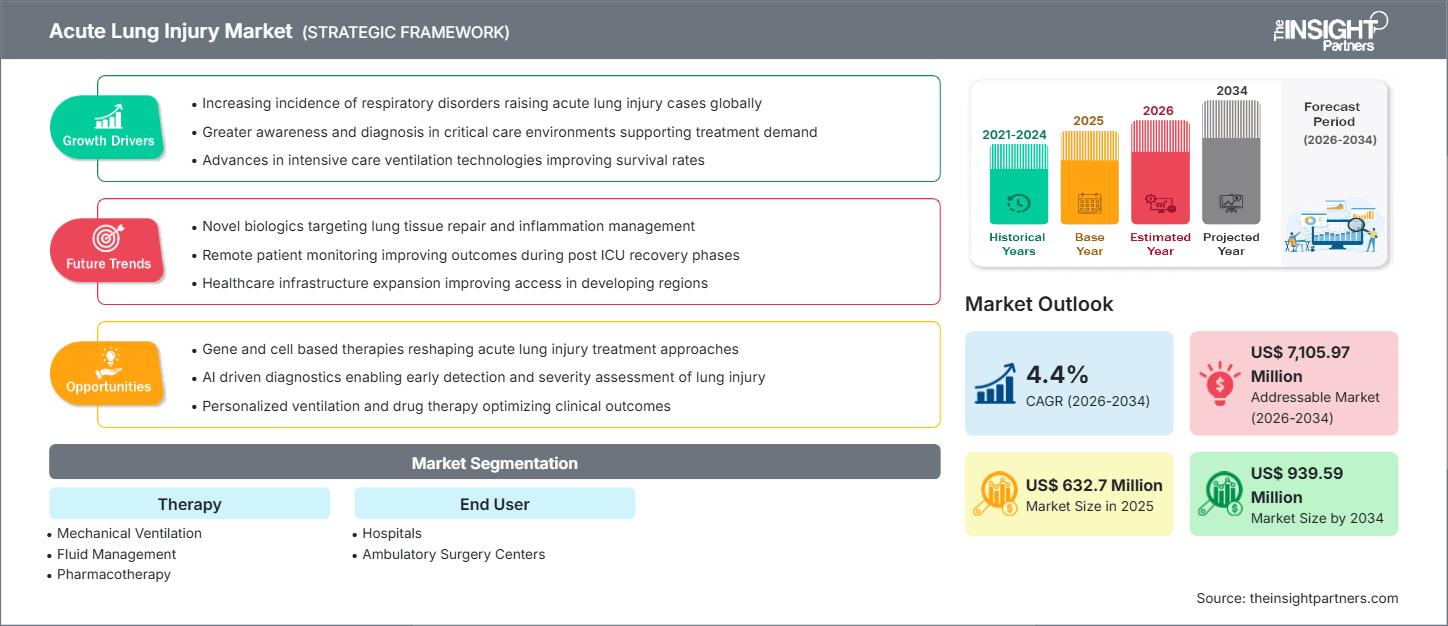
The Acute Lung Injury Market size is expected to reach US$ 939.59 million in 2034 from US$ 632.7 million in 2025. The market is anticipated to register a CAGR of 4.4% during 2026–2034.
Acute Lung Injury Market Analysis
The Acute Lung Injury (ALI) market is experiencing robust growth, primarily fueled by rising incidence of acute respiratory distress syndrome (ARDS), growing number of severe ALIs, and increasing cases of sepsis, pneumonia, and trauma worldwide. ALI therapies, such as mechanical ventilators, extracorporeal membrane oxygenation (ECMO) devices, and pharmacologic approaches, hold a key position in the intensive care unit for gas transfer and mitigating lung injuries. The evolving market is moving towards protecting the lungs with advanced ventilation practices and extracorporeal support systems to counter ventilator-induced lung injuries. Additionally, the increasing applications of ECMO from ARDS treatment for bridge therapy in lung transplant procedures will further fuel the demand. Industry players will concentrate on developing ECMO with anti-inflammatory coatings for better biocompatibility and increasing patient survival.
Acute Lung Injury Market Overview
Acute Lung Injury treatment solutions involve the use of a variety of tools and therapies aimed at facilitating the ventilation and oxygenation processes in patients who have alveolar damage. Market drivers in the sector include the adoption of precision medicine in the medical industry. Adaptive pressure modes of mechanical ventilators lead the way because the equipment can provide tidal volumes that reduce the risks of barotrauma effectively. Hospitals account for the largest market share; however, ambulatory surgical and respiratory institutes are the other markets that show promise. The market is also experiencing growth in the production of ALI treatment solutions specifically targeting newborn children who stand the greatest risks. In North America and Europe, sophisticated ALI treatment infrastructure is on the rise, leading to the adoption of highly advanced ECMO programs in large ICUs. In the Asia Pacific market, growth is driven by the mass adoption of ALI treatment solutions.
Market Assessment and Insights
- Global market for Acute Lung Injury was valued at US$ 632.70 Million in 2025
- Annual market size is expected to reach US$ 939.59 Million by 2034
- Total addressable market (TAM) during 2026-2034 is projected to reach approximately US$ 7,105.97 Million
- Market is anticipated to register a CAGR of 4.4% during the forecast period
- The United States represents a key market, supported by Increasing incidence of respiratory disorders raising acute lung injury cases globally, Greater awareness and diagnosis in critical care environments supporting treatment demand, Advances in intensive care ventilation technologies improving survival rates, as well as evolving industry dynamics
- Market analysis covers North America, Europe, Asia-Pacific, South and Central America, Middle East and Africa, with growth evaluated across the forecast period
- Market opportunities such as Gene and cell based therapies reshaping acute lung injury treatment approaches, AI driven diagnostics enabling early detection and severity assessment of lung injury, Personalized ventilation and drug therapy optimizing clinical outcomes are expected to influence market dynamics and addressable market
- Report profiles industry participants, including GlaxoSmithKline plc., Stemedica Cell Technologies, Inc, Histocell, APEPTICO Forschung und Entwicklung GmbH, Windtree Therapeutics, Inc., ReAlta Life Sciences, Inc., Apeiron Biologics AG, Qx Therapeutics, Inc., Angion, while analyzing competitive strategies and innovation developments
-
Source: The Insight Partners' analysis based on proprietary research, government publications, company annual reports, investor presentations, industry databases, and expert interviews.
● REPORT CUSTOMIZATION
Tailor This Report To Align With Your Specific Business Requirements
This report can be customized to align precisely with your business objectives, scope, and target markets. Customization options include tailored segmentation, geography, competitive analysis, and strategic insights to support informed decision-making.
Customize This Report →WHAT YOU CAN ADJUST
- ● Segmentations
- ● Geography
- ● Competitive Analysis
- ● Language Preferences
Acute Lung Injury Market: Strategic Insights
-
Get Top Key Market Trends of this report.This FREE sample will include data analysis, ranging from market trends to estimates and forecasts.
Acute Lung Injury Market Drivers and Opportunities
Market Drivers:
- High Global Burden of Respiratory Conditions: Increased cases of pneumonia and sepsis-associated ALI have driven the need for innovative ventilation strategies and ECMO in critical care units.
- Technological Advancements in Ventilation Modes: Innovations such as high-frequency oscillatory ventilation (HFOV) and neurally adjusted ventilatory assist (NAVA), thus decreasing VILI and increasing synchrony with ventilation.
- Rising ECMO Utilization: Expanded use of venovenous ECMO for refractory hypoxemia in ARDS patients creates a sustained need for integrated respiratory support systems.
Market Opportunities:
- Development of Portable and Wearable Devices: There are potential avenues for the development of compact ECMO machines as well as non-invasive ventilation systems specifically designed for transport or at home in the aftermath of ALI.
- Expansion in Emerging Markets: The improvement of the ICU infrastructure in the Asia Pacific and Latin American regions presents opportunities to develop relatively inexpensive treatments for ALI, given the rising cases of respiratory disorders caused by pollution.
- Integration of AI and Biomarkers: Smart ventilators with AI-driven weaning protocols and biomarker-guided therapies promise personalized ALI management.
Acute Lung Injury Market Report Segmentation Analysis
The Acute Lung Injury Market share is analyzed across various segments to provide a clearer understanding of its structure, growth potential, and emerging trends. Below is the standard segmentation approach used in most industry reports:
By Product:
- Mechanical Ventilator: Standard ventilators for invasive and non-invasive care, using pressure-regulated volume-controlled ventilation to prevent lung overinflation.
- Fluid Management: Fluid overload is avoided by the use of the conservative approach in managing fluids, leading to a reduction in the incidence of pulmonary edema and improving ALI recovery outcomes.
- Pharmacotherapy: Anti-inflammatory drugs and vasodilators target alveolar inflammation and disrupted gas exchange mechanisms.
- Adjunctive Procedures: Positioning the patient prone and ECMO can facilitate alveolar recruitment for patients with refractory hypoxemia cases.
By End User:
- Hospitals: The main site and location for ICUs that have provided comprehensive observation for ALI.
- Ambulatory Surgical Centers: Offer assistance with acute conditions through follow-up outpatient services.
By Geography:
- North America
- Europe
- Asia-Pacific
- South & Central America
- Middle East & Africa
Acute Lung Injury Market Report Scope
| Report Attribute | Details |
|---|---|
| Market size in 2025 | US$ 632.7 Million |
| Market Size by 2034 | US$ 939.59 Million |
| Global CAGR (2026 - 2034) | 4.4% |
| Historical Data | 2021-2024 |
| Forecast period | 2026-2034 |
| Segments Covered |
By Therapy
|
| Regions and Countries Covered |
North America
|
| Market leaders and key company profiles |
|
Acute Lung Injury Market Players Density: Understanding Its Impact on Business Dynamics
The Acute Lung Injury Market is growing rapidly, driven by increasing end-user demand due to factors such as evolving consumer preferences, technological advancements, and greater awareness of the product's benefits. As demand rises, businesses are expanding their offerings, innovating to meet consumer needs, and capitalizing on emerging trends, which further fuels market growth.
Acute Lung Injury Market Share Analysis by Geography
North America commands the largest market share, bolstered by advanced critical care networks, high ARDS incidence, and rapid adoption of ECMO protocols. Asia-Pacific is poised for the fastest growth, driven by massive populations, air pollution, and healthcare investments in countries like India and China.
North America
- Market Share: Holds the largest market share, dominated by the U.S., with its cutting-edge ICU infrastructure.
- Key Drivers:
- High ARDS prevalence from sepsis and trauma
- Robust R&D in lung-protective strategies
- Supportive reimbursement for ECMO therapies
- Trends: Growing focus on early diagnosis protocols and clinical trials targeting inflammatory lung conditions.
Europe
- Market Share: Substantial share, underpinned by universal healthcare and stringent regulatory standards.
- Key Drivers:
- Emphasis on ARDS clinical trials
- Network of specialized respiratory centers
- EU-funded innovations in ventilation tech
- Trends: Increasing adoption of lung-protective ventilation and interest in regenerative therapies.
Asia-Pacific
- Market Share: Fastest-growing region amid expanding ICU capacities.
- Key Drivers:
- Massive burden of infectious ALI cases
- Government healthcare modernization
- Rising ECMO training programs
- Trends: Expansion of ICU facilities and rising adoption of modern ventilation technologies.
South and Central America
- Market Share: Emerging with growth in major urban hospitals.
- Key Drivers:
- Increasing pneumonia and trauma incidences
- Private sector expansions
- Public health initiatives
- Trends: Transition to non-invasive ventilation in resource-limited settings.
Middle East and Africa
- Market Share: Nascent but expanding in Gulf states.
- Key Drivers:
- Oil-funded healthcare upgrades
- Medical tourism for critical care
- Awareness campaigns on ALI
- Trends: Investment in advanced critical care units and adoption of international treatment protocols.
Acute Lung Injury Market Players Density
High Market Density and Competition
The Acute Lung Injury Market is moderately fragmented, with global medtech leaders competing alongside respiratory specialists. Rivalry centers on ventilation efficiency, ECMO durability, and integration with monitoring suites over isolated products.
The competitive landscape pushes vendors to innovate via:
- Advanced algorithms mimicking natural breathing to cut weaning times and complications.
- Bundled solutions linking ventilators with ECMO for seamless ARDS escalation.
- Partnerships with trial networks to prove therapies in sepsis-ALI models.
Opportunities and Strategic Moves:
- Majors acquire startups in AI-ventilation for predictive ALI management.
- Long-term service pacts and clinician training to lock in hospital loyalty.
- Localized production to counter supply chain risks for disposables.
Major Companies Operating in the Acute Lung Injury Market Are:
- GlaxoSmithKline plc.
- Stemedica Cell Technologies, Inc
- Histocell
- APEPTICO Forschung und Entwicklung GmbH
- Windtree Therapeutics, Inc.
- ReAlta Life Sciences, Inc.
- Apeiron Biologics AG
- Qx Therapeutics, Inc.
- Angion
Disclaimer: The companies listed above are not ranked in any particular order.
Acute Lung Injury Market News and Recent Developments
- In July 2025, Merck and Verona Pharma plc, a biopharmaceutical company focused on respiratory diseases, announced that the companies have entered into a definitive agreement under which Merck, through a subsidiary, will acquire Verona Pharma for $107 per American Depository Share (ADS), each of which represents eight Verona Pharma ordinary shares, for a total transaction value of approximately $10 billion. Through this acquisition, Merck will add Ohtuvayre® (ensifentrine), a first-in-class selective dual inhibitor of phosphodiesterase 3 and 4 (PDE3 and PDE4), to its growing cardio-pulmonary pipeline and portfolio.
- In June 2025, BioAegis Therapeutics, a pioneering biotech company at the forefront of innovative therapies for inflammatory diseases, announced that the U.S. Food and Drug Administration (FDA) has granted Fast Track designation to its lead product candidate, recombinant human plasma gelsolin (rhu-pGSN), for the treatment of acute respiratory distress syndrome (ARDS). As part of the Fast Track designation, rhu-pGSN may also be made available to patients through the FDA’s Expanded Access or Compassionate Use program, offering a potential treatment option for those who are not eligible for clinical trials and have no alternative therapies.
Acute Lung Injury Market Report Coverage and Deliverables
The "Acute Lung Injury Market Size and Forecast (2021–2034)" report provides a detailed analysis of the market covering the below areas:
- Acute Lung Injury Market size and forecast at global, regional, and country levels for all the key market segments covered under the scope
- Acute Lung Injury Market trends, as well as market dynamics such as drivers, restraints, and key opportunities
- Detailed PEST and SWOT analysis
- Acute Lung Injury Market analysis covering key market trends, global and regional framework, major players, regulations, and recent market developments
- Industry landscape and competition analysis covering market concentration, heat map analysis, prominent players, and recent developments in the Acute Lung Injury Market
- Detailed company profiles.
Frequently Asked Questions

- Comprehensive Market Sizing and Forecast Analysis
- Detailed Segmentation Analysis
- In-Depth Market Dynamics Assessment
- Regional and Country-Level Insights
- Competitive Landscape and Company Benchmarking
- Strategic Business Intelligence
Recent Reports
Testimonials

The Insight Partners' SCADA System Market report is comprehensive, with valuable insights on current trends and future forecasts. The team was highly professional, responsive, and supportive throughout. We are very satisfied and highly recommend their services.
RAN KEDEM Partner, Reali Technologies LTDs
I requested a report on a very specific software market and the team produced the report in a few days. The information was very relevant and well presented. I then requested some changes and additions to the report. The team was again very responsive and I got the final report in less than a week.
JEAN-HERVE JENN Chairman, Future Analytica
We worked with The Insight Partners for an important market study and forecast. They gave us clear insights into opportunities and risks, which helped shape our plans. Their research was easy to use and based on solid data. It helped us make smart, confident decisions. We highly recommend them.
PIYUSH NAGPAL Sr. Vice President, High Beam Global
The Insight Partners delivered insightful, well-structured market research with strong domain expertise. Their team was professional and responsive throughout. The user-friendly website made accessing industry reports seamless. We highly recommend them for reliable, high-quality research services
YUKIHIKO ADACHI CEO, Deep Blue, LLC.
This is the first time I have purchased a market report from The Insight Partners.While I was unsure at first, I visited their web site and felt more comfortable to take the risk and purchase a market report.I am completely satisfied with the quality of the report and customer service. I had several questions and comments with the initial report, but after a couple of dialogs over email with their analyst I believe I have a report that I can use as input to our strategic planning process.Thank you so much for taking the extra time and making this a positive experience.I will definitely recommend your service to others and you will be my first call when we need further market data.
JOHN SUZUKI President and Chief Executive Officer, Board Director, BK Technologies
I wish to appreciate your support and the professionalism you displayed in the course of attending to my request for information regarding to infectious disease IVD market in Nigeria. I appreciate your patience, your guidance, and the fact that you were willing to offer a discount, which eventually made it possible for us to close a deal. I look forward to engaging The Insight Partners in the future, all thanks to the impression you have created in me as a result of this first encounter.
DR CHIJIOKE ONYIA MANAGING DIRECTOR, PineCrest Healthcare Ltd.Reason to Buy
- Informed Decision-Making
- Understanding Market Dynamics
- Competitive Analysis
- Identifying Emerging Markets
- Customer Insights
- Market Forecasts
- Risk Mitigation
- Boosting Operational Efficiency
- Strategic Planning
- Investment Justification
- Tracking Industry Innovations
- Aligning with Regulatory Trends






 Get Free Sample for