
Additive Manufacturing Market Size, Share & Forecast by 2034
Coverage: By Material (Plastic, Metal, Ceramics, and Others), Technology [Selective Laser Sintering (SLS), Stereolithography (SLA), Fused Deposition Modeling (FDM), and Others], and End User (Automotive, Aerospace, Healthcare, Industrial Manufacturing, and Others), and Geography (North America, Europe, Asia Pacific, and South and Central America)
- Status : Data Released
- Report Code : TIPTE100001350
- Category : Chemicals and Materials
- No. of Pages : 137
- Available Report Formats :


- Last update date : July 16, 2026


2025 Market Size
US$ 32.54 Bn
Base year value
2034 Forecast
US$ 207.41 Bn
Projected by 2034
CAGR 2026-2034
22.85 %
Growth rate
Addressable Market
US$ 940.07 Bn
(2026-2034)
The additive manufacturing market size was valued at US$ 32.54 Billion in 2025 and is projected to reach US$ 207.41 Billion by 2034, registering a CAGR of 22.85% during 2026–2034. Market expansion is being driven by rapid advances in industrial 3D printing technologies, increasing adoption of lightweight components across aerospace and automotive sectors, and growing use of customized manufacturing solutions in healthcare, industrial production, and consumer applications. Continuous improvements in printing speed, material compatibility, and software integration are further strengthening commercial adoption worldwide.
North America continues to represent the largest regional marketplace owing to strong investments in industrial automation, aerospace manufacturing, and healthcare innovation. The additive manufacturing market size in the region is expected to expand at a CAGR of 21.5–22.3% through 2034, supported by increasing deployment of metal additive manufacturing systems, government-backed advanced manufacturing initiatives, and widespread adoption of digital production technologies among leading industrial manufacturers.
Additive Manufacturing Market Assessment and Insights
- North America: Accounted for 36–40% of the additive manufacturing market share in 2025 and is anticipated to grow at a CAGR of 21.5–22.3% during 2026–2034. Strong aerospace, defense, healthcare, and industrial manufacturing sectors continue investing heavily in advanced additive manufacturing technologies.
- US: Represented 80–84% of the North American market in 2025 and is projected to expand at a CAGR of 21.8–22.6% through 2034, driven by innovation leadership and extensive industrial adoption.
- Europe: Held 27–31% share in 2025 and is forecast to register a CAGR of 22.0–22.8%. Germany, the UK, France, and Italy remain the leading contributors owing to their established automotive and industrial manufacturing bases.
- Asia Pacific: Captured 24–28% share in 2025 and is expected to record the fastest CAGR of 24.2–25.0% during 2026–2034. China, Japan, South Korea, and India continue accelerating investments in industrial digital manufacturing technologies.
- Largest Segment: Metal accounted for 44–48% of the market share in 2025 and is projected to expand at a CAGR of 23.0–23.8%, supported by increasing aerospace, defense, and medical implant production.
- High Growth Segment: Healthcare represented 18–22% market share in 2025 while advancing at a CAGR of 25.2–26.0%, driven by patient-specific implants, surgical planning models, and biocompatible medical device manufacturing.
- Key companies analyzed in detail: 3D Systems, Inc.; Stratasys Ltd.; 3T Additive Manufacturing Ltd. (formerly 3T RPD Ltd.); Arcam AB; EOS GmbH; Hubs B.V. (formerly 3D Hubs B.V.); EnvisionTEC, Inc.; ProtoCAM; Sciaky, Inc.; GPI Prototype and Manufacturing Services.
Source: The Insight Partners' analysis based on proprietary research, government publications, company annual reports, investor presentations, industry databases, and expert interviews.
Digital manufacturing techniques keep reshaping production systems in many industries through rapid prototyping, low-volume production, creation of complicated parts, and distributed manufacturing. Advancements in printing accuracy, speed of building models, automation, AI-driven design optimization, and innovative printable materials have greatly increased the use of additive manufacturing in industry. Additive manufacturing is now being adopted by manufacturers to complement their production techniques to increase supply chain agility, minimize waste, and develop new products quickly.
Increasing spending on smart factories, digitalization in industry, and resilient supply chains will fuel the growth of the Additive Manufacturing market over the long term. Developing countries keep increasing state and private funding for modern manufacturing facilities, while governments remain engaged in research initiatives on industrial innovations. Increasing sustainability in manufacturing processes, along with increasing materials and software advances, will drive commercialization during the forecast period.
Additive Manufacturing Market Report Scope
| Report Attribute | Details |
|---|---|
| Market size in 2025 | US$ 32.54 Billion |
| Market Size by 2034 | US$ 207.41 Billion |
| Global CAGR (2026 - 2034) | 22.85% |
| Historical Data | 2021-2024 |
| Forecast period | 2026-2034 |
Additive Manufacturing Market Analysis
Rapid digital transformation across manufacturing industries continues to accelerate additive manufacturing market growth, particularly as organizations seek greater production flexibility, shorter development cycles, and reduced material consumption. Aerospace, healthcare, automotive, and industrial manufacturers increasingly utilize additive manufacturing to produce lightweight components, customized products, and geometrically complex parts that cannot be manufactured economically using traditional subtractive techniques. Improvements in printable metal alloys, engineering polymers, ceramics, and composite materials are expanding commercial applications while enabling higher-performance end-use products.
The additive manufacturing value chain is constantly improving thanks to closer cooperation between printer manufacturers, software companies, material producers, engineering enterprises, and users. Cloud-based design tools, simulation software, digital twins, and automated post-processing options help increase production efficiency and decrease complexity. Material recycling opportunities and local production methods increase supply chain resilience and sustainability and drive adoption of the technology in developed and emerging countries.
Increasing competition in the market is driven by larger build sizes, faster printing, multi-material technologies, and automation in the industry. The additive manufacturing market report highlights companies such as 3D Systems, Stratasys, EOS GmbH, Arcam AB, Sciaky, EnvisionTEC, ProtoCAM, and GPI Prototype and Manufacturing Services which are constantly developing their product lines through technological advancement, partnerships, mergers and acquisitions, and expansion into regulated industries like aerospace and healthcare.
Active investment in this area of production is due to the priority of advanced manufacturing for the purpose of ensuring production capabilities and independence from supply chains. Growing demand for production-grade additive manufacturing systems, software ecosystems, and industrial materials encourages research and development in this area. More and more companies pay attention to scalable production technologies that can support mass customization and serial production of sustainable products.
● REPORT CUSTOMIZATION
Tailor This Report To Align With Your Specific Business Requirements
This report can be customized to align precisely with your business objectives, scope, and target markets. Customization options include tailored segmentation, geography, competitive analysis, and strategic insights to support informed decision-making.
Customize This Report →WHAT YOU CAN ADJUST
- ● Segmentations
- ● Geography
- ● Competitive Analysis
- ● Language Preferences
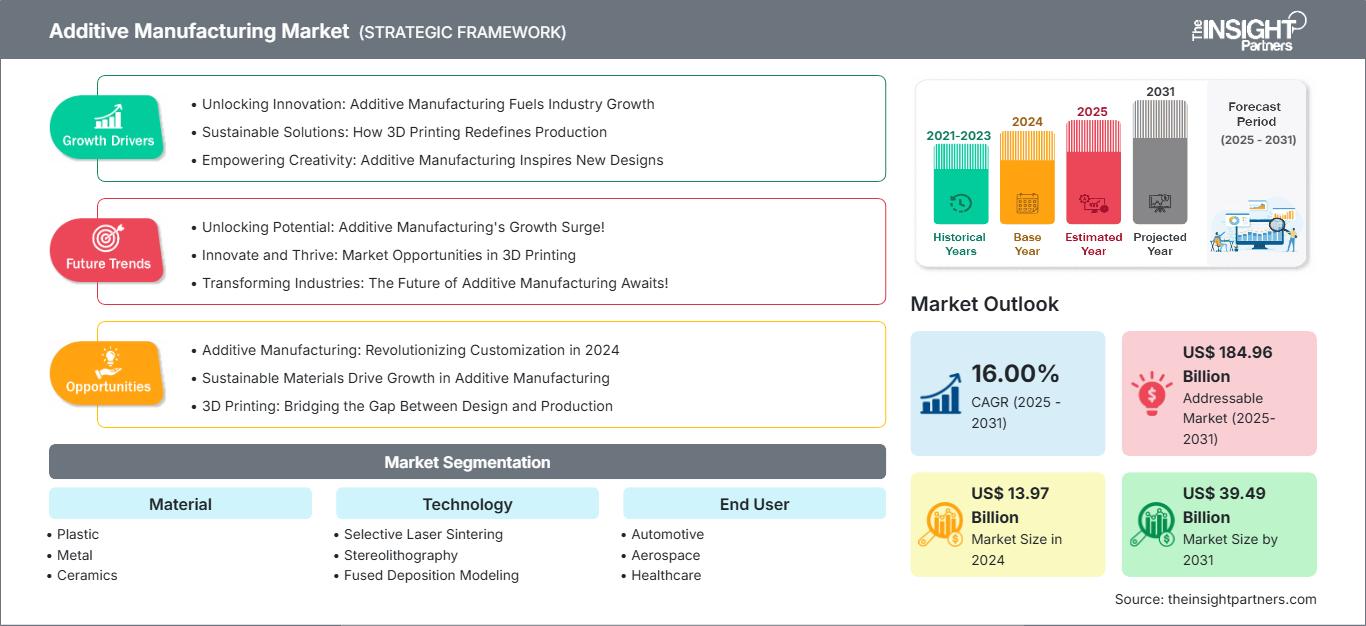
Additive Manufacturing Market: Strategic Insights
Regional Insights
North America Additive Manufacturing Market
North America accounted for 36–40% of the market in 2025 and is projected to expand at a CAGR of 21.5–22.3% during 2026–2034. The region benefits from a mature industrial ecosystem, strong aerospace and defense manufacturing capabilities, and continuous investments in digital manufacturing technologies. Government initiatives supporting advanced manufacturing, coupled with growing adoption of Industry 4.0 solutions, continue accelerating commercialization across multiple industries. Leading technology developers, printer manufacturers, software providers, and material suppliers further strengthen regional competitiveness.
The United States and Canada continue investing in industrial-scale additive manufacturing for aerospace, medical devices, automotive production, energy equipment, and defense applications. Increasing demand for lightweight components, rapid prototyping, spare-part digitization, and localized manufacturing supports sustained market expansion. Research institutions and manufacturing innovation centers collaborate extensively with private companies to develop next-generation printing technologies, advanced materials, and automated production systems that improve productivity while reducing manufacturing costs.
U.S. Additive Manufacturing Market
The United States represented 80–84% of the North American market in 2025 and is expected to register a CAGR of 21.8–22.6% through 2034. Strong adoption across aerospace, healthcare, automotive, industrial manufacturing, and defense continues driving equipment installations and material consumption. Federal manufacturing initiatives, increasing research funding, and growing commercialization of metal additive manufacturing systems further reinforce the country's leadership in advanced production technologies.
Leading companies including 3D Systems, Sciaky, ProtoCAM, and numerous aerospace manufacturers continue expanding production capabilities while investing in industrial automation and digital manufacturing platforms. Healthcare providers increasingly utilize additive manufacturing for patient-specific implants, surgical guides, and dental applications, whereas automotive manufacturers adopt the technology for lightweight components, tooling, and rapid product development. Strong venture capital investments and university-led innovation continue supporting technological advancements across the industry.
Europe Additive Manufacturing Market
Europe captured 27–31% market share in 2025 and is anticipated to grow at a CAGR of 22.0–22.8% throughout the forecast period. Germany remains the regional leader owing to its highly developed industrial manufacturing sector, followed by the United Kingdom, France, Italy, and Spain. Regional emphasis on industrial automation, sustainable manufacturing, and advanced engineering continues supporting widespread adoption across automotive, aerospace, healthcare, and machinery industries.
The United Kingdom continues expanding additive manufacturing adoption across aerospace, healthcare, motorsports, and defense sectors through increasing research investments and industrial collaborations. Germany remains Europe's largest manufacturing hub, driven by automotive production, precision engineering, industrial equipment manufacturing, and extensive Industry 4.0 implementation. France, Italy, and Spain continue strengthening regional demand through investments in aerospace manufacturing, medical technologies, industrial modernization, and advanced production capabilities, creating sustained opportunities for equipment suppliers and material manufacturers.
APAC Additive Manufacturing Market
Asia Pacific accounted for 24–28% market share in 2025 and is projected to record the fastest CAGR of 24.2–25.0% during 2026–2034. China leads regional demand, followed by Japan, South Korea, India, and Australia, supported by rapid industrialization, expanding manufacturing capacity, and strong government initiatives promoting digital manufacturing technologies.
Industrial modernization strategies, semiconductor manufacturing, automotive production, electronics manufacturing, and expanding healthcare infrastructure continue driving investments across the region. Local manufacturers increasingly adopt additive manufacturing to improve production efficiency, reduce supply chain risks, and accelerate innovation while strengthening global manufacturing competitiveness.
Middle East & Africa Additive Manufacturing Market
The Middle East & Africa is forecast to expand at a CAGR of 20.8–21.6% during the forecast period. Saudi Arabia and the United Arab Emirates lead regional adoption through investments in industrial diversification, aerospace development, healthcare modernization, and smart manufacturing initiatives. South Africa continues expanding industrial applications across mining, automotive, and engineering sectors.
Government-led economic diversification programs and infrastructure development projects continue encouraging investments in advanced manufacturing technologies. Growing adoption across energy, construction, industrial manufacturing, and healthcare industries is expected to support gradual commercialization of additive manufacturing solutions throughout the region.
Segmentation Analysis
Material
The Material segment forms the foundation of the additive manufacturing ecosystem, as material performance directly influences component quality, strength, precision, and application suitability. The additive manufacturing market scope continues expanding with continuous innovation in printable polymers, advanced metal alloys, and technical ceramics that enable increasingly complex industrial applications. The segment is projected to register a CAGR of 23.0–23.8% during 2026–2034.
- Plastic: Plastic remains extensively utilized because of its affordability, design flexibility, ease of processing, and suitability for rapid prototyping, tooling, consumer products, educational applications, and low-volume production across multiple industries.
- Metal: Metal materials dominate high-value industrial applications owing to superior mechanical strength, lightweight performance, corrosion resistance, and compatibility with aerospace, medical implant, automotive, and defense manufacturing requirements.
- Ceramics: Ceramic materials continue gaining adoption for specialized applications requiring exceptional heat resistance, chemical stability, electrical insulation, and wear resistance across electronics, healthcare, aerospace, and industrial manufacturing sectors.
Technology
Technology innovations continue improving production speed, dimensional accuracy, surface finish, automation, and material compatibility. Continuous advancements in industrial printing platforms are enabling manufacturers to transition from prototyping toward serial production, supporting a projected CAGR of 22.5–23.3% through 2034.
- Selective Laser Sintering: Selective Laser Sintering enables highly durable functional components with complex geometries and minimal material waste, making it suitable for aerospace, automotive, healthcare, and industrial production applications.
- Stereolithography: Stereolithography delivers exceptional dimensional accuracy and smooth surface finishes, supporting applications including dental devices, medical models, engineering prototypes, and precision component manufacturing.
- Fused Deposition Modeling: Fused Deposition Modeling remains widely adopted because of its cost efficiency, operational simplicity, extensive material availability, and suitability for prototyping, educational use, tooling, and low-volume manufacturing.
End User
End-user industries in the additive manufacturing market increasingly integrate additive manufacturing into production workflows to improve product customization, reduce lead times, optimize inventory management, and support lightweight engineering solutions. The segment is projected to expand at a CAGR of 24.0–24.8% throughout the forecast period.
- Automotive: Automotive manufacturers increasingly utilize additive manufacturing for lightweight parts, customized tooling, rapid prototyping, spare parts, and performance component development while reducing development costs and production timelines.
- Aerospace: Aerospace remains one of the most technologically advanced application areas, utilizing certified metal components, lightweight structural parts, fuel-efficient designs, and highly complex geometries for commercial and defense aircraft.
- Healthcare: Healthcare continues experiencing rapid adoption through customized implants, dental restorations, prosthetics, surgical guides, anatomical models, and personalized medical devices that improve patient outcomes and treatment precision.
- Industrial Manufacturing: Industrial manufacturers increasingly implement additive manufacturing for tooling, production aids, spare parts, customized equipment, maintenance operations, and flexible manufacturing systems supporting digital factory initiatives.
Opportunity Snapshot
| Segment Name | Revenue Contribution | Trend Tag | Adoption Stage |
| Automotive | High | Lightweighting | Mature |
| Aerospace | High | Flight Parts | Scaling |
| Healthcare | Medium | Personalized Care | Scaling |
| Industrial Manufacturing | High | Digital Factory | Mature |
Additive Manufacturing Market Growth Drivers and Impact Analysis
Growing demand for lightweight and complex engineered components
Aerospace firms, automakers, and machinery makers are constantly needing lightweight structures that increase the efficiency of their products and save material at the same time. Additive manufacturing provides opportunities for topology optimization as well as creating lattices that are not possible with the help of traditional subtractive technologies. There are still organizations such as NASA, the FAA, and the EASA that encourage qualification of printed parts in order to promote wider implementation of this technology. This creates increased need for advanced printers, high-quality metals and polymers, and simulation tools, which allow companies to decrease production cost, assembly time, save fuel and increase performance.
Expansion of digital manufacturing and Industry 4.0 ecosystems
The use of additive manufacturing in combination with production management systems, digital twins, industrial automation, artificial intelligence, and simulations has been increasing. This integration allows for distributed manufacturing, predictive maintenance, quick product design updates, and increased traceability and quality control. Higher investment levels in smart factories in North America, Europe, and Asia Pacific are leading to faster adoption of equipment in industrial manufacturing. Digital inventory helps save on costs related to warehousing because spare parts can be manufactured on demand.
Increasing healthcare applications for customized medical solutions
Medical professionals keep growing their application of additive manufacturing technology for the production of customized implants, prosthetics, orthodontic devices, dental appliances, surgical simulation models, and personalized medical products. The additive manufacturing market trend is driven by aging populations, growth in orthopedic surgeries, and need for customized treatment options. Advances in the field of biocompatible materials, anatomical modeling through software and regulatory framework development make the commercialization of medical printing technologies even more appealing. Hospitals, medical device manufacturers, and research facilities are working together in order to create innovations in this sphere.
Additive Manufacturing Market Future Trends
Artificial intelligence is transforming production optimization
Artificial Intelligence will become an integral part of next generation AM systems. Increasingly, machine learning algorithms are optimizing print orientations, process parameters, defect detection, and predictive maintenance along with enhancing production consistency. Trends in the AM market point to increased use of AI along with simulation software, digital twin technologies, and quality assurance systems. Companies are making investments in smart production environments that can help in reducing build failures, material waste, and certification. With increasing industrial production, AI-driven automation of the workflow will prove to be a strong competitive advantage.
Multi-material and hybrid manufacturing gaining commercial adoption
The hybrid production systems are being used by manufacturers where the combination of additive manufacturing is used along with the computer numeric controlled (CNC) milling machine and inspection and automated finishing machines. Multi-material printing has allowed for the production of parts with different mechanical, thermal, and electrical properties in one production run. Such an approach increases the flexibility of the production process and reduces the complexity of assembling the products as well as lowering production costs. The equipment makers are developing bigger build stations, more productive machines, and process monitoring tools.
Multi-material and hybrid manufacturing gaining commercial adoption
Manufacturers are increasingly deploying hybrid production systems that combine additive manufacturing with CNC machining, inspection technologies, and automated finishing processes. Simultaneously, multi-material printing capabilities are expanding opportunities to produce components with varying mechanical, thermal, and electrical properties within a single build cycle. These innovations improve manufacturing flexibility while reducing assembly complexity and production costs. Equipment suppliers continue investing in larger build platforms, higher productivity systems, and advanced process monitoring technologies, enabling additive manufacturing to support higher-volume commercial production across diverse industrial sectors.
Additive Manufacturing Market Opportunities
Localized digital manufacturing networks create new investment avenues
Manufacturing regions have been exploring localized manufacturing capabilities in order to build resilient supply chains and minimize dependency on foreign suppliers. Additive Manufacturing Market forecast reveal great potential in establishing distributed manufacturing networks through cloud-enabled production systems and digitally verified inventories. Equipment companies, software providers, and service organizations can generate additional income through decentralized manufacturing platforms catering to clients in aerospace, defense, healthcare, and industrial sectors. Moreover, development of regional manufacturing facilities will allow faster shipping, cost-effective logistics, and flexibility to cater to varying demands of the customers.
Expansion into energy and semiconductor manufacturing applications
There are some new applications in energy generation, semiconductors manufacturing equipment, electronics cooling systems, hydrogen technology infrastructure, and next-generation power systems that have promising growth potential in the future. Additive manufacturing can create extremely complicated heat exchangers, custom fluid pathways, tools, and light-weighted structures. With the continuous investment in energy transition all over the world, manufacturers who can develop approved materials and manufacturing methods for such challenging applications will get commercial benefits out of it. Cooperation between equipment suppliers, R&D centers, and industrial manufacturers is expected to facilitate the commercialization process of these technologies.
Recent Developments
- April 2026: EOS GmbH acquired Metalpine GmbH, a producer of high-quality metal powders, after previously holding a strategic equity stake in the company. The acquisition strengthens EOS' vertically integrated materials portfolio, expands access to premium titanium powders produced using Metalpine's patented atomization technology, and enhances supply chain resilience for aerospace, medical, and industrial additive manufacturing applications.
- April 2026: Stratasys Ltd. expanded its PolyJet portfolio by introducing the J850 Core 3D printer alongside new software applications and advanced printing materials designed for industrial and medical manufacturing. The launch improves accessibility to multi-material functional prototyping, streamlines production workflows, and supports broader adoption of additive manufacturing across engineering, healthcare, and industrial production environments.
Frequently Asked Questions

- Comprehensive Market Sizing and Forecast Analysis
- Detailed Segmentation Analysis
- In-Depth Market Dynamics Assessment
- Regional and Country-Level Insights
- Competitive Landscape and Company Benchmarking
- Strategic Business Intelligence
Recent Reports
Testimonials

The Insight Partners' SCADA System Market report is comprehensive, with valuable insights on current trends and future forecasts. The team was highly professional, responsive, and supportive throughout. We are very satisfied and highly recommend their services.
RAN KEDEM Partner, Reali Technologies LTDs
I requested a report on a very specific software market and the team produced the report in a few days. The information was very relevant and well presented. I then requested some changes and additions to the report. The team was again very responsive and I got the final report in less than a week.
JEAN-HERVE JENN Chairman, Future Analytica
We worked with The Insight Partners for an important market study and forecast. They gave us clear insights into opportunities and risks, which helped shape our plans. Their research was easy to use and based on solid data. It helped us make smart, confident decisions. We highly recommend them.
PIYUSH NAGPAL Sr. Vice President, High Beam Global
The Insight Partners delivered insightful, well-structured market research with strong domain expertise. Their team was professional and responsive throughout. The user-friendly website made accessing industry reports seamless. We highly recommend them for reliable, high-quality research services
YUKIHIKO ADACHI CEO, Deep Blue, LLC.
This is the first time I have purchased a market report from The Insight Partners.While I was unsure at first, I visited their web site and felt more comfortable to take the risk and purchase a market report.I am completely satisfied with the quality of the report and customer service. I had several questions and comments with the initial report, but after a couple of dialogs over email with their analyst I believe I have a report that I can use as input to our strategic planning process.Thank you so much for taking the extra time and making this a positive experience.I will definitely recommend your service to others and you will be my first call when we need further market data.
JOHN SUZUKI President and Chief Executive Officer, Board Director, BK Technologies
I wish to appreciate your support and the professionalism you displayed in the course of attending to my request for information regarding to infectious disease IVD market in Nigeria. I appreciate your patience, your guidance, and the fact that you were willing to offer a discount, which eventually made it possible for us to close a deal. I look forward to engaging The Insight Partners in the future, all thanks to the impression you have created in me as a result of this first encounter.
DR CHIJIOKE ONYIA MANAGING DIRECTOR, PineCrest Healthcare Ltd.Reason to Buy
- Informed Decision-Making
- Understanding Market Dynamics
- Competitive Analysis
- Identifying Emerging Markets
- Customer Insights
- Market Forecasts
- Risk Mitigation
- Boosting Operational Efficiency
- Strategic Planning
- Investment Justification
- Tracking Industry Innovations
- Aligning with Regulatory Trends





 Get Free Sample for