
Adhesive Equipment Market Size, Trends & Demand by 2034
Coverage: By Product (Industrial Hot Melt Adhesive Equipment, Adhesive Controllers, Cold Glue Applicator, Pneumatic Adhesive Applicator, Adhesive Pumping Systems, Adhesive Application Guns); Application (Packaging, Construction, Electronics, Healthcare, Textiles, Others), and Geography (North America, Europe, Asia Pacific, and South and Central America)
- Status : Data Released
- Report Code : TIPRE00018737
- Category : Manufacturing and Construction
- No. of Pages : 150
- Available Report Formats :


- Last update date : July 13, 2026


2025 Market Size
US$ 24.08 Bn
Base year value
2034 Forecast
US$ 34.31 Bn
Projected by 2034
CAGR 2026-2034
4.01 %
Growth rate
Addressable Market
US$ 265.16 Bn
(2026-2034)
The adhesive equipment market size is projected to grow from US$ 24.08 Billion in 2025 to US$ 34.31 Billion by 2034, registering a CAGR of 4.01% during 2026–2034. Demand is linked to equipment that provides controlled bonding, sealing, coating, and dispensing in the packaging industry, the construction industry, the electronics industry, the healthcare sector, and textiles, where there is an emphasis on accuracy and reduction of wastage.
The adhesive equipment market forecast indicates that North America is expected to record a 3.5–3.9% CAGR, as packaging automation, medical device assembly, and reshoring-linked manufacturing upgrades drive demand. There is an abundance of programmable controllers, hot melt, and precision dispensing technology in the area, whereas food packaging specifications and electronics miniaturization keep driving the development of closed loop adhesive application technology.
Adhesive Equipment Market Assessment and Insights
- North America held 26–29% share in 2025 and is projected to grow at a 3.5–3.9% CAGR during 2026–2034, supported by automated packaging, healthcare assembly, and precision dispensing upgrades.
- The US accounted for 78–82% of North America in 2025 and is expected to grow at a 3.6–4.0% CAGR, led by packaging, electronics, and medical device manufacturing.
- Europe represented 22–25% share in 2025 and is projected to grow at a 3.2–3.6% CAGR, with Germany, the UK, France, Italy, and Spain leading equipment adoption.
- Asia Pacific held 34–38% share in 2025 and is expected to grow at a 4.6–5.1% CAGR, led by China, Japan, South Korea, India, and Australia.
- Largest Segment: Packaging held 35–39% adhesive equipment market share in 2025 and is projected to grow at a 4.0–4.4% CAGR due to high-speed carton, flexible packaging, and labeling lines.
- High Growth Segment: Electronics held 12–15% market share in 2025 and is forecast to grow at a 5.0–5.5% CAGR as micro-dispensing and protective bonding needs rise.
- Key companies analyzed in detail: 3M Company, Dymax Corporation, Glue Machinery Corporation, The Gluefast Company, Graco Inc., Henkel AG & Co. KGaA, Illinois Tool Works Inc., Nordson Corporation, Robatech AG, Valco Cincinnati Inc.
Source: The Insight Partners' analysis based on proprietary research, government publications, company annual reports, investor presentations, industry databases, and expert interviews.
The adhesive equipment market has moved from manual glue guns and basic tanks toward programmable hot melt platforms, servo-driven applicators, and adhesive controllers that can synchronize bead patterns with high-speed lines. Today, packaging converters need more rapid changeovers as well as reduced glue usage, while the electronics and healthcare industries seek consistent micro-dispensing. This trend has resulted in the shift of value from isolated machines to integrated solutions comprised of pumps, nozzles, heaters, sensors, and predictive maintenance based on data analytics.
As far as future trends go, new manufacturing hubs in India, Southeast Asia, and the Middle East will create wider application areas thanks to increased investments in packaging, infrastructure, and consumer goods. In addition, the trend towards reduced volatile organic compounds content and increased product traceability will play to the advantage of systems capable of working with such adhesives, as well as energy-saving heating.
Adhesive Equipment Market Report Scope
| Report Attribute | Details |
|---|---|
| Market size in 2025 | US$ 24.08 Billion |
| Market Size by 2034 | US$ 34.31 Billion |
| Global CAGR (2026 - 2034) | 4.01% |
| Historical Data | 2021-2024 |
| Forecast period | 2026-2034 |
Adhesive Equipment Market Analysis
Demand is centered around packaging applications where hot melt technology enhances production speed, carton sealing, and material management. E-commerce, food delivery, and medical packaging drive the demand for bead deposition and quick cure properties. In addition, analysis of the Adhesive Equipment Market highlights increased demand in electronics assembly because of high precision required for miniaturization, protective coating, and battery module.
The value chain in the adhesive equipment market report includes adhesive formulators, equipment manufacturers, automation integrators, component suppliers, and end users. Supply dynamics can be affected by the presence of stainless steel parts, heaters, pumps, sensors, and controller electronics. Users are more interested in lifecycle cost, maintenance accessibility, availability of replacement parts, and suitability with various types of adhesives.
The competitive environment is relatively concentrated at the high-end segment, wherein Nordson Corporation, Graco Inc., Henkel AG & Co. KGaA, Illinois Tool Works Inc., Robatech AG, and Valco Cincinnati Inc. operate in terms of the extent of automation, application engineering, and global service. Dymax Corporation and 3M Company offer strength to specific light-curing and bonding solutions.
Investment trends are shifting toward smart applicators, closed-loop temperature control, robotic dispensing cells, and quality inspection integration. Strategic positioning depends on helping customers reduce adhesive waste, improve uptime, and document process consistency. The adhesive equipment market will likely favor suppliers that combine equipment, software diagnostics, and application support across packaging, electronics, and regulated healthcare production.
● REPORT CUSTOMIZATION
Tailor This Report To Align With Your Specific Business Requirements
This report can be customized to align precisely with your business objectives, scope, and target markets. Customization options include tailored segmentation, geography, competitive analysis, and strategic insights to support informed decision-making.
Customize This Report →WHAT YOU CAN ADJUST
- ● Segmentations
- ● Geography
- ● Competitive Analysis
- ● Language Preferences
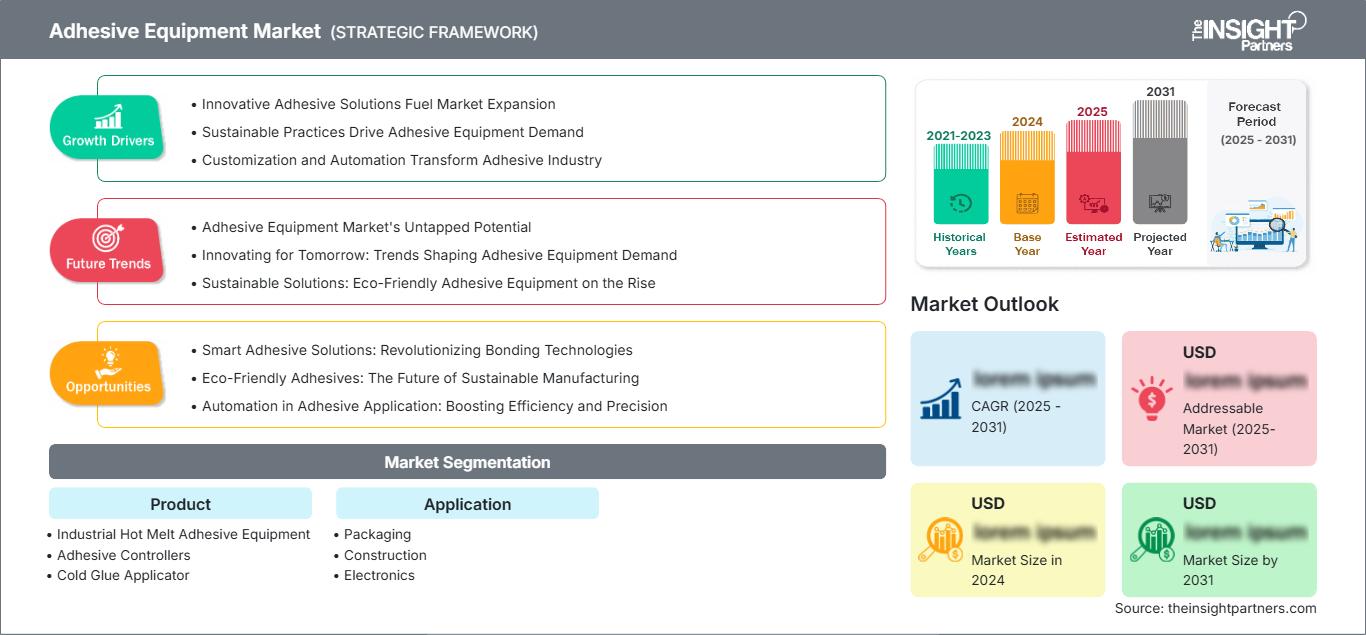
Adhesive Equipment Market: Strategic Insights
Regional Insights
North America Adhesive Equipment
North America accounted for 26–29% adhesive equipment market share in 2025 and is projected to grow at a 3.5–3.9% CAGR. The demand is backed by packaging automation, medical device manufacturing, and investment in domestic manufacturing capabilities. Equipment upgrade consists of hot melt systems, bead detection, and adhesive controllers minimizing downtime in large volume manufacturing.
The structural factors consist of e-commerce packaging, food safety standards, and precision electronic assembly. The growth of the adhesive equipment market in the region is further boosted by well-established maintenance environment and customer favorability towards programmable equipment enhancing production line consistency. The suppliers having field services have an edge where unscheduled shutdowns incur high production costs.
U.S. Adhesive Equipment Market
The US represented 78–82% of North America in 2025 and is expected to grow at a 3.6–4.0% CAGR. Packaging, electronics, healthcare, and construction products create broad application density. Local presence of Nordson Corporation, Graco Inc., 3M Company, and Valco Cincinnati Inc. supports faster technical assistance and replacement-part availability.
Application trends indicate an increase in demand for carton sealing machinery, medical wearables assembly machinery, and dispensing systems for electronics modules. Equipment makers are focusing on process information, reduction in adhesive application, and equipment for multiple formulation. This helps the US Adhesive Equipment Market maintain its position in productivity, compliance, and high-mix manufacturing.
Europe Adhesive Equipment Market
Europe held 22–25% adhesive equipment market share in 2025 and is projected to grow at a 3.2–3.6% CAGR. Germany takes the lead in regional acceptance on account of machinery, automotive parts, electronics, and industrial packaging. Consumers focus on energy-saving, safe handling, and suitability for reduced emission adhesive systems.
The UK demand comes from corrugated packaging, construction refurbishment, and medical devices assembly. Replacements come from automation in food logistics, retail delivery and pharmaceutical packaging, where the consistency of adhesive patterns decreases reject rate and provides documentation evidence.
In France, Italy, and Spain the consumers include consumer goods, textiles, and construction materials, with Germany taking the lead once again. Sustainability policies, circular packaging goals, and factory upgrades define European adhesive equipment trends towards precision dosing and low energy hot melt dispensers.
APAC Adhesive Equipment Market
APAC held 34–38% share in 2025 and is forecast to grow at a 4.6–5.1% CAGR, making it the fastest regional contributor. In terms of packaging, electronics, home appliances, and construction materials, China is the leader, thanks to advanced manufacturing enclaves and automation investments.
Precision dispensing in electronics, batteries, and medical parts is promoted by Japan and South Korea. India has been increasing the use of adhesive equipment in corrugated boxes, textiles, and construction materials, while Australia promotes demand with food processing, mining products, and construction product manufacturing.
Government policies that emphasize manufacturing localization and export competitiveness increase the need for automated adhesive systems. The increase in the regional size of adhesive equipment is associated with volume production facilities, experienced integration services, and the need to minimize adhesive wastage without reducing output.
Middle East & Africa Adhesive Equipment Market
Middle East & Africa is projected to grow at a 3.8–4.3% CAGR, with Saudi Arabia leading demand through infrastructure, packaging, and industrial diversification programs. The UAE adds demand from logistics, food packaging, and construction materials manufacturing.
South Africa is still a key market for packages, consumer goods, and construction products. The rest of MEA requires more project-specific needs, such as equipment purchases related to new facilities, maintenance, and modular adhesive applicator systems as imports.
Investments in energy and infrastructure will boost the demand for bonding adhesives, insulating adhesives, panels, and packaging lines. Equipment suppliers offering durable equipment, fast response, and operator training have an edge in this region, where heat, dust, and part shortages impact productivity.
Segmentation Analysis
Product
The product segment in the adhesive equipment market is projected to grow at a 3.9–4.3% CAGR during 2026–2034 as buyers replace standalone tools with integrated melters, controllers, pumps, and applicators. Adoption is strongest where line speed, adhesive savings, and consistent bonding quality directly influence production economics. Modular systems are preferred because they support different adhesive chemistries and maintenance schedules.
- Industrial Hot Melt Adhesive Equipment remains central in packaging, hygiene, woodworking, and assembly operations because rapid curing supports high throughput, clean application, and lower solvent exposure.
- Adhesive Controllers are strategically important as manufacturers seek programmable bead patterns, temperature stability, and process data for automated quality control across fast-moving production lines.
- Cold Glue Applicator demand is steady in paperboard, labeling, and carton applications where water-based adhesives provide cost efficiency, bond reliability, and compatibility with recyclable substrates.
- Pneumatic Adhesive Applicator systems serve manufacturers needing controlled manual or semi-automated dispensing, especially in construction products, furniture, repair, and lower-volume assembly settings.
- Adhesive Pumping Systems support bulk handling, viscosity control, and continuous supply, making them essential for plants seeking fewer refill interruptions and stable flow rates.
- Adhesive Application Guns remain important for line-side flexibility, maintenance tasks, and specialty bonding where operators require targeted placement, ergonomic handling, and quick setup.
Application
The application segment in the adhesive equipment market is projected to grow at a 4.0–4.5% CAGR during 2026–2034, led by packaging and accelerated by electronics and healthcare assembly. Users evaluate equipment by uptime, dosing precision, adhesive compatibility, and ease of integration with robots or conveyors. The adhesive equipment Market growth outlook improves where bonding replaces mechanical fastening or improves product aesthetics.
- Packaging generates the largest demand because carton sealing, case forming, flexible packaging, and labeling lines need rapid adhesive application with minimal downtime and repeatable bond strength.
- Construction uses adhesive equipment for panels, insulation, flooring, windows, sealants, and prefabricated components where bonding improves assembly speed and reduces visible mechanical fasteners.
- Electronics is strategically important because miniaturization, battery modules, sensors, and circuit protection require accurate dispensing, controlled curing, and low-contamination application environments.
- Healthcare demand is driven by medical device assembly, wound care, diagnostics, and wearable products where process validation, biocompatible adhesives, and precise dosing are essential.
- Textiles use adhesive equipment for lamination, technical fabrics, footwear, and nonwoven applications, with demand linked to automation, material flexibility, and consistent coating quality.
Opportunity Snapshot
| Application | Revenue Contribution | Trend Tag | Adoption Stage |
| Packaging | High | Smart Cartons | Mature |
| Construction | Medium | Prefab Panels | Scaling |
| Electronics | Medium | Micro Dispensing | Scaling |
| Healthcare | Medium | Wearable Devices | Scaling |
| Textiles | Low | Technical Fabrics | Emerging |
Adhesive Equipment Market Growth Drivers and Impact Analysis
Packaging Automation and Throughput Pressure
The packaging plants are improving line speeds despite the challenges in labor, SKU variety, and higher packaging quality standards. The equipment helps in achieving the above needs through provision of uniform bead formation, fast curing times, and fewer rejects in corrugated containers, cartons, labels, and flexible packages. The automated hot melt machines and controls help in minimizing excessive use of adhesives that result in increased cost efficiency and sustainability. The increasing need for high quality packaging in retail, food, and healthcare industries makes the investments in equipment more productive than maintenance costs.
Precision Needs in Electronics and Medical Devices
Increasingly, electronics and medical industries have to adopt micro dispensing, curing, and process tracking solutions. The adhesive system should be capable of handling tiny shot volumes, sensitive substrates, and validated manufacturing processes with no risk of contamination and inconsistency in bonding. The driver plays a significant role in driving the need for UV cure technology, pneumatic dispensers, precision pumps, and closed loop controllers. The industry most affected includes wearable products, diagnostic equipment, sensors, and battery packs.
Shift from Mechanical Fastening to Bonded Assembly
Some manufacturers have adopted adhesives to replace screws, rivets, and welding in certain applications due to reasons like reducing weight, improving appearance, stress distribution, and ease of assembly. Adhesive application equipment makes this possible through the controlled application of adhesives on different surfaces including metals, plastics, composites, fabrics, and construction materials. It can be seen in the construction panels, assembling of home appliances, electronic enclosures, and special packaging. Equipment manufacturers gain when customers design using bonding technology.
Adhesive Equipment Market Future Trends
Connected Dispensing Cells
Future systems will increasingly combine dispensing hardware with sensors, machine vision, and production analytics. Instead of only applying adhesive, equipment will verify bead position, monitor temperature, flag nozzle blockage, and record process data for audits. This trend will matter most in electronics, healthcare, and premium packaging where traceability improves customer confidence. Suppliers that offer open connectivity and predictive maintenance tools can strengthen long-term service revenue and reduce customer downtime.
Low-Emission Adhesive Compatibility
The adhesive equipment market trend is increasingly shaped by regulatory and customer demand for lower-emission, bio-based, and recyclable packaging-compatible adhesives. This shift is driving new equipment design requirements for precise temperature control, efficient material handling, and advanced cleaning systems that preserve adhesive performance while reducing waste. Manufacturers are focusing on validating compatibility across diverse adhesive formulations and substrates to ensure reliable operation. As sustainable adhesive chemistries become more widely adopted, demand for premium dispensing equipment will grow because consistent viscosity, strong bonding quality, and high production throughput depend on advanced equipment capabilities.
Adhesive Equipment Market Opportunities
Aftermarket Services and Retrofit Programs
A large installed base of older melters, pumps, hoses, and manual applicators creates a clear retrofit opportunity. Manufacturers can upgrade controllers, add sensors, improve nozzle technology, and integrate data logging without replacing full production lines. This approach appeals to cost-sensitive plants that need measurable efficiency gains and shorter payback periods. Service-led suppliers can capture recurring revenue through preventive maintenance, spare parts, operator training, and application audits.
Localized Solutions for Emerging Manufacturing Hubs
Emerging manufacturing hubs need durable, modular, and serviceable adhesive systems suited to varied power quality, operator skill levels, and adhesive availability. Suppliers can win by offering localized training, compact systems, financing options, and regional spare-part inventory. India, Southeast Asia, Saudi Arabia, and parts of Africa present opportunities where packaging, construction materials, and consumer goods plants are expanding. The opportunity is strongest for companies that balance global engineering with local support.
Recent Developments
- July 2025: Nordson Corporation — reported launch activity around an AutoJet 2650+ spray system with enhanced electrostatic atomization for improved coating uniformity in thin-film adhesive applications, indicating continued focus on precision electronics manufacturing and process consistency.
- June 2025: Henkel AG & Co. KGaA — introduced a collaborative robot dispensing cell using Loctite two-component adhesives, combining plug-and-play integration with real-time viscosity monitoring for prototype and small-batch production environments.
- April 2025: Valco Cincinnati Inc. — released VisionXpert technology that embeds machine-vision sensing into adhesive heads to verify bead placement and dimensions, targeting reduced rework and waste in plastic assembly and packaging applications.
Frequently Asked Questions

- Comprehensive Market Sizing and Forecast Analysis
- Detailed Segmentation Analysis
- In-Depth Market Dynamics Assessment
- Regional and Country-Level Insights
- Competitive Landscape and Company Benchmarking
- Strategic Business Intelligence
Recent Reports
Testimonials

The Insight Partners' SCADA System Market report is comprehensive, with valuable insights on current trends and future forecasts. The team was highly professional, responsive, and supportive throughout. We are very satisfied and highly recommend their services.
RAN KEDEM Partner, Reali Technologies LTDs
I requested a report on a very specific software market and the team produced the report in a few days. The information was very relevant and well presented. I then requested some changes and additions to the report. The team was again very responsive and I got the final report in less than a week.
JEAN-HERVE JENN Chairman, Future Analytica
We worked with The Insight Partners for an important market study and forecast. They gave us clear insights into opportunities and risks, which helped shape our plans. Their research was easy to use and based on solid data. It helped us make smart, confident decisions. We highly recommend them.
PIYUSH NAGPAL Sr. Vice President, High Beam Global
The Insight Partners delivered insightful, well-structured market research with strong domain expertise. Their team was professional and responsive throughout. The user-friendly website made accessing industry reports seamless. We highly recommend them for reliable, high-quality research services
YUKIHIKO ADACHI CEO, Deep Blue, LLC.
This is the first time I have purchased a market report from The Insight Partners.While I was unsure at first, I visited their web site and felt more comfortable to take the risk and purchase a market report.I am completely satisfied with the quality of the report and customer service. I had several questions and comments with the initial report, but after a couple of dialogs over email with their analyst I believe I have a report that I can use as input to our strategic planning process.Thank you so much for taking the extra time and making this a positive experience.I will definitely recommend your service to others and you will be my first call when we need further market data.
JOHN SUZUKI President and Chief Executive Officer, Board Director, BK Technologies
I wish to appreciate your support and the professionalism you displayed in the course of attending to my request for information regarding to infectious disease IVD market in Nigeria. I appreciate your patience, your guidance, and the fact that you were willing to offer a discount, which eventually made it possible for us to close a deal. I look forward to engaging The Insight Partners in the future, all thanks to the impression you have created in me as a result of this first encounter.
DR CHIJIOKE ONYIA MANAGING DIRECTOR, PineCrest Healthcare Ltd.Reason to Buy
- Informed Decision-Making
- Understanding Market Dynamics
- Competitive Analysis
- Identifying Emerging Markets
- Customer Insights
- Market Forecasts
- Risk Mitigation
- Boosting Operational Efficiency
- Strategic Planning
- Investment Justification
- Tracking Industry Innovations
- Aligning with Regulatory Trends





 Get Free Sample for