
Aerospace Tube Assemblies Market Trends, Demand & Growth by 2034
Coverage: by Type (Fuel System, Hydraulic System, Instrumentation, Others); Application (Commercial Aircraft, General Aviation, Helicopter, Military Aircraft, Others) , and Geography (North America, Europe, Asia Pacific, and South and Central America)
- Status : Data Released
- Report Code : TIPRE00010508
- Category : Aerospace and Defense
- No. of Pages : 150
- Available Report Formats :


- Last update date : October 30, 2026


2025 Market Size
US$ 1.32 Bn
Base year value
2034 Forecast
US$ 2.36 Bn
Projected by 2034
CAGR 2026-2034
6.68 %
Growth rate
Addressable Market
US$ 16.64 Bn
(2026-2034)
The Aerospace tube assemblies market is valued at US$ 1.32 Billion in 2025 and is projected to reach US$ 2.36 Billion by 2034, expanding at a CAGR of 6.68% during 2026–2034. The market covers engineered tube assemblies used to transport fuel, hydraulic fluids, and instrumentation media across commercial aircraft, general aviation platforms, helicopters, and military aircraft. Demand is shaped by aircraft production, fleet replacement, fluid-system reliability requirements, lightweighting, and the need for qualified components capable of operating under pressure, vibration, temperature, and corrosive environmental conditions.
North America remains a structurally important production and aftermarket hub, supported by aircraft OEM activity, defense procurement, MRO infrastructure, and an established supplier ecosystem. The aerospace tube assemblies market size is supported by recurring replacement demand as well as new-build aircraft requirements. A modeled regional CAGR of ~7% through 2034 reflects aircraft production recovery, defense fleet modernization, and continued demand for high-integrity fluid-management systems.
Aerospace Tube Assemblies Market Assessment and Insights
Regional Outlook
- North America: ~34% of the global market in 2025 | ~7% CAGR through 2034. Market position: North America holds the largest regional position, supported by extensive commercial and military aircraft manufacturing, established MRO networks, defense programs, and concentrated demand for qualified fuel, hydraulic, and instrumentation assemblies.
- US: ~88% of North American market revenue in 2025 | ~7% CAGR through 2034. Market position: The US represents the principal North American demand center because of its large aerospace manufacturing base, military fleet, aftermarket infrastructure, and concentration of aircraft-system suppliers serving OEM and replacement programs.
- Europe: ~29% of the global market in 2025 | ~6% CAGR through 2034. Market position: Europe has a mature aerospace manufacturing ecosystem centered on France, Germany, the UK, Italy, and Spain. France is the leading country in Europe, supported by commercial aircraft production, defense programs, and specialized aerospace component manufacturing.
- Asia Pacific: ~24% of the global market in 2025 | ~8% CAGR through 2034. Market position: Asia Pacific is the fastest-growing region, supported by fleet expansion, rising air traffic, localized aerospace manufacturing, and increasing aircraft-system demand across China, Japan, South Korea, India, and Australia.
Segment Outlook
- Hydraulic System: ~48% Share in 2025 | ~6% CAGR through 2034. Market position: Hydraulic systems lead because aircraft flight controls, landing gear, braking, actuation, and other critical functions require dependable fluid conveyance. Tube assemblies must maintain dimensional integrity and leak resistance under high pressure and repeated thermal and mechanical cycling.
- Military Aircraft: ~23% Share in 2025 | ~8% CAGR through 2034. Market position: Military aircraft represent the high-growth main segment as fleet modernization, defense procurement, mission-system upgrades, and readiness requirements increase demand for durable fluid-management assemblies across fighters, transport aircraft, helicopters, and specialized platforms.
Competitive Coverage
Ametek, Inc., Eaton Corporation, Flexfab, Leggett and Platt, Inc., Parker Hannifin Corporation, PFW Aerospace GmbH, Smiths Group plc, STEICO Industries Inc., STELIA Aerospace, Titeflex, Senior plc, Unison Industries
Methodology
The Insight Partners follows Data Collection & Secondary Research, Primary Research, Data Analysis, and Data Triangulation & Final Review to validate market estimates and insights.
Source: The Insight Partners' analysis based on proprietary research, government publications, company annual reports, investor presentations, industry databases, and expert interviews.
Aerospace tube assemblies market have moved from being fairly standard metallic tubes used to move fluids around the plane towards being engineered assemblies that focus on light weight, ease of assembly, pressure control, heat resistance, and long-term maintainability. Production projects now need suppliers to provide assemblies with approved material, accurate bending, fittings, connections, coatings, and traceability. The commercial aircraft assembly increases in production rate become relevant since each aircraft requires much fuel, hydraulic, pneumatic, and instrumentation tubing assembly. In 2025, Airbus has 793 commercial aircraft deliveries and end-of-year backlog of 8,754 aircraft.
Looking into the future, the factors influencing tube assembly supplier selection include manufacturing localization, fleet upgrade, defense spending, and increase of aircraft final assembly capacity in Asia and North America. Airbus expands industrial capacity in Mobile and Tianjin and introduces a new A320 Family final assembly line in Toulouse in 2026. This is supported by the capacity increase at Tianjin as well that helps Airbus with the localized production in China. Also, Boeing's forecast for 2026 shows a trend towards further fleet growth and replacement up until 2045.
Aerospace Tube Assemblies Market Report Scope
| Report Attribute | Details |
|---|---|
| Market size in 2025 | US$ 1.32 Billion |
| Market Size by 2034 | US$ 2.36 Billion |
| Global CAGR (2026 - 2034) | 6.68% |
| Historical Data | 2021-2024 |
| Forecast period | 2026-2034 |
Aerospace Tube Assemblies Market Analysis
Aerospace tube assemblies market is propelled by the need for safe and secure flow of fuel, hydraulic fluid and instrumentation media through limited airplane design architectures. Demand increases as more airplanes are produced, but demand for replacement and retrofits also becomes an important ongoing avenue. Pressure pulse, vibration, temperature cycle and cyclic actuation are some of the challenges that have to be overcome for hydraulic applications, and leak tightness, compatibility, flame retardancy and routeability for fuel system applications. Instrumentation assemblies function to sense and monitor and require dimensional accuracy and reliable joints.
The supply chain starts with aerospace grade metal and polymer materials, followed by tube forming, bending, machining, assembling, fittings, protection and inspection. Coordination with the airplane manufacturers is vital since tube design is highly dependent on airplane architecture. Manufacturing constraints may come from material supply, special machining capability, qualification requirement or shortages among suppliers of other components. Growth in production of airplanes makes this coordination even more important.
As per the Aerospace tube assemblies market report, competitive pressures merge comprehensive aerospace system portfolios with expert knowledge of flexible and rigid fluid management products. Parker Hannifin Corporation competes in motion and control technologies, whereas Eaton Corporation caters to the needs of aerospace fluids and mission systems. Smiths Group plc via Flex-Tek and Titeflex provides rigid and flexible tubing and ducting for the conveyance of aerospace fluids. PFW Aerospace GmbH and STELIA Aerospace provide specialized aerospace manufacturing capabilities, whereas Ametek, Flexfab, Leggett and Platt, STEICO Industries Inc., and Senior plc provide additional engineered components.
Investments are increasingly targeted at capacity, program positioning, and portfolio diversification as opposed to simple product growth. Parker has reported that its Aerospace Systems unit saw an 18% order rate increase in its fiscal 2026 fourth quarter, along with a record backlog for the company as a whole, and in addition, its acquisition agreement for 2026 with CIRCOR for the commercial and defense aerospace business strengthens its flow control capabilities on flight critical systems.
● REPORT CUSTOMIZATION
Tailor This Report To Align With Your Specific Business Requirements
This report can be customized to align precisely with your business objectives, scope, and target markets. Customization options include tailored segmentation, geography, competitive analysis, and strategic insights to support informed decision-making.
Customize This Report →WHAT YOU CAN ADJUST
- ● Segmentations
- ● Geography
- ● Competitive Analysis
- ● Language Preferences
Aerospace Tube Assemblies Market: Strategic Insights
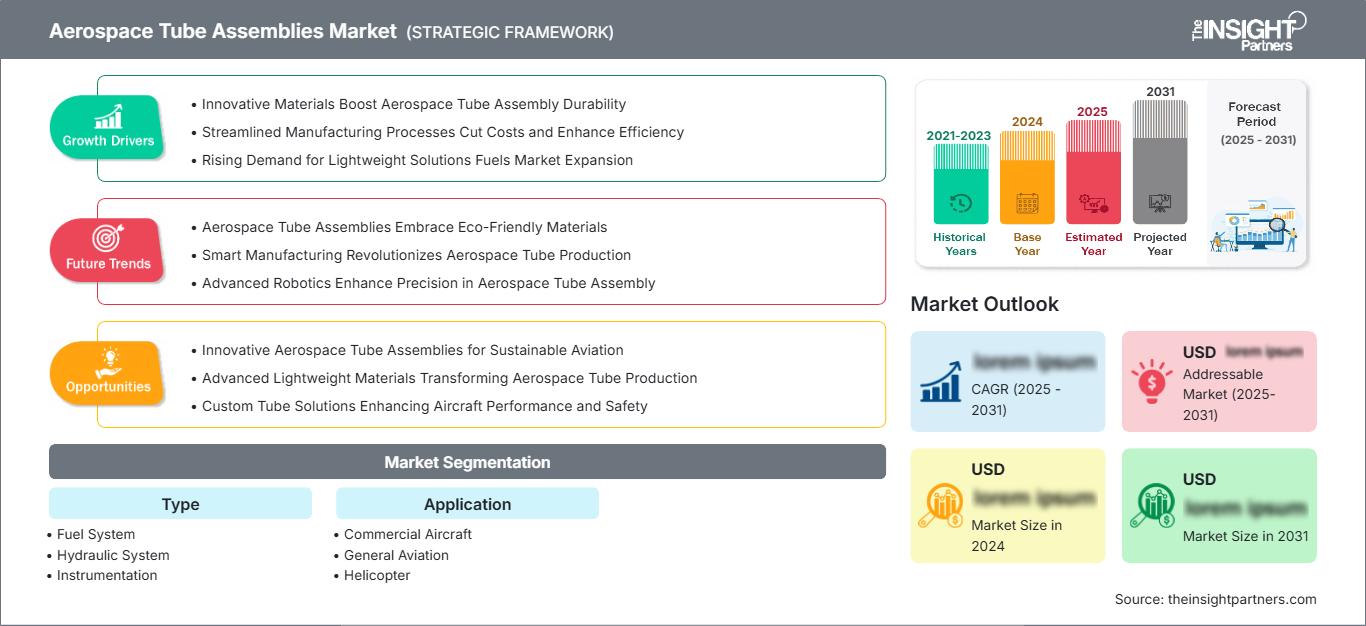
Regional Insights
North America Aerospace Tube Assemblies Market
North America makes up approximately 34% of the total global aerospace tube assemblies market in 2025, and it is expected to grow at a modelled CAGR of 7% until 2034. This is due to the dense aerospace manufacturing base in the region, big defense programs, huge aircraft maintenance operations, and a network of qualified component manufacturers. The United States is the main driver of demand, while Canada drives demand through aircraft manufacturing, regional air transport, and aerospace supplier networks.
Commercial aircraft manufacturing and defense modernization contribute as two independent sources of demand for the region. In the case of commercial aircraft manufacturing, there will be a demand for repetitive tube assemblies, while for the defense platforms, durability and mission reliability will play an important role. The expansion of Eaton's aerospace manufacturing plant in Orchard Park in 2025 is an indication of ongoing supplier investments in the region for the defense, commercial aerospace, and space markets.
U.S. Aerospace Tube Assemblies Market
The United States holds 88% of total North American market revenue of aerospace tube assemblies in 2025, with a growth rate of 7% for 2034. This represents the country’s aircraft manufacturing, procurement, engine manufacturing, MRO services, and aerospace systems engineering activities. The demand for fluid management assemblies includes commercial aircraft, helicopters, and military vehicles. The supplier capabilities include rigid tubing, flexible assemblies, fittings, and fluid management assemblies. Parker Hannifin Corporation, Eaton Corporation, Smiths Group plc, Ametek, Flexfab, Titeflex, and many others are operating within some parts of the ecosystem.
The demand has been driven by aircraft production and replacements in a very wide fleet of installed equipment. In 2025, Airbus has delivered 793 commercial aircraft worldwide and also expanding its manufacturing base in the US under the A320 Family industrial ramp up program.
Europe Aerospace Tube Assemblies Market
Europe represented ~29% of the global aerospace tube assemblies market in 2025 and is expected to expand at ~6% CAGR through 2034. France is the leading country in Europe, supported by Airbus industrial activity, defense aerospace programs, engine and system manufacturing, and a mature network of specialized suppliers. Germany provides major aircraft assembly and component capabilities, while the UK has strong positions in engines, systems, and aerospace engineering.
France and Germany play a significant role as production anchors, while the UK enhances this role with propulsion and advanced aerospace systems. Italy and Spain provide their contributions via structures, systems, aerostructures, and military programs. For Airbus, its European production network continues to be vital for the regional demand environment, and the company has set up a second updated A320 Family final assembly line at Toulouse in June 2026. This assembly line includes digital controls, automated logistics, and robotics, mirroring the trend towards high-throughput aircraft production.
The tube-assembly demand in Europe is also impacted by demanding quality standards and long qualification periods. It is necessary for suppliers to offer consistent documentation, material traceability, dimensionality, and repeatability for programs. In Europe, which already has an established aerospace industry, growth is linked to aircraft deliveries and fleet maintenance, aircraft modification, defense procurement, and replacement of aged fluid management components.
APAC Aerospace Tube Assemblies Market
The Asia Pacific constituted around 24% share of the global aerospace tube assemblies market in 2025 and is expected to register ~8% CAGR during 2026-2034, being the fastest growing region. China represents the largest country in Asia Pacific due to growth in commercial aviation activities, local final assembly, indigenous aerospace development, as well as presence of a large aircraft population (existing and future). Japan and South Korea provide advanced aerospace manufacturing capabilities, while India and Australia represent growing demand due to aviation and defense sectors' expansion.
Expansion in the aircraft-producing infrastructure in China further increases supply opportunities. The first aircraft of A320 Family from the second Tianjin final assembly line was delivered in September 2026 by Airbus. India is also supported by growing domestic air traffic and aerospace manufacturing operations. In 2025, IATA estimated 10.9% international traffic growth in Asia Pacific, the fastest among other major regions.
Middle East & Africa Aerospace Tube Assemblies Market
Middle East and Africa aerospace tube assemblies market demand is supported by airline fleet expansion, aircraft maintenance infrastructure, defense procurement, and investments in aviation hubs. A modeled CAGR of ~7% through 2034 reflects continuing fleet modernization and the development of regional MRO capabilities. Saudi Arabia and the UAE are important demand centers in the Middle East, while South Africa provides the region's most established aerospace and defense manufacturing base.
The UAE has a strong role in aircraft maintenance and aviation services, while Saudi Arabia is increasing investment in aviation infrastructure and fleet capacity. South Africa contributes through defense aerospace and technical capabilities, with the rest of MEA representing a more fragmented demand base. IATA reported strong 2025 passenger demand in the Middle East and Africa, although their aviation ecosystems differ significantly in fleet composition, manufacturing depth, and maintenance localization. These differences favor suppliers offering adaptable qualification, distribution, and aftermarket support models.
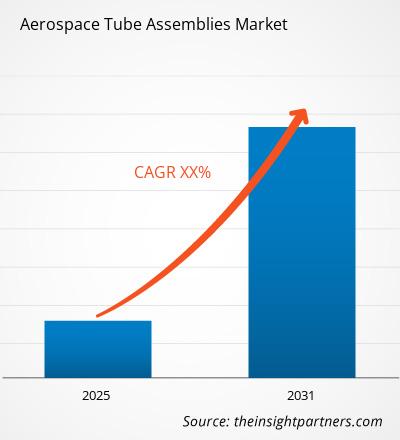
Segmentation Analysis
Type
Type segmentation in the Aerospace tube assemblies market covers Fuel System, Hydraulic System, and Instrumentation. The segment is expected to expand at a modeled CAGR of ~6% through 2034. Hydraulic System assemblies represent the largest demand pool because aircraft flight-control, landing-gear, braking, and actuation functions depend on reliable high-integrity fluid routing. Fuel System assemblies remain critical for safe fuel transfer, while Instrumentation assemblies support sensing and monitoring functions requiring precision routing and secure connections.
- Fuel System: Fuel-system assemblies serve fuel transfer and distribution functions across aircraft. Demand is shaped by aircraft configuration, tank architecture, thermal conditions, fire-safety requirements, and the need for leak-resistant connections that remain reliable through vibration and repeated operating cycles.
- Hydraulic System: Hydraulic assemblies support actuation, braking, landing gear, and flight-control functions. Their strategic importance comes from high reliability requirements, pressure exposure, and the consequences of leakage or dimensional failure in flight-critical systems.
- Instrumentation: Instrumentation assemblies connect measurement and monitoring equipment to aircraft systems. Demand emphasizes precision, compact routing, vibration resistance, and compatibility with sensors and control architectures used for engine, flight, environmental, and system monitoring.
Application
Application segmentation in the Aerospace tube assemblies market includes Commercial Aircraft, General Aviation, Helicopter, and Military Aircraft. The application segment is projected to expand at ~7% CAGR through 2034. Commercial aircraft generate substantial recurring demand from high-volume production and fleet maintenance, while Military Aircraft is the fastest-growing application because modernization programs require durable systems across new platforms, upgrades, and sustainment.
- Commercial Aircraft: Commercial aircraft demand is linked to passenger traffic, aircraft production, airline fleet renewal, and MRO requirements. Tube assemblies must support high utilization and repeatable manufacturing across large production programs.
- General Aviation: General aviation requires compact, lightweight, and serviceable tube assemblies across business aircraft, private aircraft, and specialized aviation platforms. Replacement demand is particularly relevant because aircraft ages and operating profiles vary substantially.
- Helicopter: Helicopter applications require assemblies capable of operating under high vibration and constrained routing conditions. Civil, utility, emergency-response, and defense missions create diverse requirements for fuel and hydraulic fluid conveyance.
- Military Aircraft: Military aircraft require highly durable assemblies for demanding operating environments and mission profiles. Procurement, modernization, sustainment, and readiness programs support demand across fighters, transports, rotorcraft, and specialized aircraft.
Opportunity Snapshot
| Application | Revenue Contribution | Trend Tag | Adoption Stage |
| Commercial Aircraft | High | Fleet Renewal | Mature |
| General Aviation | Low | Platform Upgrades | Mature |
| Helicopter | Medium | Rotorcraft Modernization | Scaling |
| Military Aircraft | Medium | Defense Modernization | Scaling |
Aerospace Tube Assemblies Market Growth Drivers and Impact Analysis
Aircraft Production Ramp-Up Increases Assembly Volumes
Aircraft production is a direct demand mechanism because tube assemblies are integrated into fuel, hydraulic, and instrumentation systems during aircraft manufacturing. Airbus reported 793 commercial aircraft deliveries in 2025 and continued production ramp-up across its commercial programs in 2026. Its A320 Family network is being expanded across Toulouse, Hamburg, Mobile, and Tianjin, increasing the number of production locations that require synchronized component supply. For tube-assembly suppliers, higher production rates increase requirements for repeatable forming, joining, inspection, and documentation. Suppliers with qualified designs and scalable production can benefit from longer program commitments, while production bottlenecks can create pressure to localize capacity closer to final assembly facilities.
Defense Fleet Modernization Supports High-Integrity Fluid Systems
Defense modernization increases demand for tube assemblies because military aircraft require robust fluid-management systems across propulsion, flight controls, landing systems, fuel distribution, and mission equipment. Procurement programs also create aftermarket requirements as fleets are upgraded and maintained over extended service lives. Airbus reported strong 2025 defense momentum and higher Defence and Space order intake, while major aerospace suppliers continue expanding their exposure to defense and long-cycle programs. The impact on suppliers is a greater emphasis on qualification, configuration control, corrosion resistance, vibration performance, and long-term availability. Companies able to support both original equipment and sustainment requirements can address demand across the complete platform lifecycle.
Qualification and Reliability Requirements Raise Supplier Entry Barriers
Aerospace tube assemblies operate in systems where leakage, fatigue, thermal degradation, or connection failure can affect aircraft availability and safety. Qualification requirements therefore influence supplier selection alongside price and production capacity. Tube geometry, materials, fittings, joining processes, inspection, and traceability must remain consistent across production lots and replacement orders. This favors established suppliers with engineering resources and documented manufacturing processes. It also increases the value of long-term customer relationships because qualification and validation can require substantial time and coordination. As aircraft manufacturers increase production, suppliers that can maintain quality while expanding throughput are positioned to capture program-level opportunities without compromising certification or configuration requirements.
Aerospace Tube Assemblies Market Future Trends
Digital Manufacturing and Automated Tube Processing
Aerospace tube assemblies market trends are increasingly influenced by digital production methods that improve repeatability and manufacturing control. Automated tube bending, digitally controlled forming, inspection systems, and integrated production records can reduce variation in complex geometries while supporting traceability. As aircraft production rates increase, digital manufacturing becomes more relevant because manual processes can become capacity constraints and create inconsistencies across production sites. Airbus' new Toulouse A320 Family line incorporates digital controls, automated logistics, and robotics, demonstrating how aerospace production environments are adopting connected manufacturing technologies. Over time, tube suppliers are likely to integrate digital inspection and production data more deeply into qualification, quality assurance, and customer documentation workflows.
Higher Integration of Lightweight and Multi-Function Assemblies
Future demand is expected to favor assemblies that combine weight efficiency, installation simplicity, and reliable fluid conveyance within increasingly constrained aircraft architectures. Aircraft manufacturers continue to pursue efficiency improvements, while production teams seek components that reduce installation complexity and manufacturing steps. Tube assemblies may therefore increasingly incorporate optimized routing, advanced materials, integrated fittings, flexible sections, insulation, and protective features where application requirements justify them. The trend is particularly relevant for next-generation commercial aircraft, military platforms, and advanced rotorcraft, where weight, thermal management, maintainability, and system packaging are closely linked. Suppliers that combine material expertise with application engineering can support customers seeking component-level improvements without compromising qualification requirements.
Aerospace Tube Assemblies Market Opportunities
Localized Supply Capacity in High-Growth Aerospace Hubs
Aerospace tube assemblies market opportunities are emerging from the geographic expansion of aircraft production and aerospace supply chains. Asia Pacific is particularly relevant because aircraft demand, passenger traffic, and manufacturing localization are increasing simultaneously. Airbus' second Tianjin A320 Family final assembly line strengthens China's position within the company's global production network, while India is developing a larger aerospace manufacturing and maintenance ecosystem. Suppliers can pursue opportunities through local production, qualified partnerships, regional distribution, and repair capabilities that reduce logistics complexity. Localization can also improve responsiveness to OEM production schedules and aftermarket requirements, particularly where customers seek shorter lead times and greater regional supply resilience.
Integrated OEM and Aftermarket Support Models
Another opportunity lies in combining original-equipment production with aftermarket support. Tube assemblies are subject to replacement, inspection, modification, and repair as aircraft accumulate operating cycles. Suppliers can expand customer value by maintaining configuration-controlled replacement products, engineering support, documentation, and responsive distribution. Parker's expanding aerospace portfolio and Smiths Group's long-term aerospace contracts illustrate how suppliers are strengthening positions across long-cycle programs and recurring demand. Companies that can serve both production lines and installed fleets can diversify revenue exposure while maintaining technical relationships with OEMs, system manufacturers, MRO providers, and defense operators.
Recent Developments
- September 2026: Airbus SE inaugurated a new A320 delivery centre in Toulouse to support the production ramp-up and streamline production, technical adjustment, and customer-delivery activities. The facility adds dedicated aircraft positions and technical-adjustment capacity and supports Airbus' broader A320 Family production trajectory. The development is relevant to tube-assembly suppliers because higher aircraft throughput requires coordinated component availability across final assembly and delivery operations.
- May 2026: Parker Hannifin Corporation announced an agreement to acquire CIRCOR International's Commercial and Defense Aerospace business for approximately US$ 2.55 billion. Parker stated that the transaction would add complementary flight-critical motion and flow-control capabilities and strengthen its position on commercial and defense aerospace platforms. The transaction illustrates continued consolidation around engineered aerospace fluid and motion technologies.
- March 2026: Smiths Group plc announced a five-year agreement through STS Aerospace with GE Aerospace to supply hundreds of engineered flexible and hybrid hose assemblies for commercial and defense-related engine fleets. The agreement reinforces the importance of qualified fluid-conveyance assemblies in engine applications and extends a long-standing supplier relationship across global aviation programs.
Frequently Asked Questions

- Comprehensive Market Sizing and Forecast Analysis
- Detailed Segmentation Analysis
- In-Depth Market Dynamics Assessment
- Regional and Country-Level Insights
- Competitive Landscape and Company Benchmarking
- Strategic Business Intelligence
Recent Reports
Testimonials

The Insight Partners provided valuable market intelligence that supported our global go-to-market strategy. Their team was professional, responsive, and attentive to our feedback, providing thoughtful analysis and helpful methodological clarifications throughout the project.
Junmo Kim Chief Financial Officer (CFO), Enertech Co., Ltd.
The Insight Partners' SCADA System Market report is comprehensive, with valuable insights on current trends and future forecasts. The team was highly professional, responsive, and supportive throughout. We are very satisfied and highly recommend their services.
RAN KEDEM Partner, Reali Technologies LTDs
I requested a report on a very specific software market and the team produced the report in a few days. The information was very relevant and well presented. I then requested some changes and additions to the report. The team was again very responsive and I got the final report in less than a week.
JEAN-HERVE JENN Chairman, Future Analytica
We worked with The Insight Partners for an important market study and forecast. They gave us clear insights into opportunities and risks, which helped shape our plans. Their research was easy to use and based on solid data. It helped us make smart, confident decisions. We highly recommend them.
PIYUSH NAGPAL Sr. Vice President, High Beam Global
The Insight Partners delivered insightful, well-structured market research with strong domain expertise. Their team was professional and responsive throughout. The user-friendly website made accessing industry reports seamless. We highly recommend them for reliable, high-quality research services
YUKIHIKO ADACHI CEO, Deep Blue, LLC.
This is the first time I have purchased a market report from The Insight Partners.While I was unsure at first, I visited their web site and felt more comfortable to take the risk and purchase a market report.I am completely satisfied with the quality of the report and customer service. I had several questions and comments with the initial report, but after a couple of dialogs over email with their analyst I believe I have a report that I can use as input to our strategic planning process.Thank you so much for taking the extra time and making this a positive experience.I will definitely recommend your service to others and you will be my first call when we need further market data.
JOHN SUZUKI President and Chief Executive Officer, Board Director, BK Technologies
I wish to appreciate your support and the professionalism you displayed in the course of attending to my request for information regarding to infectious disease IVD market in Nigeria. I appreciate your patience, your guidance, and the fact that you were willing to offer a discount, which eventually made it possible for us to close a deal. I look forward to engaging The Insight Partners in the future, all thanks to the impression you have created in me as a result of this first encounter.
DR CHIJIOKE ONYIA MANAGING DIRECTOR, PineCrest Healthcare Ltd.Reason to Buy
- Informed Decision-Making
- Understanding Market Dynamics
- Competitive Analysis
- Identifying Emerging Markets
- Customer Insights
- Market Forecasts
- Risk Mitigation
- Boosting Operational Efficiency
- Strategic Planning
- Investment Justification
- Tracking Industry Innovations
- Aligning with Regulatory Trends





 Get Free Sample for