
Afterburner Market Share, Demand & Growth by 2034
Coverage: By Engine Type (Turbofans Engine, Turbojet Engine); Plane Type (Air Superiority Fighter, Light Fighter, Electric Compressor) , and Geography (North America, Europe, Asia Pacific, and South and Central America)
- Status : Data Released
- Report Code : TIPRE00018330
- Category : Aerospace and Defense
- No. of Pages : 150
- Available Report Formats :


- Last update date : October 30, 2026


2025 Market Size
US$ 173.46 Mn
Base year value
2034 Forecast
US$ 363.82 Mn
Projected by 2034
CAGR 2026-2034
8.58 %
Growth rate
Addressable Market
US$ 2,409.66 Mn
(2026-2034)
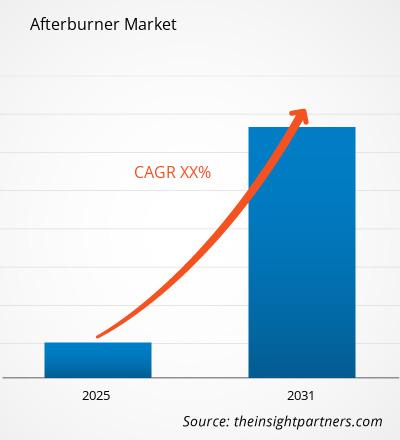
The afterburner market is expanding from US$ 173.46 Million in 2025 to US$ 363.82 Million by 2034, registering a CAGR of 8.58% from 2026 to 2034. Afterburners, also referred to as augmentors, are integrated into military jet propulsion systems to provide temporary thrust augmentation during takeoff, rapid acceleration, air combat, and supersonic flight. Demand is closely associated with fighter-aircraft procurement, engine modernization, propulsion upgrades, and the continued deployment of high-performance combat aircraft.
Across North America, the afterburner market size is supported by sustained fighter fleet modernization, high utilization of advanced turbofan propulsion, and investment in next-generation combat-aircraft programs. The regional market is projected to expand at approximately ~7% CAGR through 2034, with demand supported by replacement engines, sustainment programs, and development of propulsion architectures capable of combining high thrust with improved thermal management and maintainability.
Afterburner Market Assessment and Insights
Regional Outlook
- North America: ~35% of the global market in 2025 | ~7% CAGR through 2034. Market position: North America maintains the largest regional position because of its extensive fighter-engine installed base, sustained defense procurement, engine sustainment programs, and continued investment in propulsion technologies for air-superiority and multirole aircraft.
- US: ~78% of North American market revenue in 2025 | ~7% CAGR through 2034. Market position: The US represents the largest national demand center in North America, supported by large fighter fleets, advanced engine manufacturing capabilities, modernization of F-15, F-16, F/A-18, and other combat platforms, and recurring propulsion sustainment requirements.
- Europe: ~31% of the global market in 2025 | ~8% CAGR through 2034. Market position: Europe has a mature propulsion ecosystem supported by France, Germany, the UK, Italy, and Spain. Collaborative fighter programs, Rafale and Eurofighter requirements, industrial localization, and next-generation combat-aircraft development sustain regional demand.
- Asia Pacific: ~24% of the global market in 2025 | ~10% CAGR through 2034. Market position: Asia Pacific is the fastest-growing region as China, Japan, South Korea, India, and Australia expand or modernize combat-aircraft fleets. Domestic propulsion development, localization policies, and fighter procurement support increasing afterburner requirements.
Segment Outlook
- Turbofans Engine: ~72% Share in 2025 | ~8% CAGR through 2034. Market position: Turbofan engines account for the largest market position because afterburning turbofans combine efficient dry-thrust operation with temporary high-thrust augmentation, making them central to modern fighter propulsion and fleet modernization.
- Air Superiority Fighter: ~64% Share in 2025 | ~9% CAGR through 2034. Market position: Air-superiority fighters generate substantial afterburner demand because acceleration, climb, maneuverability, and rapid energy recovery remain important mission requirements. New aircraft programs and upgrades to established fighter fleets sustain propulsion investment.
Competitive Coverage
GE Aerospace, Pratt & Whitney, Honeywell Aerospace, Aviadvigatel, Rolls-Royce plc, SE Ivchenko-Progress, Safran, Eurojet, JSC Klimov, United Engine Corporation, MTU Aero Engines AG
Methodology
The Insight Partners follows Data Collection & Secondary Research, Primary Research, Data Analysis, and Data Triangulation & Final Review to validate market estimates and insights.
Source: The Insight Partners' analysis based on proprietary research, government publications, company annual reports, investor presentations, industry databases, and expert interviews.
The evolution of the afterburner market is linked to progress in the military turbofan architecture, fuel combustion, turbine construction materials, exhaust nozzle development, and digital engine control systems. The current generation of augmentors should enable fast thrust growth without unacceptable penalties in terms of engine life, fuel consumption, heating and maintenance. The relevance of modular engine architectures, advanced exhaust nozzles, enhanced fuel injection, high-temperature materials, and digital control systems increased significantly. Also, market production will be impacted by the number of fighter engines, their replacements period, engine life extensions and manufacturer capability to support specialty products through long-term defense program lifecycles.
In the future, the investment trends in propulsion will shift towards regions which strive for increasing domestic control over fighter engine technology and supply chain. India, Japan, South Korea and Europe are building up their own capabilities in this field with the help of national projects and multinational cooperation. Additionally, regulations and procurement needs push the development of thermal management, emissions performance, manufacturing efficiency and maintainability. Thus, these tendencies provide opportunities for afterburners' suppliers offering modular augmentors, advanced nozzles, high-temperature materials, digital controls and support along with entire engine solutions.
Afterburner Market Report Scope
| Report Attribute | Details |
|---|---|
| Market size in 2025 | US$ 173.46 Million |
| Market Size by 2034 | US$ 363.82 Million |
| Global CAGR (2026 - 2034) | 8.58% |
| Historical Data | 2021-2024 |
| Forecast period | 2026-2034 |
Afterburner Market Analysis
The primary push factor is the constant need for fast thrust augmentation for fighters in challenging missions. Afterburners add fuel to the gas stream behind the turbine; this causes fast energy generation and, consequently, fast thrust generation and fast acceleration and flight speed during times when maximum engine power is needed. Thus, the ecosystem includes engine producers, combustor/augmentor suppliers, fuel system providers, nozzle producers, control systems, material suppliers, testing equipment, and OEMs or defense companies. The supply factors include manufacturing process specialization, qualification, long engine development periods, and reliable part availability over the lifecycle of the aircraft.
Competitive Environment in the afterburner market report will be determined by the installed base of engines for the military aircraft and participation in fighter developments. GE Aerospace and Pratt & Whitney have extensive range of engines for all USA fighter aircraft, Rolls-Royce, Safran, Eurojet, and MTU Aero Engines are participating in European and other propulsion systems developments, United Engine Corporation, Aviadvigatel, SE Ivchenko-Progress, and JSC Klimov are involved in Russia and other countries propulsion systems development, while Honeywell Aerospace is participating in propulsion and auxiliary propulsion systems developments. Investment in advanced materials, additive manufacturing, control technologies, cooling system improvement, modular maintenance and propulsion systems that allow to create high thrust propulsion systems with reduced engine weight and maintenance.
● REPORT CUSTOMIZATION
Tailor This Report To Align With Your Specific Business Requirements
This report can be customized to align precisely with your business objectives, scope, and target markets. Customization options include tailored segmentation, geography, competitive analysis, and strategic insights to support informed decision-making.
Customize This Report →WHAT YOU CAN ADJUST
- ● Segmentations
- ● Geography
- ● Competitive Analysis
- ● Language Preferences
Afterburner Market: Strategic Insights

Regional Insights
North America Afterburner Market
North America accounted for about 35% of the afterburner market share in 2025 and is set to grow by a CAGR of about 7% until 2034. The region has a huge fleet of fighter aircraft and well-established engine manufacturing ecosystem. The US will continue to be the largest consumer of afterburners, owing to the presence of ongoing and upcoming programs such as F-15, F-16, F/A-18, and many others that require engines and afterburners.
The existing ecosystems within the region have well-established ties among various defense bodies, engine manufacturers, and aircraft Original Equipment Manufacturers (OEM). For instance, GE Aerospace has been involved with production of two afterburning turbofan engines; the F110 and F414 series. Meanwhile, Pratt & Whitney is actively working on F100 and F135 engine programs.
U.S. Afterburner Market
The US market represented around ~78% of the North America market revenue in 2025, and the US national market was expected to grow at around ~7% CAGR through 2034. This demand depends on the size of the US combat aircraft fleets, priorities of modernization, foreign military sales, and constant need for propulsion readiness for various fighter generations.
There are major players in the US afterburner market of fighter propulsion – GE Aerospace and Pratt & Whitney. The supply chain consists of augmentors, exhaust systems, fuel controls, materials, testing, and maintenance. F110, F414, F100, and other afterburning propulsion families show how mature engines create ongoing requirements through the extension of production, sustainment, upgrade, and replacement modules. The development of adaptive propulsion technologies shows the way to advanced thrust management systems.
Europe Afterburner Market
Europe held about ~31% of the global afterburner market share in 2025 and is expected to grow at about ~8% CAGR till 2034. The market in the region is driven by existing fighter aircraft and multinational propulsion programs. France leads in Europe considering the concentration of combat aircraft propulsion activities in relation to Rafale and the M88 engine family. Germany, the UK, Italy, and Spain add to the mix due to the Eurofighter requirements, their national aerospace industry, maintenance services, and defense cooperation.
Germany and Spain continue to be relevant in the context of the Eurofighter industrial base, the UK provides large aerospace engineering and development capacity and is active in future combat aircraft propulsion projects. Italy adds to Eurofighter projects as well as to wider European aerospace manufacturing base. Demand in Europe is increasingly influenced by modernization, sovereign industry, technology development, and multinational cooperation, which all drive towards suppliers that can integrate advanced high-temperature materials, control systems, exhausts, and modular design.
APAC Afterburner Market
Asia Pacific accounted for approximately ~24% of the global afterburner market share in 2025 and is expected to record approximately ~10% CAGR through 2034, making it the fastest-growing regional market. China is the leading country in Asia Pacific, supported by its large military-aircraft manufacturing base and continued development of advanced fighter propulsion.
Japan, South Korea, India, and Australia add to the regional demand for fighters through acquisition, upgrading of their fleets, their domestic aeronautics industries, and localization policies. Indigenous development of engines is increasingly important in India, whereas domestic involvement in advanced fighter aircraft ecosystem becomes more pronounced in Japan and South Korea. Thus, the regional growth will be generated by aircraft orders, engine replacement, domestic production, technology transfer, and propulsion independence.
Middle East & Africa Afterburner Market
Middle East and Africa market is estimated to grow at ~9% CAGR until 2034 on the back of fighter modernization programs, replacement of old age propulsion system, and investments in advanced combat aircraft capabilities. Countries such as Saudi Arabia and UAE are key procurement centers in the Middle East, whereas South Africa adds in terms of aircraft engineering and maintenance capability.
Saudi Arabia is the dominant country in Middle East and Africa market where procurement size and combat-aircraft requirements drive propulsion system market growth. Regional operators are now emphasizing more on availability of fleet, maintenance capability, and lifecycle support of their fighters. In this respect, suppliers offering services, spare module availability, and technical support can generate value apart from propulsion system deliveries.
Segmentation Analysis
Engine Type
Engine Type is divided into Turbofans Engine and Turbojet Engine. The segment is projected to expand at approximately ~8% CAGR from 2026 to 2034. Turbofan-based propulsion dominates modern fighter applications because it provides a flexible combination of dry thrust, fuel efficiency, high specific thrust when augmented, and compatibility with advanced control and nozzle technologies. Turbojet systems remain relevant in selected legacy and specialized propulsion applications where compact architecture and high-speed performance remain important.
- Turbofans Engine: Afterburning turbofans constitute the principal demand base because modern fighter aircraft require both efficient non-afterburning cruise and rapid thrust augmentation. Their integration with digital controls, variable-area nozzles, advanced turbine materials, and modular maintenance supports continuing procurement and upgrade activity.
- Turbojet Engine: Turbojet afterburners retain strategic importance in selected legacy platforms, missiles, target vehicles, and specialized high-speed propulsion applications. Demand is narrower than turbofan demand but remains relevant where compact propulsion, high exhaust velocity, and established platform integration provide operational advantages.
Plane Type
Plane Type comprises Air Superiority Fighter, Light Fighter, and Electric Compressor. The segment is expected to expand at approximately ~9% CAGR from 2026 to 2034. Demand varies according to aircraft mission requirements, propulsion architecture, platform weight, and the level of thrust augmentation required during acceleration and high-speed operations.
- Air Superiority Fighter: These aircraft generate substantial afterburner demand because high acceleration, rapid climb, maneuverability, and energy recovery remain central to demanding combat missions. Advanced fighter programs also require tightly integrated engine, nozzle, control, and thermal-management systems.
- Light Fighter: Light fighters require propulsion systems balancing thrust, weight, acquisition cost, maintenance simplicity, and fuel consumption. Afterburning engines can provide additional performance during takeoff, interception, acceleration, and combat maneuvering without requiring a substantially larger airframe.
- Electric Compressor: Electric compressor concepts represent an emerging propulsion-support architecture in which electrically driven systems can influence engine airflow and thermal management. Their strategic importance is associated with future aircraft electrification and the potential integration of distributed power-management technologies.
Opportunity Snapshot
| Plane Type | Revenue Contribution | Trend Tag | Adoption Stage |
| Air Superiority Fighter | High | High-Thrust Combat | Mature |
| Light Fighter | Medium | Fleet Modernization | Scaling |
| Electric Compressor | Low | Electrified Propulsion | Emerging |
Afterburner Market Growth Drivers and Impact Analysis
Fighter Fleet Modernization and Engine Replacement
Modernization of aging fighter fleets is a direct demand mechanism for afterburner systems because propulsion upgrades frequently require replacement engines, upgraded augmentors, improved exhaust nozzles, and associated control hardware. Operators extending aircraft service lives also require dependable access to replacement modules and repair capabilities. Mature aircraft such as the F-15, F-16, and F/A-18 illustrate how established propulsion platforms can continue generating component demand long after initial aircraft production. Newer aircraft programs create a parallel requirement for advanced augmentors capable of managing higher temperatures and increasingly complex digital controls. This combination of new production and sustainment broadens the addressable market for manufacturers and specialized suppliers. It also encourages modular architectures that reduce maintenance time and improve availability across long defense-program lifecycles.
Higher Thrust Requirements for Advanced Combat Missions
The operational requirement for rapid acceleration and high-speed maneuvering continues to support afterburner adoption in combat aircraft. Modern fighters operate across increasingly demanding mission profiles involving rapid changes in altitude, speed, payload, and maneuvering conditions. These requirements increase the value of propulsion systems capable of temporarily delivering substantially higher thrust than dry operation. Engine designers therefore focus on combustion stability, nozzle actuation, thermal management, and component durability to ensure augmentor performance under demanding conditions. Improvements in turbine materials and digital engine controls allow manufacturers to manage higher operating temperatures and complex transient conditions more effectively. The resulting technology cycle creates demand for upgraded fuel systems, control electronics, exhaust components, and high-temperature materials, extending opportunities beyond complete engine sales.
Expansion of Indigenous Aerospace Propulsion Capabilities
National efforts to develop indigenous combat-aircraft propulsion are creating new opportunities for afterburner technology suppliers and domestic aerospace manufacturers. Countries seeking greater control over defense supply chains are investing in engine design, testing, component manufacturing, materials, and maintenance infrastructure. This localization process can create demand for technology partnerships, licensed production, specialized tooling, qualification services, and local repair capabilities. India provides a significant example of this direction, while European collaborative programs seek to preserve sovereign propulsion capabilities through multinational technology development. Indigenous propulsion programs can also increase demand for specialized augmentor and nozzle expertise because these components must be optimized alongside the engine's compressor, turbine, combustor, and control architecture. Suppliers with transferable engineering capabilities and strong qualification records can therefore participate in emerging regional propulsion ecosystems.
Afterburner Market Future Trends
Digital Augmentor Control and Advanced Nozzle Integration
Future afterburner architectures are expected to place greater emphasis on digitally coordinated fuel injection, exhaust-nozzle actuation, engine control, and aircraft flight-management systems. Integrated control can improve transient response by coordinating thrust augmentation with airflow, turbine conditions, aircraft speed, and mission requirements. This approach may also support better diagnostics by capturing operating data from fuel systems, actuators, temperature sensors, and nozzle mechanisms. As fighter engines become more digitally integrated, augmentor performance will increasingly depend on software and control-system optimization rather than mechanical hardware alone. Manufacturers are likely to emphasize modular electronic architectures, health monitoring, and predictive maintenance capabilities that reduce unplanned maintenance and improve fleet availability. These changes can shift value toward suppliers with expertise in controls, sensors, actuation, software, and high-temperature electronic environments.
Higher-Temperature Materials and More Efficient Thrust Augmentation
Future engine development is expected to increase the role of advanced materials and manufacturing methods in afterburner components exposed to extreme temperatures and pressure conditions. Improved nickel-based alloys, thermal-management techniques, coatings, additive manufacturing, and optimized component geometries can help manufacturers increase durability while controlling weight. Development programs are also examining ways to obtain greater thrust from compact engine architectures without creating proportionate increases in maintenance burden. The implication for the afterburner market trends is a gradual transition from conventional replacement hardware toward engineered component systems designed around specific temperature, pressure, airflow, and lifecycle requirements. Suppliers able to qualify advanced materials and manufacturing processes for defense applications can benefit as new propulsion programs progress from demonstrators to production.
Afterburner Market Opportunities
Localized Engine Manufacturing and Sustainment Networks
The expansion of domestic fighter-engine manufacturing and sustainment capabilities creates opportunities for suppliers of augmentor modules, exhaust nozzles, fuel controls, high-temperature components, and maintenance services. Countries pursuing aerospace localization require industrial partners capable of transferring manufacturing knowledge while meeting stringent defense qualification requirements. Localized sustainment can also shorten repair cycles and reduce dependence on overseas component supply, particularly for fleets expected to remain operational for several decades. Suppliers can participate through joint ventures, licensed production, technology partnerships, component manufacturing, depot-level maintenance, and engineering support. The afterburner market forecast opportunity extends beyond new engines because established fighter fleets require periodic inspection, module replacement, refurbishment, and life-extension work. Companies with mature engineering processes and transferable production capabilities can therefore develop recurring revenue streams around regional propulsion ecosystems.
Advanced Augmentor Components for Next-Generation Fighters
Next-generation fighter programs create opportunities for companies developing lighter, more durable, and more controllable augmentor components. Future propulsion requirements are likely to place greater emphasis on thrust-to-weight performance, thermal management, rapid transient response, maintainability, and integration with advanced aircraft systems. This creates demand for improved fuel injectors, flameholders, actuators, exhaust nozzles, liners, sensors, control electronics, and high-temperature materials. Component specialists can address these requirements even when they are not prime engine manufacturers by supplying qualified technologies to larger propulsion companies. Partnerships with engine OEMs and defense laboratories can accelerate qualification and provide access to future aircraft programs. The commercial opportunity is particularly relevant where new fighter platforms are being developed alongside domestic industrialization initiatives.
Recent Developments
- September 2026: GE Aerospace — GE Aerospace reported progress on assembly of its XA102 adaptive-cycle engine for the US Air Force's Next Generation Adaptive Propulsion program. The development demonstrates continuing investment in propulsion architectures intended to provide greater adaptability and performance for future combat-aircraft applications, reinforcing the industry's movement toward advanced thermal management and variable-cycle technologies.
- August 2026: Rolls-Royce plc — Rolls-Royce and Reliance Industries announced a strategic intent to partner on development, manufacturing, and delivery of an indigenous combat engine for India's Advanced Medium Combat Aircraft program. The companies also proposed exploring an Aerospace Gas Turbine Complex in India, highlighting the increasing importance of localized propulsion development and industrial capability.
- June 2026: Safran — Safran, MTU Aero Engines, and Avio Aero received European Defence Fund support for the SHARP project, which focuses on scalable technology building blocks for next-generation military helicopter engines. Although centered on rotorcraft propulsion, the program demonstrates continued European investment in sovereign high-performance military-engine technology and collaborative propulsion research.
Frequently Asked Questions

- Comprehensive Market Sizing and Forecast Analysis
- Detailed Segmentation Analysis
- In-Depth Market Dynamics Assessment
- Regional and Country-Level Insights
- Competitive Landscape and Company Benchmarking
- Strategic Business Intelligence
Recent Reports
Testimonials

The Insight Partners provided valuable market intelligence that supported our global go-to-market strategy. Their team was professional, responsive, and attentive to our feedback, providing thoughtful analysis and helpful methodological clarifications throughout the project.
Junmo Kim Chief Financial Officer (CFO), Enertech Co., Ltd.
The Insight Partners' SCADA System Market report is comprehensive, with valuable insights on current trends and future forecasts. The team was highly professional, responsive, and supportive throughout. We are very satisfied and highly recommend their services.
RAN KEDEM Partner, Reali Technologies LTDs
I requested a report on a very specific software market and the team produced the report in a few days. The information was very relevant and well presented. I then requested some changes and additions to the report. The team was again very responsive and I got the final report in less than a week.
JEAN-HERVE JENN Chairman, Future Analytica
We worked with The Insight Partners for an important market study and forecast. They gave us clear insights into opportunities and risks, which helped shape our plans. Their research was easy to use and based on solid data. It helped us make smart, confident decisions. We highly recommend them.
PIYUSH NAGPAL Sr. Vice President, High Beam Global
The Insight Partners delivered insightful, well-structured market research with strong domain expertise. Their team was professional and responsive throughout. The user-friendly website made accessing industry reports seamless. We highly recommend them for reliable, high-quality research services
YUKIHIKO ADACHI CEO, Deep Blue, LLC.
This is the first time I have purchased a market report from The Insight Partners.While I was unsure at first, I visited their web site and felt more comfortable to take the risk and purchase a market report.I am completely satisfied with the quality of the report and customer service. I had several questions and comments with the initial report, but after a couple of dialogs over email with their analyst I believe I have a report that I can use as input to our strategic planning process.Thank you so much for taking the extra time and making this a positive experience.I will definitely recommend your service to others and you will be my first call when we need further market data.
JOHN SUZUKI President and Chief Executive Officer, Board Director, BK Technologies
I wish to appreciate your support and the professionalism you displayed in the course of attending to my request for information regarding to infectious disease IVD market in Nigeria. I appreciate your patience, your guidance, and the fact that you were willing to offer a discount, which eventually made it possible for us to close a deal. I look forward to engaging The Insight Partners in the future, all thanks to the impression you have created in me as a result of this first encounter.
DR CHIJIOKE ONYIA MANAGING DIRECTOR, PineCrest Healthcare Ltd.Reason to Buy
- Informed Decision-Making
- Understanding Market Dynamics
- Competitive Analysis
- Identifying Emerging Markets
- Customer Insights
- Market Forecasts
- Risk Mitigation
- Boosting Operational Efficiency
- Strategic Planning
- Investment Justification
- Tracking Industry Innovations
- Aligning with Regulatory Trends





 Get Free Sample for