
Agriculture Drone Market Size, Share & Trends by 2034
Coverage: By Component (Hardware and Software), Type (Fixed Wing and Rotary Wing), Farming Location (Indoor and Outdoor), Type of Produce (Field Crops, Fruit & Vegetable, Dairy & Livestock, and Others), Farm Size (Small & Medium Crops, and Large Crops), Application (Precision Farming, Livestock Monitoring, Smart Greenhouse, and Others) and Geography
- Status : Data Released
- Report Code : TIPTE100001007
- Category : Aerospace and Defense
- No. of Pages : 150
- Available Report Formats :


- Last update date : October 30, 2026


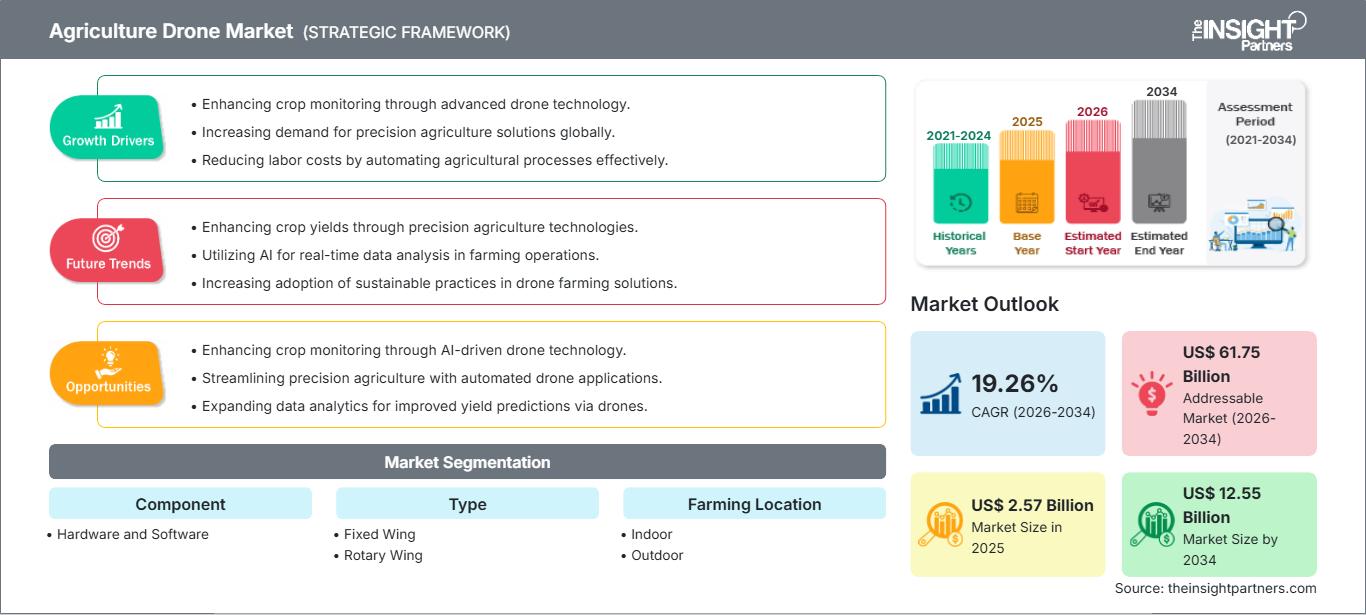
2025 Market Size
US$ 2.57 Bn
Base year value
2034 Forecast
US$ 12.55 Bn
Projected by 2034
CAGR 2026-2034
19.26 %
Growth rate
Addressable Market
US$ 61.75 Bn
(2026-2034)
The agriculture drone market is expanding from US$ 2.57 Billion in 2025 to US$ 12.55 Billion by 2034, registering a CAGR of 19.26% during 2026–2034. The market covers drone hardware and software used for crop monitoring, field mapping, spraying, spreading, scouting, and related precision-farming workflows. Adoption is increasingly linked with automation, remote sensing, variable-rate application, labor constraints, and the integration of aerial data with farm-management platforms.
Across North America, the agriculture drone market size is supported by established precision-agriculture infrastructure, large commercial farms, and increasing integration of aerial imagery with farm-management software. The regional market is estimated to register a ~17% CAGR through 2034, supported by demand for high-resolution crop intelligence, automated scouting, and increasingly capable unmanned aircraft operations.
Agriculture Drone Market Assessment and Insights
Regional Outlook
- North America: ~27% of the global market in 2025 | ~17% CAGR through 2034. Market position: North America represents a mature adoption base, supported by large-scale farms, established precision-agriculture ecosystems, drone-service providers, and integration with farm machinery, GNSS, imagery, and agronomic decision-support systems.
- US: ~85% of North American market revenue in 2025 | ~17% CAGR through 2034. Market position: The US is the principal North American market, supported by commercial row-crop operations, technology-intensive farming, established drone-service networks, and growing use of aerial intelligence for crop scouting, mapping, and targeted application.
- Europe: ~23% of the global market in 2025 | ~18% CAGR through 2034. Market position: Europe has a comparatively mature precision-agriculture ecosystem. Germany, France, the UK, Italy, and Spain support adoption, with France representing the leading country in Europe as regulatory pathways increasingly accommodate agricultural drone applications.
- Asia Pacific: ~38% of the global market in 2025 | ~22% CAGR through 2034. Market position: Asia Pacific is the largest and fastest-growing regional market, led by China, with Japan, South Korea, India, and Australia contributing through labor-saving requirements, crop-protection applications, and government-backed agricultural modernization.
Segment Outlook
- Hardware: ~76% Share in 2025 | ~18% CAGR through 2034. Market position: Hardware leads because aircraft, propulsion, batteries, navigation systems, cameras, spraying assemblies, and sensing equipment represent the physical foundation of agricultural drone deployments. Replacement demand and higher payload capability further support revenue.
- Software: ~24% Share in 2025 | ~24% CAGR through 2034. Market position: Software is the high-growth main segment as growers increasingly require image processing, prescription mapping, automated flight planning, analytics, fleet management, and integration between drone-generated data and broader precision-agriculture systems.
Competitive Coverage
AeroVironment, Inc., AgEagle Aerial Systems Inc., DJI, DroneDeploy, Third Element Aviation GmbH, Sentera, Yamaha Motor Corporation U.S.A., Trimble Inc., Parrot Drone SAS, John Deere, XAG
Methodology
The Insight Partners follows Data Collection & Secondary Research, Primary Research, Data Analysis, and Data Triangulation & Final Review to validate market estimates and insights.
Source: The Insight Partners' analysis based on proprietary research, government publications, company annual reports, investor presentations, industry databases, and expert interviews.
While the agriculture drone market used to focus mainly on aerial imaging and field survey capabilities, the industry has moved towards more versatile devices that could be engaged not only in mapping and crop scouting but also in spraying, spreading and route planning. Multispectral, thermal, RGB, LiDAR, RTK, radar and machine vision technology enable collection of more data on every flight. Simultaneously, increased payload capabilities and enhanced battery, propulsion and flight control designs allow drones to operate within tasks that could be performed with tractors, aircraft or even manual inspection.
Future development will be driven by growth of agricultural economies, wider availability of drone services and regulations facilitating repetitive commercial flights. Investments will go into navigation, AI technologies, prescription making, fleet management and connectivity with farming management systems. Multirotor platforms offering reduced cost can help to cover spraying and scouting requirements in regions with fragmented land ownership or labor shortage, while fixed wing devices will stay relevant in large-scale surveying.
Agriculture Drone Market Report Scope
| Report Attribute | Details |
|---|---|
| Market size in 2025 | US$ 2.57 Billion |
| Market Size by 2034 | US$ 12.55 Billion |
| Global CAGR (2026 - 2034) | 19.26% |
| Historical Data | 2021-2024 |
| Forecast period | 2026-2034 |
Agriculture Drone Market Analysis
The agriculture drone market is the need to conduct field inspections in larger land areas through less field workforce and improve timing and accuracy of crop intervention. Drones help in obtaining high resolution images in less time without a lot of ground operation, which makes it easier for farmers and agronomists to detect plant stress, weeds, diseases, stands issues, and water problems. Aircraft can be used in spraying and spreading tasks without soil compaction that comes from normal field equipment.
Value chains include airframes, motors, batteries, flight controllers, navigations systems, cameras, sensors, sprayer and spreaders, connectivity, mapping, analytics, distributors, training centers, and agricultural service companies. Hardware producers now rely on sensors and software specialists, while software vendors need aircraft and geospatial information. It is thus more beneficial to have an ecosystem rather than individual sales of aircraft only. Payload, flight time, navigation accuracy, spare parts, training, and approvals play a role in the commercial success of the drones' applications.
Increasingly, competition mentioned in the agriculture drone market report is being differentiated based on the application rather than the aircraft itself. DJI incorporates spraying, spreading, mapping, safety systems, and training into its growing suite of agricultural products, whereas Yamaha Motor has been focusing on unmanned agricultural aircraft and automation for some time now. AeroVironment, Inc. and AgEagle Aerial Systems Inc. provide fixed-wing aircraft and sensor solutions, and Trimble Inc. provides positioning solutions and precision agriculture. Companies like DroneDeploy represent software solutions that focus on data analysis, mapping, workflow management, and integration.
Increasingly, investment is going into automation, aerial sensing, artificial intelligence-based crop interpretation, and integration of drone solutions with farm machinery. For instance, the purchase of Sentera by John Deere shows the importance of integration of aerial imagery with existing agriculture data systems. Similarly, investments in agriculture by Yamaha Motor show the company moving towards automation beyond merely the unmanned aircraft. This trend will push manufacturers to compete on hardware, sensing, analysis, service delivery, and integration with farm workflows.
● REPORT CUSTOMIZATION
Tailor This Report To Align With Your Specific Business Requirements
This report can be customized to align precisely with your business objectives, scope, and target markets. Customization options include tailored segmentation, geography, competitive analysis, and strategic insights to support informed decision-making.
Customize This Report →WHAT YOU CAN ADJUST
- ● Segmentations
- ● Geography
- ● Competitive Analysis
- ● Language Preferences
Agriculture Drone Market: Strategic Insights
Regional Insights
North America agriculture drone market
North America had accounted for around ~27% of the worldwide agriculture drone market share in 2025, and the region is anticipated to achieve ~17% CAGR till 2034. The US is responsible for most of the regional demand, as the region is home to extensive farms that offer the right economics for flying the drones for surveillance, crop imaging, and crop protection processes. Commercial growers are integrating drone imagery with GPS positioning, prescription maps, farm management software, and precision farming equipment.
There are several other factors driving the regional market, including regulation and increase in commercial operation of drones. The FAA regulates the use of unmanned aerial systems (UAS) in commercial operations, whereas there are several ways through which agricultural drones can be certified. As a result, it is aiding the emergence of service providers offering repeatable agricultural operations and not just surveys.
U.S. agriculture drone market
The United States has accounted for ~85% of the total North America agriculture drones revenue share in 2025, which is projected to witness a ~17% CAGR till 2034. The applications in agriculture drones are limited mainly to commercial farming areas, where the drone scouting can be used effectively to gather field level data for agronomists, crop consultants, and farmers. Applications include row crops, specialty crops, and crop protection.
Some of the companies that have helped the entire technology value chain by providing aircraft, sensors, positioning technology, imaging, or analysis include DJI, AeroVironment, Inc., AgEagle Aerial Systems Inc., DroneDeploy, Trimble Inc., and Sentera. Applications are increasingly integrating the drone imagery with the variable rate prescriptions and machinery processes. Regulatory requirements continue to be important in a business sense, as operator certification, aircraft qualification, air space regulations, and operation permissions are important factors.
Europe agriculture drone market
Europe accounted for approximately ~23% of the global agriculture drone market in 2025 and is projected to record a ~18% CAGR through 2034. France is the leading country in Europe, supported by vineyards, specialty crops, crop-protection requirements, and an established agricultural technology ecosystem. Germany contributes through precision farming, agricultural machinery integration, and technology-intensive commercial operations, while the UK maintains demand for field monitoring and crop intelligence.
France has become particularly relevant for agricultural drone spraying applications in hard-to-reach crops, while Italy and Spain provide opportunities in vineyards, orchards, horticulture, and other specialty-crop environments. The regional opportunity is shaped by aviation rules, pesticide-use requirements, environmental considerations, and the economics of labor-intensive agricultural operations. Consequently, adoption varies considerably by crop and national regulatory pathway. The European market is moving toward controlled, application-specific use rather than unrestricted substitution of conventional agricultural equipment.
APAC agriculture drone market
Asia Pacific represented approximately ~38% of the global agriculture drone market in 2025 and is expected to achieve a ~22% CAGR, making it the fastest-growing region. China is the leading country in Asia Pacific, supported by extensive agricultural drone deployment, domestic manufacturing capabilities, and large-scale spraying and spreading applications. Japan contributes through established unmanned agricultural aircraft, while South Korea is developing smart-farming applications.
India is expanding drone use through precision agriculture initiatives and growing interest in aerial crop monitoring and spraying. Australia adds demand from broad-acre agriculture and difficult-to-access farmland. Regional adoption is reinforced by labor shortages, farm fragmentation in selected markets, crop-protection requirements, and government programs promoting agricultural modernization. The combination of domestic drone production and rapidly expanding service networks creates a strong ecosystem for deployment.
Middle East & Africa agriculture drone market
The Middle East & Africa agriculture drone market share is expected to register a ~20% CAGR through 2034. Saudi Arabia and the UAE are developing technology-enabled agriculture programs in response to water scarcity, controlled-environment farming, and food-security priorities. Drone-based imaging can support crop monitoring where agricultural resources are constrained and farm operations require detailed field information.
South Africa provides a more established agricultural base for aerial scouting and crop monitoring, while other Middle Eastern and African markets offer emerging opportunities where large farms, plantation agriculture, and difficult terrain justify drone services. Adoption remains sensitive to aviation regulations, operator availability, connectivity, and farm-level economics. Service-based models can therefore be particularly relevant because they reduce the need for growers to purchase, maintain, and operate complete drone fleets independently.
Segmentation Analysis
Component
The Component segment in the agriculture drone market is divided into Hardware and Software. Hardware is expected to register a ~18% CAGR, while software is projected to achieve a ~24% CAGR through 2034. The combined segment is shaped by demand for increasingly autonomous aircraft and the transition from basic image collection toward integrated agricultural workflows.
- Hardware: Airframes, propulsion, batteries, cameras, navigation equipment, radar, spraying systems, and spreading assemblies determine payload, endurance, safety, and mission productivity. Demand increasingly favors systems designed for specific crop-protection, mapping, and scouting tasks.
- Software: Flight planning, mapping, image processing, analytics, prescription generation, and farm-management integration improve the usefulness of aerial data. Software becomes strategically important as growers seek repeatable workflows rather than isolated drone missions.
Type
The Type segment in the agriculture drone market comprises Fixed Wing and Rotary Wing systems. Fixed Wing is expected to register a ~17% CAGR, while Rotary Wing is projected to achieve a ~21% CAGR through 2034. Their applications differ according to coverage requirements, payload needs, terrain, and operational flexibility.
- Fixed Wing: Fixed-wing platforms remain relevant for large-area surveying because their aerodynamic efficiency supports extensive coverage and long missions. They are particularly suited to mapping, crop intelligence, and field-level data acquisition.
- Rotary Wing: Rotary-wing aircraft provide hovering, vertical takeoff and landing, route flexibility, and payload-carrying capability. These characteristics support spraying, spreading, orchard inspection, and operations where farms contain obstacles or irregular terrain.
Farming Location
The Farming Location segment in the agriculture drone market consists of Indoor and Outdoor agriculture. Indoor applications are expected to record a ~23% CAGR, while outdoor applications are projected to achieve a ~19% CAGR. Growth reflects increasing automation across both controlled and open agricultural environments.
- Indoor: Greenhouses and controlled-environment farms require compact monitoring systems capable of operating around crops, structures, and production equipment. Drone-enabled inspection can support crop-health assessment and localized monitoring.
- Outdoor: Outdoor farming remains the principal application environment for mapping, spraying, spreading, scouting, and crop monitoring. Large field areas and diverse terrain create broad requirements for autonomous aerial operations.
Type of Produce
The Type of Produce segment in the agriculture drone market includes Field Crops, Fruit & Vegetable, Dairy & Livestock, and Others. Field Crops are expected to register a ~18% CAGR, Fruit & Vegetable ~22%, Dairy & Livestock ~20%, and Others ~19% through 2034. Application requirements vary substantially by production environment.
- Field Crops: Large cultivated areas favor drone-based mapping, scouting, crop-protection application, and variable-rate workflows, particularly where rapid field assessment is operationally valuable.
- Fruit & Vegetable: Orchards, vineyards, and horticultural production benefit from high-resolution sensing and precise aerial application, especially where uneven terrain and dense crop structures complicate conventional equipment access.
- Dairy & Livestock: Drone applications extend beyond crop production into pasture monitoring, forage assessment, livestock-area observation, and vegetation management, creating a broader precision-agriculture role.
- Others: Additional produce categories create localized applications based on crop geometry, farm size, terrain, and the economics of aerial monitoring or treatment.
Opportunity Snapshot
| Type of Produce | Revenue Contribution | Trend Tag | Adoption Stage |
|---|---|---|---|
| Field Crops | High | Field Mapping | Mature |
| Fruit & Vegetable | Medium | Precision Spraying | Scaling |
| Dairy & Livestock | Medium | Pasture Monitoring | Scaling |
| Others | Low | Specialized Scouting | Emerging |
Agriculture Drone Market Growth Drivers and Impact Analysis
Labor shortages and demand for automated field operations
Labor availability is becoming a structural consideration for agricultural producers, particularly in regions where farm populations are aging or seasonal workers are difficult to secure. Agriculture drones can automate or accelerate field scouting, crop monitoring, spraying, and spreading without requiring operators to move heavy equipment across every part of a farm. The operational impact is strongest when drones are integrated into scheduled farm workflows rather than deployed as isolated technology projects. Higher payload capacity and automated navigation are also expanding the number of practical missions. This increases the addressable role of drones in labor-intensive crops and creates demand for training, maintenance, software, and service providers alongside aircraft sales.
Precision application reduces unnecessary field inputs
The ability to identify crop stress and apply inputs selectively is strengthening the economic case for aerial technology. Multispectral and high-resolution RGB imagery can support identification of weed pressure, plant stress, stand irregularities, and crop-development differences. When these observations are converted into prescription maps, spraying or other interventions can become more localized. Drone-based application also avoids some soil-compaction effects associated with repeated ground passes. The impact extends through the value chain because growers require sensors, analytics, positioning systems, software, and compatible application equipment. This creates a shift from selling aircraft as standalone products toward integrated precision-agriculture solutions.
Regulatory development is widening commercial operating pathways
Agricultural drone adoption depends on aviation rules, pesticide application requirements, operator qualifications, aircraft certification, and operating permissions. As regulators establish clearer frameworks for recurring agricultural operations, suppliers can design products and services around predictable operating requirements. The US is developing specific regulatory guidance for agricultural unmanned aircraft, while other markets are creating pathways for defined crop-protection and monitoring activities. This regulatory evolution affects payload design, remote identification, flight planning, training, and service economics. It can also encourage institutional buyers and agricultural cooperatives to adopt drones because compliance requirements become more transparent and operational procedures can be standardized.
Agriculture Drone Market Future Trends
Autonomous drone fleets will move from individual missions to coordinated farm workflows
Future agricultural drone deployments are expected to emphasize fleet-level automation rather than single-aircraft operation. Advances in obstacle detection, route planning, RTK positioning, machine vision, and cloud-based task management can allow multiple missions to be scheduled around field conditions and crop-development stages. The commercial implication is significant because the value of a drone fleet increasingly depends on utilization, data continuity, and integration with other farm equipment. Software platforms can become the coordinating layer between aircraft, sensors, agronomic models, and application equipment. As this model develops, recurring software and service revenue may become more important to suppliers than one-time aircraft transactions, particularly for large commercial farms and agricultural service providers.
AI-driven aerial intelligence will connect sensing directly with agronomic decisions
The next generation of agriculture drones is likely to place greater emphasis on interpreting aerial data automatically. AI models can classify weeds, identify crop anomalies, estimate stand characteristics, detect disease indicators, and prioritize areas requiring field inspection. Combining these capabilities with historical farm data, satellite imagery, weather information, and machinery records can turn drone missions into continuous decision-support workflows. The resulting architecture reduces the need for agronomists to manually inspect every image and enables faster conversion of observations into prescriptions. The agriculture drone market trend will also increase demand for high-quality training datasets, calibrated sensors, interoperable software, and reliable connectivity, making data quality as important as aircraft performance.
Agriculture Drone Market Opportunities
Drone-as-a-service can accelerate adoption among smaller farms
Drone-as-a-service models offer an opportunity to expand agricultural drone adoption where growers cannot justify purchasing complete aircraft, sensors, software, batteries, and maintenance infrastructure. Service providers can spread equipment utilization across multiple farms while supplying trained operators and application-specific expertise. The model in the agriculture drone market forecast is particularly relevant for specialty crops, fragmented farmland, and seasonal applications where equipment utilization would otherwise be low. Providers can differentiate through agronomic analytics, prescription generation, compliance documentation, and integration with farm-management systems. Manufacturers can participate through dealer networks, leasing arrangements, software subscriptions, and certified service programs, creating a broader route to market beyond direct equipment sales.
Integrated sensing and application platforms can capture higher-value workflows
An important commercial opportunity lies in connecting aerial sensing directly with agricultural application equipment. A drone can identify crop conditions or weed locations, convert observations into digital prescriptions, and transmit instructions to compatible sprayers or farm-management platforms. This creates a closed workflow in which aerial data produces an operational action rather than simply a report. Companies with capabilities across aircraft, sensors, GNSS, analytics, and agricultural machinery can therefore develop differentiated solutions. Strategic partnerships and acquisitions may increase as participants seek to combine complementary technologies. Suppliers that support open data interfaces and compatibility across agricultural ecosystems can address a broader customer base.
Recent Developments
- May 2025: John Deere — John Deere announced its acquisition of Sentera to strengthen aerial field scouting and integrate high-resolution remote imagery into its agricultural technology portfolio. Sentera's drone-compatible cameras and FieldAgent software support crop-health assessment, weed identification, and prescription workflows, while integration with John Deere Operations Center connects aerial intelligence with broader farm-management processes.
- March 2025: Trimble Inc. — Trimble and PTx Trimble announced availability of IonoGuard for precision agriculture, designed to improve RTK GNSS signal tracking and positioning performance during challenging ionospheric conditions. More reliable positioning supports precision agricultural operations where accurate navigation and repeatable field-level positioning are important to drone mapping, machinery guidance, and connected farm workflows.
- July 2025: DJI — DJI launched the Agras T100, T70P, and T25P globally, expanding its agricultural portfolio across spraying, spreading, lifting, mapping, and automated operations. The T100 supports substantially larger payloads than compact systems, while the T25P targets solo operations. DJI also introduced agricultural drone training courses through DJI Academy in selected countries, reinforcing the operator ecosystem supporting deployment.
Frequently Asked Questions

- Comprehensive Market Sizing and Forecast Analysis
- Detailed Segmentation Analysis
- In-Depth Market Dynamics Assessment
- Regional and Country-Level Insights
- Competitive Landscape and Company Benchmarking
- Strategic Business Intelligence
Recent Reports
Testimonials

The Insight Partners provided valuable market intelligence that supported our global go-to-market strategy. Their team was professional, responsive, and attentive to our feedback, providing thoughtful analysis and helpful methodological clarifications throughout the project.
Junmo Kim Chief Financial Officer (CFO), Enertech Co., Ltd.
The Insight Partners' SCADA System Market report is comprehensive, with valuable insights on current trends and future forecasts. The team was highly professional, responsive, and supportive throughout. We are very satisfied and highly recommend their services.
RAN KEDEM Partner, Reali Technologies LTDs
I requested a report on a very specific software market and the team produced the report in a few days. The information was very relevant and well presented. I then requested some changes and additions to the report. The team was again very responsive and I got the final report in less than a week.
JEAN-HERVE JENN Chairman, Future Analytica
We worked with The Insight Partners for an important market study and forecast. They gave us clear insights into opportunities and risks, which helped shape our plans. Their research was easy to use and based on solid data. It helped us make smart, confident decisions. We highly recommend them.
PIYUSH NAGPAL Sr. Vice President, High Beam Global
The Insight Partners delivered insightful, well-structured market research with strong domain expertise. Their team was professional and responsive throughout. The user-friendly website made accessing industry reports seamless. We highly recommend them for reliable, high-quality research services
YUKIHIKO ADACHI CEO, Deep Blue, LLC.
This is the first time I have purchased a market report from The Insight Partners.While I was unsure at first, I visited their web site and felt more comfortable to take the risk and purchase a market report.I am completely satisfied with the quality of the report and customer service. I had several questions and comments with the initial report, but after a couple of dialogs over email with their analyst I believe I have a report that I can use as input to our strategic planning process.Thank you so much for taking the extra time and making this a positive experience.I will definitely recommend your service to others and you will be my first call when we need further market data.
JOHN SUZUKI President and Chief Executive Officer, Board Director, BK Technologies
I wish to appreciate your support and the professionalism you displayed in the course of attending to my request for information regarding to infectious disease IVD market in Nigeria. I appreciate your patience, your guidance, and the fact that you were willing to offer a discount, which eventually made it possible for us to close a deal. I look forward to engaging The Insight Partners in the future, all thanks to the impression you have created in me as a result of this first encounter.
DR CHIJIOKE ONYIA MANAGING DIRECTOR, PineCrest Healthcare Ltd.Reason to Buy
- Informed Decision-Making
- Understanding Market Dynamics
- Competitive Analysis
- Identifying Emerging Markets
- Customer Insights
- Market Forecasts
- Risk Mitigation
- Boosting Operational Efficiency
- Strategic Planning
- Investment Justification
- Tracking Industry Innovations
- Aligning with Regulatory Trends





 Get Free Sample for