
Agriculture Seeder Market Size, Growth & Trends by 2034
Coverage: by Type (Air Seeders And Seed Drills, Seed Planters); Application (Agriculture, Others) , and Geography (North America, Europe, Asia Pacific, and South and Central America)
- Status : Data Released
- Report Code : TIPRE00011263
- Category : Manufacturing and Construction
- No. of Pages : 150
- Available Report Formats :


- Last update date : July 13, 2026


2025 Market Size
US$ 5.34 Bn
Base year value
2034 Forecast
US$ 6.86 Bn
Projected by 2034
CAGR 2026-2034
3.17 %
Growth rate
Addressable Market
US$ 56.36 Bn
(2026-2034)
The agriculture seeder market size is projected to grow from US$ 5.34 Billion in 2025 to US$ 6.86 Billion by 2034, registering a CAGR of 3.17% during 2026–2034. The market dynamics are driven by the degree of farm mechanization, the need for precise positioning, and the replacement cycle for machinery in cereals, oilseeds, and row crops. The industry is still connected with the accuracy of planting, crop establishment, and the need to cut down on manual dependence during tight planting seasons.
North America is still a region that depends heavily on technology when it comes to demand, with a CAGR forecast of 2.9 to 3.3 percent, based on the presence of large farms, conservation tillage practices, and the replacement of old drills with advanced planters.
Agriculture Seeder Market Assessment and Insights
- North America held 28–31% share in 2025 and is growing at a CAGR range of 2.9–3.3% during 2026–2034, supported by high-horsepower tractors, no-till acreage, and precision retrofit adoption.
- US accounted for 78–82% of North America in 2025 and is growing at 2.8–3.2%, driven by corn, soybean, wheat, and cover-crop seeding cycles.
- Europe represented 24–27% share in 2025 and is growing at 2.7–3.1%, led by Germany, France, the UK, Italy, and Spain through conservation farming and machinery renewal.
- Asia Pacific held 30–33% share in 2025 and is growing at 3.6–4.1%, led by China, India, Japan, Australia, and South Korea as mechanization expands.
- Largest Segment Air Seeders And Seed Drills held 58–62% market share in 2025, with a 2.9–3.3% CAGR range during 2026–2034 due to broad-acre grain use.
- High Growth Segment Seed Planters held 38–42% market share in 2025 and is growing at 3.5–4.0%, supported by precision row-crop planting demand.
- Key companies analyzed in detail: AGCO Corporation, Linamar Corporation, CNH Industrial N.V., Deere & Company, Gandy Company, HORSCH Maschinen GmbH, Kubota Corporation, Morris Industries Ltd., Väderstad AB, Great Plains Manufacturing, Inc.
Source: The Insight Partners' analysis based on proprietary research, government publications, company annual reports, investor presentations, industry databases, and expert interviews.
In equipment design, metering alone has been replaced by integration into platforms featuring coulter pressure, seed-depth setting, row shutoff, and data capturing technologies. Manufacturers are now considering the production balance between high volume broad acre machines and compact and affordable ones for fragmented farming operations. The agriculture seeder industry, therefore, continues to develop through modular platforms, localization, and software-based precision technology, and the production dynamics continue to be influenced by costs of steel, availability of hydraulics, and dealer services.
Future demand will be driven by mechanization in Asia Pacific, conservation agriculture in North America, and political pressure in Europe to conserve inputs. Mechanization financing schemes, consolidation of farms, and yield risk management will fuel replacement sales. In the emerging markets, the agriculture seeder industry will thrive where the government offers subsidy on mechanization accompanied by training, spare parts support, and demonstration of agricultural machinery use for specific crops.
Agriculture Seeder Market Report Scope
| Report Attribute | Details |
|---|---|
| Market size in 2025 | US$ 5.34 Billion |
| Market Size by 2034 | US$ 6.86 Billion |
| Global CAGR (2026 - 2034) | 3.17% |
| Historical Data | 2021-2024 |
| Forecast period | 2026-2034 |
Agriculture Seeder Market Analysis
The agriculture seeder market is anchored in the need to plant faster within narrower weather windows, particularly for grains, oilseeds, and row crops. Seeders are being assessed based on singulation, residue management, fertilizer placement, and compatibility with guidance systems. Supply depends on order volumes for different seasons, steel manufacturing capacity, electronics, and dealers’ preparedness before the spring and fall seed planting seasons.
There are many players across the supply chain from OEMs to distributors and field technicians that affect the performance of the equipment. Metering systems, openers, pneumatic seeding, bearings, and hydraulics still represent significant cost areas. There are also connections between demand and agronomy consulting due to the fact that accurate singulation will only bring benefit with the use of soil maps, rotations, and seed population.
The agriculture seeder market report indicates a competitive field led by full-line machinery groups and specialist seeding firms. Deere & Company, CNH Industrial N.V., AGCO Corporation, Kubota Corporation, and Väderstad AB compete through precision platforms, while HORSCH Maschinen GmbH, Morris Industries Ltd., Gandy Company, Great Plains Manufacturing, Inc., and Linamar Corporation strengthen niche coverage.
Investment focus is moving towards automation-capable row units, telematics, variable rate control systems, and machines that can operate in high residue conditions. Positioning requires finding an equilibrium between precision at a premium and simple mechanics. Localized dealers, parts availability, and agronomic expertise make some companies more suited to protecting profit margins while the customer analyzes total cost of ownership.
● REPORT CUSTOMIZATION
Tailor This Report To Align With Your Specific Business Requirements
This report can be customized to align precisely with your business objectives, scope, and target markets. Customization options include tailored segmentation, geography, competitive analysis, and strategic insights to support informed decision-making.
Customize This Report →WHAT YOU CAN ADJUST
- ● Segmentations
- ● Geography
- ● Competitive Analysis
- ● Language Preferences
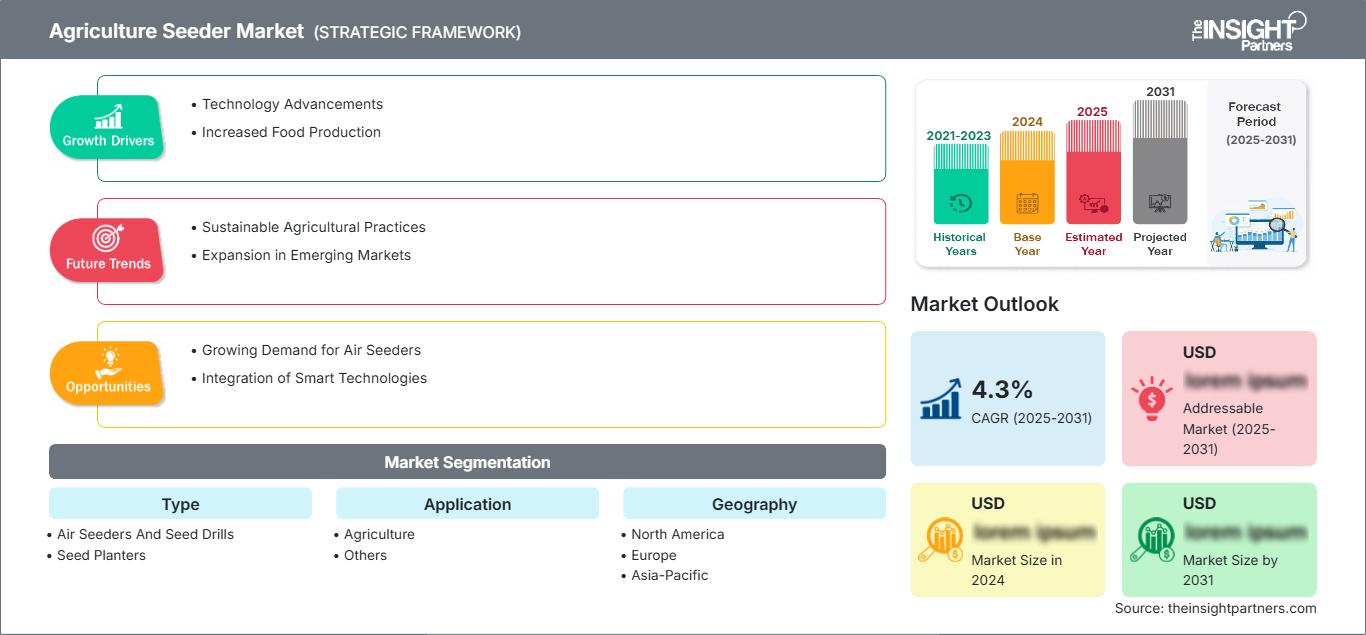
Agriculture Seeder Market: Strategic Insights
Regional Insights
North America Agriculture Seeder
North America accounted for 28–31% of the agriculture seeder market share in 2025, with a CAGR range of 2.9–3.3% during 2026–2034. The factors supporting demand for high-volume drills and planters are large farms, narrow window of sowing season, conservation tillage and robust dealer network. Share of agriculture seeder in the region is further strengthened by crop types such as corn, soybean, wheat and canola, which require controlled depth and seeding rates.
Structural considerations include fleet renewal, cover crop expansion and increasing use of ISOBUS compliant equipment. The US and Canadian farmers value machinery that minimizes the number of passes through the field, optimizes residue flow and connects with their farm management software. Demand for the equipment tends to be cyclic, but precision capabilities make purchases more justified when seed prices increase.
U.S. Agriculture Seeder Market
The U.S. represented 78–82% of North America in 2025 and is growing at a CAGR range of 2.8–3.2%. Demand for this product is prevalent in corn, soybeans, wheat, cotton, and forage operations where singulation, row shutoff, and residue performance have an impact on emergence. Deere & Company, AGCO Corporation, CNH Industrial N.V., and Great Plains Manufacturing, Inc. show prominent distribution and support networks.
Product use is trending towards high-speed planters in row crops and air drills for wheat and cover crop planting. Variable-rate seeding in varying soil productivity is becoming a common practice among farmers. The dealer’s role in calibration, availability of replacement parts, and financing determine the timing of purchases, while conservation programs help promote no-till/reduced-till equipment.
Europe Agriculture Seeder Market
Europe held 24–27% share in 2025 and is growing at a CAGR range of 2.7–3.1%. Germany is a leader in machinery intensity and conservation farming practice. United Kingdom has demand for direct drills and reduced tillage systems where farmers have to deal with fuel, labor and soil structure. France has demand for broad cereals and oilseeds from combined use of drills and planters.
Italy and Spain have replacement demand for smaller machines appropriate for varied crops and soil conditions. Väderstad AB, HORSCH Maschinen GmbH, Kubota Corporation and CNH Industrial N.V. fight on premium and mainstream segments. Pressure on input efficiency policy makes machines for better seed placement with low disturbance establishment.
APAC Agriculture Seeder Market
APAC accounted for 30–33% share in 2025 and is expanding at 3.6–4.1% CAGR. China is leading by its mechanization of its grains production process, whereas India is seeing an increase in demand for affordable seed drillers and planters due to lack of labor availability.
Countries like Japan, South Korea, and Australia have joined this bandwagon by creating demand for precise and conservation technologies. Mechanization policy support, custom hiring policy, and food security policy play an important role in this adoption.
Middle East & Africa Agriculture Seeder Market
Middle East & Africa is growing at 2.6–3.0% CAGR, with Saudi Arabia and the UAE focused on controlled agriculture, forage, and water-efficient crop establishment. South Africa leads regional field-crop equipment demand.
Infrastructure investment, irrigation expansion, and food security programs support selective adoption, although fragmented farms and financing constraints limit scale. Rest of MEA demand is strongest where mechanization services and dealer parts networks are available.
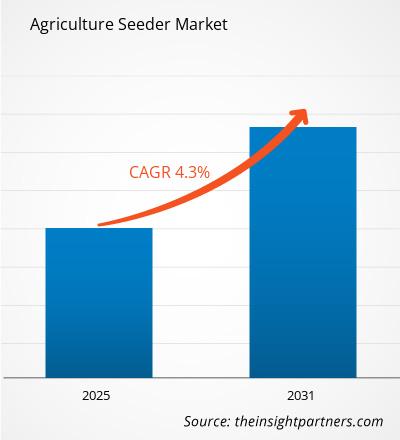
Segmentation Analysis
Type
Type is expected to grow at a CAGR range of 3.0–3.5% during 2026–2034. The agriculture seeder market scope across type categories reflects two purchasing logics: high-capacity drills for cereals and broad-acre crops, and precision planters for row crops. Buyers evaluate residue clearance, metering reliability, maintenance access, and compatibility with tractors and digital control systems.
- Air Seeders And Seed Drills remain the leading type, preferred in wheat, barley, canola, pulses, and cover crops where wide working widths, uniform depth, and fertilizer placement improve establishment.
- Seed Planters are strategically important in corn, soybean, cotton, sunflower, and specialty row crops because accurate singulation, spacing, and downforce control directly influence emergence and plant population.
Application
Application is expected to grow at a CAGR range of 3.1–3.6% during 2026–2034. Demand is concentrated in commercial agriculture, where planting speed, seed savings, and crop uniformity influence profitability. Adoption is also supported by custom operators that spread equipment cost across farms and increase access for growers unable to purchase large machines.
- Agriculture dominates application demand as grain, oilseed, pulse, and row-crop producers use mechanized seeding to improve timeliness, reduce labor dependency, and support precision agronomy decisions.
Opportunity Snapshot
| Application | Revenue Contribution | Trend Tag | Adoption Stage |
| Agriculture | High | Precision Sowing | Mature |
| Others | Low | Specialty Plots | Emerging |
Agriculture Seeder Market Growth Drivers and Impact Analysis
Compressed Planting Windows Increase Equipment Productivity Needs
Changing weather patterns are causing uncertainties with regard to crop planting, thus forcing farmers to look for machinery that allows for covering more hectares on a daily basis without compromising on precision of planting. Features like wide drill, big tank capacity, fast row unit speed, and faster calibration ensure maximum efficiency of planting process when soil is moist and warm. This trend affects the market directly in that efficiency-related attributes provide reasons for higher prices as well as upgrading of old mechanical machinery.
Precision Agronomy Raises Demand for Controlled Seed Placement
Seeds are high-value inputs; thus, poor emergence may limit yield before any decisions about crop protection or fertilization are made. Hence, farmers have moved to technologies that include variable-rate metering, row-by-row shut-off, down-force control, and map-enabled planting. Such systems minimize overlap, allow for population zones, and enhance uniformity through different soil types. This technology does not only affect equipment sales but also creates increased demand for sensors, controls, displays, and calibration services from dealers.
Conservation Farming Supports No-Till and Reduced-Till Adoption
With increased soil conservation activities, there is a growing requirement of seeders that work under residue, conserve water, and minimize tillage. The no-till drills, disc opener, press wheel, and residue manager enable the farmers to plant crops in stubbles without losing seed to soil contact. This gives rise to the requirement for heavy-duty frames, robust bearings, and agronomic flexible openers. The commercial implications can be witnessed in the areas where erosion control, carbon-based agriculture, and low fuel usage coincide with agricultural economics.
Agriculture Seeder Market Future Trends
Connected Seeder Platforms Move Toward Autonomous Workflows
Agriculture seeder market trends will increasingly center on connected implements that communicate planting depth, downforce, population, and blockage alerts to farm management systems. The future of machines will include semi-autonomous systems where tractors, planters, and farm field maps make repeatable passes while minimizing human involvement. In the future, this will benefit companies that combine machine durability and intuitive software, data mobility, and remote troubleshooting. The process of adoption will take place slowly since farms will require dependable dealer support, cyber security, and tangible profits from less rework and better crop establishment.
Low-Disturbance Systems Gain Relevance in Soil Health Programs
Low-disturbance seeding will become more important as growers balance yield, moisture retention, fuel use, and soil organic matter. Future drill designs are likely to emphasize narrow openers, consistent closing pressure, and residue flow without excessive horsepower needs. This shift creates opportunities for specialist manufacturers that understand agronomy as well as fabrication. It also supports retrofit markets for coulters, press wheels, and monitoring kits that help farms upgrade existing fleets without full equipment replacement.
Agriculture Seeder Market Opportunities
Affordable Precision Packages for Emerging Mechanization Markets
Manufacturers can capture agriculture seeder market forecasts upside by offering scalable precision packages for India, Southeast Asia, Africa, and Latin America. The opportunity lies in pairing mechanical durability with optional electronics, simple calibration, and compatibility with mid-range tractors. Localized assembly and service training can reduce downtime fears, while custom-hiring models allow smallholders to access modern equipment without ownership. Companies that build finance partnerships and agronomy demonstrations will convert interest into recurring equipment demand.
Aftermarket Upgrades and Retrofit Kits Expand Revenue Pools
Retrofit demand is attractive because many farms own structurally sound seeders that need improved metering, monitoring, or residue-handling capability. Suppliers can monetize blockage sensors, variable-rate controllers, section control, coulter assemblies, and wear parts without requiring a full machine sale. This opportunity is less cyclical than new equipment because maintenance spending continues even in tighter farm-income years. Dealers that bundle installation, calibration, and seasonal inspection can improve customer retention and build recurring service revenue.
Recent Developments
- October 2025: Väderstad AB — launched the next generation row unit for Tempo and Proceed, adding electronic planting depth setting, easier crop switching, upgraded seed meters, and improved seed furrow precision. The company said serial production would begin from June 2026 across Tempo and Proceed product models.
- September 2025: Väderstad AB — introduced new Spirit and Inspire seed drills with a new seed coulter, extended coulter pressure, optional following harrow, and hydraulic depth setting from the cab. The update strengthens the company’s broad-acre seeding portfolio ahead of Agritechnica 2025.
- April 2025: Virkar Group — launched its new TACTIC direct-drill seeder, expanding its portfolio of conservation agriculture equipment. Introduced as an evolution of the company's Ocean series, the TACTIC is designed for farmers seeking higher operational capacity while maintaining precision and maneuverability in no-till farming. The machine offers a working width of 7.5–9 meters, a 7,000-liter pressurized hopper with an automatic opening and closing lid, and a newly developed seed dosing system to improve seeding accuracy.
Frequently Asked Questions

- Comprehensive Market Sizing and Forecast Analysis
- Detailed Segmentation Analysis
- In-Depth Market Dynamics Assessment
- Regional and Country-Level Insights
- Competitive Landscape and Company Benchmarking
- Strategic Business Intelligence
Recent Reports
Testimonials

The Insight Partners' SCADA System Market report is comprehensive, with valuable insights on current trends and future forecasts. The team was highly professional, responsive, and supportive throughout. We are very satisfied and highly recommend their services.
RAN KEDEM Partner, Reali Technologies LTDs
I requested a report on a very specific software market and the team produced the report in a few days. The information was very relevant and well presented. I then requested some changes and additions to the report. The team was again very responsive and I got the final report in less than a week.
JEAN-HERVE JENN Chairman, Future Analytica
We worked with The Insight Partners for an important market study and forecast. They gave us clear insights into opportunities and risks, which helped shape our plans. Their research was easy to use and based on solid data. It helped us make smart, confident decisions. We highly recommend them.
PIYUSH NAGPAL Sr. Vice President, High Beam Global
The Insight Partners delivered insightful, well-structured market research with strong domain expertise. Their team was professional and responsive throughout. The user-friendly website made accessing industry reports seamless. We highly recommend them for reliable, high-quality research services
YUKIHIKO ADACHI CEO, Deep Blue, LLC.
This is the first time I have purchased a market report from The Insight Partners.While I was unsure at first, I visited their web site and felt more comfortable to take the risk and purchase a market report.I am completely satisfied with the quality of the report and customer service. I had several questions and comments with the initial report, but after a couple of dialogs over email with their analyst I believe I have a report that I can use as input to our strategic planning process.Thank you so much for taking the extra time and making this a positive experience.I will definitely recommend your service to others and you will be my first call when we need further market data.
JOHN SUZUKI President and Chief Executive Officer, Board Director, BK Technologies
I wish to appreciate your support and the professionalism you displayed in the course of attending to my request for information regarding to infectious disease IVD market in Nigeria. I appreciate your patience, your guidance, and the fact that you were willing to offer a discount, which eventually made it possible for us to close a deal. I look forward to engaging The Insight Partners in the future, all thanks to the impression you have created in me as a result of this first encounter.
DR CHIJIOKE ONYIA MANAGING DIRECTOR, PineCrest Healthcare Ltd.Reason to Buy
- Informed Decision-Making
- Understanding Market Dynamics
- Competitive Analysis
- Identifying Emerging Markets
- Customer Insights
- Market Forecasts
- Risk Mitigation
- Boosting Operational Efficiency
- Strategic Planning
- Investment Justification
- Tracking Industry Innovations
- Aligning with Regulatory Trends





 Get Free Sample for