
Agriculture Tractors Market Trends, Share & Demand by 2034
Coverage: By Power Output (Less Than 30 HP, Hp,31-70 Hp, 71-130 Hp, 131-250 Hp, Above 250 Hp); Drive Type (Two-Wheel Drive, Four-Wheel Drive); Equipment Type (Combines, Balers, Sprayers); Function Type (Plowing Cultivating, Plant Protection Fertilizing, Harvesting Threshing); Type (Tractors, Combines) , and Geography (North America, Europe, Asia Pacific, and South and Central America)
- Status : Data Released
- Report Code : TIPRE00003851
- Category : Automotive and Transportation
- No. of Pages : 150
- Available Report Formats :


- Last update date : August 10, 2026


2025 Market Size
US$ 67.19 Bn
Base year value
2034 Forecast
US$ 115.83 Bn
Projected by 2034
CAGR 2026-2034
6.24 %
Growth rate
Addressable Market
US$ 828.47 Bn
(2026-2034)
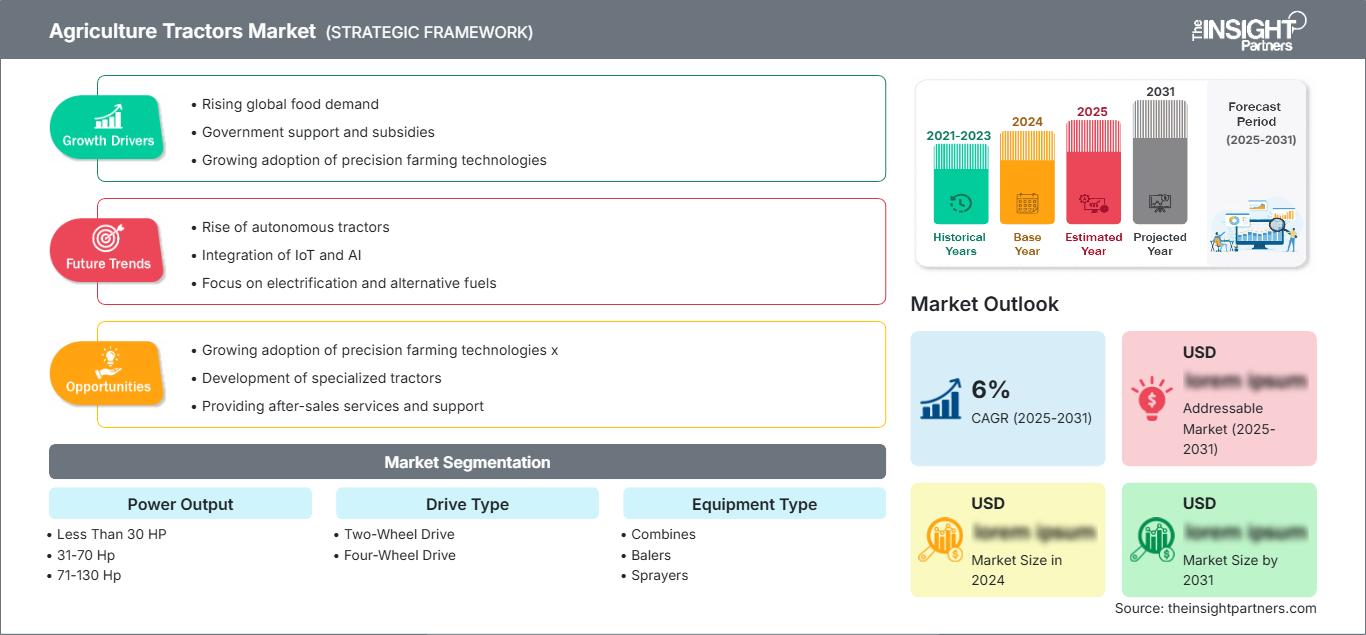
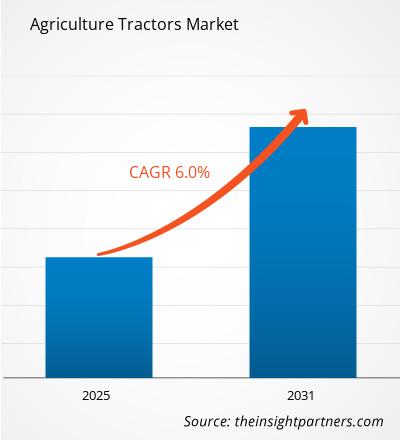
The agriculture tractors market was valued at US$ 67.19 Billion in 2025 and is projected to reach US$ 115.83 Billion by 2034, expanding at a CAGR of 6.24% during 2026–2034. Market expansion is supported by increasing farm mechanization, labor shortages in agricultural operations, and the adoption of precision farming technologies. Equipment manufacturers continue to enhance tractor efficiency through digital connectivity, automation features, and fuel-efficient powertrain systems, strengthening long-term industry demand across developed and developing agricultural economies.
Across North America, mechanized farming practices, large-scale agricultural holdings, and continuous technology upgrades are sustaining equipment replacement cycles. The agriculture tractors market size in the region benefits from precision agriculture integration, higher farm productivity requirements, and government-supported modernization initiatives. Market expansion is further supported by increasing utilization of GPS-enabled equipment, telematics platforms, and autonomous field operation technologies among commercial farm operators.
Agriculture Tractors Market Assessment and Insights
- North America: The region remains technologically advanced with extensive use of precision agriculture solutions. Share in 2025 is estimated at 28–32%, while the market is expected to grow at a CAGR range of 5.6–6.3% during 2026–2034.
- US: Strong commercial farming activity and replacement demand support expansion. The country accounts for 68–72% of North America in 2025 and is anticipated to register a 5.8–6.4% CAGR during 2026–2034.
- Europe: Germany, France, Italy, and the UK remain major contributors due to mechanized cultivation and sustainability initiatives. Regional share in 2025 is estimated at 23–27%, with CAGR projected at 5.2–5.9% during 2026–2034.
- Asia Pacific: China, India, Japan, and Australia continue to drive volume demand. Share in 2025 is estimated at 38–42%, while CAGR is expected to reach 6.9–7.6% during 2026–2034.
- Largest Segment: 31–70 HP tractors dominate agricultural operations due to versatility and affordability. Market share in 2025 is estimated at 32–36%, with CAGR of 6.0–6.6% from 2026–2034.
- High Growth Segment: Four-Wheel Drive tractors are witnessing higher adoption in commercial farming applications. Market share in 2025 is estimated at 28–32%, while CAGR is projected at 7.2–7.9% during 2026–2034.
- Key companies analyzed in detail: AGCO Corporation, Argo Tractors S.p.A., CLAAS KGaA mbH, CNH Industrial N.V., Deere & Company, SDF S.p.A. (Deutz-Fahr), Iseki & Co., Ltd., Kubota Corporation, Mahindra & Mahindra Limited, Yanmar Holdings Co., Ltd.
Source: The Insight Partners' analysis based on proprietary research, government publications, company annual reports, investor presentations, industry databases, and expert interviews.
Current agriculture production processes rely more on the use of mechanized methods, which decrease dependency on labor and increase efficiency. Improvements in engine performance, guidance systems, equipment connectivity architecture, and precision farming technologies affect decisions related to the purchase of the equipment. Agricultural equipment suppliers keep developing product ranges by increasing them in various horsepower segments to suit different sizes of farms and crop operations. This leads to diversification of competition in the market and ensures the continued growth of the need for innovative machines.
Market development in the Agriculture Tractors Market in the future can be influenced by investment in smart farming systems, electrification, and autonomous equipment technologies. Development of agricultural economies leads to greater rates of mechanization with the help of financing initiatives and infrastructure improvement in the countryside. Sustainability, resource efficiency, and digital farm management become increasingly important and can stimulate growth in the market.
Agriculture Tractors Market Report Scope
| Report Attribute | Details |
|---|---|
| Market size in 2025 | US$ 67.19 Billion |
| Market Size by 2034 | US$ 115.83 Billion |
| Global CAGR (2026 - 2034) | 6.24% |
| Historical Data | 2021-2024 |
| Forecast period | 2026-2034 |
Agriculture Tractors Market Analysis
The agriculture tractors market growth trajectory is supported by rising mechanization requirements across agriculture-intensive economies. Increasing labor shortages, greater demand for food production, and expanding adoption of precision agriculture technologies are transforming tractor purchasing behavior. Today’s tractors operate as complete farm management units, which can handle GPS navigation, yield management, automatic steering, and telecommunication systems. The increased consciousness about efficiency has driven many to upgrade their older tractors for technologically advanced ones.
In the value chain, tractor manufacturers work with component manufacturers, precision technology firms, software companies, and dealerships to add more functionality to their products. There is no doubt that supply continues to be positively influenced by rural financing programs, government programs for mechanization, and investments in improving agricultural productivity. Demand is especially strong in those areas where there is an increase in commercial farming due to land consolidation.
Market analysis of agriculture tractors shows that competitive intensity is growing as companies expand their product range and invest in digital agriculture technology. The leading companies prioritize innovations, building their dealer networks, fleet connectivity, and lifecycle customer support. Competing is not just about the ability of a tractor to perform tasks but also about its software integration and predictive maintenance capabilities.
Deere & Company, AGCO Corporation, CNH Industrial N.V., Kubota Corporation, and Mahindra & Mahindra Limited are continuing to invest in ecosystems of smart farming and next-generation machinery. Simultaneously, CLAAS KGaA mbH, Argo Tractors S.p.A., Iseki & Co., Ltd., SDF S.p.A., and Yanmar Holdings Co., Ltd. are consolidating their positions via specialized approaches to their business, including specialization, manufacturing regions, and product lines. Strategic alliances that promote precision agriculture will be crucial for the forecast period.
● REPORT CUSTOMIZATION
Tailor This Report To Align With Your Specific Business Requirements
This report can be customized to align precisely with your business objectives, scope, and target markets. Customization options include tailored segmentation, geography, competitive analysis, and strategic insights to support informed decision-making.
Customize This Report →WHAT YOU CAN ADJUST
- ● Segmentations
- ● Geography
- ● Competitive Analysis
- ● Language Preferences
Agriculture Tractors Market: Strategic Insights
Regional Insights
North America Agriculture Tractors Market
North America accounted for approximately 28–32% agriculture tractors market share in 2025. A high level of mechanization, extensive commercial farming activities, and adoption of agricultural digital technologies make the market a leader. Increasing investments in connected technology to help achieve better input management, decrease operating expenses, and improve the yield are observed. Large-scale crop growing makes continuous demand for high-horsepower machines and technologically advanced tractors.
The growth of the market is forecast to be 5.6–6.3% CAGR from 2026 to 2034. Continuous development of agriculture, available financial conditions, and replacement needs of outdated equipment are structural factors for market development. Precision planting, guidance technology, and telematics-based fleet management systems become common in commercial farming. Sustainable development goals and resource management needs stimulate investments in agricultural equipment.
U.S. Agriculture Tractors Market
The United States represents approximately 68–72% of the North American market in 2025, supported by large-scale grain, oilseed, and specialty crop farming operations. Equipment replacement demand remains strong due to the increasing integration of digital technologies into agricultural workflows. Commercial operators prefer solutions capable of improving labor productivity while maintaining operational accuracy across diverse field conditions.
The U.S. market is projected to expand at a 5.8–6.4% CAGR during 2026–2034. Deere & Company, AGCO Corporation, CNH Industrial N.V., and Kubota Corporation maintain significant operational presence through manufacturing facilities, distribution networks, and technology partnerships. Farmers continue adopting automated steering, precision application systems, and data-driven equipment management tools to improve productivity and support long-term profitability.
Europe Agriculture Tractors Market
Europe accounted for approximately 23–27% of the global Agriculture Tractors Market in 2025 and is projected to expand at a CAGR of 5.2–5.9% through 2034. Germany remains the leading contributor to the Agriculture Tractors Market in the region due to extensive mechanization and strong manufacturing capabilities. The country benefits from established agricultural machinery production clusters, advanced engineering expertise, and continuous investments in farm productivity enhancement, supporting sustained growth in the Agriculture Tractors Market.
In the United Kingdom, the demand is maintained by modernization efforts emphasizing efficiency and sustainable agriculture. As for France, Italy, and Spain, the volume of their combined contribution to the region is quite significant, thanks to their cereal crops, vineyards, horticulture, and mixed agriculture. The environmental restrictions, precision agriculture, and replacement demand keep promoting the purchases of equipment in Europe.
APAC Agriculture Tractors Market
Asia Pacific represented approximately 38–42% of the global Agriculture Tractors Market in 2025, making it the largest regional contributor. China and India account for the majority of demand in the Agriculture Tractors Market due to extensive agricultural activity, government-supported mechanization programs, and rising farm productivity requirements. Japan, South Korea, and Australia further support growth in the market through advanced farming practices and increasing adoption of precision agriculture technologies.
The regional market is anticipated to expand at a 6.9–7.6% CAGR during 2026–2034. India remains the leading growth engine because of expanding tractor penetration in semi-mechanized farming areas. China continues investing in agricultural modernization, while Australia increasingly utilizes high-horsepower equipment for large-scale commercial operations.
Middle East & Africa Agriculture Tractors Market
The Middle East & Africa Agriculture Tractors Market is developing steadily as countries focus on food security, irrigation efficiency, and agricultural modernization. Saudi Arabia and the UAE continue investing in advanced farming technologies to improve domestic agricultural productivity, supporting demand in the Agriculture Tractors Market. South Africa remains the largest tractor-consuming country in Sub-Saharan Africa due to its comparatively mature commercial farming sector, making it a key contributor to the regional Agriculture Tractors Market.
The region is projected to register a 5.8–6.5% CAGR during 2026–2034. Infrastructure development, mechanization initiatives, and increasing agricultural investment support growth prospects. Rising adoption of modern cultivation practices across emerging agricultural economies is expected to improve long-term equipment demand throughout the forecast period.
Segmentation Analysis
Power Output
The Power Output segment is expected to grow at a 6.1–6.7% CAGR during 2026–2034. Tractor selection remains closely linked to farm size, crop type, and operational requirements. Increasing demand for efficiency and versatility encourages farmers to adopt horsepower categories tailored to specific agricultural activities. The agriculture tractors market scope continues expanding as manufacturers introduce advanced technologies across multiple power ranges to serve both smallholders and large commercial farms.
- Less Than 30 HP: Primarily utilized by small farms, orchards, landscaping operations, and horticulture applications. Their affordability and maneuverability make them important in regions characterized by fragmented landholdings and small-scale cultivation practices.
- 31–70 HP: This category remains the dominant product range due to its flexibility across cultivation, planting, transport, and maintenance tasks. Balanced performance and cost efficiency support extensive adoption across emerging agricultural economies.
- 71–130 HP: Widely employed in medium-sized commercial farms requiring greater operational efficiency. Demand benefits from increasing mechanization intensity and broader implementation of precision agriculture technologies.
- 131–250 HP: Preferred for intensive agricultural operations involving larger implements and higher productivity requirements. Growing commercial farming activities continue to strengthen demand within this horsepower range.
- Above 250 HP: High-performance machinery designed primarily for large-scale operations. Adoption is concentrated in developed agricultural markets where large land areas justify investment in premium equipment solutions.
Drive Type
The Drive Type segment is projected to record a 6.5–7.2% CAGR during 2026–2034. Rising emphasis on productivity, field efficiency, and operation under challenging terrain conditions contributes to increased demand for advanced drivetrain configurations. Farmers continue evaluating traction performance, fuel efficiency, and operational reliability when selecting equipment.
- Two-Wheel Drive: Maintains relevance in lightweight agricultural operations and cost-sensitive markets. Lower purchase costs and straightforward maintenance requirements continue to support adoption among smaller farms.
- Four-Wheel Drive: Increasingly favored in commercial agriculture because of superior traction, productivity, and compatibility with larger implements. Adoption remains particularly strong in large-scale cultivation environments requiring intensive field operations.
Equipment Type
The Equipment Type segment is anticipated to expand at a 6.3–6.9% CAGR during 2026–2034. Agricultural productivity objectives encourage integration between tractors and specialized farm equipment. Efficient harvesting, crop protection, and post-harvest processing requirements continue supporting segment development worldwide.
- Combines: Critical for mechanized harvesting operations across grain-producing regions. Demand is supported by increasing efforts to improve harvest efficiency and reduce labor dependency during peak seasons.
- Balers: Widely utilized in forage management and livestock-oriented agricultural activities. Their role in preserving crop quality contributes to steady market relevance.
- Sprayers: Adoption continues rising due to precision agriculture initiatives and increasing focus on efficient crop protection. Modern spraying solutions support optimized input utilization and improved field management outcomes.
Function Type
The Function Type segment is expected to register a 6.0–6.6% CAGR during 2026–2034. Agricultural activities increasingly rely on specialized tractor functionality to improve operational precision and farm efficiency. Manufacturers continue designing solutions capable of addressing multiple cultivation stages through integrated machinery systems.
- Plowing Cultivating: Represents a foundational agricultural application supporting soil preparation and field management. Demand remains stable due to its essential role across nearly all crop production systems.
- Plant Protection Fertilizing: Growing emphasis on precision input application encourages adoption of equipment capable of delivering improved productivity and sustainability outcomes.
- Harvesting Threshing: Strongly influenced by mechanization trends and labor availability. Farmers increasingly invest in efficient harvesting solutions to reduce crop losses and improve operational performance.
Opportunity Snapshot
| Function Type | Revenue Contribution | Trend Tag | Adoption Stage |
|---|---|---|---|
| Plowing & Cultivating | High | Soil Prep | Mature |
| Plant Protection & Fertilizing | Medium | Precision Spray | Scaling |
| Harvesting & Threshing | High | Smart Harvest | Scaling |
Agriculture Tractors Market Growth Drivers and Impact Analysis
Expansion of Agricultural Mechanization Programs
The governments and agricultural organizations in the underdeveloped countries keep on advocating for mechanization for enhanced productivity and lesser dependence on manpower, along with food security. Agricultural equipment financing, purchases at reduced cost, and modernization of agriculture help in encouraging farmers to move toward mechanization rather than using traditional ways of farming. The increasing pressure on agricultural production caused by the increase in population also contributes to higher demands for machinery. The tractor has played an important role in the modernization of farming owing to its usefulness in many agricultural activities. The rise in the rate of mechanization in different areas of the world, like Asia-Pacific, Latin America, and certain African countries, creates a huge untapped market for the manufacturers of such equipment.
Adoption of Precision Agriculture Technologies
Precision agriculture changes the way agricultural equipment is purchased around the world. Today, farmers tend to choose technology that can help boost efficiency but reduce costs at the same time. With GPS guidance, telematics, autonomous steering, and analytics built-in features, modern tractors offer tangible efficiency gains. This includes better field navigation, more efficient fertilizer usage, and more efficient use of agricultural equipment. In search of greater return on investment, agribusinesses implement more connected equipment into their strategies. Digital solutions combined with conventional agricultural equipment provide a possibility to create more value-added products and services. Thus, demand for advanced tractors will be growing in developed and developing countries.
Rising Demand for Food Production Efficiency
Food consumption around the world keeps rising with the increase in the number of people, urbanization, and the evolution in diets. The farmers find themselves under increasing pressure to produce more and are dealing with resource scarcity and environmental concerns. The tractors become a very important part of the process of becoming more productive as they ensure the effective field preparation, planting, cultivation, spraying, and harvesting. Modern farming companies buy more and more modern equipment to be competitive and reliable. Increased productivity expectations mean the need to substitute the old equipment with the new one that will operate in a more fuel-efficient way and will include automation.
Agriculture Tractors Market Future Trends
Autonomous and Semi-Autonomous Farm Equipment Adoption
The agriculture tractors market trends increasingly reflect the transition toward autonomous and semi-autonomous farming operations. Machine vision, AI-enabled navigation, telemetry, and automated steering systems are being incorporated into new-generation tractor models by equipment providers. Agricultural businesses are considering the automation features to mitigate the problem of labor shortage, improve precision and decrease downtime during crucial periods such as plantings and harvests. Further developments are anticipated to be related to the collaboration of machines within fleets under centralized farm management systems that are able to gather and analyze field data in real time. With the expansion of connectivity in agricultural regions, automation features will most likely expand from premium product lines to commercial use, leading to dramatic changes in agricultural production worldwide.
Integration of Sustainability-Focused Powertrain Technologies
The objectives and changing expectations regarding environmental impact are anticipated to speed up the introduction of alternative powertrains. Manufacturers are continuing to focus on the development of hybrid, low-emissions, and electrified solutions aimed at minimizing fuel usage while maintaining vehicle performance. Sustainability goals set by the government and farming bodies are stimulating the development of innovations in all types of machines. Future tractors are supposed to include such features as energy management systems, efficiency technologies, and sustainability during the whole life cycle of a vehicle. The traditional diesel engines will still dominate the market over the forecast period, but growing interest and testing activities should open new doors for alternative powertrains, especially agricultural ones.
Agriculture Tractors Market Opportunities
Expansion Potential Across Emerging Agricultural Economies
Significant opportunities remain available in agricultural markets where mechanization rates continue to lag global averages. Several developing economies are expanding support for modern cultivation practices through financing programs, rural infrastructure development, and agricultural modernization initiatives. These factors create favorable conditions for equipment manufacturers seeking new revenue streams beyond mature markets. Growing awareness of productivity enhancement, combined with increasing pressure to improve food security, is expected to strengthen the adoption of mechanized farming solutions. Long-term agriculture tractors market Forecasts indicate that manufacturers capable of introducing affordable, durable, and technologically adaptable products tailored to regional farming conditions will benefit from substantial expansion opportunities. Strategic localization of production and distribution networks can further strengthen competitive positioning.
Digital Agriculture Service Ecosystem Development
The evolution of connected farming creates opportunities extending beyond equipment sales. Manufacturers increasingly recognize the value of recurring revenue streams supported by software platforms, predictive maintenance services, telematics subscriptions, and precision agriculture solutions. The integration of machinery with digital decision-support tools can improve equipment utilization and strengthen customer retention. Agricultural producers are becoming more receptive to data-driven operational management approaches that support cost optimization and productivity enhancement. Companies capable of developing comprehensive service ecosystems around their machinery platforms may achieve stronger differentiation in competitive markets. This opportunity is particularly attractive because it combines equipment demand with long-term service relationships that extend throughout the operational lifecycle of agricultural assets.
Frequently Asked Questions

- Comprehensive Market Sizing and Forecast Analysis
- Detailed Segmentation Analysis
- In-Depth Market Dynamics Assessment
- Regional and Country-Level Insights
- Competitive Landscape and Company Benchmarking
- Strategic Business Intelligence
Recent Reports
Testimonials

The Insight Partners provided valuable market intelligence that supported our global go-to-market strategy. Their team was professional, responsive, and attentive to our feedback, providing thoughtful analysis and helpful methodological clarifications throughout the project.
Junmo Kim Chief Financial Officer (CFO), Enertech Co., Ltd.
The Insight Partners' SCADA System Market report is comprehensive, with valuable insights on current trends and future forecasts. The team was highly professional, responsive, and supportive throughout. We are very satisfied and highly recommend their services.
RAN KEDEM Partner, Reali Technologies LTDs
I requested a report on a very specific software market and the team produced the report in a few days. The information was very relevant and well presented. I then requested some changes and additions to the report. The team was again very responsive and I got the final report in less than a week.
JEAN-HERVE JENN Chairman, Future Analytica
We worked with The Insight Partners for an important market study and forecast. They gave us clear insights into opportunities and risks, which helped shape our plans. Their research was easy to use and based on solid data. It helped us make smart, confident decisions. We highly recommend them.
PIYUSH NAGPAL Sr. Vice President, High Beam Global
The Insight Partners delivered insightful, well-structured market research with strong domain expertise. Their team was professional and responsive throughout. The user-friendly website made accessing industry reports seamless. We highly recommend them for reliable, high-quality research services
YUKIHIKO ADACHI CEO, Deep Blue, LLC.
This is the first time I have purchased a market report from The Insight Partners.While I was unsure at first, I visited their web site and felt more comfortable to take the risk and purchase a market report.I am completely satisfied with the quality of the report and customer service. I had several questions and comments with the initial report, but after a couple of dialogs over email with their analyst I believe I have a report that I can use as input to our strategic planning process.Thank you so much for taking the extra time and making this a positive experience.I will definitely recommend your service to others and you will be my first call when we need further market data.
JOHN SUZUKI President and Chief Executive Officer, Board Director, BK Technologies
I wish to appreciate your support and the professionalism you displayed in the course of attending to my request for information regarding to infectious disease IVD market in Nigeria. I appreciate your patience, your guidance, and the fact that you were willing to offer a discount, which eventually made it possible for us to close a deal. I look forward to engaging The Insight Partners in the future, all thanks to the impression you have created in me as a result of this first encounter.
DR CHIJIOKE ONYIA MANAGING DIRECTOR, PineCrest Healthcare Ltd.Reason to Buy
- Informed Decision-Making
- Understanding Market Dynamics
- Competitive Analysis
- Identifying Emerging Markets
- Customer Insights
- Market Forecasts
- Risk Mitigation
- Boosting Operational Efficiency
- Strategic Planning
- Investment Justification
- Tracking Industry Innovations
- Aligning with Regulatory Trends





 Get Free Sample for