
AI Deception Tools Market Trends, Size & Growth by 2034
AI Deception Tools Market Size and Forecast (2021 - 2034), Global and Regional Share, Trend, and Growth Opportunity Analysis Report Report Coverage : by Component (Software, Services), Deployment Mode (Cloud-based, On-premises), Organization Size (SMEs and Large Enterprises), Application (Threat Detection and Analysis, Incident Response, Network Secturity, Endpoint Security) Industry (BFSI. IT and Healthcare, Governmenta nd Defense, Manufacturing, Retail) and Geography
- Status : Data Released
- Report Code : TIPRE00042035
- Category : Technology, Media and Telecommunications
- No. of Pages : 150
- Available Report Formats :


- Last update date : August 12, 2026


2025 Market Size
US$ 870.00 Mn
Base year value
2034 Forecast
US$ 8,431.00 Mn
Projected by 2034
CAGR 2026-2034
28.71 %
Growth rate
Addressable Market
US$ 33,909.90 Mn
(2026-2034)
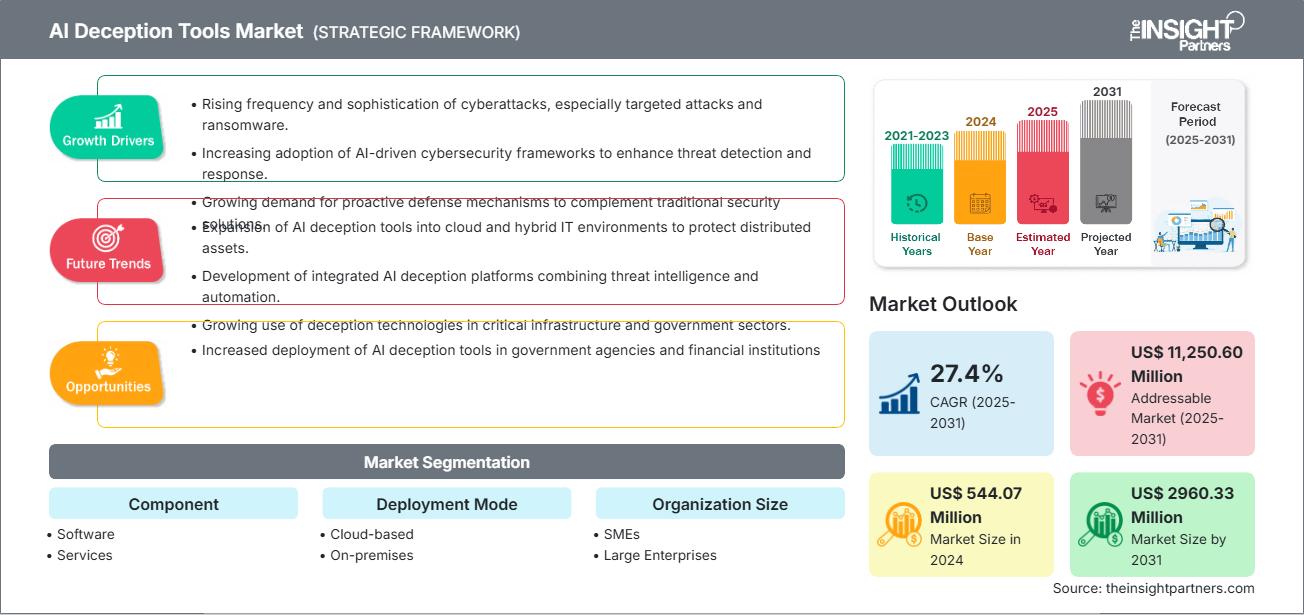
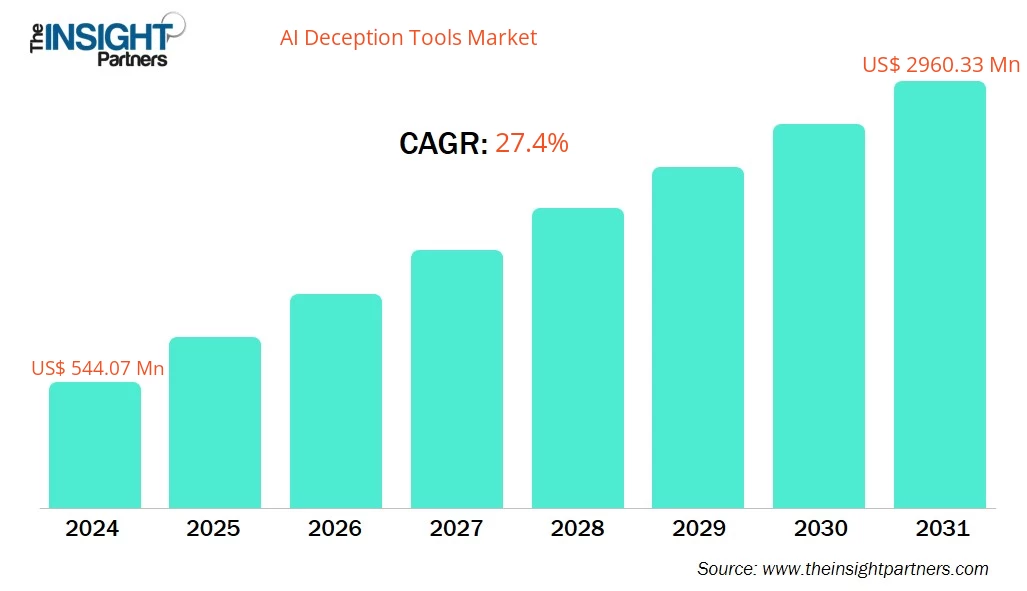
The AI deception tools market was valued at US$ 870 Million in 2025 and is projected to reach US$ 8,431 Million by 2034, expanding at a CAGR of 28.71% during 2026–2034. Growth is being supported by rising enterprise investment in proactive cyber defense, increasing sophistication of ransomware campaigns, and broader adoption of deception-based architectures designed to identify lateral movement, credential misuse, and advanced persistent threats before operational damage occurs.
Across North America, adoption is accelerating as enterprises shift toward zero-trust security models and continuous threat exposure management practices. The AI deception tools market size is being strengthened by demand from government agencies, critical infrastructure operators, and highly regulated sectors. Regional growth is expected to remain within a 26–30% CAGR range during the forecast period as cloud-native security modernization programs continue expanding.
AI Deception Tools Market Assessment and Insights
- North America: Share in 2025 estimated at 38–42%, supported by mature cybersecurity spending and strong enterprise adoption. Expected CAGR between 27–30% during 2026–2034.
- US: Accounts for 75–80% of North America in 2025, driven by defense, financial services, and technology sectors. Expected CAGR between 27–30% during 2026–2034.
- Europe: Share in 2025 estimated at 24–28%, with Germany, the UK, and France leading deployments. Expected CAGR between 26–29% during 2026–2034.
- Asia Pacific: Share in 2025 estimated at 22–26%, led by China, Japan, India, South Korea, and Australia. Expected CAGR between 30–33% during 2026–2034.
- Largest Segment: Software segment holds an estimated 68–72% market share in 2025 and is expected to grow at 28–31% CAGR through 2034.
- High Growth Segment: Cloud-based deployment represents 58–62% market share in 2025 and is projected to expand at 30–33% CAGR through 2034.
- Key companies analyzed in detail: Attivo Networks, Inc.; TrapX Security; Illusive Networks; Rapid7, Inc.; Cymmetria; Smokescreen Technologies; Fidelis Security; Guardicore; CyberTrap; SpecterOps.
Source: The Insight Partners' analysis based on proprietary research, government publications, company annual reports, investor presentations, industry databases, and expert interviews.
From static honey pots, the market has moved to intelligent deception ecosystems where it is possible to produce dynamic decoys, behavioral alerts, and attack paths. More companies are incorporating the use of deception with XDR, SIEM, SOAR, and identity management systems in order to enhance accuracy of detection while decreasing the burden on analysts. Complexity in the hybrid environment, as well as speed of attack, has necessitated the need for automation of deception solutions.
Going forward, market growth prospects are supported by cybersecurity regulations, the the development of sovereign digital infrastructures, and an increasing emphasis on proactive threat detection by enterprises. Countries in the Asia Pacific and Middle East regions are incorporating deception solutions in their national cybersecurity strategies. Increased venture capital investment, identity-centric security solutions, and AI-enabled threat hunting will open up more deployment possibilities.
AI Deception Tools Market Report Scope
| Report Attribute | Details |
|---|---|
| Market size in 2025 | US$ 870.00 Million |
| Market Size by 2034 | US$ 8,431.00 Million |
| Global CAGR (2026 - 2034) | 28.71% |
| Historical Data | 2021-2024 |
| Forecast period | 2026-2034 |
AI Deception Tools Market Analysis
The AI deception tools market growth is being fueled by increasing attack sophistication and the growing inability of traditional preventive controls to detect lateral movement within enterprise environments. Deception products are being used by organizations to develop realistic attack surfaces that can detect malintent at an early stage during the course of any intrusion process. The need for such products is most acute among financial institutions, government entities, healthcare providers, and critical infrastructure players who seek precise information on threats and faster identification of incidents.
Within the cybersecurity value chain, deception products are evolving into essential parts of larger security operations ecosystems. Deception vendors offer increasing support for compatibility with endpoint detection tools, identity solutions, network analytics solutions, and cloud security platforms. With migration of workloads to hybrid environments, scalability in deployment has emerged as a major buying consideration.
The AI deception tools market analysis indicates growing competitive intensity as vendors differentiate through AI-driven attack-path mapping, autonomous decoy creation, identity deception, and threat intelligence integration. SpecterOps, Illusive Networks, TrapX Security, and Smokescreen Technologies emphasize their expertise in offensive defense tactics, whereas Fidelis Security and Rapid7 rely on their wider range of offerings in the cybersecurity domain in order to broaden their customer base.
The level of investment is quite high, since enterprises pay increasing attention to preventive detection systems. The need to find solutions for decreasing dwell time and increasing investigation quality becomes more prevalent for enterprise customers.
● REPORT CUSTOMIZATION
Tailor This Report To Align With Your Specific Business Requirements
This report can be customized to align precisely with your business objectives, scope, and target markets. Customization options include tailored segmentation, geography, competitive analysis, and strategic insights to support informed decision-making.
Customize This Report →WHAT YOU CAN ADJUST
- ● Segmentations
- ● Geography
- ● Competitive Analysis
- ● Language Preferences
AI Deception Tools Market: Strategic Insights
Regional Insights
North America AI deception tools market
North America accounted for approximately 38–42% share in 2025 and is projected to register a 27–30% CAGR through 2034. The region benefits from large cybersecurity budgets, extensive digital infrastructure, and strong adoption of zero-trust architectures. Financial institutions, defense organizations, healthcare systems, and cloud service providers represent major adopters of deception environments.
Growing ransomware activity, regulatory scrutiny, and increasing investment in threat exposure management are supporting sustained demand. The region also benefits from a dense vendor ecosystem and extensive cybersecurity research activity. The AI deception tools market share remains highest in North America due to enterprise awareness, advanced security operations maturity, and continuous modernization of cyber defense programs.
U.S. AI deception tools market
The United States represents roughly 75–80% of North American revenue in 2025 and is expected to grow at a 27–30% CAGR. Federal cybersecurity initiatives, defense spending, and expanding adoption of identity protection technologies continue to support implementation across large enterprises and government agencies.
Strong vendor presence, including Rapid7, SpecterOps, Fidelis Security, and Attivo Networks, supports innovation and deployment. Organizations increasingly use deception tools for credential theft detection, attack-path assessment, insider-threat monitoring, and advanced threat analytics. Growing cloud adoption and AI-driven security operations further reinforce demand across the country.
Europe AI deception tools market
Europe accounts for approximately 24–28% of global revenue in 2025 and is projected to expand at a 26–29% CAGR. Regulatory frameworks focused on data protection, operational resilience, and critical infrastructure security continue to encourage investment in advanced cyber defense technologies.
The UK remains a leading adopter due to financial-sector cybersecurity requirements and extensive managed security service ecosystems. Germany benefits from industrial cybersecurity investment across manufacturing and critical infrastructure environments. France, Italy, and Spain are witnessing increasing implementation of proactive detection platforms as enterprises strengthen resilience against targeted cyberattacks and supply-chain intrusions.
APAC AI deception tools market
Asia Pacific holds an estimated 22–26% share in 2025 and is expected to achieve the fastest expansion at a 30–33% CAGR. China, Japan, India, South Korea, and Australia are increasing investment in cyber resilience, driven by digital transformation and critical infrastructure modernization.
Government-backed cybersecurity initiatives, expanding cloud adoption, and rising cybercrime activity support growth. China remains the largest regional market, while India is emerging as a high-opportunity environment due to accelerating enterprise security spending and digital economy expansion.
Middle East & Africa AI deception tools market
The Middle East & Africa market is forecast to expand at a 25–28% CAGR through 2034. Digital infrastructure programs in Saudi Arabia and the UAE are generating demand for proactive detection technologies across government, energy, and financial sectors.
Saudi Arabia leads regional adoption, followed by the UAE and South Africa. Investments linked to smart-city initiatives, energy infrastructure protection, and national cybersecurity frameworks continue improving the long-term outlook for deception security solutions.
Segmentation Analysis
Component
Component represents a foundational market category with expected growth of 27–30% CAGR during 2026–2034. The AI deception tools market scope continues expanding as organizations seek integrated technology and expert services capable of supporting deployment, tuning, threat hunting, and incident investigation.
- Software: Dominant segment supporting decoy creation, attacker engagement, threat intelligence collection, and attack-path visibility across enterprise environments.
- Services: Growing demand for consulting, deployment, managed detection integration, and optimization services supports broader enterprise adoption.
Deployment Mode
Deployment Mode is projected to grow at 29–32% CAGR through 2034. Flexibility, scalability, and integration requirements are influencing deployment choices across organizations of varying sizes.
- Cloud-based: Preferred for rapid implementation, centralized visibility, and compatibility with distributed workforces and multi-cloud infrastructure.
- On-premises: Maintains relevance among organizations requiring strict data control, regulatory compliance, and isolated security environments.
Organization Size
Organization Size is expected to expand at 28–31% CAGR during the forecast period. Adoption is increasing as cybersecurity risk exposure rises across businesses of all scales.
- SMEs: Growing awareness of ransomware and managed security offerings is driving gradual deployment among smaller organizations.
- Large Enterprises: Lead adoption due to complex infrastructures, larger security budgets, and sophisticated threat-management requirements.
Application
Application is forecast to grow at 30–33% CAGR through 2034 as enterprises increasingly prioritize proactive detection and attack disruption capabilities.
- Threat Detection and Analysis: A critical use case focused on identifying malicious behavior before operational disruption occurs.
- Incident Response: Supports forensic investigations and accelerated containment through enriched attacker intelligence.
- Network Security: Enables detection of lateral movement, reconnaissance activity, and credential misuse across infrastructure.
- Endpoint Security: Extends deception capabilities closer to user devices, improving visibility into attacker techniques.
Opportunity Snapshot
| Application | Revenue Contribution | Trend Tag | Adoption Stage |
| Threat Detection and Analysis | High | Attack Paths | Mature |
| Incident Response | Medium | Rapid Triage | Scaling |
| Network Security | High | East-West | Scaling |
| Endpoint Security | Medium | Identity Lures | Emerging |
AI Deception Tools Market Growth Drivers and Impact Analysis
Rising Sophistication of Ransomware and Advanced Threats
The new breed of attackers can overcome the existing perimeter security measures and stay undetected for a long period of time. Deception technology creates an environment that reveals the intentions, tools, and behavior of the attacker prior to any damage caused by the attack to the enterprise. With the increase in use of automation and artificial intelligence in attacks carried out by the ransomware operators, organizations have started focusing on acquiring high-confidence threat detection solutions with low false-positive rates.
Expansion of Zero-Trust Security Architectures
Zero-trust projects involve continuous validation of users, devices, and network activities. Deception solutions can be seen as part of these projects through the creation of verifiers that help in detecting malicious activity inside the networks. Corporations see their deception tools as vital intelligence sources for helping them detect threats in their networks without causing any operational problems. With the modernization of identity security and hybrid cloud infrastructures, there has been an increase in alignment between the use of deception platforms and the corporate security transformation project. Deception integration with SIEM, XDR, and security orchestration platforms further helps in the visibility of incidents and improves response.
Growing Need for Proactive Threat Exposure Management
The focus among security professionals is shifting from reaction monitoring to exposure management and attack path management. The use of deception technology enables them to gain visibility into the exploitation process and the later stages of lateral movement. This has the advantage of exposing the attacker early enough during the attack lifecycle. This is an area that will continue to act as one of the key drivers for market growth in the coming years. Technological improvements in threat validation, behavior analytics, and advanced security operations using artificial intelligence are contributing to the improved effectiveness of deception solutions. These technologies produce very accurate alerts while reducing false positives.
AI Deception Tools Market Future Trends
AI-Driven Autonomous Deception Ecosystems
Future platforms will increasingly use machine learning to generate adaptive decoys, automate environmental modeling, and dynamically modify deception assets in response to emerging attack patterns. The AI deception tools market trends indicate a shift toward self-optimizing architectures capable of delivering richer behavioral intelligence while minimizing administrative effort. Such capabilities are expected to improve detection accuracy and enable security teams to scale defenses across highly distributed digital environments.
Identity-Centric Deception Strategies
Identity systems are becoming the main target of attacks, prompting vendors to integrate credential traps, privilege deception, and attack path analytics in their platform solutions. Businesses are supposed to give preference to solutions capable of detecting abuse of credentials and privileges. This trend coincides with wider investment in the identity security space and will presumably promote tighter integration of deception platforms with identity governance platforms. Moreover, the growing popularity of cloud identity services and remote access solutions creates more attack vectors for threat actors. Deception-powered identity security solutions offer compromised indicators, improved monitoring of privileged accounts, and better incident response.
AI Deception Tools Market Opportunities
Expansion Across Critical Infrastructure Operations
The growing digitalization of utilities, transportation systems, and industrial facilities creates significant opportunities for specialized deception solutions. Operators increasingly require technologies capable of identifying sophisticated intrusions without disrupting mission-critical processes. AI deception tools market Forecasts indicate strong investment potential in operational technology environments where visibility challenges remain significant. Vendors capable of providing industry-specific deployment models and compliance support may achieve substantial competitive advantages.
Managed Deception as a Security Service
Many organizations lack the expertise required to deploy and maintain advanced deception environments internally. This creates opportunities for managed security providers to integrate deception capabilities into broader monitoring and response offerings. Service-oriented models can accelerate adoption among mid-sized enterprises while expanding recurring revenue potential for vendors. Platforms emphasizing automation, simplified deployment, and interoperability are expected to benefit most from this opportunity.
Frequently Asked Questions

- Comprehensive Market Sizing and Forecast Analysis
- Detailed Segmentation Analysis
- In-Depth Market Dynamics Assessment
- Regional and Country-Level Insights
- Competitive Landscape and Company Benchmarking
- Strategic Business Intelligence
Recent Reports
Testimonials

The Insight Partners provided valuable market intelligence that supported our global go-to-market strategy. Their team was professional, responsive, and attentive to our feedback, providing thoughtful analysis and helpful methodological clarifications throughout the project.
Junmo Kim Chief Financial Officer (CFO), Enertech Co., Ltd.
The Insight Partners' SCADA System Market report is comprehensive, with valuable insights on current trends and future forecasts. The team was highly professional, responsive, and supportive throughout. We are very satisfied and highly recommend their services.
RAN KEDEM Partner, Reali Technologies LTDs
I requested a report on a very specific software market and the team produced the report in a few days. The information was very relevant and well presented. I then requested some changes and additions to the report. The team was again very responsive and I got the final report in less than a week.
JEAN-HERVE JENN Chairman, Future Analytica
We worked with The Insight Partners for an important market study and forecast. They gave us clear insights into opportunities and risks, which helped shape our plans. Their research was easy to use and based on solid data. It helped us make smart, confident decisions. We highly recommend them.
PIYUSH NAGPAL Sr. Vice President, High Beam Global
The Insight Partners delivered insightful, well-structured market research with strong domain expertise. Their team was professional and responsive throughout. The user-friendly website made accessing industry reports seamless. We highly recommend them for reliable, high-quality research services
YUKIHIKO ADACHI CEO, Deep Blue, LLC.
This is the first time I have purchased a market report from The Insight Partners.While I was unsure at first, I visited their web site and felt more comfortable to take the risk and purchase a market report.I am completely satisfied with the quality of the report and customer service. I had several questions and comments with the initial report, but after a couple of dialogs over email with their analyst I believe I have a report that I can use as input to our strategic planning process.Thank you so much for taking the extra time and making this a positive experience.I will definitely recommend your service to others and you will be my first call when we need further market data.
JOHN SUZUKI President and Chief Executive Officer, Board Director, BK Technologies
I wish to appreciate your support and the professionalism you displayed in the course of attending to my request for information regarding to infectious disease IVD market in Nigeria. I appreciate your patience, your guidance, and the fact that you were willing to offer a discount, which eventually made it possible for us to close a deal. I look forward to engaging The Insight Partners in the future, all thanks to the impression you have created in me as a result of this first encounter.
DR CHIJIOKE ONYIA MANAGING DIRECTOR, PineCrest Healthcare Ltd.Reason to Buy
- Informed Decision-Making
- Understanding Market Dynamics
- Competitive Analysis
- Identifying Emerging Markets
- Customer Insights
- Market Forecasts
- Risk Mitigation
- Boosting Operational Efficiency
- Strategic Planning
- Investment Justification
- Tracking Industry Innovations
- Aligning with Regulatory Trends





 Get Free Sample for