
AI in Environmental Sustainability Market Trends & Future Prospects by 2034
AI in Environmental Sustainability Market Size and Forecast (2021 - 2034), Global and Regional Share, Trend, and Growth Opportunity Analysis Report Report Coverage : by Technology (Machine learning and deep learning, Natural language processing, Computer vision, Robotics), Application (Climate change mitigation, Natural resource management, Pollution control and waste management, Biodiversity and ecosystem preservation), End‑User (Government and Public sector, Energy and utilities, Agriculture and forestry, Manufacturing and Industrial, Others)and Geography
- Status : Data Released
- Report Code : TIPRE00042036
- Category : Technology, Media and Telecommunications
- No. of Pages : 150
- Available Report Formats :


- Last update date : August 12, 2026


2025 Market Size
US$ 18.51 Bn
Base year value
2034 Forecast
US$ 91.98 Bn
Projected by 2034
CAGR 2026-2034
19.5 %
Growth rate
Addressable Market
US$ 450.27 Bn
(2026-2034)
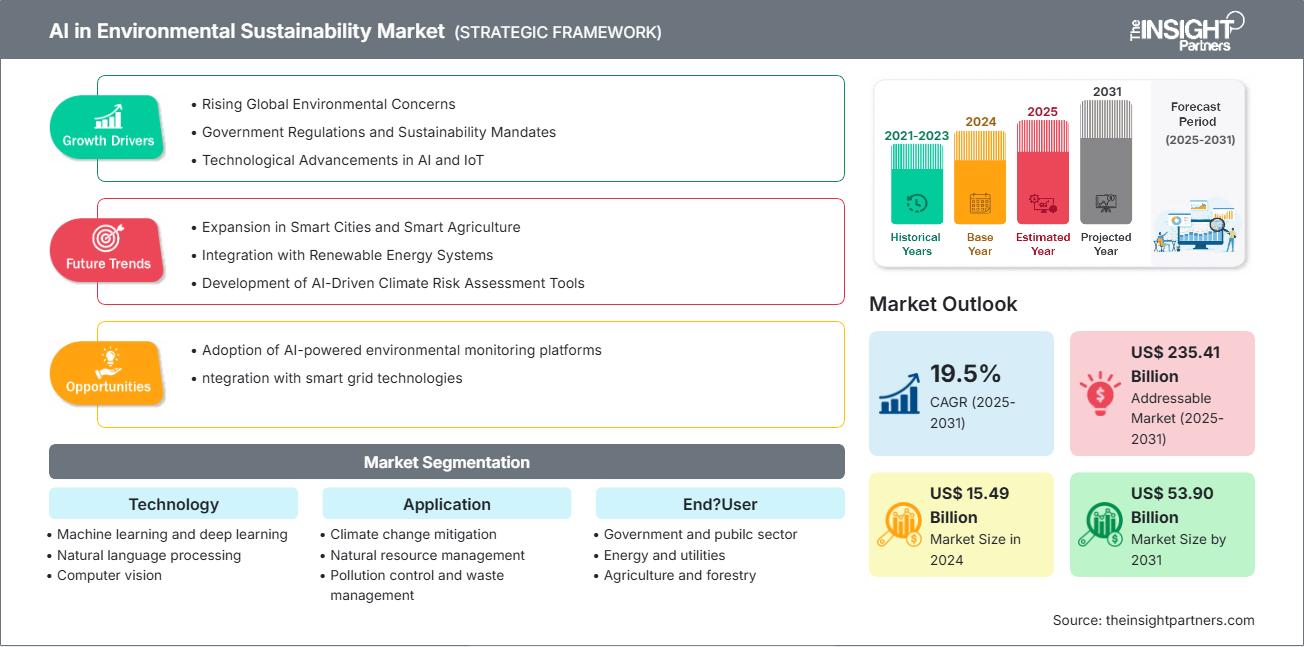
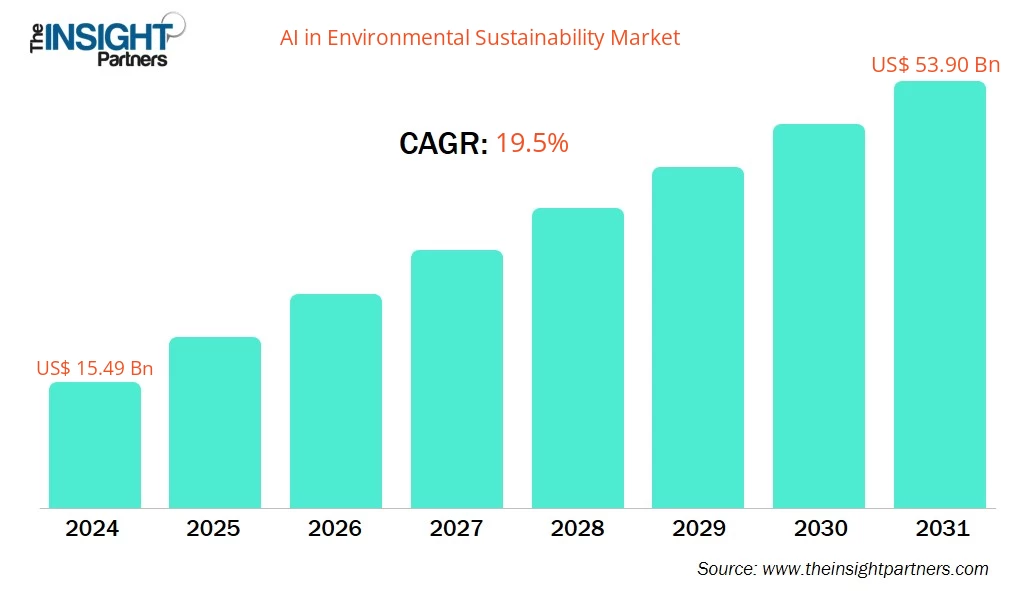
The AI in environmental sustainability market was worth US$ 18.51 Billion in 2025 and is expected to touch US$ 91.98 Billion by 2034, posting a CAGR of 19.5% for 2026-2034. The market is seeing benefits due to the rising use of artificial intelligence in environmental sustainability including climate surveillance, energy optimization, carbon emission surveillance, biodiversity surveillance, and circular economy practices. Enterprises, governments, and utilities are embracing data-driven sustainability solutions in order to achieve their sustainability goals and ensure resiliency.
In North America, adoption is advancing due to the need for sustainable disclosures, investment in environmental intelligence solutions, and application of AI in utilities and industrial processes. North America AI in environmental sustainability market size is enabled by the development of cloud technology and climate programs by the public sector. Growth of the market in the region is forecast in the range of 17.5%-19.0% CAGR up until 2034.
AI in Environmental Sustainability Market Assessment and Insights
- North America: Accounted for 34–38% AI in environmental sustainability market share in 2025 and is expected to grow at a 17.5%–19.0% CAGR during 2026–2034, supported by climate technology funding, smart-grid modernization, and enterprise sustainability investments.
- US: Represented 72–76% of North America in 2025 and is projected to expand at a 18.0%–19.5% CAGR during 2026–2034, driven by large-scale AI deployment across utilities, manufacturing, and environmental agencies.
- Europe: Held 27–31% share in 2025 and is anticipated to grow at a 18.5%–20.0% CAGR during 2026–2034, with Germany, the UK, and France leading sustainability technology adoption.
- Asia Pacific: Captured 24–28% share in 2025 and is expected to register a 21.0%–23.0% CAGR during 2026–2034, supported by China, Japan, India, South Korea, and Australia.
- Largest Segment: Based on Application, Climate change mitigation subsegment accounted for 31–35% market share in 2025 and is forecast to advance at a 20.0%–21.5% CAGR during 2026–2034 due to emissions analytics and decarbonization requirements.
- High Growth Segment: Based on End User, Energy and utilities subsegment represented 22–26% market share in 2025 and is projected to grow at a 21.5%–23.5% CAGR during 2026–2034 through grid optimization and renewable integration.
- Key companies analyzed in detail: IBM Corporation, Microsoft Corporation, Google LLC, Siemens AG, Schneider Electric SE, Accenture plc, Amazon Web Services, Inc., C3.ai, Inc., EcoVadis SAS, Wolters Kluwer N.V. (Enablon).
Source: The Insight Partners' analysis based on proprietary research, government publications, company annual reports, investor presentations, industry databases, and expert interviews.
Innovations in machine learning, digital twins, geospatial analytics, and cloud computing technologies have transformed the process of making environmental decisions. The use of predictive modeling has been adopted by many organizations to monitor their emissions, conserve resource consumption, and adhere to regulation requirements. AI is helping organizations get sustainable intelligence through satellite imaging, sensors, and automation of reporting mechanisms.
Expansion of the AI in environmental sustainability market will be driven by the adoption of climate-related regulations, carbon accounting, and climate-resilient project finance during the next decade. Developing countries have adopted AI to manage resources and plan the environment. Involvement of venture capitalists, collaboration between private and public sectors, and development of green digital infrastructure will help in further commercialization and adoption of the technology across different industries.
AI in Environmental Sustainability Market Report Scope
| Report Attribute | Details |
|---|---|
| Market size in 2025 | US$ 18.51 Billion |
| Market Size by 2034 | US$ 91.98 Billion |
| Global CAGR (2026 - 2034) | 19.5% |
| Historical Data | 2021-2024 |
| Forecast period | 2026-2034 |
AI in Environmental Sustainability Market Analysis
High pressure on meeting carbon reduction objectives has been identified as one of the key drivers in promoting AI in market growth towards environmental sustainability. Companies are using AI technology for monitoring environmental metrics, enhancing energy efficiency and process optimization. Management of sustainability data has become more complex, and there is a need for intelligent solutions that can collect, process and analyze environmental data sets.
The value chain in the AI in environmental sustainability market includes AI software suppliers, cloud computing companies, environmental consulting firms, sensor manufacturers and end-user organizations. The demand is very high in utility, agricultural, transportation and industrial sectors due to environmental sustainability being crucial to operational efficiency. Availability of environmental data has increased model accuracy and adoption in climate risk assessment, waste management and ecosystem monitoring applications.
The competitive dynamics are still defined by cooperation of technology suppliers and sustainability experts. According to AI in environmental sustainability market analysis, major firms concentrate on developing integrated solutions including AI, sustainability reporting, and predictive analytics. IBM Corporation, Microsoft Corporation, Google LLC, and Amazon Web Services, Inc. actively develop sustainability solutions enabled by the cloud technologies, whereas Siemens AG and Schneider Electric SE utilize operational technology to improve industrial sustainability results.
Companies invest more into digital twins, ESG intelligence, climate forecasting, and biodiversity assessment solutions. Accenture plc provides enterprise transformation services for integration of sustainability goals with digital infrastructures, whereas C3.ai, Inc. specializes in AI-powered emissions management and operational optimization. EcoVadis SAS and Wolters Kluwer N.V. (Enablon) increase competitiveness of the market due to their sustainability performance assessment and compliance platforms.
● REPORT CUSTOMIZATION
Tailor This Report To Align With Your Specific Business Requirements
This report can be customized to align precisely with your business objectives, scope, and target markets. Customization options include tailored segmentation, geography, competitive analysis, and strategic insights to support informed decision-making.
Customize This Report →WHAT YOU CAN ADJUST
- ● Segmentations
- ● Geography
- ● Competitive Analysis
- ● Language Preferences
AI in Environmental Sustainability Market: Strategic Insights
Regional Insights
North America AI in environmental sustainability market
In 2025, the North American region had a AI in environmental sustainability market share of about 34–38%, making it the dominant region in the market. Deployment is facilitated by robust cloud infrastructure, developed digital ecosystems, and commitment to sustainability on the part of enterprises. Compliance with environmental regulations, net-zero goals of corporates, and investments made in smart-energy systems are driving adoption of AI-based sustainability platforms. The regional market is set to grow at a CAGR of 17.5%–19.0% until 2034.
The region has the benefit of strong representation from technology vendors, utilities, and environmental agencies. Deployment is taking place in areas such as emissions monitoring, climate risks assessment, renewable energy forecasting, and intelligent resource management. The North American AI in environmental sustainability market share leadership is driven by the innovation ecosystem and sustainability policies in the region.
U.S. AI in environmental sustainability market
The United States represented 72–76% of the North American market in 2025 and continues to serve as the region's primary innovation hub. Large-scale sustainability investments, advanced AI research capabilities, and strong cloud adoption support market development. Government agencies and private organizations increasingly rely on predictive analytics to improve environmental planning and operational sustainability. The country is expected to grow at a 18.0%–19.5% CAGR through 2034.
Major market participants including Microsoft Corporation, Google LLC, Amazon Web Services, Inc., IBM Corporation, and C3.ai, Inc. maintain substantial domestic operations. Application demand is particularly robust in utilities, industrial sustainability management, renewable energy optimization, and climate intelligence solutions. Increasing ESG reporting requirements are also encouraging implementation of environmental data management technologies.
Europe AI in environmental sustainability market
The Europe region held a AI in environmental sustainability market share of 27%–31% in 2025 and is expected to witness a CAGR of 18.5%–20.0% through 2034. Germany is currently the most prominent national market owing to digitalization and sustainability initiatives in the industry. The UK is making investments in climate and environment analytics and environmental monitoring systems, which is further driving market adoption in the energy sector, infrastructure, and public projects.
Germany holds advantages in manufacturing capacities and efforts in decarbonization programs. The UK is benefiting from an ecosystem of climate technology and sustainability-driven investments. France, Italy, and Spain are adopting artificial intelligence in efficiency, emissions reduction, and environmental risks management programs, adding strength to market prospects in the region.
APAC AI in environmental sustainability market
Asia Pacific captured 24–28% market share in 2025 and is forecast to grow at a 21.0%–23.0% CAGR, the fastest among major regions. China leads adoption through large-scale environmental monitoring programs and industrial digitalization initiatives. Japan and South Korea continue to integrate AI technologies into energy optimization and sustainability planning.
India and Australia are experiencing increased deployment of environmental intelligence platforms supported by renewable energy projects and climate resilience programs. Rapid urbanization, government sustainability targets, and growing investments in smart infrastructure continue to strengthen regional growth prospects.
Middle East & Africa AI in environmental sustainability market
The Middle East and Africa region is gradually expanding as governments focus on resource efficiency and climate adaptation. Saudi Arabia and the United Arab Emirates are investing in digital transformation projects integrating AI with environmental management systems. Regional growth is projected at 18.0%–20.0% CAGR during the forecast period.
South Africa and other regional economies are exploring AI applications for water management, biodiversity monitoring, and energy optimization. Infrastructure modernization, renewable energy deployment, and sustainability-focused national strategies continue to create market opportunities across the region.
Segmentation Analysis
Technology
The technology segment is projected to grow at a 19.0%–20.5% CAGR during 2026–2034. The AI in environmental sustainability market scope continues to broaden as organizations combine machine learning, computer vision, robotics, and advanced analytics to improve environmental performance. Increasing demand for automation, predictive intelligence, and real-time monitoring supports segment expansion across multiple industries.
- Machine learning and deep learning enable predictive emissions modeling, energy optimization, and climate forecasting. Adoption remains strong due to the ability to analyze extensive environmental datasets and improve operational sustainability outcomes.
- Natural language processing supports environmental reporting, regulatory compliance management, and ESG documentation. Organizations increasingly utilize NLP solutions to streamline sustainability disclosures and extract actionable intelligence from unstructured information.
- Computer vision plays a vital role in ecosystem monitoring, waste identification, biodiversity assessment, and remote environmental surveillance through drones, satellites, and connected imaging systems.
- Robotics supports automated environmental inspections, precision agriculture operations, waste sorting processes, and industrial sustainability initiatives aimed at reducing resource consumption and improving efficiency.
Application
The application segment is expected to register a 19.5%–21.0% CAGR through 2034. Expanding climate challenges and sustainability objectives are encouraging deployment across environmental management activities. Organizations seek intelligent systems capable of enhancing visibility, forecasting environmental risks, and improving decision-making capabilities.
- Climate change mitigation remains the dominant application area due to rising demand for emissions monitoring, carbon accounting, renewable energy forecasting, and decarbonization planning across industries and governments.
- Natural resource management utilizes AI to improve water conservation, land-use planning, forest monitoring, and resource allocation, supporting long-term environmental sustainability objectives.
- Pollution control and waste management solutions help identify contamination sources, improve recycling efficiency, optimize waste collection routes, and strengthen environmental compliance processes.
- Biodiversity and ecosystem preservation applications support species monitoring, habitat assessment, conservation planning, and ecosystem restoration through advanced data analytics and environmental intelligence.
End User
The end-user segment is anticipated to grow at a 20.0%–21.5% CAGR during the forecast period. Greater sustainability accountability and environmental disclosure requirements are increasing AI adoption across organizations. Long-term efficiency gains and improved environmental visibility continue to support deployment.
- Government and public sector organizations increasingly utilize AI for environmental policy implementation, climate planning, disaster management, and sustainability reporting, improving decision-making capabilities and operational responsiveness.
- Energy and utilities companies leverage predictive analytics, renewable forecasting, grid optimization, and emissions management solutions to improve sustainability performance and operational efficiency.
- Agriculture and forestry stakeholders adopt intelligent monitoring systems, precision farming technologies, and land-management platforms to enhance productivity while minimizing environmental impact.
- Manufacturing and industrial organizations integrate AI into resource optimization, emissions tracking, waste reduction, and compliance activities to support sustainability objectives and operational excellence.
Opportunity Snapshot
| Application | Revenue Contribution | Trend Tag | Adoption Stage |
|---|---|---|---|
| Climate change mitigation | High | Carbon Analytics | Mature |
| Natural resource management | Medium | Water Intelligence | Scaling |
| Pollution control and waste management | Medium | Smart Recycling | Scaling |
| Biodiversity and ecosystem preservation | Low | Habitat Mapping | Emerging |
AI in Environmental Sustainability Market Growth Drivers and Impact Analysis
Expansion of Global Decarbonization Programs
Net-zero goals set by countries and companies reducing their carbon footprints have led to the need for environmental intelligence tools powered by AI. There is an increasing need for predictive tools which can assess sources of emissions, optimize energy use, and help achieve environmental goals. AI technology enables constant monitoring and decision making on large networks of operations, thus becoming useful in reaching environmental goals. The demand for such technologies is also driven by sustainability reporting regulations. With greater emphasis being put on environmental responsibility in corporate strategy, the demand for AI-powered analytics, automation, and climate intelligence is likely to rise.
Growth of Environmental Data Ecosystems
An increase in the number of connected sensors, satellites, drones, and other digital data monitoring mechanisms means that there is a huge amount of environmental data being generated. Using AI can help organizations leverage such data by translating raw and complex data into actionable intelligence for sustainable development initiatives. Increased availability of data helps in increasing predictive accuracy and applicability in biodiversity monitoring, resource utilization, pollution prevention, and climate prediction. Increasing demand for environmental intelligence means that organizations look for tools and applications that help with such activities.
Increasing Investment in Smart Energy Systems
Rapid deployment of renewable energy resources requires advanced forecasting and optimization capabilities. AI technologies help utilities balance supply and demand, improve grid reliability, and maximize renewable energy utilization. Energy providers increasingly integrate predictive analytics into operations to reduce waste and improve sustainability outcomes. Smart-grid modernization projects further accelerate demand for intelligent environmental management systems. The ability to process energy, weather, and infrastructure data simultaneously allows organizations to enhance operational performance while supporting environmental objectives. This dynamic contributes significantly to long-term market expansion across developed and emerging economies.
AI in Environmental Sustainability Market Future Trends
Integration of AI and Digital Twins for Sustainability
The AI in environmental sustainability market trends increasingly reflect adoption of digital twin technologies capable of simulating environmental systems in real time. Organizations are expected to deploy virtual representations of facilities, ecosystems, and infrastructure networks to evaluate sustainability scenarios before implementation. Combining predictive analytics with simulation capabilities improves resource allocation, environmental planning, and climate resilience strategies. Utilities, manufacturers, and governments are likely to expand investments in digital twin ecosystems as environmental performance management becomes more sophisticated. This trend supports enhanced forecasting accuracy, reduced operational waste, and improved sustainability outcomes across multiple sectors.
Emergence of Autonomous Environmental Monitoring Networks
Environmental monitoring systems are expected to become increasingly autonomous through integration of AI, edge computing, drones, and advanced sensors. Future deployments will deliver continuous assessment of air quality, water resources, biodiversity indicators, and ecosystem conditions with minimal human intervention. Automated intelligence capabilities will improve response times and support proactive sustainability management. Governments and enterprises are anticipated to invest in scalable monitoring infrastructure capable of generating high-frequency environmental insights. The trend is expected to strengthen transparency, accelerate regulatory compliance activities, and improve environmental risk management capabilities.
AI in Environmental Sustainability Market Opportunities
Expansion Across Emerging Economies
Emerging markets present substantial growth potential as governments invest in climate adaptation, renewable energy, and environmental modernization initiatives. Increasing urbanization and industrial activity create demand for intelligent solutions capable of improving resource efficiency and environmental governance. Investment opportunities exist in cloud-based sustainability platforms, environmental analytics tools, and sector-specific applications. AI in environmental sustainability market Forecasts indicate that emerging economies are likely to become increasingly important contributors to future demand as digital infrastructure improves. Strategic partnerships involving governments, technology companies, and environmental organizations can accelerate market penetration while supporting long-term sustainability objectives and economic development goals.
Commercialization of Biodiversity Intelligence Platforms
Growing attention to nature-related risks is creating opportunities for biodiversity-focused AI solutions. Organizations increasingly require tools capable of monitoring ecosystems, assessing environmental impacts, and supporting conservation planning. Advanced analytics platforms can deliver measurable value through improved decision-making, regulatory compliance, and sustainability reporting. Technology vendors have opportunities to develop specialized services addressing habitat monitoring, ecosystem restoration, and natural capital assessment. As investors and regulators place greater emphasis on biodiversity outcomes, demand for intelligent environmental management solutions is expected to expand significantly across both public and private sectors.
Frequently Asked Questions

- Comprehensive Market Sizing and Forecast Analysis
- Detailed Segmentation Analysis
- In-Depth Market Dynamics Assessment
- Regional and Country-Level Insights
- Competitive Landscape and Company Benchmarking
- Strategic Business Intelligence
Recent Reports
Testimonials

The Insight Partners provided valuable market intelligence that supported our global go-to-market strategy. Their team was professional, responsive, and attentive to our feedback, providing thoughtful analysis and helpful methodological clarifications throughout the project.
Junmo Kim Chief Financial Officer (CFO), Enertech Co., Ltd.
The Insight Partners' SCADA System Market report is comprehensive, with valuable insights on current trends and future forecasts. The team was highly professional, responsive, and supportive throughout. We are very satisfied and highly recommend their services.
RAN KEDEM Partner, Reali Technologies LTDs
I requested a report on a very specific software market and the team produced the report in a few days. The information was very relevant and well presented. I then requested some changes and additions to the report. The team was again very responsive and I got the final report in less than a week.
JEAN-HERVE JENN Chairman, Future Analytica
We worked with The Insight Partners for an important market study and forecast. They gave us clear insights into opportunities and risks, which helped shape our plans. Their research was easy to use and based on solid data. It helped us make smart, confident decisions. We highly recommend them.
PIYUSH NAGPAL Sr. Vice President, High Beam Global
The Insight Partners delivered insightful, well-structured market research with strong domain expertise. Their team was professional and responsive throughout. The user-friendly website made accessing industry reports seamless. We highly recommend them for reliable, high-quality research services
YUKIHIKO ADACHI CEO, Deep Blue, LLC.
This is the first time I have purchased a market report from The Insight Partners.While I was unsure at first, I visited their web site and felt more comfortable to take the risk and purchase a market report.I am completely satisfied with the quality of the report and customer service. I had several questions and comments with the initial report, but after a couple of dialogs over email with their analyst I believe I have a report that I can use as input to our strategic planning process.Thank you so much for taking the extra time and making this a positive experience.I will definitely recommend your service to others and you will be my first call when we need further market data.
JOHN SUZUKI President and Chief Executive Officer, Board Director, BK Technologies
I wish to appreciate your support and the professionalism you displayed in the course of attending to my request for information regarding to infectious disease IVD market in Nigeria. I appreciate your patience, your guidance, and the fact that you were willing to offer a discount, which eventually made it possible for us to close a deal. I look forward to engaging The Insight Partners in the future, all thanks to the impression you have created in me as a result of this first encounter.
DR CHIJIOKE ONYIA MANAGING DIRECTOR, PineCrest Healthcare Ltd.Reason to Buy
- Informed Decision-Making
- Understanding Market Dynamics
- Competitive Analysis
- Identifying Emerging Markets
- Customer Insights
- Market Forecasts
- Risk Mitigation
- Boosting Operational Efficiency
- Strategic Planning
- Investment Justification
- Tracking Industry Innovations
- Aligning with Regulatory Trends





 Get Free Sample for