
AI In Social Media Market Trends, Size & Forecast by 2034
AI In Social Media Market Size and Forecast (2021 - 2034), Global and Regional Share, Trend, and Growth Opportunity Analysis Report Report Coverage : by Technology (Machine learning, Computer vision, Natural language learning, Robotics and automation), Organization type (SME and Large enterprise), Deployment (Cloud and On-premise) and Geography
- Status : Data Released
- Report Code : TIPRE00039711
- Category : Technology, Media and Telecommunications
- No. of Pages : 150
- Available Report Formats :


- Last update date : August 11, 2026


2025 Market Size
US$ 3.63 Bn
Base year value
2034 Forecast
US$ 24.56 Bn
Projected by 2034
CAGR 2026-2034
23.66 %
Growth rate
Addressable Market
US$ 109.32 Bn
(2026-2034)
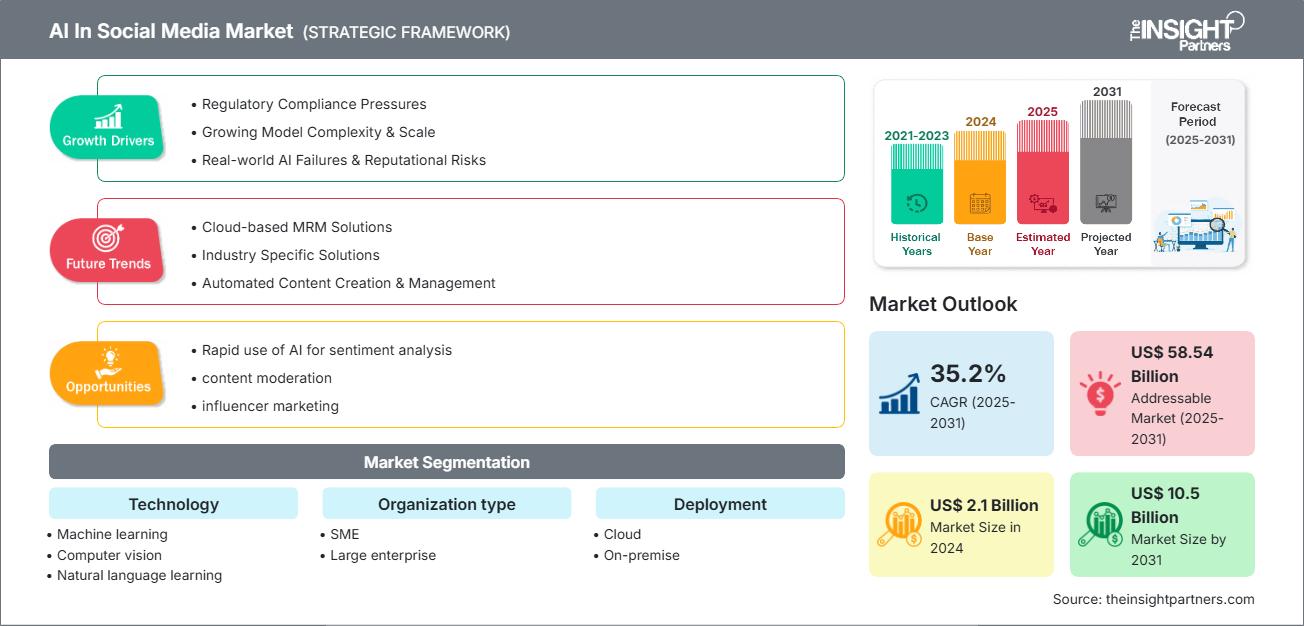
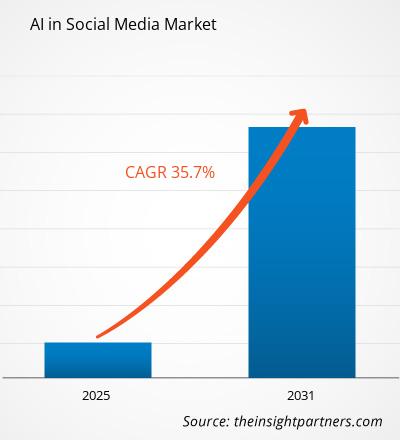
The AI in social media market is projected to grow from US$ 3.63 Billion in 2025 to US$ 24.56 Billion by 2034, registering a CAGR of 23.66% during 2026–2034. Adoption is expanding as social platforms, marketing teams, creators, and enterprises use machine learning, computer vision, natural language processing, and automation to personalize content, improve engagement, strengthen moderation, and optimize advertising performance across digital ecosystems.
North America remains the most mature demand center, supported by high digital advertising intensity, cloud AI availability, and early enterprise experimentation with generative workflows. The AI in social media market size in the region is expected to advance at a CAGR range of 22–24% through 2034 as brands deploy AI for campaign automation, social listening, recommendation engines, and customer-service chatbots.
AI In Social Media Market Assessment and Insights
- North America: The region held an estimated 35–38% share in 2025 and is growing at a CAGR of 22–24% during 2026–2034, led by platform AI investment, agency automation, and cloud-based analytics.
- U.S.: The U.S. represented 78–82% of North America in 2025 and is expanding at a CAGR of 22–24%, supported by major platform, advertising technology, and enterprise software vendors.
- Europe: Europe accounted for a 23–26% share in 2025 and is growing at a CAGR of 21–23%, with the UK, Germany, France, Italy, and Spain driving adoption under stronger governance expectations.
- Asia Pacific: Asia Pacific held a 26–29% share in 2025 and is growing at a CAGR of 25–27%, supported by China, Japan, South Korea, India, and Australia.
- Largest Segment: Machine learning held 38–42% market share in 2025 and is growing at a CAGR of 22–24% due to its role in recommendations, targeting, analytics, and moderation.
- High Growth Segment: Natural language learning held a 24–28% share in 2025 and is growing at a CAGR of 26–28% as brands adopt AI for captions, sentiment, chatbots, and multilingual engagement.
- Key companies analyzed in detail: Microsoft Corporation, International Business Machines Corporation, Cisco Systems, Inc., Amazon Web Services, Inc., Meta Platforms, Inc., Google LLC, Adobe Inc., HubSpot, Inc., Baidu, Inc., and AspireIQ, Inc.
Source: The Insight Partners' analysis based on proprietary research, government publications, company annual reports, investor presentations, industry databases, and expert interviews.
Industry development has shifted from rule-based scheduling and keyword listening toward predictive, multimodal, and generative AI systems. The AI in social media market growth is increasingly shaped by real-time inference, creator workflows, and campaign optimization rather than isolated content automation. Social platforms are embedding AI into recommendations, ad delivery, safety review, and audience segmentation, while enterprises are integrating social data with customer relationship management and commerce systems.
Over the forecast period, the AI in social media market report investment will concentrate on AI governance, brand-safe automation, synthetic media controls, and measurable performance attribution. Emerging geographies are expected to adopt cloud-first tools faster than on-premise systems because they reduce infrastructure barriers. Regulatory scrutiny around data privacy, disclosure, and content authenticity will influence procurement, encouraging vendors to offer auditable models, explainable analytics, and stronger moderation workflows.
AI In Social Media Market Report Scope
| Report Attribute | Details |
|---|---|
| Market size in 2025 | US$ 3.63 Billion |
| Market Size by 2034 | US$ 24.56 Billion |
| Global CAGR (2026 - 2034) | 23.66% |
| Historical Data | 2021-2024 |
| Forecast period | 2026-2034 |
AI In Social Media Market Analysis
Demand is rising because social teams need faster content production, sharper audience segmentation, and continuous performance monitoring. AI supports these requirements by analyzing behavioral signals, predicting engagement, and adapting posts across channels.
The AI in social media market analysis shows that buyers are moving from experimentation to workflow integration, particularly in marketing, customer support, influencer discovery, and social commerce.
The ecosystem includes hyperscale cloud providers, platform operators, analytics vendors, social management tools, and creative software companies.
Microsoft Corporation, Amazon Web Services, Inc., Google LLC, and International Business Machines Corporation support infrastructure and AI services, while Meta Platforms, Inc., Adobe Inc., HubSpot, Inc., Baidu, Inc., Cisco Systems, Inc., and AspireIQ, Inc. address platform, content, engagement, and influencer workflows.
● REPORT CUSTOMIZATION
Tailor This Report To Align With Your Specific Business Requirements
This report can be customized to align precisely with your business objectives, scope, and target markets. Customization options include tailored segmentation, geography, competitive analysis, and strategic insights to support informed decision-making.
Customize This Report →WHAT YOU CAN ADJUST
- ● Segmentations
- ● Geography
- ● Competitive Analysis
- ● Language Preferences
AI In Social Media Market: Strategic Insights
Regional Insights
North America AI in social media market
North America held an estimated 35–38% AI in social media market share in 2025, reflecting dense vendor presence, high digital ad spending, and strong adoption of cloud AI. Agencies and enterprises use AI for social listening, campaign recommendations, creative testing, and conversational engagement, with a CAGR of 22–24% expected during 2026–2034.
Demand is strongest across retail, media, technology, and business services, where social platforms are tied directly to customer acquisition and retention. Large enterprises prioritize governance, brand safety, and analytics accuracy, while SMEs favor cloud-based subscription tools that reduce setup costs and accelerate experimentation.
U.S. AI in social media market Market
The U.S. represented 78–82% of North America in 2025 and is projected to grow at a CAGR of 22–24%. The country benefits from the presence of Meta Platforms, Inc., Microsoft Corporation, Google LLC, Adobe Inc., Amazon Web Services, Inc., HubSpot, Inc., Cisco Systems, Inc., and AspireIQ, Inc.
Adoption is driven by performance marketing, creator monetization, customer-service automation, and AI-assisted content planning. Enterprises are also investing in compliance review, synthetic media monitoring, and multilingual support as social engagement becomes more automated and measurable.
Europe AI in social media market Market
Europe accounted for a 23–26% share in 2025 and is growing at a CAGR of 21–23%. The UK and Germany lead adoption through advertising technology, enterprise analytics, and multilingual customer engagement, while France, Italy, and Spain are expanding AI use in retail, tourism, media, and consumer brands.
European buyers are more sensitive to privacy, transparency, and disclosure requirements. This environment favors vendors that can document model behavior, protect user data, and support responsible automation. Social listening, sentiment analysis, and compliant content moderation are important buying criteria across the region.
APAC AI in social media market Market
APAC held 26–29% share in 2025 and is expected to expand at a CAGR of 25–27%. China leads at the regional scale, while Japan, South Korea, India, and Australia show growing demand for social commerce analytics, creator tools, multilingual chatbots, and automated campaign optimization.
Mobile-first usage patterns, high creator activity, and rapid e-commerce integration support adoption. Cloud deployment is preferred by SMEs and agencies, while large enterprises increasingly invest in localized models and governance controls.
Middle East & Africa AI in social media market Market
Middle East & Africa is growing at a CAGR of 20–22%, led by Saudi Arabia, the UAE, and South Africa. Adoption is supported by digital government programs, tourism promotion, retail modernization, and expanding Arabic-language content automation across social channels.
Infrastructure investment and cloud partnerships are improving access to AI tools. However, uneven digital maturity and data-governance readiness keep adoption concentrated among large enterprises, agencies, telecom operators, and public-facing service organizations.
Segmentation Analysis
Technology
Technology is expected to grow at a CAGR of 23–25% during 2026–2034. The AI in social media market scope spans machine learning, computer vision, natural language learning, and robotics and automation, with adoption focused on recommendations, visual recognition, sentiment analysis, automated publishing, campaign optimization, and content safety.
- Machine learning supports recommendation engines, audience segmentation, ad targeting, and predictive analytics, making it the largest technology layer for platforms and enterprise social media management teams.
- Computer vision enables image recognition, video tagging, brand-safety screening, and visual trend detection across high-volume social feeds, supporting moderation and creative intelligence.
- Natural language learning powers captions, sentiment analysis, comment classification, chatbots, multilingual listening, and influencer assessment, making it central to engagement and service workflows.
- Robotics and automation automate scheduling, response routing, campaign reporting, and repetitive operational tasks, helping lean teams scale activity without proportional headcount growth.
Organization type
The organization type segment is projected to expand at a CAGR of 23-24% over 2026-2034. Large organizations are making investments because they need governance, brand control, integration capabilities, and sophisticated analytics, whereas small and medium-sized enterprises have been using subscription-based software for its ease of deployment.
- SME buyers prioritize affordability, ease of deployment, content generation, and scheduling automation, using AI to improve productivity without large data science teams.
- Large enterprise users require scalable governance, cross-brand analytics, compliance review, and integration with customer data platforms, advertising systems, and enterprise collaboration tools.
Deployment
Deployment is anticipated to grow at a CAGR of 23%-25% between 2026 and 2034. Cloud deployment is predominant due to the need for social workflows that demand elasticity in computing power, model updates, and integration, whereas on-premises solutions remain significant for regulated businesses.
- Cloud deployment enables rapid access to generative AI, analytics dashboards, content automation, and API-based integrations, making it preferred by agencies, SMEs, and distributed teams.
- On-premise deployment is selected when organizations require tighter data control, customized security policies, internal model hosting, or strict compliance oversight.
Opportunity Snapshot
| Technology | Revenue Contribution | Trend Tag | Adoption Stage |
| Machine learning | High | Predictive Targeting | Mature |
| Computer vision | Medium | Visual Safety | Scaling |
| Natural language learning | High | Conversational AI | Scaling |
| Robotics and automation | Medium | Workflow Automation | Emerging |
AI In Social Media Market Growth Drivers and Impact Analysis
Automation of Content and Campaign Workflows
Marketing departments are being pushed to create more channel-specific content with the minimum possible delay, and AI reduces the effort required to generate content ideas, adapt copy, schedule posts, generate reports, and test ads. Content marketing and social media specialists increasingly rely on AI to generate new content ideas, write captions, and accelerate their workflows, driving higher software subscription rates. AI has the biggest impact on the market through agencies and SMEs, where automation improves throughput, reduces repetitive work, and enables faster campaign iteration without expanding teams proportionally.
Rising Need for Personalization and Engagement Intelligence
Personalization is essential in social platforms and branding for user retention, enhanced advertising, and achieving tangible results from engagement. Machine learning models use behavioral data, audience segmentation, browsing habits, and interaction records to provide recommendations for content and campaign optimization. This driver increases the need for analytics tools, recommendation systems, and social listening services. It also drives growth in investments in dashboards that help marketers understand sentiment and trends, enabling them to spend their budget more effectively.
Expansion of AI-Based Moderation and Brand Safety
Growth in short-form video, user-generated content, and AI-generated content has created more need for scalable moderation and brand safety solutions. Computer vision and natural language learning can identify any harmful, misleading, or policy-related content more quickly than by relying solely on manual checks. Companies require solutions to ensure that ads cannot be placed in inappropriate environments and that campaign contexts are monitored.
AI In Social Media Market Future Trends
Multimodal Creative Intelligence
AI in social media market trends will increasingly be able to evaluate multimedia by analyzing text, images, videos, audio, and audience reactions. In addition, the ability of such systems to predict which combinations of media would work best in advance will save money on guesswork. Brand rules, disclosures, and performance metrics will be embedded in creative processes by solution vendors. This will be a significant factor for agencies and marketers of consumer brands that need to generate customized content quickly.
Governed Generative AI for Social Operations
Future implementation will shift from an open-ended content creation approach to a more governed AI system with approval processes, audit logs, role-based access, and model performance tracking. Organizations will require solutions that offer explanation capabilities, customer data protection, and content identification, including synthetic and policy-driven content. This means that future vendor competition will focus on governance, integration, and business impact.
AI In Social Media Market Opportunities
Social Commerce Optimization
AI in Social Media Market Forecasts suggest significant potential in social commerce, which requires automated product discovery, creator matchmaking, sentiment analysis, and conversion tracking. By linking engagement signals to purchase intent, AI will help retailers leverage campaigns through short-form videos, creator-generated content, and messenger. For vendors providing recommendation engines, catalog management, and campaign attribution, the demand will come from consumer goods, fashion, beauty, electronics, and direct-to-consumer brands.
Localized AI for Multilingual Engagement
Multilingual social interaction presents an opportunity for AI to understand local language, tone, culture, and regulations. Businesses that expand into the Asia-Pacific region, Europe, and the Middle East need the ability to localize captions, track sentiment, categorize comments, and escalate sensitive interactions. Providers of localized model tuning and compliant processes can help businesses run campaigns globally while reducing costs.
Frequently Asked Questions

- Comprehensive Market Sizing and Forecast Analysis
- Detailed Segmentation Analysis
- In-Depth Market Dynamics Assessment
- Regional and Country-Level Insights
- Competitive Landscape and Company Benchmarking
- Strategic Business Intelligence
Recent Reports
Testimonials

The Insight Partners provided valuable market intelligence that supported our global go-to-market strategy. Their team was professional, responsive, and attentive to our feedback, providing thoughtful analysis and helpful methodological clarifications throughout the project.
Junmo Kim Chief Financial Officer (CFO), Enertech Co., Ltd.
The Insight Partners' SCADA System Market report is comprehensive, with valuable insights on current trends and future forecasts. The team was highly professional, responsive, and supportive throughout. We are very satisfied and highly recommend their services.
RAN KEDEM Partner, Reali Technologies LTDs
I requested a report on a very specific software market and the team produced the report in a few days. The information was very relevant and well presented. I then requested some changes and additions to the report. The team was again very responsive and I got the final report in less than a week.
JEAN-HERVE JENN Chairman, Future Analytica
We worked with The Insight Partners for an important market study and forecast. They gave us clear insights into opportunities and risks, which helped shape our plans. Their research was easy to use and based on solid data. It helped us make smart, confident decisions. We highly recommend them.
PIYUSH NAGPAL Sr. Vice President, High Beam Global
The Insight Partners delivered insightful, well-structured market research with strong domain expertise. Their team was professional and responsive throughout. The user-friendly website made accessing industry reports seamless. We highly recommend them for reliable, high-quality research services
YUKIHIKO ADACHI CEO, Deep Blue, LLC.
This is the first time I have purchased a market report from The Insight Partners.While I was unsure at first, I visited their web site and felt more comfortable to take the risk and purchase a market report.I am completely satisfied with the quality of the report and customer service. I had several questions and comments with the initial report, but after a couple of dialogs over email with their analyst I believe I have a report that I can use as input to our strategic planning process.Thank you so much for taking the extra time and making this a positive experience.I will definitely recommend your service to others and you will be my first call when we need further market data.
JOHN SUZUKI President and Chief Executive Officer, Board Director, BK Technologies
I wish to appreciate your support and the professionalism you displayed in the course of attending to my request for information regarding to infectious disease IVD market in Nigeria. I appreciate your patience, your guidance, and the fact that you were willing to offer a discount, which eventually made it possible for us to close a deal. I look forward to engaging The Insight Partners in the future, all thanks to the impression you have created in me as a result of this first encounter.
DR CHIJIOKE ONYIA MANAGING DIRECTOR, PineCrest Healthcare Ltd.Reason to Buy
- Informed Decision-Making
- Understanding Market Dynamics
- Competitive Analysis
- Identifying Emerging Markets
- Customer Insights
- Market Forecasts
- Risk Mitigation
- Boosting Operational Efficiency
- Strategic Planning
- Investment Justification
- Tracking Industry Innovations
- Aligning with Regulatory Trends





 Get Free Sample for