
Air Scrubber Market Size, Share & Growth by 2034
Coverage: By Product (Dry Air Scrubber, Wet Air Scrubber); End User (Industrial, Commercial, Residential) , and Geography (North America, Europe, Asia Pacific, and South and Central America)
- Status : Data Released
- Report Code : TIPRE00008788
- Category : Manufacturing and Construction
- No. of Pages : 150
- Available Report Formats :


- Last update date : July 13, 2026


2025 Market Size
US$ 4.57 Bn
Base year value
2034 Forecast
US$ 8.49 Bn
Projected by 2034
CAGR 2026-2034
7.12 %
Growth rate
Addressable Market
US$ 58.93 Bn
(2026-2034)
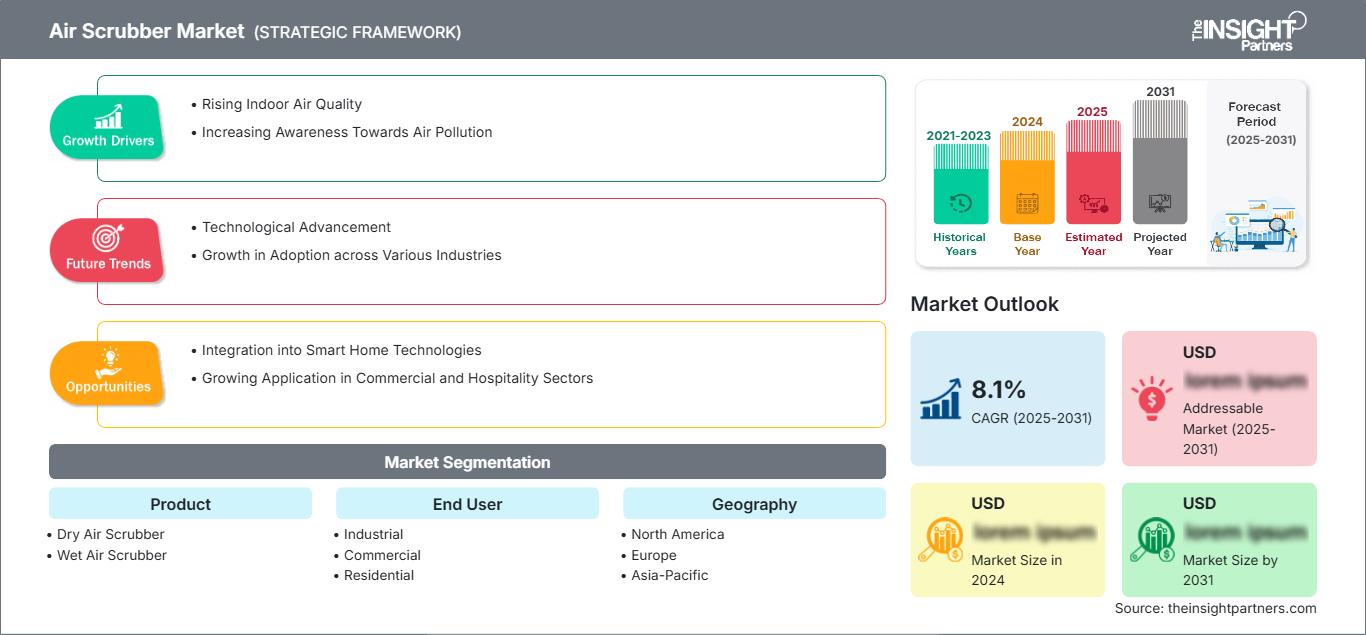
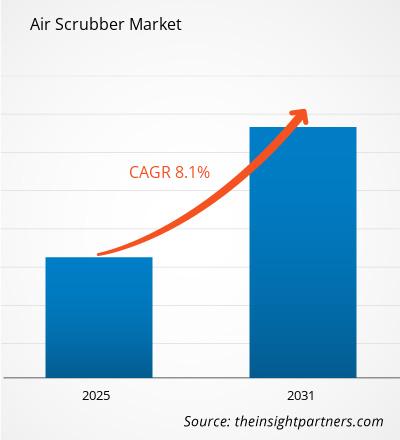
The air scrubber market is projected to grow from US$ 4.57 Billion in 2025 to US$ 8.49 Billion by 2034, registering a CAGR of 7.12% during 2026–2034. The demand is backed up by stricter limitations on emissions from industrial units, wider use of particulate and acid gas control systems, as well as increasing worry about air pollution in indoor environments.
Across North America, the air scrubber market size outlook remains tied to modernization of industrial ventilation, hazardous air pollutant compliance, and rebuilding activity in commercial facilities. The region is expected to advance at a 6.6–7.4% CAGR during 2026–2034, with upgrades in chemical processing, metal fabrication, and healthcare estates creating recurring retrofit demand alongside replacement of aging wet and dry scrubbing units.
Air Scrubber Market Assessment and Insights
- North America accounted for 34–36% share in 2025 and is projected to grow at a CAGR between 6.6–7.4% during 2026–2034, supported by EPA-aligned industrial compliance and commercial air-quality upgrades.
- US represented 78–82% of North America in 2025 and is forecast to expand at a CAGR between 6.7–7.5% during 2026–2034.
- Europe held 25–27% share in 2025 and is expected to grow at a CAGR between 6.1–6.9% during 2026–2034, led by Germany, the UK, France, Italy, and Spain.
- Asia Pacific captured 27–29% share in 2025 and is projected to rise at a CAGR between 7.8–8.6% during 2026–2034, with China, India, Japan, South Korea, and Australia driving demand.
- Largest Segment Wet air scrubber held 58–62% market share in 2025 and is expected to grow at a CAGR between 6.8–7.6% during 2026–2034.
- High Growth Segment Industrial end user accounted for 63–67% share in 2025 and is forecast to grow at a CAGR between 7.4–8.2% during 2026–2034.
- Key companies analyzed in detail: CECO Environmental Corp., Ducon Environmental Systems Inc., Babcock & Wilcox Enterprises, Inc., Evoqua Water Technologies LLC, Anguil Environmental Systems, Inc., Pollution Systems, Tri-Mer Corporation, Monroe Environmental Corp., Verantis Environmental Solutions Group, and Airex Industries Inc.
Source: The Insight Partners' analysis based on proprietary research, government publications, company annual reports, investor presentations, industry databases, and expert interviews.
Adoption of technology will be moving away from pollution control technology designed for removing only one pollutant to engineered solutions that include particulate removal, acid gas scrubbing, mist eliminators, and automation. This change is being experienced due to vessel, packing, and chemical delivery optimization in a bid to minimize pressure drop and amount of water used in the process while at the same time maintaining the effectiveness of the removal process.
Investment trends during the forecasted period will be in emerging industrial corridors, data centers adjacent commercial parks, and intensive energy users who are more stringent about permits. Regulatory tailwinds from air-quality standards, occupational exposure controls, and environmental permitting will keep the air scrubber market relevant across both retrofit and new-build projects, especially where operators need verifiable emissions reduction and predictable lifecycle costs.
Air Scrubber Market Report Scope
| Report Attribute | Details |
|---|---|
| Market size in 2025 | US$ 4.57 Billion |
| Market Size by 2034 | US$ 8.49 Billion |
| Global CAGR (2026 - 2034) | 7.12% |
| Historical Data | 2021-2024 |
| Forecast period | 2026-2034 |
Air Scrubber Market Analysis
Demand drivers center on compliance, worker safety, and process reliability. The air scrubber market growth profile is reinforced by industrial expansion in chemicals, metals, waste treatment, and power generation, where pollutant control is no longer discretionary. Additionally, facilities are upgrading their systems to accommodate the reduction in particulates, sulfur oxides, ammonia, hydrogen chloride, and VOCs and enhance visibility of operations by installing sensors and implementing preventive maintenance systems.
The eco-system comprises engineering companies, parts manufacturers, system integrators, reagent providers, monitors, and after-market services. Dynamics in the supply chain favor those vendors that have strong application engineering capability since the scrubber size is dependent on the temperature of the gases, the level of contaminants, variable flows, corrosiveness, and the manner of disposal.
The competitive environment remains fragmented but technically demanding. CECO Environmental Corp., Ducon Environmental Systems Inc., Babcock & Wilcox Enterprises, Inc., Evoqua Water Technologies LLC, Anguil Environmental Systems, Inc., and Pollution Systems compete on engineering capability, emissions guarantees, delivery timelines, and installed-base service. The air scrubber market analysis indicates that buyers increasingly evaluate lifecycle economics rather than only capital cost.
Investments are being made in modular products, diagnostic software, corrosion-resistant alloys, and full pollution control packages. Companies such as Tri-Mer Corporation, Monroe Environmental Corp., Verantis Environmental Solutions Group, and Airex Industries Inc. are located within specialized niches where tailoring is critical. The most effective strategic positioning is evident in those organizations able to provide documentation, pilot studies, retrofits, and performance analysis across different end user segments.
● REPORT CUSTOMIZATION
Tailor This Report To Align With Your Specific Business Requirements
This report can be customized to align precisely with your business objectives, scope, and target markets. Customization options include tailored segmentation, geography, competitive analysis, and strategic insights to support informed decision-making.
Customize This Report →WHAT YOU CAN ADJUST
- ● Segmentations
- ● Geography
- ● Competitive Analysis
- ● Language Preferences
Air Scrubber Market: Strategic Insights
Regional Insights
North America Air Scrubber Market
North America held 34–36% of air scrubber market share in 2025 and is projected to grow at a 6.6–7.4% CAGR during 2026–2034. The demand rests on federal and state permits, hazardous air pollutants, and facility renovation for chemicals, energy generation, food processing, and metals. Benchmarking of air quality by WHO and regulations regarding stationary sources by the EPA remain relevant to corporate investment plans.
Replacement cycles matter, considering that old scrubbers might have a high pressure drop, higher water usage, and inadequate monitoring capability. Industrial applications are shifting towards engineering solutions that maintain the ductwork system but have improved capture rates. Demand is growing within commercial applications in hospitals, laboratories, restoration, and large structures, where indoor air quality control is associated with risk management.
U.S. Air Scrubber Market
The U.S. represented between 78-82% of the North American region in 2025 and is expected to grow at a 6.7-7.5% CAGR through 2026-2034. Installed base capacities in refining, chemical, electricity generation, pulp and paper, and metal finishing drive replacement purchases. Compliance standards for stationary source emissions and state permits generate consistent demand for performance-based pollutant removal documentation.
Companies have wide reach, which includes CECO Environmental Corp., Ducon Environmental Systems Inc., Babcock & Wilcox Enterprises, Inc., Anguil Environmental Systems, Inc., Pollution Systems, and Monroe Environmental Corp. serving industrial applications. Emerging applications involve acid gas removal, odor reduction, dust collection, and air purification to restoration quality levels. Buyers are focusing on integration, reduced reagent usage, and fast turnarounds.
Europe Air Scrubber Market
Europe held a market share of 25-27% in 2025 and is anticipated to register a CAGR of 6.1-6.9% in 2026-2034. The leading country in this region is Germany owing to chemicals, automotive industry supply chains, waste-to-energy projects, and metal manufacturing. The UK sees potential in the laboratory, commercial, healthcare, and water treatment facilities due to compliance audits and improved indoor air quality.
The contribution from France, Italy, and Spain comes through pharmaceuticals, food and beverages production, cement and ceramics manufacturing, and industrial renovations. The newly adopted industrial emissions legislation in Europe promotes reducing pollutant intensity and applying best available techniques. Suppliers that offer corrosion resistance and energy-saving solutions are more desirable for customers who should consider emissions, electricity, water, and chemicals.
APAC Air Scrubber Market
APAC held a market share of 27-29% in 2025 and is expected to register a 7.8-8.6% CAGR between 2026 and 2034. China dominates APAC, benefiting from economies of scale in production, emissions regulation, and modernization in the energy sector. Japan and South Korea focus on highly efficient systems used in electronics, chemicals, and machining industries.
The growth of India and Australia is achieved thanks to activities such as mining, construction, pharmaceuticals, and industries related to infrastructure. The government provides incentives in the form of strict particulate standards, air quality management in cities, and better occupational safety rules. The buyers in the area prefer dependable equipment that works well despite the variation in feed gas.
Middle East & Africa Air Scrubber Market
MEA & Africa is forecast to grow at a CAGR of 6.3–7.1% in the period 2026–2034, driven by Saudi Arabia. The demand is related to petrochemical, oil and gas processing, desalination, waste, and infrastructural developments in the districts. The UAE is building environmentally-friendly industrial parks and controlled indoor facilities for businesses.
In South Africa and the Rest of MEA, there is selective growth in mining, metals, cement, and municipal utility projects. Diversification of energy sources, refineries, and environmental regulations are leading to projects opportunities. Purchasers tend to favor durability of metallurgy, minimal maintenance and supplier assistance due to the absence of water and technical personnel in remote areas.
Segmentation Analysis
Product
The Product segment is expected to grow at a 6.9–7.7% CAGR during 2026–2034. The air scrubber market scope within product selection depends on pollutant chemistry, humidity, temperature, and disposal requirements. Wet systems dominate corrosive and acid gas applications, while dry systems gain traction where water use, wastewater handling, and space constraints influence procurement.
- Dry Air Scrubber demand is increasing in facilities seeking low-water operation, compact installation, and reduced wastewater treatment, especially for odor, vapor, and selected acid gas control applications.
- Wet Air Scrubber remains the preferred option for high-load particulate, soluble gas, and corrosive stream treatment because it offers adaptable configurations and strong removal performance.
End User
The End User segment is forecast to grow at a 7.2–8.0% CAGR during 2026–2034. Industrial users lead adoption because compliance failures can affect permits, production continuity, and worker exposure. Commercial facilities are upgrading indoor-air systems for laboratories and healthcare, while residential demand remains smaller but supported by restoration, wildfire smoke response, and premium air-cleaning needs.
- Industrial buyers prioritize engineered systems for process emissions, hazardous pollutants, odor, and dust control, making this the most strategic demand base for suppliers and integrators.
- Commercial adoption is strongest in healthcare, laboratories, schools, restoration services, and large offices where indoor air quality, risk management, and occupant assurance influence purchasing.
- Residential demand is niche but expanding through wildfire smoke events, mold remediation, renovation projects, and consumer preference for higher-capacity air-cleaning equipment.
Opportunity Snapshot
| Segment Name | Revenue Contribution | Trend Tag | Adoption Stage |
| Industrial | High | Permit Retrofit | Mature |
| Commercial | Medium | Indoor Compliance | Scaling |
| Residential | Low | Smoke Response | Emerging |
Air Scrubber Market Growth Drivers and Impact Analysis
Stricter Emission Permitting for Industrial Facilities
Regulatory authorities are setting lower limits for emissions of particulate, acid gases, odors, and other air toxics that result from stationary sources. According to WHO, its latest data base of standards of air quality involved over 140 countries and indicated a 17% increase in the number of countries that were adopting standards of pollutants, further emphasizing the direction of tightening the regulation policy. It means that, for industries, scrubbers will be seen not as mitigation devices but as infrastructure that enables permits to be issued. The effect of this trend is most pronounced in retrofit projects in which plant operators need to improve their ability to trap emissions without overhauling entire production lines.
Industrial Capacity Expansion in High-Emission Sectors
Expansion of chemical, mining, metallurgical, cement, waste treatment, and power plant processes leads to an increase in the number of air cleaning process points. Process equipment works under conditions of gas flow variation, dust abrasion, and corrosion; therefore, air cleaning equipment becomes necessary for providing a steady operation of the process. The result can be seen in the need for larger size equipment, more durable alloys, special packings, and monitoring systems. The expansion of plants along industrial areas results in budgeting emissions reduction during the design stage instead of at the post-permitting stage, which contributes to high-valued orders.
Rising Indoor Air Quality Accountability
Both commercial and residential customers are increasingly realizing the importance of controlled air environments following a number of experiences with smoke, mold, construction dust, and other airborne contaminants. Institutions such as healthcare properties, labs, restoration services, and educational institutions will require systems capable of dealing with the particulates and odors for either remediation purposes or continuous use. The consequence of this driver would be an expansion of the market addressable base beyond heavy industries even though the sizes and prices of units will vary.
Air Scrubber Market Future Trends
Digitally Verified Scrubber Performance
The next phase of air scrubber market trends will be shaped by digital verification, not only mechanical efficiency. Operators are expected to integrate differential pressure, pH, conductivity, flow, temperature, and emissions data into plant dashboards to predict fouling, reagent depletion, and pump failures. This will shift maintenance from calendar-based service to condition-based intervention. Suppliers that offer controls, analytics, and remote diagnostics can defend margins while reducing customer downtime. Over time, performance records may become part of permitting evidence, insurance reviews, and corporate sustainability reporting, making data transparency a core buying criterion.
Water-Efficient and Hybrid Treatment Architectures
The cost of water supply and wastewater treatment will affect the product design to a larger extent until 2034. The wet scrubber will continue to be essential in cases where the application is of soluble gas or high loading. However, the customer's requirements for mist removal, recirculation control, and hybrid dry/wet will increase. In industrially water-starved regions, the liquid to gas ratio and efficiency of reagents may make the difference between feasibility and non-feasibility. It will promote the tendency for engineering towards resource consumption efficiency of the whole system.
Air Scrubber Market Opportunities
Retrofit Packages for Aging Industrial Assets
A major opportunity lies in retrofit packages that upgrade existing vessels, ducting, pumps, nozzles, packing, and controls without full plant shutdowns. Many facilities installed pollution-control systems before digital monitoring and current emissions expectations became standard, creating a measurable replacement pool. The air scrubber market forecasts point to strong demand where operators must improve compliance while preserving production uptime. Suppliers can differentiate by offering site audits, prefabricated modules, outage planning, and guaranteed performance testing. Financing models tied to maintenance savings, lower reagent use, and reduced downtime can further accelerate procurement decisions in cost-sensitive industrial plants.
Commercial Indoor-Air Remediation Channels
Specialized commercial channels offer another investment route, particularly restoration contractors, healthcare facilities, laboratories, schools, and large property managers. These buyers need equipment that is portable or semi-permanent, easy to validate, and suitable for smoke, mold, dust, and odor events. Vendors can build recurring revenue through rental fleets, filter and media replacement, service contracts, and emergency-response partnerships. Product design should emphasize low noise, simple controls, safety certifications, and rapid deployment. This opportunity is distinct from heavy industrial demand because customer decisions are tied to risk mitigation, business continuity, and occupant confidence.
Recent Developments
- June 2026: CECO Environmental Corp. — completed its acquisition of Thermon Group Holdings, creating a larger industrial platform focused on mission-critical environmental and thermal solutions, with broader project execution capacity for energy, industrial, and infrastructure customers.
- June 2026: Babcock & Wilcox Enterprises, Inc. — announced support for TerraSpark’s planned 1.6 GW coal-fired power plant project in West Virginia, indicating continued demand for engineered power-generation systems and environmental support services in high-emission infrastructure.
- February 2026: Camfil — launched its new CC X-Series, a next-generation range of intelligent industrial air cleaners designed to support cleaner, healthier, and more energy-efficient facilities, particularly in industrial environments such as manufacturing plants, logistics centres, and food production facilities where dust and airborne contaminants can create operational challenges.
Frequently Asked Questions

- Comprehensive Market Sizing and Forecast Analysis
- Detailed Segmentation Analysis
- In-Depth Market Dynamics Assessment
- Regional and Country-Level Insights
- Competitive Landscape and Company Benchmarking
- Strategic Business Intelligence
Recent Reports
Testimonials

The Insight Partners' SCADA System Market report is comprehensive, with valuable insights on current trends and future forecasts. The team was highly professional, responsive, and supportive throughout. We are very satisfied and highly recommend their services.
RAN KEDEM Partner, Reali Technologies LTDs
I requested a report on a very specific software market and the team produced the report in a few days. The information was very relevant and well presented. I then requested some changes and additions to the report. The team was again very responsive and I got the final report in less than a week.
JEAN-HERVE JENN Chairman, Future Analytica
We worked with The Insight Partners for an important market study and forecast. They gave us clear insights into opportunities and risks, which helped shape our plans. Their research was easy to use and based on solid data. It helped us make smart, confident decisions. We highly recommend them.
PIYUSH NAGPAL Sr. Vice President, High Beam Global
The Insight Partners delivered insightful, well-structured market research with strong domain expertise. Their team was professional and responsive throughout. The user-friendly website made accessing industry reports seamless. We highly recommend them for reliable, high-quality research services
YUKIHIKO ADACHI CEO, Deep Blue, LLC.
This is the first time I have purchased a market report from The Insight Partners.While I was unsure at first, I visited their web site and felt more comfortable to take the risk and purchase a market report.I am completely satisfied with the quality of the report and customer service. I had several questions and comments with the initial report, but after a couple of dialogs over email with their analyst I believe I have a report that I can use as input to our strategic planning process.Thank you so much for taking the extra time and making this a positive experience.I will definitely recommend your service to others and you will be my first call when we need further market data.
JOHN SUZUKI President and Chief Executive Officer, Board Director, BK Technologies
I wish to appreciate your support and the professionalism you displayed in the course of attending to my request for information regarding to infectious disease IVD market in Nigeria. I appreciate your patience, your guidance, and the fact that you were willing to offer a discount, which eventually made it possible for us to close a deal. I look forward to engaging The Insight Partners in the future, all thanks to the impression you have created in me as a result of this first encounter.
DR CHIJIOKE ONYIA MANAGING DIRECTOR, PineCrest Healthcare Ltd.Reason to Buy
- Informed Decision-Making
- Understanding Market Dynamics
- Competitive Analysis
- Identifying Emerging Markets
- Customer Insights
- Market Forecasts
- Risk Mitigation
- Boosting Operational Efficiency
- Strategic Planning
- Investment Justification
- Tracking Industry Innovations
- Aligning with Regulatory Trends





 Get Free Sample for