
Air Traffic Control Voice Recognition Market Size, Trends & Demand by 2034
Coverage: By Technology (Voice Recognition, Speech Recognition); Application (Commercial ATC, Defense ATC), and Geography (North America, Europe, Asia Pacific, and South and Central America)
- Status : Data Released
- Report Code : TIPRE00014068
- Category : Aerospace and Defense
- No. of Pages : 150
- Available Report Formats :


- Last update date : November 02, 2026


2025 Market Size
US$ 10.44 Bn
Base year value
2034 Forecast
US$ 17.38 Bn
Projected by 2034
CAGR 2026-2034
5.82 %
Growth rate
Addressable Market
US$ 126.01 Bn
(2026-2034)
The air traffic control voice recognition market was valued at US$ 10.44 Billion in 2025 and is expected to reach US$ 17.38 Billion by 2034, registering a CAGR of 5.82% during 2026–2034. The market covers voice and speech recognition technologies used to capture, interpret, transcribe, and operationalize controller-pilot communications across commercial and defense air traffic control environments. Applications extend from controller training and communication transcription to call-sign recognition, readback support, automated response, and AI-assisted operational workflows.
Across North America, the air traffic control voice recognition market size is supported by established air navigation infrastructure, extensive controller training requirements, and continuing modernization of communication and automation systems. The regional market is modeled to expand at approximately ~5% CAGR through 2034, supported by integration of speech technologies into simulation, safety analysis, and controller-assistance applications. The US remains the principal demand center because of its large airspace infrastructure, defense aviation activity, and technology-development ecosystem.
Air Traffic Control Voice Recognition Market Assessment and Insights
Regional Outlook
- North America: ~34% of the global market in 2025 | ~5% CAGR through 2034. Market position: North America represents the largest regional market, supported by extensive ATC infrastructure, advanced simulation programs, defense applications, and established procurement channels connecting technology suppliers with air navigation service providers.
- US: ~78% of North American market revenue in 2025 | ~5% CAGR through 2034. Market position: The US represents the leading country in North America, with demand spanning commercial ATC, military training, simulator environments, speech analytics, and automation-support applications. FAA modernization and a large installed aviation technology base sustain adoption.
- Europe: ~29% of the global market in 2025 | ~5% CAGR through 2034. Market position: Europe has a mature ATM technology ecosystem, with the UK, Germany, France, Italy, and Spain supporting deployment through established ANSPs, research programs, digital-tower initiatives, and increasing integration of speech recognition with operational automation.
- Asia Pacific: ~24% of the global market in 2025 | ~7% CAGR through 2034. Market position: Asia Pacific is the fastest-growing region as expanding aviation networks, airport construction, modernization of ATC infrastructure, and investment in digital communication systems increase the addressable deployment base across China, Japan, South Korea, India, and Australia.
Segment Outlook
- Voice Recognition: ~56% Share in 2025 | ~5% CAGR through 2034. Market position: Voice recognition leads the technology segment because ATC environments require direct interpretation of spoken commands, call signs, responses, and standardized phraseology. Its role extends from simulation to operational assistance and automated communication processing.
- Defense ATC: ~39% Share in 2025 | ~7% CAGR through 2034. Market position: Defense ATC represents the high-growth application segment as military organizations adopt realistic voice-enabled simulation, automated communication support, and speech-processing capabilities for complex and degraded communication environments.
Competitive Coverage
Adacel Technologies Limited, Appareo, Frequentis AG, Kongsberg Geospatial, MATRIXHCI, LLC, Micro Nav Limited, SITTI S.p.A., Telephonics Corporation, UFA, Inc., Vocapia Research SAS, Rohde & Schwarz GmbH & Co. KG, Indra Sistemas, S.A.
Methodology
The Insight Partners follows Data Collection & Secondary Research, Primary Research, Data Analysis, and Data Triangulation & Final Review to validate market estimates and insights.
Source: The Insight Partners' analysis based on proprietary research, government publications, company annual reports, investor presentations, industry databases, and expert interviews.
Voice recognition for air traffic control has been evolving due to digitalizing the working positions, communication devices, and simulation training of the controllers. While previous implementations used simulation with scripts and simple voice-command recognition, now the voice recognition system includes acoustic modeling, domain-related language modeling, context information, and machine learning. The recognition of ATC speech is difficult because the transmissions may include radio noise, environmental sounds, fast phraseology, accentuated speech, and incomplete messages. Hence, modern solutions employ aviation-specific data and contextual information rather than generic speech recognition technologies. Moreover, the switch to IP telephony makes integration of transcription and recognition capabilities easier.
In the future, the trend towards investment will be into the development of an environment that integrates communication, where speech recognition is tied into automation, recordings, monitoring, flight data, and decision-making processes. Europe will be moving through stages of interoperability and automation, whereas Asia Pacific is going to make investments into ATC infrastructures as traffic volume and number of airports increase. As far as regulatory and safety regulations are concerned, systems that operate reliably in aviation environment would have more priority than the consumer-type voice assistance.
Air Traffic Control Voice Recognition Market Report Scope
| Report Attribute | Details |
|---|---|
| Market size in 2025 | US$ 10.44 Billion |
| Market Size by 2034 | US$ 17.38 Billion |
| Global CAGR (2026 - 2034) | 5.82% |
| Historical Data | 2021-2024 |
| Forecast period | 2026-2034 |
Air Traffic Control Voice Recognition Market Analysis
The demand is motivated by the requirement of reduction in manual processing of communication while maintaining the situational awareness of the controller. Speech recognition can be used for transforming the radio communications into searchable text format, detecting the call signs, recognizing the clearances, checking the readbacks, and creating the structured information for other systems. Such features link the communication infrastructure with the automation and recording systems, extending the value chain from the microphones and radios to software and other components.
As per the air traffic control voice recognition market report, the supply chain consists of specialized speech recognition technology developers, ATC simulation vendors, voice communication firms, automation vendors, and defense technology vendors. Frequentis, UFA, MATRIXHCI, Vocapia Research SAS, and Adacel Technologies Limited cater to different segments of this value chain. The availability of appropriate ATC audio data, aviation-related language models, secure computing environment, integration capabilities, and validation against operational phraseology is critical for deployment. It makes the domain data and system integration an important input beside the speech recognition algorithm.
Recognition is becoming more about embedding recognition capability into existing operational frameworks rather than delivering standalone speech-to-text application. Frequentis integrates AI-powered speech recognition into their voice, automation, and recording solutions, while UFA specializes in speech-enabled ATC simulation and training. MATRIXHCI offers specialized ATC recognition that uses aviation audio and contextual information, and Vocapia Research SAS delivers speech transcription and call sign recognition solutions for ATC operations. Adacel Technologies Limited provides ATM automation with simulation and training capabilities.
In terms of investments, more focus is being placed on interoperability, edge computing, AI model customizability, and secure data management. SITTI S.p.A., Telephonics Corporation, Micro Nav Limited, Kongsberg Geospatial, and Appareo operate in neighboring ecosystems of communication, simulation, geospatial, or aviation technology. Rohde & Schwarz and Indra Sistemas have more mission-critical communications and ATM capabilities. Increasingly, strategic positioning is about the integration of speech recognition into the controller workstation, simulator, communication system, and safety-management workflow rather than high recognition accuracy alone.
● REPORT CUSTOMIZATION
Tailor This Report To Align With Your Specific Business Requirements
This report can be customized to align precisely with your business objectives, scope, and target markets. Customization options include tailored segmentation, geography, competitive analysis, and strategic insights to support informed decision-making.
Customize This Report →WHAT YOU CAN ADJUST
- ● Segmentations
- ● Geography
- ● Competitive Analysis
- ● Language Preferences
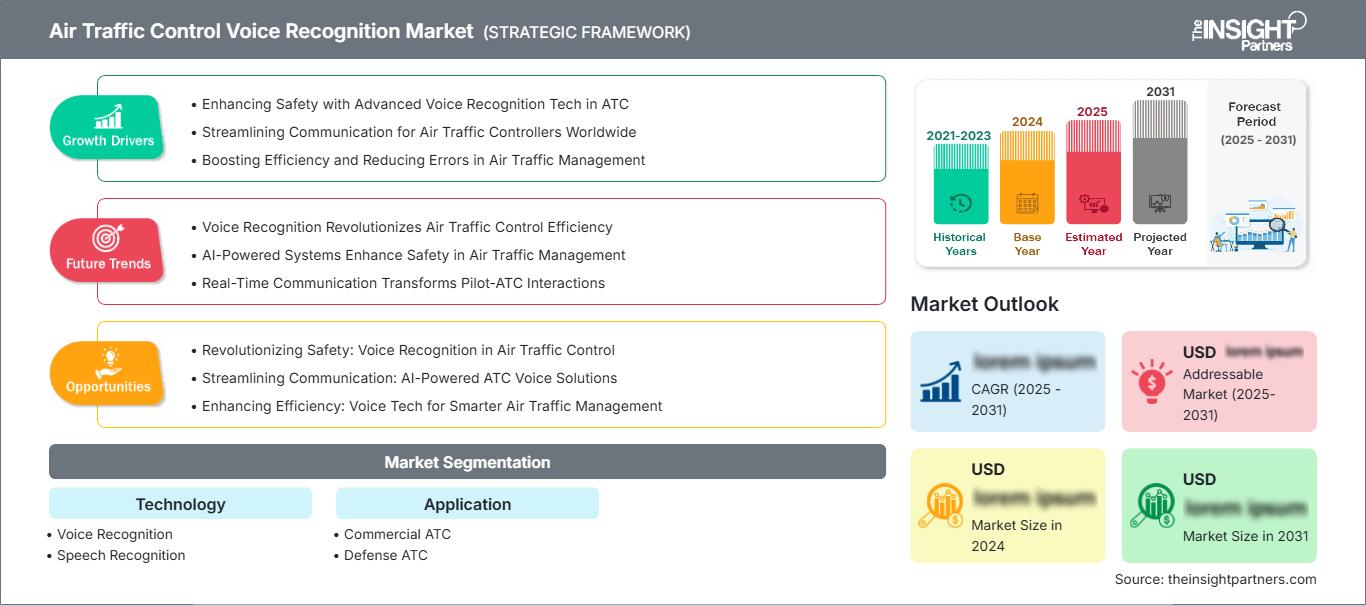
Air Traffic Control Voice Recognition Market: Strategic Insights
Regional Insights
North America Air Traffic Control Voice Recognition Market
North America was a 34% of the overall air traffic control voice recognition market share in 2025 and is expected to witness 5% CAGR growth till 2034. North America is endowed with the presence of a large installed base of air traffic control systems and also the demand for the training of controllers, simulations, voice recording and communication management. US represents the majority of the regional demand, whereas Canada contributes via the modernization initiatives of civil and defense aviation. The regional environment is conducive for suppliers of niche solutions that specialize in speech enabled simulation and analysis.
The US market comprises the applications for operations, training and defense. Research carried out by the FAA has recognized voice recognition and voice synthesis to be technologies which are being considered for providing better interactions in the ATC system in pilot training simulation, thereby establishing the institutional route for further development. UFA offers speech enabled simulation solutions, whereas MATRIXHCI provides ATC specific recognition systems based on aviation audio and context.
U.S. Air Traffic Control Voice Recognition Market
The US accounted for ~78% of North American air traffic control voice recognition market revenue in 2025 and is modeled to grow at ~5% CAGR through 2034. Demand is distributed across commercial ATC, military operations, controller training, flight simulation, and research. The market benefits from the concentration of aviation technology developers and a large installed base requiring compatibility with existing communication and simulation environments.
Applications for commercial use involve controller workload, communication logging, transcription, and operational assistance, while applications in defense include speech recognition in difficult communication circumstances. The ATWorld software by UFA uses speech recognition and automatic response features to build ATC interactions through flight simulation and training. The MATRIXHCI also produces speech recognition solutions that have specific acoustic and linguistic models for ATC communications.
Europe Air Traffic Control Voice Recognition Market
Europe represented ~29% of the global air traffic control voice recognition market in 2025 and is modeled to grow at ~5% CAGR through 2034. The region has a mature ATM ecosystem supported by established ANSPs, aerospace suppliers, research organizations, and digitalization programs. The UK, Germany, France, Italy, and Spain all contribute through airport modernization, controller training, communication upgrades, and ATM research. The UK is the leading country in Europe based on the concentration of advanced ATM activity, established ANSP infrastructure, and technology development.
The trend in Europe towards the adoption of such systems focuses on interoperability and integration with operational automation. Frequentis is working on a unified aeronautical communications system in which voice, automation, recording, and speech recognition using AI technology are working together in a common environment. In addition, Frequentis’s efforts are related to the ontology and interoperability of speech recognition via EUROCAE. France is a good place for conducting research in the field of speech recognition for aviation; the other two countries contributing to this effort are Germany and Italy.
APAC Air Traffic Control Voice Recognition Market
Asia Pacific represented ~24% of the global air traffic control voice recognition market share in 2025 and is modeled to grow at ~7% CAGR through 2034, making it the fastest-growing region. China is the leading country in Asia Pacific, supported by its extensive aviation infrastructure and continued modernization of airports and airspace systems. Japan and South Korea contribute through technologically advanced aviation networks, while India and Australia provide additional demand through infrastructure expansion and modernization.
India represents one of the significant markets for deployment of SITTI products since modernization of the communication system infrastructure of ATC takes place at a number of airports. SITTI supplied voice communication and recording systems in a nationwide Airports Authority of India initiative involving 45 airports, which confirms the large-scale development of communication systems modernization in India. In 2026, Frequentis also launched a research and development cooperation with an emphasis on AI functions like AI-based speech recognition and digital assistants for ATC in APAC region.
Middle East & Africa Air Traffic Control Voice Recognition Market
The Middle East & Africa market is modeled to grow at ~6% CAGR through 2034. Saudi Arabia is the leading country in the Middle East & Africa region where evidence supports a comparatively advanced aviation infrastructure base, while the UAE remains an important technology and airport hub. South Africa provides a significant Southern African aviation base, and other MEA markets are progressively upgrading communications as airports and airspace infrastructure expand.
Energy-sector aviation activity, airport development, defense requirements, and airspace modernization support investment in secure communications and ATC systems. Modern VCS deployments across African and Middle Eastern markets also demonstrate the continuing transition from legacy communications toward IP-enabled architectures. For speech recognition suppliers, these projects can create future integration opportunities when voice communication, recording, training, and operational analytics are modernized together. Deployment conditions vary substantially by country, making modular architectures and lifecycle support important commercial considerations.
Segmentation Analysis
Technology
Voice Recognition and Speech Recognition form the technology segmentation of the market. Voice recognition focuses on identifying and interpreting spoken inputs from controllers or pilots, while speech recognition more broadly converts and analyzes spoken communication. Domain-specific acoustic models, phraseology databases, and contextual information increasingly determine performance in noisy ATC environments.
- Voice Recognition: Voice recognition supports command interpretation, speaker-related processing, automated simulator interaction, and hands-free interfaces. Its strategic importance is increasing as ATM platforms seek to convert radio communications into structured operational information without requiring controllers or trainees to manually enter every communication event.
- Speech Recognition: Speech recognition supports transcription, searchable communications, call-sign extraction, training assessment, and incident analysis. Demand is strengthened by the growing availability of aviation audio datasets and the integration of AI processing with communication-recording and operational systems.
Application
Commercial ATC and Defense ATC define the application segmentation. Commercial ATC emphasizes safe and efficient management of civil traffic, controller training, communications recording, and operational support, while defense ATC requires additional resilience, simulation fidelity, and support for complex communication environments. The application segment is expected to benefit from wider integration of speech processing with digital ATC systems.
- Commercial ATC: Commercial deployments focus on controller assistance, transcription, simulation, communication analysis, and operational workflow integration. Adoption is closely linked to modernization programs, digital towers, communication-system upgrades, and the requirement to manage increasing information volumes without adding unnecessary controller workload.
- Defense ATC: Defense applications support military controller training, simulated traffic environments, speech-enabled operational stations, and communication processing. The segment has strong strategic relevance because military users often require recognition systems capable of operating with degraded audio, specialized phraseology, and scenario-specific communications.
Opportunity Snapshot
| Application | Revenue Contribution | Trend Tag | Adoption Stage |
| Commercial ATC | High | Digital ATC | Mature |
| Defense ATC | Medium | AI Simulation | Scaling |
Air Traffic Control Voice Recognition Market Growth Drivers and Impact Analysis
Integration of AI With Controller Workflows
AI-based speech processing is moving from post-event transcription toward real-time operational assistance. Recognition engines can identify call signs, clearances, readbacks, and other structured elements, enabling communication information to appear alongside flight and surveillance data. This changes the economic role of speech technology because a single recognition layer can support transcription, analytics, safety functions, training, and controller assistance. Frequentis describes applications including speech-to-text, call-sign and clearance recognition, readback checking, mismatch alerting, and extraction of operational meaning. As these functions become integrated with controller working positions, suppliers can address larger portions of the ATM software value chain. The resulting market impact is a shift from standalone speech software toward integrated, aviation-specific AI services embedded in mission-critical workflows.
Expansion of Simulation-Based Controller and Pilot Training
Training represents an important deployment pathway because voice recognition allows simulation systems to reproduce realistic controller-pilot interactions without requiring a human instructor to generate every background communication. Automated voice responses, recognition of standard phraseology, and recording of trainee interactions can increase scenario variety while generating structured assessment data. UFA's ATWorld and ATLIVE products demonstrate how voice recognition is incorporated into aviation training environments, including automated traffic communications and interactive ATC exercises. The FAA's 2025–2029 National Aviation Research Plan also identifies evaluation of simulated ATC environments using voice recognition, voice synthesis, and AI for realistic pilot-training interactions. These developments create demand for recognition models optimized for aviation rather than general consumer speech.
Modernization of IP-Based ATC Communications
The transition toward IP-based voice communication provides a technical foundation for integrating recognition services with recording, automation, and data systems. Modern VCS platforms increasingly expose digital interfaces that make it easier to route communications to transcription, analytics, and AI processing layers while preserving operational resilience. SITTI's deployments demonstrate the continuing migration toward ED-137-compliant VoIP communication infrastructure across airports and control centers. As communication systems are renewed, speech-recognition vendors gain opportunities to integrate with new controller working positions instead of relying exclusively on retrofit architectures. The impact extends across hardware and software suppliers because modernization programs can bundle voice communication, recording, training, and intelligent analysis. This favors vendors capable of supporting legacy interfaces while providing scalable digital integration.
Air Traffic Control Voice Recognition Market Future Trends
Context-Aware Speech Recognition and Operational Semantics
The next phase of speech recognition is likely to focus less on transcription alone and more on contextual interpretation. ATC communication contains structured information about aircraft identity, altitude, routing, clearances, and operational intent. Recognition systems can combine spoken content with flight data, surveillance information, previous communications, and known phraseology to resolve incomplete or noisy transmissions. This approach can improve the usefulness of recognition even when raw audio quality is imperfect. Frequentis is already describing speech recognition functions that identify call signs and clearances and extract structured operational meaning. Through 2034, vendors are likely to place greater emphasis on contextual models, domain-specific AI, explainable outputs, and integration with automation systems so that recognized speech becomes an operational data layer rather than a transcript archive.
Edge and On-Premises AI for Safety-Critical ATC
Safety-critical aviation environments in the air traffic control voice recognition market trends are expected to maintain strong requirements for availability, cybersecurity, data governance, and predictable system behavior. These requirements support continued development of on-premises and edge AI architectures that can process communications close to the operational environment. Local processing can reduce dependence on external connectivity while enabling rapid response for recognition, transcription, and alerting functions. Frequentis has introduced ATC recording capabilities incorporating on-premises AI-based speech recognition and understanding, while broader ATM architectures are moving toward modular services. Future systems are therefore likely to combine local inference with centrally managed models, secure updates, and controlled data pipelines. This architecture can allow ANSPs and defense organizations to introduce advanced recognition without moving sensitive operational audio into unsuitable external environments.
Air Traffic Control Voice Recognition Market Opportunities
Integrated Speech Intelligence for Existing ATM Infrastructure
A significant opportunity in the air traffic control voice recognition market forecast exists in adding speech intelligence to existing ATC environments rather than replacing complete communication systems. Retrofit-oriented solutions can connect recognition engines with recording platforms, controller workstations, simulation systems, and surveillance data through standardized interfaces. This approach reduces the need for organizations to undertake full infrastructure replacement solely to gain transcription or analytics capabilities. Suppliers can develop modular offerings covering call-sign detection, searchable transcripts, training assessment, readback analysis, and incident review. The opportunity is particularly relevant for mature aviation markets where installed communication infrastructure remains operational but software modernization is required. Vendors that can support legacy radio inputs, modern IP communications, secure local processing, and aviation-specific model customization can address a broader customer base.
AI-Enabled ATC Training and Defense Simulation
Training and defense simulation provide an opportunity for vendors to commercialize advanced recognition without requiring immediate integration into live operational ATC decision loops. Simulation environments can use voice recognition to automate virtual controllers, reproduce realistic radio traffic, evaluate trainee responses, and create objective communication records. Defense customers can additionally use specialized models for mission-specific phraseology and degraded communication conditions. UFA's established speech-enabled simulation portfolio illustrates the commercial pathway, while MATRIXHCI's aviation-specific recognition work shows the importance of dedicated acoustic and language models. Future investment can therefore target reusable simulation platforms, cloud-accessible training where security requirements permit, digital-twin environments, and model customization. These applications can also generate training data that improves recognition performance for later operational deployments.
Frequently Asked Questions

- Comprehensive Market Sizing and Forecast Analysis
- Detailed Segmentation Analysis
- In-Depth Market Dynamics Assessment
- Regional and Country-Level Insights
- Competitive Landscape and Company Benchmarking
- Strategic Business Intelligence
Recent Reports
Testimonials

The Insight Partners provided valuable market intelligence that supported our global go-to-market strategy. Their team was professional, responsive, and attentive to our feedback, providing thoughtful analysis and helpful methodological clarifications throughout the project.
Junmo Kim Chief Financial Officer (CFO), Enertech Co., Ltd.
The Insight Partners' SCADA System Market report is comprehensive, with valuable insights on current trends and future forecasts. The team was highly professional, responsive, and supportive throughout. We are very satisfied and highly recommend their services.
RAN KEDEM Partner, Reali Technologies LTDs
I requested a report on a very specific software market and the team produced the report in a few days. The information was very relevant and well presented. I then requested some changes and additions to the report. The team was again very responsive and I got the final report in less than a week.
JEAN-HERVE JENN Chairman, Future Analytica
We worked with The Insight Partners for an important market study and forecast. They gave us clear insights into opportunities and risks, which helped shape our plans. Their research was easy to use and based on solid data. It helped us make smart, confident decisions. We highly recommend them.
PIYUSH NAGPAL Sr. Vice President, High Beam Global
The Insight Partners delivered insightful, well-structured market research with strong domain expertise. Their team was professional and responsive throughout. The user-friendly website made accessing industry reports seamless. We highly recommend them for reliable, high-quality research services
YUKIHIKO ADACHI CEO, Deep Blue, LLC.
This is the first time I have purchased a market report from The Insight Partners.While I was unsure at first, I visited their web site and felt more comfortable to take the risk and purchase a market report.I am completely satisfied with the quality of the report and customer service. I had several questions and comments with the initial report, but after a couple of dialogs over email with their analyst I believe I have a report that I can use as input to our strategic planning process.Thank you so much for taking the extra time and making this a positive experience.I will definitely recommend your service to others and you will be my first call when we need further market data.
JOHN SUZUKI President and Chief Executive Officer, Board Director, BK Technologies
I wish to appreciate your support and the professionalism you displayed in the course of attending to my request for information regarding to infectious disease IVD market in Nigeria. I appreciate your patience, your guidance, and the fact that you were willing to offer a discount, which eventually made it possible for us to close a deal. I look forward to engaging The Insight Partners in the future, all thanks to the impression you have created in me as a result of this first encounter.
DR CHIJIOKE ONYIA MANAGING DIRECTOR, PineCrest Healthcare Ltd.Reason to Buy
- Informed Decision-Making
- Understanding Market Dynamics
- Competitive Analysis
- Identifying Emerging Markets
- Customer Insights
- Market Forecasts
- Risk Mitigation
- Boosting Operational Efficiency
- Strategic Planning
- Investment Justification
- Tracking Industry Innovations
- Aligning with Regulatory Trends





 Get Free Sample for