
Air-Water Monobloc Heat Pumps Market Size, Growth & Demand by 2034
Coverage: by Type (Single-Phase Models, Three-Phase Models); Application (Residential, Commercial, Industrial) , and Geography (North America, Europe, Asia Pacific, and South and Central America)
- Status : Data Released
- Report Code : TIPRE00011241
- Category : Manufacturing and Construction
- No. of Pages : 150
- Available Report Formats :


- Last update date : July 13, 2026


2025 Market Size
US$ 1.77 Bn
Base year value
2034 Forecast
US$ 4.79 Bn
Projected by 2034
CAGR 2026-2034
11.70 %
Growth rate
Addressable Market
US$ 28.84 Bn
(2026-2034)
The air-water monobloc heat pumps market size is projected to grow from US$ 1.77 Billion in 2025 to US$ 4.79 Billion by 2034, recording a CAGR of 11.70% during 2026–2034. Demand is being shaped by electrified heating adoption, integrated outdoor-unit design, and the shift from fossil-fuel boilers toward efficient hydronic heating solutions across residential, commercial, and industrial facilities.
Across North America, air-water monobloc heat pumps market size is supported by retrofit incentives, colder-climate product engineering, and utility programs that favor electrification. The region is estimated to expand at a CAGR range of 10.8–12.2% through 2034, with adoption concentrated in single-family homes, light commercial buildings, and campuses seeking lower on-site combustion emissions.
Air-Water Monobloc Heat Pumps Market Assessment and Insights
- North America accounted for 24–27% share in 2025 and is expected to grow at a CAGR between 2026–2034 of 10.8–12.2%, supported by building electrification incentives, hydronic retrofit demand, and cold-climate product availability.
- US represented 72–76% of North America in 2025 and is forecast to grow at a CAGR between 2026–2034 of 10.9–12.4%, led by rebates and contractor training.
- Europe held 34–38% share in 2025 and is projected to grow at a CAGR between 2026–2034 of 10.5–11.9%, with Germany, France, Italy, the UK, and Spain driving replacement of fossil-fuel heating.
- Asia Pacific captured 29–33% share in 2025 and is anticipated to grow at a CAGR between 2026–2034 of 12.4–13.8%, led by China, Japan, South Korea, India, and Australia.
- Largest Segment Residential held 58–62% market share in 2025 and is expected to grow at a CAGR range of 11.1–12.3%, supported by home retrofits and new-build electrification.
- High Growth Segment Commercial held 25–29% market share in 2025 and is forecast to grow at a CAGR range of 12.1–13.6%, driven by schools, offices, and hospitality upgrades.
- Key companies analyzed in detail: Bosch Thermotechnik GmbH, Glen Dimplex Group, Panasonic Holdings Corporation, Fujitsu General Limited, Mitsubishi Electric Corporation, LG Electronics Inc., Danfoss A/S, NIBE Industrier AB, Gree Electric Appliances, Inc. of Zhuhai, Sanden International (U.S.A.), Inc.
Source: The Insight Partners' analysis based on proprietary research, government publications, company annual reports, investor presentations, industry databases, and expert interviews.
Product innovation in the air-water monobloc heat pumps market has gone through changes from simple outdoor units to inverter models that operate quietly with improved compressors, weather compensation, and low-GWP refrigerants. Manufacturing processes have been modified such that the new products feature modular outdoor units, hydraulic kits, and standard interfaces. The innovations reduce complexity, shorten installation process, and enhance the product's appropriateness in replacing boilers in cases where space, refrigerant, and water are factors.
The future growth of demand will depend on locations where there is decarbonization of electricity grids and policies for heating have become stringent. North America, select European renovation markets, and Asia-Pacific urban areas are likely to receive more production capacity, installer collaborations, and digital services investments. The favorable regulation environment due to standards for building performance, restrictions on fossil-fuel boilers, and incentives for renewable heating will drive the use of air-water monobloc heat pumps.
Air-Water Monobloc Heat Pumps Market Report Scope
| Report Attribute | Details |
|---|---|
| Market size in 2025 | US$ 1.77 Billion |
| Market Size by 2034 | US$ 4.79 Billion |
| Global CAGR (2026 - 2034) | 11.70% |
| Historical Data | 2021-2024 |
| Forecast period | 2026-2034 |
Air-Water Monobloc Heat Pumps Market Analysis
The drivers for air-to-water monobloc heat pump market development include the intersection of climate policy, growing price sensitivity towards gas, and need for smaller heating systems without internal refrigeration circuitry. The International Energy Agency notes that heat pumps are three to five times more efficient compared to gas boilers, which makes the financial arguments for electrified hydronic heating even stronger.
The ecosystem consists of manufacturers of compressors, heat exchangers, control electronics, installers, utility companies, and building owners. The supply chain dynamics move in the direction of localization of assembly process, meeting refrigerant regulations, and depth of service network. The demand side favors the regions with existing base of hydronic emitters, hot water tanks, and retrofit programs.
Competitive positioning in air-to-water monoblock heat pumps' analysis includes climate capability, acoustic characteristics, warranty period, installer experience, and digital controls ecosystem. Bosch Thermotechnik GmbH, Mitsubishi Electric Corporation, Panasonic Holdings Corporation, NIBE Industrier AB, and LG Electronics Inc. have plans for further growth through expanding their product range with higher temperature models, smart diagnostics, and wider capacity range.
The main areas of investments include compressor efficiency, heat pump-ready buildings design, and contractor certifications. Danfoss A/S provides components optimization, while Glen Dimplex Group, Gree Electric Appliances, Inc. of Zhuhai, Fujitsu General Limited, and Sanden International (U.S.A.), Inc. deal with differentiated applications by region. Scale effects are important, but post-sale service becomes the critical factor.
● REPORT CUSTOMIZATION
Tailor This Report To Align With Your Specific Business Requirements
This report can be customized to align precisely with your business objectives, scope, and target markets. Customization options include tailored segmentation, geography, competitive analysis, and strategic insights to support informed decision-making.
Customize This Report →WHAT YOU CAN ADJUST
- ● Segmentations
- ● Geography
- ● Competitive Analysis
- ● Language Preferences
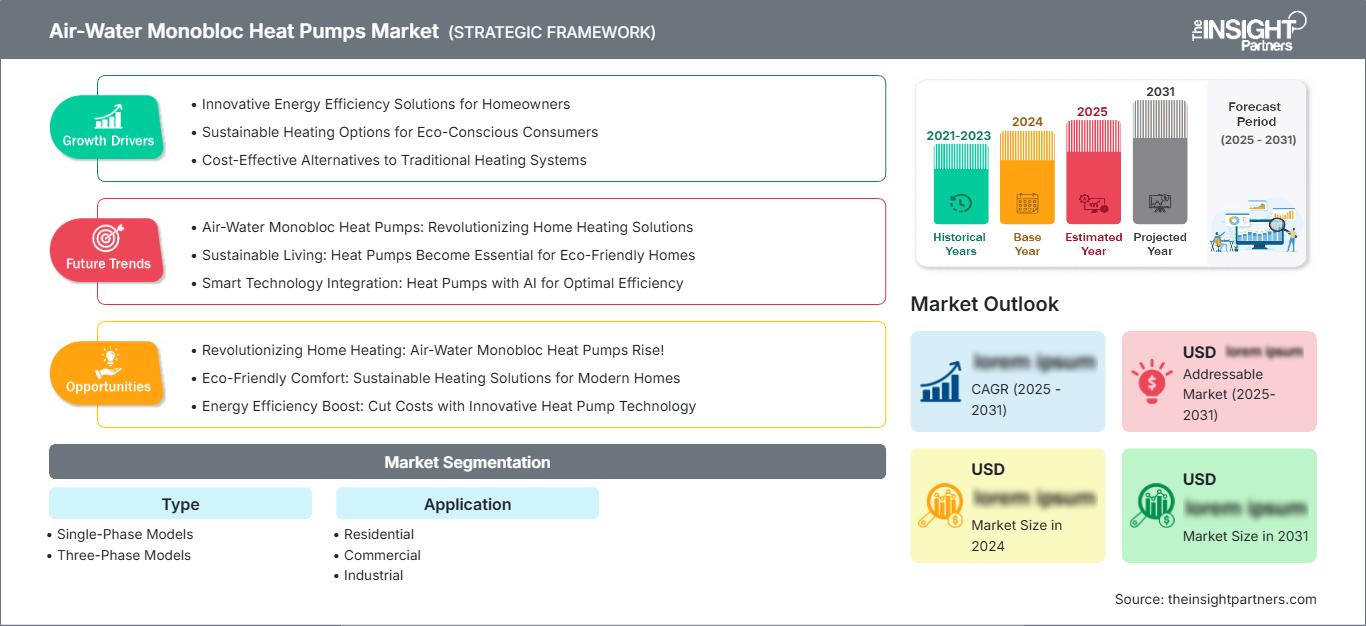
Air-Water Monobloc Heat Pumps Market: Strategic Insights
Regional Insights
North America Air-Water Monobloc Heat Pumps Market
North America accounted for 24–27% of global revenue in 2025, reflecting accelerating electrification in residential heating and selected commercial retrofits. The air-water monobloc heat pumps market share is rising where hydronic distribution, incentive stacking, and grid decarbonization programs create favorable lifecycle economics. Regional CAGR is estimated at 10.8–12.2% through 2034, supported by utility rebates and building-code updates.
Adoption is strongest in the US Northeast, Pacific states, and Canadian provinces with carbon pricing or oil-heating displacement initiatives. Manufacturers are prioritizing low-ambient performance, integrated backup control, and installer training. The market remains constrained by upfront costs and hydronic retrofit complexity, yet policy certainty and expanding cold-climate field data are improving buyer confidence.
U.S. Air-Water Monobloc Heat Pumps Market
The US represented 72–76% of North America in 2025 and is expected to post a 10.9–12.4% CAGR during 2026–2034. Growth is concentrated in boiler-heavy housing stock, multifamily upgrades, and light commercial projects where hydronic heating infrastructure reduces conversion barriers. Federal tax credits and state clean-heat programs are improving project economics.
Bosch Thermotechnik GmbH, Mitsubishi Electric Corporation, LG Electronics Inc., Panasonic Holdings Corporation, and Sanden International (U.S.A.), Inc. are visible through product distribution, training, and specification channels. Applications are shifting from premium residential retrofits toward schools, municipal buildings, and small hospitality assets. Installer availability remains decisive because monobloc units require hydronic design capability and reliable freeze-protection practices.
Europe Air-Water Monobloc Heat Pumps Market
Europe held 34–38% share in 2025 and is forecast to grow at a 10.5–11.9% CAGR, led by Germany. The UK benefits from grants for low-carbon heating and new-build standards, while Germany’s renewable-heating requirements and subsidy mechanisms favor high-temperature monobloc systems for boiler replacement in detached and multifamily buildings.
France, Italy, and Spain contribute through renovation programs, heat-pump-ready domestic hot-water demand, and electrification of smaller commercial assets. European buyers emphasize seasonal efficiency, refrigerant compliance, and acoustic limits in dense housing. Local manufacturing presence, certification familiarity, and installer networks support premium positioning, although electricity-to-gas price ratios continue to influence replacement timing.
APAC Air-Water Monobloc Heat Pumps Market
APAC accounted for 29–33% of the global revenue in 2025 and is projected to expand at a 12.4–13.8% CAGR, with China as the leading country. Japan and South Korea support premium residential and commercial adoption, while India and Australia add demand through policy-led electrification and hot-water efficiency programs.
Industrial and district-scale applications are emerging as factories, hotels, hospitals, and campuses assess low-temperature process heat. Gree Electric Appliances, Inc. of Zhuhai, Panasonic Holdings Corporation, Fujitsu General Limited, and Mitsubishi Electric Corporation benefit from regional manufacturing depth. Grid expansion, urban construction, and appliance efficiency standards reinforce long-term air-water monobloc heat pumps adoption.
Middle East & Africa Air-Water Monobloc Heat Pumps Market
Middle East & Africa remains an emerging market, with a projected CAGR of 9.2–10.6% through 2034. Saudi Arabia and the UAE lead demand through hospitality, mixed-use developments, and high-efficiency hot-water systems. South Africa contributes selectively where electricity reliability, commercial energy audits, and solar integration support payback.
Adoption is shaped by cooling-dominant building profiles, infrastructure investment, and water-heating loads rather than space heating alone. Developers are evaluating monobloc units for centralized domestic hot water, staff housing, and institutional projects. Growth depends on installer capability, product durability in high ambient conditions, and alignment with energy-efficiency procurement standards.
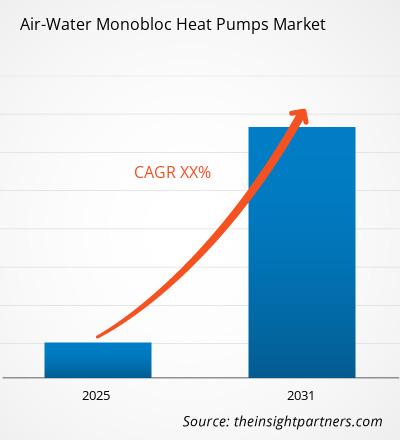
Segmentation Analysis
Type
Type is expected to grow at a CAGR range of 11.3–12.7% during 2026–2034. The air-water monobloc heat pumps market scope by type is shaped by electrical infrastructure, output capacity, and installation setting. Single-phase models dominate homes and small commercial buildings, while three-phase units address higher-load commercial and industrial projects requiring stable electrical supply and larger hydronic distribution.
- Single-Phase Models serve residential and small commercial users that need simplified electrical connection, compact output ranges, and easier retrofit compatibility with existing domestic hot-water tanks and radiator loops.
- Three-Phase Models support larger buildings, process-water applications, and higher-capacity hydronic systems where electrical stability, compressor performance, and continuous-duty operation are central to project specification.
Application
Application is forecast to grow at a CAGR range of 11.5–12.9% from 2026 to 2034. Residential demand is volume-led, commercial adoption is specification-led, and industrial uptake is linked to low-temperature heat needs. Buyers compare installed cost, seasonal efficiency, maintenance simplicity, and compatibility with heating emitters before selecting air-water monobloc heat pumps.
- Residential remains the primary application, supported by boiler replacement, new-build electrification, domestic hot-water integration, and consumer preference for outdoor units that reduce indoor equipment complexity.
- Commercial demand is rising in schools, offices, hospitality, and healthcare facilities where owners seek lower operating emissions, predictable maintenance, and compatibility with building management systems.
- Industrial applications are selective but strategically important, especially for low-temperature process heat, wash water, staff facilities, and sites combining electrification with onsite renewable power.
Opportunity Snapshot
| Application | Revenue Contribution | Trend Tag | Adoption Stage |
| Residential | High | Boiler Swap | Scaling |
| Commercial | Medium | Campus Heat | Scaling |
| Industrial | Low | Process Heat | Emerging |
Air-Water Monobloc Heat Pumps Market Growth Drivers and Impact Analysis
Building Electrification Policies Accelerate Boiler Replacement
Heating purchasing policies are moving away from fuel preference toward emissions performance; this is particularly favorable for air-water monobloc heat pumps. Minimum energy performance standards, prohibitions on the use of fossil fuel boilers, and grant schemes alleviate the costs to individual customers. In practical terms, it means an increase in the pipeline of replacements for buildings that already have a hydronic infrastructure. Monobloc solutions are optimal in this situation since the refrigerant is kept outside, thus decreasing complexity and certifications. As government ties its incentives to efficiency metrics, heat pump producers have to demonstrate their efficiency, low noise, and ability to adapt to electricity demand.
Cold-Climate Performance Improves Retrofit Confidence
Inverter compressor technology, vapor injection, defrost cycle management, and weather compensation controls have made the output more stable in colder ambient conditions, minimizing the notion that electric hydronic heating systems are viable only in moderate climates. As far as distributors and contractors are concerned, enhanced capabilities in the cold weather translate into increased numbers of homes and business establishments that could be serviced without oversized backup equipment. End users experience greater comfort and reduced risks of system failure. This effect will have the greatest influence in northern Europe, Canada, the northern part of the US, Japan, and South Korea.
Hydronic Retrofit Demand Supports Monobloc Adoption
The already-installed stock of radiator systems, underfloor heating systems, and domestic hot water cylinders provides an ideal route into using monobloc heat pumps. Homeowners like solutions that work with the existing water-based distribution system and do not need to completely revamp the heating system indoors. Thus, the practical advantage of air-to-water monobloc heat pumps is their ability to be used in old residential houses, apartment buildings, schools, and municipal buildings. The practical implications of the market include easier retrofits and higher contractor acceptance. But effective implementations still require heat losses calculation, emitter selection, buffer tanks, and anti-freeze solutions.
Air-Water Monobloc Heat Pumps Market Future Trends
Grid-Interactive Heating Controls
The air-water monobloc heat pumps market trends in the air-water monobloc heat pump market are going to be less about the efficiency of individual appliances and more about their ability to operate in grid-interaction mode. The controls of such systems can move heat loads, pre-heat the water tanks and react to dynamic pricing while maintaining high levels of comfort. These systems will be valued by the utilities as flexible demand resources, particularly in the areas where the share of renewable energy sources is growing. The software and cybersecurity will become competitive advantages for the manufacturers.
Lower-GWP Refrigerant Platforms
Product roadmap for the future will give more importance to refrigerants with low global warming potential and conforming to upcoming safety standards. Monobloc technology will contribute in this way as well since the refrigerant will be present inside the outdoor cabinet making it easier to incorporate safe indoor operations along with allowing the use of next generation refrigerant types. This development will have an effect on compressors, heat exchangers, charging levels and installer training. Those who can switch the refrigerant without compromising on high water temperatures and noise will have an edge in specifications.
Air-Water Monobloc Heat Pumps Market Opportunities
Commercial Retrofit Packages
The commercial building segment provides lucrative air-to-water heat pumps market forecast since the building owners require a proven reduction in carbon emission levels without having to replace the whole HVAC system. There are a number of building types such as schools, office spaces, hotels, health clinics, and municipalities which provide constant demands for heating and hot water supply, making it easier to sell packaged heat pumps solutions. Suppliers would be able to succeed by integrating equipment, hydraulic solution, controls, financial aid and maintenance packages.
Hybrid Solar and Storage Integration
Coupling monobloc technology with solar roof panels, thermal energy storage, and intelligent rates can be an effective way to boost economics in environments with increasing electricity consumption. Home-based producers-consumers and corporate campuses can utilize water boilers for flexible energy storage, lowering grid peaks and increasing the consumption of renewable energies. Producers and suppliers need to create control mechanisms that will synchronize heat pumps, photovoltaics, batteries, and auxiliary heating systems. In this way, a unique value proposition goes beyond the mere substitution of traditional heating systems.
Recent Developments
- March 2025: Glen Dimplex Group — The company announced a leadership transition, appointing Fergal Naughton as Group CEO, with continued emphasis on low-carbon electric heating and ventilation solutions across residential and commercial markets.
- March 2026: LG Electronics – The company unveiled a new lineup of indoor units (IDUs) for air-to-water heat pump systems at Mostra Convegno Expocomfort (MCE) 2026 in Milan, Italy, from March 24-27. The all-new Combi, Hydro and Control Units expand LG’s heating solution portfolio with cohesive design, flexible installation and improved system integration for residential applications.
- June 2026: Terris Energy- introduced a new 60 kW model of its T-DUO hybrid monobloc heat pump, expanding its product portfolio to address the needs of medium-scale commercial, collective housing, and tertiary building applications. The R290 refrigerant-based hybrid solution integrates an air-to-water heat pump with a high-efficiency gas condensing boiler in a compact system architecture, aimed at facilitating easier installation and integration in both retrofit and new construction projects.
Frequently Asked Questions

- Comprehensive Market Sizing and Forecast Analysis
- Detailed Segmentation Analysis
- In-Depth Market Dynamics Assessment
- Regional and Country-Level Insights
- Competitive Landscape and Company Benchmarking
- Strategic Business Intelligence
Recent Reports
Testimonials

The Insight Partners' SCADA System Market report is comprehensive, with valuable insights on current trends and future forecasts. The team was highly professional, responsive, and supportive throughout. We are very satisfied and highly recommend their services.
RAN KEDEM Partner, Reali Technologies LTDs
I requested a report on a very specific software market and the team produced the report in a few days. The information was very relevant and well presented. I then requested some changes and additions to the report. The team was again very responsive and I got the final report in less than a week.
JEAN-HERVE JENN Chairman, Future Analytica
We worked with The Insight Partners for an important market study and forecast. They gave us clear insights into opportunities and risks, which helped shape our plans. Their research was easy to use and based on solid data. It helped us make smart, confident decisions. We highly recommend them.
PIYUSH NAGPAL Sr. Vice President, High Beam Global
The Insight Partners delivered insightful, well-structured market research with strong domain expertise. Their team was professional and responsive throughout. The user-friendly website made accessing industry reports seamless. We highly recommend them for reliable, high-quality research services
YUKIHIKO ADACHI CEO, Deep Blue, LLC.
This is the first time I have purchased a market report from The Insight Partners.While I was unsure at first, I visited their web site and felt more comfortable to take the risk and purchase a market report.I am completely satisfied with the quality of the report and customer service. I had several questions and comments with the initial report, but after a couple of dialogs over email with their analyst I believe I have a report that I can use as input to our strategic planning process.Thank you so much for taking the extra time and making this a positive experience.I will definitely recommend your service to others and you will be my first call when we need further market data.
JOHN SUZUKI President and Chief Executive Officer, Board Director, BK Technologies
I wish to appreciate your support and the professionalism you displayed in the course of attending to my request for information regarding to infectious disease IVD market in Nigeria. I appreciate your patience, your guidance, and the fact that you were willing to offer a discount, which eventually made it possible for us to close a deal. I look forward to engaging The Insight Partners in the future, all thanks to the impression you have created in me as a result of this first encounter.
DR CHIJIOKE ONYIA MANAGING DIRECTOR, PineCrest Healthcare Ltd.Reason to Buy
- Informed Decision-Making
- Understanding Market Dynamics
- Competitive Analysis
- Identifying Emerging Markets
- Customer Insights
- Market Forecasts
- Risk Mitigation
- Boosting Operational Efficiency
- Strategic Planning
- Investment Justification
- Tracking Industry Innovations
- Aligning with Regulatory Trends





 Get Free Sample for