
Airborne Warning and Control Systems Market Growth, Trends & Demand by 2034
Coverage: By Component (RADAR, Command and Control System, Communication Support System); Application (Surveillance, Communications, Battle Management, Others) , and Geography (North America, Europe, Asia Pacific, and South and Central America)
- Status : Data Released
- Report Code : TIPRE00025486
- Category : Aerospace and Defense
- No. of Pages : 150
- Available Report Formats :


- Last update date : October 30, 2026


2025 Market Size
US$ 5.31 Bn
Base year value
2034 Forecast
US$ 10.45 Bn
Projected by 2034
CAGR 2026-2034
7.81 %
Growth rate
Addressable Market
US$ 70.92 Bn
(2026-2034)
The airborne warning and control systems market was valued at US$ 5.31 Billion in 2025 and is expected to reach US$ 10.45 Billion by 2034, registering a CAGR of 7.81% during 2026–2034. These systems combine airborne radar, command and control, and communication support capabilities to provide persistent situational awareness, threat detection, battle management, and coordinated information exchange. Demand is shaped by air-defense modernization, replacement of aging surveillance fleets, multi-domain operations, and the need to integrate airborne sensors with national and allied command networks.
The airborne warning and control systems market size is supported by sustained procurement across North America, where modernization of airborne battle-management fleets, NORAD requirements, and interoperability with allied forces are strengthening demand. The regional market is expected to expand at a CAGR of ~7% through 2034, supported by the replacement of aging platforms, investment in advanced electronically scanned radar, and integration of airborne surveillance assets with wider air and missile defense architectures.
Airborne Warning and Control Systems Market Assessment and Insights
Regional Outlook
- North America: ~31% of the global market in 2025 | ~7% CAGR through 2034. Market position: North America maintains the largest regional position because of substantial US procurement programs, NORAD modernization, established airborne battle-management infrastructure, and continuing demand for interoperable radar, communications, and command systems.
- US: ~80% of North American market revenue in 2025 | ~7% CAGR through 2034. Market position: The US represents the principal North American demand center, supported by E-7A modernization, E-2D procurement, advanced radar development, and requirements for joint battle management across air, naval, space, and ground forces.
- Europe: ~24% of the global market in 2025 | ~9% CAGR through 2034. Market position: Europe combines mature airborne surveillance fleets with an accelerating replacement cycle. Germany is the leading country in Europe, while the UK, France, Italy, and Spain are strengthening NATO-compatible surveillance, command, and communications capabilities.
- Asia Pacific: ~25% of the global market in 2025 | ~10% CAGR through 2034. Market position: Asia Pacific is the fastest-growing region, supported by indigenous AEW&C development, fleet modernization, maritime surveillance requirements, and expanding investment in airborne radar and command architectures across China, India, Japan, South Korea, and Australia.
Segment Outlook
- Radar: ~55% Share in 2025 | ~8% CAGR through 2034. Market position: Radar leads because long-range detection, tracking, identification, and persistent airspace monitoring remain fundamental to airborne warning missions. AESA architectures, multi-target tracking, improved electronic protection, and integration with battle-management software sustain replacement and upgrade demand.
- Communication Support System: ~21% Share in 2025 | ~10% CAGR through 2034. Market position: Communication Support System is the high-growth main segment as AEW&C platforms increasingly operate as networked nodes linking aircraft, ground stations, ships, satellites, and command centers. Secure data links and multi-domain interoperability are accelerating investment.
Competitive Coverage
BAE Systems, Beriev Aircraft, Embraer S.A., Israel Aerospace Industries, Ltd., L3Harris Technologies, Inc., Leonardo S.p.A., Lockheed Martin Corporation, Northrop Grumman Corporation, Saab AB, Shaanxi Aircraft Corporation
Methodology
The Insight Partners follows Data Collection & Secondary Research, Primary Research, Data Analysis, and Data Triangulation & Final Review to validate market estimates and insights.
Source: The Insight Partners' analysis based on proprietary research, government publications, company annual reports, investor presentations, industry databases, and expert interviews.
The airborne warning and control systems market has evolved from large aircraft equipped primarily for long-range radar surveillance into integrated mission systems capable of coordinating information across multiple operational domains. Advances in AESA radar, digital signal processing, electronic support measures, secure communications, and software-defined mission architectures have resulted in a higher volume of information that can be gathered and shared during the mission. Platform-wise, the modernization effort is moving toward business jet AEW&C configurations, which allow for reduced platform requirements and extended endurance, along with advanced sensor integration. Existing fleets are crucial due to the possibility of extending the life of the systems through upgrades to radar, mission computers, communications and electronic warfare capabilities without the need for platform replacements.
From a future point of view, procurement is driven by the necessity to link airborne warning systems with integrated air and missile defense, fifth-generation fighters, unmanned systems, satellites, and national command and control. Europe is moving into an era of fleet recapitalization as NATO states update their airborne surveillance capabilities, whereas Asian Pacific states are using imports and domestic development. The Middle East is also investing in long-range surveillance and networked air-defense capabilities. Airborne Warning and Control Systems Market share is increasingly shaped by regulatory and defense-policy priorities emphasizing interoperability, secure information exchange, survivability, and sovereign control of sensitive mission data, encouraging suppliers to provide modular architectures that can accommodate national communication standards and locally developed systems.
Airborne Warning and Control Systems Market Report Scope
| Report Attribute | Details |
|---|---|
| Market size in 2025 | US$ 5.31 Billion |
| Market Size by 2034 | US$ 10.45 Billion |
| Global CAGR (2026 - 2034) | 7.81% |
| Historical Data | 2021-2024 |
| Forecast period | 2026-2034 |
Airborne Warning and Control Systems Market Analysis
The demand structure is closely linked to the operational requirement for early detection beyond the coverage of fixed ground-based sensors. Airborne platforms provide elevated sensor positions, wider surveillance horizons, and the ability to reposition rapidly in response to changing operational requirements. Radar suppliers, therefore, interact with aircraft manufacturers, mission-system integrators, communication providers, electronic warfare specialists, and defense ministries. The Airborne Warning and Control Systems Market forecast reflects a value chain extending from aircraft modification and radar production through mission-computer integration, data links, training, sustainment, software updates, and lifecycle support. Replacement programs can create long revenue cycles because customers require extensive testing and certification before operational deployment.
Supply dynamics are increasingly shaped by the availability of advanced AESA radar components, high-performance processors, secure communications equipment, and specialized integration expertise. Suppliers are also adapting to demand for smaller business-jet-based platforms, which can provide alternative procurement pathways to traditional widebody or transport aircraft. Airborne Warning and Control Systems Market trends increasingly emphasize open mission-system architectures because customers want to introduce new sensors and software without redesigning the complete platform. This favors companies capable of combining aircraft integration with radar, communications, electronic warfare, and command-and-control expertise.
The competitive landscape of the Airborne Warning and Control Systems Market includes platform integrators, radar specialists, defense electronics companies, and aircraft manufacturers. Saab is expanding its GlobalEye position through international procurement activity, while Northrop Grumman remains closely associated with advanced airborne early warning radar and the E-2D ecosystem. L3Harris is developing business-jet-based AEW&C solutions, and Israel Aerospace Industries integrates conformal AESA radar, electronic intelligence, communications, and battle management on aircraft such as the Global 6500 and G550. Embraer continues to support airborne early warning modernization through the E-99M platform.
Investment in the Airborne Warning and Control Systems Market is increasingly directed toward scalable architectures rather than isolated sensor upgrades. Lockheed Martin, Leonardo, BAE Systems, and other defense technology companies participate across adjacent sensing, electronic warfare, communications, mission integration, and sustainment activities. Strategic positioning therefore, depends on the ability to provide complete mission solutions, maintain interoperability with allied networks, and support customers throughout long platform lifecycles.
● REPORT CUSTOMIZATION
Tailor This Report To Align With Your Specific Business Requirements
This report can be customized to align precisely with your business objectives, scope, and target markets. Customization options include tailored segmentation, geography, competitive analysis, and strategic insights to support informed decision-making.
Customize This Report →WHAT YOU CAN ADJUST
- ● Segmentations
- ● Geography
- ● Competitive Analysis
- ● Language Preferences
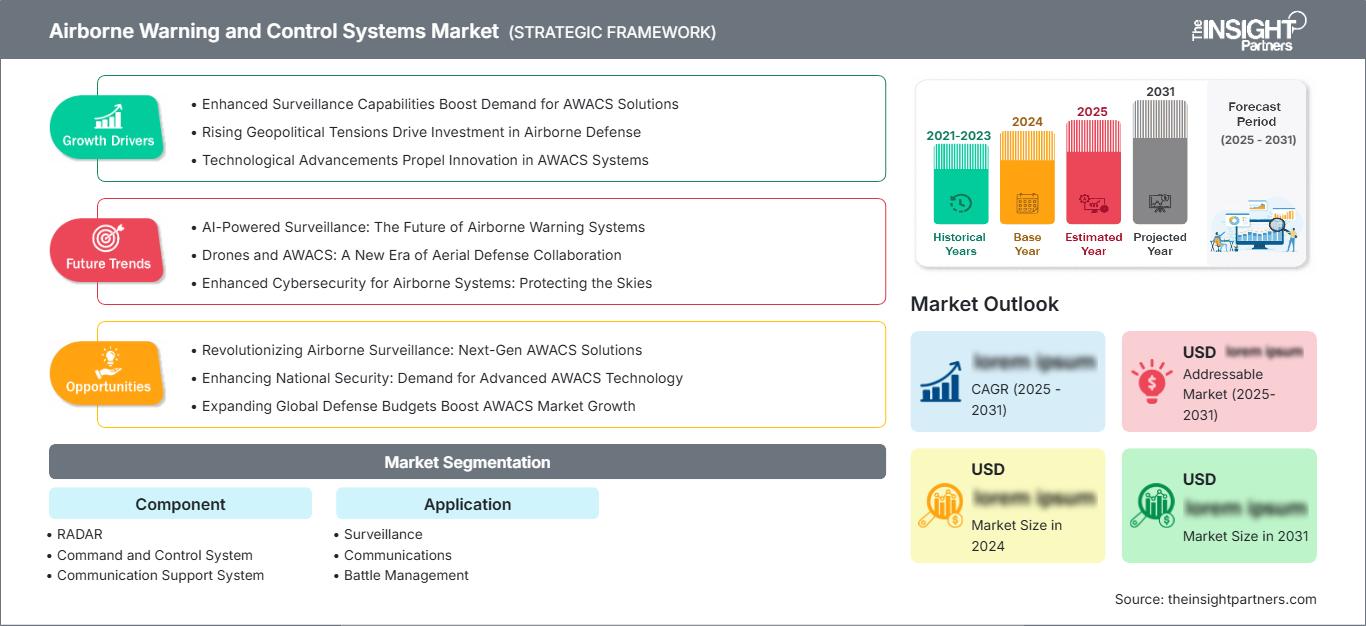
Airborne Warning and Control Systems Market: Strategic Insights
Regional Insights
North America Airborne Warning and Control Systems Market
North America accounted for ~31% of the global Airborne Warning and Control Systems Market in 2025 and is expected to record a CAGR of ~7% through 2034. Airborne battle management capabilities modernization and the upgrade from E-3 platforms, along with the ongoing development of carrier-based airborne early warning capabilities, form the basis for regional procurement driven by the US. These projects need sophisticated radars, mission computing, secure communications systems, and integration with joint command networks. Modernization cycles are currently underway in Canada in connection with NORAD and long-range Arctic surveillance requirements.
The US defense market enjoys the presence of a well-established aerospace industrial base encompassing aircraft integration, radar manufacture, mission systems, electronic warfare, and full-life support. Companies like Northrop Grumman, L3Harris Technologies, Lockheed Martin, and BAE Systems provide technologies pertinent to airborne surveillance missions and integration thereof, whereas Boeing plays a central role in the architecture of the E-7A airframe. Interoperability with allied countries’ forces and sensor data dissemination to command centers are now key aspects of regional procurement.
U.S. Airborne Warning and Control Systems Market
The US represented ~80% of the North American Airborne Warning and Control Systems Market revenue in 2025 and is expected to grow at a CAGR of ~7% through 2034. The demand is driven by the need to replenish old airborne surveillance systems and improve battle management in highly interconnected missions. There are two separate paths of procurement – the E-7A program and the procurement of the E-2D Advanced Hawkeye aircraft.
US producers are also key drivers of technology standards, since allied programs often demand compatibility with US communication, datalink, radar and command structures. Northrop Grumman produces airborne radars and E-2D, Boeing integrates the E-7A platform, and L3Harris is developing the next generation of business jet-based AEW&C system. Demand becomes increasingly driven by sensor fusion, secure communications, robustness against electronic warfare, and fifth-generation aircraft integration.
Europe Airborne Warning and Control Systems Market
Europe represented ~24% of the global Airborne Warning and Control Systems Market in 2025 and is projected to expand at a CAGR of ~9% through 2034. The region combines established airborne surveillance fleets with a major replacement requirement. Germany is the leading nation in Europe due to its priorities regarding defense modernization and its involvement in NATO capability development. The UK is improving the E-7 Wedgetail capability, and France is acquiring Saab GlobalEye aircraft to enhance sovereign and alliance airborne surveillance.
The role of Germany goes beyond acquisition since it will influence interoperability, training, communication, and sustainment issues due to its participation in multilateral European and NATO capability development programs. France is purchasing additional GlobalEye aircraft in addition to its existing capabilities for airborne surveillance, and Italy and Spain focus on NATO-compatible command and control, air defense integration, and communication. Consequently, the demand from Europe is moving from pure aircraft acquisition to capability packages combining various elements.
The regional replacement cycle also creates opportunities for modular mission architectures. Suppliers that can integrate sensors from multiple technology domains while supporting national security requirements can address diverse European procurement models. NATO interoperability remains a central technical consideration, particularly as European operators seek common operational pictures and distributed command structures.
APAC Airborne Warning and Control Systems Market
Asia Pacific represented ~25% of the global Airborne Warning and Control Systems Market in 2025 and is expected to register a CAGR of ~10% through 2034, making it the fastest-growing region. China is the leading country in Asia Pacific, while India, Japan, South Korea, and Australia are expanding or modernizing their airborne surveillance capabilities. Maritime geography, large airspace areas, and regional security requirements encourage investment in long-range sensors and airborne command systems.
China and India are developing greater indigenous capabilities, while Japan, South Korea, and Australia combine domestic infrastructure with established international platforms and suppliers. Australia operates the E-7A Wedgetail, Japan fields E-767 and E-2D capabilities, and South Korea operates E-737 aircraft. India's indigenous AEW&C development supports the localization of radar, mission systems, and integration capabilities, strengthening the regional supplier ecosystem.
Middle East & Africa Airborne Warning and Control Systems Market
The Middle East & Africa Airborne Warning and Control Systems Market is expected to expand at a CAGR of ~9% through 2034. Of all the countries in the Middle East and Africa, Saudi Arabia emerges as the top procurement country with regard to airborne long-range surveillance and integrated air defenses. The need for the Gulf states to monitor large areas of airspace, defend vital installations and detect hostile aircraft at a distance cannot be overlooked.
The United Arab Emirates and Saudi Arabia have become procurement destinations due to their military modernization projects, which stress surveillance networks, secure communications and command and control in multiple domains. South Africa is one of the select markets that emerge due to fleet sustainment and national surveillance needs. In other parts of the region, adoption depends on defense budgeting, platform life cycle, border monitoring and infrastructural capability for maintaining advanced mission systems in the air.
Segmentation Analysis
Component
Component segmentation of the Airborne Warning and Control Systems Market covers Radar, Command and Control System, and Communication Support System. Radar remains the largest main segment, accounting for ~55% of 2025 revenue and growing at a CAGR of ~8% through 2034. Its position reflects the essential role of detection, tracking, target identification, and surveillance in every airborne warning architecture. AESA adoption, electronic protection, multi-function radar operation, and improved processing are sustaining modernization demand.
- Radar: Radar systems provide the primary sensing layer for airborne warning missions. Demand increasingly favors AESA architectures capable of simultaneous detection and tracking across complex air and maritime environments, with improved electronic protection and integration into wider sensor-fusion architectures.
- Command and Control System: Command and Control System components convert sensor information into an operational picture and support identification, prioritization, and mission coordination. Their strategic importance is increasing as AEW&C aircraft become distributed battle-management nodes connecting fighters, ships, ground forces, and unmanned systems.
- Communication Support System: Communication Support System is the fastest-growing main segment, with a CAGR of ~10% through 2034 and a 2025 share of ~21%. Secure data links, satellite connectivity, tactical networking, and interoperable communications are becoming essential for transmitting airborne surveillance information to distributed users.
Application
Application segmentation includes Surveillance, Communications, and Battle Management. Surveillance remains central because airborne platforms provide elevated sensing and persistent monitoring beyond the limitations of fixed radar installations. Communications are gaining strategic importance as platforms increasingly operate as network nodes, while Battle Management supports the conversion of sensor information into coordinated operational decisions.
- Surveillance: Surveillance applications support continuous detection, tracking, identification, and monitoring of airborne and maritime activity. They remain fundamental to national airspace awareness and are increasingly linked with multi-sensor fusion, electronic intelligence, and unmanned-system operations.
- Communications: Communications applications enable AEW&C aircraft to distribute information to fighters, ships, command centers, satellites, and ground-based systems. Secure, resilient, low-latency connectivity is strategically important for coalition operations and distributed command architectures.
- Battle Management: Battle Management applications transform surveillance data into coordinated operational information. Demand is supported by multi-domain operations, integrated air defense, automated decision-support functions, and the need to coordinate aircraft and other forces in contested environments.
Opportunity Snapshot
| Application | Revenue Contribution | Trend Tag | Adoption Stage |
|---|---|---|---|
| Surveillance | High | Wide-Area Sensing | Mature |
| Communications | Medium | Secure Networking | Scaling |
| Battle Management | High | Multi-Domain C2 | Scaling |
Airborne Warning and Control Systems Market Growth Drivers and Impact Analysis
Replacement of aging airborne surveillance fleets
Fleet age is creating a structural procurement requirement because legacy airborne warning aircraft require increasingly expensive maintenance while their original computing, radar, and communications architectures become difficult to upgrade. NATO's planned modernization of its airborne surveillance capability and national replacement programs in North America and Europe demonstrate how platform age can translate directly into new procurement. Replacement programs also allow defense ministries to move from mechanically scanned or legacy architectures toward AESA radar, digital mission systems, secure networking, and improved battle management. The impact extends beyond aircraft sales because each replacement cycle generates demand for training, mission-system integration, software, maintenance, spares, and lifecycle support. Suppliers with established certification and integration capabilities can therefore capture recurring revenue after the initial aircraft procurement.
Expansion of networked multi-domain operations
Modern air forces increasingly require airborne warning platforms to function as information nodes rather than isolated radar aircraft. Sensor data must be shared with fighters, naval forces, ground-based air defense, unmanned aircraft, and command centers to produce a common operational picture. This requirement increases demand for secure communications, data links, mission computers, and software capable of integrating information from different sources. The effect on procurement is a shift toward architectures that can support multiple communication standards and accommodate future sensors without replacing the complete platform. Business-jet-based systems are particularly relevant because they can combine long endurance with lower platform complexity while providing space for mission equipment. This architecture expands the addressable supplier base beyond traditional large-aircraft programs.
Growth in long-range air and maritime surveillance requirements
Expanding requirements for monitoring maritime approaches, remote airspace, strategic infrastructure, and low-altitude threats are increasing the operational value of airborne surveillance. Airborne sensors can reposition rapidly and provide detection beyond the line-of-sight constraints of ground systems, making them useful for large geographic areas. Maritime security requirements further strengthen demand because airborne warning systems can track aircraft and surface contacts while distributing information to naval and air units. The market impact is strongest where countries face extensive coastlines, dispersed territory, or requirements for persistent monitoring. Procurement decisions increasingly consider sensor range, endurance, communications resilience, and interoperability together rather than evaluating radar performance independently.
Airborne Warning and Control Systems Market Future Trends
AI-enabled sensor fusion and automated battle management
Artificial intelligence and advanced analytics are expected to become more deeply embedded in airborne warning architectures as the volume and complexity of sensor information increase. Future systems are likely to combine radar, electronic support, identification, communications, and external data sources to create more coherent operational pictures. Automated classification and prioritization can reduce operator workload while enabling faster response to large numbers of simultaneous tracks. The commercial implication is a gradual shift in value toward mission software, high-performance computing, data architectures, and updateable algorithms alongside traditional radar hardware. Suppliers will need to demonstrate explainable, secure, and certifiable software because military users require reliable decision support under contested conditions. Open architectures will also facilitate the insertion of new algorithms without redesigning complete aircraft systems.
Business-jet-based AEW&C architectures
Business-jet-based platforms are expected to gain greater attention as countries seek persistent airborne surveillance without adopting the operating profile of very large aircraft. Modern business jets offer mature propulsion, established maintenance networks, high-altitude performance, and suitable cabin volume for mission equipment and operators. Integrating conformal AESA radar, electronic intelligence, satellite communications, and battle-management systems can produce a compact platform suited to national and regional missions. This approach may also shorten delivery cycles because the underlying aircraft platform already exists in commercial service. The trend creates opportunities for modular mission-system suppliers and aircraft integrators while increasing competition between traditional large-platform AEW&C solutions and smaller, more flexible architectures.
Airborne Warning and Control Systems Market Opportunities
Indigenous mission-system development in emerging procurement markets
Countries seeking greater control over defense technology are creating opportunities for local development and industrial participation across radar, mission computing, communications, and aircraft integration. India provides a significant example of the localization pathway, while other Asia Pacific and Middle Eastern customers are also seeking technology transfer, domestic maintenance capability, and sovereign control over sensitive mission data. Suppliers can address this opportunity through joint ventures, local assembly, software development partnerships, training centers, and long-term sustainment agreements. The commercial opportunity is not limited to new aircraft because indigenous mission-system capability can also support upgrades to existing fleets. Companies able to balance technology protection with meaningful local industrial participation can improve their ability to compete for multi-year procurement programs.
Lifecycle modernization and open-architecture upgrades
Large installed fleets create opportunities for suppliers that can upgrade radar, mission computers, communications, electronic warfare, and data links without replacing the entire aircraft. Modernization can extend fleet usefulness while introducing digital capabilities required for networked operations. Open architectures are particularly valuable because they allow customers to add new sensors and software as threats evolve. This opportunity also supports recurring revenue through software updates, maintenance, training, and system support. Companies with established aircraft integration experience can use upgrade programs to build long-term customer relationships and position additional products across communications, electronic warfare, and command-and-control domains. For operators facing constrained procurement schedules, modular modernization can provide a practical path to capability enhancement.
Frequently Asked Questions

- Comprehensive Market Sizing and Forecast Analysis
- Detailed Segmentation Analysis
- In-Depth Market Dynamics Assessment
- Regional and Country-Level Insights
- Competitive Landscape and Company Benchmarking
- Strategic Business Intelligence
Recent Reports
Testimonials

The Insight Partners provided valuable market intelligence that supported our global go-to-market strategy. Their team was professional, responsive, and attentive to our feedback, providing thoughtful analysis and helpful methodological clarifications throughout the project.
Junmo Kim Chief Financial Officer (CFO), Enertech Co., Ltd.
The Insight Partners' SCADA System Market report is comprehensive, with valuable insights on current trends and future forecasts. The team was highly professional, responsive, and supportive throughout. We are very satisfied and highly recommend their services.
RAN KEDEM Partner, Reali Technologies LTDs
I requested a report on a very specific software market and the team produced the report in a few days. The information was very relevant and well presented. I then requested some changes and additions to the report. The team was again very responsive and I got the final report in less than a week.
JEAN-HERVE JENN Chairman, Future Analytica
We worked with The Insight Partners for an important market study and forecast. They gave us clear insights into opportunities and risks, which helped shape our plans. Their research was easy to use and based on solid data. It helped us make smart, confident decisions. We highly recommend them.
PIYUSH NAGPAL Sr. Vice President, High Beam Global
The Insight Partners delivered insightful, well-structured market research with strong domain expertise. Their team was professional and responsive throughout. The user-friendly website made accessing industry reports seamless. We highly recommend them for reliable, high-quality research services
YUKIHIKO ADACHI CEO, Deep Blue, LLC.
This is the first time I have purchased a market report from The Insight Partners.While I was unsure at first, I visited their web site and felt more comfortable to take the risk and purchase a market report.I am completely satisfied with the quality of the report and customer service. I had several questions and comments with the initial report, but after a couple of dialogs over email with their analyst I believe I have a report that I can use as input to our strategic planning process.Thank you so much for taking the extra time and making this a positive experience.I will definitely recommend your service to others and you will be my first call when we need further market data.
JOHN SUZUKI President and Chief Executive Officer, Board Director, BK Technologies
I wish to appreciate your support and the professionalism you displayed in the course of attending to my request for information regarding to infectious disease IVD market in Nigeria. I appreciate your patience, your guidance, and the fact that you were willing to offer a discount, which eventually made it possible for us to close a deal. I look forward to engaging The Insight Partners in the future, all thanks to the impression you have created in me as a result of this first encounter.
DR CHIJIOKE ONYIA MANAGING DIRECTOR, PineCrest Healthcare Ltd.Reason to Buy
- Informed Decision-Making
- Understanding Market Dynamics
- Competitive Analysis
- Identifying Emerging Markets
- Customer Insights
- Market Forecasts
- Risk Mitigation
- Boosting Operational Efficiency
- Strategic Planning
- Investment Justification
- Tracking Industry Innovations
- Aligning with Regulatory Trends





 Get Free Sample for