Aircraft Cargo Handling Equipment Market Size & Overview
The aircraft cargo handling equipment market is expanding as airports, airlines, cargo operators, and ground handlers invest in equipment that supports faster aircraft turnarounds, higher cargo throughput, safer ULD movement, and lower operating emissions. The market is projected to increase from US$ 10.52 Billion in 2025 to US$ 19.00 Billion by 2034, registering a CAGR of 6.79% during 2026–2034. Demand is supported by growth in air freight activity, freighter fleet modernization, airport cargo infrastructure investment, and the transition toward automated and electric ground support equipment.
North America remains an important equipment market because of its extensive cargo airport network, established freight operators, and large installed base of cargo-handling assets. The aircraft cargo handling equipment market in the region is expected to expand at a modeled CAGR of ~6% through 2034, supported by the replacement of aging diesel equipment, the modernization of cargo hubs, and greater deployment of electric loaders, tractors, and dollies.
The Aircraft Cargo Handling Equipment Market forecast is closely linked to cargo throughput, aircraft movements, ULD utilization, airport cargo terminal capacity, and the number of freighter and wide-body aircraft requiring specialized ground equipment. Air cargo demand hit record highs in 2025 with worldwide CTK up 3.4% compared to the previous year, while available cargo capacity increased 3.7%. This strengthens the necessity for equipment that is able to operate with a greater volume of cargo. The supply chain consists of many aspects, starting from equipment design and component production through battery and power source production, integration, airport purchases, ground handlers, airlines, leasing firms, maintenance and spare parts. The supply is influenced by modular equipment design, as manufacturers adapt loaders, transporters, tractors to be diesel, battery, hybrid, or alternative energy driven. Being able to use a common control system and being able to replace components and charge remotely might lower transition costs for the customer. This implies that not only are lifting capacities important, but also reliability, maintainability, safety systems and airport operational procedures compliance.
Competition in the aircraft cargo handling equipment market includes specialized GSE manufacturers, airport logistics integrators, cargo-system suppliers, and diversified industrial companies. TLD Group combines loaders, transporters, belt loaders, electric tractors, and autonomous technologies, while TELAIR International GmbH focuses heavily on aircraft cargo loading systems and related equipment. Siemens Logistics GmbH participates across airport logistics and cargo-handling systems, creating an ecosystem-oriented competitive position rather than a narrow equipment-only proposition. Key Aircraft Cargo Handling Equipment Market trends show that investment is increasingly directed toward electric drivetrains, battery systems, autonomous movement, telematics, and safety technologies. TLD’s product portfolio illustrates this transition through electric loaders and cargo transporters, including equipment designed for lithium-ion, hybrid, and other power configurations. Other suppliers differentiate through aircraft compatibility, high-capacity loaders, aftermarket support, customization, and integration with cargo terminal workflows. This creates opportunities for both established suppliers and specialists with niche capabilities.
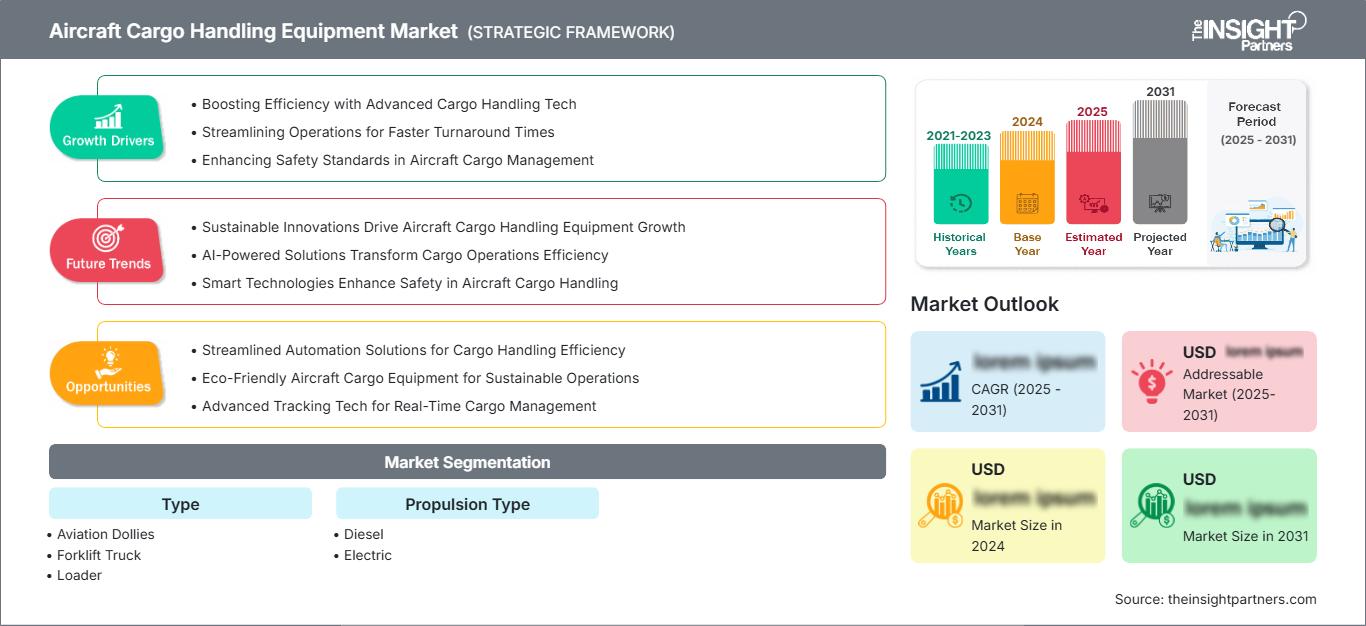
Aircraft Cargo Handling Equipment Market Assessment and Insights
Regional Outlook
- North America: ~30% of the global market in 2025 | ~6% CAGR through 2034. Market position: North America represents a mature equipment base supported by major cargo hubs, express logistics networks, and established ground-handling operations. Fleet renewal and electrification of ramp equipment sustain replacement demand.
- US: ~83% of North American market revenue in 2025 | ~6% CAGR through 2034. Market position: The US accounts for most North American equipment demand because of its extensive cargo airport infrastructure, large express networks, freighter operations, and continued modernization of loaders, tractors, conveyors, and related ground equipment.
- Europe: ~25% of the global market in 2025 | ~5% CAGR through 2034. Market position: Europe has a mature installed base and stringent environmental requirements. Germany represents the leading country in Europe, while the UK, France, Italy, and Spain contribute through major cargo airports, airline networks, and logistics centers.
- Asia Pacific: ~28% of the global market in 2025 | ~9% CAGR through 2034. Market position: Asia Pacific is the fastest-growing region as manufacturing, e-commerce, cross-border trade, and airport expansion increase cargo-handling requirements. China represents the leading country in Asia Pacific, supported by extensive aviation infrastructure and industrial activity.
Segment Outlook
- Loader: ~34% Share in 2025 | ~7% CAGR through 2034. Market position: Loaders command a substantial position because containerized and palletized cargo requires controlled vertical and horizontal transfer between aircraft decks, ULD systems, dollies, and terminal interfaces. Replacement and modernization support sustained demand.
- Electric: ~32% Share in 2025 | ~11% CAGR through 2034. Market position: Electric propulsion is the high-growth segment as airports and handlers address emissions, noise, maintenance, and fuel costs. Lithium-ion systems, opportunity charging, telematics, and regenerative technologies increasingly influence procurement decisions.
Competitive Coverage
AERO Specialties, Inc., Aerofilm Systems, Air Tech Innovations Ltd., McGrath Industries Ltd., Siemens Logistics GmbH, S-P-S International B.V., TELAIR International GmbH, TLD Group, U.S. Cargo Systems, Wilcox Ground Services, Oshkosh AeroTech, Mallaghan GSE
Methodology
The Insight Partners follows Data Collection & Secondary Research, Primary Research, Data Analysis, and Data Triangulation & Final Review to validate market estimates and insights.
Source: The Insight Partners' analysis based on proprietary research, government publications, company annual reports, investor presentations, industry databases, and expert interviews.
Aircraft Cargo Handling Equipment Market Trends
Electric Equipment with Flexible Energy Architectures
The aircraft cargo handling equipment market is likely to move beyond a simple diesel-versus-battery purchasing decision toward flexible energy architectures. Manufacturers are developing equipment that can accommodate different battery chemistries, hybrid configurations, hydrogen-related concepts, and charging arrangements according to airport infrastructure. TLD already describes equipment capable of using lithium-ion, hybrid, hydrogen, or other power approaches across parts of its portfolio. Future procurement will increasingly consider how equipment fits the airport's broader energy system, including charging availability, grid constraints, duty-cycle requirements, and renewable-energy integration. This trend should encourage modular electrical platforms, faster opportunity charging, regenerative energy systems, and common battery architectures across equipment families. Operators can consequently transition fleets in stages rather than replacing every diesel asset simultaneously.
Autonomous Cargo Movement and Connected Fleet Operations
Automation is expected to progress from isolated assistance features toward connected fleets in which tractors, dollies, loaders, and terminal systems exchange operational information. Autonomous-ready cargo dollies and electric tractors demonstrate how machine navigation, sensor systems, fleet supervision, and cargo transfer can be combined. TLD's EZDolly, for example, is designed for autonomous operation and integration through application programming interfaces. As adoption develops, equipment data can support predictive maintenance, asset utilization analysis, automated dispatch, and route optimization. The trend is particularly relevant at large cargo hubs where repetitive movement between terminals and aircraft stands creates measurable opportunities for automation. Cybersecurity, airport-system interoperability, safety validation, and human-machine supervision will become increasingly important alongside hardware performance.
Aircraft Cargo Handling Equipment Market Growth Factors
Growth in Air Cargo Throughput and Freighter Fleet Capacity
Rising cargo volumes directly increase utilization requirements for loaders, dollies, tractors, conveyors, and terminal equipment. Global air cargo demand increased 3.4% in 2025, while Airbus forecasts substantial long-term expansion in the dedicated freighter fleet. More freighter capacity increases the number of aircraft turns requiring cargo transfer equipment, while passenger-to-freighter conversions expand the installed base of aircraft requiring compatible cargo-loading systems. Equipment demand therefore, follows both traffic growth and changes in aircraft configuration. Airports with growing cargo throughput also need additional handling capacity to prevent terminal bottlenecks. This creates demand for high-capacity loaders, automated conveyors, and faster ULD transfer equipment, particularly at major cargo hubs where turnaround performance directly affects aircraft utilization and network reliability.
Airport Decarbonization and Electric GSE Adoption
Airport and ground-handling operators are increasingly incorporating emissions and energy efficiency into GSE procurement. Electric propulsion can eliminate local exhaust emissions during operation while reducing noise and potentially lowering maintenance requirements. TLD's electric equipment portfolio includes loaders, belt loaders, cargo transporters, and tractors using battery-based or alternative power configurations. The market impact extends beyond replacing diesel engines because electric fleets require charging infrastructure, energy management, battery servicing, and fleet-monitoring systems. Equipment manufacturers that provide flexible power configurations can therefore address airports at different stages of electrification. Adoption is strongest where duty cycles are predictable and charging can be integrated into apron or terminal planning, while diesel equipment remains relevant for remote stands and operations with limited electrical capacity.
Automation and Safety Requirements in Ground Cargo Operations
Ground operations increasingly use proximity detection, automated docking, telematics, and autonomous movement technologies to improve safety and reduce manual intervention. The operating environment around aircraft is highly constrained, with personnel, vehicles, ULDs, and aircraft moving within limited apron space. Technologies that help position equipment accurately can reduce the likelihood of aircraft contact and improve operational consistency. TLD's EZDolly concept demonstrates the direction toward autonomous cargo movement, combining electric propulsion, automated navigation, ULD handling, and connectivity with airport operating systems. The commercial impact is likely to extend from individual machines to fleet-management platforms, software integration, remote diagnostics, and data-driven maintenance. This increases the value of equipment suppliers capable of combining mechanical systems with digital controls and airport-system interfaces.
Aircraft Cargo Handling Equipment Market Opportunities
Modernization of Aging Cargo Equipment Fleets
Fleet modernization creates an opportunity for suppliers to combine replacement equipment with energy transition, safety upgrades, and digital services. Many mature airports operate mixed generations of loaders, tractors, conveyors, and dollies, creating fragmented maintenance requirements and uneven equipment performance. A modernization program can consolidate controls, standardize charging, introduce telematics, and reduce dependence on aging diesel platforms. Suppliers can strengthen customer relationships by offering lifecycle packages covering equipment, spare parts, maintenance, battery support, software, training, and refurbishment. The opportunity is particularly relevant in North America and Europe, where mature installed bases create recurring replacement requirements, but it also applies to rapidly expanding Asian and Middle Eastern cargo hubs building new capacity. Procurement strategies centered on total cost of ownership can increase the addressable value of each equipment contract beyond the initial vehicle purchase.
Integrated Cargo Handling Solutions for Emerging Cargo Hubs
Expansion of airport cargo infrastructure in Asia Pacific, the Middle East, and selected emerging markets creates opportunities for suppliers capable of delivering integrated equipment packages rather than individual machines. New cargo terminals can incorporate loaders, dollies, tractors, conveyors, warehouse interfaces, charging infrastructure, fleet software, and maintenance services from the planning stage. This approach allows equipment specifications to be matched with cargo flows, aircraft mix, terminal geometry, and expected throughput. Airbus identifies Asia Pacific and North America as major sources of future freighter demand, while Boeing highlights South Asia, China, and Southeast Asia among the faster-growing air cargo markets. Suppliers with local service networks and configurable electric or diesel platforms can use these projects to establish long-term aftermarket positions.
Segmentation Analysis
Type
Type represents a core purchasing dimension because airports and ground handlers require different equipment according to aircraft configuration, ULD movement requirements, terminal layout, cargo weight, and turnaround procedures. The segment is projected to register a ~7% CAGR during 2026–2034. Loaders account for the largest position because they perform the critical interface between ground cargo systems and aircraft cargo doors. Conveyor systems and dollies support horizontal transfer, while forklifts and terminal tractors address complementary handling tasks.
- Aviation Dollies: Aviation dollies provide the basic transfer interface for ULDs and pallets between aircraft stands, loaders, and cargo facilities. Demand depends on fleet composition, airport layout, turnaround intensity, and compatibility with different container and pallet configurations. Their relatively simple architecture supports broad deployment and replacement demand.
- Forklift Truck: Forklift trucks support cargo movement in warehouses, build-up areas, storage facilities, and airside logistics zones. Electric variants are increasingly relevant indoors and in controlled environments where operators seek lower noise, reduced local emissions, and predictable operating costs.
- Loader: Loaders are central to aircraft cargo operations because they bridge ground-level cargo equipment with aircraft main-deck or lower-deck doors. Procurement emphasizes lifting capacity, aircraft compatibility, platform stability, docking safety, maintenance accessibility, and increasingly electric propulsion.
- Conveyor System: Conveyor systems facilitate continuous movement between cargo terminal processes and aircraft-side operations. Their strategic importance increases at high-throughput facilities where automated or semi-automated transfer can reduce manual handling, improve consistency, and support tighter aircraft turnaround schedules.
- Terminal Tractor: Terminal tractors move trailers, containers, ULDs, and other cargo assets within airport logistics compounds. Demand is influenced by terminal scale and yard configuration, with electric and digitally monitored tractors becoming more relevant where operators pursue lower emissions and better fleet utilization.
Propulsion Type
Propulsion Type is increasingly important as airport operators assess energy costs, emissions, noise, maintenance, and charging requirements. The segment is expected to grow at a modeled ~8% CAGR during 2026–2034. Diesel remains relevant for high-utilization applications and airports with limited charging infrastructure, while electric equipment is gaining momentum as battery technology and opportunity charging improve. TLD's electric cargo transporter, for example, uses an 80V electrical system and supports opportunity charging, illustrating how manufacturers are adapting equipment for intensive cargo operations.
- Diesel: Diesel equipment remains established across high-load and high-utilization applications because of mature fueling infrastructure, established maintenance practices, and long operating cycles. It continues to serve operators where charging capacity, grid availability, or duty-cycle requirements limit immediate electrification.
- Electric: Electric equipment is gaining adoption because it can reduce point-of-use emissions, noise, and some maintenance requirements. Lithium-ion batteries, opportunity charging, regenerative systems, and digital fleet monitoring are improving suitability for intensive cargo operations and supporting airport decarbonization programs.
Opportunity Snapshot
| Type | Revenue Contribution | Trend Tag | Adoption Stage |
|---|---|---|---|
| Aviation Dollies | High | ULD Mobility | Mature |
| Forklift Truck | Medium | Warehouse Electrification | Scaling |
| Loader | High | Electric Loading | Mature |
| Conveyor System | High | Automated Transfer | Scaling |
| Terminal Tractor | Medium | Yard Electrification | Scaling |
| Other Air Cargo Handling Equipment | Low | Specialized Handling | Emerging |
Regional Insights
North America aircraft cargo handling equipment market
North America represented a modeled ~30% share of the global aircraft cargo handling equipment market in 2025 and is expected to register a ~6% CAGR through 2034. The region has an extensive fleet of loaders, dollies, tractors, conveyors, and other terminal equipment at passenger and dedicated cargo airports. The US is the key demand market, and cargo activities are dispersed among integrated express facilities, international gateways, and regional freight terminals.
Replacement demand is especially relevant as the established players increasingly assess diesel-to-electric conversion together with traditional replacement of their fleet. Cargo airlines and ground service providers need equipment capable of handling high utilization, widebody ULD services, and fast turnaround schedules. Telematics and proximity detection solutions are being embraced by North American operators for improved fleet management and fewer disruptions due to equipment problems. According to IATA, North American air cargo demand faced difficulties at certain points in 2025 but was positive in 2026, highlighting the impact of trade changes on equipment utilization.
U.S. aircraft cargo handling equipment market
The US accounted for a modeled ~83% share of North American aircraft cargo handling equipment market revenue in 2025 and is projected to grow at a ~6% CAGR through 2034. Supporting demand are big cargo facilities, integrator systems, military logistics, passenger-to-freighter conversion, and large airport infrastructure. Loaders and transporters are needed not only at the major international airfields but also at domestic freight airfields.
The purchase of equipment is becoming more dependent on the principles of life cycle costing and safety. Vendors like Oshkosh AeroTech offer loaders for containers and pallets in various loading capacities, while the company TLD Group provides loaders and transporters for both ramp and cargo terminal operations. The electric-powered equipment becomes more relevant due to the availability of charging facilities at the airports. The US market creates demand for spare parts, diagnostics, and repair services for used equipment.
Europe aircraft cargo handling equipment market
Europe represented a modeled ~25% share of the global aircraft cargo handling equipment market in 2025 and is expected to expand at a ~5% CAGR through 2034. Germany is the leading country in Europe, supported by major aviation manufacturing, cargo gateways, logistics activity, and a developed GSE supplier base. The UK remains important through Heathrow and other logistics centers, while France benefits from Paris-area cargo activity and airline operations. Italy and Spain contribute by expanding airport logistics infrastructure and growing international freight connectivity.
Maturity of the region implies that replacement and modernization are critical factors affecting demand rather than simply adopting new machinery for the first time. Environmental considerations are contributing to increased interest in electric propulsion, efficient energy use in hydraulic systems, and monitoring. Germany has a strong industry base that allows for specialized engineering and production, while the UK utilizes its cargo airports in addition to existing ground-handling service providers. France leverages its role in important European logistics chains, while Italy and Spain contribute through manufacturing and perishable goods, express services, and tourism-related cargo handling networks.
APAC aircraft cargo handling equipment market
Asia Pacific accounted for a modeled ~28% share of the global aircraft cargo handling equipment market in 2025 and is expected to register the fastest regional CAGR of ~9% through 2034. China is the leading country in Asia Pacific, supported by industrial production, large airport networks, e-commerce logistics, and extensive international cargo flows. Japan and South Korea maintain sophisticated cargo operations, while India is expanding aviation infrastructure, and Australia supports long-distance freight connectivity.
The equipment needs of the region are linked to airport development, manufacturing clustering, cross-border e-commerce, and the building of dedicated logistics hubs. According to IATA, the Asia Pacific region accounted for the largest share of the global airline CTKs in 2025, with robust cargo growth in the region confirming the need for extra capacity. The adoption of electric loader trucks and electric tugs is becoming increasingly relevant as airports look for reduced-emission ground-handling operations when it becomes possible with new infrastructures.
Middle East & Africa aircraft cargo handling equipment market
The Middle East and Africa aircraft cargo handling equipment market is projected to expand at a modeled CAGR of ~7% through 2034. Saudi Arabia and the UAE are important demand centers because of airport investment, logistics diversification, cargo-hub development, and strategic geographic positions connecting Asia, Europe, and Africa. South Africa serves as an important regional logistics center, while the rest of MEA presents opportunities linked to airport modernization and trade infrastructure.
The Middle East benefits from large hub airports and cargo-oriented infrastructure, creating demand for high-capacity loaders, terminal tractors, conveyors, and specialized transfer equipment. Africa's opportunity is more fragmented and depends on airport modernization, airline network development, perishables logistics, and regional trade. Equipment suppliers with strong maintenance networks and flexible propulsion options can address different infrastructure conditions across the region, particularly where charging infrastructure is still developing.
Aircraft Cargo Handling Equipment Market Report Scope
| Report Attribute | Details |
|---|---|
| Market size in 2025 | US$ 10.52 Billion |
| Market Size by 2034 | US$ 19.00 Billion |
| Global CAGR (2026 - 2034) | 6.79% |
| Historical Data | 2021-2024 |
| Forecast period | 2026-2034 |
| Segments Covered | Type, Propulsion Type |
| Region scope | North America, Europe, Asia-Pacific, South and Central America, Middle East and Africa |
Frequently Asked Questions

Recent Reports






