
Aircraft Ceramic Armor Panels Market Growth, Size & Forecast by 2034
Coverage: By Product Type (Aluminum Oxides, Silicon Carbides, Boron Carbides, Other); Applications (Civil Aviation Aircraft, Military Aviation Aircraft) , and Geography (North America, Europe, Asia Pacific, and South and Central America)
- Status : Data Released
- Report Code : TIPRE00024198
- Category : Aerospace and Defense
- No. of Pages : 150
- Available Report Formats :


- Last update date : November 02, 2026


2025 Market Size
US$ 2.78 Bn
Base year value
2034 Forecast
US$ 4.69 Bn
Projected by 2034
CAGR 2026-2034
5.98 %
Growth rate
Addressable Market
US$ 33.83 Bn
(2026-2034)
The aircraft ceramic armor panels market is valued at US$ 2.78 Billion in 2025 and is projected to reach US$ 4.69 Billion by 2034, registering a CAGR of 5.98% during 2026–2034. The market covers ceramic armor panels manufactured from aluminum oxides, silicon carbides, and boron carbides for civil aviation aircraft and military aviation aircraft. Demand is shaped by the requirement for lightweight ballistic protection, aircraft survivability, structural integration, and material efficiency across fixed-wing and rotary-wing platforms.
North American demand is being shaped by sustained military aircraft modernization and the integration of lightweight protection into survivability architectures. The aircraft ceramic armor panels market in the region is projected to expand at a defensible ~6% CAGR through 2034, supported by aircraft fleet upgrades, domestic defense procurement, and continued development of high-performance ceramic and composite armor systems.
Aircraft Ceramic Armor Panels Market Assessment and Insights
Regional Outlook
- North America: ~32% of the global market in 2025 | ~6% CAGR through 2034. Market position: North America holds the largest regional position, supported by extensive military aircraft programs, established advanced-ceramics manufacturing, and procurement requirements emphasizing ballistic protection with low areal weight.
- US: ~84% of North American market revenue in 2025 | ~6% CAGR through 2034. Market position: The US accounts for most regional demand because of its large military aviation fleet, extensive aircraft modernization activity, and domestic ecosystem spanning ceramic materials, armor integration, composite structures, and defense-system engineering.
- Europe: ~29% of the global market in 2025 | ~5% CAGR through 2034. Market position: Europe represents a mature aerospace and defense manufacturing base, with Germany leading regional demand, followed by the UK, France, Italy, and Spain. Aircraft survivability programs and indigenous defense production support continued adoption.
- Asia Pacific: ~25% of the global market in 2025 | ~8% CAGR through 2034. Market position: Asia Pacific is the fastest-growing region as China, Japan, South Korea, India, and Australia expand military aviation capabilities, localize defense manufacturing, and prioritize lighter protection systems for modern aircraft platforms.
Segment Outlook
- Applications: ~68% Share in 2025 | ~7% CAGR through 2034. Market position: Military aviation aircraft represent the largest application because ballistic survivability, crew protection, and mission continuity directly influence platform design. Modernization programs and evolving threats support higher incorporation of ceramic armor.
- Product Type: ~6% CAGR through 2034. Market position: Product demand is shifting toward silicon carbide and boron carbide where weight efficiency and ballistic performance justify higher material and processing complexity, while aluminum oxide remains important for cost-sensitive and established protection configurations.
Competitive Coverage
CoorsTek, 3M, Saint-Gobain, FMS, Paxis, SM Group, Nurol Teknoloji, CeramTec, ArmorWorks, Schunk Carbon Technology
Methodology
The Insight Partners follows Data Collection & Secondary Research, Primary Research, Data Analysis, and Data Triangulation & Final Review to validate market estimates and insights.
Source: The Insight Partners' analysis based on proprietary research, government publications, company annual reports, investor presentations, industry databases, and expert interviews.
The aircraft ceramic armor panels market has evolved from relatively standardized ceramic strike-face components toward engineered protection systems combining ceramic tiles, backing materials, adhesives, and aircraft-specific attachment architectures. Alumina remains relevant because of its established processing routes and cost profile, while silicon carbide and boron carbide support applications where weight reduction and ballistic efficiency are prioritized. Manufacturing has also moved toward tighter dimensional control, customized geometries, modular assemblies, and process optimization. Ceramic suppliers increasingly support complete panel configurations rather than supplying only individual tiles, enabling integration with aircraft structures and mission-specific protection requirements.
Looking forward, Aircraft Ceramic Armor Panels Market share is likely to be increasingly influenced by procurement favoring materials and panel architectures that balance ballistic performance with aircraft weight, maintainability, and manufacturability. The Asia Pacific region continues to develop its aerospace and defense manufacturing capabilities at home, thus driving further demand for domestically made armor ceramics and know-how for their integration. The European programs continue to focus on the issues of sovereignty and survivability, whereas the North American demand stays closely related to aircraft modernization efforts. Issues of regulatory qualification, ballistic certification, logistics, and production security are expected to play a key role in future purchasing decisions.
Aircraft Ceramic Armor Panels Market Report Scope
| Report Attribute | Details |
|---|---|
| Market size in 2025 | US$ 2.78 Billion |
| Market Size by 2034 | US$ 4.69 Billion |
| Global CAGR (2026 - 2034) | 5.98% |
| Historical Data | 2021-2024 |
| Forecast period | 2026-2034 |
Aircraft Ceramic Armor Panels Market Analysis
The aircraft ceramic armor panels market is supported by the need to protect crews, critical equipment, and vulnerable aircraft zones against ballistic threats while minimizing the additional mass carried by the platform. The value chain begins with ceramic powders and advanced material processing, followed by forming, sintering, machining, inspection, panel assembly, backing integration, qualification, and aircraft-level installation. Ceramic manufacturers, therefore, compete on material properties as well as process consistency, geometric customization, quality assurance, and integration support. Supply dynamics are influenced by access to high-purity feedstocks, specialized furnaces, machining capacity, ballistic testing infrastructure, and secure production facilities.
The Aircraft Ceramic Armor Panels Market forecast indicates that competitive differentiation increasingly centers on the ability to combine material science with application engineering. CoorsTek provides aircraft armor components through aluminum oxide, silicon carbide, and boron carbide structures, and Saint-Gobain provides silicon carbide and boron carbide ceramic products for aircraft and other vehicle armor. CeramTec is a company that uses silicon carbide for helicopter armor, considering weight effectiveness. On the other hand, Nurol Teknoloji utilizes its own ceramic manufacturing process, ballistic testing, numerical simulation, and platform armor services. 3M provides advanced ceramic and aerospace ceramics, and companies such as FMS, Paxis, SM Group, ArmorWorks, and Schunk Carbon Technology also offer more competition.
Key Aircraft Ceramic Armor Panels Market trends show that investment is increasingly directed toward production efficiency, material optimization, testing, and vertically integrated manufacturing. Those suppliers that have control over the powder manufacturing process, the ceramic fabrication process, machining, panels assembly, and qualification will be able to lower the dependency on the external processes and react more efficiently to the needs of defense programs. The expansion of the testing, procurement system, certification, and structural composites of Nurol Teknoloji is an example of how the armor companies are diversifying their business operations. In this regard, the competition includes both advanced material suppliers and dedicated ballistic protection companies.
● REPORT CUSTOMIZATION
Tailor This Report To Align With Your Specific Business Requirements
This report can be customized to align precisely with your business objectives, scope, and target markets. Customization options include tailored segmentation, geography, competitive analysis, and strategic insights to support informed decision-making.
Customize This Report →WHAT YOU CAN ADJUST
- ● Segmentations
- ● Geography
- ● Competitive Analysis
- ● Language Preferences
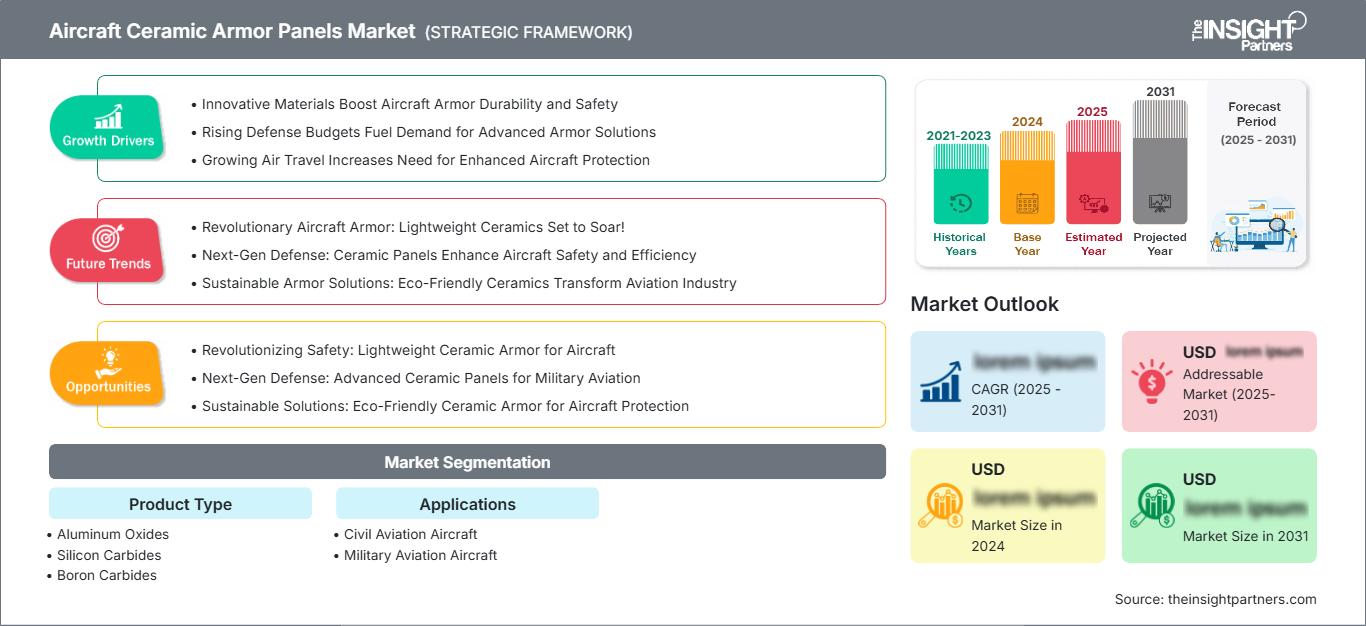
Aircraft Ceramic Armor Panels Market: Strategic Insights
Regional Insights
North America aircraft ceramic armor panels market
North America accounted for ~32% of the global aircraft ceramic armor panels market in 2025 and is projected to record a ~6% CAGR through 2034. The US represents the principal demand center because military aircraft fleets require protection systems compatible with survivability, mission equipment, and aircraft weight constraints. Demand spans both rotor wing and fixed wing aircraft, including those that require protection for areas such as crew compartments. The procurement initiatives prefer suppliers who can deliver repetitive ceramic products in defense-grade quality standards.
The regional environment comprises leading ceramic manufacturers, armor integrators, aerospace manufacturers, and defense procurement authorities. CoorsTek has aircraft armor products, including alumina, silicon carbide, and boron carbide options, whereas 3M is known to have an aerospace ceramics range, and Saint-Gobain has ceramic armor solutions for fixed-wing and rotor-wing aircraft. Additionally, the US market has a developed testing and qualification framework, as well as local manufacturing and demand for composite armor products. Canada has the aerospace manufacturing and advanced materials research capability, but has a smaller aircraft armor demand compared to the US.
U.S. aircraft ceramic armor panels market
The US represented ~84% of the North American aircraft ceramic armor panels market revenue in 2025 and is expected to expand at a ~6% CAGR through 2034. The country’s stance is based on the magnitude of military aircraft procurement and modernization of aircraft platforms that need increased survivability. The market requirement is limited to the military aircraft sector, wherein ceramic armor can be installed in the crew compartments, doors, floor, fuselage, and other vulnerable areas without adding the burden of weight that would be caused by the use of traditional metallic armor.
The US ecosystem comprises material providers, armor suppliers, aircraft manufacturers, and defense contractors. CoorsTek offers alumina, silicon carbide, and boron carbide armor products for aircraft, whereas 3M supplies advanced ceramic materials for the aerospace and defense industry. Saint-Gobain provides ceramic armor components for aircraft. Requirements for procurement include repeatability, ballistics, environmental resistance, repairability, and integration in composite structures. Such factors drive suppliers to focus on customized geometries, modular panels, and processes for established aircraft programs and future modernization programs.
Europe aircraft ceramic armor panels market
Europe represented ~29% of the global aircraft ceramic armor panels market in 2025 and is projected to grow at ~5% CAGR through 2034. Germany is the leading country in Europe, supported by its advanced industrial base, defense manufacturing capabilities, and established technical ceramics ecosystem. The UK and France also contribute significant demand through military aviation programs and aerospace manufacturing, while Italy and Spain participate through aircraft production, maintenance, defense programs, and industrial supply chains. Regional procurement increasingly considers survivability alongside weight and lifecycle requirements.
Germany is advantaged by the availability of specialist ceramic engineering services such as CeramTec, which provides silicon carbide products that enhance the protection of helicopters and other defense purposes for aerospace vehicles. France has an extensive aerospace and defense manufacturing industry, whereas the UK has established military aviation and aerospace engineering expertise. Italy and Spain contribute to the market through European aircraft and defense systems programs and the supplier network. In addition, the European market increasingly demonstrates the need to consider national industrial strength, qualification capability, and safe sourcing of advanced materials. Suppliers with the capability of providing customized ceramics geometry and panels with ballistic performance data can participate in the market.
APAC aircraft ceramic armor panels market
Asia Pacific represented ~25% of the global aircraft ceramic armor panels market in 2025 and is expected to register a ~8% CAGR through 2034, making it the fastest-growing regional market. China is the largest country in the Asia Pacific region, owing to massive military aviation operations and indigenous production of advanced materials and aerospace manufacturing facilities. Both Japan and South Korea have highly advanced aerospace industries, whereas India and Australia are developing their defense aviation and indigenous industries.
Demand within the region is related to aircraft upgrades, indigenous production, survivability needs, and technology localization. Long-term demand from China and India results from the growth of their indigenous aerospace industry, whereas technology and defense manufacturing capabilities are provided by Japan and South Korea. Australia provides demand through defense aviation upgrades and integration into allied defense logistics. This combination of industrial localization, diversified procurement, and the growing importance of lightweight armor offers opportunities for ceramics companies capable of providing qualified materials, custom panel designs, and local manufacturing capabilities.
Middle East & Africa aircraft ceramic armor panels market
The Middle East & Africa market is projected to expand at a ~7% CAGR through 2034. Saudi Arabia is the leading country in the Middle East & Africa region, where available defense-industrial activity and military aviation investment support demand. The UAE also represents an important procurement and aerospace services center, while South Africa contributes specialized aerospace and defense engineering capabilities. The rest of MEA demand remains more fragmented and depends strongly on defense procurement cycles.
The requirements for aircraft protection systems regionally depend on the operating environment, fleet upgrades, infrastructure developments, and the need for aircraft to retain survivability in challenging environments. The Gulf states have made investments in their domestic defense-industry capacities and local production of maintenance and manufacturing of aircraft; thus, there is an opportunity for suppliers of protection solutions, not just for individual ceramic parts. Environmental resistance, maintainability, security of supply, and compatibility with the existing structure of the aircraft become more significant in countries where there is a mixed fleet and industrial cooperation from abroad.
Segmentation Analysis
Product Type
The Aircraft Ceramic Armor Panels Market product type segment is projected to register a ~6% CAGR from 2026 to 2034. Material selection is governed by the required ballistic protection level, aircraft weight budget, manufacturing economics, geometry, and integration method. Aluminum oxide remains important because of its established manufacturing base and cost efficiency, while silicon carbide and boron carbide address applications where lower density and higher performance justify greater processing complexity.
- Aluminum Oxides: Aluminum oxide remains an established armor ceramic because it offers a mature manufacturing route, broad availability, and a cost-performance balance suitable for applications where extreme weight reduction is not the sole design priority. It can be processed into tiles and customized geometries for composite armor assemblies.
- Silicon Carbides: Silicon carbide is strategically important where aircraft designers prioritize lower mass while maintaining high hardness and ballistic resistance. Its application in helicopter armor and other weight-sensitive aviation structures makes it suitable for customized panels, multi-tile assemblies, and protection systems requiring higher mass efficiency.
- Boron Carbides: Boron carbide serves high-performance protection requirements where very low density and strong ballistic efficiency are important. Its higher material and processing complexity can be justified in weight-sensitive military aircraft applications, particularly when designers seek additional protection without proportionally increasing aircraft structural burden.
Applications
The Aircraft Ceramic Armor Panels Market applications segment is projected to grow at a ~7% CAGR through 2034 and represents the dominant demand dimension. Military aviation aircraft account for the largest requirement because ballistic protection is directly linked to aircraft survivability and mission continuity. Civil aviation remains a specialized opportunity where protection requirements, aircraft economics, certification, and operational risk justify the incorporation of ceramic-based systems.
- Civil Aviation Aircraft: Civil aviation applications remain selective because commercial aircraft operate under stringent weight, certification, maintenance, and cost requirements. Adoption is therefore concentrated on specialized aircraft and protection requirements where lightweight ballistic or impact protection provides an operational benefit without compromising passenger capacity or lifecycle economics.
- Military Aviation Aircraft: Military aviation aircraft represent the core application because helicopters, transport aircraft, special-mission platforms, and other defense aircraft may require protection for crews and mission-critical systems. Ceramic panels offer a means of increasing ballistic resistance while limiting the mass penalty imposed on aircraft performance and payload.
Opportunity Snapshot
| Applications | Revenue Contribution | Trend Tag | Adoption Stage |
|---|---|---|---|
| Civil Aviation Aircraft | Low | Selective Protection | Emerging |
| Military Aviation Aircraft | High | Fleet Survivability | Scaling |
Aircraft Ceramic Armor Panels Market Growth Drivers and Impact Analysis
Military Aircraft Modernization and Survivability Requirements
The upgrading of military aircraft has emerged as one of the key demand mechanisms, as modern aircraft platforms need to be protected using integrated survivability measures instead of separate protection components. Ceramic armor plates can help in providing ballistic protection to crew cabins, fuselages, doors, and other critical portions of the aircraft without incurring any major mass penalties due to metallic protection systems. The effect on the commercial side is most significant in relation to the operation of rotorcraft as well as specialized military aircraft that face threats from projectiles and fragments during their missions. There is an ongoing effort by suppliers to develop lightweight ceramics along with custom geometries, modular assemblies, and backings. The effect goes beyond the area of ceramics in the market, as the panel producers will have to integrate material selection, bonding, machining, and testing, along with aircraft integration.
Weight Reduction and Higher Ballistic Efficiency
Aircraft designers face a direct trade-off between protection, structural weight, payload, range, and endurance. This relationship increases the importance of silicon carbide and boron carbide, which can provide higher mass efficiency than conventional metallic protection and, in selected configurations, alumina. CoorsTek, CeramTec, Saint-Gobain, and Nurol Teknoloji illustrate the industry's movement toward engineered ceramic solutions that combine material optimization with application-specific panel construction. The impact is not limited to material substitution. Lower-weight protection can influence panel geometry, attachment methods, backing selection, and the allocation of protection across an aircraft. As aircraft architectures become more sensitive to weight and available payload, demand is likely to favor suppliers that can demonstrate consistent ballistic performance while controlling thickness, density, manufacturing tolerances, and integration complexity.
Expansion of Domestic Defense Manufacturing Capacity
Defense localization is expanding the addressable supplier base for advanced ceramic armor by encouraging domestic production, testing, qualification, and integration capabilities. Countries seeking greater control over defense supply chains are investing in ceramic manufacturing, ballistic laboratories, and specialized engineering capabilities. This creates demand for equipment, processing expertise, material know-how, and qualification services alongside the finished panels themselves. The impact is particularly relevant in Asia Pacific and the Middle East, where domestic aerospace and defense programs increasingly seek local industrial participation. Suppliers with vertically integrated ceramic production and testing capabilities can reduce dependence on external qualification stages and respond more quickly to platform-specific requirements. For aircraft armor companies, localization also creates opportunities for joint ventures, technology partnerships, licensed production, and regional manufacturing agreements tied to long-term defense procurement.
Aircraft Ceramic Armor Panels Market Future Trends
Hybrid Ceramic Architectures and Integrated Sensing
Future aircraft protection systems are likely to move beyond isolated ceramic strike-face tiles toward hybrid architectures that combine ceramic materials, composite backing, structural elements, adhesives, and monitoring technologies. The objective is to improve protection while enabling faster assessment of damage and simplifying replacement of affected modules. Hybrid combinations of silicon carbide and boron carbide can balance hardness, toughness, density, and processing requirements, while modular panel designs can simplify installation and maintenance. Digital impact monitoring could add another layer of functionality by identifying the location and severity of damage after a ballistic event. These developments may shift competition from material supply toward integrated protection engineering, where suppliers capable of combining ceramics, composites, sensors, simulation, and testing can address more of the aircraft survivability value chain.
Advanced Manufacturing and Data-Driven Ceramic Processing
Manufacturing technology is expected to become a stronger differentiator as aircraft armor requirements become more geometrically complex and performance tolerances tighten. Numerical modeling, automated process control, improved powder compaction, precision machining, and digital quality monitoring can reduce material waste and improve consistency across production batches. Such methods are particularly relevant to boron carbide and silicon carbide, where processing conditions can materially influence final properties and production economics. Data-driven manufacturing can also support faster qualification of customized geometries by connecting process parameters with inspection and ballistic-test results. Over time, the use of simulation and digital production records could shorten development cycles and strengthen traceability. This trend will favor suppliers with integrated R&D, manufacturing, testing, and quality systems rather than companies competing only on ceramic material availability.
Aircraft Ceramic Armor Panels Market Opportunities
Localized Production and Regional Qualification Partnerships
Regional qualification and localized production provide an investment opportunity as defense customers seek secure access to critical armor materials and shorter supply chains. Suppliers can establish production partnerships, machining centers, testing laboratories, or final panel assembly capabilities close to aircraft manufacturing and maintenance hubs. Asia Pacific, the Middle East, and selected European markets offer opportunities where governments are encouraging domestic defense-industrial participation. A localized model can reduce logistics complexity and improve responsiveness to customer-specific geometries while supporting national procurement requirements. Partnerships can also combine the ceramic expertise of established material companies with the aircraft integration capabilities of regional aerospace firms. For investors and suppliers, the commercial opportunity lies in building repeatable regional capabilities rather than relying solely on one-off component exports.
High-Performance Ceramics for Weight-Sensitive Aircraft Platforms
Weight-sensitive military aircraft create opportunities for suppliers specializing in advanced silicon carbide, boron carbide, and hybrid ceramic solutions. Helicopters, special-mission aircraft, and other platforms where payload and endurance are closely linked to empty weight can benefit from protection systems optimized around mass efficiency. Commercial opportunities exist across material development, custom tile production, preassembled panels, backing systems, qualification, and lifecycle replacement. Suppliers can differentiate by demonstrating repeatable ballistic performance at lower mass while accommodating complex aircraft geometries and attachment requirements. Investment in precision forming, machining, simulation, and testing can strengthen the ability to serve smaller but technically demanding aircraft programs. The opportunity is therefore centered on engineered protection packages rather than commodity ceramic tiles, with value increasingly created through integration and qualification expertise.
Frequently Asked Questions

- Comprehensive Market Sizing and Forecast Analysis
- Detailed Segmentation Analysis
- In-Depth Market Dynamics Assessment
- Regional and Country-Level Insights
- Competitive Landscape and Company Benchmarking
- Strategic Business Intelligence
Recent Reports
Testimonials

The Insight Partners provided valuable market intelligence that supported our global go-to-market strategy. Their team was professional, responsive, and attentive to our feedback, providing thoughtful analysis and helpful methodological clarifications throughout the project.
Junmo Kim Chief Financial Officer (CFO), Enertech Co., Ltd.
The Insight Partners' SCADA System Market report is comprehensive, with valuable insights on current trends and future forecasts. The team was highly professional, responsive, and supportive throughout. We are very satisfied and highly recommend their services.
RAN KEDEM Partner, Reali Technologies LTDs
I requested a report on a very specific software market and the team produced the report in a few days. The information was very relevant and well presented. I then requested some changes and additions to the report. The team was again very responsive and I got the final report in less than a week.
JEAN-HERVE JENN Chairman, Future Analytica
We worked with The Insight Partners for an important market study and forecast. They gave us clear insights into opportunities and risks, which helped shape our plans. Their research was easy to use and based on solid data. It helped us make smart, confident decisions. We highly recommend them.
PIYUSH NAGPAL Sr. Vice President, High Beam Global
The Insight Partners delivered insightful, well-structured market research with strong domain expertise. Their team was professional and responsive throughout. The user-friendly website made accessing industry reports seamless. We highly recommend them for reliable, high-quality research services
YUKIHIKO ADACHI CEO, Deep Blue, LLC.
This is the first time I have purchased a market report from The Insight Partners.While I was unsure at first, I visited their web site and felt more comfortable to take the risk and purchase a market report.I am completely satisfied with the quality of the report and customer service. I had several questions and comments with the initial report, but after a couple of dialogs over email with their analyst I believe I have a report that I can use as input to our strategic planning process.Thank you so much for taking the extra time and making this a positive experience.I will definitely recommend your service to others and you will be my first call when we need further market data.
JOHN SUZUKI President and Chief Executive Officer, Board Director, BK Technologies
I wish to appreciate your support and the professionalism you displayed in the course of attending to my request for information regarding to infectious disease IVD market in Nigeria. I appreciate your patience, your guidance, and the fact that you were willing to offer a discount, which eventually made it possible for us to close a deal. I look forward to engaging The Insight Partners in the future, all thanks to the impression you have created in me as a result of this first encounter.
DR CHIJIOKE ONYIA MANAGING DIRECTOR, PineCrest Healthcare Ltd.Reason to Buy
- Informed Decision-Making
- Understanding Market Dynamics
- Competitive Analysis
- Identifying Emerging Markets
- Customer Insights
- Market Forecasts
- Risk Mitigation
- Boosting Operational Efficiency
- Strategic Planning
- Investment Justification
- Tracking Industry Innovations
- Aligning with Regulatory Trends





 Get Free Sample for