
Aircraft Emergency Parachute Market Share, Growth & Forecast by 2034
Coverage: by Type (Single-Person Type, Two-Person Type, Others); Application (Airliner, General Aviation, Business Aircraft, Others) , and Geography (North America, Europe, Asia Pacific, and South and Central America)
- Status : Data Released
- Report Code : TIPRE00010247
- Category : Aerospace and Defense
- No. of Pages : 150
- Available Report Formats :


- Last update date : November 02, 2026


2025 Market Size
US$ 161.67 Mn
Base year value
2034 Forecast
US$ 272.91 Mn
Projected by 2034
CAGR 2026-2034
5.99 %
Growth rate
Addressable Market
US$ 1,968.27 Mn
(2026-2034)
The aircraft emergency parachute market reached US$ 161.67 Million in 2025 and is projected to reach US$ 272.91 Million by 2034, registering a CAGR of 5.99% during 2026–2034. The market covers emergency parachute systems designed to reduce aircraft descent rates and improve occupant survivability following critical flight events. Demand is concentrated in aircraft where weight, deployment reliability, certification, and integration requirements influence system selection across airliner, general aviation, and business aircraft applications.
The aircraft emergency parachute market size in North America is supported by established general aviation activity, a substantial installed aircraft base, and continued emphasis on emergency recovery technologies. The region is expected to register a ~5% CAGR through 2034, with growth supported by replacement demand, retrofit opportunities, aircraft safety upgrades, and the presence of specialized parachute-system manufacturers and installation networks.
Aircraft Emergency Parachute Market Assessment and Insights
Regional Outlook
- North America: ~36% of the global market in 2025 | ~5% CAGR through 2034. Market position: North America represents the largest regional market, supported by its extensive general aviation fleet, established certification ecosystem, retrofit opportunities, and sustained adoption of whole-aircraft recovery systems for light aircraft.
- US: ~83% of North American market revenue in 2025 | ~5% CAGR through 2034. Market position: The US anchors North American demand through its large general aviation fleet, active pilot community, aircraft manufacturing base, and established market for certified whole-aircraft parachute systems and replacement services.
- Europe: ~30% of the global market in 2025 | ~5% CAGR through 2034. Market position: Europe has a mature safety-equipment ecosystem, with Germany, France, Italy, the UK, and Spain supporting demand. Germany represents the leading country in Europe through its aviation manufacturing, light-aircraft, and specialist aerospace supply base.
- Asia Pacific: ~25% of the global market in 2025 | ~8% CAGR through 2034. Market position: Asia Pacific is the fastest-growing region as general aviation infrastructure expands and aircraft ownership develops. China represents the leading country in Asia Pacific, supported by aviation industrial development and expanding private and training aviation activity.
Segment Outlook
- General Aviation: ~68% Share in 2025 | ~6% CAGR through 2034. Market position: General Aviation leads because emergency parachutes are particularly relevant to light aircraft, personal aviation, training platforms, and retrofit programs where whole-aircraft recovery can be integrated into the airframe.
- Two-Person Type: ~32% Share in 2025 | ~7% CAGR through 2034. Market position: Two-Person Type has a higher growth outlook as tandem recreational aircraft, training configurations, and two-seat light aviation platforms broaden the addressable installed base and increase demand for compact, load-rated recovery systems.
Competitive Coverage
Apco Aviation Ltd., Ballistic Recovery Systems, Fly Products, Fly-market Flugsport-Zubehör GmbH and Co. KG, Fruity Chutes Inc., Gin Gliders, Life Support International, Inc., MCC Aviation, Mills Manufacturing, Sky Paragliders, a.s.
Methodology
The Insight Partners follows Data Collection & Secondary Research, Primary Research, Data Analysis, and Data Triangulation & Final Review to validate market estimates and insights.
Source: The Insight Partners' analysis based on proprietary research, government publications, company annual reports, investor presentations, industry databases, and expert interviews.
The Aircraft Emergency Parachute Market share has evolved from relatively simple reserve and recovery canopies toward integrated systems combining parachute assemblies, deployment mechanisms, bridles, containers, rockets, reefing devices, and aircraft-specific mounting structures. Whole-aircraft recovery systems have demonstrated the feasibility of lowering an aircraft rather than merely protecting an individual occupant. Ballistic deployment technology has also enabled parachutes to be extracted rapidly from compact aircraft compartments, expanding their application across certified light aircraft and specialized platforms. At the same time, lightweight textiles, improved suspension-line configurations, controlled inflation, and compact packing are influencing product design where aircraft payload and available installation volume are constrained.
Through 2034, the Aircraft Emergency Parachute Market forecast is expected to benefit from broader aviation activity in emerging economies, increasing awareness of last-resort recovery systems, and the expansion of certified aircraft equipped with integrated parachute architecture. Investment is likely to focus on lighter systems, easier maintenance, faster deployment, and certification-compatible designs. Regulatory attention to occupant protection and continuing-airworthiness practices can reinforce replacement and inspection demand. Asia Pacific is positioned to gain importance as aircraft manufacturing, flight training, business aviation, and private aviation infrastructure develop, while Europe and North America continue to generate demand through installed-base servicing and retrofit activity.
Aircraft Emergency Parachute Market Report Scope
| Report Attribute | Details |
|---|---|
| Market size in 2025 | US$ 161.67 Million |
| Market Size by 2034 | US$ 272.91 Million |
| Global CAGR (2026 - 2034) | 5.99% |
| Historical Data | 2021-2024 |
| Forecast period | 2026-2034 |
Aircraft Emergency Parachute Market Analysis
The aircraft emergency parachute market is driven by the requirement to provide a controlled descent option when continued flight or conventional landing becomes unsafe. The demand is mainly generated by aircraft manufacturers, aircraft owners, operators, modification services, and maintenance facilities. The supply chain ranges from high-strength textile and webbing vendors to canopy makers, deployment device manufacturers, integrators, certification experts, installers, and maintenance facilities. Canopy performance is dependent upon such factors as canopy geometry, textile strength, suspension lines, deployment capability, inflation load management, and compatibility with the aircraft.
The supply side is affected by certification needs, engineering expertise, manufacturing quality, and the relatively low volume of many aircraft-specific products. Manufacturers need to ensure consistency of their textile cutting, sewing, packaging, inspections, and component tracking. Retrofit systems are another source of demand as existing aircraft may need model-specific installation kits and properly trained personnel. Maintenance cycles generate another demand source as they include periodic inspections, repacking, and consumables replacements.
Competition in the Aircraft Emergency Parachute Market trends spans whole-aircraft recovery specialists, emergency-reserve manufacturers, aviation equipment suppliers, and parachute companies serving adjacent light-aircraft and recreational aviation applications. Ballistic Recovery Systems has established a broad whole-aircraft recovery portfolio, while Cirrus integrates its CAPS architecture into certified aircraft. Apco Aviation, Fly Products, Gin Gliders, and Sky Paragliders address emergency-reserve requirements in lightweight and recreational aviation. Life Support International and Mills Manufacturing contribute broader aerospace and parachute-system capabilities, while Fruity Chutes focuses strongly on recovery parachutes for unmanned and aerospace applications.
The focus of investments is moving to certification, lightweight, manufacturing repeatability, and field reliability. Positioning of these companies also requires aircraft model coverage and service coverage because installation and maintenance can add to the lifecycle value of their product offering. Companies that have engineering, manufacturing, testing, and after-sales can cover more of the value chain, while specialists may win because of compact design and specific performance.
● REPORT CUSTOMIZATION
Tailor This Report To Align With Your Specific Business Requirements
This report can be customized to align precisely with your business objectives, scope, and target markets. Customization options include tailored segmentation, geography, competitive analysis, and strategic insights to support informed decision-making.
Customize This Report →WHAT YOU CAN ADJUST
- ● Segmentations
- ● Geography
- ● Competitive Analysis
- ● Language Preferences
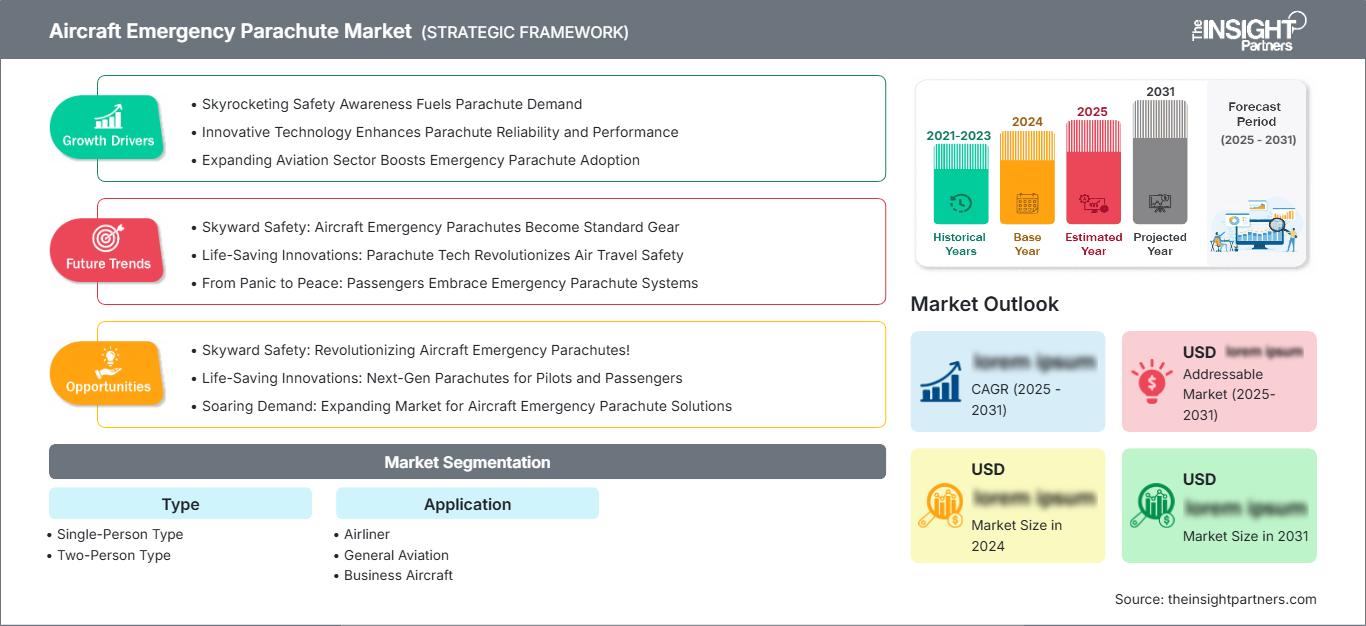
Aircraft Emergency Parachute Market: Strategic Insights
Regional Insights
North America aircraft emergency parachute market
North America accounted for ~36% of the global aircraft emergency parachute market in 2025 and is projected to expand at a ~5% CAGR through 2034. The region will take advantage of the existence of a significant number of general aviation aircraft, existing certification facility of aircraft, and a high level of involvement from private pilots, training institutes, aircraft owners and business aviation users. The United States will be the main demand base, while Canada will contribute from general aviation, recreation, and operations in remote regions.
Additionally, the region will benefit from existing retrofit channels. Installation of certified equipment on aircraft like the Cessna 172 and Cessna 182 shows the practicality of the installation of aftermarket products. The Cirrus aircraft provides an example of an aircraft equipped with a whole-aircraft parachute system. The replacement, repacking, servicing and inspections provide additional demand beyond first-time aircraft delivery.
U.S. aircraft emergency parachute market
The US represented ~83% of the North American aircraft emergency parachute market revenue in 2025 and is expected to register a ~5% CAGR through 2034. The country has a large general aviation ecosystem encompassing personal aircraft, flight training, charter operations, experimental aircraft, and business aviation. This installed base provides a broad addressable population for factory installation, retrofit systems, replacement canopies, and maintenance services.
The Federal Aviation Administration reported more than 275,000 general aviation aircraft in the US in 2025, underscoring the scale of the addressable aviation environment. Ballistic Recovery Systems, Cirrus, and specialist parachute suppliers contribute to the domestic ecosystem through certified systems, aircraft integration, and service capabilities. Demand is particularly relevant to light aircraft where whole-aircraft recovery can be engineered without the structural and weight constraints associated with larger commercial platforms.
Europe aircraft emergency parachute market
Europe represented ~30% of the global aircraft emergency parachute market in 2025 and is expected to record a ~5% CAGR through 2034. Germany is the leading country in Europe, supported by its aerospace manufacturing base, general aviation activity, specialist suppliers, and established technical infrastructure. UK demand comes from business aviation, general aviation, flight training, and recreational flying, while in France, the country’s extensive aviation ecosystem and network of operators and maintainers help boost demand.
Italy has an advantageous standing in light aviation and paramotor equipment manufacturing, enabling a demand for small emergency parachutes and related accessories. In Spain, the country's demand arises from recreational flying, flight training, and business aviation. All around Europe, the choice of products depends on certification, aircraft compatibility, packed size, release mechanisms, and maintenance considerations. There are also opportunities for specialist manufacturers due to the European concentration of free-flying and light-aircraft flying.
APAC aircraft emergency parachute market
Asia Pacific represented ~25% of the global aircraft emergency parachute market in 2025 and is forecast to grow at a ~8% CAGR through 2034, making it the fastest-growing region. China is the leading country in Asia Pacific, supported by expanding aviation manufacturing, general aviation infrastructure, flight training, and private aviation activity. Japan and South Korea provide mature aviation markets with strong engineering capabilities and established safety requirements.
India and Australia add further demand through pilot training, recreational aviation, regional operations, and growing aviation infrastructure. The region's opportunity is linked to the development of new aircraft fleets and supporting maintenance ecosystems rather than replacement alone. As local aircraft production and aviation services mature, suppliers can pursue certification partnerships, localized installation capabilities, and distributor networks to reduce deployment and maintenance barriers.
Middle East & Africa aircraft emergency parachute market
The Middle East and Africa market is expected to register a ~6% CAGR through 2034. Saudi Arabia and the UAE provide important demand centers in the Middle East because of investment in aviation infrastructure, business aviation, tourism-related flying, and high-value aircraft operations. South Africa remains an important African aviation market due to its established general aviation community, flight training infrastructure, and recreational aviation activity.
The regional opportunity is influenced by airport and aviation infrastructure investment, private aircraft utilization, and the operating requirements of aircraft used across large geographic areas. Suppliers may increasingly rely on regional distributors, certified maintenance partners, and localized support arrangements to address service requirements. In markets where new-aircraft deliveries remain relatively limited, aftermarket replacement, inspection, and retrofit activities can provide a more consistent route to demand.
Segmentation Analysis
Type
Type segmentation comprises Single-Person Type and Two-Person Type. The Type segment reflects differences in occupant load, canopy sizing, packed volume, deployment configuration, and aircraft or recreational-platform integration. Two-Person Type is expected to register a ~7% CAGR during 2026–2034, supported by expanding demand for tandem and two-seat aircraft configurations.
- Single-Person Type: This sub-segment serves lightweight aircraft and individual-pilot applications where low system mass and compact packaging are important. Demand is influenced by aircraft payload limits, ease of installation, deployment reliability, and the availability of appropriately rated reserve systems.
- Two-Person Type: This sub-segment addresses aircraft and recreational configurations carrying two occupants. Higher load requirements influence canopy dimensions, suspension systems, deployment characteristics, and attachment arrangements, making engineering compatibility and certification particularly important.
Application
Application segmentation comprises Airliner, General Aviation, and Business Aircraft. General Aviation is the largest main segment, representing ~68% of the aircraft emergency parachute market in 2025 and recording a ~6% CAGR through 2034. Its position reflects the greater technical feasibility of integrating recovery systems into smaller aircraft.
- Airliner: Airliners generally present greater structural, weight, speed, and certification challenges for whole-aircraft parachute integration. Demand is therefore concentrated on specialized emergency or recovery applications rather than broad fleet-wide installation.
- General Aviation: General Aviation represents the central addressable application because light aircraft can accommodate integrated or retrofit recovery systems more readily. Personal aviation, training aircraft, recreational platforms, and aircraft operating from smaller airfields support continuing demand.
- Business Aircraft: Business aircraft provide a specialized opportunity where occupant protection and differentiated safety architecture can influence aircraft design. Adoption depends on aircraft size, weight, certification feasibility, and the commercial value placed on additional emergency recovery capability.
Opportunity Snapshot
| Application | Revenue Contribution | Trend Tag | Adoption Stage |
|---|---|---|---|
| Airliner | Low | Specialized Recovery | Emerging |
| General Aviation | High | Whole-Aircraft | Mature |
| Business Aircraft | Medium | Safety Integration | Scaling |
Aircraft Emergency Parachute Market Growth Drivers and Impact Analysis
Expansion of Certified Whole-Aircraft Recovery Systems
The expansion of certified whole-aircraft recovery systems is a central growth driver because it converts emergency parachute technology from a specialist accessory into an integrated aircraft safety architecture. Factory-installed systems can be engineered around aircraft structure, deployment pathways, weight distribution, and cockpit controls from the beginning of the design process. This approach can reduce integration complexity compared with aftermarket modification and gives aircraft manufacturers an opportunity to differentiate safety architecture. Existing certified retrofit programs also widen the addressable installed base by allowing selected aircraft models to receive parachute systems after entry into service. As more aircraft owners and operators become familiar with certified recovery technology, the market can benefit from both new-aircraft installation and lifecycle replacement demand.
Growth of General Aviation and Light Aircraft Utilization
General aviation provides a broad demand base because aircraft in this category include personal, training, recreational, experimental, and specialized platforms that can operate under conditions where emergency recovery technology has practical value. The US alone had more than 275,000 general aviation aircraft in 2025, demonstrating the scale of the potential installed environment. Growth in flight training and private aviation in developing markets can further enlarge the future customer base. For manufacturers, the impact extends beyond initial equipment sales because parachute systems require inspection, repacking, replacement of selected components, and eventual renewal. This creates a lifecycle-oriented revenue structure tied to aircraft utilization and maintenance schedules.
Advances in Lightweight Materials and Deployment Engineering
Advances in textile engineering, canopy design, suspension materials, packing methods, and deployment mechanisms can improve the feasibility of emergency parachutes in aircraft where payload and space are constrained. Lower system mass allows aircraft designers to manage the impact on useful load, while controlled inflation and reefing technologies can limit peak deployment loads. Compact packaging also creates opportunities for integration into fuselage or cabin structures without excessive redesign. For suppliers, improvements in materials and manufacturing precision can support product differentiation while maintaining the reliability and repeatability required for safety-critical equipment. The resulting technology progression can expand application suitability across aircraft configurations that previously faced weight, volume, or deployment limitations.
Aircraft Emergency Parachute Market Future Trends
Integration With Multi-Layer Aircraft Safety Architecture
Future aircraft safety architectures are likely to combine emergency parachutes with complementary systems such as emergency autoland, flight-envelope protection, redundant avionics, and improved occupant protection. The objective is not to replace one technology with another, but to create multiple layers addressing different failure scenarios. Cirrus aircraft illustrate this direction by combining CAPS with other automated safety features. As avionics become more capable, parachute systems may increasingly be positioned as a final recovery layer activated when automated or conventional recovery options are unavailable. This trend can influence aircraft design because deployment controls, system status monitoring, maintenance access, and pilot interfaces may need to operate as part of a coordinated emergency architecture rather than as isolated equipment.
More Compact and Load-Efficient Recovery Systems
Future product development is expected to emphasize higher load efficiency, reduced packed volume, lower system mass, and more predictable deployment characteristics. These attributes are particularly important for two-seat aircraft and lightweight aviation platforms where every kilogram affects payload economics. Manufacturers can use improved fabrics, suspension lines, deployment bags, and canopy geometries to optimize performance while maintaining required structural margins. Controlled inflation and specialized deployment devices may also help manage opening loads across a wider range of operating conditions. As aircraft platforms become more electronically integrated, system monitoring and maintenance records could increasingly support condition-based servicing, although certification and safety requirements will remain central to adoption.
Aircraft Emergency Parachute Market Opportunities
Retrofit Programs Across Large Installed Aircraft Fleets
The installed base of general aviation aircraft creates an opportunity for manufacturers and installation partners to expand retrofit offerings. Aircraft owners may seek additional safety equipment without replacing otherwise serviceable aircraft, particularly where certified systems are available for widely operated models. Retrofit opportunities extend beyond the parachute canopy to installation kits, deployment components, inspection, repacking, replacement rockets where applicable, and technical support. Suppliers can improve commercial reach by expanding aircraft-model coverage and developing qualified installation networks. Partnerships with maintenance organizations and distributors can reduce geographic barriers and provide owners with a complete lifecycle service proposition. Markets with substantial older light-aircraft fleets can be particularly relevant because replacement and modernization decisions can coincide with scheduled maintenance events.
Localized Manufacturing and Service Networks in Emerging Aviation Markets
Asia Pacific and other developing aviation regions provide opportunities for localized distribution, installation, maintenance, and eventually manufacturing partnerships. Aircraft operators increasingly require shorter service cycles, reliable spare-part availability, and technical support close to the aircraft. Establishing regional capabilities can reduce logistics complexity and improve access to certification and maintenance expertise. Suppliers can also work with aircraft manufacturers and local aviation organizations to adapt systems to regionally popular aircraft configurations. The commercial opportunity extends beyond new parachute sales because training, inspection, repacking, replacement, and technician qualification can create recurring services. Companies that combine product engineering with regional support infrastructure may therefore capture a larger portion of the lifecycle value associated with emergency recovery equipment.
Frequently Asked Questions

- Comprehensive Market Sizing and Forecast Analysis
- Detailed Segmentation Analysis
- In-Depth Market Dynamics Assessment
- Regional and Country-Level Insights
- Competitive Landscape and Company Benchmarking
- Strategic Business Intelligence
Recent Reports
Testimonials

The Insight Partners provided valuable market intelligence that supported our global go-to-market strategy. Their team was professional, responsive, and attentive to our feedback, providing thoughtful analysis and helpful methodological clarifications throughout the project.
Junmo Kim Chief Financial Officer (CFO), Enertech Co., Ltd.
The Insight Partners' SCADA System Market report is comprehensive, with valuable insights on current trends and future forecasts. The team was highly professional, responsive, and supportive throughout. We are very satisfied and highly recommend their services.
RAN KEDEM Partner, Reali Technologies LTDs
I requested a report on a very specific software market and the team produced the report in a few days. The information was very relevant and well presented. I then requested some changes and additions to the report. The team was again very responsive and I got the final report in less than a week.
JEAN-HERVE JENN Chairman, Future Analytica
We worked with The Insight Partners for an important market study and forecast. They gave us clear insights into opportunities and risks, which helped shape our plans. Their research was easy to use and based on solid data. It helped us make smart, confident decisions. We highly recommend them.
PIYUSH NAGPAL Sr. Vice President, High Beam Global
The Insight Partners delivered insightful, well-structured market research with strong domain expertise. Their team was professional and responsive throughout. The user-friendly website made accessing industry reports seamless. We highly recommend them for reliable, high-quality research services
YUKIHIKO ADACHI CEO, Deep Blue, LLC.
This is the first time I have purchased a market report from The Insight Partners.While I was unsure at first, I visited their web site and felt more comfortable to take the risk and purchase a market report.I am completely satisfied with the quality of the report and customer service. I had several questions and comments with the initial report, but after a couple of dialogs over email with their analyst I believe I have a report that I can use as input to our strategic planning process.Thank you so much for taking the extra time and making this a positive experience.I will definitely recommend your service to others and you will be my first call when we need further market data.
JOHN SUZUKI President and Chief Executive Officer, Board Director, BK Technologies
I wish to appreciate your support and the professionalism you displayed in the course of attending to my request for information regarding to infectious disease IVD market in Nigeria. I appreciate your patience, your guidance, and the fact that you were willing to offer a discount, which eventually made it possible for us to close a deal. I look forward to engaging The Insight Partners in the future, all thanks to the impression you have created in me as a result of this first encounter.
DR CHIJIOKE ONYIA MANAGING DIRECTOR, PineCrest Healthcare Ltd.Reason to Buy
- Informed Decision-Making
- Understanding Market Dynamics
- Competitive Analysis
- Identifying Emerging Markets
- Customer Insights
- Market Forecasts
- Risk Mitigation
- Boosting Operational Efficiency
- Strategic Planning
- Investment Justification
- Tracking Industry Innovations
- Aligning with Regulatory Trends





 Get Free Sample for