Aircraft Fuel Nozzle Market Size & Overview
The aircraft fuel nozzle market was valued at US$ 914.49 Million in 2025 and is projected to reach US$ 1,524.00 Million by 2034, registering a CAGR of 5.84% during 2026–2034. The market covers fuel nozzles used in aircraft propulsion systems, with analysis segmented by injection mechanism, nozzle type, aircraft type, and distribution channel. Demand is influenced by aircraft production, fleet utilization, engine efficiency requirements, replacement activity, and continuing investments in combustion technologies.
North America remains a structurally important market for Aircraft Fuel Nozzle Market share because of its extensive commercial and military aircraft base, established engine manufacturing ecosystem, and concentration of aerospace component suppliers. The region is expected to record a ~5% CAGR through 2034, supported by fleet modernization, engine maintenance requirements, and continued development of fuel-efficient propulsion technologies. The combination of OEM production and mature aftermarket channels supports recurring demand for replacement and upgraded nozzle systems.
The aircraft fuel nozzle market is closely linked to aircraft engine production, engine overhaul cycles, fleet utilization, and propulsion technology development. Demand begins with engine OEM requirements and flows through specialized component manufacturers, precision machining and additive-manufacturing suppliers, testing providers, MRO organizations, and aircraft operators. Nozzle specifications must satisfy strict requirements for fuel metering, atomization, combustion stability, thermal resistance, and durability. Increasing engine operating temperatures and pressure conditions raise the importance of advanced materials, manufacturing precision, and combustion testing. Aircraft Fuel Nozzle Market trends are shaped by lengthy qualification cycles and close integration between nozzle manufacturers and engine developers. Once a nozzle design enters an aircraft engine program, replacement demand can continue throughout the engine’s service life. Supply-chain constraints therefore, affect both new-production and aftermarket availability. Industry-wide aircraft delivery constraints have also encouraged airlines to retain aircraft for longer periods, supporting maintenance-related component demand. IATA reported a record aircraft backlog and elevated fleet age, conditions that support continued aftermarket requirements.
The competition consists of both large aerospace-system manufacturers and fuel-system and combustion technology manufacturers. One company, which is known as GE Aerospace (its original name was the General Electric Company), possesses a substantial propulsion network, while the Parker Hannifin Corporation is involved through its aerospace fuel systems and Advanced Atomization Technologies. Woodward, Inc. is known for its fuel injection and ignition systems that include pressure atomizing, air-blast, and multi-circuit direct-injection types. More strategic investments have been made in the areas of durability, additive manufacturing, precision atomization, and afterservice. Examples of durability efforts in GE Aerospace in the area of fuel nozzles highlight the significance of lowering the need for on-wing replacements, while Woodward highlights the design of additively manufactured fuel nozzles along with advanced combustion technologies.
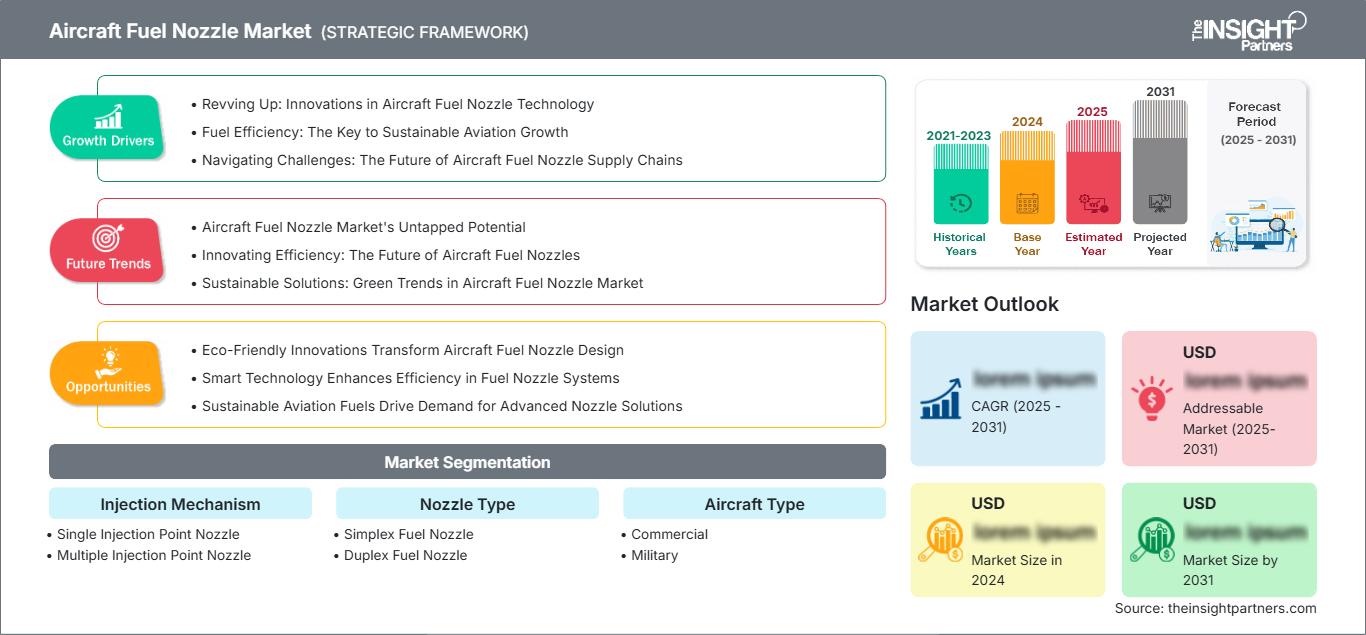
Aircraft Fuel Nozzle Market Assessment and Insights
Regional Outlook
- North America: ~34% of the global market in 2025 | ~5% CAGR through 2034. Market position: North America holds the largest regional position, supported by a large installed aircraft base, established engine programs, extensive MRO capabilities, and strong participation from manufacturers serving commercial, military, and general aviation applications.
- US: ~82% of North American market revenue in 2025 | ~5% CAGR through 2034. Market position: The US accounts for most North American demand because of its large airline fleet, defense aviation activity, engine manufacturing base, and extensive network of OEM and aftermarket suppliers supporting fuel-system maintenance and modernization.
- Europe: ~27% of the global market in 2025 | ~5% CAGR through 2034. Market position: Europe represents a mature aerospace ecosystem, with France leading the regional market, supported by engine and aircraft manufacturing, airline fleet renewal, MRO activity, and regulatory pressure for more efficient propulsion systems.
- Asia Pacific: ~25% of the global market in 2025 | ~7% CAGR through 2034. Market position: Asia Pacific is the fastest-growing region, driven by expanding airline fleets, rising passenger traffic, aircraft deliveries, and growing MRO infrastructure. China leads the regional market, while India is a major source of incremental fleet demand.
Segment Outlook
- Commercial: ~76% Share in 2025 | ~6% CAGR through 2034. Market position: Commercial aircraft represent the largest aircraft-type segment because of their large installed fleet, high utilization rates, continuous engine operating cycles, and recurring requirements for engine maintenance, component replacement, and fuel-system upgrades.
- Aftermarket: ~30% Share in 2025 | ~7% CAGR through 2034. Market position: Aftermarket demand is supported by aging fleets, extended aircraft utilization, scheduled engine maintenance, replacement of worn or degraded components, and retrofit activity. Higher aircraft utilization increases the importance of reliable nozzle replacement and repair channels.
Competitive Coverage
Avstar Fuel Systems, Inc., Axian Technology, Inc., Elaflex, Gardner Denver, Inc., General Aviation Modifications, Inc., General Electric Company, operating as GE Aerospace, OPW, a Dover Corporation business, Parker Hannifin Corporation, Turner Aviation, Woodward, Inc.
Methodology
The Insight Partners follows Data Collection & Secondary Research, Primary Research, Data Analysis, and Data Triangulation & Final Review to validate market estimates and insights.
Source: The Insight Partners' analysis based on proprietary research, government publications, company annual reports, investor presentations, industry databases, and expert interviews.
Aircraft Fuel Nozzle Market Trends
Greater Adoption of Additive Manufacturing for Complex Nozzle Geometries
Additive manufacturing is expected to become more influential in fuel-nozzle development because it can support geometries that are difficult to produce using conventional machining and fabrication methods. The technology enables designers to integrate complex internal passages, optimize fuel distribution, reduce part counts, and shorten prototype development cycles. Woodward, Inc. already identifies additive manufacturing as part of its fuel-nozzle development and production approach. Through 2034, broader qualification of additively manufactured components could shift supplier economics by reducing tooling requirements and enabling faster design iteration. The effect will be strongest where nozzle designs demand intricate internal features, rapid engineering changes, or customized combustion characteristics. Qualification, repeatability, material certification, and process control will remain important constraints as adoption expands.
Durability-Focused Nozzle Upgrades and Retrofit Programs
Future nozzle development is likely to place greater emphasis on extending time-on-wing and reducing replacement frequency. Engine manufacturers are already applying cooling and durability improvements to address fuel-nozzle degradation under severe operating conditions. In July 2026, CFM secured certification for the LEAP-1B reverse bleed system, which is designed to reduce the need for on-wing fuel-nozzle replacements. Such developments indicate a shift from component replacement toward integrated durability management. Through 2034, retrofit kits, improved nozzle materials, cooling strategies, and condition-based maintenance could become increasingly important. Suppliers able to demonstrate longer component life while maintaining combustion performance may gain opportunities across both new-production engines and installed fleets.
Aircraft Fuel Nozzle Market Growth Factors
Expansion of Commercial Aircraft Fleets and Engine Utilization
Growing aircraft fleets directly expand the installed base of engines requiring fuel-nozzle assemblies, while high utilization increases component wear and maintenance frequency. Airbus projects demand for approximately 43,400 new passenger and freighter aircraft over the next 20 years, with single-aisle aircraft representing the largest portion of deliveries. Each new engine creates an initial OEM requirement, followed by a longer aftermarket cycle covering inspection, replacement, overhaul, and upgrades. Fleet utilization therefore creates two connected demand streams rather than a one-time equipment requirement. Aircraft operators retaining older aircraft while waiting for new deliveries can also increase replacement activity. This mechanism is particularly important for fuel nozzles because combustion-system performance and durability directly affect engine reliability, maintenance intervals, and operating economics.
Pressure for Fuel Efficiency and Lower Combustion Emissions
Fuel efficiency and emissions performance are strengthening the technical requirements placed on aircraft fuel nozzles. Precise atomization and controlled fuel distribution influence combustion quality, fuel consumption, temperature profiles, and emissions characteristics. Engine manufacturers therefore continue to invest in nozzle geometries, cooling approaches, advanced materials, and manufacturing processes capable of operating under demanding pressure and temperature conditions. Woodward, Inc. highlights pressure-atomizing, air-blast, and multi-circuit direct-injection designs, including additive manufacturing approaches for precise atomization. As new propulsion programs seek improved efficiency, fuel nozzles increasingly become integrated elements of combustion-system optimization rather than commodity components. This raises the technical value of qualified suppliers and creates opportunities for companies with specialized design, testing, and manufacturing capabilities.
Fleet Aging and the Increasing Importance of Aftermarket Availability
Aircraft delivery constraints and longer fleet operating lives are increasing the importance of maintenance and component availability. IATA has reported a record aircraft backlog and an elevated average fleet age, while airlines have continued operating aircraft longer because of delayed deliveries. Older engines require greater attention to component condition, replacement intervals, and durability improvements. Fuel nozzles can become important maintenance items when carbon deposits, thermal exposure, wear, or combustion-system changes affect performance. This environment supports aftermarket distributors, repair organizations, component manufacturers, and suppliers capable of providing qualified replacement hardware. It also encourages engine manufacturers to develop upgrades that reduce unscheduled removals and improve time-on-wing, creating additional demand for redesigned and retrofit-compatible nozzle technologies.
Aircraft Fuel Nozzle Market Opportunities
Expansion of Aftermarket and MRO-Oriented Component Services
The aftermarket offers opportunities because aircraft operators are extending fleet utilization while aircraft deliveries remain constrained. IATA has identified delayed deliveries, higher fleet age, and engine-related disruptions as significant aviation supply-chain issues. These conditions increase the value of reliable replacement-part availability, component repair, overhaul, and distribution networks. Fuel-nozzle suppliers can strengthen their position by combining certified hardware with inspection, repair, engineering support, and rapid-response distribution. Partnerships with MRO organizations can also improve access to installed fleets and shorten replacement lead times. Companies with established qualification records and broad engine-platform coverage can use aftermarket channels to diversify revenue beyond new aircraft production. Regional MRO expansion in Asia Pacific and the Middle East creates additional opportunities for localized support.
Development of Advanced Nozzles for Next-Generation Propulsion
Long-term propulsion development creates opportunities for suppliers capable of supporting lower-emission combustion systems and alternative fuel requirements. Advanced fuel nozzles must accommodate changes in fuel properties, combustion temperatures, pressure ratios, and emissions-control strategies while preserving reliable ignition and stable operation. Woodward's development work includes designs intended to address advanced emissions requirements and alternative fuels, illustrating the direction of technology development. Suppliers can pursue opportunities through co-development agreements with engine manufacturers, specialized combustion testing, additive manufacturing, and materials engineering. The commercial potential is strongest where nozzle technology becomes closely integrated with new engine architectures, because qualification and certification can create long-duration supplier relationships.
Segmentation Analysis
Injection Mechanism
The Aircraft Fuel Nozzle Market Injection Mechanism segment is projected to register a ~5% CAGR from 2026 to 2034. Demand is influenced by combustion-system architecture, engine pressure conditions, emissions requirements, and the need for precise fuel distribution. Manufacturers increasingly optimize injection designs for atomization quality, thermal durability, and stable combustion across operating conditions.
- Single Injection Point Nozzle: Single injection point configurations remain relevant where engine architecture and combustion requirements favor simpler fuel-delivery arrangements. Their strategic importance lies in established applications, maintainability, and compatibility with specific propulsion-system designs.
- Multiple Injection Point Nozzle: Multiple injection point designs provide greater flexibility in distributing fuel across the combustion zone. Demand is associated with combustion optimization, improved fuel-air mixing, emissions management, and advanced engine architectures requiring more precise fuel distribution.
Nozzle Type
The Aircraft Fuel Nozzle Market Nozzle Type segment is expected to expand at a ~5% CAGR through 2034. Simplex and duplex configurations remain differentiated by fuel-flow requirements, operating conditions, combustion architecture, and engine control strategies. Technology development increasingly emphasizes atomization consistency, reliability, and efficient operation across changing engine loads.
- Simplex Fuel Nozzle: Simplex fuel nozzles serve applications where a single fuel-flow circuit can satisfy engine operating requirements. They remain strategically relevant because of established designs, straightforward integration, and applicability across selected propulsion configurations.
- Duplex Fuel Nozzle: Duplex fuel nozzles support differentiated fuel-flow requirements across engine operating conditions. Their importance increases where engines require controlled fuel delivery across low-power and high-power regimes while maintaining combustion stability and efficient atomization.
Aircraft Type
The Aircraft Fuel Nozzle Market Aircraft Type segment is projected to register a ~6% CAGR through 2034 and represents the largest demand dimension in the market. Commercial aircraft account for the majority of requirements because of their large installed base, high utilization, continuous fleet expansion, and recurring engine maintenance cycles. Military applications provide an additional demand stream where reliability and mission readiness are critical.
- Commercial: Commercial aircraft generate the dominant requirement for fuel nozzles because airline fleets operate at high utilization and require regular engine inspections, overhauls, replacements, and upgrades. New aircraft deliveries additionally create OEM demand for qualified nozzle assemblies.
- Military: Military aircraft require specialized fuel-system components designed for demanding operating conditions, variable mission profiles, and high reliability. Procurement cycles can be longer than commercial programs, but defense modernization and fleet sustainment create recurring replacement opportunities.
Distribution Channel
Distribution Channel is expected to grow at a ~7% CAGR through 2034. The segment benefits from the dual contribution of OEM production and aftermarket replacement. Aftermarket demand is supported by aircraft age, engine overhaul intervals, component wear, repair requirements, and the increasing operational importance of keeping aircraft available.
- OEM: OEM channels connect nozzle manufacturers directly with engine and aircraft production programs. Qualification requirements are stringent, but successful program participation can provide long-duration demand across production ramps and installed fleets.
- Aftermarket: Aftermarket channels support replacement, repair, overhaul, and retrofit requirements after aircraft and engines enter service. Fleet aging, high utilization, supply constraints, and efforts to extend aircraft operating lives increase the strategic importance of this channel.
Opportunity Snapshot
| Distribution Channel | Revenue Contribution | Trend Tag | Adoption Stage |
| OEM | High | Engine Programs | Mature |
| Aftermarket | Medium | Fleet Sustainment | Scaling |
Regional Insights
North America Aircraft Fuel Nozzle Market
North America held ~34% of the global aircraft fuel nozzle market in 2025 and is projected to expand at a ~5% CAGR through 2034. The region benefits from the scale of the US commercial aviation fleet, extensive military aviation programs, established engine manufacturing, and a mature network of maintenance providers. The United States stands out as the leading national market in the area due to the fact that there are large fleets of aircraft and defense forces that require regular maintenance of engine parts.
The production of aircraft as well as the after-market industry run parallel in North America. The commercial industry has continued to contend with issues of supply chain and aging fleet, while defense programs demand high reliability and availability of components. This makes it possible for the fuel nozzle market to be driven not only by the production of engines but also by the overhaul and replacement of components.
U.S. Aircraft Fuel Nozzle Market
The US represented ~82% of the North American aircraft fuel nozzle market revenue in 2025 and is expected to record a ~5% CAGR through 2034. Its position reflects the country's large commercial airline fleet, extensive military aircraft inventory, engine manufacturing capabilities, and concentration of aerospace suppliers. The FAA maintains long-range projections for the aviation industry with regard to commercial aviation, regional aviation, general aviation, and other business segments.
Demand includes new engine programs and replacement demand. The General Electric Company, in its capacity as GE Aerospace, Parker Hannifin Corporation, Woodward, Inc., and other specialty manufacturers cater to various segments of the engine systems and fuel system industry. High aircraft usage results in frequent engine maintenance needs, whereas the defense sector requires equipment that can function in tough environments and missions.
Europe Aircraft Fuel Nozzle Market
Europe accounted for ~27% of the global aircraft fuel nozzle market in 2025 and is projected to register a ~5% CAGR through 2034. France is the leading country in Europe, reflecting its strong aircraft and propulsion manufacturing base. Germany also contributes substantially through engine, component, and MRO capabilities, while the UK maintains a significant aerospace engineering ecosystem. France and Germany benefit from deep integration across aircraft, engine, and component value chains.
Demand from the UK is supplemented through commercial airliners, military aircraft, and aerospace manufacturing operations. Aircraft production and airline services from Italy and Spain drive the demand in Europe. Increasingly, the suppliers in Europe are concentrating on combustion efficiency, durability of components, lightweight manufacturing, and emissions compliance. This is in line with the goals and requirements in terms of decarbonization and efficiency of aircraft.
Development of the European market is also driven by the timing of fleet renewals. Inadequacies in the supply chain have pushed back some of the aircraft deliveries, making the airlines hold their existing aircraft for longer periods and thus increasing the maintenance needs. On the other hand, the development of new aircraft models generates the demand for fuel system components.
APAC Aircraft Fuel Nozzle Market
Asia Pacific represented ~25% of the global aircraft fuel nozzle market in 2025 and is expected to grow at a ~7% CAGR through 2034, making it the fastest-growing regional market. China leads in the Asia Pacific region due to its large aviation market, aircraft manufacturing plans, and growing commercial airline fleet. Japan and South Korea come in due to their existing airlines, aerospace manufacturing capacity, and maintenance capabilities.
India is a significant supplier of additional demand because of the growth of domestic aviation and aircraft fleets, and Australia, for its well-established aviation and MRO capabilities. The IATA stated that in 2025, Asia Pacific airlines have achieved the highest growth of international traffic among all regions, while according to Airbus, there will be a high demand for aircraft in the Asia Pacific region in the future.
Middle East & Africa Aircraft Fuel Nozzle Market
The Middle East & Africa market is expected to register a ~6% CAGR through 2034. Demand Centers in the Middle East include Saudi Arabia and the UAE due to having airline fleets, infrastructure investment in airports, long-range aviation operations, and aircraft fleet modernization. The UAE has an especially advanced aviation ecosystem that has associations with major airlines and airports.
South Africa is the aviation and maintenance base for the region, whereas RoMEA is driven by aircraft fleet replacement, connectivity needs, and defense aviation needs. High-temperature and dusty conditions in some Middle Eastern countries make the durability of engines and fuel nozzles even more crucial. GE Aerospace has emphasized the durability aspects of aircraft operations in Middle Eastern and South Asian conditions.
Aircraft Fuel Nozzle Market Report Scope
| Report Attribute | Details |
|---|---|
| Market size in 2025 | US$ 914.49 Million |
| Market Size by 2034 | US$ 1,524.00 Million |
| Global CAGR (2026 - 2034) | 5.84% |
| Historical Data | 2021-2024 |
| Forecast period | 2026-2034 |
| Segments Covered | Injection Mechanism, Nozzle Type, Aircraft Type, Distribution Channel |
| Region scope | North America, Europe, Asia-Pacific, South and Central America, Middle East and Africa |
Frequently Asked Questions

Recent Reports






